
Month: February 2012

What cheeses should you get for a cheese course?
Until a few years ago I’d answer that question with what I’d learned as an event caterer. Go with a variety: a young soft cheese, an aged harder cheese, maybe a blue, maybe a goat or sheep’s milk option. Two ounces per person. That is still a safe and delicious way to go.
Spending time with cheese mongers and makers over the last decade, I’ve experienced a few other ways to serve a cheese course that are fun, educational and rather tasty.
Progressions
Two or three versions of the same cheese aged for different lengths of time. For example, a young and extra-aged Comté. Or three different ages of Gouda. This is also great if you have different vintages of the wine from the same region.
Threesomes
Three goat cheeses: one fresh, one bloomy, one hard as a rock. Three blues. You get the idea.
Old World, New World
Try two clothbound cheddars, like Cabot from Vermont and Montgomery’s from England. Or a classic Swiss Gruyère and a cheese inspired by it, like Pleasant Ridge Reserve, Gouda from Holland, Gouda from Wisconsin.
One Giant Piece
I don’t know exactly why but big cheese is way more fun than small cheese. Splurge for a four pound hunk of Parmigiano-Reggiano and stab it with the old, weird knife you’ve had lurking in the drawer for all these years. (Bigger chunks last longer so you can continue to gnaw on it for weeks.)
Cheese as Aperitif
Cheese to start dinner, like the cocktail and cheese hour our parents knew, is a more American way to serve cheese than the formal, end-of-dinner French way. Try kicking the evening off with an unusual pairing, like cheese with a salty anchovy or a couple salt packed capers, where the cheese becomes the sweet part of the experience.
Cheese Dessert
A sliver of Raw Milk Stilton with shards of dark chocolate. A small marble of aged gouda with a shot of espresso. If you’re serving dessert with sweet syrup, save some and drizzle it on the cheese.
Month: February 2012
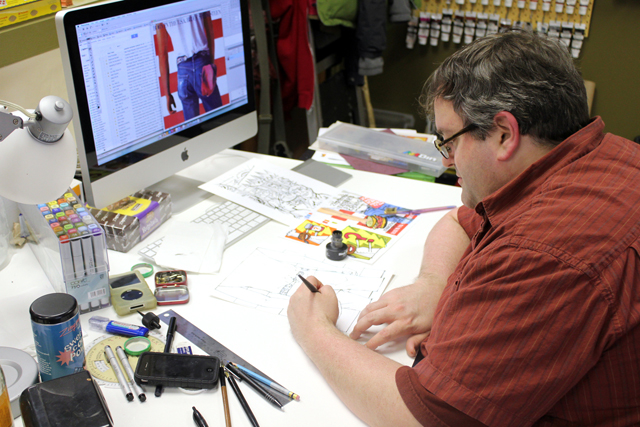
His name is Ian Nagy and he’s one of two illustrators at Zingerman’s. We sat down with Ian to ask him a few questions about the process of turning great food to great art.
What do you do at Zingerman’s?
I draw food for money! More specifically, I illustrate products, the people who make & eat them and the places where they are made for mail order catalogs, websites, menus, brochures, packaging, apparel, signage, labels…
How long have you worked here?
Basically 20 years. I started in 1991, left in 1995, spent 1996 doing freelance art for Zingerman’s, officially came back in 1997. Best. Job. EVER.
How many illustrations do you do in a week?
Depends. Maybe I average about 3-4 a week but that’s just a guess. I do a lot of sketching to come up with ideas, prepare final artwork and show people what I’m thinking before I do the finished product.
For the artists reading this, what tools do you use?
My trusty black ink brush pen, tons of non-photo blue pencils (they are light blue and are for the most part not picked up by photocopiers and computer scanners when scanning in black and white), markers, tech pens (fine-tipped black markers), acrylic paint, paint brushes, scratchboard, colored pencils, regular pencils, erasers, white-out pens, traditional pen and ink tools, rubber stamps, a Macintosh computer with Adobe Illustrator, Photoshop, InDesign and Bridge and other software, a scanner, a printer.
What is the process like? How do we get from food to the printed illustration?
It differs from project to project, but here’s the most common processes. We call images that are just the food alone “actuals” and ones with people, scenes and characters “conceptuals”. This is how they are born.
Actuals:
- receive the product sample
- turn on my desk lamp for a main light source
- unpack and arrange the still life
- drink some tea
- sketch the product with markers
- scan and email it to my client or the project manager
- sometimes go back and forth with them changing perspectives or the product set ups based on their feedback
- get approval
- set up the still life again
- sketch it on nice watercolor paper
- paint with acrylic paint
- let it dry
- scan it on the computer
- jump for joy
Conceptuals:
- receive the product sample
- seek out some inspiring artwork
- sit there with weird looks on my face and try to think of cool ideas
- sometimes brainstorm with my co-workers, mom, family and friends
- do small simple thumbnail sketches with pencil, ballpoint pen or Sharpie that only make sense to me
- drink some tea
- do a better, clearer, full-color sketch with markers
- scan and email it to my client or the project manager
- go back and forth with them tweaking the concept and details based on their feedback
- get approval
- sketch it on basic white cardstock
- ink it in and add shading/texture with the ol’ brush pen, marker, pencil or any number of line-making devices
- scan it on the computer
- convert it to digital black and white shapes, chop up and color the shapes
- appreciate how freakin’ cool my job is
Do you get to eat the stuff you draw?
Often. I wish it was always.
What is your favorite thing to illustrate?
People, buildings, animals, aliens, monsters, robots, patterns, handwriting, Halloween stuff.
Do you have any favorite illustrations?
See more at my website iannagy.com.
What is your favorite Zing memory?
I have a lot of them, many being bizarre, fantastic and hilarious conversations with co-workers. Here’s one of my favorites.
In 1996/1997 graphic designer/art director Lakshmi Shetty entered the Bakehouse bread bag that we worked hard on in the Print Magazine Regional Design Annual and it got in! I had no idea she did that. Print is a national graphic design magazine that’s been around a while and they often have around 30,000 entries to the annuals. Lots of cool stuff, a huge honor. They did a 4-5 page article in their regular magazine about our department around that time and we got at least one project in every annual from 1997-2002, six years in a row. It was unbelievable.
What do you do when you’re not making Zing art?
Rock! I play guitar and write songs. I’m always in at least one band and I often jam with my musical friends. I enjoy playing bass, drums and piano too. It’s TONS OF FUN. Lots of personal art projects. Freelance illustration work. Hang out with cats, guinea pigs, and other animals. Oh yeah, family and friends too. Watch cartoons, movies and stand-up comedy. Read. Travel. Power sleeping and encouraging people to get more of it. Try to make people laugh. Shop for music and musical instruments. Go to concerts. Eat at ethnic restaurants.


Month: February 2012
“Americans, more than any other culture on earth, are cookbook cooks; we learn to make our meals not from any oral tradition, but from a text.”
—John Thorne, Simple Food
There is a lament in Mr. Thorne’s words. A regret for a bygone era of cooking, or perhaps one that never came to America, young as the nation is when compared to some others. An era when recipes were handed down by the doyennes of the kitchen to their daughters, bringing to mind images of warm hearths and burnished farm tables; or by virtuoso chefs to a cadre of apprentices in sparkling, well organized restaurant kitchens.
There is much to be said for that kind of cooking—most notably that each generation bears and owns a sense of responsibility to their traditions and to passing them on, usually enriched by an attendant respect for the land and the its ingredients, a smattering of pleasant ritual and an invaluable hands-on training in technique.
But there is much to be said for cooking from cookbooks and recipes as well.
The most obvious of the benefits of recipes is that they more or less guarantee repeated and consistent success. And what cook has not wished that they had used a tried and true recipe at that moment when they’re putting out a somewhat dubious dinner for a table full of expectant and hungry guests?
Along with that consistency, comes a certain stability, or structure, if you will, within which one can be successfully creative. Once a recipe has been mastered, by repeated and obedient execution, it allows the cook a foundation on which to safely play and experiment. Substituting an ingredient here, adding a little step there—and voila! A new dish, perhaps even a new tradition, is born.
But there is more to recipes than their reassuring repeatability. Recipes allow us to explore new cuisines and techniques, to bring into our kitchens, worlds and ingredients our grandmothers neither dreamed of visiting nor would have known what to do with in the kitchen.
Recipes also break down unfamiliar, seemingly magical foods into a series of simple steps that anyone can follow. Who remembers the wonder of making their first soufflé? Or the miracle of baking pâte à choux for eclairs for the first time and the delighted disbelief at its perfectly empty interior?
But perhaps, best of all, recipes make teachers of us all, whether our students be near or far, known or anonymous. And then recipes let our students become teachers and the cycle continues and spreads, far more rapidly and powerfully than any oral tradition could, and while one would not argue with Mr. Thorne, that there is something to lament in a nation of “cookbook cooks”, perhaps there is also something to celebrate.
The power of recipes translates just as powerfully outside the kitchen, and for many of the same reasons. Small businesses, or large ones for that matter, would do well to understand and harness the power of recipes.
It is not an uncommon challenge, in small businesses in particular, that seemingly simple tasks can be the source of frequent frustration because each person executes them somewhat differently. Wiping down a table in a restaurant or coffee shop would seem to be a task that is simplicity itself, and yet we’ve all sat at tables where only the edges were wiped, or tables with an unintentional pattern of water spots, or tables where clean meant “transfer crumbs to floor and chair”. It would be no large effort to write a recipe for such a simple task, but the power of it would be far out of proportion to the effort.
Recipes are also a protection against the tyranny of competence. Regulars at many coffee shops will tell you that there are baristas whose drinks verge on being downright undrinkable and yet, the other barista in that same coffee shop serves up sublime cappuccinos. Why must it be so? While there will always be varying degrees of skill and virtuosity in any profession, must we also accept so dramatic a vacillation in quality? The best coffee shops, one imagines, have ingredients and proportions for each drink they serve and a standardized set of instructions – in other words, a recipe.
The least intuitive of the uses of recipes in the management of a business is for those ideas and concepts that we consider to be somewhat nebulous or abstract – such as great service, or inspiring leadership, or caring conflict resolution. And yet, were we to keenly observe and meaningfully engage those that we find to be consistently superior practitioners of these abstract skills we would find that there is a pattern of behavior that emerges, and a repeated drawing upon of tried and true techniques. The foundations of a recipe.
And so it is, that we must respectfully thank Mr.Thorne for his regrets about recipes, and for enriching our lives with so many brilliant books, and then with a wink and a nod in his direction, turn to our near-perfect cappuccinos, delivered to us by a barista with a happy, enthusiastic smile, and sit at our spotless tables, and begin to develop a recipe for good service in our workplace.
Month: February 2012
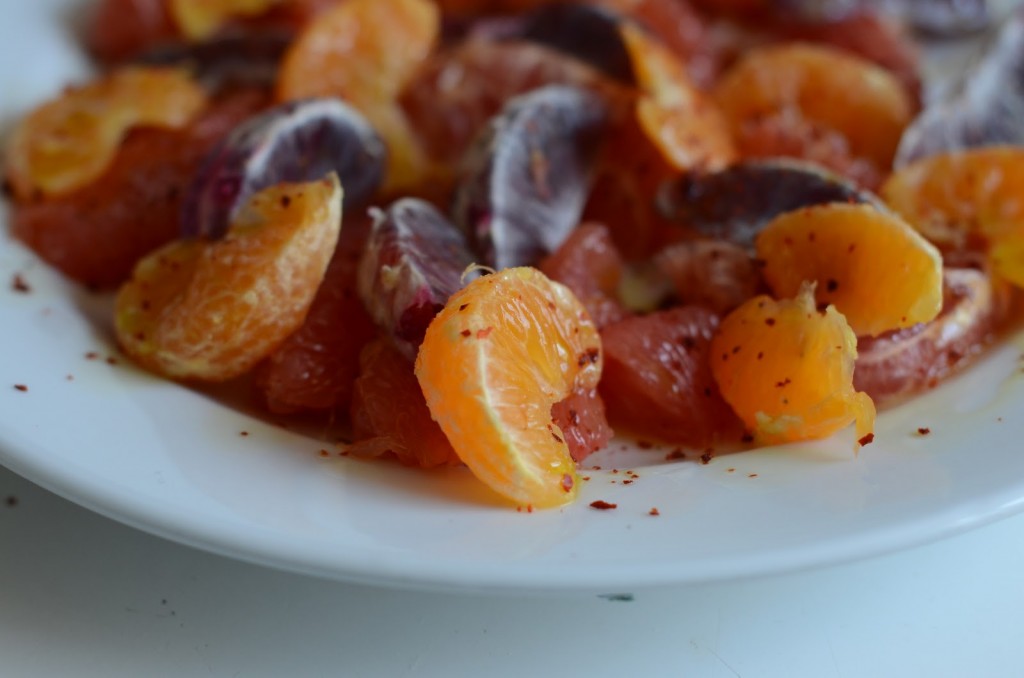
It’s high citrus season. This is the time of the year oranges, grapefruits and their cousins are at their best. You can really smell them from the outside — scratch and sniff the rind for full effect — and, inside, their fruit is at its most luscious.
I like to make this salad, which is simply fruit (here grapefruit, blood orange and mandarin), olive oil and Marash red pepper. Which fruit you choose isn’t that important. But it’s key to peel, segment and seed them, in the process getting rid of as much white pith as possible. Scrape at the pith and get all the stringy bits off. This is quite a pain. Set yourself up with a very sharp knife and some 1950s Calypso music, to make it go easier, for it will take a while. To serve, lay the fruit on the plate, in a colorful jumble, douse it with long pours of rustic, fruity olive oil, then crop dust it with the pepper. Since Marash pepper is already salted you don’t need to add any. Leave it to rest for a half an hour to let the flavors mingle and the fruit to warm up.
I stop there, but you could go further, perhaps adding thinly sliced onion, a small handful of capers, a squeeze of fresh lime.
Backing up a bit, you might want to zest the fragrant peels first and save the zest for pasta or salad dressing.
Month: February 2012
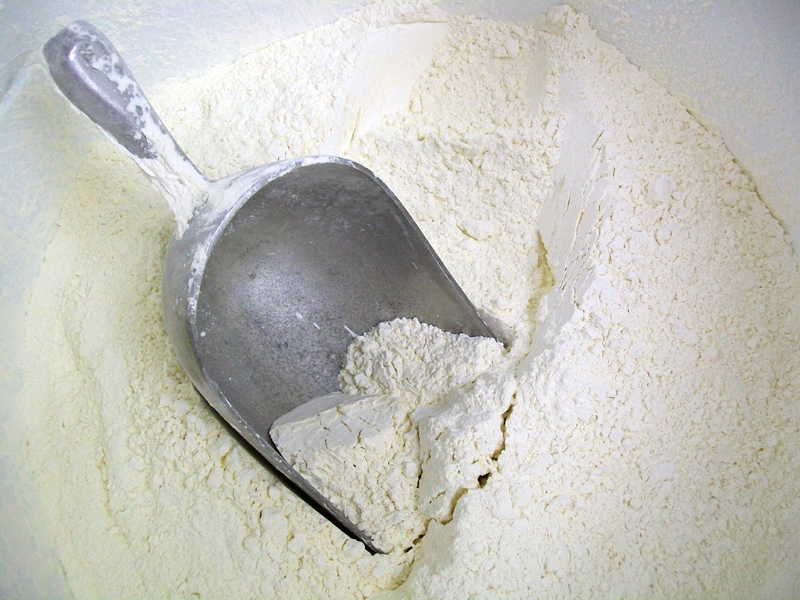
Here at BAKE! and next door at Zingerman’s Bakehouse, we work with wheat every day. Flour is one of our most important ingredients. We often talk about how it feels in our hands, how it responds to mixing, the extensibility and elasticity of the dough once the flour has been mixed with the other ingredients, the flavor of the flour, the protein content of the flour, and the price. These are the things we focus our attention on daily. More recently, we have felt an urgent need to ask ourselves a couple questions of place. Where is this flour from? Is there any way we can use more local flour?
The white all purpose flour we use for most of our breads and pastries has been on quite a journey since it was harvested: grown in the plains (Kansas, Nebraska, the Dakotas), it is milled in Minnesota by a company based out of Quincy, Massachusetts. We do not expect this to change overnight, but at the same time the questions that we have asked have led us to a couple of interesting realizations. Firstly, before cheap gas and interstate trucking and the railroad system, most flour used in America was sourced fairly locally. There were ways that enabled the farmer to get his wheat to the miller, who then milled it and got it to the baker. Those foodways have largely disappeared. With the growth of industrialized food production and processing, local mills have withered and most bakeries are using flour that has traveled thousands of miles. Our second realization is that if we want to re-establish some local foodways and use flour that is both grown and milled locally, we are going to have to rebuild those foodways ourselves.
For some of our pastries we use a Michigan grown and milled soft wheat pastry flour, which is proudly milled for us by Star of the West Milling Company, based out of Frankenmuth, MI. This flour is featured in our brownies and some of our pie crusts.
Additionally, for over a year now, we’ve had the great fortune of using some whole rye flour that is grown here in Michigan and milled for us just an hour’s drive from our bakery. This has made us feel like we’ve got our toe in the door of the local grain economy, and has also added a special element of flavor and local integrity to our rye breads. It has made us very eager to do more.
In the fall of 2011 we got in touch with an agent from MSU’s extension office to see what we could do. Phil Tocco, our contact, said he had been working with a couple farmers on growing hard wheat in Michigan, and had a small sample to work with. He had the wheat ground into flour at West Wind Milling and brought us the flours. We used the samples and made very fragrant, tasty, and beautiful loaves of bread! Excited by our experiment, we asked Phil what our next step might be. That has led us to contract a farmer to grow one acre of hard wheat for us. We have agreed to pay that farmer for growing that single acre of wheat, no matter what the outcome. The risk is real, but is more than offset by the opportunity that we have been given to participate in the process of hopefully building a more local food economy which would feature more and more local farmers choosing to grow wheat because they feel confident that we and other local bakeries will buy it and use it well and that the prices that we will pay are better than they could fetch on the bulk commodities market.
It is a small first step but we are extremely excited to be involved in this process! Nothing would make us happier than to be using more locally grown grains and baking breads and pastries that are more amazing and full-flavored because of the care and attention of the farmers, the millers, and our dedicated staff of talented bakers. We hope this is just the beginning of a path that will eventually impact hundreds of local lives and positively impact all of our customers. We’ll keep you all posted!
Month: February 2012

Excerpted from Zingerman’s Guide to Good Leading, Part 2: A Lapsed Anarchist’s Approach to Being a Better Leader
From the outside in we need to encourage others—especially those who aren’t accustomed to working this way— to make conscious choices about what they’re doing, or not doing. Part of that means that we need to respect that others will make choices we won’t particularly like. This is inherent in encouraging people to be themselves and telling them to speak up for what they believe. Which is, I know, far easier said than done. Being a hardass is a tough habit to break; the traditional work world is all based on the belief that “we’re paying these people, of course they’re going to do what we tell them to.” The idea of letting staff say “no” in a constructive manner, where they’re not immediately stomped on for saying so, is something we spelled out sixteen or so years ago when we wrote up the stuff we teach today in our training. But it’s not the norm most places. Performance may be poor, discussions may be difficult, and employment may ultimately end anyways, but dialogue, respect and fair treatment never need to go away because someone opted not to do what we would have liked them to. Without a doubt, this approach is certainly easier to adopt intellectually than it is to really implement (believe me—wait ‘til the first employee politely tells you to take a hike) . . . but, I believe, from the bottom of my very hard-working heart, it’s imperative to growing the kind of caring, creative (anarcho capitalist) community we’re going after.
The way I see it, anarcho-capitalism in action is always based on each of us exercising free will and free choice. It is built onto a foundation of freely made, mindful choices. Quite simply, as a few of my friends are probably sick of me saying, none of us have to do anything. If we do it, we do it because—mindfully or not—we choose to do it, not because someone else “made us.” Though, I’d venture to guess that’s not the way most businesses seem to operate. “Compulsion” is the most common motivational tool.
This ever-present, if generally unacknowledged, sense of compulsion is, by the way, all over our everyday language. Take ten minutes at the next meeting you go to and count how many times someone says, “I have to,” “I can’t” or “I should.” There’s a lot of power floating around those tables, but when we’re talking like that the power is noticeably not inside of us. Feeling “forced” to do things is simply never a good feeling. No one—and no organization we’re a part of—is going to get to greatness unless each of us reclaims it and owns it in a grounded, caring, and mindful way.