
Month: April 2012
Russ Collins and his crew at the Michigan Theater have big plans. After all they’ve done over the years to restore Ann Arbor’s beautiful art house theater and bring us the best movies in the world, they’re going one big step beyond. This May, they are launching the Cinetopia International Film Festival from May 31-June 3 they’re bringing in over 30 films to be shown over four days.
Zingerman’s and the Michigan Theater have collaborated a lot over the years and I’ve had the pleasure of working with Russ, Drew Waller, Lee Berry, Amanda Bynum and other great folks on their staff. One of the big reasons that Ann Arbor was high on my list of possible places to move 12 years ago was because I was determined to live in a place where I could see small budget movies on a big screen down town. Thanks to the Michigan Theater, Ann Arbor has more movies than I can fit in my schedule. Though Russ will tell you that this year’s festival is a small step, I have no doubt they will exceed their wildest expectations in the coming years. That’s why Zingerman’s signed up to be a sponsor in the first year. When it grows in the festival they envision, we’ll be happy to have been there from the beginning. Their hope is to build a big, vibrant festival that will bring thousands of movies lovers from all around the region to Ann Arbor every year.
This year’s festival features 60 years of 3-D films and 3-D film technology and they will celebrate the work of UM screenwriting grad David Newman (“Bonnie & Clyde,” “What’s Up Doc” and “Superman”) and the silent film comedy of Harold Lloyd featuring a live appearance by Mr. Lloyd’s granddaughter Suzanne (who is curator of the Harold Lloyd Trust). Maybe most exciting for movie junkies, Cinetopia will also gather the best contemporary films now playing the international festival circuit.
Watch the trailer here and sign up for Cinetopia‘s mailing list to get the latest developments and ticket info. Pre-sales begin May 3.
Month: April 2012

Recently, a new structure appeared in the parking lot behind Zingerman’s Bakehouse. No we didn’t open a new business. In this case, the new structure was a big propane tank and as soon as it was up, there was a steady line of our delivery trucks waiting to fuel up for their runs across Washtenaw County and across lower Michigan. Why propane? Well, why don’t we let Bakehouse founder and co-managing partner Frank Carollo explain.
How did we get here?
I guess it all started a couple of years ago when we got all of the managers and many of the staff at the Bakehouse together to write a Bakehouse Vision for 2020. We all got talking about how the work we do here at the Bakehouse impacts the environment and our world. While having an inspirational vision is a nice thing, what I find amazing is what it helps you accomplish. Suddenly we had all kinds of input about how we could do a better and more effective job of recycling (which we had already been doing for about 10 years). Next we got started separating our compostable waste and found a partner to make good use of it. Then, since we work here 24 hours a day, we decided to look at our electrical usage and see what improvements we could make. So a bit more than a year ago we replaced all of the light fixtures in the Bakehouse with bulbs that consume a fraction of the electricity as well as putting in sensors that shut off the lights when there is no one nearby.
The logical next step was to consider the energy use of our delivery fleet. The Bakehouse delivers our cakes, pastries, and breads throughout much of southeastern Michigan 363 days each year. Our vehicles log approximately 150,000 miles per year making those deliveries. So last spring when I knew that the lease for 3 of our vehicles was coming to term, we acted on the opportunity to try and make a difference in our consumption of fuel and the contributions to greenhouse gasses.
Why propane?
With the help of the Clean Energy Coalition I discovered that liquid propane was a viable option for our fleet. We found that liquid propane is a low-carbon alternative fuel that produces significantly fewer greenhouse gas emissions than diesel and gasoline in our vehicle application.
- Propane auto gas exhaust creates 60 to 70 percent less smog-producing hydrocarbons than gasoline.
- Compared to gasoline, propane yields 12 percent less carbon dioxide, about 20 percent less nitrogen oxide, and as much as 60 percent less carbon monoxide (World Liquid Propane Gas Association, January 2003; California Energy Commission, January 2003).
- Propane auto gas cuts emissions of toxins and carcinogens, like benzene and toluene, by up to 96 percent when compared to gasoline (Southwest Research Institute).
With the help of Ferrell Gas, Jake Haas (our landlord), Pittsfield Township, and the DEQ we were able to build a fueling station nearby. The first vehicle in our fleet was delivered in February 2012 and as of March 15th, we’ve had 3 new Ford Econoline trucks on the road running on liquid propane. We are excitedly looking forward to continuing to investigate alternative fuel vehicles as we have a chance to replace another vehicle this December.
Month: April 2012
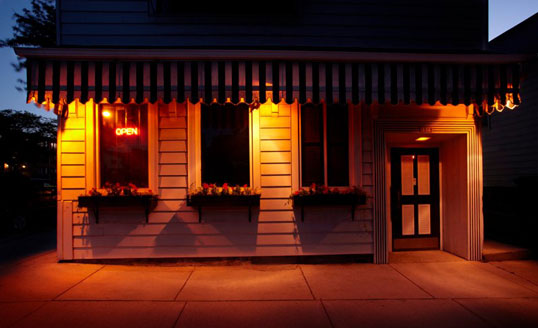
Bryant’s Cocktail Lounge, est. 1938, is a house on a corner of Milwaukee’s Mitchell Street residential neighborhood. A bar in a house—oh boy. It could feel like drinking in grandma’s basement. Not so. Bryant’s has so many cool, cheap design tricks—tricks that feel utterly natural—that I felt it some of them were worth sharing.
The first thing you notice: no alcohol. Not a bottle visible. All the booze is in the well or cupboards underneath. The back bar is stocked exclusively with glassware. About 35 different glasses, many specific to a single drink.
There is nothing on the front bar. No coasters, no napkins. It is flat and smooth, uninterrupted. No taps, either. There is no beer (this, in Milwaukee, is probably a statement in and of itself).
There are no drink menus.
It’s almost like you expect no bartenders. But there they are, in white shirts, vests, ties. Ordering is done by discussion, a talk as short or as long as you’d like. They take your order by suggestion, by inference, by your mood. Tell them where you’re from, there’s a drink. Tell them the last piece of poetry you read, there’s a drink. They’re young and they’re not perfect at this brand of palmistry but I appreciate the effort.
Bryant’s makes “serious” cocktails but they also do a fair business in fruity pseudo-island drinks which makes me happy. So much bartending these days is furrowed brow nonsense. It’s refreshing to see umbrellas and big hunks of pineapple and drinks that try to make you laugh instead of squint and nod.
The bar was redecorated after a fire in 1971 and, from what I can tell, nothing has changed. It has wood veneer paneling, leatherette everywhere, wall-to-wall carpeting, patterned wallpaper, drop ceilings, fake flowers. I know this sounds horrible. I have no way of assuring you that it is not. A singular, cohesive vision makes it work somehow.
They have also made it work through darkness. Dim the lights far enough and it doesn’t matter what how big a travesty your wallpaper is. I have no argument with this technique. One of my other favorite joints, the Bronx Bar in Detroit, does the same thing and I’ve come to appreciate super dark bars. I know they’re hiding something, but I don’t care. At Bryant’s they shutter all the windows, keep the few lights they have on deep dim, light indirectly with burnt caramel orange color bulbs and use a vintage Macintosh tuner as the bar’s sole light source. Darkness forgives a lot. I’m sure if you saw the place in daylight you’d run screaming. But in the evening it’s so dim they deliver your bill on a tray with its own light so you can read it. It’s so dark that a Google search for pictures inside the bar comes up empty. I guess it must be like trying to take a picture at the bottom of the ocean.
Month: April 2012
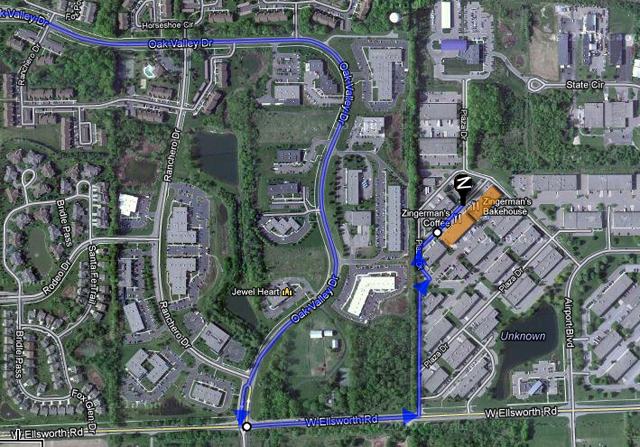
It’s easy to get your breads, pastries, cheeses, gelato and coffee at Zingerman’s Southside without hitting the construction on State and Ellsworth. Get on Oak Valley and take it all the way to Ellsworth. Left on Ellsworth and then another left into the Airport Plaza Industrial Park.
Zingerman’s Southside is located at 3711-3723 Plaza Drive, Ann Arbor MI 48108.
Month: April 2012
Herbs are among the first things to pop up in spring in my garden here in Ann Arbor. This winter was mild enough that the parsley came back, and is now a foot high and bushy with shiny leaves. The lavender is putting out new leaves, the peppermint is too, and even the rosemary survived the winter. Looking at my super-happy, healthy parsley, makes me think about Pierre.
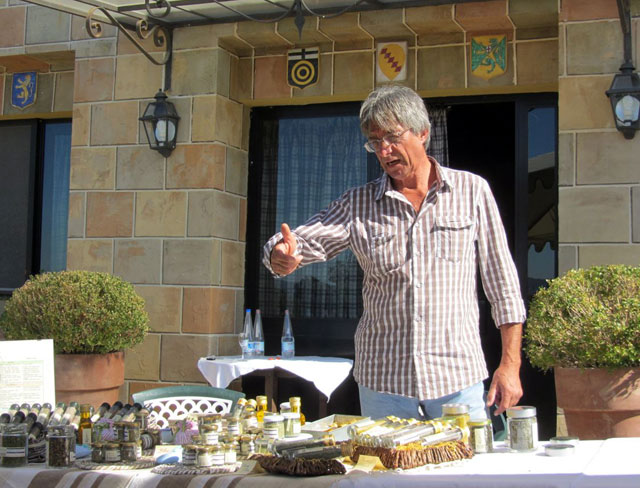
During last fall’s Zingerman’s Food Tour to Tuscany, culinary herbalist Pierre Cousea visited us at our villa in the Arno valley, from his home nearby. He loves talking about his herbs – they are like his children, which he tends but does not coddle. He doesn’t water them; the herbs need to hold their own through the summer heat.
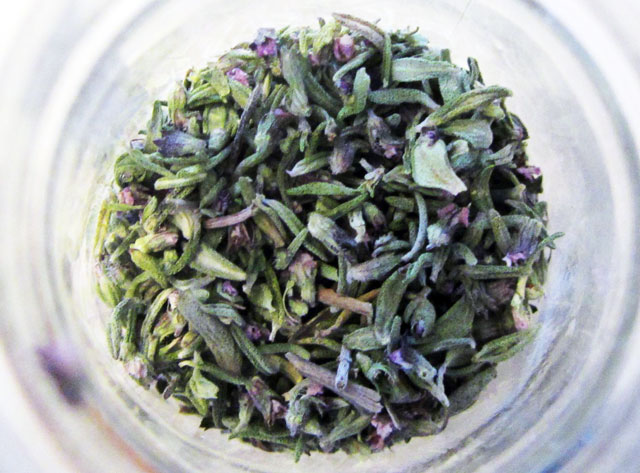
He says that each herb has its peak moment, a short span during its blooming time when it is at the pinnacle of potency. At that perfect moment for each plant, Pierre harvests the herb, by hand. He harvests the flowers rather than the leaves, which he then air dries. The flowers, he says, contain the pure expression of the herb at its
strongest, if it’s picked at the right time. It’s painstaking work, and it takes thousands of flowers to fill up a small jar.
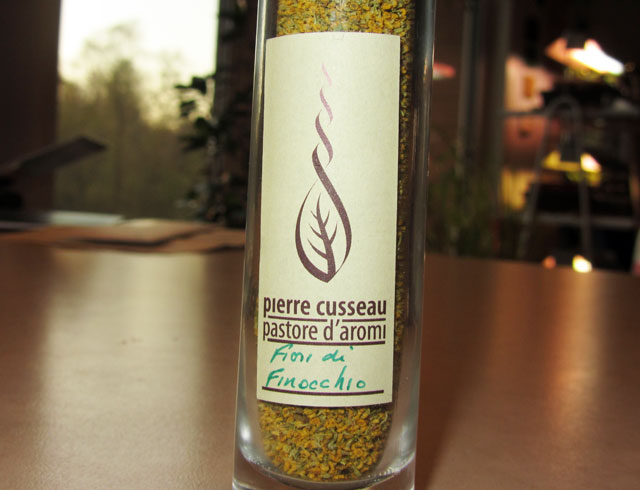
When Pierre visited he brought an array of jars of herbs, which he opened and passed around for us to smell – the aromas were powerful, and it was intriguing to see the tiny flowers and buds rather than leaves as I’m more used to.
Pierre also makes aromatic herb salts – he blends sea salt with herbs, and other elements such as citrus and hot pepper flakes, to create wonderful culinary combinations. He names his blends and provides his recommendations of what kinds of dishes each blends works best with. Here’s a very short clip of Pierre describing how he makes his salt blends.
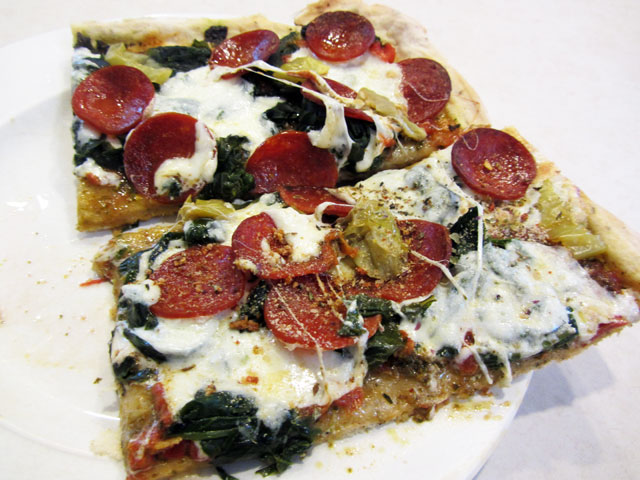
Pierre says that the herbs are potent yet delicate, and that they should be added, sparingly, to a dish only near the end of the cooking time. So, when I made this pizza for dinner last weekend, I sprinkled on oregano flowers, as well as some of my Il Grande Sale aromatic herb salt (with thyme, pepperoncini flakes, and scallions), at the moment I took the pizza out of the oven. The hot cheese warmed the herbs, and the aroma and flavor were just right. Yum.
I purchased several jars from Pierre to bring home, and had intended to give them as gifts, but somehow I never got around to giving them away! I’m enjoying experimenting with them, with awareness of the love and care that went in to them and marveling at the depth of flavor they bring to my cooking.
Month: April 2012
At the Manhattan Cocktail Classic I took a class on preserving fruits in alcohol. It was the most interesting class I attended. If there was one thing I took away it’s that any bar should be thinking about doing this, especially one in a fruit-growing state like Michigan. It’s also something anyone can do at home.
Preserving is different than infusing. Infusing — adding fruits or aromatics to alcohol and letting them mingle at room temperature — creates a certain kind of flavor effect. When the alcohol is gone, however, the fruit is basically inedible. (Maraschino cherries are preserved, not infused. If you’ve ever tasted some “home made” ones that are bitter, alcoholic and nasty, chances are they were infused, not preserved.)
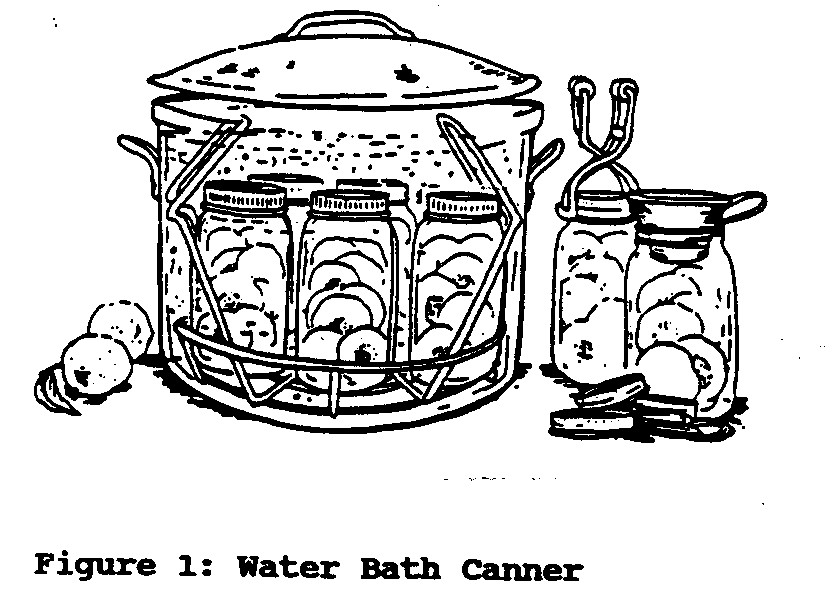
Preserving fruits with liquor is like canning but using alcohol instead of water. There’s usually sugar and spices and some cooking involved. When you’re done everything is usable. Use the alcohol in drinks. The preserved fruits go in drinks, in desserts and so on.
There are plenty of recipes for preserved fruits out there on the internets. But I also took down ten notes that seemed important and might not be covered in any recipe:
- Start with pint canning jars, not quarts. That way you can test lots of different recipes.
- Once you open a jar you need to use it up in two weeks.
- You will fail more than succeed in the first year.
- It’s expensive so be conservative.
- Use stone fruits that are slightly under ripe, that way they fall apart less.
- Strawberries and plums are good, but they will get so soft they’ll only be good for muddling.
- Vegetables and cocktails almost never go together.
- Follow the latest USDA canning guidelines for temperatures and sanitation. Botulism is the main danger.
- If you are in a restaurant have the kitchen chef in a restaurant supervise the process, not the bartenders. (No offense, bartenders.)
- Jars blow up sometimes.