
Month: May 2012
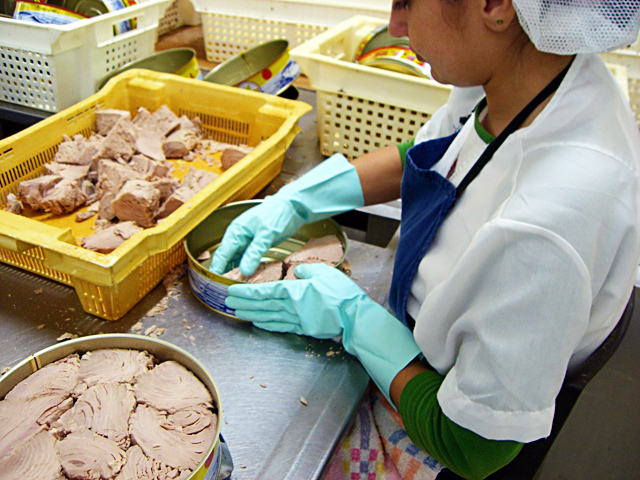
I wrote down a quote years ago and it’s never left my side. I think it was from a review of a New York restaurant. The author said Spain is “perhaps the only country in the world where it is desirable to serve food that comes in a can.”
They were poking fun at the restaurant where, in the writer’s mind, the chef should have been more ambitious about cooking than being a good shopper. Well, be that as it may, chances are the chef couldn’t make tuna better than what you get from Spain in a tin. If you’ve had Spanish tinned tuna before, you’ll know it’s something very special. It’s not a poor substitute for fresh tuna. It’s got its own thing going on. For me, it is more rewarding and interesting than the fresh stuff. Given the choice, I’d choose to eat a tin of Ortiz’s tuna over tuna sushi any day.
It may be hard to think of tuna in a tin being worth eight or nine bucks, especially when you find them at the supermarket for a buck. I think we should all be a bit more weirded out by the dollar tins, though. After all, fresh tuna is expensive. They’re only caught wild (we haven’t domesticated them yet) and raw tuna goes for $20-$30 a pound. It’s almost always one of the most expensive fish in the case. Why should it be the cheapest tinned food on the shelf?
Month: May 2012

Date : early May
Location : Ann Arbor Farmer’s Market by Zingermans Deli and Kerrytown.
even though there is still a cold nip in the air, nothing that your warm fleecy sweater can’t easily combat, the sun is high in the sky and bright and nary a cloud marks its course through the day. it is finally spring in michigan. the birds know it. the bees know it. and the dandelions most certainly know it.
the market is teeming with people and produce. being that today might be the first “real” day of spring, the color in the market comes from the flowers that are for sale. the produce is all green, because the leaves need nothing more than a little bit of warmth, a little bit of sunshine and a little bit of love to grow quickly and become large enough to be cut and brought to market. the peppers and brinjals and onions and cauliflower and tomatoes need time which the season has yet to give them. but they will come. yes, indeed, they will come.
oh. but the greens. spinach arugula lettuce mustard sorrel peashoots. a thousand colors and a thousand shapes. some frilly and riotous, others placid and broad. yet others diminutive and delicate so you have the urge to stroke them gently before you pop them in your mouth, eagerly anticipating the sweet juice they will give up as you chew. and the colors! the playful translucence of the baby new leaves, the mature flat wrinkly green of new spinach that like some of us, is born old, the spiky bright of arugula that warns you of its hidden spiciness, the plump green-ness of peashoots, as irresistible as the earlobes of newborn babies. oh. the greens.
the flowers are riotous and glorious, colourful princess in their pretty ball gowns, demanding your attention, but it is the greens that win my heart. just as beautiful and also capable of nourishing more than just your soul.
and everywhere today, in just about every stall, there are promises being sold in little black plastic containers. seedlings of your future garden. thoughtfully planted and nurtured by someone who was thinking of love and spring and sunlight while you still whined about the dark and the cold. they now generously offer you these promises that they made, for a mere $1.50 a promise, so that you can happily buy them as you imagine being in your garden in late july in your shorts and sandals harvesting juicy red tomatoes for your dinner.
a mere $1.50 for a little promise that someone sowed for you when you were too tired and cold and lacking in imagination. a mere $1.50 for the seedling of a dream that you can plant in the soil to nurture and watch it grow. a mere $1.50 for a basketful of tomatoes that you will pop into your mouth, sticky juices exploding and dribbling down your chin as the sun happily bakes your skin to a luscious brown ripeness.
a mere $1.50 for a promise and a dream. go and get yours today.
Month: May 2012
Mary H. Schlitt, Director of Development and Marketing of Food Gatherers, invites all Zingerman’s friends to come to Grillin’:
Want a glimpse of what Food Gatherers does on a daily basis? Go to Grillin’! Grillin’ is Food Gatherers annual fundraiser, held always the second Sunday of June (rain or shine). Just like our food rescue and food bank program, Grillin’ is a gathering of community goodwill; made possible by good food, caring volunteers and engaged donors. There’s the:
Food! Many of the tasty side dishes and desserts you will see at Grillin’ are donated by local restaurants and distributors who support Food Gatherers food rescue program on a daily basis. Founded by Zingerman’s Deli in 1988, Food Gatherers was the first food rescue program in Michigan and among the first six in the United States. Today, Food Gatherers distributes more than 5 million pounds of food to 150 non-profit programs serving our neighbors in need.
Volunteers! Those friendly faces who will be grilling your sausage, setting up the event and playing some groovy music onstage are volunteers; they are the passion and power behind your Grillin’ experience. These event volunteers are just a small sample of the nearly 6,000 individuals who donate their time to Food Gatherers operations annually.
Donors! From the sponsors to the Grillin’ guests, and to the food donors and silent auction donors; there are hundreds of folks who help ensure that most of the funds raised from Grillin’ fight hunger in our community. You can get involved! By purchasing just one adult ticket to Grillin, you can provide up to 120 meals for the 1 in 7 adults – and 1 in 6 children- who struggle with hunger in Washtenaw County. Food Gatherers exists because of the caring and generosity of many individuals in the community!
So slather on some sunscreen, bring a friend and your appetite, and we’ll save a seat for you! Grillin’ for Food Gatherers is Sunday, June 10 from 3-8PM at Washtenaw County Farm Council Grounds. In addition to great food, there will be live music from George Bedard and the Kingpins, The Appleseed Collective and Back Forty,kids activities, a food-inspired silent auction – it’s the best party of the year! Purchase tickets online now or at ticket sale locations: Zingerman’s Deli, Bakehouse or Roadhouse; Saline Picture Frame Co. and Dexter Picture Frame Co. or call 734-761-2796.
Month: May 2012

My colleague Gauri Thergaonkar wrote in March about Open Book Management (OBM) – the innovative business practice we use here at Zingerman’s based on the Great Game of Business which was developed by Jack Stack (you can read more about it in his book, The Great Game of Business, co-written with Bo Burlingham, editor-at-large of Inc. Magazine and author of Small Giants: Companies that Choose to be Great instead of Big)
Last week was the Gathering of Games, the 20th annual conference of OBM practitioners from around the world. It’s a pretty amazing and powerful thing to be sitting in a room with hundreds of people who are among the small percentage of organizations running their businesses using the same principles around finances that we do here at Zingerman’s. Over the three days of the conference, one of my favorite things about attending the Gathering is hearing the stories of how OBM has changed businesses substantially for the better, the unique ways OBM brings everyone together to overcome challenges, and the fun ways other folks celebrate success in their organization!
Bo Burlingham, who is a good friend to Zingerman’s and has been to Ann Arbor many times, was there, and I took the opportunity to ask him about coming to the Gathering year after year: “Having been to all but one or two of the Annual Gatherings – when we started out, the people who came to the Gathering of Games were either not yet practicing Open Book Management or had only been using it 1-2 years. Now, we have participants who have been using Open Book for thirteen, fourteen, fifteen years! To me, that’s really amazing! The focus at the Gathering can be really different now – at the beginning, all of the questions were about ‘Will it work in a union business? Will it work in a small business? Will it work for me?’ Now the answers to those questions are in the variety of people and businesses that are here!”
I felt incredibly honored to be invited to be a presenter again this year – last year I led a pre-conference workshop on Zingerman’s approach to customer service, and this year I followed it up with “Keeping Score on Service,” sharing how we measure customer service, what we’ve learned by doing it, and how mini-games can help build a service culture in other organizations. The participants in my workshop were from a wide variety of different industries, but I believe that customer service is universal, so an owner of a bakery outside of Chicago can provide insights to a manager who is in software support on the East Coast, and vice versa.
One of the highlights this year for me, other than the one-on-one interactions, were hearing keynotes from Kim Jordan, CEO and President of New Belgium Brewing Company, and Brian Scudamore, Founder and CEO of 1-800-GOT-JUNK. Before hearing about them being at the Gathering, I didn’t know that these were also OBM companies! It was fantastic to hear about their achievements, with the principles of Open Book at the heart of their core values, and very interesting that the business practices and philosophies of both organizations are very much in alignment with Zingerman’s.
The break-out sessions are led by practitioners, who share best practices, tools, resources, and tips for improving how we’re all “playing the game.” Ari led a session on Servant Leadership, sharing how this management style helps support great staff in OBM. One of the sessions I attended was called “OBM: Vehicle for Change,” led by Alan Kent, President and CEO of Meadows Regional Medical Center in Vidalia, GA, (home of the delicious onions currently featured at Zingerman’s Roadhouse!) He credits Open Book in large part for turning around his non-profit hospital and helping it open a $92 million, 194,000 square foot facility with no community tax support in 2011. It was inspiring to hear him speak about the cultural change that OBM had helped bring about, and to see the dramatic change in the numbers once everyone on the team was playing together to achieve the same results.
I’m still thinking about what I learned, and how we can put the experiences and learnings from other practitioners into use here at Zingerman’s. And I’m already looking forward to going back next year!
Month: May 2012
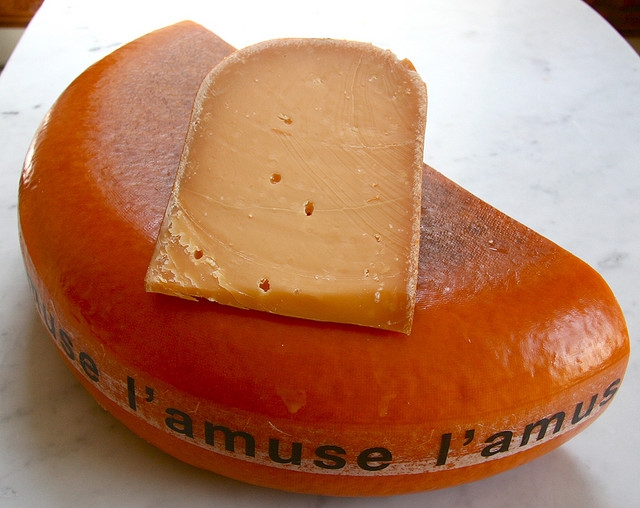
In March, we started selling a new gouda from l’Amuse cheese shop, in Santpoort-Noord in the Netherlands. It’s fantastic stuff: rich, barely tangy, subtly sweet. It immediately became a staff favorite.
But if you ever get to visit l’Amuse, don’t expect to find gouda on the shelves. “We don’t really use the word ‘gouda’ in the Netherlands,” Betty Koster, owner of l’Amuse, explained to me. Instead, she calls this cheese a Beemster, after the region it comes from. “Gouda” isn’t a very precise term: though it’s always made using the same techniques and in the same shape, gouda can be made anywhere in the world; it can be aged anywhere from one month to several years; it can range in size from one to 88 pounds per wheel; its flavor can vary from mild and creamy to intense and nutty. No wonder Dutch cheese shops prefer to use more precise names!
When I asked Betty what makes this particular gouda (er, Beemster) so special, she explained it’s a combination of factors.
- The soil in Beemster is a sweet, salty clay. The grasses and other pasturage growing in this soil make for flavorful, creamy milk.
- The Holstein-Friesian cows are never overmilked. While some farmers take as much as 90 liters of milk per cow per day, these cows are never milked more than 30 liters per day.
- The cheese is matured at a warm 15°C (or about 50°F). This speeds up the aging process, allowing for more intense flavor development but also creating a risk that off-flavors may develop.
- The cheese is made to be eaten at a particular age, and Betty is careful to select and sell only cheeses that are at their peak.
The gouda we sell is aged about two years, and each wheel has been hand-selected for us by Betty. Though older cheeses are often drier, this one has a creamy, almost velvety texture. It’s also dotted with plenty of crunchy flavor crystals. The flavor is buttery, almost toasty like roasted hazelnuts or caramel.
And how to eat it? Betty offered two suggestions: cut thin slices for sandwiches, or – her personal favorite – lob off small lumps and it eat plain. If the rapidly-disappearing hunk of it I have here beside me is any indication, I think I must agree.
Month: May 2012
Jillian: “Hello Mimi? This is Jillian from Zingerman’s Food Tours, I just wanted to let you know we’ll be arriving at your chocolate store in about half an hour.”
Mimi: “Wonderful, I’ll have dark-chocolate hot chocolate ready for you. Would you like fresh whipped cream with it?”
Now that’s my kind of conversation.
Two weekends ago, a few Zingerman’s Food Tour colleagues and I went north to the Leelanau Peninsula area of Michigan to meet with artisanal food producers. The Leelanau is not only incredibly beautiful, it’s also overflowing with passionately dedicated food producers and a strong locavore culture – which is why we’re putting together a domestic food tour there for Spring 2013.
One of our favorite stops of the weekend was at The Grocer’s Daughter – a small chocolate store tucked away on a rural road outside of Empire, a stone’s throw from the massive dunes and blue water of Sleeping Bear Dunes National Lakeshore.
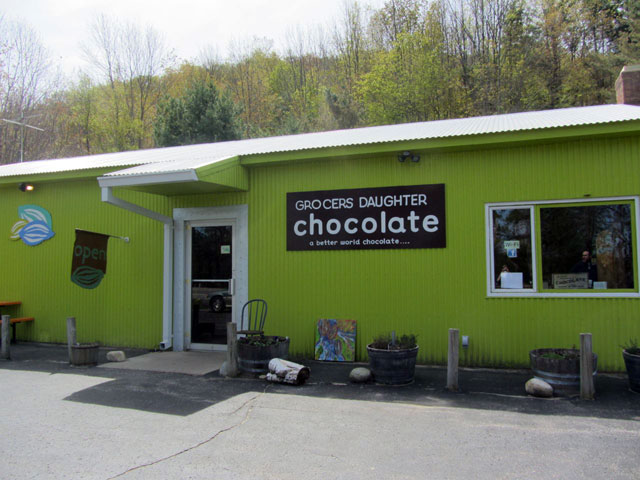
Founder and chocolate-maker Mimi gave us a warm welcome.
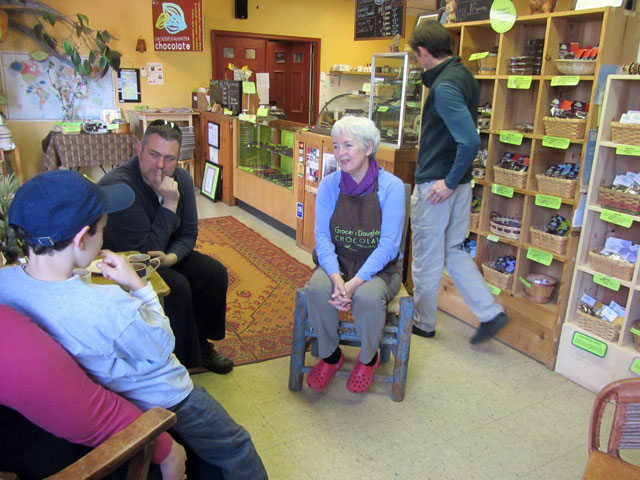
She showed us her workspace, shared her story of how she got started, and plied us with tastes of her hand-crafted chocolates.
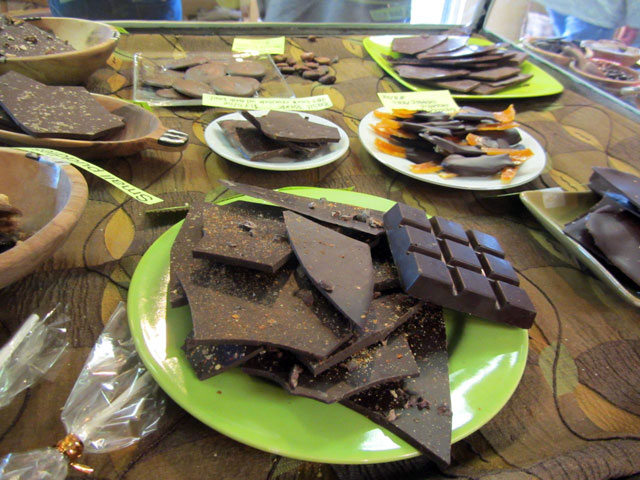
It’s hard to choose, but the candied orange peel dipped in dark chocolate was probably my favorite – an intense burst of flavor. But the marzipan in dark chocolate was not far behind, and then what about the real hot chocolate, the frozen chocolate fudgsicle, or the dark chocolate “puddle” with crystallized ginger? All delicious.
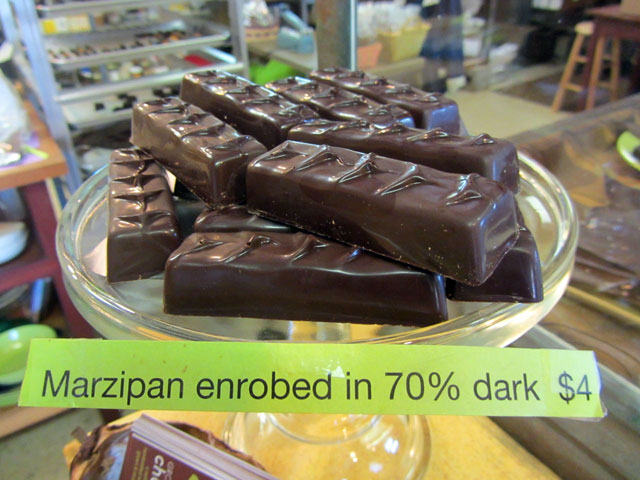
After spending an hour talking, tasting, and enjoying Mimi’s company, we said our good-byes, and with chocolate-inspired energy hiked a nearby dune to enjoy the view of Lake Michigan. Then we piled in the van to head back to Ann Arbor – well stocked with yet more chocolates from Mimi to sustain us during our drive.