
Month: July 2012
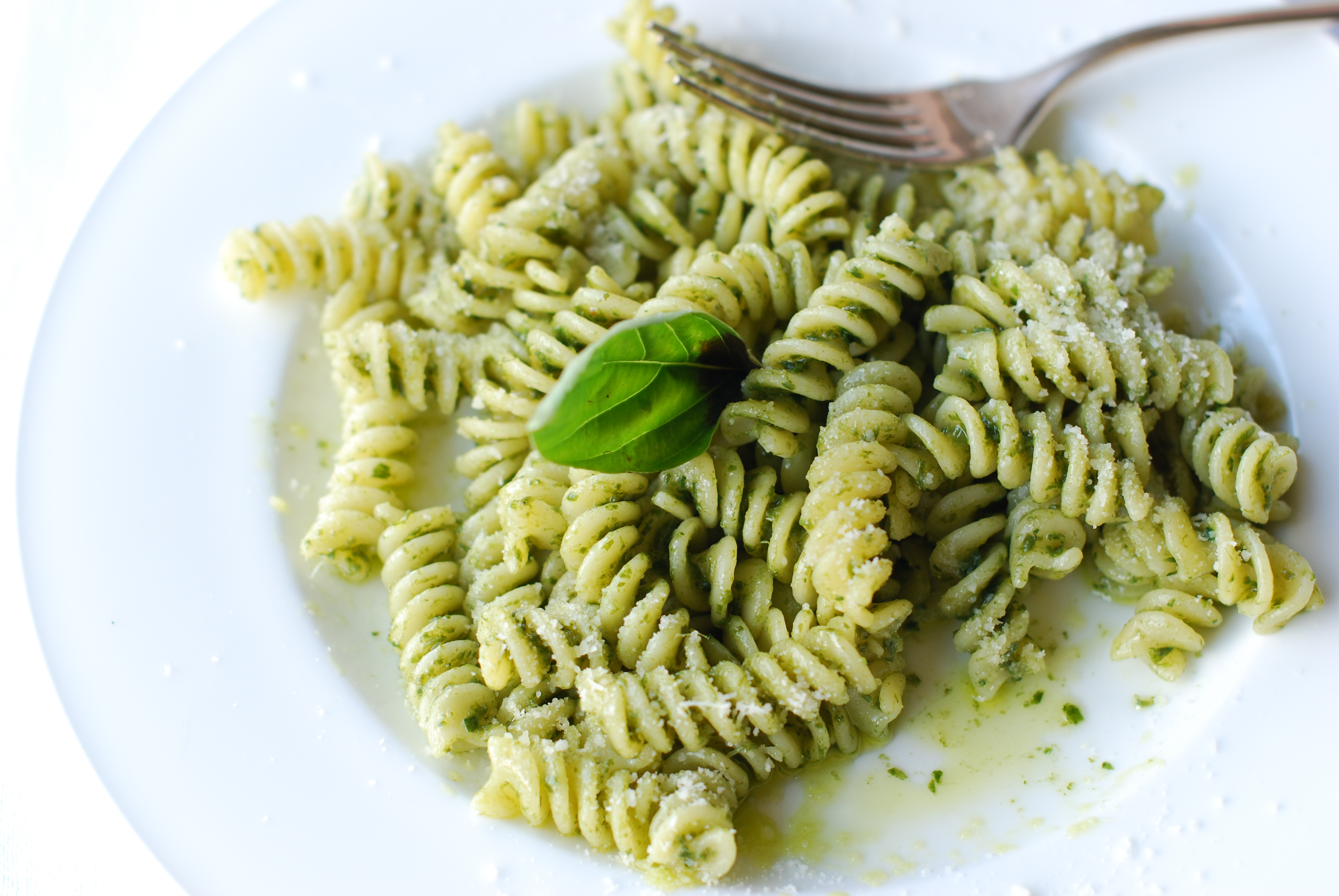
For tips on making pesto, see this post. For the recipe I like to use when I make pesto, read on!
2 packed cups of fresh basil leaves, preferably less than 1 ½ inches long
3 tablespoons pine nuts
1 large clove of garlic, unpeeled
¼ cup grated Parmigiano–Reggiano cheese
3-4 tablespoons delicate extra virgin olive oil
Rip the basil into small shreds. Doing this by hand causes the least damage to the leaves, but a food processor can do the same job much more quickly.
Toast the pine nuts in a small, dry skillet over medium heat, shaking frequently, until they are nicely browned and smell toasty, about 5-7 minutes. Remove the pine nuts from the pan and set them aside. Put the pan back on the heat and add the unpeeled garlic, turning every 2-3 minutes, until dark on all sides and fragrant, about 8-10 minutes total. Let the garlic cool, then peel.
In a large mortar, pound the garlic with a large pinch of salt until it forms a smooth paste. Add the pine nuts and pound for about 2-3 minutes, until you have a smooth mass that sticks to the bottom of the pestle. Then add in the ripped leaves, a few tablespoons at a time. Grind them into a paste, pressing with a steady rotary movement, lifting the pestle as little as possible. Keep pressing until individual pieces of basil are hardly distinguishable.
Stir in the grated cheese with a spoon, using it to homogenize the paste. Finally, stir in the olive oil to create a thick, creamy sauce.
When serving pesto on pasta or potatoes, thin it out with three parts pesto to one part starchy cooking water. This helps the sauce to coat evenly.
Store pesto in a jar topped off with olive oil at room temperature for a couple of days, or refrigerated for up to a week. Pesto can also be frozen for longer storage, but in this case it’s best to not add in any cheese until you serve the pesto.
Makes one cup of pesto – enough to serve six to eight
Month: July 2012
I love going to the farmer’s market this time of year, when the warm breeze jostles the big, leafy bunches of fresh basil and inundates the market with their sweet, spicy aroma. When the scent of basil is no longer enough, it’s time to whip up a batch of pesto. Here are a few of the tricks I have learned to make better pesto:

1. Use smaller basil leaves. In Liguria, home of the original pesto, they always make their pesto with young basil. As basil leaves get bigger, the texture get tougher and the flavor gets duller. Stick to leaves that are no bigger than about an inch and a half long. If you need to use larger leaves, though, stirring in a spoonful of ricotta at the end is a quick way to boost the creaminess.
2. Toast the pine nuts and the garlic. It’s not traditional, but toasting the nuts brings a richer flavor, and caramelizing the garlic makes it sweeter and less sharp. Cook the nuts in a dry skillet over medium heat for 5-7 minutes, shaking frequently, just until brown and fragrant. Then take the nuts out of the pan and slide in a few cloves of unpeeled garlic to brown for a few minutes on each side.
3. Using a mortar and pestle matters. Though it’s more work to make the sauce by hand, the resulting sauce is more velvety in texture, has better color, and stays homogeneous longer. To cut down on grinding time, try ripping the basil into small bits before adding it to the mix. Or not: as Patience Gray notes in Honey from a Weed, “Pounding fragrant things — particularly garlic, basil, parsley — is a tremendous antidote to depression.”
Month: July 2012
The Legend of Sharon Hollow
Sharon Hollow is a little town (pop. 7,067) 26 miles Southwest of Ann Arbor and just up the road from Manchester, MI which was the first home of the Creamery. When John set up shop in Manchester in 2001 he began the tradition of naming his cheeses after communities in the area and our Sharon Hollow was born. Sharon Hollow is one of our cow’s milk cheese (using fresh milk we get from our friends at Calder Dairy in Carleton, MI) and, as always, we hand-ladle the curds to protect their delicate flavor and texture during the cheese-making process. We make Sharon Hollow in two flavors: Telicherry black pepper and garlic, or garlic and freshly-chopped chive. Its crisp, clean, milky flavor is accentuated by the strength of the garlic and either pepper or chives that run throughout.
Stop by our cheese shop on Plaza Drive and see cheese-making in action and make sure to ask for a taste. You can also sample Sharon Hollow at Zingerman’s Delicatessen and Roadhouse, stop or see us at one of the eight southeastern Michigan farmers markets we attend.
Month: July 2012

Over the last few days, I’ve been reading The Book of Marmalade by C. Anne Wilson. It’s a good read: comprehensive, engaging, witty. Here are a few of the best things I’ve learned:
- In the early 17th century, marmalade was associated with the sweet side of love, used in descriptions like “a soft marmalade heart” or “my lady’s… marmalade lips.” A hundred years later, it seems marmalade’s reputation had soured: a “marmalade madam” was a lady of easy virtue. During the same time period, marmalade went from being typically made with sweet quinces (“marmalade” comes from marmelo, Portuguese for quince, and the sweet marmelada preserves they made with it) to often being made with bitter Seville oranges. Coincidence?
- According to a book published in 1857, many of the marmalades that purported to be made with Seville oranges at that time had actually been supplemented with other fruits. In the best cases, less flavorful sweet oranges were added to the mix; other common fillers included apples, carrots, turnips, and rutabagas.
- The English first ate their marmalade at the end of dinner, as a dessert or digestive. It was the Scots who made marmalade a breakfast food. In the 18th century, tea and toast with marmalade became the standard breakfast in Scotland, replacing the former standard breakfast of “a dram of whisky, [followed] with ale with toast swimming in it.” Unsurprisingly, not everyone was happy about the change. Two hundred years later, several Scottish companies began producing marmalade with whisky; ironically, the innovation occurred just as Scottish breakfast habits were moving away from toast and marmalade to cold cereals. There must still be some demand, though – this company has been making whisky marmalade for 60 years now.
Month: July 2012
Fresh or dried, which is better? Is America concerned about this? Are you talking about it at dinner, arguing one for one pasta style over the other? Frankly, I don’t know if this is a debate or not. If it is I’m sure it ranks very low on the scale of disputes, somewhere far below the controversy on serving water with or without ice. It does, however, come up with friends and colleagues from time to time. And almost always I find that folks assume fresh pasta is better. That if you had the time and wherewithal you should use fresh pasta over dried all the time. Maybe it’s because it’s more work to make (if you make the pasta at home). Maybe it’s because fresh pasta is more fragile, more perishable, and seems more precious. Maybe it’s because dried seems more industrial, more like a commodity and can sell for so much less.
Whatever the story behind the myth, it’s not true. Fresh pasta is not better than dried. It’s just different. There are many times when dried pasta is preferable. Probably the most concise way to think of it is like this: use dried pasta when you want to enjoy noodles with a lot of texture and flavor; use fresh when you want a softer, subtler dish.
The two styles are made very differently, hence the different results and different uses in the kitchen. Traditional dried pasta is made by extruding durum semolina dough through bronze dies. It’s dried at relatively low temperatures for a couple days. The bronze-die extrusion leaves the pasta with a rough texture. You can feel it in your mouth and the sauce really grips to it. The slow drying ferments the flour just a bit. It transforms the dough from tasting like raw flour to something more like bread. In contrast, fresh pasta is usually rolled and cut and there is no fermentation. The texture is much softer, smoother and the flavor is much less intense, simpler, more like the flour it was made from.
It’s important to note I’m not talking about any old dried pasta here. There are only a few companies that do dried pasta right. (My two favorites are Martelli and Rustichella.) Most dried pasta is industrially made with exasperating shortcuts that leave it tasting unexceptional. In particular, they employ hot, short drying times so there is no transformation of the dough’s flavor. It tastes like flour. Worse, it’s flour with a burnt edge to the flavor. The extra hot ovens singe the surface in a way Martelli and Rustichella’s do not. To see what I mean taste a piece of uncooked commercially made DeCecco pasta (one of the better industrial companies) and Martelli spaghetti next to each other. The flavor is remarkably different.
At home I almost exclusively use dried pasta. The dishes I like to cook are robust. Spaghetti with sardines, arugula and lemon. Penne with black pepper, pecorino and sausage. And my regular favorite: Il Mongetto’s plain tomato sauce with a tin of Ortiz tuna tipped in, oil and all.
Month: July 2012
At the bakery we’re studying Hungarian foodways, which include a rich collection of Jewish recipes. Jewish communities have existed in Hungary since at least the 1100s when we know for certain of their existence because of references to Jews in written court records. Jews were treated relatively better in Hungary than in many other European countries (had even been granted full rights of citizenry) until World War II when they were the last Eastern European Jews to be targeted by the Nazi extermination policy. Since the campaign came nearer the end of the war a greater number of people survived and returned to Hungary where they appeared to live as non-Jews during communist rule.
In the twenty-some years since the fall of the Berlin wall, the Jewish community in Hungary has become more visible and vibrant. Budapest currently has the largest and most active Jewish community in Eastern Europe. The result for Hungarian Foodways, of 900 years of Jewish/Magyar co-existence is a surprising appearance of Jewish foods as standards in the Hungarian repertoire – latkes, matzo ball soup and cholent to name three – even called by their Yiddish names! Discovering all of this has certainly been eye opening.
Today’s Magyar story is about our acquaintance with the traditional Hungarian and Jewish bean dish called sólet in Hungarian and cholent in Yiddish. Sólet is a traditional slow cooked stew. It is usually simmered overnight for 12 hours or more, and eaten for lunch on the Sabbath to conform with Jewish laws that prohibit cooking on the Sabbath. The pot is brought to boil on Friday before the Sabbath begins, and placed in a slow oven until the following day. There are many variations of the dish and the basic ingredients of cholent are meat, beans and barley. It’s not dissimilar in style of cooking from the famous French dish cassoulet or American baked beans.
Prior to coming to Hungary my knowledge of sólet/cholent was sketchy. Years ago, I asked my grandmother (one of my sources for traditional Jewish food knowledge) about cholent and she didn’t have much to say. Rather, it got her reminiscing about other traditional dishes that she hadn’t eaten in a long time, which was interesting for other reasons but the cholent question wasn’t answered. My mother, another source for traditional Jewish food information, said she’s never eaten it and responded in a way that made me think I wouldn’t want to. Hmm…whom to ask now? Well, my friend Michael Fahy, who I often turn to for general history questions if my archaeologist husband doesn’t know, seemed like he might be a good bet. Besides having what seems like a vast and eclectic internal database of facts, he’s by far the most Jewish person of Irish descent I’ve ever met. He had the most to say about cholent, and amazingly his connection to it was also Hungarian, via Israel, about 30 years ago. Michael was living on a Kibbutz in Israel in the 1970s, which had many Hungarian Jewish residents, some of them Holocaust survivors. According to Michael they really looked forward to their Sabbath cholent every Saturday. It was an important part of their Sabbath tradition. He remembered it as a relatively plain and heavy bean dish.
This spring a number of us from the bakery visited Budapest to continue our studies of Hungarian foodways. Sólet was on our itinerary. Finally I could have first hand experience of this classic dish. No one else on the trip had any prior knowledge of sólet or any personal connection to it but somehow it became the hit of the trip. Who would’ve thought? We ate it in three different venues; only one considered a Jewish restaurant and thoroughly enjoyed deciphering their differences. The sólet at Kadar’s was considered the best but more about that later. Not only did sólet grab the group’s taste bud attention, but it was the first Hungarian food made by any of us on our return. (Shelby, our BAKE! principal made it a few days after our return.) Additionally, the most prized souvenir from the trip is a well used ceramic cholent pot which I hand carried back with the reverence and care usually reserved for a long lost family bible or art treasure. Since we are now all sólet enthusiasts we decided that the cherished pot would reside at the bakery to be shared by all of us when the mood for cholent cooking hit.
The sólet we ate in Hungary was varied and delicious. The dishes were generally a mix of small red beans and barley cooked with onions, paprika, a little garlic, some kind of meat, and a liquid. It was created to be a dish that would cook properly in a wood-burning oven that was no longer being used so the temperature was decreasing. Jews could put the dish in the oven before sundown on Friday and leave it until Saturday when it would then be ready to eat – meaning no work was done on the Sabbath itself. On our trip we learned that it had been a convenient dish for Hungarians in the past when they were living with wood-burning ovens, so who knows which direction this dish went in the mixing of the foodways.
My first encounter of sólet was at Kadar’s a restaurant in Budapest which had opened in the 1950s, is now on its second owner and was famous for its sólet although it serves many other things and in no way was known as a Jewish restaurant. Kadar is a Hungarian surname. Gabor, our guide and friend called to reserve several servings for us because it was Saturday and they were known to sell out (“Bubbe, 86 the sólet!” I like the way that sounds.) I couldn’t wait. Finally I was going to taste this almost mythical dish and we’d be in a restaurant famous for it and they served many versions!
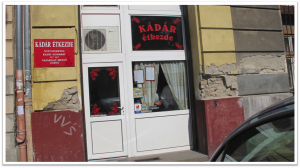
Before I tell you about the sólet, let me describe the restaurant. It’s tiny. It’s crammed and it’s plain. The owner, tall, broad and imposing, is taking orders and bringing out the food. It’s a down to business experience. Our server was a middle-aged woman who’d been there longer than the owner, close to 30 years and claimed to be better at making the sólet. The clientele was mixed with natives and a few tourists. Each table had seltzer water on it and the walls were lined with signed pictures of famous people who had enjoyed a meal there. We ordered matzoh ball soup, on our quest to taste it in as many places as served it, and the sólet started arriving. Three separate plates came each with beans and one with a baked egg, one with roast goose and one with a pork chop! Yes, sólet with pork. There were many versions of different pork cuts with sólet on the menu, a true intermixing of cuisines. The beans and barley were moist and moderately seasoned—quite satisfying! The group seemed excited about this first encounter. Nina Huey (nee Plasencia) loved the dish, claiming that it spoke to her Hispanic beans and pork heritage.
Our next sólet encounter came at Fülemüle, a restaurant known for serving Jewish dishes as well as Hungarian standards, which opened in the early 1990s. It is owned by András Singer, a Jewish restaurateur committed to serving delicious and refined food. His most prized dish is his smoked meat, which he claims is better than Schwartz’s in Montreal. He travelled to eat at Schwartz’s several times while he was developing his own. If you haven’t been to Schwartz’s, it’s definitely worth a trip. Nina, so taken with her first taste of sólet, ordered the Kind David sólet, which came with roast goose, smoked meat and hard boiled egg. It was big enough for at least three people, was quite delicious, especially the smoked meat and equally moderately spiced as the cholent at Kadar’s. The beans and barely were a bit less moist however. We were getting a hint that moisture was going to be one of the keys to the sólet’s success. You might be wondering about all of the goose being served. It’s very prevalent in Hungarian cuisine, including foie gras and Jews were historically the goose farmers of the country.
Our final encounter with sólet was at the family owned Thummerer Winery, northeast of Budapest. Sólet in a winery? You bet. We came to Thummerer to cook, bake and taste wine for the day with the chef András and his wife Éva, the daughter of the winery founder. The dynamic and talented pair play a very important role in running the winery now. We were using a wood-burning oven to roast a goose, and then the next dish András demonstrated for us was sólet with his own cured pork belly. Yes, once again sólet and pork! It became clear that his associations with sólet had absolutely no Jewish connections. This sólet was lighter in the paprika, heavier on the salt (a result of the cured bacon) and wetter than Kadar’s, once again pointing out to us that achieving the perfect consistency would be something we’d have to work on.
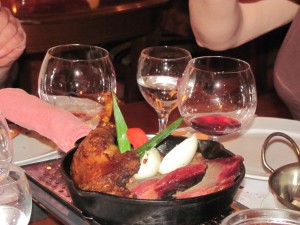
So Kadar’s sólet turned out to be the group’s favorite version. Did it have the advantage of being the first we tasted? Perhaps…but perhaps it was years of experience that lead to a delicious version. We’ll have to go back and taste everyone’s again.
What now? Rumor has it that my sólet education can continue right here in Ann Arbor. Ann Arbor food blogger Mary Bilyeu let me know that a local temple does a cholent Kiddush every January. I’ll be there to compare, contrast and learn.
Eating and writing about sólet has it’s limits though. I want to move into hands on practice. I’ve got the red beans, a bag of barley; paprika I carried back from Budapest in the blessed sólet pot. With a trip to Zingerman’s Delicatessen to buy a nice piece of smoked meat I’ll be ready to make my fist sólet. How exciting!
Taste of Hungary with Amy and Frank
Come taste Hungarian food on Tuesday, September 11, 2012 6:00pm-8:00pm $40 per person. Book your spot today!