
Month: November 2012
Barbara Wilson, owner (along with husband Joe (Jose) Meza) of Mindo Chocolate, was very pleased to hear that Food & Wine rated the Mindo Hot Cocoa served by the Zingerman’s Next Door Coffeehouse as among the “Best Hot Chocolate in the U.S.”
“It’s awesome!” she said.
We agree: Mindo Chocolate is awesome.
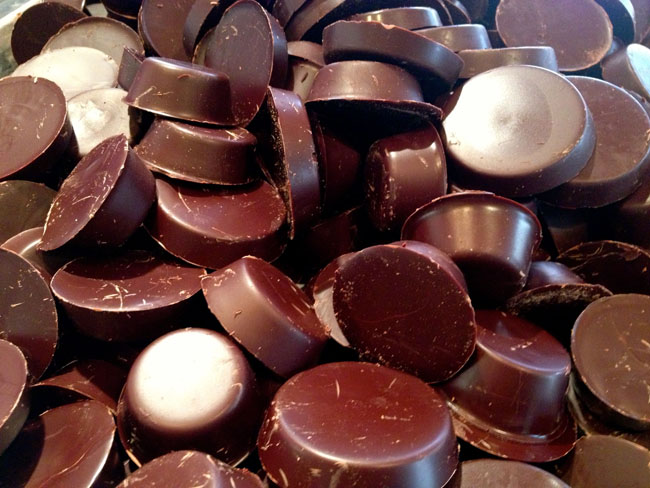
The company began in 2008 with a humble dream to retire and build a winter retreat in Joe’s native Ecuador. From the beginning, Joe was frustrated by the lack of high-speed Internet access in Ecuador. So, Joe (described as a “serial entrepreneur” by a customer) remedied the situation by transforming their house into a hostel and restaurant. Roasting and serving locally grown coffee for the restaurant soon led them to the local high-quality cacao, and they began making their own chocolate. In 2009, they began importing green coffee and cacao back to Dexter, MI and their reputation for good, small-batch chocolate soon spread here in the U.S.
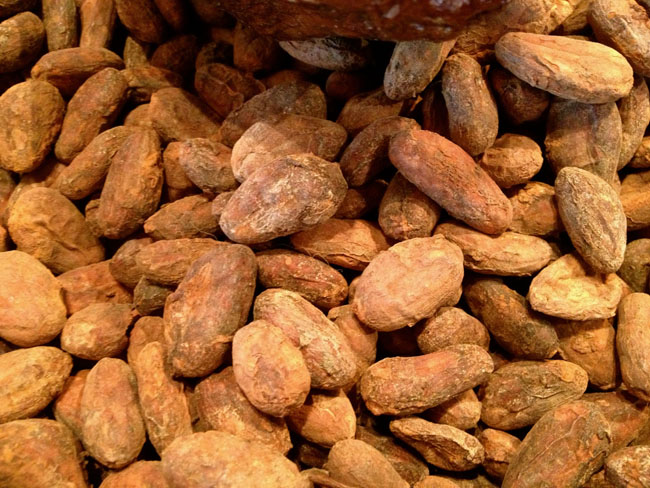
One of the products Mindo is especially proud of is their Cocoa Fruit Syrup. As the cacao pods are stored and fermented prior to processing into cocoa, the syrup from the pod is collected, and then boiled down into a concentrated version. The syrup, which has an intense, fruity flavor that’s been compared to tamarind, is a versatile addition to just about any meal. Add it to a sauce to enhance a meat dish, or use it as a base for a tangy salad dressing. It will bring an amazing dimension of flavor to almost any dessert under the sun, and it’s a great option for a cocktail that calls for a syrup or fruit juice.
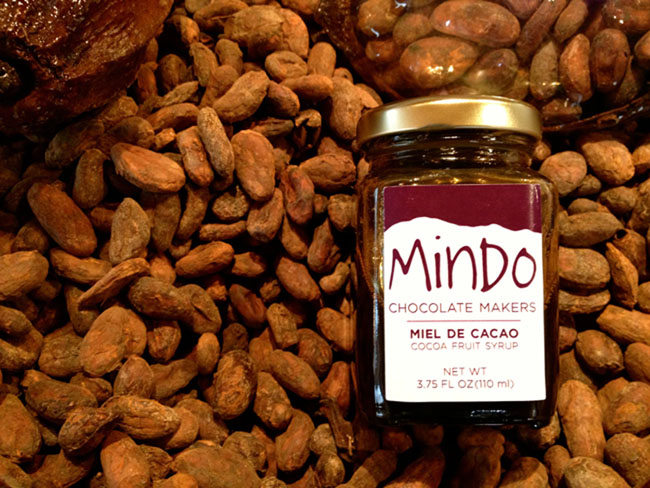
Mindo Chocolate is a delicious, high-quality chocolate that’s a great addition to any kitchen.
In addition to the delicious Mindo Hot Cocoa, the Zingerman’s Deli also sells Mindo Cocoa Powder, and Mindo Baking Chocolate. The Zingerman’s Bakehouse also stocks the Baking Chocolate, and Mindo Chocolate Bars are available at the Zingerman’s Roadhouse.
Month: November 2012
In anticipation of tonight’s Culinary Collaboration from Across the Lake event at the Zingerman’s Roadhouse, representatives from the Wisconsin Milk Marketing Board and Death’s Door Spirits hosted a tasting at the Roadhouse yesterday.
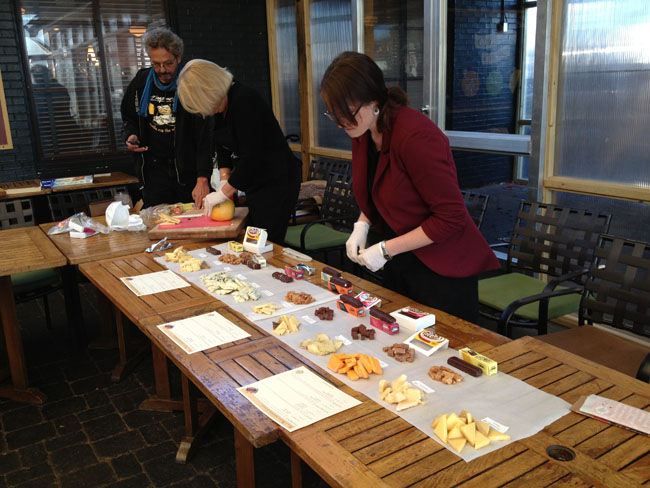
Attendees were presented with carefully selected parings of artisanal Wisconsin cheeses and several complimentary flavors of Zzang! Bars from Zingerman’s Candy Manufactory. While this might seem surprising to some, it reflects an emerging trend in high-quality cheese pairings.
Wisconsin Milk Marketing’s Heather Engwall explains that historically, fine cheese was paired with wine (“there’s nothing wrong with that!”), and more recently, good beer. But lately, the taste interplay between good cheese and fine quality chocolate has gained recognition as delicious alternative to beverages.
But, good beverages deserve recognition as well, so the good folks at Death’s Door Spirits were on hand to offer (small!) samples of their Vodka, White Whisky, and Gin. The distillers at Death’s Door emphasize handcrafted, small-batch grain spirits made from locally sourced quality ingredients. The result is a smooth, clean-tasting spirit sure to enhance any cocktail.

Culinary Collaboration from Across the Lake tonight 7pm – 10pm at the Zingerman’s Roadhouse. Seats are still available. Please call 734.663.FOOD (3663) to make your reservation.
Month: November 2012
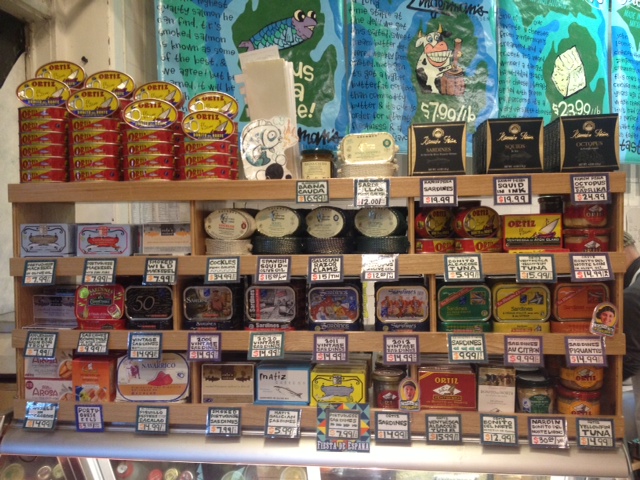
If you check with some of the most serious sardine lovers in the US ten years from now, and ask them to name the go-to spot to find their favorite forms of these delicious little fish, I forecast that eight out of ten are going tell you they do their sardine shopping at Zingerman’s. Yes, Zingerman’s, in landlocked Ann Arbor, will have become one of the centers of the specialty sardine trade. And while our sardine reputation is destined to spread, we’ve already got an amazing, world-class sardine selection today. The sardine selection at the Deli is already deeper, and more delicious that it’s ever been. All sixteen different varieties are worth trying. As you already know, if we don’t like ‘em we won’t stock ‘em! But, the glass-jarred beauties from the Ortiz family of the Basque Country in Spain are at the top of my personal list right.

ORTIZ SARDINES
While I understand that sardines may not seem a particularly scintillating subject to those who aren’t as in love with them as I am, I assure you that putting a jar of these in front of a sardine lover will probably get you more attention than you would with a beautiful, dry-aged steak cut from Cornman Farms’ pasture-raised beef (at the Zingerman’s Roadhouse) or a bar of the incredible Vietnamese chocolate that just arrived at the Zingerman’s Deli. The Ortiz sardines are truly that beautiful. Silvery, and glistening through the glass in the golden-green olive oil in which they’re packed, I can guarantee that every sardine lover will be anxious to open the jar and eat.
These particular sardines from northern Spain are one of those really amazing offerings that are sure to attract the attention of every little fish lover that tries them. Prepared and packed by the Ortiz family on Spain’s Cantabrian coast, I shouldn’t have been surprised that they’re as good as they are. Ortiz has been Spain’s premier producer of tinned tuna, anchovies, and other small fish for over a century and is currently being run by the fifth generation of the family. Their products are recognized as some of the best anywhere. Ortiz is the BMW of the tinned fish world; classy, stylish, smooth riding, and very high quality. They’re definitely the can of choice for connoisseurs.
For some reason, these special sardines fell out of Ortiz’s production for many decades. Last year, the family resumed sardine packing and I’m very happy they did. The sardines are produced according to an old French recipe that dates to 1824, the earliest years of preserving fish in jars or tins. As with their tuna and anchovies, the Ortiz folks are very finicky about the fish they select. They use only true pilchards, the most prized of the many species of small fish canned around the world as “sardines.” As they cook and pack only fresh sardines, production is seasonal and they have only about three months to pack sardines for the year.
PROCESSING
The freshly landed fish are taken from the dock directly to the processing plant in the village. They are then cleaned, fried in extra virgin olive oil, and left to stand for a few hours in order to drain the naturally occurring water they still contain. This makes the sardines mellower and more delicate in texture than others on the market. By contrast, most middle-of-the-pack commercial canneries use frozen fish. This changes the texture and flavor significantly. They cook the fish with steam once in the tins, and then add the oil, tomato or other sauces. All the water that was inside the sardines remains in the tin, reducing the quality and eating enjoyment. The Ortiz family prepares their sardines a l’ancienne, a process that leaves the fish tender from cooking with skin and bones still on. The result is a traditional soft, delicate, but meaty texture. Finally, they’re hand-packed with extra virgin olive oil in glass jars.
EAT AND ENJOY
What do you do with such amazing sardines? You eat them! I put them on salads. I eat them on pasta with either a fennel-scented tomato sauce or, equally excellent, a few spoonfuls of olive or caper paste and some grated breadcrumbs over the top. They’re fantastic on the traditional insalata pantesca, the traditional salad of the caper-growing Sicilian island of Pantelleria. The salad is very simple:
cooked potatoes
cherry tomatoes
a bit of slivered red onion
a handful of black olives
and plenty of capers
Toss with a bit of your favorite wine vinegar (I love the Txakoli vinegar from the Basque Country, not far from the Ortiz factories), and then add:
a touch of sea salt
a little crushed dried oregano
and plenty of extra virgin olive oil
Let stand for about half an hour to allow the flavors to come to together, lay the sardines over top and serve.
The Ortiz sardines are also delicious laid atop a bed of the spicy harissa we get in from the Mahjoub family in Tunisia. Just pour a bit of good extra virgin olive oil into the bottom of a salad bowl, and add a generous amount of the harissa. The vermillion color of the harissa will look beautiful against the light green-gold background of the oil.L ay the sardines over top, sprinkle on a touch of sea salt and a grind of good black pepper, and enjoy with a nice piece of warm Paesano bread in hand.
MATURE SARDINES
Before I move on I should mention something about maturing. No, not me—the sardines. It’s not common knowledge outside of sardine circles but aficionados actually age these little fish. As they age in the jar (or tin), the olive oil penetrates ever more effectively into the flesh of the fish and the flavor gets fuller, the texture a bit more tender. Connoisseurs will keep a case of sardines each year to mature in their cellars. If you ask the owners of any sardine cannery what sardines they’re eating at home, they’ll tell you something like “We’re eating the 2006 sardines now, and we have a few left from 2005.” The point is obvious: when you have your pick of the pack, the aged sardines are the way to go.
While we don’t have any aged offerings from Ortiz yet, we do have a couple of great ones from our French friends, the Gonidec family in Brittany. We’ve got a limited number of their “Les Mouettes d’Arvor” sardines from 2010 and 2009, which are a bit more full in flavor. My idea of a good time would be to open one of each and kick off the most serious sardine-tasting party in town!
Month: November 2012
Download the Zingerman’s Newsletter November-December 2012 (PDF)
Month: November 2012
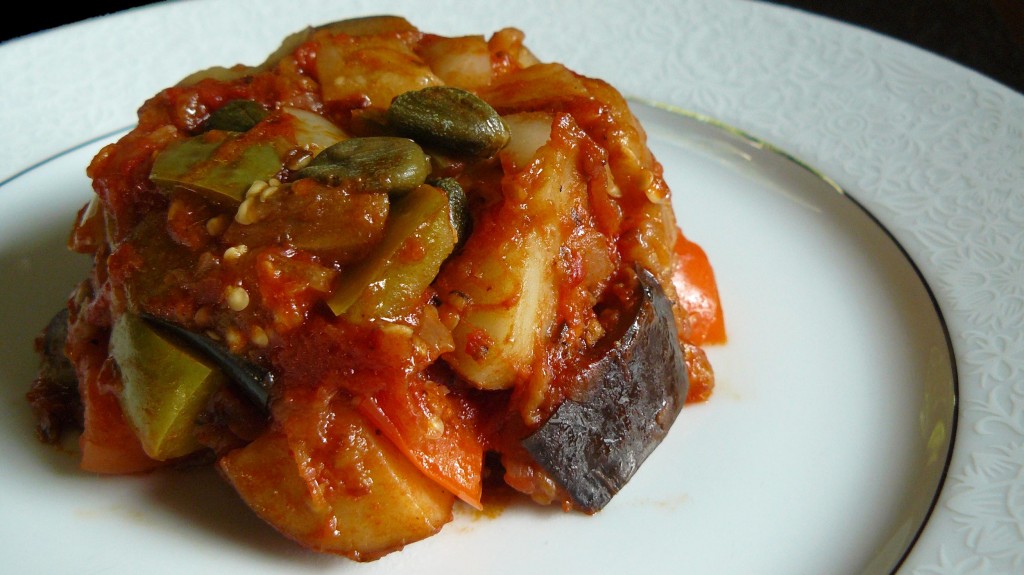
Sciaki Sciuka (pronounced shah-key shoo-kah) appears in restaurants and on home tables across Pantelleria. When I visited in September, I ate sciaki sciuka almost every day. Like all dishes that originated at home, each version was a little different. Some were served hot, others cold. One dish was served family-style with diced hard boiled egg on top, another was carefully molded into individual portions on fancy plates with fresh herbs for garnishes. What remained the same, though, were the vegetables — especially the fantastic capers.
2 tablespoons salt-packed capers
1/3 cup extra virgin olive oil
1 medium onion, diced
1 lb potatoes, cut in ¾” dice
1 large eggplant, cut in ¾” dice
3-4 bells peppers, diced
1 lb fresh tomatoes, or 1 14-oz can of tomatoes
½ teaspoon oregano
Sea salt and black pepper to taste
Set the capers in a small bowl of water to soak to remove some of the saltiness.
In a large frying pan over medium heat, saute the diced onion in a couple of tablespoons of olive oil, stirring occasionally. After a few minutes, when the onion is starting to turn translucent, add the rest of the olive oil and the potatoes to the pan. Cook for five minutes, stirring once or twice, then add the eggplant, peppers, tomatoes, oregano, sea salt and pepper. Cook over medium high heat, stirring every few minutes, until the eggplant and potatoes are cooked through. If the pan becomes dry and the vegetables start sticking, add a tablespoon or two of the caper soaking water or regular water.
When the potatoes are cooked, turn off the heat. Drain the capers from any remaining water, and add them to the pan. Stir once to mix everything together.
The sciaki sciuka is ready to eat right away, or will keep a few days in the fridge. Serve hot or cold, with crusty bread for sopping up any juices.
Serves 3-4 as a main course, or 8-10 as a side dish
Month: November 2012
 Take a trip around the Land of a Thousand Flavors and make a contribution to Double Up Food Bucks, an innovative and effective program that provides healthy food to those in need in our state community. When you visit Zingerman’s Delicatessen, Roadhouse, Creamery, Bakehouse and Coffee Co. in a 24-hour period and get your passport signed by a staff member at each stop, we’ll donate $5 (per person) to the Double Up Food Bucks program. Passports are available at any Zingerman’s location (on the back cover of our newsletter) or you can download it here. (As an bonus, completing the tour and turning in your passport also gets you entered into a monthly drawing for a $250 gift card!)
This donation ensures greater access to healthy, fresh food to lower-income residents of our inner cities and “food deserts” while simultaneously strengthening the local economy and improving the livelihood of farmers and rural communities.
 How does the Double Up Food Bucks program work?
Supplemental Nutrition Assistance Program (SNAP) shoppers spend their benefits at a participating farmers’ market and receive an equal amount (up to $20 per market day) provided by DUFB in tokens to purchase any Michigan-grown fruits or vegetables at the market. In effect, the SNAP recipients’ food dollars are doubled: by spending $20 of SNAP benefits at the farmers’ market, the shopper comes home with $40 worth of healthy, fresh, regionally grown produce.
Farmers’ markets are not an immediately apparent solution to problems found in lower-income and historically excluded communities–they are often viewed as primarily serving middle- or upper-class families. But the DUFB program shows that it is possible to create a healthier food environment for lower-income consumers and benefit the local farm economy by increasing the number of SNAP dollars being spent in farmers’ markets.
Funded by more than 35 foundations and corporations, the program has spread from a pilot in 5 Detroit markets in 2009 to 77 markets in 2012.
DUFB is demonstrating the feasibility and effectiveness of using incentives to encourage lower income families to purchase healthier food and support farmers. So far the program is almost exclusively supported by philanthropic dollars, but as our food and farm policy is created for the future with the reauthorization of the Farm Bill, we have an opportunity to provide public funding for this very successful approach to nutrition and rural economic development.
If you want to learn more and become engaged with FFN’s policy campaign to “Shrink Food Deserts and Expand Regional Food Systems,” go to www.fairfoodnetwork.org and sign up to become part of our communications network, so you will be poised to take action with us when the moment comes.
Zingerman’s Community of Businesses is proud to support Fair Food Network which also happens to be based here in Ann Arbor! Thanks to this visionary organization and the work it’s doing for our neighbors in need AND providing a boost to Michigan’s farmers.
Learn more about our November/December Tour de Food and get the passport!