
Month: February 2013
*From time to time, we share the writing of our friends and co-workers on this site. Today’s guest post comes from the blog of Cornman Farms’ Allison Anastasio Zeglis. Allison’s blog is called The Last Bite.
 I’m working my way through M.F.K. Fisher’s anthology The Art of Eating. It is not a cookbook, but a series of books that contain short essays about food and eating and cooking and their social im.plications. Although I have come across her work in “best of” food writing collections, I decided to make the commitment to read through her whole body of work.
She is a fantastic writer, full of wit, tongue-in-cheek humor, insightful examinations of human behavior seen through the eyes of the cook and the eater. If prose can be poetry, she nails that subtlety. There are over 700 pages of nuance, so I’m not going to summarize it all. But I was so struck by something I read last night, I wanted to take note of it and share the experience with you.
The final book in this collection is Alphabet for Gourmets. As you’d expect, each chapter has some alphabetical significance in it’s title and inspiration.
‘H is for Happy’ is a love song. She starts out by discussing the times when people are most happy at the table: when they’re young, when they’re in love, when they’re alone… There are many more.
In a prior essay called ‘The Pale Yellow Glove’ from Serve it Forth, Fisher discusses those moments of “complete gastronomic satisfaction.” They’re rare if you’re a foodie, maybe because we are often more aware of the shortcomings of a food experience. But in this essay, she touches on those times when the stars align, when the food and the experiences, internal and external, are in harmony to produce a scintillating memory It is the sense of being simultaneously satisfied, physically and emotionally. It could be the complicated result of a good friend making you a five star birthday dinner or the simplicity of eating blackberries from your garden that are more sweet than sugar and still warm from the heat of the afternoon August sun. For me, music can provide the same sort of accord between the physical and emotional. For a pregnant second, the world seems to stop so you can absorb something bigger than yourself, something immortal. It’s as if you can feel LIFE.
Keeping that in mind, we’ll travel back to ‘H is for Happy.’ Fisher dwells on a memory of eating fried egg sandwiches, but not just any… Aunt Gwen’s fried egg sandwiches. They were a secret treat at the time, something that neither her grandmother nor mother would have indulged in. Take a look at this excerpt and recipe:
When I was a child my Aunt Gwen (who was not an aunt at all but a large-boned and enormous-hearted woman who, thank God, lived next door to us) used to walk my little sister Anne and me up into the hills at sundown. She insisted on pockets. We had to have at least two apiece when we were with her. In one of them, on those twilight promenades, would be some cookies. In the other, oh, deep sensuous delight! would be a fried egg sandwich!
Nobody but Aunt Gwen ever made fried egg sandwiches for us. Grandmother was carefully protected from the fact that we had ever even heard of them, and as for Mother, preoccupied with a second set of children, she shuddered at the thought of such grease-bound proteins with a thoroughness which should have made us chary but instead succeeded only in satisfying our human need for secrets.
The three of us, Aunt Gwen weighing a good four times what Anne and I did put together, would sneak out of the family ken whenever we could, into the blue-ing air, our pockets sagging and our spirits spiraling in a kind of intoxication of freedom, breathlessness, fatigue, and delicious anticipations. We would climb high above the other mortals, onto a far rock or a fallen eucalyptus tree and sit there, sometimes close as burrs and sometimes apart, singing straight through Pinafore and the Episcopal Hymn Book (Aunt Gwen was British and everything from contralto to basso profundo in the Whittier church choir), and biting voluptuously into our tough, soggy, indigestible and luscious suppers. We flourished on them, both physically and in our tenacious spirits.
AUNT GWEN’S FRIED EGG SANDWICHES
ingredients (physical)
1/2 to 1 cup drippings
6 fresh eggs
12 slices bread
waxed paperThe drippings are very English, the kind poured off an unidentified succession of beef, mutton, and bacon pans, melted gradually into one dark puddle of thick unappetizing grease which immediately upon being dabbed into a thick hot iron skillet sends out rendingly appetizing smells.
The eggs must be fresh, preferably brown ones, best of all freckled brown ones.
The bread must be good bread, no puffy, blanched, uniform blotters from a paper cocoon.
The waxed paper must be of honest quality, since at the corners where it will leak a little some of it will stick to the sandwich and in a way merge with it and be eaten.ingredients (spiritual)
These have been amply indicated in the text, and their prime requisite-Aunt Gwen herself would be the first to cry no to any further exposition of them. Suffice it that they were equal parts of hunger and happiness.method
Heat the drippings in a wide flat-bottomed skillet until they spit and smoke. Break in the eggs, which will immediately bubble around the edges, making them crisp and indigestible, and break their yolks with a fork and swirl them around, so that they are scattered fairly evenly through the whites. This will cook very quickly and the eggs should be tough as leather.Either push them to one side of the pan or remove them, and fry bread in the drippings for each sandwich, two slices to an egg. It too will send off a blue smoke. Fry it on one side only, so that when the sandwiches are slapped together their insides will turn soggy at once. Add to this sogginess by pressing them firmly together. Wrap them well in the waxed paper, where they will steam comfortably.
These sandwiches, if properly made and wrapped, are guaranteed, if properly carried in sweater or pinafore pockets, to make large oily stains around them.
Seasoning depends on the state of the drippings. As I remember Aunt Gwen’s, they were such a “fruity” blend of last week’s roast last month’s gammon, that salt and pepper would have been an insult to their fine flavor.
prescription
To be eaten on top of a hill at sunset, between trios of “A Wandering Minstrel I” and “Onward Christian Soldiers” preferably before adolescence and its priggish queasiness set in.
Can you not feel yourself walking & singing with Aunt Gwen? I’d like to advocate including both physical and spiritual ingredients in recipes, in addition to prescriptions of how to enjoy. Not just the common “serve with rice” but literally the how, where, who with. If we demanded this, can you imagine how many insipid recipes would be forced to come to terms with their irrelevance?
As I’ve said before on The Last Bite, sometimes food is fuel, and when you’re cooking for a family, preparing food spiritually might feel like a stretch. But we should all remember that providing sustenance is more than fulfilling a physical need. It is filling a need bigger than a stomach. Because it is life sustaining, most literally, it carries a heavier weight than caloric input. It has the opportunity to reach someone deep down in their core being. It has the capacity to stop the world for a second, to cause a person to take inventory of where they are in the universe, to create a memory that will stick with them through the rest of their days.
Month: February 2013
*From time to time, we share the writing of our friends and co-workers on this site. Today’s guest post comes from the blog of Zingerman’s Mail Order Managing Partner, Mo Frechette. You can read Mo’s blog here.
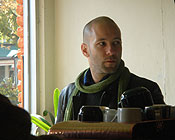 Sometime in the last decade or so I lost whatever hangup I had about going to restaurants that serve a lot of tourists. I guess it should have happened a lot sooner given that I’ve been part of Zingerman’s for almost two decades and we’ve been a tourist joint almost the entire time. I think I can pinpoint my personal transformation to sometime around the second bite of lunch at Cal Pep in Barcelona. It was a crowded counter swarmed by Americans. I was there with my friend Eric Farrell, now the owner of one of my favorite bars. We did that kind of anxious wait you do in Europe when you stand around not sure if anyone has seen you or if you should be doing something different or just leave. Sometime later a bottle of wine was handed to us, no questions asked; naturally we emptied it. An hour and a half later we closed the place having eaten most of the menu. I’ve never forgotten the food. I’m sure there are technically better meals in Barcelona — I’ve eaten a couple of them — but for sheer force of expression almost no place I’ve eaten at feels quite like Cal Pep.
What was a small transformation has grown into a larger passion. Where once I avoided them or held my nose when I visited, now I’m really drawn to old places that continue to do something great. That said, I like new places, too. They have loads of energy and I learn all kinds of things. They’re exciting like a new rock band is exciting. But with older places there’s almost something else to grasp. It’s not like they have to do everything well, and in fact most of them don’t. It’s kind of like watching old movies; you have to get over the period artifice to some extent in order to enjoy it. Same with old restaurants. Most of the time half the menu will be crap. Order carefully. If they do enough well — or even just one thing — that’s enough for me. The part that makes it worth it is that they’ve done whatever it is so well for so long they wear an elegance that newness can’t share. My friend Dai who owns Astro Coffee (highly recommended) put it well when he recently told me, “When people ask me where to go in San Francisco I tell them Chez Panisse. I mean Mission Chinese is red hot and it’s fine but Chez Panisse has been at it and after 40 years it’s beautiful. You want to know the secret to a great place? That’s it. You just show up and keep making it great—endlessly.”
Here are a few of my favorite old tourist joints — some older than others — that I think are worth it for one reason or other.
Barcelona, Cal Pep
San Francisco, Swan Oyster Depot and, on some nights, the Tonga Room at the Fairmont Hotel
Buenos Aires, La Preferida
Rome, Sora Margherita
New York, Grand Central Oyster Bar
Montreal, Schwartz’s
New Orleans, almost anything…
Month: February 2013
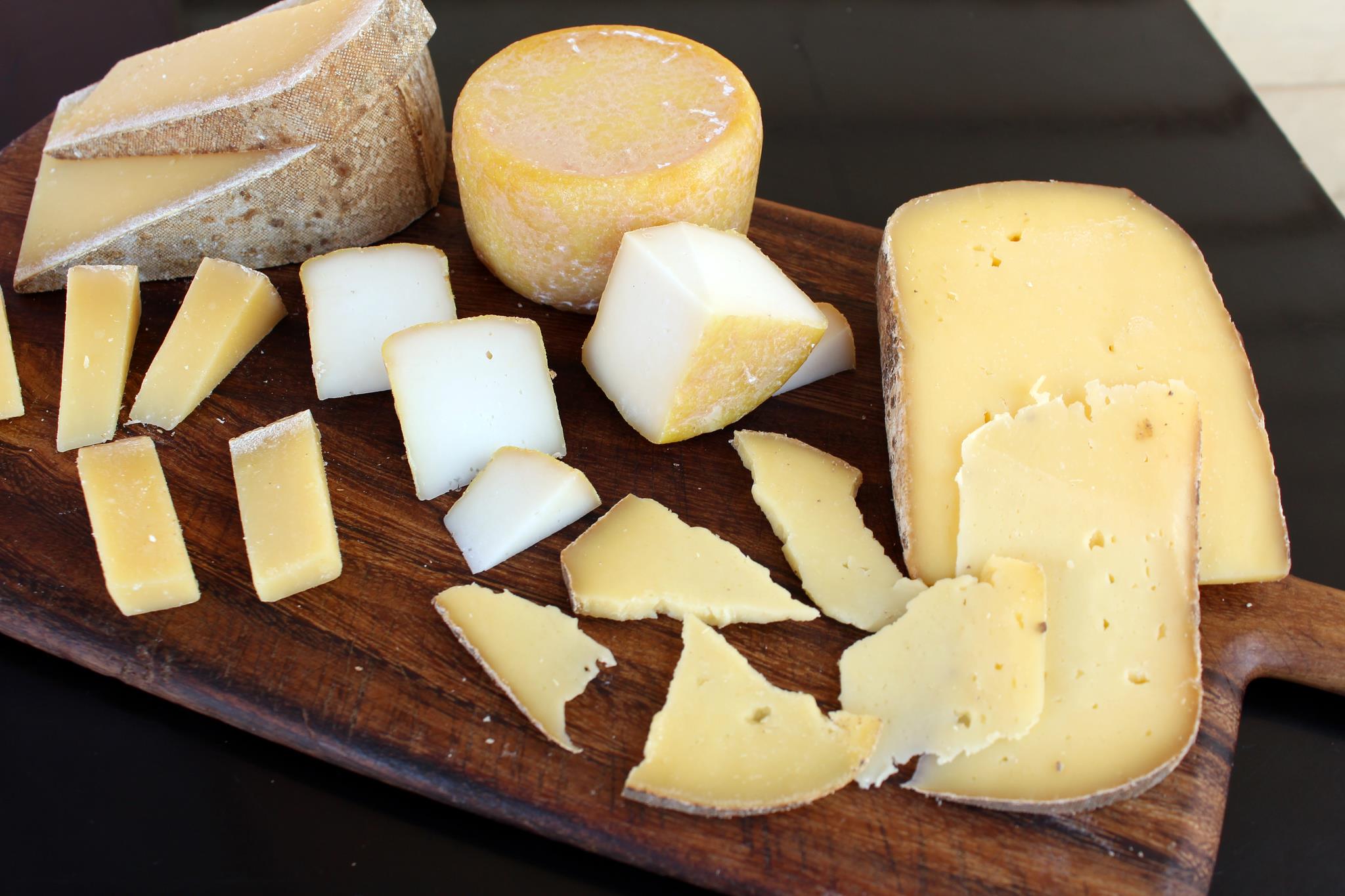
 Please join us this coming Wednesday, March 6, 7 p.m. at Zingerman’s Events on 4th for a delicious evening of cheese tasting honoring the life and work of our friend and cheesemonger, Daphne Zepos. All proceeds go to the Daphne Zepos Teaching Award, an annual scholarship for aspiring cheese professionals.
The event will be a guided tasting featuring the favorite cheeses of some of the most noted cheesemongers in the business today. Each monger will pick one cheese they love most of all, and tell us everything they know about it. Some wine will be included, and a cash bar for wine and beer will be open all evening. Drink, eat cheese, hear some great stories, and meet some great people!
Among the guests:
Jason Hinds of Neal’s Yard Dairy, who pioneered selling farmhouse British cheese in America and who has trained legions of American cheesemongers in selecting, aging and selling at NYD’s home base in London.
Anne Salxelby of Saxelby’s Cheese, an all-American cheese shop in Essex Street Market in New York City. She was named Small Business of the Year in 2011 by Mayor Bloomberg.
Mateo Kehler of Jasper Hill, who, along with his brother Andy, make their own cheese, and, perhaps more importantly, select and age cheese for other Vermont cheesemakers. They have created a hub of operations for all Vermont cheesemakers and have revived clothbound cheddar in America.
Daphne Zepos was an internationally known authority on cheese whose expertise encompassed the buying of it, the selling of it, and the making of it. She was a writer, teacher, consultant, importer, chef and cheese-competition judge. As the The New York Times wrote of her in 2005, Daphne Zepos was “one of the most respected voices in the field of American cheese.” (Not the processed stuff)
From 2002 to 2005, Ms. Zepos was associated with Manhattan’s Artisanal Cheese Center. In 2006, she helped found the Essex Street Cheese Company, a New York City-based importer and wholesaler of a small number of artisanal cheeses from Europe, her favorite among them, Comté, a French cousin of Gruyère, which she once described as “unleashing a tsunami wave of cream” in the mouth that “… leaves that incredible aftertaste of cream and butter on the tongue.”
In 2011, Ms. Zepos became an owner of the Cheese School of San Francisco. In addition to her work, Daphne Zepos wrote about cheese for the Atlantic magazine and she is often credited with helping inspire the current interest in artisanal cheeses here in America.
“Twenty years ago, the image of cheese, other than amongst a very tiny percentage of Americans who had traveled a lot, was really about mass-market cheese,” says Zingerman’s Founding Partner, Ari Weinzweig. “Today, thanks in part to Daphne’s leadership and teaching and training, a far bigger slice of the American populace understands what artisan cheese is, and can be.”
“She wanted people to support small makers of cheese and to understand all the work and the love that went into it,” says Corby Kummer, senior editor at The Atlantic. “She told people how to appreciate the full range of scents and taste and how to look at and how to feel cheese — literally: touch it, crumble it, understand the texture. She never was blasé. She loved what she did. She loved the people who made cheese. She loved looking at the light in your eyes when she put a piece of cheese into your mouth.”
“Nearly every cheesemonger everywhere knew here and considered her a friend — she was the kind of person who was very immediately close and interested, no matter how long you’d been in the industry,” said Zingerman’s Mail Order Managing Partner, Mo Frechette. “She created a cheese mastery class that was taught, among other places, at ZingTrain. The fact that we have a group of cheese industry people coming to ZingTrain for education is a legacy of that work.”
The Daphne Zepos Teaching Award is an annual scholarship awarded to an USA-based cheese professional who uses the funds to travel, learn and further their education on cheese. This award will grow a squad of cheese professionals who teach about the history, culture and techniques in making, aging and selling cheese. Each year someone new will go forth to learn about cheese. The scholarship will fund travel and living expenses. The winner will return to share their learnings with the cheese community — at the annual American Cheese Society Annual Conference and beyond.
Please join us for this very special event.
$30/person, Call us to reserve your seat, 734-663-3400 or reserve online here.
Month: February 2013
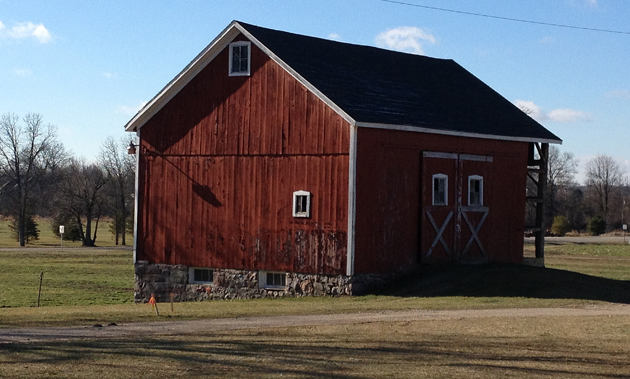
For all the old buildings that slowly fall into disrepair until they are torn down (or just wither away), one local landmark will experience a happier fate as part of the development of Zingerman’s Cornman Farms in Dexter. Alex Young, Managing Partner at Zingerman’s Roadhouse and the driving force behind Cornman Farms is working with local architect Charles Bultman to rescue the barn on his recently acquired property on Island Lake Road in Dexter.
(read more about Charles Bultman here)
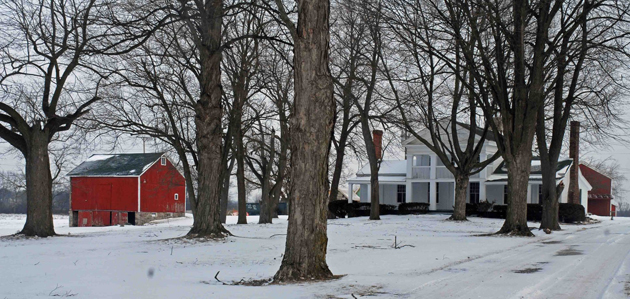
As the project begins, it might look to passers-by that the barn is being torn down, but that is not the case. Instead, the barn will be dismantled, piece by piece and every salvageable item will be tagged and shipped to a barnwright in Ohio, Christian and Son, who will begin the painstaking process of rebuilding the grand structure.
Architect Bultman notes eloquently that an event like this shouldn’t pass without notice:
History is told in retrospect, and often with great struggle to try to sort fact from fiction. Witnesses to many significant events can seem to not have the same experiences, as evidenced by accounts that sometimes vary wildly. But then these events are rarely cued up for us, and they do occur in real time, which can be faster than we might want to admit.
Some events however can come at us slowly and deliberately. And if we don’t stop to acknowledge them they pass in a flash. One such event begins this week in Dexter.
A barn that has stood in service to its Dexter farm since Dexter was founded, pre-dating the Civil War and possibly Michigan’s statehood, is going to be dismantled. To those of us who bring buildings to life, these moments give us great pause. As best we know right now, this barn has graced its property since the founding of Dexter; the adjacent house is said to have been built in 1834 and the barn either pre-dates that, or followed right after. Regardless of the date, this barn has been a landmark on Island Lake Road for generations and will be gone for the first time since the early 1800’s.
Bultman also notes that the case of barns is a special one in the world of historic preservation.
Sadly, most barns are not afforded this opportunity. Their descent is not interrupted and they languish; slowly decaying and sinking. This too should give us great pause, but it rarely does, due to the relentlessly slow pace of the decline. But the work that begins this week and continues in the coming months will bring great change to the barn and the farm. And these events will highlight the fact that there is so much that is valuable and interesting in these old structures and that they can, and should, become as important in our future as they have been in our past.
The entire project is expected to last into the summer of 2014. The barn will be refurbished and brought back to its site, where it will be re-raised in approximately the same location it has occupied for well over a century. It will then begin its new life as an integral part of Zingerman’s Cornman Farms and will be the center of food celebrations for decades to come.
Month: February 2013
It’s a frigid, windy day, but the Bakeshop is warm and filled with delicious aromas. I take a number and join the crowd waiting to be called. As I wander through the shop I am drawn, as always, to the big picture windows that look into the Bakehouse beyond. I’ve worked in kitchens and baked at home, but it’s still fun to watch the staff knead, work, and shape the giant mounds of dough on flour-dusted tables. Will this batch become loaves of crusty Farmhouse bread? Perhaps a nice Jewish Rye?
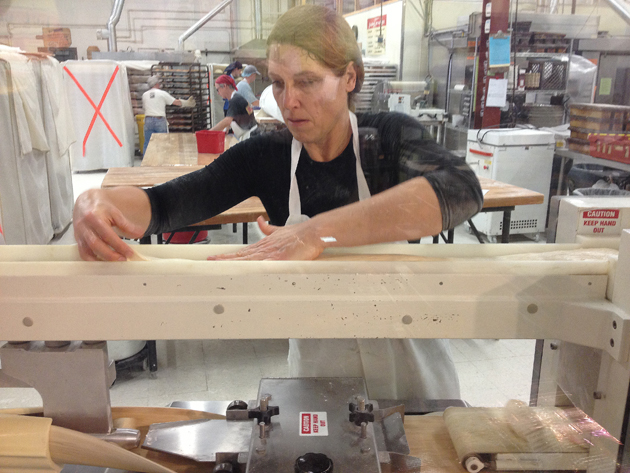
But today is different. In the foreground of the Bakehouse kitchen, right next to the window, an unfamiliar piece of equipment is in motion. I’m reminded initially of a Rube Goldberg contraption. It’s a long, slender machine, parts of it chrome and parts white enamel. It’s perhaps fifteen feet in length, with a flexible belt that runs its length and it seems to be processing dough because I can see a baker feeding the stuff into it. I shift my position, and see small dough rings rapidly emerging from the other end and it suddenly becomes clear that this is a bagel-shaping machine.
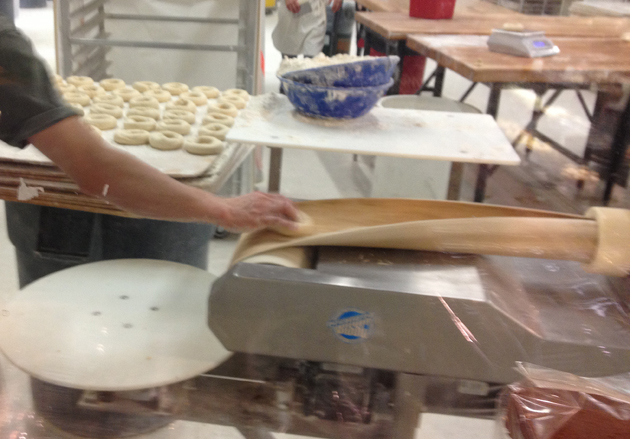
The ever-courteous staff in the Bakeshop direct me to one of the bakers in the kitchen who confirms that the machine is indeed making bagel dough into rings. He further explains that the Bakehouse needs this machine because they make hundreds of bagels of varying flavors every day, with the number rising into the thousands to accommodate weekend demand. Without it, the bakers simply wouldn’t have enough time to hand-form the sheer numbers of bagels needed. Each morning, many batches of bagel dough are mixed and then set aside to rise for about two hours. When the dough is ready, one of the bakers hoists the huge blob of dough onto a flour-dusted table and begins cutting it into long, thick slabs to make it easier to feed into the shaping machine. The only exceptions to this process are the Egg and 9-Grain bagels, whose flour texture demands hand-forming.

The machine requires two people to operate; one to feed dough into the hopper and another to catch the bagel dough rings at the other end. And boy, is it fast! The dough is fed into the machine’s narrow hopper. The hopper winds the dough down through a cutter, which chops it into rectangular chunks. Periodically, the bakers will snatch one of these pieces away to be weighed, verifying that the machine is cutting to the appropriate weight.
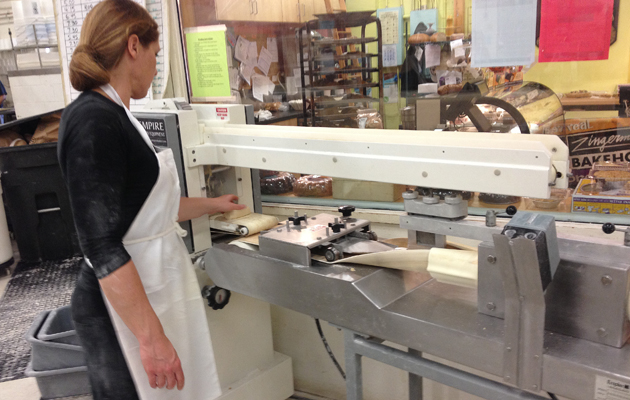
Once cut, the dough pieces are carried to a point where they meet a metal protrusion that resembles the forward end of a golf putter. At the same time, the flexible belt is moving through a guide that gradually curls up the sides, forming it into a tube. The action of the dough meeting the putter at the same moment the conveyor belt becomes tubular forms the dough into a kind of horseshoe shape.
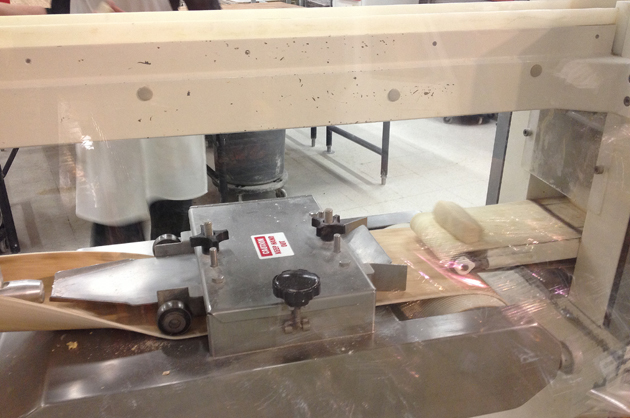
The tube-belt passes through another hopper, which rotates the dough and joins the two ends of the horseshoe into a ring. On the other side, the belt flattens out again and bagel-shaped rings of dough tumble out, where another baker dusts them with flour and lays them onto a large tray. The filled rack is then moved into a large walk-in refrigerator where it will cure with dozens and dozens of others for about twelve hours.
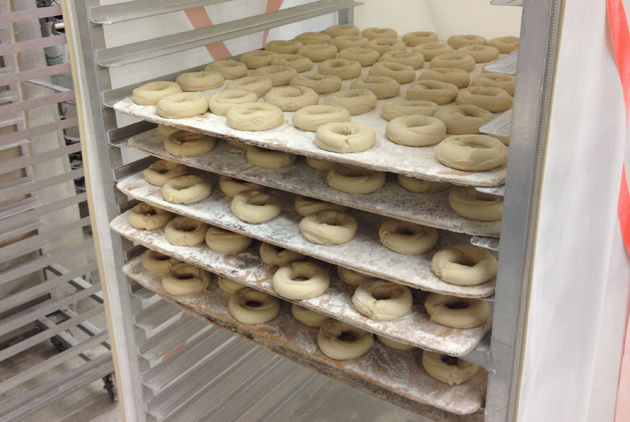
When dough is cured, the Bakehouse night shift takes over and it’s time to cook the bagels. The racks are rolled over to an enormous kettle filled with boiling water and the cured bagels go in for a couple of minutes, giving them a nice, firm exterior. Then, still wet and steaming, they’re dipped into coatings like sesame, poppy seed, or salt, depending on flavor. Finally, the bagels go into the ovens where they’re baked until golden brown.
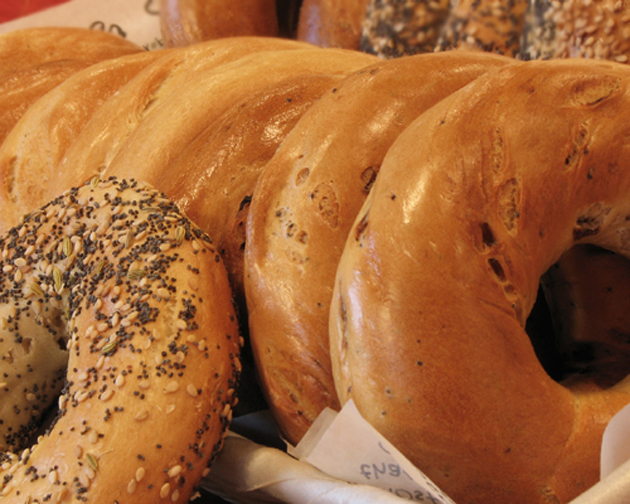
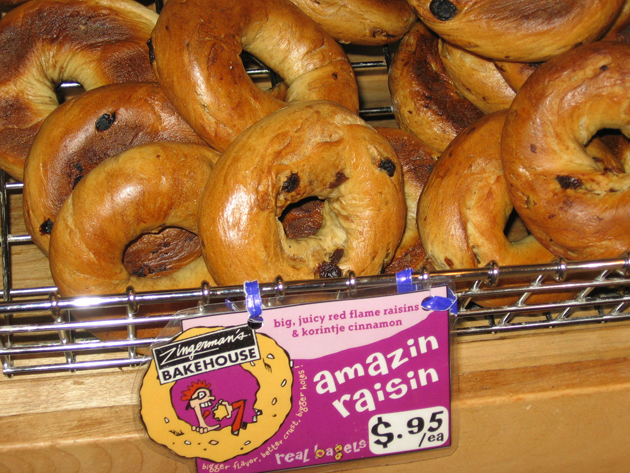
The bakers work through the night, moving hundreds of bagels from the cooler to the kettle, into the ovens, and onto cooling racks. Soon, the bagels will be packaged and loaded onto trucks bound for delis, restaurants, and markets all over the region. The drivers will leave the Bakehouse in darkness and make their rounds quickly, so the bagels will be there to greet the dawn with the first customers of the day.
Month: February 2013
Just 7 days left to stock up and save on delicious Zingerman’s Pot Pies!
All of our homemade pot pies are available heated, ready to heat or frozen.
Keep a few on hand this winter for a quick and delicious dinner option!
Zingerman’s Classic Chicken Pot Pie
Free range chicken hand picked off the bone and blended with big chunks of carrots, celery, potatoes, onions and herbs. Wrapped in a handmade butter crust. It’s the perfect lazy cook Winter meal; it’s warm, filling and easier than pie.
John H. Turkey – Turkey Pot Pie
Harnois & Son Farm turkey with big chunks of celery, carrots, onions, potatoes and spiced with Turkish Urfa pepper and fresh herbs. Then wrapped in a handmade butter crust.

Fungi Pot Pie
*vegetarian selection*
A fun pie for the fungiphiles! Michigan Maitake Mushrooms, Tantré Farm Organic Shiitake Mushrooms and a little Balinese long pepper, tucked in an all-butter crust.

Darina’s Dingle Pie
A salute to the miners on the Dingle Peninsula of Ireland: this pie is made with lamb from Back Forty Acres in Chelsea, MI, loads of potatoes, rutabaga, onions and a dash of cumin and rosemary. Wrapped miner-style (no tin) in a butter crust.
Cheshire Pork Pie
Made from a 4-H Tamworth hog raised by Nic Harnois a future star farmer from Northern Washtenaw Co. Braised with onions, apple cider and spices then stuffed in a handmade pastry crust with apples from Kapnick Orchards in Britton, MI. Wrapped miner style (no tin).

The Red Brick Beef Pot Pie
This beef pie is our heartiest one yet. Packed with big chunks of all natural beef from Ernst Farm Here in Washtenaw Co., carrots, potatoes, fresh herbs and wrapped in our handmade crust.
Stock up for winter on frozen pies and save!
– Buy 10 or more get 10% off
– Buy 20 or more get 20% off
– Buy 30 or more get 30% off
Call ahead to order for pick up at the Deli, 734-663-3354, or call 1-888-636-8162 for shipping.