Tag: BAGELS
A coming together of Ashkenazi and Sephardic culinary traditions
With the holiday of Shavuot coming up in a few weeks, I’ve had the Jewish tradition of eating dairy foods and fish on my mind. I’m not sure exactly what led me to put this powerfully tasty combo together now, but I’m glad I did—it’s delicious!
Like most things I enjoy making, this one’s super simple. It reflects both the cuisine of the Sephardic Jewish Mediterranean and the foods of the Ashkenazi Jewish community of Northern and Eastern Europe.
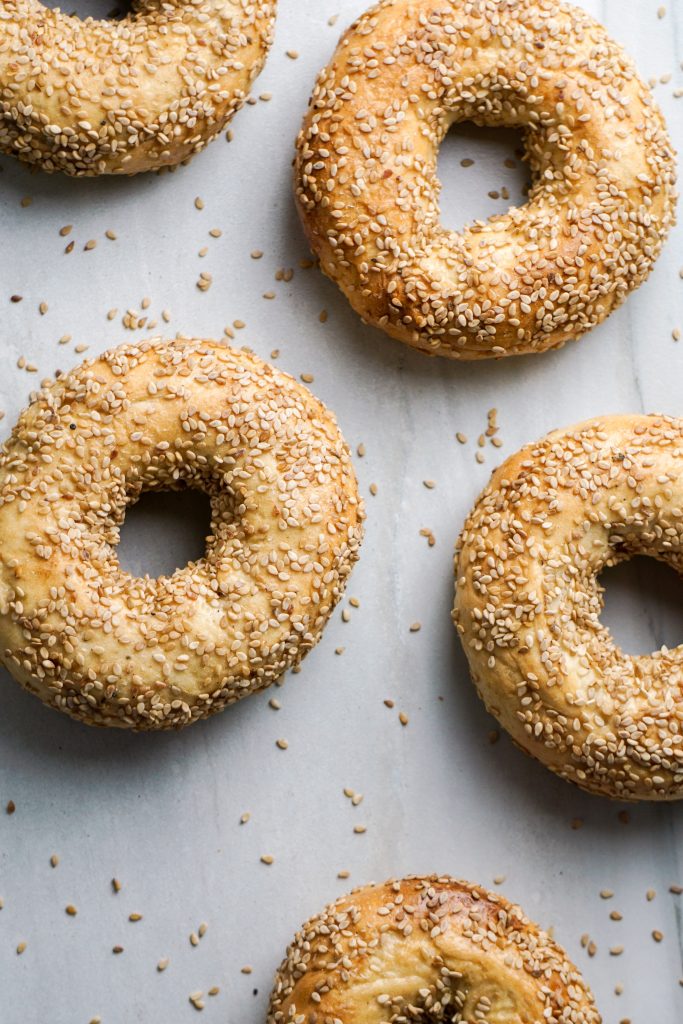
To make it, I started with one of the Bakehouse’s lovely Sesame Street Bagels, but take your pick; they’ll all be good. Toast until golden brown, then drizzle generously with one of our more delicate extra virgin olive oils—I’ve long loved the ROI oil from the Boeri family in the region of Liguria, the Italian Riviera.
Spread some room-temperature world-class Zingerman’s Cream Cheese on the still-warm bagel. Lay on some really good anchovies—as many as you like. I used the outstanding ones we get from Ortiz, from the Cantabrian Sea off the north coast of the Spanish Basque Country. I also love the anchovies from Fishwife, which hail from Spain as well but via California.
Grind on fresh black pepper and add any more vegetables you want: the pipparras pickled peppers from Spain, a couple of tomato slivers in season.
The warmth of the toasted bagel softens the cream cheese, and the creaminess of the cheese contrasts beautifully with the salty, meaty, umami tang of the anchovies. And when I think about it all culturally, I love that it’s a great coming together of the two main streams of Jewish culture in exile: the olive oil, anchovies, and herbs or capers from the Sephardic tradition, and the bagel and cream cheese from the Ashkenazi!
It’s a frigid, windy day, but the Bakeshop is warm and filled with delicious aromas. I take a number and join the crowd waiting to be called. As I wander through the shop I am drawn, as always, to the big picture windows that look into the Bakehouse beyond. I’ve worked in kitchens and baked at home, but it’s still fun to watch the staff knead, work, and shape the giant mounds of dough on flour-dusted tables. Will this batch become loaves of crusty Farmhouse bread? Perhaps a nice Jewish Rye?
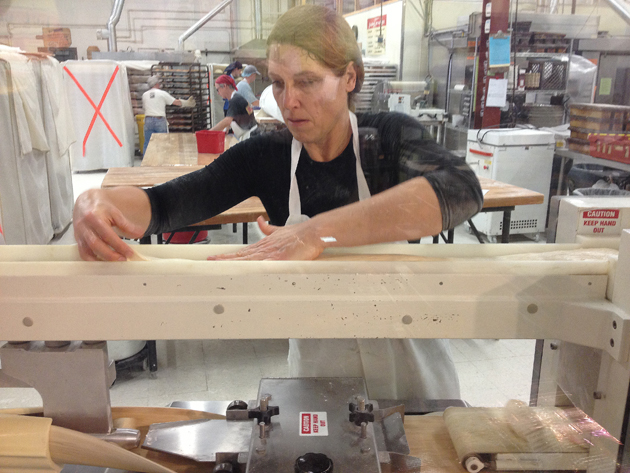
But today is different. In the foreground of the Bakehouse kitchen, right next to the window, an unfamiliar piece of equipment is in motion. I’m reminded initially of a Rube Goldberg contraption. It’s a long, slender machine, parts of it chrome and parts white enamel. It’s perhaps fifteen feet in length, with a flexible belt that runs its length and it seems to be processing dough because I can see a baker feeding the stuff into it. I shift my position, and see small dough rings rapidly emerging from the other end and it suddenly becomes clear that this is a bagel-shaping machine.
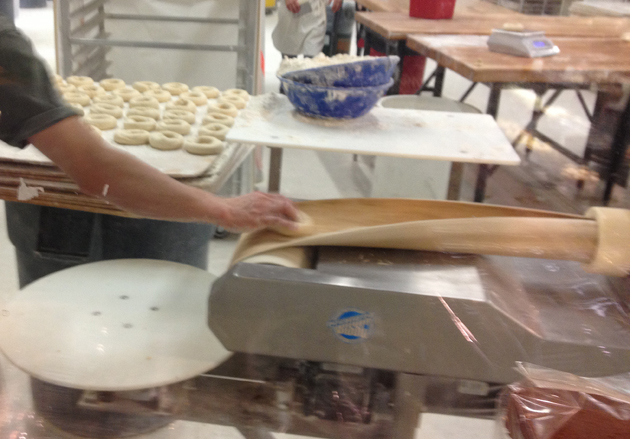
The ever-courteous staff in the Bakeshop direct me to one of the bakers in the kitchen who confirms that the machine is indeed making bagel dough into rings. He further explains that the Bakehouse needs this machine because they make hundreds of bagels of varying flavors every day, with the number rising into the thousands to accommodate weekend demand. Without it, the bakers simply wouldn’t have enough time to hand-form the sheer numbers of bagels needed. Each morning, many batches of bagel dough are mixed and then set aside to rise for about two hours. When the dough is ready, one of the bakers hoists the huge blob of dough onto a flour-dusted table and begins cutting it into long, thick slabs to make it easier to feed into the shaping machine. The only exceptions to this process are the Egg and 9-Grain bagels, whose flour texture demands hand-forming.
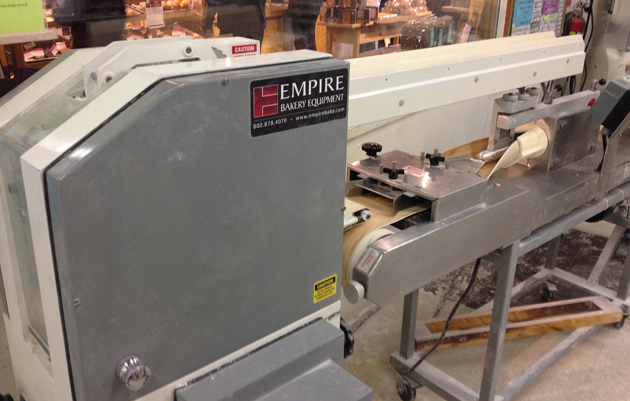
The machine requires two people to operate; one to feed dough into the hopper and another to catch the bagel dough rings at the other end. And boy, is it fast! The dough is fed into the machine’s narrow hopper. The hopper winds the dough down through a cutter, which chops it into rectangular chunks. Periodically, the bakers will snatch one of these pieces away to be weighed, verifying that the machine is cutting to the appropriate weight.
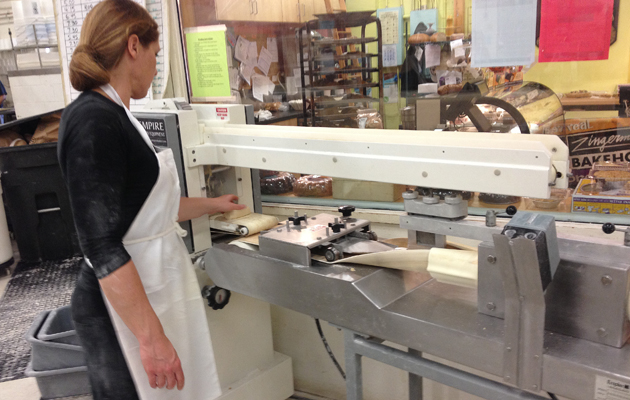
Once cut, the dough pieces are carried to a point where they meet a metal protrusion that resembles the forward end of a golf putter. At the same time, the flexible belt is moving through a guide that gradually curls up the sides, forming it into a tube. The action of the dough meeting the putter at the same moment the conveyor belt becomes tubular forms the dough into a kind of horseshoe shape.
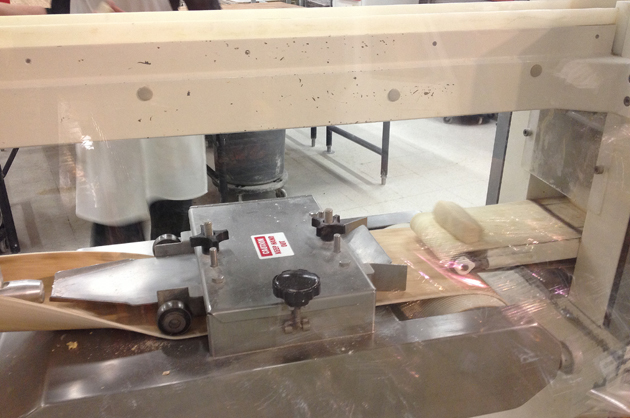
The tube-belt passes through another hopper, which rotates the dough and joins the two ends of the horseshoe into a ring. On the other side, the belt flattens out again and bagel-shaped rings of dough tumble out, where another baker dusts them with flour and lays them onto a large tray. The filled rack is then moved into a large walk-in refrigerator where it will cure with dozens and dozens of others for about twelve hours.
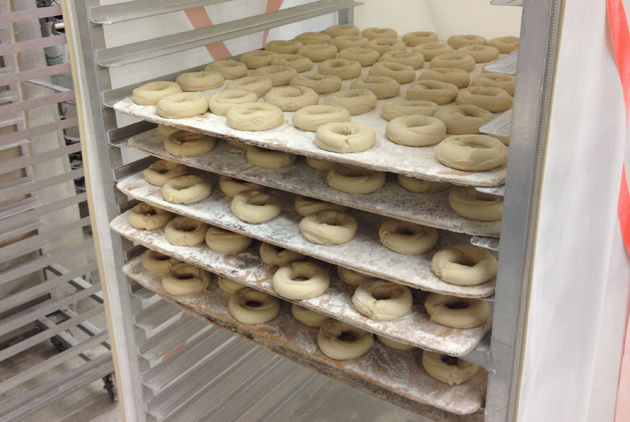
When dough is cured, the Bakehouse night shift takes over and it’s time to cook the bagels. The racks are rolled over to an enormous kettle filled with boiling water and the cured bagels go in for a couple of minutes, giving them a nice, firm exterior. Then, still wet and steaming, they’re dipped into coatings like sesame, poppy seed, or salt, depending on flavor. Finally, the bagels go into the ovens where they’re baked until golden brown.
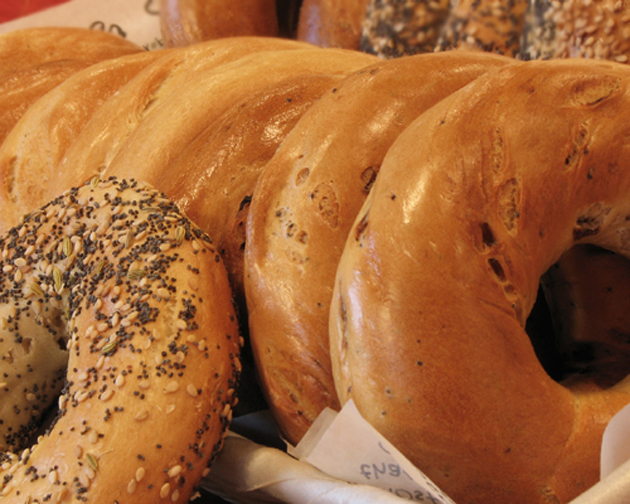
The bakers work through the night, moving hundreds of bagels from the cooler to the kettle, into the ovens, and onto cooling racks. Soon, the bagels will be packaged and loaded onto trucks bound for delis, restaurants, and markets all over the region. The drivers will leave the Bakehouse in darkness and make their rounds quickly, so the bagels will be there to greet the dawn with the first customers of the day.