
Tag: HUNGARIAN FOOD

At Zingerman’s, we believe that delicious food and new experiences are the cure for the winter blues. That’s why we’re really excited to announce our Winter Hungarian Feast! Hosted by Zingerman’s Deli co-owner and head chef Rodger Bowser and our Hungarian friend Gábor Bánfalvi, this multi-course meal scheduled for Sunday, January 28 at the Greyline will honor the traditional Hungarian celebration of disznóvágás, which includes the harvest and preservation of pork.
The pork we’ll be using throughout the evening’s menu will come from the Mangalica pig, a Hungarian breed, specially sourced by Rodger right here in Michigan. “It is always exciting to work with the traditional sources of food when your doing meals from different food cultures of the world,” says Rodger. “Sourcing the Mangalica from Meadowbrook Farms in Benton Harbor, Michigan made writing this menu easy. The hog really lends itself to ‘winter’ food and all the traditional Hungarian dishes. With the Mangalica’s fat content, there will be plenty szalonna and lardo to go around.”
Each course, from Hungarian Bean and Barley Stew, called sólet, to a traditional meat platter, will include this very special pork. The meal will begin with with szalonna, traditional fire-roasted bacon served with bread. “Bacon roasting goes back to this ritual that Hungarians do. ‘Szalonna’ means ‘bacon’, and it’s an essential part of Hungarian cuisine and the old-school Hungarian lifestyle,” says Gábor. “Every family, a couple of times of year, eats by the campfire, and instead of roasting marshmallows, we sit down with a piece of bread in our hand—typically the bread is covered with sliced red onions—and a stick with a nice piece of bacon on the end of it.”
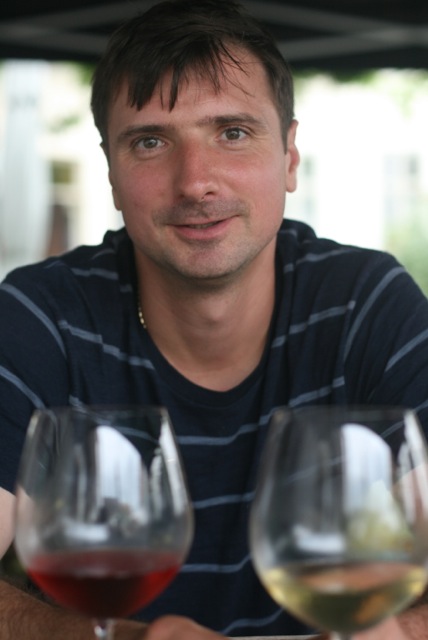
Gábor says that wine plays a big part of the “ritual” as well, and he’ll be helping us complete the experience with Hungarian wine pairings he’s chosen to perfectly complement each dish. “Hungary is one of the oldest European wine-making countries. We have a very old wine culture,” Gábor explains, adding that he’s working on a diverse selection that will include crisp sparkling wines, medium-bodied reds, and maybe even an aromatic wine to go with desserts.
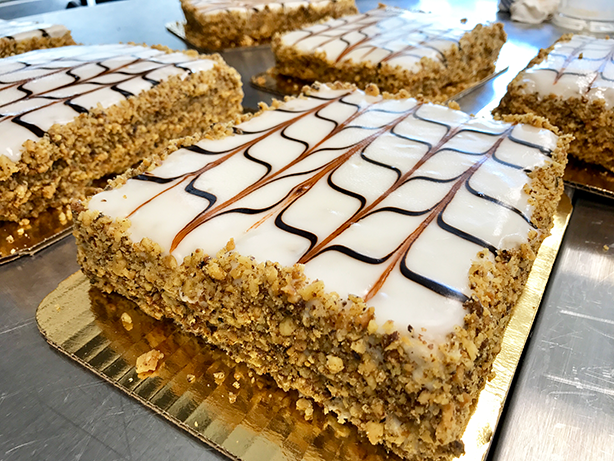
And desserts will be pretty special, too. Made by our own Amy Emberling of Zingerman’s Bakehouse, the sweetest portion of the night will be a selection of Hungarian specialties: esterházy torta, rigó Jancsi, and dobos torta, which have received the seal of approval from Gábor. Here’s what Amy had to say about the erházy torta in the new Zingerman’s Bakehouse book: “This classic Hungarian torta is pure elegance—petite and beautiful to look at, refined and balanced in flavor, with a perfect level of sweetness….” We think it will be the perfect ending to this ultimate winter feast!
Our Winter Hungarian Feast takes place Sunday, January 28, at the Greyline from 7:00 – 9:00 pm. Cost is $80 per person and includes multi-course dinner and wine pairings. Would you like to attend? Check out the full menu and reserve your spot here today.
Rodger is making extra batches of double-smoked Hungarian bacon and sausages from the Mangalica breed to offer those who wish to extend the flavor into the winter. Limited supply.
Spend some more time with Gábor! He’ll be our special guest host at BAKE! for A Taste of Hungary. At this presentation and demonstration, Gábor will share his stories from his travels around Hungary while we demo Palóc Leves soup, Pogácsa, and Poppy Seed Rétes for dessert. Sign up here!
During the holidays, we read an interesting New York Times article from writer Jeffrey Yoskowitz titled “Goose: A Hanukkah Tradition”. In the piece, he talked about a forgotten tradition—the Chanukah goose:
When Hanukkah fell on the Sabbath, Jewish families of means would host a feast with roast goose, latkes fried in its schmaltz and most likely pickled vegetables. ‘The smell of smoking goose fat became the traditional scent’ of Hanukkah, Michael Wex says in his book ‘Rhapsody in Schmaltz.’
Yoskowitz goes on to say that goose was once a focal point of European Jewish cooking even beyond Chanukah, but the tradition didn’t withstand migration to America. The main reason being that geese and their notoriously belligerent dispositions aren’t conducive to the modern factory farm. Chickens, on the other hand, are easier to confine and breed, making them a cheaper, more accessible recipe alternative. These days, buying a goose is more expensive that ever, and Yoskowitz reports that the nine-pounder he recently purchased was a whopping $250!
Here at Zingerman’s we’re passionate about traditional full-flavored foods, so it shouldn’t be a big surprise that, yes, we still use goose and goose fat. In fact, it’s a prized ingredient at the Bakehouse.
Bakehouse co-managing partner Amy Emberling says that the business starting using goose fat while studying Hungarian Jewish cooking. “We were making traditional Hungarian foods, and then we made things that Jews in Hungary made,” explains Amy. “Jews were the goose farmers in Hungary, and I think it was because there was a lot of pork, and they weren’t going to be the pig farmers, so they raised the geese, and they used goose fat in a lot of their foods. That’s why we’ve put it into a couple of our recipes.”
Goose is still prevalent in Hungary. In the markets and in kitchens, you’ll find goose fat and goose lard. Instead of butter, diners are often served a mound of goose fat in Hungarian restaurants.
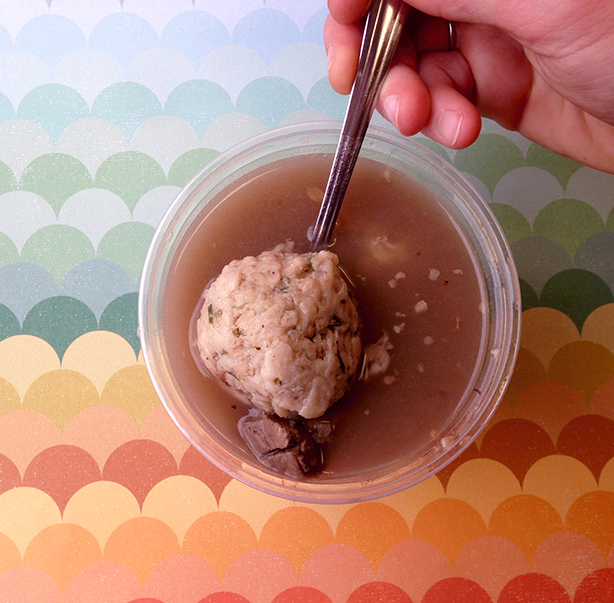
Currently, we use goose products in our Matzo Ball Soup and cabbage Rétes (a strudel). The inspiration for using goose broth in the soup came from a visit to a restaurant of a famous Hungarian chef—goose leg is also a common addition in Hungary. We source whole geese (along with tubs of goose fat) from local purveyor Schiltz Food, which we roast, putting the meat into the soup and using the bones for the broth.
When we asked Yoskowitz what he thought about us keeping up the tradition, he had this to say: “I was surprised to learn that you use goose fat in your chicken soup and strudel, but not surprised to learn the reason: over the years I’ve come to expect that Zingernman’s cares deeply about such details. I was also a bit surprised since goose fat isn’t that easy to come by, though sources have told me that goose farms are more common in the Midwest. And, yes, it played an incredibly important role in Jewish cuisine across central and eastern Europe. I’m so delighted to know that the tradition continues in the Bakehouse.”
Come get in on the tradition. We serve our Tibor’s Goose & Matzo Ball soup every Friday in the Bakeshop and our Rétes are available daily.
And check out Jefferey Yoskowitz and Liz Alpern’s book The Gefilte Manifesto and online shop.
This Tuesday, June 24, 6pm, our friends Gábor and Carolyn Bánfalvi, owners of the premier Hungarian food tour company, Taste Hungary, will join us at Zingerman’s Roadhouse for an evening of Hungarian food, wine, and personal stories about life in this still emerging Eastern European country.
They recently took a few minutes to answer some questions about their business, Hungarian wines, and this Tuesday’s wine tasting.
Tell us about your tour company, Taste Hungary.
Our company specializes in personalized and authentic food and wine tours, mainly in Hungary. We offer several types of walking tours in Budapest, as well as full-day wine and food tours in other wine regions of Hungary and Austria. We love to introduce visitors to the local foods and wines which they would not find on their own, and to the people who create these foods and wines. This is still a relatively unknown region to American travelers, and we hope to make our tours experiences that our clients will remember for a lifetime.

What is it about Hungarian food and wine that you find compelling?
Before I began to write about Hungarian food, and then guided food and wine tours, I spent many years discovering it myself! What I love about Hungarian cuisine is that it perfectly combines simplicity and elegance. Even the dishes with the most complex flavors are created with the simplest ingredients and techniques. It’s a cuisine which has a large repertoire of dishes that is underrated and still little-known outside of the region.
How about a short introduction to Hungarian Wine? How is it unique?
Hungary has a very long and illustrious tradition of winemaking, but the industry was destroyed during Communism. It’s come along way over the past two decades, but there is still much work to be done. Tokaj wines are one thing that makes winemaking in Hungary unique. In the 18th century the Tokaj region became the world’s first delimited wine region, and its sweet wines were considered the best in the world and exported all over Europe.
Today, both the small family operations and the state-of-the-art foreign-owned wineries are once again producing excellent wines. However, their challenge is now finding a place in the market for them. While there are many other things that make winemaking in Hungary unique—such as the indigenous grapes and the different terroirs—keep in mind that the borders in this region of the world have changed so many times over the centuries. So winemaking in Hungary actually has more similarities with its neighbors than differences.
Can you recommend some wines that you feel capture the essence of Hungary?
Hungary produces a wide range of wines, from all of the major international varieties to some indigenous varieties that are only planted on a few acres. In Hungary there are 22 official wine regions, and there are many wonderful wines produced in the country—most of which are not available outside of the country. For me personally, the wines that capture the essence of Hungarian winemaking are: the crisp dry furmints from Tokaj, the luscious sweet wines from Tokaj, the mineralic whites made from the hárslevelű and juhfark from the tiny region of Somló, the aromatic whites from the Lake Balaton area, the smooth reds from Szekszárd, and the Cabernet franc from Villány.

Your tour company recently won a wine & spirits award. Can you tell us more?
Yes, we were so thrilled to have won in the category of Best Contribution to Wine & Spirits Tourism at Drinks Business Awards recently. The Drinks Business Awards are awarded annually by The Drinks Business magazine, a leading UK drinks trade publication, which recognizes companies from around the world in different categories. As a small family company, we were so honored to be recognized for our achievements and chosen among so many other worthy (and larger) companies from around the world. We think this award is also a recognition that now is the time for the Hungarian wine industry to make a stronger push at finding its place in the world markets.
What can our guests expect at the Hungarian Wine Tasting?
The wine tasting will be a chance to get to know some of the most exciting wines and wine regions from Hungary. We will taste five different wines from different regions, which demonstrate the range of flavors and wine styles which are being produced in Hungary today. In addition to explaining the wines, Gábor will also tell stories about the history and culture of Hungarian wine, and the talk about the directions that winemakers are going in today.
Gábor and Carolyn will be busy while they’re visiting us! On Wednesday, June 25, they’re leading a Hungarian Home Cooking class at Zingerman’s BAKE!, and then on Thursday, June 26, they’re teaming up with Zingerman’s Deli Chef Rodger Bowser to create a Hungarian Feast at Zingerman’s Events on 4th. These events are sold out, but you can add your name to the waiting list by following the reservation links.
See you soon!
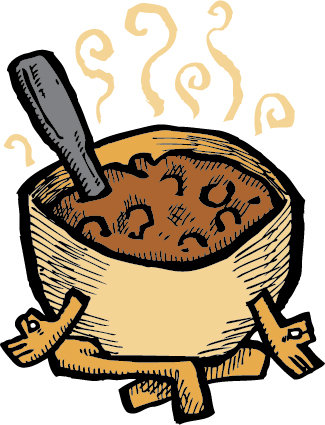 Stop in and try our delicious and traditional Sólet
Traditionally the only hot dish of the day, Sólet (pronounced ‘show- let’) is usually simmered overnight for 12 hours or more, and eaten for lunch on Shabbat (the Sabbath). Over the centuries, Sólet, known as Cholent in Yiddish, was adapted by Jews living in Hungary to conform to Jewish laws that prohibit cooking on the Sabbath. Jewish families would bring their Sólet pots to village bread bakers (quite fitting, eh?) to be placed in their wood-fired ovens before sunset on Friday to bake all night.
Our Sólet is a hearty stew of beans, barley, smoked meat, and a bit of Hungarian paprika! True to form, we start our Sólet on Friday in order to bring you a hot, hearty lunch on Saturday!
Stop by for a taste!
At Zingerman’s Bakehouse we’re bringing traditional Hungarian foods to Ann Arbor. Hungary has an incredibly rich and varied food tradition reaching back at least 1500 years, including an Eastern European Jewish influence. After doing the research we got excited about learning these new foods and sharing them with you. So we traveled to Hungary in September 2011, May 2012 and again in October 2012 to eat and research. And we’re going back this coming October!
Stop in and ask for a taste of our favorite Hungarian foods.
7 Reasons:
1. It Tastes Delicious
We fell in love with it first hand on our trips to Hungary. The proof is in the eating! Gulyás, cabbage goose fat strudel, lesco, pickles of all sorts, körözött, foie gras, lángos, krémes, dobos torta…delicious!
2. Practice Makes Perfect- Hungarian cuisine is more than 1000 years old!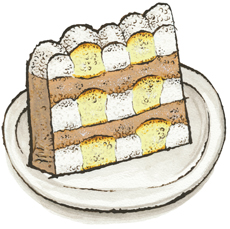
It has incredible depth and richness starting with the Magyars themselves, the inventors of gulyás. It includes flavors and methods from Ottomans, French, Italians, and Austrians! Any food tradition that’s persisted and evolved for 1,000 years is worth knowing about.
3. We’re Connecting with Our Hungarian Customers
Food can be an incredibly positive community builder. Many of our guests are now telling us about their Hungarian ancestry and bringing family members and friends to our shop (or to learn in our BAKE! classes) so that they can enjoy a taste of home. We love making food, but it is even more meaningful when it brings so much joy, appreciation and connection.
4. It Connects Us with Zingerman’s Jewish Roots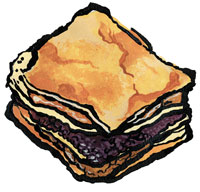
Studying Hungarian food has helped us learn even more about Ashkenazi Jewish cooking. Many Jewish dishes are fully integrated and regularly served in the daily Hungarian repertoire and the largest Jewish community in Eastern Europe is thriving (and cooking) in Budapest today.
5. It’s Abundant and Full of Variety
There is a seemingly endless number of great pastries, cakes, breads and soups for us to explore. It will take us years to really learn this cuisine and fully share it with you.
6. We Enjoy Educating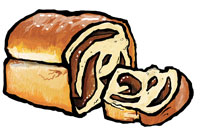
We’re very excited to introduce Hungarian foods to a new audience. Many of us know nothing about Hungary, let alone its cuisine.
7. Hungarian Words are Fun
We delight in learning to say and spell them. Rétes! Krémes! Rigó Jancsi! Stop in and ask for help with the pronunciations and a taste of delicious Hungarian foods!
See you soon!
*From time to time, we share the writing of our friends and co-workers on this site. Today’s guest post comes from Zingerman’s Bakehouse staffer Chrissy Abe.
Upon arrival on her first visit to Hungary, Zingerman’s Bakehouse Partner Amy Emberling wanted what any weary, jet-lagged person would want – a meal. Any meal. It needn’t even be a good meal, just something to begin the assimilation process after touching down in another country. So, when Amy, Bakehouse Partner Frank Carollo and Zingerman’s founder, Ari Weinzweig, ended up at Duna Corso, a restaurant in a touristy part of Budapest, they were pleasantly surprised to find good food in a family-style restaurant.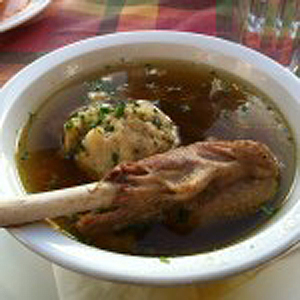
Seeing matzo ball soup on the menu, with no mention of it being a Jewish dish, was intriguing to them. Even more interesting was that the matzo balls were swimming in goose broth instead of the chicken broth usually found in the U.S. version. The goose broth was rich and complex, and was served along with an entire goose leg as a garnish. Then there was the matzo ball itself: It was much coarser in texture than any the Bakehouse crew had previously experienced, and it was flavored with fresh ginger root! (Don’t let your bubbe read this…)
“The food that warms your soul is what makes an impression…”
Interestingly, Hungarian cuisine and Jewish cuisine are quite intertwined today. Matzo ball soup is often on menus, latkes are readily available and cholent, often served with pork, is surprisingly common. Jewish communities have existed in Hungary since at least the 1100s and their impact on the nation’s cultural landscape is significant. World War II brought the same fate to Hungarian Jews as it did other European Jews. But this occurred much later in the war since Hungary was an ally of Germany, and maintained its independence until the spring of 1944. Some Hungarian Jews fortunate enough to survive the Holocaust returned after the war, only to find themselves living under repressive Communist rule.
After the fall of the Berlin Wall in 1989, the community became more visible and vibrant. Budapest now has the largest and most active Jewish community in Eastern Europe, and 90% of Hungary’s Jewish population lives in the capital. The result of 900 years of Jewish/Magyar co-existence is an interesting assimilation of Jewish foods into the Hungarian standard cuisine. What we might think of as Jewish food here in the U.S. is simply considered Hungarian food in that country.
One of the goals of the spring 2012 trip was to explore Jewish cuisine in Hungary, which makes sense as Zingerman’s has its roots in Jewish food. Toward that end, the group decided to pay a visit to Tibor Rosenstein. Tibor is the chef and owner of Rosenstein, one of a handful of restaurants in Budapest known for their Jewish offerings. He survived the Holocaust as a baby, and was raised, along with his sister, by resourceful elderly grandparents. After finishing middle school, he chose cooking as a trade because “eating is good, and everyone must eat.”
Tibor built on what his aging grandmothers had taught him: cook what is locally available with love and great care. He opened his restaurant in the early 1990s, and he cooks what his grandmothers cooked. The food that warms your soul is what makes an impression, and his restaurant is a wonderful representation of Jewish and Hungarian traditional dishes served in an elegant setting. One of the best parts of the restaurant is Tibor himself. He is an energetic, smiling, and passionate chef. Truly inspiring!
Returning to the matzo ball soup… At his restaurant, Tibor makes a flavorful goose stock using a mix of vegetables such as mushrooms, parsnips, celery root and Savoy cabbage. But the crowning jewels are the matzo balls. Tibor welcomed the Bakehouse group into his small, but efficient kitchen to show us how he makes his matzo balls, using coarsely crumbled whole matzos, whole eggs, goose fat, fresh parsley, and fresh grated ginger root. We left his kitchen prepared to bring Hungarian matzo ball soup to Ann Arbor.
Intrigued? We promise a tasty experience whether you’re a matzo ball soup novice or connoisseur. Come and see us at the Bakehouse on Fridays and try our tribute to Tibor’s soup.