Tag: MO FRECHETTE
We’re busy ushering in the holidays across the Zingerman’s Community of Businesses with all sorts of seasonal favorites. The Bakehouse is baking loaves of Cranberry Pecan bread and the Coffee Company is brewing up batches of Holiday Blend coffee. The Deli is mixing up their house blend of Hot Cocoa Mix. Mail Order is busy shipping everything from heirloom turkeys to loaves of Chocolate Babka across the country.
While we’re looking forward to sharing all of those treats with you and yours, we also wanted to bring you a few of the dishes that help usher in the holidays for some of our Managing Partners. They’ll be whipping them for friends and family throughout the holidays, and now you can, too. And, since they’re all two-bite recipes, you can share and enjoy more of them!
A Holiday Recipe from the Bakehouse
We first created Espresso Stars for our most beloved BAKE! class, Fancy Schmancy Holiday Cookies, at the suggestion of Nikki Lohmann, one of our BAKE! Instructors. We started the class in December 2009, and have been teaching it every holiday season since, adding more sessions along the way—we now teach the class 100 times between Thanksgiving and Christmas! The combination of coffee, chocolate, and buttery shortbread was such a hit that, for a time, they made it into our regular line-up at the Bakeshop, Zingerman’s Coffee Company, and Zingerman’s Roadhouse.
This recipe can be found in our Fancy Schmancy Holiday Cookies cookbooklet, a bite-sized collection of some of our favorite cookies from the class over the years. I’m excited to share that it will also appear in Celebrate Every Day: A Year’s Worth of Favorite Recipes for Festive Occasions, Big and Small, our second full-length cookbook, which will be released in the fall of 2023. We packed it full with nearly 80 recipes, most of which have never been published, and included a number of guest favorites. We can’t wait to share it with you!
—Amy Emberling, Zingerman’s Bakehouse Managing Partner

These shortbread cookies are flavored with freshly ground espresso beans from Zingerman’s Coffee Company, making them a rather adult addition to a dessert line-up, both in terms of flavor and the little jolt of caffeine. We like the added help staying awake until the celebratory ball drops at midnight in New York City’s Times Square on New Year’s Day; but if you’d prefer less of a burst of energy, feel free to use decaf beans. (Just don’t be tempted to try and swap in instant espresso powder, which is designed to dissolve; we want both the flavor and the texture from the freshly ground coffee to be front and center.) To make them look as festive as they taste we partially dip them into chocolate, and make the effort to find gold luster dust or gold leaf to garnish them.
Chocolate-Dipped Espresso Stars
Makes 2 to 3 dozen cookies
1/2 cup (110 g) unsalted butter, room temperature
1/4 cup (50 g) granulated sugar
1/2 tsp fine sea salt
1 cup plus 1 Tbsp (150 g) all-purpose flour
2 Tbsp (10 g) espresso beans, finely ground
1 cup (170 g) semisweet chocolate, chopped
Gold luster dust or edible gold leaf (optional)
Make the cookies
- Preheat the oven to 300°F (150°C).
- In a medium mixing bowl, cream together the butter, sugar, and salt until sugar is well mixed in.
- Add the flour and ground espresso beans and mix until the dough holds together. If necessary, use your hands to gently knead the dough together into a ball.
- On a lightly floured surface, roll the dough out to 1/4-in (6 mm) thick. Cut out cookies using a 1 1/2- to 2-in (4- to 5-cm) star cutter. You can reroll scraps and cut out more stars, but take care not to overwork the dough. This cookie will be delicious in many different sizes and shapes. Use what you prefer and what you’re able to find. If you choose a much bigger cutter, leave them a little thicker. If they are large and too thin they will break easily.
- Carefully place cut cookies on a baking sheet lined with parchment paper, evenly spaced about 1 in apart.
- Bake for 30 minutes. The tops should look dry and cookies should be slightly browned. Cool on the baking sheets for 5 minutes, then transfer to a rack to cool completely to room temperature before dipping in melted chocolate.
Garnish the cookies with melted chocolate
- Melt the chocolate slowly in the microwave or over a double boiler until just melted.
- Dip 1/3 of each cookie into the melted chocolate, then place onto a baking sheet lined with parchment paper. If you have gold leaf use a couple of small pieces as garnish and apply them to the soft chocolate. Let the cookies sit at room temperature until the chocolate hardens.
- If desired, lightly brush gold luster dust over the hardened chocolate.
Storage:
Store the cookies in an airtight container, with parchment paper between layers of cookies, at room temperature for up to a week or in the freezer for up to 2 months. Thaw frozen cookies at room temperature before enjoying. If thawing cookies with luster dust, do so gradually, moving them from the freezer to the refrigerator, and then to room temperature.
Tip!
Luster dust is a type of decorating powder used to add color and sparkle to cakes, candy, cookies, and other sweet treats. It’s available in stores that sell cake decorating supplies or online, as is edible gold leaf.
A Holiday Recipe from the Deli
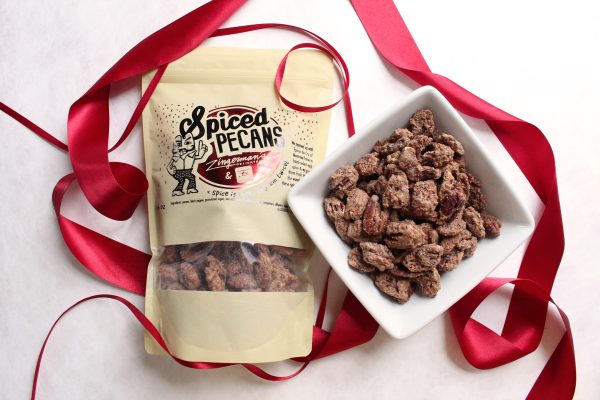
You definitely know it’s the holiday season when you start smelling Spiced Pecans in the Deli kitchen. Every batch is made by hand and bagged right at 422 Detroit Street. We get the pecans from the South Georgia Pecan Company in Valdosta, Georgia, and use a spice blend we make ourselves using Épices de Cru spices.
There is a disco dancing spiced pecan cartoon on our Spiced Pecan bag and a few years back we figured out we could print them with sparkly red ink. Nick Jaroch painted a poster of this pecan guy with glittery pants that is one of my favorite pieces of merchandising ever at the Deli. We like to make big, bountiful displays of these bags all over the Deli. Like hanging tinsel on your tree, it’s festive and fun and you know the holidays have arrived.
—Rodger Bowser, Zingerman’s Deli Managing Partner
Spiced Pecans with Apples & Cheddar
Pick up a bag of Zingerman’s Deli Spiced Pecans, crisp local apples (like from Nemeth Farms in Milan or Kapnick Orchards in Britton), and a block of cheddar—you can’t go wrong with Nor’Easter Cheddar from Cabot, but the new cheddars from Deer Creek in Wisconsin are also pretty fabulous. Put these three items on a tray and viola! A simple, yet delicious combination that’s sure to win over your kids, neighbors, or a crowd!
A Holiday Recipe from Mail Order
Zingerman’s Mail Order does half its years’ business in the month of December. That kind of surge is as crazy as it sounds. We go from a nicely busy business to a rather insane business. Our staff quadruples. Food and boxes fill our warehouse to the rafters. Trucks and people and conveyors are constantly in motion. The operation runs 24/7. It’s kind of nuts. I’ve known no other version of December for the past two and a half decades, it’s a really strange yet exhilarating way to spend the holidays.
—Mo Frechette, Zingerman’s Mail Order Managing Partner
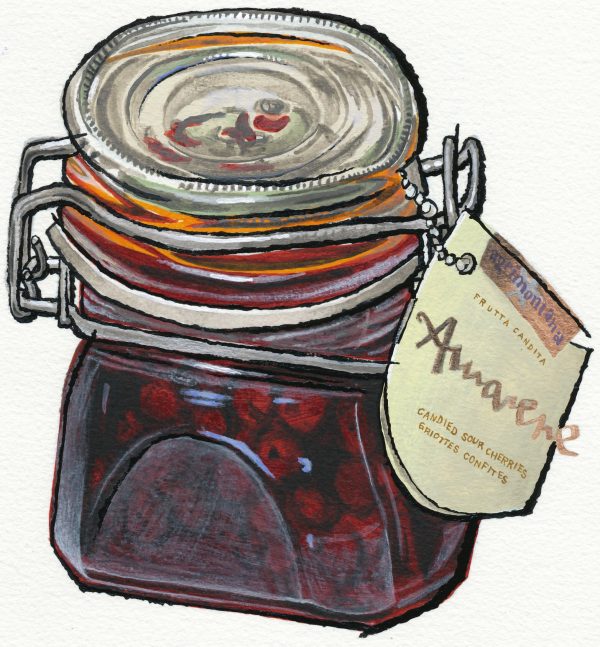 Preserved fruits, candied fruits, fruit cakes—they all say the holidays are here. They’ve been part of festive eating for centuries. For me, outside of jam on toast, I rarely eat fruits like this from January through November. But I crave them in December. Agrimontana’s Italian cherries are the handcrafted, flavorful alternative to the ubiquitous blue and white jars of Amarena cherries you see at cafes. They taste of dark fall fruit, sweetened in their purple syrup. Combining them with chalk white Brabander goat gouda is stunning to look at and, frankly, a blast to eat. I think of Brabander as the milkshake of cheese—creamy, sweet, and easy to eat. Why not have a cherry on top?
Goat Gouda with Wild Cherries
Spoon one or two Agrimontana wild cherries from the jar and drape them on a thick shard of Brabander Goat Gouda cheese.
Originally published in the November/December 2022 Zingerman’s Newsletter
Who are our oldest food makers?
I’ve been working on a spread for next spring’s catalog about the oldest companies we work with. Some have been around for decades, some for centuries. We even have one that’s a millennium old this year. It’s been an interesting experience to think about them more deeply, bringing up lots of questions. Like, why are they still around? More importantly, how are they still around and making great food? How much did they have to change along the way? Who decided what to change and what not to change? How did they transition when their founder left the business? I ran across this article about why there are so many old companies in Japan that explains how traditional firms like Nintendo manage succession (these days it’s often done by the owner adopting an adult into the family to run the business—a surprise to me).
Some of our venerable food makers and the year they got in business:
1014 Castello di Cacchiano olive oil in Tuscany
1731 Amarelli licorice in Cosenza
1880 Usinger liverwurst in Milwaukee Wisconsin
1898 Rizzoli anchovies in Parma Italy
1900 Cope’s corn in Rheems Pennsylvania
1900 Roi olive oil and sauces in Badalucco Italy
1903 Raye’s mustard in Eastport Maine
1909 Broadbent cured meats in Kuttawa Kentucky
1925 Koeze peanut butter in Grand Rapids Michigan
1926 Martelli pasta in Lari Italy
1926 Edwards cured meats in Surry Virginia
1947 Benton’s cured meats in Madisonville, Tennessee

– Mo
Do cheese and tuna have anything in common?
What happened when I selected tinned tuna at Ortiz.
Decades ago chefs used to select their preferred tuna batches from the factory at Ortiz, Spain’s highly esteemed fifth generation tinned fish titan. Cheesemongers do this with cheese, in fact it’s a specialty of some exporters like Neal’s Yard Dairy and Essex Street Cheese. But it’s something that hasn’t been done for decades with tinned fish. Last fall, I visited with my colleague Brad to see if we could revive the practice.


We landed in Barcelona on a sunny November Sunday, a couple weeks after the six month tuna season had ended. It was a four hour drive northwest to Getaria, a small town on the Bay of Biscay, where the weather got progressively more Irish along the way: wetter, mistier, greener. Tasting was 9am Monday, a fifteen foot table in the break room set up with twenty-six batches of tuna and sardines. We had a round of Nespresso pod coffees and went to work.
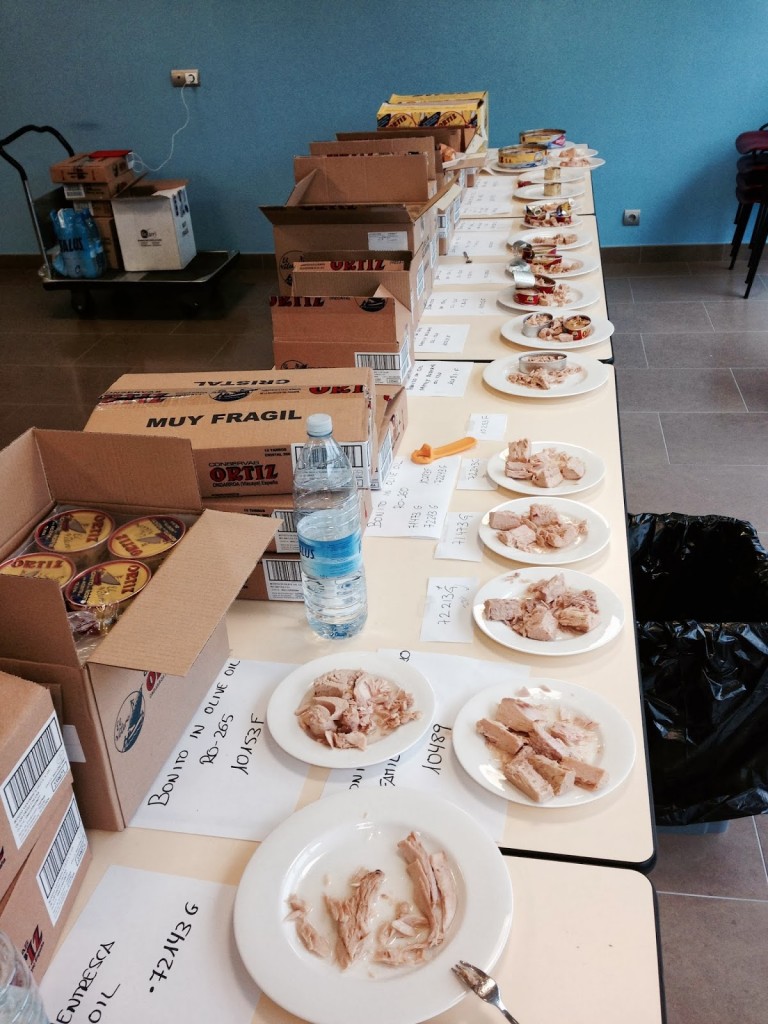
The first question on all of our minds—including the folks from Ortiz, who, being in their 30s and 40s, had never batch-tasted either—was, “Can we taste a difference?” That got answered quickly. The second tin we tasted was very different than the first. That continued throughout the morning with some batches being good, some excellent, and a couple extraordinary. There is a big difference between batches of tinned fish.
The main differences in flavor were complexity, balance between sweetness and brine, and length. The best tunas had a range of high and low notes, were never just sweet or just salty, and had great length of flavor. Color foreshadows flavor: if a tuna was rosier, it was often better tasting. Texture played a smaller part on these tins, just made this summer, but over time it has a much bigger role. The older a tinned tuna in oil, the softer and more luxurious its mouth feel.

One thing that you may be asking is, “What constitutes a batch of tinned fish?” It’s a little more complicated than with cheese, where a batch is a single day’s make, usually a mix of last night’s and that morning’s milk. A tuna batch is a single catch from a single boat, brought in at one time and sold to one buyer. That’s how fish are managed in the Biscay auction market and Ortiz stays faithful to the one boat one batch cooking, which means the tin you get from Ortiz is traceable back to a single boat on a single day’s catch (that said, a catch may last longer than a day, but it comes from a single shoal of fish). It may take several days to cook a big catch and, since the fish in it are different sizes and different ages, there’s bound to be more variability than with a single batch of cheese.
We decided on a single catch of bonito, caught that summer, but brought examples of nearly every tin we tasted back to Michigan so we can taste again and confirm what we thought. A second round of tasting is one of those steps that I’ve learned, over time, to be important when I’m making a big flavor decision. Sometimes, out on the road where everything may be a bit more exciting, I can talk myself into liking something that, second time around, doesn’t live up to the hype.
We’re going to cellar a few thousand tins, too. I tasted some two and three year old tunas at Ortiz and pretty much everything I liked about a young tuna got better when they aged. (This is only true for good tuna stored in oil—water-packed tuna gets worse with age.) The good thing about aging tuna is it’s a lot easier than aging wine. You don’t need a special cellar with specific humidity and temperature. Tuna in a tin is practically indestructible. Our aging room is going to consist of boxes stacked on a pallet stored high up on the racks in our warehouse, wrapped in plastic with a note that says “Don’t Touch till 2016!”
Our first selected tunas will arrive this May.
www.zingermans.com
*From time to time, we share the writing of our friends and co-workers on this site. Today’s guest post comes from the blog of Zingerman’s Mail Order Managing Partner, Mo Frechette. You can read Mo’s blog here.
Why is one tinned tuna better than another?
Take two tins of tuna, one from Ortiz, one typical of the supermarket. One smells like the sweet sea, peels off in thick blond chunks and tastes like a fancy dinner out. The other smells like harbor at low tide, spoons out in pulpy shreds and tastes like saltwater. They came from the same animal living in the same ocean. What happened? Here are five buyer’s guide tips to understand what makes one tinned tuna different from another.
1. How are the tuna fished?
Bonito tuna, a common species for tinning, are not big fish. Most are two feet long and weigh about ten pounds. They’re warm-blooded. Taken together that means any bruising or bleeding affects a large portion of each fish and muddies its flavor. That’s rare with Ortiz’s tuna since they are entirely line-caught, classic fisherman style, one at a time on a rod. It’s more common with netted fish—the most common way to catch tuna, where hundred foot long nets drag the tuna in a thrashing bundle up from the sea.
2. How are they stored at sea?
Tuna are stored in a boat’s hold on ice. A more conscientious captain will freight a lot of ice, enough to surround each fish so they don’t touch one another and cool down quickly. After all, no one knows how long they’ll be at sea or how much they’ll catch and the fish starts to deteriorate the moment it’s caught.
3. What happens after they’re cooked?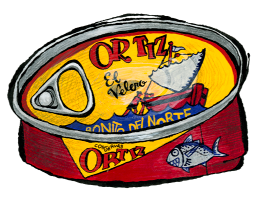
Cooking canned tuna is more or less standardized: the fish is boiled in salted water for a couple hours. But what happens next is not at all the same from factory to factory. At Ortiz the just-cooked fish sits out to cool in the kitchen, then gets time to chill in cold storage. The two steps take hours and hog up space on the floor and in the refrigerators. Not all tuna makers choose to take it. Like most food makers who worry about price more than flavor, they cut time out of the equation. What the extra time and care does, though, is critical. It stops the fish from fermenting. Fermenting can be ruinous—a carbonation that makes the tins unsalable—or it can be mild. Even mild fermentation has a flavor that, to my taste, is a sour tang that runs throughout most tins of cheap tuna and mars its sea-sweet origins.
4. How are they cleaned?
Another act of grace Ortiz commits after cooking is to clean its tuna by hand. This is as labor-intensive as it sounds (if you’ve ever deboned and skinned cooked fish you know what I mean). It’s not at all standard practice in the tuna world. The women—and I can say from my experience visiting that 100% of the cleaners are women—work meticulously with paring knives, scraping and cleaning every bruise, every discoloration, every chance for the flavor to head south, leaving only pristine fish to find their way into the tin.
5. What goes into the tin?
Whole chunks of fish and olive oil. That’s it. No flakes, no water. That’s the way you get great tinned tuna. Shredded smaller pieces deteriorate faster and that will show in the flavor. As for olive oil, well, the American tuna industry has pawned off water-packed tuna as healthier but what they failed to mention was that in losing 20% of the calories we lost 98% of the taste. Water leaches flavor from the fish. Ortiz only packs in olive oil, which amplifies the tuna’s flavor and gives it a silky, rich mouthfeel.
Ortiz Tuna is available from Zingerman’s Mail Order and at the Zingerman’s Deli! Isn’t it time to taste the good stuff?
*From time to time, we share the writing of our friends and co-workers on this site. Today’s guest post comes from the blog of Zingerman’s Mail Order Managing Partner, Mo Frechette. You can read Mo’s blog here.
Let’s Outsource Some CEOs
“American executives argue—conveniently enough—that their compensation should be compared to what other American executives are paid. This argument has tended to be persuasive to American boards, which—conveniently enough—are made up primarily of American corporate executives. And big American investment management firms—also led by American corporate executives—likewise think this makes sense. Which is all quite nice, but if you tried convincing one of these very same executives that he shouldn’t replace an American factory worker with a cheaper Chinese one, he would laugh you out of the room.”
From Matt Yglesias—who’s almost always worth reading—about how US CEOs are paid way more than CEOs in other countries. Wages have been on my mind a lot lately as I’m writing a vision for a new way of thinking about pay at Zingerman’s and simultaneously watching income inequality in America hit levels that would make a robber baron blush.

Thanks Mo!
*From time to time, we share the writing of our friends and co-workers on this site. Today’s guest post comes from the blog of Zingerman’s Mail Order Managing Partner, Mo Frechette. You can read Mo’s blog here.
Chilled Salad
If you regularly buy too much at the farmer’s market and the results crowd out your fridge all week here’s one way to cut the clutter and help ensure you don’t end up throwing a lot out. Spend half an hour blanching your haul in a single pot of heavily salted water, dropping each batch of cooked vegetables into a fresh bowl of ice water. Seal ’em up and use throughout the week. Then make something like this.
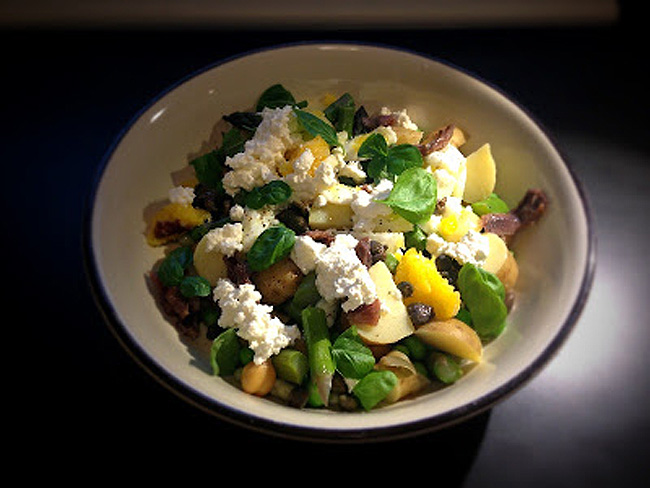
My whatever-works kind of farmer’s market salad. The one pictured has blanched asparagus, peas, favas; boiled potatoes, chickpeas and egg; ricotta, anchovies, capers and basil ripped from an indestructable plant that’s been surviving on my sill for five months. I doused it in good olive oil, salt, pepper. (Sometimes I dress it in a vinaigrette of torn basil leaves pounded with a clove of garlic, Txakoli vinegar, salt, pepper and olive oil.) Serve it cool.
It also works great with green beans, tinned tuna, shreds of cured ham, chunks of salami, flakes of Comté, a squeeze of lemon, and probably a hundred other things.