
Tag: NUESKE’S
Celebrating SafeHouse Center, Nueske’s, and an amazing Corgi
On Tuesday evening, March 31, we’ll gather to support SafeHouse Center, our local shelter for survivors of domestic abuse. It’s an especially meaningful evening for me—it marks the 11th annual Jelly Bean Jump Up, held in honor of my beloved Corgi, Jelly Bean. When she passed away in the spring of 2015, we wanted to celebrate her loving spirit in a way that would serve the community, just as she brought so much joy and generosity to our lives for 17 years. Because SafeHouse Center does such important work—and because we live nearby, where the staff would often see Jelly Bean and me running past—we chose it as the cause to commemorate her memory.
This year’s dinner feels especially meaningful—it will be a bit of a redux of Camp Bacon, the fundraising event we ran annually for the 10 years leading up to Covid. We had educational speakers, cooking classes, special dinners like this one, and a bacon street fair at the Ann Arbor Farmers Market. This dinner is also a great opportunity to celebrate the wonderful relationship we’ve built with the Nueske family over the last 44 years.
Eleven days from today, we will celebrate the 44th anniversary of what has evolved over the years into Zingerman’s Community of Businesses. A deep heartfelt thanks to all of you for your encouragement, support, and patience over all these years. One of our Guiding Principles talks about our dedication to long-term relationships—many of you have been with us from the beginning. That is also true of many of our suppliers. In fact, March 15 will also mark the 44th anniversary of cooking Nueske’s applewood smoked bacon. Their commitment to quality, generosity of spirit, shared values, and dedication to dignity in every direction have made our connection with the Nueske family one of the most rewarding elements of those 44 years. If being kind, caring, and doing the right thing are the way human beings are meant to be—and I believe that from the heart—then Nueske’s, per what I wrote last week, are wholly unordinary in the best possible ways.
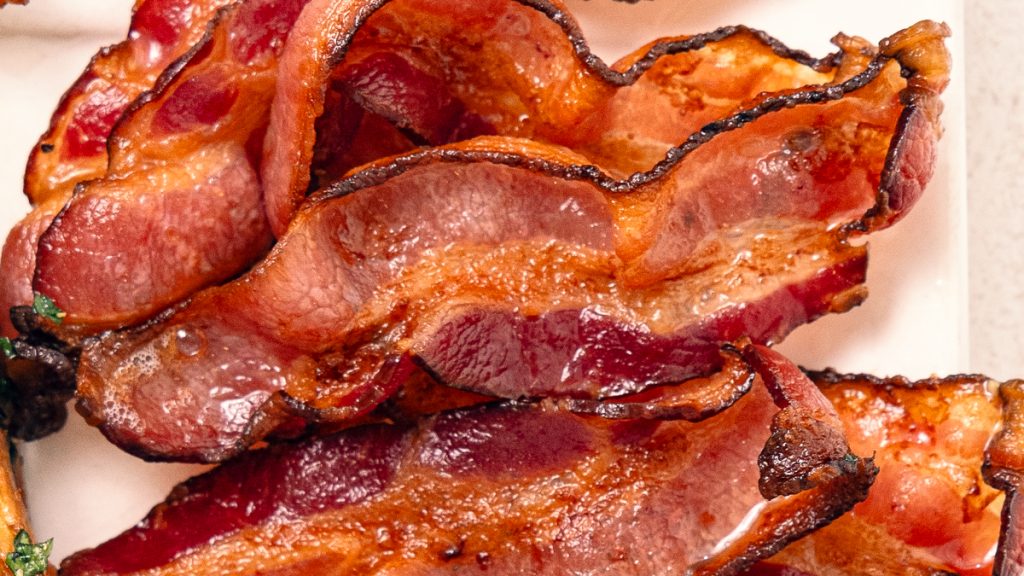
If you eat bacon and you’ve come to Zingerman’s regularly over the years, the odds are high you’ve already appreciated the wonderful meaty, gently salted, subtly sweet, beautifully smoky deliciousness that Nueske’s bacon has always been about. If you want a big-time testimonial about this bacon, take it from the late and very great writer, R.W. Apple, who put in print in The New York Times that Nueske’s was “the beluga of bacon, the Rolls-Royce of rashers.”
Tanya Nueske, granddaughter of the founder, Robert Nueske, is as passionate about her product as you’re going to get. Even though she’s been around applewood smoked bacon her entire life, she still loves to talk about it, sell it, and eat it. “I eat bacon so much. I eat it plain all the time. Basically, we use bacon with everything!”
“What we do is a very old tradition,” she told me. “My grandfather started selling the bacon in 1933. He started out smoking over applewood. And he had a way of doing it and a style that came from his grandparents.” Robert’s parents, Wilhelm and Wilhelmina Nueske, came to Wisconsin from Prussia in 1882—exactly 100 years before we opened the Deli.
Given all that I’ve already said over the years and in “A Taste of Zingerman’s Food Philosophy” about raw materials, it’s no surprise that bacon this good starts with special pork. Nueske’s sources higher-quality hogs, crossbred with Pietrain pigs because of the latter’s excellent lean-to-fat ratio. We’ve been working with our suppliers for well over 25 years. And we still hand-trim everything.”
The Nueskes cure fresh slabs of bacon in brine, hang them to dry for a day or so, and then smoke them for at least another day. Tanya says, “When you smoke slowly over genuine applewood embers for a full 24 hours, the sweetness of the smoke really has a chance to permeate each cut of meat and impart our signature flavor.” They approach the smoking process as a craft:
We design our smokehouses ourselves and have them built for us. The smoking is all hand-controlled by the smokemaster, but it’s still a very artisan thing. … The smokemaster will tell you that each smokehouse is different. And we still use actual applewood logs. People should know that “applewood smoke” can mean almost anything these days—apple juice, apple smoke flavoring, liquid smoke. … But we only use real logs of Wisconsin applewood.
Without question, over all these years, Nueske’s has proven one of the most popular foods we’ve got for sale anywhere in our organization. Its flavor is on the mellower side, with soft sweetness from the applewood that I think amplifies the natural sweetness in the high-quality pork the family goes to such lengths to source. We sell lots of it for folks to take home to cook in their own kitchens, and we also use it extensively here in our own businesses. If you come visit, you can try it on any number of sandwiches at the Deli, in the collard greens at the Roadhouse, or the Potato Bacon Rétes at the Bakehouse. It’s become a big hit on what we call the 24-7 Burger—the bacon, having been smoked for 24 hours, sitting astride a couple slices of 7-year-old Wisconsin cheddar, which in turn has been melted over a burger of freshly ground, dry-aged, Roadhouse beef. (It’s not on the actual menu right now, but just ask, and we’ll happily make you one!)
Whether you’re just buying some Nueske’s bacon to enjoy at home, coming into the Deli to eat a an amazing BLT, or better still, are able to join us for this special dinner on March 31, thank you for caring, thank you for supporting us over all these years, and thank you for supporting SafeHouse Center in their ever more important work!
See you there?
P.S. If you can’t make the dinner, and/or don’t eat meat, you can still support the Jelly Bean Jump Up for Safehouse Center through our silent auction, or donate directly to Safehouse.
P.P.S. Nueske’s bacon is part of Mail Order’s annual spring sale! Same great bacon as always, but for the next few weeks, at a really great price! Stock up!
An Interview with Mike Zoromski, Smokemaster at Nueske’s
*Note: Mike will be a guest speaker at this year’s Camp Bacon® where he’ll give us “A Look Behind the Smokehouse Door.” Recently, Zingerman’s co-founder Ari Weinzweig had a quick chat with Mike about his background, and the smoky magic that happens at Nueske’s.
Visit our website to reserve your Camp Bacon seat and find more info. Please join us!
Pretty much every morning for the last 34 ½ years, the Deli kitchen crew has begun its day by cooking many pounds of Nueske’s amazing applewood smoked bacon! The same can be said for the Roadhouse over the past 13 years. Their wonderful product graces the menus at the Deli and the Roadhouse, shows up on sandwiches, in Bakehouse breads and Creamery pimento cheese. It’s a regular feature in our Mail Order bacon of the month club. It’s safe to say that without Nueske’s, Zingerman’s would be a very different place today!
It’s also safe to say that without the work of Mike Zoromski to design, build, and manage the artisan smokehouses in which all that bacon gets smoked, Nueske’s would be a pretty different place as well. To get a look, so to speak, behind the smokehouse door we’ve gotten Mike to make a rare public appearance at Camp Bacon this year!! What follows is an interview with him, and a chance to hear some behind-the-scenes, behind-the-smoke, sense of what makes the Nueske’s smoking so special. Come to Camp Bacon® 2016 and meet Smokemaster Mike in person!
How did you get involved with smoking? How did you get involved with Nueske’s?
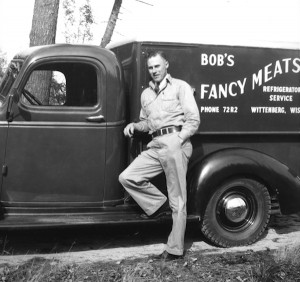
I was so young and foolish back in ‘83 when I was asked if I wanted to work here, that I had no clue of what I was getting into. But what I do remember was that everything that Bob and Jim Nueske, (sons of founder, Robert “R.C” Nueske), and my brother Jeff taught me about smoking this product stuck with me. Even back then it seemed like I had a knack for doing it, but I was young and still wasn’t sure what I wanted to do, so I left to get back into the building trade.
After fifteen years in construction, Jeff asked me if I wanted to come back. He needed someone to tend the smokehouses, so I came back and it was amazing. Everything that I was taught in 1983 came right back to me, almost as if I hadn’t left. I knew I was where I belonged, and I took it very seriously. I was going to make these smokehouses my own. Soon I started to see that each one had their own personality, and I knew I needed to figure them out so that the all the products came out looking and tasting the same every time.
What are some of the things that go into building a great smokehouse?
A controlled heat source, which distributes and disperses the heat and smoke evenly through the product, and a good consistent draft throughout the house that you have control of with a good damper system.
Many consumers love bacon but don’t really understand the details of the smoking process. I know some of the details will be proprietary, but can you take us novices through the process of smoking?
There are three basic cycles in almost every smoke process. There is a drying cycle, where you might have more of an open damper setting with smoke, and you slowly bring up the temperature. Then there are some critical meat temperature ranges that you need to get through in certain amount of time for food safety reasons. During that time you would have a more closed damper to hold the heat and humidity in, and during that that time you are getting a lot of smoke penetration into the meat. I have looked at the product during these early cycles, and you never believe that the product will end up with the beautiful deep color that it does at the end, but the smoke and flavor is getting in throughout the night. The last cycle in this long process is to start bringing up the smokehouse temperatures slowly to reach your final meat temperature. I like to use this time to put my final touches on the finish color, adding more smoke or adjusting the dampers. There is a science behind what really happens during the whole smoke process and there is always something new to learn.
What are some of the things that distinguish artisan smoking the way you do it at Nueske’s from the commercially smoked meats that people are used to buying in the supermarket?
Our competitors probably think we are nuts when we keep building single truck houses. They think the way to increase production is to build fifteen truck houses and mass-produce. Well, that’s not the way to hold onto what we have done for 80-some years. We use real Applewood logs in our houses, they use smoke injectors that burn wood sawdust, or even liquid smoke that tastes fake. We have a 24-hour cycle to get that full flavor; their process is about half that. Our houses are seasoned with a year’s worth of smoke on the walls; theirs are cleaned every day. You could probably run product through ours without putting any wood on and they would end up with more smoke flavor than a normal cycle with wood at one of those other places. That special attention that each rack gets in our houses is something that no mass-producing smokehouse could ever duplicate.
Are there seasonal differences in the smoking?
Yes, very much so. In the cold winter months, you have to control the draft more. The air is dry and it wants to get up and out, and if you don’t make those adjustments, you could end up with lighter colored meats. Then when the cold nights switch to the spring thaw and the frost turns to dew, we again make adjustments. Then comes the heat and humidity of the summer. Thunderstorms are tricky; they are unpredictable and usually bring a quick change in temps outside. Then, when the summer air starts to change to fall, and at the beginning there is a lot of dew, you start to see the differences again, then when the dew switches back to frost again, the draft in the houses start to speed up, and then we are back to winter. If I had a choice as far as how the houses best perform, I would pick the winter, because we have more control over the air flow in the houses.
Nueske’s has long used the applewood—have you smoked with hickory? How are they different?
I have not used Hickory here at Nueske’s. I have tried products that were smoked with Hickory and I do like the flavor, but it doesn’t compare to Applewood. Applewood has a much sweeter flavor and produces a deeper golden color. Hickory is a much harder wood that produces a bitter nut, so I think the differences in smoke flavor are similar to the fruit they produce, not that hickory smoke is bitter, but the oils that are trapped in the wood from a tree that produces an apple compared to that of a nut.
With the new cherrywood smoked bacon… Was it hard to learn to work with a new wood?
It’s funny how much your past helps you in everything you do. I spent a lot of time with my dad logging, making pulp and firewood, and all that time he would teach me about the different types of wood we would be working with. One of the trees we had worked with a lot in our area, was the Wild Cherrywood we now use here. The Wild Cherrywood is a lot different type of wood than Applewood; it is a solid but light wood, with a closed grain and a very bitter berry. When we were kids we called it a choke cherry.
When we decided to try it for our Cherrywood smoked bacon, I knew it would probably burn away faster than Applewood does. So on my very first try in our smokers, I figured I might have to use a little bit bigger size piece of wood than I do with Applewood, and I was right on. We use that much all the time now and the color is very good. A little lighter than Applewood, which I thought it would be, but by using the bigger pieces we get very close the color of our Applewood bacon.
I think that having that knowledge that was passed on to me from my dad really helped me, and it still does every day when I’m picking wood for the houses. I go through and select only the higher quality wood and the rest goes home to my fireplace.
Nueske’s products are clearly very special. But so is the company. What’s it like working at Nueske’s?
It is pretty special to work for a company that produces the products we do, and it has always been like working for family. I always admired Bob’s toughness on how he ran this company, yet I considered him a friend. It is no different with Tanya, she too is my friend, and I would never let them down. It’s quite an honor to have the title of Smokemaster of Nueske Meats.
What else should we know about your work at Nueske’s?
I now have three guys working for me in the smokehouses, including my son Matt. I also now have Steve and Dallas, and I couldn’t be more proud of the job they are doing. Every day it seems like they learn more and more about these smokehouses. It doesn’t take four guys to do this work right now; it’s about a two and a half man job. But with expansion on the horizon, we need to train them now, so that when there are more smokehouses to run, the products will continue to get the personal attention they need. These three guys have shown a lot of passion towards this job already, so it will be in good hands when I retire…someday.
Are you excited about coming to Camp Bacon?
Yes and no. I never considered myself to be a very good public speaker, but this bacon and my smokehouses are not hard to talk about. So I’ll try and pretend that I’m walking around and giving a tour of my smokehouses.

Zingerman’s was saddened to hear of the loss of our friend, Bob Nueske. To help remember him, we’re reprinting Ari’s interview with Bob from 2013.
In honor of Bob Nueske
This year’s Camp Bacon 2015 is dedicated to the memory of Bob Nueske, much-loved patriarch of the first family of bacon, who died unexpectedly this past January. We’ve had the great pleasure of cooking, serving, and eating Nueske’s bacon every day at Zingerman’s for over thirty years, and we were graced by Bob’s passion, stories and love for pork at Camp Bacon the last two years. Long esteemed by pretty much everyone in the specialty food industry, Bob was intelligent, quiet, and determinedly committed to quality in all he did. He helped take his father’s work to ever greater heights. His love for Johnny Cash was legendary amongst friends and family members. Like his hero he generally wore all black. His soft voice, strong opinions, dedication to perfecting his craft while walking his own way, caring for community and those in need, all combined to lead me to start referring to Bob as a “the Johnny Cash of Bacon.” Two years ago when he spoke at Camp Bacon for the first time, we played Johnny’s version of “I Walk the Line” when Bob came up to the podium. Imagine it playing, if you like, as you start to read the interview with Bob that follows. Done two years ago, it still conveys the powerful character, quality conscious, quiet, but opinionated leader he was in both business and in bacon. – Ari
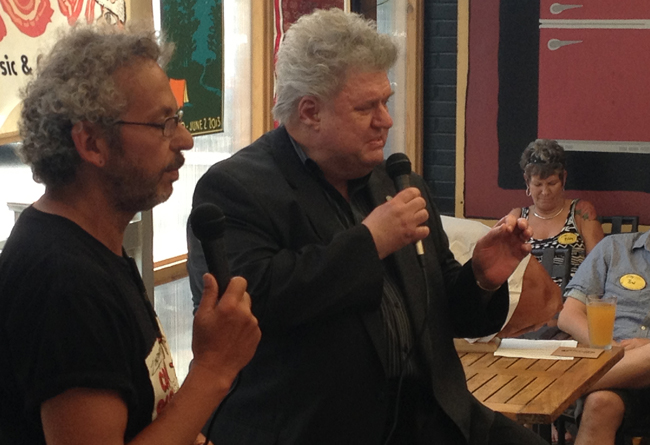
Ari recently had a chance to chat with renowned Wisconsin bacon maker Bob Nueske about the history of his family’s business. Bob will be speaking at Zingerman’s 4th Annual Camp Bacon this summer. Please join us!

Bob Nueske’s great-grandfather came to the small town of Wittenberg, Wisconsin in 1882. Shortly thereafter he started to cure and smoke meats in the style of his German heritage. Located up near the UP, they’ve been making their bacon using basically the same family recipe for nearly a century and a half now. We’ve cooked off Nueske’s Applewood smoked bacon at the Deli every morning for over 31 years now. I have no idea how many tens of thousands of pounds it adds up to but I know it’s a lot. That record, like the bacon on which it’s based, is something special. So too is the man behind the bacon—Bob Nueske is a marvelous story teller, a very grounded and forward thinking business man, a “Small Giant” long before Bo Burlingham wrote the book, a master bacon maker and a bacon lover. We’re excited to have successfully enticed Bob to leave northern Wisconsin for the wilds of Ann Arbor and a few days at Camp Bacon.
Ari: Can you tell me a bit of the Nueske story?
Bob: I hardly know how to begin. When you’re born and raised into something that becomes your life it’s hard to know where to start. The only way I can explain it is that if you’re born in a cooler and raised in a smokehouse it permeates into your being and you don’t even realize it. I’ve been part of Nueske bacon literally my whole life. And when you are born and raised in a family business, working as a father and son it makes a special situation. I had a good father. He smiled a lot. He was a good man and a good businessman. He was really firm and fair. And yet as a kid, you know, when you’re 16, 17, 18, and you have all the answers . . . when I was 16 years old . . . . Well, I’ll you a story. Back when I was 16 I had a car. Back then Wittenberg was a town of 895 people (Today, it’s totally taken off—the 2010 census said it had 1081 people). It’s all a farm community. I figured the best way for me to see the world was to head down to Chicago on my own. So I drove south. I got downtown by myself. I’d never been there. I was looking at all these great big buildings and I noticed there were a whole lot of good restaurants. But I couldn’t afford to eat in em. And I thought to myself, I’d love to understand ’em. Now, who’d have ever thought that bacon would take you to places like that? But today our bacon is in some of the best restaurants and stores in the country. As I remember growing up, my dad had put four hours in at work by the time we kids got up in the morning. We were always eating the odd shaped pieces he didn’t want to sell to other people. My mother would say, “I’m married to the man who has the best bacon, but you always bring home the other stuff!” He’d say, “We don’t sell those odd cuts, we eat em. It tastes the same. It just don’t look the same!” We have some pictures of me sitting on a truck with three birthday candles. When you’re little it seems like your parents are doing things you could never do. Then you get to the age when you think, “They don’t know anything.” But then eventually you realize that things that seemed big aren’t that big, they aren’t that important. And I realized that my dad knew what he was doing. In learning how to do a product like my dad taught us it was time consuming and it wasn’t like I took notes. Day in and day out you learn it and you don’t even know you’re learning it. But my dad had these little books that he used. And they weren’t just sitting on the shelf. They were well read, well worn. And he would take a lot of notes. My dad was a good student of bacon. Making bacon like ours is like making fine wine. You don’t hurry the process. I remember him saying, “You know Bobby, we do it this way because of . . . . ., but, not this way because . . . ” There were good reasons why each piece of the process happened. I remember thinking “There has to be a faster quicker way to make bacon!” But eventually I realized that he really knew what he was doing.
Where did your grandfather come from?
He was from Germany. I’m still trying to figure out exactly where. I got drafted into the military got my medical training at Ft. Sam Houston and thought for sure I was headed for Vietnam. It was not a pretty time. But somehow I was the only one in our class that ended up stationed in Germany. So through a fluke of luck I learned the heritage of the meat. My great grandfather came to Wisconsin in 1882. Wilhelm Nueske. I’m still trying to find out what town he came from. No one really knows. We know it’s German heritage. I’m starting to discover that it was up in the northeast area of Germany and what’s now Poland. There are still some Nueskes up there. It’s not that common a name. I literally know most everyone of them in this country. After I went through the military I went into the printing press business for a while. But then I came back to smoking meats and I began to experiment a little on my own, I realized that speeding things up, going fast just creates another me-too product. Volume and big is not what we’re after at Nueske’s. We don’t want to be the biggest. One of the best words I’ve learned over all these years is, “No.” When we’re approached by certain companies to sell to them we look at how they actually run their business. A lot of times I can see that we’re not large enough to produce enough for them so we say, “No.”
Speaking of which, you and I both read a lot of business books. Were there any that were particularly helpful to you?
I was remembering a book called Beyond World Class. It’s by Ross Alan. It was written about the way I think a business should be run. It said that if your suppliers don’t treat you like you wanted to be treated, and if someone in your company or a customer doesn’t fit the way you want to work, then you just say, “We’re not interested.” You just don’t stay with them. You need to work with people who care like you do and who want to work the way you do. That’s a recipe for how to have fun while you’re running your company. You enjoy your relationship with everyone and you work with a great group of people. It takes work to keep it that way. But growing up in a company like ours . . . well, you know . . . When I left the family business at 18 I had two really good experiences. One was in a small printing company. And then I was wooed away to American Can Company. It was a huge corporation. I actually got that feeling of putting your brains up on the time clock when you punched in. They didn’t want your thoughts. And then you picked them up when you left. They didn’t want you to think. I learned I could get done 8 hours work in 3 hours and kept pushin’. But then I was told “Don’t do that again.” People that work here like what they do and they’re having fun. That’s the key. Many an outsider looking in at our company goes by and says, “How do you do this? How do you get your culture?” At first they think it was a trick, like when you used to go to Russia and they put on a stage Grand Tour to fool you. But after a while, the visitors realize there’s no “Grand Tour.” That’s the key. What your people do. How they smile. How they work. That’s what makes a great company. It just seems to work.
We love your bacon here at Zingerman’s. It’s gotten great press in the New York Times and just about everywhere else. What makes the bacon so great?
Well, what really makes the difference how the hogs are fed. How they’re grown. How they’re treated as far as stress. You don’t want stress in the hogs. You have to find companies who know how to slaughter and cut and sort correctly. And then how you cure and smoke the meat properly. We taste test constantly. Even though there are strict formulas, there’s still always the human side. If something doesn’t seem right when we taste the product we pull it off. We all know that our bacon is a natural product and the whole production system can run a little off one way or another. Pretty much it means the standards of where you want it to be even though the flavor profile never changes. Something comes in wrong and you have to make a point and send it back. Consistency is key. Don’t accept anything that’s less than what you really want. Our hogs are raised in Canada. They’re the Belgian Pietrain breed and some others. We cure the bellies and then give them 24 hours in the smoker. We use real Wisconsin Applewood. We actually have one man who’s responsible to select the Applewood. We buy full trees, not wood already cut in pieces. He actually cuts it as we need it. When you select the wood it has to be the right balance of dryness and greenness. Not too dry, not too green. We use wild Cherrywood and it’s the same thing there. We start with a full tree. We’re fortunate . . . when I think back when my grandparents moved here, we’re fortunate that they picked an area with so many apple and cherry orchards. 
It’s pretty impressive that Nueske’s has stayed small and focused for four generations. Why do you think it’s worked so well?
Let me tell you another story. There’s a man around here who started a very large nationally known meat curing company around the time my father was getting going. He and my dad knew each other pretty well. The companies were just about 45 miles a part. Our location was on a dead end street. We didn’t really have a retail store. We just were wholesaler but my dad would let people in when they knocked on the door. Finally he put in a tiny little counter. Anyways, Fritz would come in to that little counter and buy our bacon and smoked liver sausage. “I said why are you buying our bacon when you have your own?” He said, “I want to buy the good stuff for our big shots coming up to my cottage up north.” “Well, Fritz is probably in his 70s now. He came in one day quite a few years ago now and he asks one of the retail clerks in our shop, if I was there. I asked him the same question I would ask every time he came back when I was 14. “What are you doing buying bacon here?” And he said the same thing he said back then: “I’m going up to my cabin and need the good stuff.” But then he said, “I want to tell you a story about your dad and me. You know, I would tell your dad, ‘Robert, I’m gonna build the biggest meat company I can. And your dad would look at me and say, ‘Well Fritz, I’m gonna become the best meat company I can become.'” Then Fritz said to me, “I succeeded. I sold out to a big company. I made a lot of money. But I don’t like what the big company did with our products. And you know what? Your dad was right and I was wrong. I would never do that again.” When I think of the decisions I’ve made over the years. You gotta know when to say ‘No!’
What’s your favorite way to eat bacon?
I love it best when you lay it on parchment paper and bake it in the oven. It comes out sort of crispy and soft in the middle. I love it that way.
See you at camp!
Ari recently had a chance to chat with renowned Wisconsin bacon maker Bob Nueske about the history of his family’s business.
Bob will be speaking at Zingerman’s 4th Annual Camp Bacon this summer. Please join us!
Bob Nueske’s great-grandfather came to the small town of Wittenberg, Wisconsin in 1882. Shortly thereafter he started to cure and smoke meats in the style of his German heritage. Located up near the UP, they’ve been making their bacon using basically the same family recipe for nearly a century and a half now. We’ve cooked off Nueske’s Applewood smoked bacon at the Deli every morning for over 31 years now. I have no idea how many tens of thousands of pounds it adds up to but I know it’s a lot. That record, like the bacon on which it’s based, is something special. So too is the man behind the bacon—Bob Nueske is a marvelous story teller, a very grounded and forward thinking business man, a “Small Giant” long before Bo Burlingham wrote the book, a master bacon maker and a bacon lover. We’re excited to have successfully enticed Bob to leave northern Wisconsin for the wilds of Ann Arbor and a few days at Camp Bacon.
Ari: Can you tell me a bit of the Nueske story?
Bob: I hardly know how to begin. When you’re born and raised into something that becomes your life it’s hard to know where to start. The only way I can explain it is that if you’re born in a cooler and raised in a smokehouse it permeates into your being and you don’t even realize it. I’ve been part of Nueske bacon literally my whole life.
And when you are born and raised in a family business, working as a father and son it makes a special situation. I had a good father. He smiled a lot. He was a good man and a good businessman. He was really firm and fair. And yet as a kid, you know, when you’re 16, 17, 18, and you have all the answers . . . when I was 16 years old . . . . Well, I’ll you a story. Back when I was 16 I had a car. Back then Wittenberg was a town of 895 people (Today, it’s totally taken off—the 2010 census said it had 1081 people). It’s all a farm community. I figured the best way for me to see the world was to head down to Chicago on my own. So I drove south. I got downtown by myself. I’d never been there. I was looking at all these great big buildings and I noticed there were a whole lot of good restaurants. But I couldn’t afford to eat in em. And I thought to myself, I’d love to understand ’em. Now, who’d have ever thought that bacon would take you to places like that? But today our bacon is in some of the best restaurants and stores in the country.
As I remember growing up, my dad had put four hours in at work by the time we kids got up in the morning. We were always eating the odd shaped pieces he didn’t want to sell to other people. My mother would say, “I’m married to the man who has the best bacon, but you always bring home the other stuff!” He’d say, “We don’t sell those odd cuts, we eat em. It tastes the same. It just don’t look the same!”
We have some pictures of me sitting on a truck with three birthday candles. When you’re little it seems like your parents are doing things you could never do. Then you get to the age when you think, “They don’t know anything.” But then eventually you realize that things that seemed big aren’t that big, they aren’t that important. And I realized that my dad knew what he was doing. In learning how to do a product like my dad taught us it was time consuming and it wasn’t like I took notes. Day in and day out you learn it and you don’t even know you’re learning it. But my dad had these little books that he used. And they weren’t just sitting on the shelf. They were well read, well worn. And he would take a lot of notes.
My dad was a good student of bacon. Making bacon like ours is like making fine wine. You don’t hurry the process. I remember him saying, “You know Bobby, we do it this way because of . . . . ., but, not this way because . . . ” There were good reasons why each piece of the process happened. I remember thinking “There has to be a faster quicker way to make bacon!” But eventually I realized that he really knew what he was doing.
Where did your grandfather come from?
He was from Germany. I’m still trying to figure out exactly where. I got drafted into the military got my medical training at Ft. Sam Houston and thought for sure I was headed for Vietnam. It was not a pretty time. But somehow I was the only one in our class that ended up stationed in Germany. So through a fluke of luck I learned the heritage of the meat. My great grandfather came to Wisconsin in 1882. Wilhelm Nueske. I’m still trying to find out what town he came from. No one really knows. We know it’s German heritage. I’m starting to discover that it was up in the northeast area of Germany and what’s now Poland. There are still some Nueskes up there. It’s not that common a name. I literally know most everyone of them in this country.
After I went through the military I went into the printing press business for a while. But then I came back to smoking meats and I began to experiment a little on my own, I realized that speeding things up, going fast just creates another me-too product. Volume and big is not what we’re after at Nueske’s. We don’t want to be the biggest. One of the best words I’ve learned over all these years is, “No.” When we’re approached by certain companies to sell to them we look at how they actually run their business. A lot of times I can see that we’re not large enough to produce enough for them so we say, “No.”
Speaking of which, you and I both read a lot of business books. Were there any that were particularly helpful to you?
I was remembering a book called Beyond World Class. It’s by Ross Alan. It was written about the way I think a business should be run. It said that if your suppliers don’t treat you like you wanted to be treated, and if someone in your company or a customer doesn’t fit the way you want to work, then you just say, “We’re not interested.” You just don’t stay with them. You need to work with people who care like you do and who want to work the way you do.
That’s a recipe for how to have fun while you’re running your company. You enjoy your relationship with everyone and you work with a great group of people. It takes work to keep it that way. But growing up in a company like ours . . . well, you know . . .
When I left the family business at 18 I had two really good experiences. One was in a small printing company. And then I was wooed away to American Can Company. It was a huge corporation. I actually got that feeling of putting your brains up on the time clock when you punched in. They didn’t want your thoughts. And then you picked them up when you left. They didn’t want you to think. I learned I could get done 8 hours work in 3 hours and kept pushin’. But then I was told “Don’t do that again.”
People that work here like what they do and they’re having fun. That’s the key. Many an outsider looking in at our company goes by and says, “How do you do this? How do you get your culture?” At first they think it was a trick, like when you used to go to Russia and they put on a stage Grand Tour to fool you. But after a while, the visitors realize there’s no “Grand Tour.” That’s the key. What your people do. How they smile. How they work. That’s what makes a great company. It just seems to work.
We love your bacon here at Zingerman’s. It’s gotten great press in the New York Times and just about everywhere else. What makes the bacon so great?
Well, what really makes the difference how the hogs are fed. How they’re grown. How they’re treated as far as stress. You don’t want stress in the hogs. You have to find companies who know how to slaughter and cut and sort correctly. And then how you cure and smoke the meat properly. We taste test constantly. Even though there are strict formulas, there’s still always the human side. If something doesn’t seem right when we taste the product we pull it off.
We all know that our bacon is a natural product and the whole production system can run a little off one way or another. Pretty much it means the standards of where you want it to be even though the flavor profile never changes. Something comes in wrong and you have to make a point and send it back. Consistency is key. Don’t accept anything that’s less than what you really want.
Our hogs are raised in Canada. They’re the Belgian Pietrain breed and some others. We cure the bellies and then give them 24 hours in the smoker. We use real Wisconsin Applewood. We actually have one man who’s responsible to select the Applewood. We buy full trees, not wood already cut in pieces. He actually cuts it as we need it. When you select the wood it has to be the right balance of dryness and greenness. Not too dry, not too green. We use wild Cherrywood and it’s the same thing there. We start with a full tree. We’re fortunate . . . when I think back when my grandparents moved here, we’re fortunate that they picked an area with so many apple and cherry orchards.
It’s pretty impressive that Nueske’s has stayed small and focused for four generations. Why do you think it’s worked so well?
Let me tell you another story. There’s a man around here who started a very large nationally known meat curing company around the time my father was getting going. He and my dad knew each other pretty well. The companies were just about 45 miles a part. Our location was on a dead end street. We didn’t really have a retail store. We just were wholesaler but my dad would let people in when they knocked on the door. Finally he put in a tiny little counter. Anyways, Fritz would come in to that little counter and buy our bacon and smoked liver sausage. “I said why are you buying our bacon when you have your own?” He said, “I want to buy the good stuff for our big shots coming up to my cottage up north.”
“Well, Fritz is probably in his 70s now. He came in one day quite a few years ago now and he asks one of the retail clerks in our shop, if I was there. I asked him the same question I would ask every time he came back when I was 14. “What are you doing buying bacon here?” And he said the same thing he said back then: “I’m going up to my cabin and need the good stuff.”
But then he said, “I want to tell you a story about your dad and me. You know, I would tell your dad, ‘Robert, I’m gonna build the biggest meat company I can. And your dad would look at me and say, ‘Well Fritz, I’m gonna become the best meat company I can become.'” Then Fritz said to me, “I succeeded. I sold out to a big company. I made a lot of money. But I don’t like what the big company did with our products. And you know what? Your dad was right and I was wrong. I would never do that again.” When I think of the decisions I’ve made over the years. You gotta know when to say ‘No!’
What’s your favorite way to eat bacon?
I love it best when you lay it on parchment paper and bake it in the oven. It comes out sort of crispy and soft in the middle. I love it that way.