
Tag: ZINGERMAN’S COFFEE COMPANY
Craft coffee from one of the classic regions of South America
Back around the time we opened, one of the most effective marketing campaigns in the U.S. was about coffee. In an era when the whole country was getting its news from the same three or four national TV programs, one could, in theory, spend a lot of money on a national ad campaign and, within a few months or years, make a major impact. That’s the story of one Juan Valdez! Twenty-five years ago, surveys showed that the fictional Valdez—the ad-company-created “spokesperson” for Colombian coffee—was recognized more than far bigger brands, like Nike and Michelin.
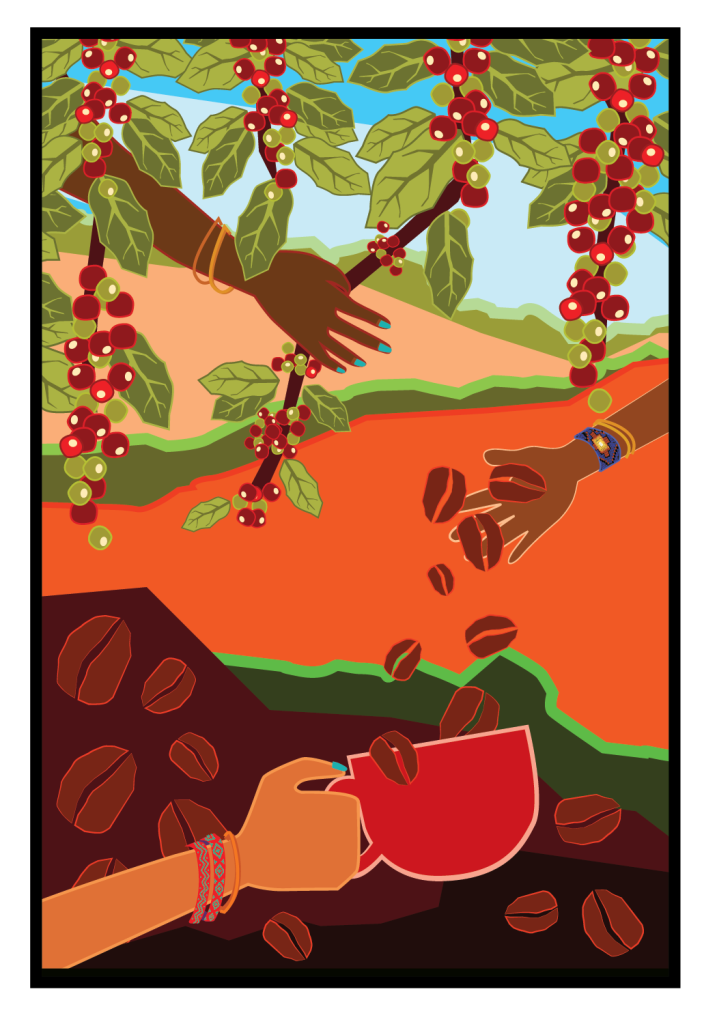
What we have at Zingerman’s Coffee Company is decidedly the opposite approach. Rather than banking on the regular appearances of a made-up character created in a studio, we count on the very real efforts of very real Colombian women dealing with real-life plants and problems to produce some of the best coffee you can find anywhere, including the uncommon varietals of Caturra, Colombia, and Castillo.
The Cauca region is in the southwest of the country. These traditional Andean lands are a great place to grow coffee: the altitude of 5,000-6,000 feet above sea level keeps temperatures cool enough to nurture quality and complexity, and the volcanic soil means richer flavors. Unfortunately, the region is also where government forces and rebels are currently going at it—which makes it all the more important that we support these values-focused women farmers from afar with our purchases. Our investment also supports the development of the indigenous people of the region, the Guambiano or Misak.
The CoSurCa co-op (Cooperativa del Sur del Cauca) was founded 22 years ago, in 2004, as part of an effort to provide Colombian farming families with meaningful income and an alternative to planting drug crops. Similarly, its partner Café Feminino Colombia is a sustainable and effective program designed to help shift power in the region to women farmers. Initially, lack of confidence and discomfort around breaking social norms held many of these women back; slowly but surely, however, more and more have taken advantage of the program’s training in leadership, regenerative farming, and other areas.
Today, Café Femenino Colombia supports 438 of CoSurCa’s female coffee producers, who uphold the highest standards of quality and sustainability. The Coffee Company is proud to help empower these women, and a portion of the proceeds from this coffee go toward sponsoring a project to bring internet capabilities to their community.
One of the beauties of the Coffee Company is, of course, that we can brew the same beans with so many different methods, and each yields its own distinctive flavors. When we brew it in the urn—as you can enjoy it every day this month at the Coffee Company and the Roadhouse—the Colombian coffee is, according to the crew, “milk chocolate, crisp, silky smooth.” The pour-over method produces a cup with a classic, clean, lively Colombian profile including plenty of high notes, while the immersion brewer’s is complex and syrupy. The AeroPress emphasizes more body and cocoa, the Chemex is especially chocolatey, and the press pot is surprisingly light—the Coffee Company baristas describe it as “smooth and juicy, with lots of high notes that remind us of green apple.”
Traditional single-source honey at the Coffee Company
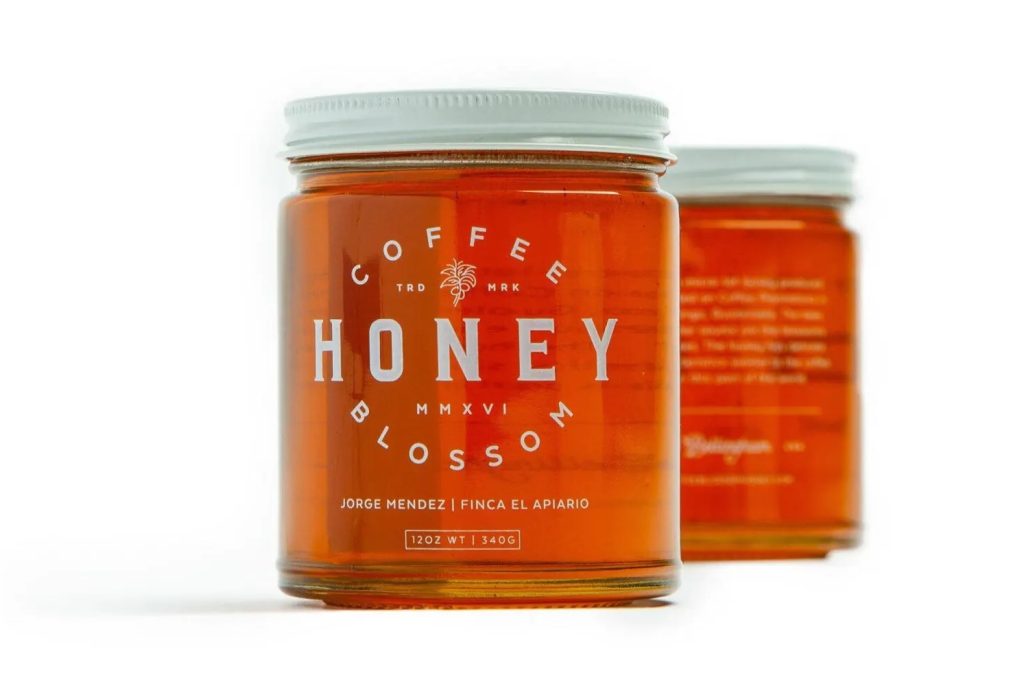
I’ve long believed that honey—great, single-source, traditional honey—could be one of the best desserts on the planet. In much the same way that eating amazing stone fruit or just-picked berries brings us flavors as they exist in nature—uncooked, unrefined, unprocessed—the same goes for honey. For those who want to bring a bit of beauty to their day but worry about having enough time … nothing could be easier than opening a jar of great honey, dipping in a spoon, and savoring it just as it is. In the spirit of appreciating the nuances of nature—and of life—as art, this Coffee Blossom Honey strikes me as natural beauty incarnate.
Each honey varietal—and each different location in which the honey is gathered, and each season—will yield markedly different, unique flavors. In the same way that each year’s vintage of a great wine tastes a bit different than the year before and the year after, the same is true of honey. This coffee blossom honey from Guatemala fits all of those characteristics quite well. Honestly, I’ve never tasted anything quite like it. We get it through the folks at a small, quality-focused company called (not shockingly) Coffee Blossom Honey. They’re our kind of producer—“We travel and source each micro lot of coffee blossom honey with the goal of strengthening farmer relationships, promoting bee education, improving quality, and building sustainability.”
The beekeeper is Francisco “Chico” Cardona. Starting years ago with next to nothing, Cardona diligently worked with coffee until he had the funds for his own farm. There, he began working with beekeeping and, over time, it became a passion for him. Today, Cardona has three apiaries and 150 hives, and his farm carries the name “La Colmenita,” meaning “The Little Beehive.” Regulations require that the hives be set up within a kilometer of the source. The flavor? To be clear, it doesn’t taste anything like coffee. Ethereal. Apricot. Tropical fruit—maybe mango. Muscovado sugar and vanilla. The Coffee Blossom Honey folks say that it has “a subtle sweetness with delicate lavender notes.” I’d add that there’s a faint menthol-like freshness. It finishes big on the nose: intensely aromatic and enticing.
What do you do with honey this good? If you like your coffee on the sweet side, add a spoonful. If you want to be geographically congruent, add it to a pourover of the really good Guatemala El Regalito at the Coffee Company. Put it on toast. Totally terrific, I’m happy to report, with really good hazelnut butter. Make a honey cake with it. Put a bit in, or on, a blintz. Mix it with olive oil and a nice wine vinegar to make a honey vinaigrette. Use it for a glaze or in sauces—see the recipe for lamb roasted with honey and rosemary in Zingerman’s Guide to Good Eating. Try a Zingerman’s Cream Cheese and honey omelet. Or, as I said, just stick a spoon in and eat. Appreciate. Enjoy!
A beautiful brew from the coffee-growing star of Central America
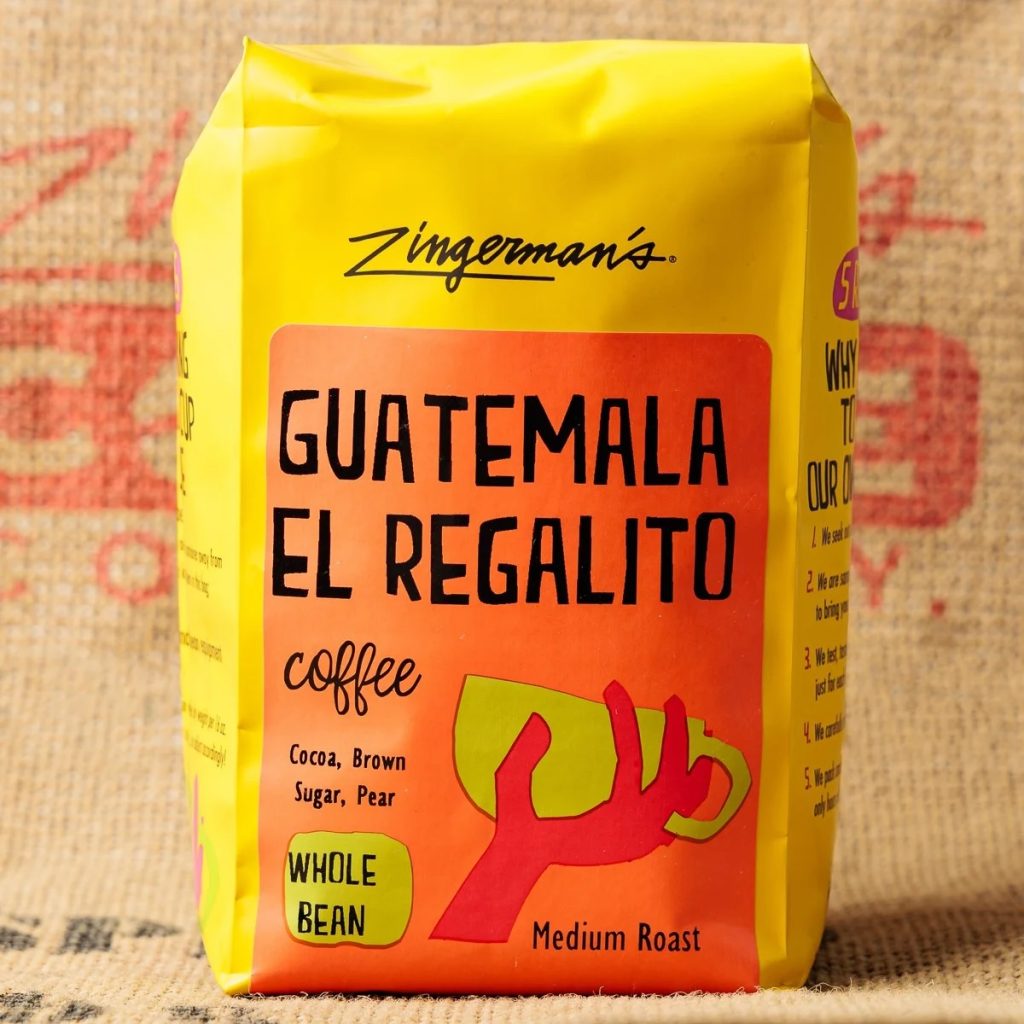
March means the rollout of a great newly-arrived single-estate coffee from Guatemala. What we’ve come to know here in recent weeks as El Regalito—“the little gift” in English—is lovely, easy to drink, and highly enjoyable. I’m sipping it as I write, and I have the feeling I’ll keep that up all day! It’s that good!
Author Eduardo Galeano writes that “A search for keys in the past history to help explain our time—a time that also makes history on the basis that the first condition for changing reality is to understand it.” With Galeano’s wise words in mind, Guatemala has an ancient and highly esteemed history that goes back to the advanced Mayan civilization from about 2000 B.C. Coffee, though, is a relatively recent arrival—serious commercial planting started in the middle of the 19th century, primarily with German immigrant planters, about a decade after the demise of a nation-state that almost no one around these parts will have heard of. The Federal Republic of Central America was founded in 1823, less than 50 years after the Declaration of Independence of the U.S. It included what’s now Nicaragua, Costa Rica, El Salvador, Honduras, Chiapas, and Guatemala. The Federal Republic started with much the same spirit as the U.S., as a democratic nation-state, but came apart in the course of its own Civil War in 1838. Had it continued as the U.S. did, we would likely be thinking of all those places as the Central American corollary to California, North Carolina, or Texas.
A century and a half down the road of history, Guatemala consistently produces some of the most flavorful coffee one can find anywhere. And some of the best of the best comes from the Huehuetenango region in the county’s northwest. Here’s what the crew at the Coffee Company said:
Finca El Regalito is on the west side of the village of Hoja Blanca in Huehuetenango, Guatemala, with Mexico almost visible across the valley to the northwest. Huehuetenango is one of Guatemala’s prized coffee-growing regions, and with coffees as vibrant and exciting as this one, it’s easy to see why.
El Regalito is led by Arturo Villatoro and his son Vielmann, who manages the day-to-day running of the farm. Their lots are on a sheer ridgeline where Chalum, Mandarin, and Capulin trees shade the classic Bourbon and Caturra coffee varieties.
We found this coffee to be layered and approachable, with familiar flavors like cocoa and brown sugar plus a hint of crisp fruit that reminded us of pear.
I’ve been loving this great Guatemalan coffee and drinking it regularly for the last few weeks. It’s got a wonderful combination of depth and delicacy, substance and subtlety, softness and strength. There is something special, hard to pin down, that makes it so eminently calming, comforting, and enjoyable. It has what architect Christopher Alexander, whose work I reference in “The Story of Visioning at Zingerman’s” pamphlet, describes: “In our lives, this quality without a name is the most precious thing we ever have.”
Come by the Coffee Company, the Deli, or Roadhouse and grab a bag of beans or a cup to go.
A little gift to yourself
A Taste of Pennsylvania Dutch Country in Washtenaw County
Sometimes we take things for granted. Or maybe it’s that we’ve subconsciously sloughed something off because our early-in-life encounters with it were wholly uninteresting. Even I, who’ve been investigating artisan food for many years now, still forget to consider what, once upon an unremembered-by-most time, came before the now-standard commercial offering.
If you look hard enough, though, you can almost always find a high-quality example of what most of the world has long experienced as ordinary.
While soft pretzels at the Bakehouse are always appealing to me, I never really gave much thought to the standard, crunchy hard-crusted pretzels that I—and maybe you?—grew up with until now. In my mind, I classed them as industrial snack foods. Sometimes they come in looped circles, other times in long, thick-as-a-cigar sticks, or in small bits of straight two-inch-long sticks.
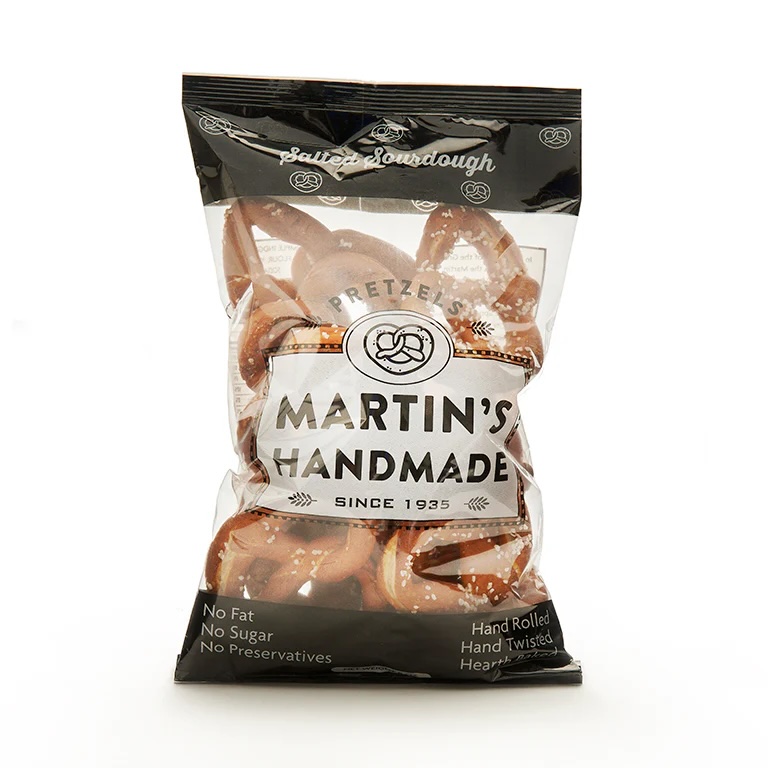
Like everything else we eat, the commercial version I grew up with is a pale comparison to the original. The difference is night and day! Ed Levine, the man who started the first nationally known food blog, New York Eats, writes of these traditionally made pretzels, “Martin’s Pretzels—a fixture in the City’s Greenmarkets since 1982—are to machine-made pretzels what a BMW is to a Yugo.” Half the people who I have invited to try them come back to tell me they ate the whole bag in a single sitting. Then they come back and buy more. In fact, it’s safe to say I’ve bought more bags of pretzels in the months since we got these in at the Coffee Company than I have in the last few decades. They’re very good! In the context of what I wrote above, I would say that they’re truly unordinary in the best possible way.
Martin’s Pretzels are crafted much the way a hard-crusted pretzel would have been made over a hundred years ago. The Martins are Conservative Mennonites from Pennsylvania’s Lancaster County. They are old-guard pretzel bakers keeping the handmade tradition alive just as they have since the middle of the 20th century. The first contributor to their high quality is a simple secret-recipe sourdough that, like so many of the breads at the Bakehouse, is made from just flour, water, yeast, and salt. The folks at Martin’s use no preservatives, no sweeteners, and no fat. Like the sourdough breads at the Bakehouse, this old-style sourdough takes longer, but delivers loads more flavor. From there comes hand shaping, rolling, and twisting.
Machine-made pretzels are produced far more quickly than anything human hands could ever manage. Automated lines can shape and bake thousands of pretzels an hour. A good pretzel roller at Martin’s is ridiculously slow by industrial standards. Instead of hundreds or thousands a minute, the men and women at Martin’s each twist only about 10 to 12 pretzels per minute, working by hand. In their view, speed, when it comes to pretzel production, can be deadly. That deliberate pace means the density varies through the pretzel, and tiny air bubbles in the dough are baked into the finished product. No two twists are exactly alike. Like you and I, every Martin’s pretzel is unique. And, fortunately for us, also delicious.
Longtime pretzel baker Alfred Milanese says, “Martin’s are the Rolls-Royce of the pretzel world.” Julia Child used to stock them at her house! I love the crunch, the dark bake, the irregularity of the hand-done texture, and that almost-but-not-quite-too-much touch of coarse salt the bakers broadcast onto the twisted raw dough before it goes into the oven.
The Martin’s Pretzels are awesome, eaten right out of the bag, on their own. Wonderful with good beer. With cheese—Zingerman’s Pimento Cheese and Zingerman’s Liptauer Cheese! With a down-to-the-wire NCAA Tournament game on TV. With a smile. And a deep appreciation for the Pennsylvania Dutch traditionalists who make these special pretzels possible. I’d agree wholeheartedly with what the folks at Martin’s say: “There is no way to imagine the difference between machine and handmade pretzels without tasting.”
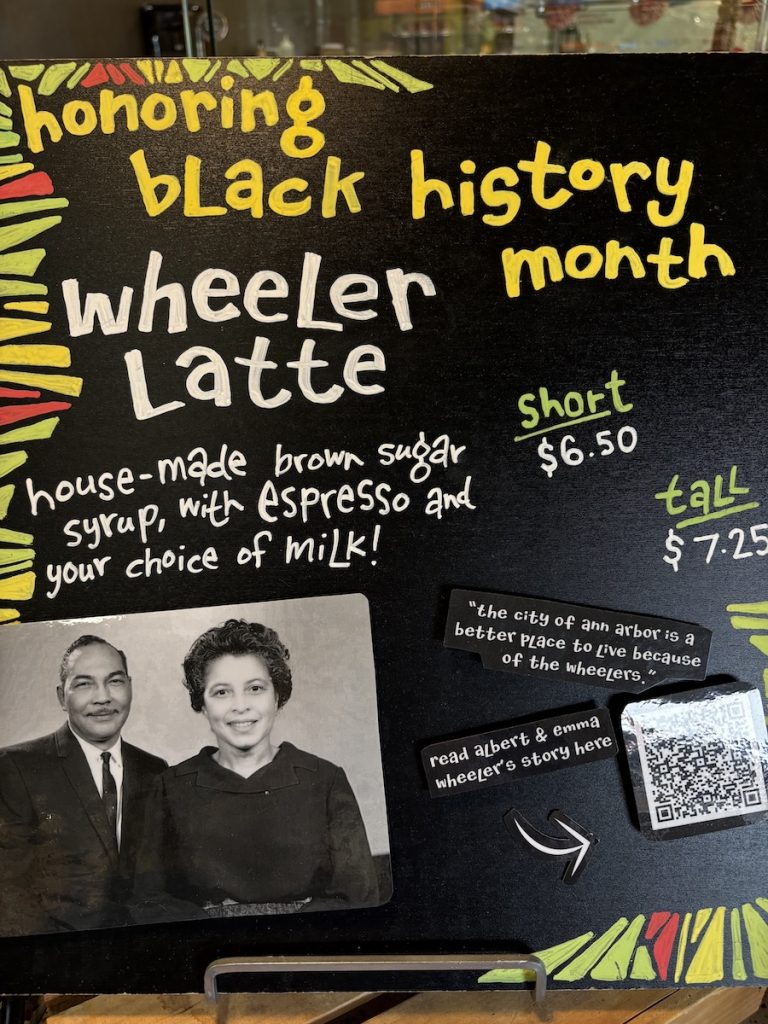
Paying homage to one of Ann Arbor’s great leaders
A super-tasty coffee drink. An important part of Ann Arbor history. The practical application of a promise beyond ableness. An homage to Ann Arbor’s first Black mayor. A way to support a good cause in the process! It all comes together in the Coffee Company’s Wheeler Latte.
On Monday, April 7, 1975, Albert Wheeler was elected mayor of Ann Arbor. Wheeler’s election was historic. He was the city’s first—and so far, only—Black mayor.
Many non-Black residents of the city may not realize that, in the years leading up to Wheeler’s election, Ann Arbor remained segregated through a series of largely unspoken social norms that are still not talked about much today. As an Ann Arbor News reporter later wrote:
Far away from the segregated lunch counters and water fountains of the Deep South, Ann Arbor was wrestling with its own brand of racism in the 1940s and 1950s. Blacks moving to town were only shown houses in the North Fourth Avenue area, a grimy neighborhood heavy with the odor of slaughterhouses and coal-fired plants. Jobs for African Americans at the University of Michigan usually got no better than cleaning floors or operating elevators.
Mayor Wheeler was born in St. Louis in 1915. He studied biology at Lincoln University, an HBCU (historically Black colleges and universities) in Pennsylvania, and then came to Ann Arbor in the late 1930s to study at the University of Michigan’s School of Public Health. When he moved to Ann Arbor, the Great Depression was winding down and the geopolitical tension in Europe that was about to turn into World War II was increasing. In 1945, when Wheeler and his wife, Emma, attempted to buy a house, the banker urged them to consider only Black neighborhoods. Nevertheless, the couple persevered in pursuing the home they hoped to live in. In 1952, Dr. Wheeler became the first Black professor at the university to gain tenure and went on to have a remarkable career as an educator and researcher.
The Wheelers, motivated in part by the poor treatment they received as they tried to purchase property, would go on to be instrumental in founding Ann Arbor’s chapter of the NAACP. Al first ran for mayor, unsuccessfully, in 1970. He then ran again in 1975 and won. As mayor, Wheeler worked to change beliefs about what a city government is supposed to do. Many have credited him with instilling the idea that city government should be involved in human services. He assisted disadvantaged citizens and advocated for significantly increased services for all residents. Wheeler’s path was not an easy one. To connect this idea to the essay above, I’ll mention that a PBA drove his work. He was determined to make a positive difference for people of color both at the university and throughout town.
Even in our fairly “liberal” city, Wheeler faced verbal and physical threats. He pushed forward anyway, especially in improving public housing. The Ann Arbor News noted that “a pattern of scattered public housing on small sites throughout Ann Arbor is another Wheeler legacy” and that Wheeler “worked to avoid the large, isolated housing projects that other cities built with public funds.”
Wheeler explained his deep dedication to working for civil rights in the city in terms of dignity: “I thought I was working for what I was entitled to as a human being.” His daughter Mary McDade, an appellate court judge in my home state of Illinois, told Michigan Public Radio about how her father consistently led with positive beliefs: “He recognized that as women and as Black people, it was going to be an uphill struggle to do anything in this life.” And yet, McDade says, “he was constantly reminding us that if you used your brains, if you applied yourself, there was nothing that you couldn’t do.”
In 1987, five years after we opened the Deli, Summit Park, located a few blocks to the north of us, became Wheeler Park. The plaque at the park says it well: “The city of Ann Arbor is a better place to live because of the Wheelers.” Albert Wheeler passed away in 1994, at the age of 78.
To mark the 51st anniversary of Al Wheeler becoming mayor, the Coffee Company created the Wheeler Latte. It’s a super-tasty coming-together of the Coffee Company’s Espresso Blend #1, a house-made Demerara brown sugar syrup, and steamed milk from Calder Dairy in Carleton, Michigan.
As we see it, the Wheeler Latte is a tribute to Mayor Wheeler’s wonderful work in the 20th century and a recognition of what we can all do to build on his caring community contributions. Order one up this week and toast the mayor’s memory. It’s a great way to salute the social improvements that he worked so hard to make happen—and that all of us remain responsible for today! To sweeten the deal, the Coffee Company is donating $1 from every Wheeler Latte to the local chapter of the NAACP.
Have one ready and waiting
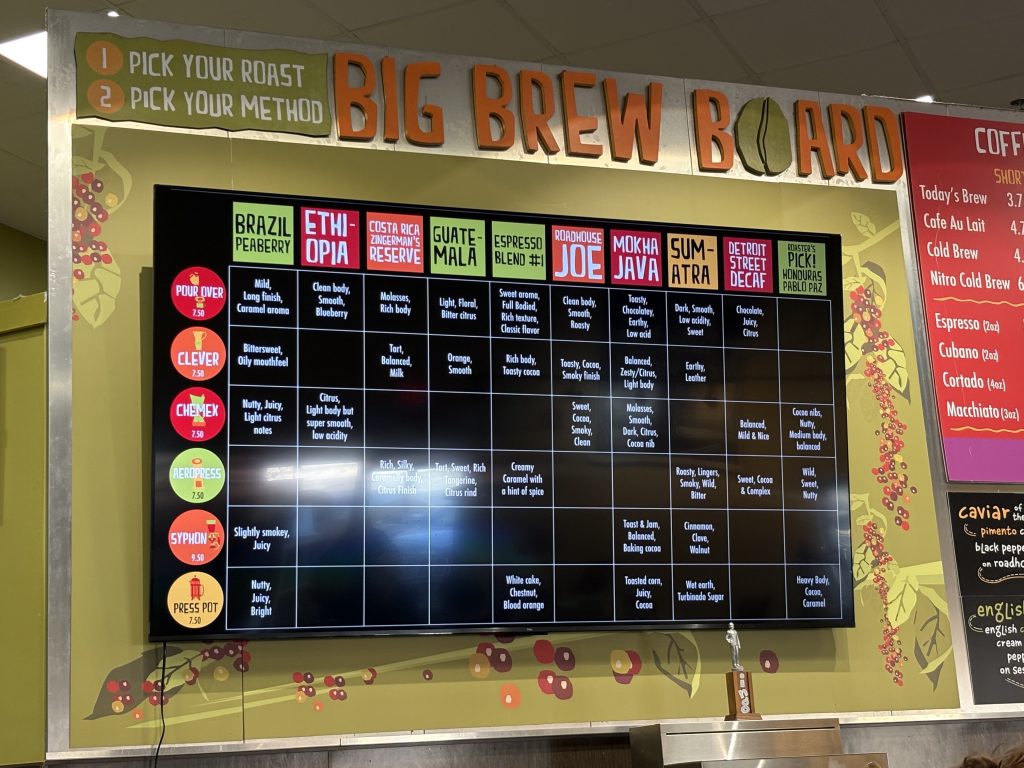
A great way to take your coffee tasting to the next level
One of my big learnings of the last 20 years or so has been just how much a particular brewing method can impact the flavor of a cup of coffee. I think most of us understand that a coffee from Guatemala tastes totally different from a coffee from Ethiopia. But the fact that the same batch of Guatemalan beans brewed using four different methods will yield four distinctly different profiles in the cup is still, to this day, something of a “secret.” The Big Brew Board at the Coffee Company on Plaza Drive, at what we call Zingerman’s Southside, is a great way to explore those differences—so many combinations to explore, so many fun flavors to enjoy.
The Big Brew Board is hanging from the ceiling, so you can’t miss it when you walk into the shop. Brewing options and flavor descriptors from the crew—who are constantly brewing and tasting to compare—are up there for the rest of us to learn from.
For those who’ve studied the subject in depth for decades, this is hardly new news. I certainly knew at some level that there would be a difference from one brewing process to the next. But when we started offering the same coffee brewed in half a dozen different ways at the Coffee Company, I suddenly had the chance to experience the difference firsthand. What stopped me in my sipping tracks was the chance to taste two or three or even four different brewing methods of the same coffee side by side.
The Big Brew Board holds the key to making the experience both easy and interesting—six or seven different brewing methods, all arranged top to bottom on the left side of a grid, and a dozen or so different coffees arrayed across the top. All of which means that you or I can stop by the Coffee Company and sip and sample, compare and contrast. To make the main point again, the same beans brewed in, say, a pourover taste pretty different than the same exact coffee brewed in a siphon pot. Or a Clever or a French press.
A few weeks ago, the Coffee Company crew brought the Big Brew Board into the 21st century. I love chalkboards, as the Big Brew Board was for the last 10 years or so, but when the crew can simply type in new tastings every 10 or 15 minutes, it is way more likely that the board will be filled in with great tasting notes to help folks like me and maybe you decide what brew method to have them make for us.
For my taste, having this is an exceptional service to a coffee drinker like me who loves to taste and learn but doesn’t want to do the work (or take up the counter space) at home. Thanks to the Coffee Company crew, too, for bringing back what we refer to as “the third grinder,” which allows us to make the Coffee of the Month into an espresso. The shots of Honduras I’ve had this past week have been super smooth and terrifically tasty. Order one and raise a toast to the good work we can all do together in 2026.