
Month: January 2012
While business books often focus on some stroke of Steven Jobs-like genius, I think that more often than not the real genius is mostly in doing the sort of drudgerous stuff that anyone who really thinks about it could do, but doesn’t. For whatever reason the best businesses do it, while their (oft-complaining) competitors can’t quite muster up the energy to make it happen.
I could tell a thousand stories to illustrate this point but the one that always sticks in my head is about how we got our bread back when we first opened the Deli in the early ’80s. We knew that if we wanted to have a great corned beef sandwich (a key part of our vision) we had to build it on great bread. After testing loaves from better than 20 different sources, we settled on the rye bread from a bakery about 45 minutes away, in the Detroit suburbs. Our excitement quickly turned to uncertainty when we went to talk to the owner. He was happy to sell to us but he didn’t deliver to Ann Arbor. So working with him meant someone had to leave Ann Arbor early enough to get back with the bread before we opened the doors at 7 a.m. And, mind you, the winters in Michigan make for difficult driving. I think nearly every other bakery was willing to deliver. But we wanted the best bread we could get, and that meant we were going to drive to Detroit every day to get it. Which we did about 3800 times (round trip) until we opened Zingerman’s Bakehouse in 1992.
I’m not telling you this story to brag, but merely to illustrate the value of the law. At the time we probably didn’t agonize that much over the decision—it just seemed clear to us that it was the right thing to do.
If you look around at the most successful businesses in any industry I bet you’ll find that each has a folder full of similar stories. Not only are they an important part of the company’s initial success, but the truly great organizations continue to do such things even as they grow and mature. While their competitors cut corners, they just keep doing all those unglamorous little things: they stay open late, they open early, they thank a few more staff and customers, they pay a bit more to get better raw materials, they forgive loyal employees who err, they give a bit more to the community…
Twelve Natural Laws of Business:
There are organizational principles that consistently work and, in the big scheme of things, follow a natural order. We call these “Natural Laws of Business.” Our experience here is that the natural laws are applicable for any business regardless of size, scale, age or product offering. Exceptions exist, but I’ll say up front I wouldn’t recommend expending much energy trying to prove these rules to be wrong.
Month: January 2012
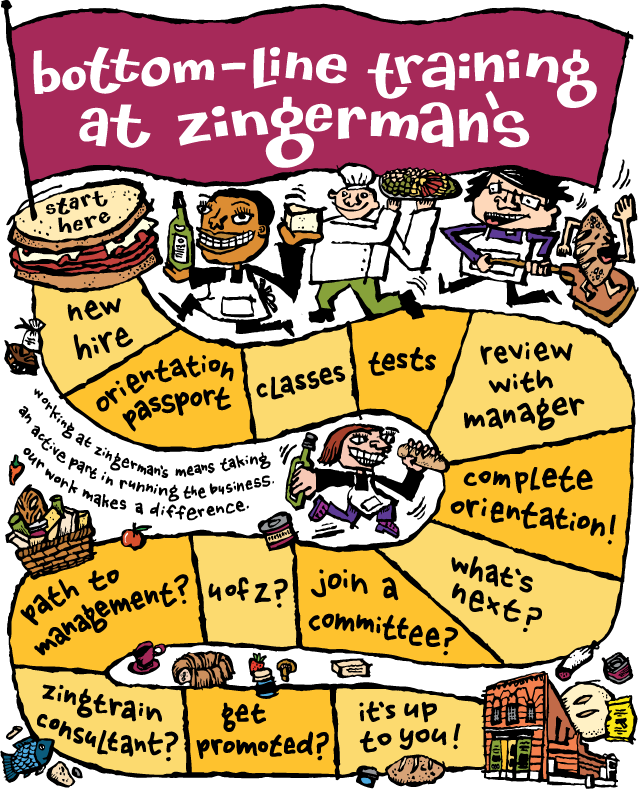
This concept is the core of Zingerman’s Training Compact, which we developed under the leadership of Maggie Bayless, managing partner at ZingTrain, back in the mid-’90s. We’ve been working to live up to it—if imperfectly—ever since. To run a great organization it’s very clear that we need to be clear about what we’re asking from the folks who work for us. And then we need to effectively teach them how to meet our expectations.
The validity of this natural law was confirmed in Marcus Buckingham and Curt Coffman’s book, First, Break All the Rules, in which the Gallup Organization surveyed 1,000,000 workers and 80,000 managers to determine which factors were most important for keeping the best workers in their jobs for the longest period of time. Their single most important element? Clear expectations. Second most critical? The tools to do their work, among which effective training figures at the top of the list.
Twelve Natural Laws of Business:
There are organizational principles that consistently work and, in the big scheme of things, follow a natural order. We call these “Natural Laws of Business.” Our experience here is that the natural laws are applicable for any business regardless of size, scale, age or product offering. Exceptions exist, but I’ll say up front I wouldn’t recommend expending much energy trying to prove these rules to be wrong.
Month: January 2012
This rule is less obvious and probably less widely accepted than some of the others. But it’s every bit as important. It’s one of the key tenets of Servant Leadership, which is the core of our leadership philosophy here at Zingerman’s. (We learned it from Robert Greenleaf’s excellent book, Servant Leadership.) Here’s the deal: the service that the staff gives to customers is never going to be better than the service that we as leaders provide to the staff. The tone comes from the top; although exceptional service providers may occasionally crop up on their own, they’ll always be the exception. The rest is up to us.
It’s pretty easy to determine how well you’re doing on this point: I can tell with a very high degree of accuracy how the leaders of one of our businesses or departments are treating their staff simply by watching the way the staff wait on customers.
Twelve Natural Laws of Business:
There are organizational principles that consistently work and, in the big scheme of things, follow a natural order. We call these “Natural Laws of Business.” Our experience here is that the natural laws are applicable for any business regardless of size, scale, age or product offering. Exceptions exist, but I’ll say up front I wouldn’t recommend expending much energy trying to prove these rules to be wrong.
Month: January 2012

I suppose there have been times in history, like during the Great Depression, when people would take just about any job they could get. But unless your vision is to be the only person active in your business, you’re going to want to provide a really great place for people to work. Why? Because while offering a great, rewarding, spiritually sound workplace won’t by itself guarantee success, I can assure you that any business that does so will outperform organizations that follow the other 11 natural laws but ignore this one. In fact, I’ll posit that you won’t really be able to make many of the other principles work very well for very long without providing a great workplace.
As with our customers, we need our staff way more than they need us. So how rewarding does the workplace have to be? (Please note that we mean “rewarding” in every sense of the word—financially, sure, but also emotionally, intellectually, and physically.) We’re always working on how to make Zingerman’s a more positive place by sharing our vision (see Law #1 above), by involving people in running the business, by creating and promoting processes for organizational change, by practicing open book finance, by offering great training, etc.
Ultimately people want to feel that their work makes a positive difference; that their extra efforts are noticed; that they can improve the quality of their lives and the lives of those around them through their work. When we accomplish this we have more fun, service improves, sales go up, and all those other good things that we like to see, start to happen—and with amazing regularity!
Twelve Natural Laws of Business:
There are organizational principles that consistently work and, in the big scheme of things, follow a natural order. We call these “Natural Laws of Business.” Our experience here is that the natural laws are applicable for any business regardless of size, scale, age or product offering. Exceptions exist, but I’ll say up front I wouldn’t recommend expending much energy trying to prove these rules to be wrong.
Month: January 2012
This one is so widely accepted that I almost didn’t include it on the list. But you know what happens when you “assume,” right? Plus it’s quite possible to fulfill most or all of the other natural laws as they’re laid out here and still not have a sustainable business from a financial standpoint. Granted, it’s way more likely that your finances will be good if you live up to all the other laws on the list, but there are still absolutely no guarantees. Many businesses that are doing special things fail every year because they don’t manage their money well.
I’ll be brief here because there are a million places for you to learn about business finance. (You may want to start with Karen Berman and Joe Knight’s book, Financial Intelligence, or come to ZingTrain’s Fun, Flavorful Finance seminar.) The bottom line (pun intended) is that you can have all the good intentions and good ideas in the world, but you still have to be profitable in order for the business to survive; you do have to have cash on hand in order to pay the bills; and if you don’t pay your taxes properly and on time you’ll get in a lot of trouble.
Twelve Natural Laws of Business:
There are organizational principles that consistently work and, in the big scheme of things, follow a natural order. We call these “Natural Laws of Business.” Our experience here is that the natural laws are applicable for any business regardless of size, scale, age or product offering. Exceptions exist, but I’ll say up front I wouldn’t recommend expending much energy trying to prove these rules to be wrong.
Month: January 2012
Zingerman’s co-founder Paul Saginaw recently appeared on an MSNBC panel discussion on the state of small business and the 2012 election. Host JJ Ramberg brought together small business owners from around the country to discuss the current business climate and asked what they are looking for from the 2012 candidates to help them succeed during a the economic recovery. Paul’s answer? Stop shifting the tax burden onto the middle class.