
Month: April 2012
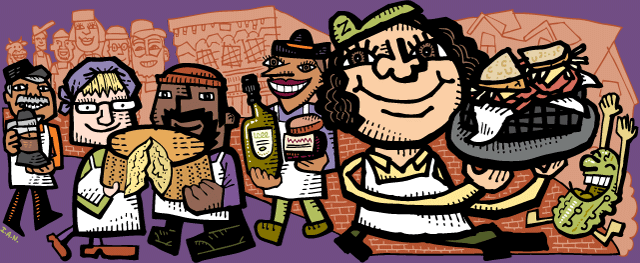
Every year when Zingerman’s celebrates another year of being in business, it means we all celebrate another year of working together at what has been called “The Coolest Small Company In America”. I have to admit, when I first started working here, I was only nineteen years old, had never heard of Zingerman’s before and only went to a job fair for the Roadhouse because a friend had mentioned it and I was moving to the area. I had no idea what to expect or what I was getting involved in. Almost nine years later, I still work for Zingerman’s and cannot imagine working anywhere else.
I think most of the staff would agree with me that working here kind of spoils you for working anywhere else. When we are first hired, we hear from the staff that this is a different kind of place, where the front line staff’s opinions count and the managers are really here to work for the staff. But it isn’t until it happens to you that you realize what they are talking about. I remember back in 2003 when the Roadhouse first opened, I was a server, one of the youngest and most inexperienced. Back then we used team service and split tips amongst the team. It wasn’t great and a lot of people were unhappy. The staff talked to the managers about it and instead of just coming up with a new system and enforcing it, the managers asked who wanted to help fix it. I volunteered and worked on a committee with two other servers who created the new service system on how we tipped out. The managers helped us roll it out to the staff and that was how I helped make a big change that affected the entire Roadhouse. It made me feel empowered, like I could help change anything. Over the next several years, I did help make change and I learned how to make change and I really felt like part of the team, which is something I don’t think you get at many places.
There are so many opportunities presented to staff here, it can almost be overwhelming. From the staff scholarship to U of Z (University of Zingerman’s, an internal training program), attending ZingTrain seminars, working your way up in the business, being a line owner, leading huddles, attending Partner’s Group, being a part of the Leadership Development Program, taking as many classes as there are listed on the calendar, teaching classes, leading a BLC, training new staff members, being on a ZCoB wide committee, I think I could just go on and on. All these really great opportunities are right here for us and it is inspiring to work for a company that encourages us to reach beyond our current jobs and wants us to move forward.
The 30th Anniversary Staff and Alumni party is happening soon—Sunday, July 8th to be exact! All current and former staff plus their families and friends are invited, along with some of our favorite producers and friends from the community. The celebration is our way to say thank you to everyone who has helped shaped Zingerman’s. Whether you worked here for two weeks, two years or two decades, this is our party. It will be a chance to see old co-workers, meet folks from the other businesses and just have a good time. After 30 years, everyone deserves a big staff bash! There will of course be delicious food, music, games, prizes and an exclusive t-shirt commemorating the event. If you are planning on coming and/or are interested in helping out, you can email me, Joanie, at [email protected]. Hope to see you there!
Month: April 2012
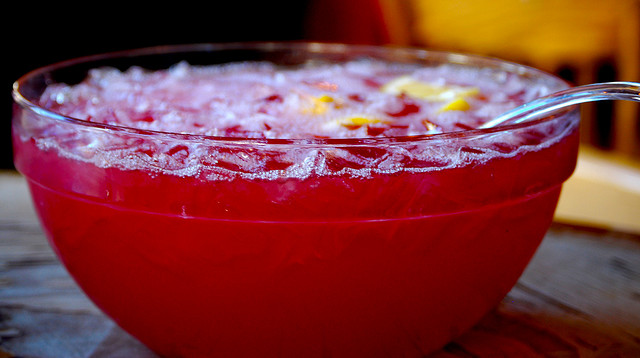
When you throw a party and want your guests to have a drink as soon as they take off their jackets punch does the trick. It can handle a mob of arrivals that would crush a bar making drinks to order. You can buy beautiful old cut glass punch bowls cheap at flea markets and garage sales. Settle a giant hunk of ice in the middle of the bowl. As it melts the flavor of the punch changes, the architecture of the evening follows suit.
There are several bars in New York (Prime Meats, for one) doing punch service either at bar or table side. San Francisco, too. And one in Ann Arbor. Punch originated in Southeast Asia, quickly moved with sailors to the West Indies and before the age of the cocktail it was the most common blended drink in America. After that it unfairly faded into kitsch. Old cocktail books often have whole sections devoted to it. It fits nicely into the flow of traditional American food.
If you’re interested in learning more, I recommend Punch by David Wondrich. Wondrich writes some of the most comprehensive treatises on drinking today. He has a few books under his belt and commits a regular column to Esquire. I always learn interesting tidbits from him. Like from this book: bartending was traditionally a woman’s job in eighteenth century England; the term “pop-in” meant a shot of booze dropped in a mug of beer.
Month: April 2012
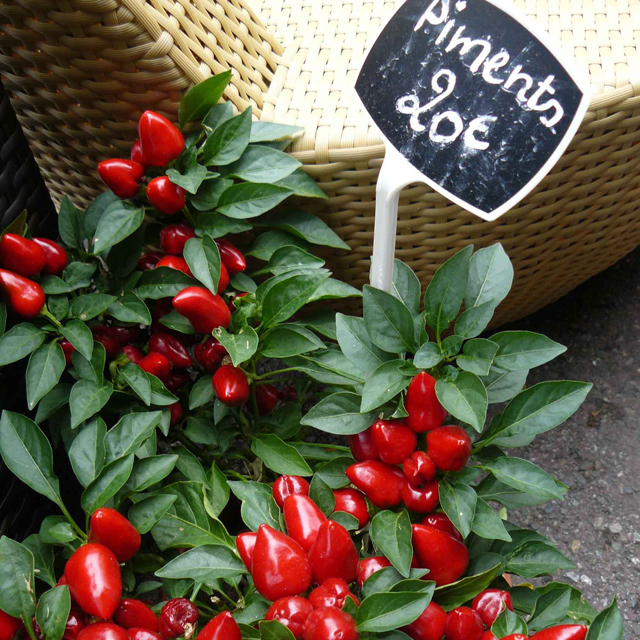
It’s early September. You’re walking down the narrow, cobbled streets of a small town in southwestern France. The cool breeze carries a whiff of the ocean, not more than a few miles away. The tall, faded stone buildings provide a spot of shade in the strong afternoon sun. You’re surrounded by small shops and cafes. And everywhere you look, draping out of windows and off of balconies, there are bright red bunches of peppers. You’ve come to pepper season in the Basque country.
Peppers, called piments in French, have been grown in this region ever since they were brought here from their native Mexico in the 16th century. Trade is most active around the town of Espelette, about three miles north of Spain and five miles east of the Atlantic. The piment d’Espelette grown, dried, and ground here has become synonymous with the cuisine of the whole region. Since the 18th century, piment d’Espelette (or Ezpeletako Biperra in Basque) has replaced black pepper as the primary spice used in Basque cooking.
The peppers are grown today the same way that they were grown a hundred years ago. In spring, farmers start the pepper seedlings in long hothouses. By May, when the plants reach a height of about two feet, they’re planted outdoors by hand. Between August and November, the peppers begin to ripen. All autumn, the peppers are picked by hand, air-dried for at least 15 days, and finally baked at a low temperature to complete the drying process. Once dried, the peppers are ground, seeds and all, into a fine, copper-colored powder.
The Basques like to say that you need to have been raised under the hot sun of southern France to withstand the heat of the peppers. In reality, though, piment d’Espelette is pretty mild. The peppers score a grade of about 4,000 on the Scoville scale – about the same as a jalapeño, much lower than a habanero (which scores between 100,000–350,000). A pinch of piment d’Espelette adds a subtle spicy kick.
Along with the heat is a deep sweetness, similar to a roasted red bell pepper. When I asked Kitty Keller, who imports our piment d’Espelette, what she likes about the flavor, she commented, “it has so much more dimension than cayenne.” I think the Basques must agree, because they use it on just about everything. It’s rubbed on hams as they hang to cure. It’s stirred into stews, whisked into sauces, sprinkled on fish or greens. It’s even added to chocolate, both for drinking and in bar form. (Fun fact: Bayonne, the capital of the Basque region, was the first city in France to make chocolate.)
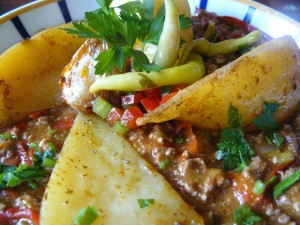 When I visited the Basque region a few years ago, I was struck by the similarity between the food of southwestern France and that of the southwestern US – at least in terms of use of chiles. The Basque region is the only place in France that really cooks with piment d’Espelette, and piment d’Espelette is the only spice in France with an AOC. While I was there, I ate axoa (pronounced ah-shwa), which I described in my journal as “kind of like Basque chili.” That’s Texan chili, mind you – all meat and spice, no beans. For those, you have to head a few hours east to Languedoc-Roussillon for cassoulet.
My favorite way to use piment d’Espelette, though, is one of the simplest: toss a pinch into eggs and whip up an omelet. Add in some caramelized garlic, roasted bell pepper, cook in good olive oil and you have a damn fine lunch, Basque-style.
Month: April 2012
The director and writer/star of Forgetting Sarah Marshall reteam for the irreverent comedy The Five-Year Engagement. Beginning where most romantic comedies end, the new film from director Nicholas Stoller, producer Judd Apatow (Knocked Up, The 40-Year-Old Virgin) and Rodney Rothman (Get Him to the Greek) looks at what happens when an engaged couple, Jason Segel and Emily Blunt, keeps getting tripped up on the long walk down the aisle. The film was written by Segel and Stoller. www.tomandviolet.com
The movie is set here in Ann Arbor and features cameos of a number of different local landmarks including Zingerman’s! After leaving his prestigious chef job in San Francisco to join Violet in Ann Arbor, Tom is dismayed to find that the best restaurant job he can find is making sandwiches at our very own Deli. He joins forces with self-proclaimed pickle nerd Tarquin but life in Ann Arbor isn’t what he expected. With his life in a downward spiral while Violet continues to succeed, Tom leaves the Deli, almost leaves Violet, and almost loses all hope until he winds up as a baker at Zingerman’s Bakehouse. I won’t give the ending away but it was really, really funny. Seeing so much of downtown Ann Arbor and so many familiar neighborhoods was big fun, especially at full-house premier at the Michigan Theater.
For more on the movie (from an actual movie critic!) check out this in the New York Times.