
Month: May 2012
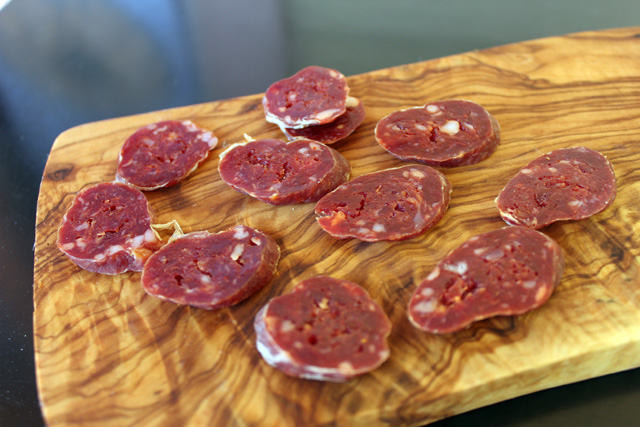
We just got in a few pork products that you should try. These are pretty limited edition products that have come from our friend Herb Eckhouse.
First off is the Borsellino. Borsellino is Italian for purse or small hand bag. It is also the last name of his dear Italian friend. So the reason why he thought of making this sausage was he was so tired of throwing away the scrap trim from the Hogs that he was processing for his Prosciutto Americano. He works very closely with his Hog Producers that supply him incredible pork. The thought of all that energy that went into these breed specific hog raising, and the fact that he was throwing away trim from when the Hams come in to make the Prosciutto, he decided he needed to make a product.
The idea behind this product is to have a sausage that you could throw in your bag (it has a long shelf life inside its little bag) and eat on the run, or at a picnic. Herb was inspired by the sausages that he could just grab and go with in Italy. It comes in two flavors, regular and piccante.
Next is the Acorn Edition Woodland Finish Tamworth Products.
So this year in addition to doing the normal Berkshire Acorn Fed Hogs, Herb wanted to branch out a little. He had been looking at other breeds and settled on the Tamworth Hog. It wasn’t easy finding a Tamworth producer to work with, since there are not many of them in the country. But after four years of searching he finally found Russ Kremer. He wanted to raise the Tamworth’s in a certain fashion. These Tamworths live a happy go lucky life (check out laquercia.us to see some fun pictures of these beautiful animals), and then in August they get put out to pasture in the Ozark Mountainside of Missouri. They spend their last three months foraging on the side of a mountain that is filled with fruiting oak, and hickory trees.
So for the first time ever, the Deli has some Pancetta, Guanciale, and Lardo from these beautiful and very tasty Tamworth hogs.
Come by the deli for a taste, or take some home and cook with it, and if you do shoot me an email or leave a comment and let me know what you think. I will happily send all the good tasting notes back to Herb and Kathy.
Month: May 2012
By Drew Waller, Director – Michigan Theater
What a difference a year can make right? Ask me this time last year — with 365 days of continuous film programming, live concerts and speaking engagements already keeping us up to our eyeballs in exciting activity here at the historic Michigan Theater — how close we were to delivering the first-ever international film festival for southeastern Michigan and I would have politely said, “I’m sorry, whaaaa?”
CINETOPIA International Film Festival, a dream of our executive director Russ Collins, for decades longer than it’s fair to say anyone should have to hold onto a dream without seeing it come to fruition, took its preliminary steps after a trio of successful years conducting events with Sundance Film Festival USA. That project, SSFUSA, was one of my first “wow” moments I helped with here at the Michigan when I walked in its doors as part of the executive team in late 2009.
To explain, Sundance as an organization wanted to expand its reach beyond its hometown of Park City, Utah and it did so with Russ and a network of art house cinemas across the country to deliver a concept called Sundance Film Festival USA. SSFUSA took Sundance-approved films of that given year’s festival and send them out to cities across the U.S., right when Sundance was still taking place each year in January to communities who may never get to see a film festival.
The success of Sundance Film Festival USA over the past three years here in Ann Arbor alone has helped expose a wider audience to the power of cinema of what was being debuted at this acclaimed winter international film festival. It has helped bring visionary directors like the Duplass brothers (CYRUS), Miguel Arteta (CEDAR RAPIDS), and soon-to-be success Jamie Travis (FOR A GOOD TIME, CALL…) to our town of Ann Arbor and leave in love with how we embraced their films. Brought respected screenwriters and actors like Oscar® nominee Jonah Hill, Lauren Miller and U-M alum James Wolk (ABC’s HAPPY ENDINGS) in front of sold out crowds of over 1,700 within our historic main theater to see what our friends and neighbors can really do to give a standing ovation to the art and entertainment of film.
If we could deliver that type of excitement for the area for three years, how hard could it be to do that same thing over four days in one year? Now THAT, is a good question and one we asked ourselves in late 2011. From it, came the genesis of this new venture: CINETOPIA International Film Festival. “Cine” from French “cinéma”, or the shortening of “cinématographe” (term coined by the Lumière brothers in the 1890s) and from Ancient Greek κίνημα (kinēma, “movement”) coupled with “topia” or the Ancient Greek of τόπος (topos, “place, region”). CINETOPIA aspires to be an international film festival that brings the best of the festival circuit, be it Tribeca, Toronto or yes, even Sundance to our market; powerful film from the foreign movie distribution groups we work with that may not see major distribution here in the States; the power of 3D as a medium and how close we can get to being there with the illusion of this expanding technology; and a focus on a near and dear product of the University of Michigan: screenwriting.
Now, sounds great on paper, or being relayed via blog post, but then what? Well, fast forward to the months over the first part of 2012 and you would witness an experiment in making something out of nothing. We looked to other film festivals like the Cleveland Film Festival to the south, Michael Moore’s incredibly successful traverse City Film festival to the north of us, to see what we could learn. We also looked to all of you through local businesses and partners to make sure as a non-profit we could fund such an undertaking. Many nails bitten to the quick, we are happy to say with folks like the team at Zingerman’s that we are able to deliver what you will see later this month, happening across three venues (one screen at the Michigan, one screen at the State Theatre, an U-M Angell Hall, Aud. A), over 30 films, and over the course of four days: Thursday, May 31 – Sunday, June 3 and you’re invited. All of Michigan and its neighboring states are invited. Heck, invite your relatives from anywhere and show them just how great Ann Arbor can be when we look to collectively welcome thousands to our humble downtown and show what it really means to love film!
How did we pick all these films and themes? Like everything Zingerman’s does, organically of course! A project of this size can’t just grow on hope alone. We needed to see what was out there building momentum, what films were getting the right amount of buzz, the right amount of care and the right amount of thought-provoking promotion to then welcome them to Ann Arbor. From that we have reached out to indie distributors, nationally respected movie houses and a mountain of other resources to get what you can now look at in its final form on our website. Trust me, it wasn’t easy (PLEASE NOTE: no Michigan Theater employees were injured during the deciding process of this festival) but completely worth the work and effort of our team.
We hope you consider yourself a part of this little nugget of local history and join us for as many films as you can over this special four-day fest. With your help, it can be nurtured and grow into something that we can all take pride in, look back years from now and say: “we made this” and smile as a town, a community and a landmark for cinema and culture.
Month: May 2012

Lecsó (pronounced, if I have it right, “lehtch-o”) has been on my mind ever since we made that first trip to Hungary last fall to learn more about the country’s rich culinary heritage. It is actually a very simple dish, akin to ratatouille in texture but of course with a Hungarian flavor all its own. Every cook seems to have their own version, along with strongly held opinions about the “right” way to make it. There’s clearly no totally “wrong” way to make it so I’ll get over the fact that I’m a relative novice and just share what I know.
Our trip to Budapest last fall was well timed for many reasons, one of which is that the markets were loaded with great produce. Vegetables are a big deal in Hungary. To quote George Lang, “In Hungary vegetables are not just ‘cooked;’ they are ‘prepared.’ The difference between an American vegetable dish and a Hungarian one is similar to the difference between plain boiled meat and a meat stew.” So, you see, although making the dish isn’t really very difficult, making lecsó is not a thing to be taken lightly. Lang calls lecsó, “… one of the most ingeniously used vegetable dishes in the Hungarian kitchen.” Gábor tells me that in his interpretation, “lecsó is basically a pepper stew. The key ingredient when I make it is the onion. This will provide you with a thick, rich, sauce. Lots of onions.”
Most of the lecsó recipes I’ve seen, and what I’ve been doing at home, are a mix of onions, peppers and tomatoes, cooked in lard or oil, and seasoned with bacon, salt, and Hungarian paprika. Most recipes add some sugar, but I prefer this (and most things) less sweet so I’ve been leaving it out. You can finish the dish by mixing in some beaten egg, and I’ve done that on occasion as well. For onions, I’ve been using sweet onions from the market. For tomatoes, when the season comes, I’ll use whatever heirlooms look good; right now, in the Michigan spring, I’d stick to really good canned tomatoes. And for the peppers, the Hungarian long yellow wax peppers.
In Hungary we had lecsó that was spicy and lecsó that wasn’t, so clearly not all Hungarians are in agreement on whether you should use the hot peppers or the sweet peppers. Normally, people don’t make it too spicy and individuals add their own heat at the table with fresh hot peppers, crushed pepper, dried whole peppers hot paprika or anything else you like. I’ve been doing a blend of hot and sweet peppers. I’ve also been throwing in some long red peppers, too. Bacon levels also varied a lot, and some of the lecsó had sliced sausage in it as well. In Hungary, people like to add sour cream to their lecsó at the table.
George Lang, says that its origins are Serbian, and that it’s “very closely related to their djuvets.” Serbia lies just south of Hungary and pepper-based dishes are eaten all over the Balkans. I’ve also heard it’s similar to a dish made in Romania, though there I guess they would roast the peppers first giving the dish a bit smokier flavor. In Romania it would often be served over m˘am˘alig˘a (polenta).
To make the lecsó, take a good bit of Hungarian bacon and chop it into small pieces. Cook it on low heat in a deep skillet for a few minutes. I’ve been using the double smoked Hungarian bacon we have at the Deli but you can of course use any good bacon you like (well, you can use bad bacon too but . … ). The guanciale or smoked jowl that we have at the Deli will be delicious, too. If the bacon gives off enough fat, you can continue to cook just in that. If you’re in need of more grease, and you have bacon fat standing by you can just use that. Alternatively, you can use oil—in Hungary sunflower oil seems to be the choice, but I’ve been addicted to olive oil for so long that’s what I’ve been using.
Add a good-sized onion, sliced medium, to the skillet. Sprinkle on a pinch of sea salt, and then cook over moderately low heat for above five or six minutes ‘til the onion is soft.
Meanwhile cut the peppers into half-inch slices. It will likely seem like a lot of peppers if you’re not used to doing this but they’re the key element of the dish, not just a back up ingredient. I’ve been using a high ratio of peppers (about a pound probably) to the one good-sized onion. When the onion is soft, add the peppers. Sprinkle on a touch more salt and cook over low-medium heat for another ten to fifteen minutes or so. (The salting makes a difference because it pulls the moisture out of the peppers.)
While the peppers are cooking, cut three or so large tomatoes into chunks. Or, if you’re using canned, open a large can of Italian tomatoes. Add the tomatoes to the pan, along with a touch more salt and some Hungarian paprika. Generally people seem to use the sweet paprika rather than hot, but I’ve used some of each. It’s your lecsó and you can do what you like. Stir well and simmer another ten to fifteen minutes. I’ve been cooking it covered to keep the mixture moist but you can also add a bit of water as you cook. It should have the texture of a vegetable stew, like ratatouille or coronate—thicker than a soup, but not totally dry either. You should be able to spoon it onto toast if you so desired. Taste for texture, salt and spice level and adjust accordingly.
You can eat the lecsó right away, but it also cools and keeps really well too. If you like, add some beaten egg in at the end and let it set into vegetable mix before you serve. Alternatively you can cook the lecsó without the bacon but of course … then it won’t have any bacon in it. Or if you want to go part way with it, Molly Stevens favors cooking it in bacon fat but not using any actually pieces of pork in the dish, so you can try it that way.
Molly Stevens, whose wonderful new book, All About Roasting, is winning awards all over the country, has come to love lecsó, too. “I’ve been doing a lot of what the chef showed us with the pork loin at one of the restaurants in Budapest. You sear the meat (pork or chicken would both be good), then set it into a skillet with a bed of warmed lecsó and cover and cook till meat/poultry is cooked through. This application underscores how lecsó is like a Spanish sofrito or a tomato sauce in other cuisines—it’s a real foundation of the cuisine and used in many dishes AND also served as a side dish.”
Interestingly, George Lang suggests another version of lecsó you might make to use as a base for other dishes when peppers and tomatoes aren’t in season—a lot of onions, cooked slowly in bacon fat, and then simmered with paprika and salt. Basically a winter version of lecsó that would be good right now in the Michigan spring as well.
Month: May 2012
Download the Zingerman’s Newsletter for May-June 2012
Month: May 2012

Typically, palmiers are sweet, crispy cookies baked in a shape said to resemble the foliage of a palm tree – hence the name. In the US, sometimes they’re called elephant ears. To make ‘em, you roll puff pastry dough in plenty of sugar, fold it into a palmier shape (more on that below), slice and bake until caramelized. They’re excellent with tea, ice cream, or on their own as a decadent sweet afternoon treat.
But at the puff pastry BAKE! class I took a few weeks ago (more on that here and here), we made a second batch of palmiers: instead of rolling the dough in sugar, we rolled it in grated Parmigiano-Reggiano cheese and freshly-cracked Tellicherry black pepper.
Just imagine: you pick one up, bring it to your nose. Inhale deeply. Appreciate the rich aroma of butter and good parmesan. Take a nibble. Feel the light, flaky dough shatter on your tongue. Taste the golden, toasty cheese. Let the faint heat of the pepper linger on the back of your tongue.
Parmesan pepper palmiers would make exceptional hors d’oeurves, if you’re willing to share them. Otherwise, they’re a phenomenal snack. I’ve been enjoying them lately alongside a crisp hard cider.
Ingredients
16 oz freshly grated parmigiano-reggiano cheese
1 1/2 teaspoons freshly ground black pepper
22.5 oz puff pastry dough
Preheat oven to 400°F.
Line a baking sheet with parchment paper.
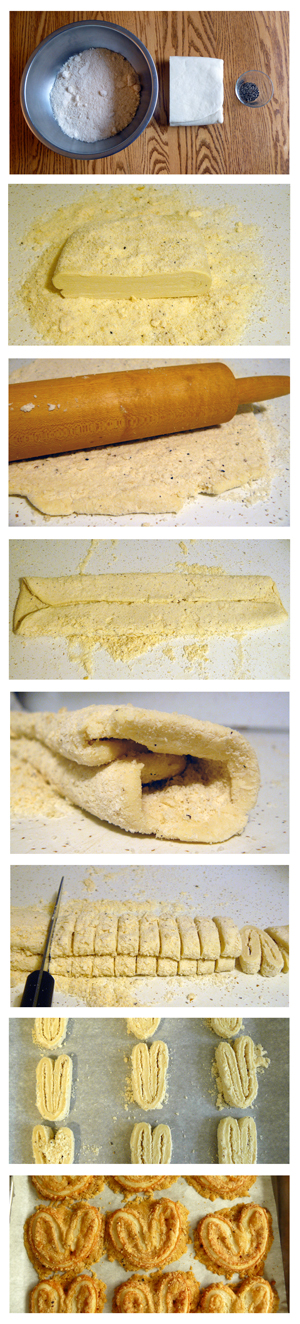
Combine the pepper and the cheese.
Spread some of the cheese on a counter, then put the puff pastry dough on the cheese and sprinkle more cheese on top.
Roll the dough into an oblong rectangle, until the dough is about 1/8″ thick.
As you roll, add more cheese until you’ve added in as much as the dough will take.
Take the outer lengthwise edges of the dough and fold them so that they meet in the middle.
Fold the dough in half lengthwise, so that you now have four layers of dough.
Cut the dough into 1/2″ slices.
Place the dough on the parchment-lined baking sheet. They will expand to get wider, but not taller, so leave plenty of room on either side of each palmier.
Bake in the pre-heated oven for 20-25 minutes, until golden and bubbling. Rotate the baking sheet in the oven every 5 minutes to ensure they brown evenly.
Let cool – at least enough so that they won’t burn your tongue.
If you don’t eat them all right away, store in an airtight container for up to a week, or freeze for up to two months.
Yield: about 30 palmiers
Month: May 2012

One thing I can say for sure about visiting Hungary and taking up the cause of Hungarian cooking is that I’ve eaten more poppy seeds in the six months since we got back than I have in the previous six years put together. Hungarians put poppyseeds into almost everything—sweet and savory alike. On top of my list is this super simple, but extremely delicious, sweet noodle dish. Hungarians of all ages seem to love it. And having made it a fair few times now, I can see why.
To quote Gábor Bánfalvi, our very excellent Hungarian guide on our recent trip there, “Mákos tészta is an everyday Hungarian dish. Poppy seed, as you must have seen, is very important for our cuisine. Kids eat mákos tészta from nursery school to university cafeterias. It is more of a weekday dish, usually comes after a simple soup, like gulyás, or vegetable soup. As with any home-style dish there are dozens of versions—everyone’s mother, I can tell, has a bit of a different take. Basically though it’s hot egg noodles tossed with lots of poppy seeds and sugar. Generally the fat the noodles are tossed in is melted butter, but I’ve seen recipes that call for vegetable oil and others that laud the use of lard.”
Like so many of the foods I find most pleasing, mákos tészta is really quite simple to make. The sort of thing you could throw together after a long day’s work, or for a quick lunch, or I suppose, even breakfast. Just boil some good egg pasta until al dente. Toss with a decent bit of melted butter and lots of ground poppy seeds. (It’s easy to grind them in a coffee grinder at home. Poppy seed grinders pop up as frequently in Hungarian kitchens as cheese graters in Italy—i.e., pretty much everywhere. The standard ratio of poppy to sugar is one to one. I skipped the sugar and used vanilla syrup. I like the lilt of the vanilla and it’s easy to use. Or, you could also use vanilla sugar, one to one with the poppy seeds. To quote Gábor again, “The poppy seed is always ground and mixed with finely ground sugar. In our house my mom always ground the seeds together with crystal sugar in her small coffee grinder, just before lunch, so it was really fresh. Now instead of sugar I put honey on the pasta, which is really good.”
In terms of how much poppy seed to use, I’ll just say that the Hungarians use a LOT. So much so that really the dish looks like it’s been dressed in some sort of pale blue-black sweet poppy seed “pesto.” If you keep the sugar/syrup levels low, you can actually eat it for a main course. I’ve doctored it up a couple times with a bit ricotta cheese and/or toasted walnuts. In any case it’s basically an uncooked noodle kugel.
Speaking of walnuts, there’s a comparable Hungarian dish that calls for ground walnuts to be used in place of the poppy seeds. You can also do it with walnut oil instead of butter. Or, in the spirit of lemon poppy seed cake, you can use the lemon olive oil we get from Italy instead of the butter—that’s also quite delicious!
Going back to Gábor: “My kids love mákos tészta and it is usually the first thing they ask for when they visit their Hungarian grandma. They could eat it everyday. It is a simple dish, but with freshly ground poppy seeds, honey and homemade pasta you can bring it to a different level.” I can see why they love it. Mákos tészta is sweet, warm, comforting and super delicious!