
Month: May 2012
Butter has a fairly low melting point – around 95°F. Shortening, on the other hand, melts around 118°F. It’s easier to make puff pastry with shortening because there’s less risk it will melt, eliminating the need to keep cooling the dough between rounds of folding and rolling.
But have you ever tasted shortening by itself? It’s made from mostly flavorless vegetable oil that’s been hydrogenated to make it a solid. What little flavor it has isn’t pleasant. And unlike butter, which melts so nicely on your tongue, shortening has a kind of sticky, gummy texture – after all, your mouth isn’t warm enough to melt shortening.
Puff pastry dough uses more butter than anything else – one batch calls for 1.21 pounds of butter and 1.07 pounds of flour. Using shortening results in a pastry that lacks the rich flavor and delicate, melt-in-your-mouth texture achieved with butter.
When choosing a butter, look for one that’s unsalted. In addition to giving you more control over the level of salt in your baking, butter is sold by weight, and salt is cheaper than butter. The more salt has been added to the butter, the less butter you’re actually buying. When possible, it’s also a good idea to choose a butter with a higher butterfat content. Legally, butter must be at least 80% butterfat by weight (the rest of the weight being water and, if it’s salted, salt). Butters with higher butterfat are creamier and create more luscious textures when you cook or bake with ’em. At BAKE!, they recommend Plugra, which has 82% butterfat.
By the way, lard’s not a great option for puff pastry either: the melting point for real lard is around 86°F, making it even tougher to work with. I bet it would be tasty, though!
Month: May 2012
As you’ll quickly be able to tell from either the headline or reading even half of what follows, I’ve got Hungary on my mind, and, increasingly, in my heart. What follows is just a taste, a glimpse, my initial sense of an incredibly interesting cuisine, complex culture and engaging history. In the last few years, I’ve learned a bit, but I feel like I have about two lifetimes of more learning to do. I may just be at the beginning, but I’m very excited. Sorry for the pun, but I’m hungry for Hungary. What follows are a few featured “courses” from my first year of study. I’m far from fluent in Hungarian culture but if enthusiasm and interest count for anything I’m well on my way—our future at Zingerman’s holds many good, and very flavorful, Hungarian things to come.
I Wish I’d Met George Lang
There are a thousand ways to approach the complex world of Hungarian food. I entered it first, rather casually at the time, many years ago through the writing of George Lang and his 1971 classic, The Cuisine of Hungary. Even if I wasn’t yet as fascinated by the subject as I am today, it’d have been hard not to take notice. “The subject of this book,” Lang begins, “is the cuisine and wines of a comparatively little-known country which has had the misfortune that the little that is known about it is generally pseudo folklore with a lot of gypsies playing into the ears of contented tourists while they eat the red-hot ‘goulash.’” Lang’s intro had me hooked. And while I’ve learned only a little about the difficult-to-master Hungarian language, I have learned quite a lot about George Lang.
At the time I first cracked open his book, I really knew very little about him. Back when we were getting the Deli going in the early ‘80s he was one of those people who everyone knew about and who clearly had enormous positive influence on the culture of food and cooking in America. Like a kid learning to play basketball who looked up to someone like Michael Jordan, I admired George Lang. He was someone who seemed to have attained international success at a level that was almost unimaginable to me. I was intrigued, but as a shy 25-year-old just getting started in the food business I wasn’t about to pick up the phone and call one of the most renowned of restaurant consultants. I wish I had.
Sadly, I waited too long—George Lang passed away last summer at the age of 86. My mistake. I actually had plenty of time to have taken action on my desire. When we opened the Deli back in 1982, he was living in New York and was actively involved in running the classic Café des Artistes. He stayed active in the food world up until his death. While I truly like to learn from everyone—eight-year-olds, world famous experts and everyone in between—George Lang was the sort of man I really look up to. While many people are good at one or two things, he was clearly multi-talented and very much multi-faceted; he lived a life that was loaded with travels, travails, achievements and insights. George Lang lived a long time and he pretty clearly seems to have kept learning through it all, at least up until he began to suffer from Alzheimer’s in his last few years. From what I can tell, George Lang always had his own way of doing things. He didn’t give in to everyone else’s opinions every time they pressured him to conform and he brought a lot of pleasure to other people’s lives. Writer Rozanne Gold, who did get to meet Mr. Lang, said he was, “brilliant, urbane, cultured, a story-teller, clever. I believed he felt his role in daily life was to amuse and ignite the imagination of others.” And she went on, “George Lang emanated brilliance. Whimsy. A life of the mind and of the senses. He even invented a few of his own.” Like I said, he seems like my kind of guy. If he’d been a bit younger, it’s not really that much of a reach to think that we’d have connected and that I’d have taken my first trip to Hungary with a list of tips that he’d emailed me before leaving.
While I might like to have entered the world of Hungarian food with Mr. Lang on my arm, I did do it with his insight in hand. Like so many things in my life, I suppose my admiration and interest in his work and his life started with a book—in this case, the above-mentioned, 500-page classic, The Cuisine of Hungary. It has long been one of my favorites. If I had to move into an efficiency apartment and could only take, say, seventy or eighty books with me (the “only” in there ought to give you some sense of how many food books I actually have), Lang’s would be one of the top picks on my list. Which, now knowing a bit about him, is probably one of the highest quality compliments that I could pay—the man had had over 3000 cookbooks in his personal collection.
There was, of course, a lot more to George Lang than his book. The man that I know as George Lang was actually born György Deutsch in 1924. He grew up in an academically oriented, Jewish-Hungarian, kosher-keeping home in the easy to remember, very simple to spell (just kidding) town of Skékesfehérvár, about 35 miles from Budapest. In 1944 the family was sent to labor camps by the Nazis. His parents died in the camps, but György got out and made his way to the U.S in 1946, where he changed his name to George Lang. Given the literal meaning of the surname he’d been born with—“Deutsch” means “German”—it’s not that hard to see why he chose to change it. “Lang” was his mother’s maiden name. Here in the States he went on to become one of the country’s great restaurateurs and wrote beautifully about Hungarian food and other subjects. He helped open over 300 restaurants in nearly 30 countries, best known of which was the above-mentioned Café des Artistes in Manhattan. In 1992 he traveled back to Budapest to renovate and restore Gundel, the Hungarian restaurant landmark that had fallen into disrepair. He was one of the real pioneers of the restaurant world in the modern era. His work with the firm Restaurant Associates and with his own restaurant, Café des Artistes, was well ahead of the curve.
George Lang’s legacy is one of pace setting, scene changing, trend taking, and history teaching. It is food-oriented and very rooted in culture and tradition. Here’s what the Village Voice wrote about him following an interview a few years ago: “George Lang, at 83, seems to have lived several lives, many happy, and some incredibly difficult. Over the course of an hour or so, Lang talked about being a child violin prodigy and eventually playing with the Dallas Symphony Orchestra. As a teenager, he was a 100-meter running champion. Later he escaped Hungary, where his entire family perished in the concentration camps. At 21, Lang came to New York and rented a bed in Hell’s Kitchen while working as a dishwasher, then later as a saucier at the Plaza and a manager at an Italian wedding factory on the Lower East Side. He is an impressive calligrapher, a former Fulbright Scholar in Italy, and a writer at Travel + Leisure; he ran the Four Seasons; and, of course, he revived the Café des Artistes and became the first international restaurant consultant. Oh, and last Christmas, he hung out with the pope. What did you do?” Like I said, I wished I’d made the effort to meet the man.
I can only smile to tell you that he, like me, started his food service work as a dishwasher. If I can take my work to the same sort of heights George Lang did by the time he died, I’ll feel pretty satisfied. Asked what he would have at a theoretical last meal, George Lang gave a rather lengthy and detailed answer. Much of what he listed were dishes from his mother’s kitchen: fisherman’s soup, stuffed goose neck, sour cherry soup, layered cabbage, stuffed peppers, plum dumplings, pancakes with apple meringue, and whipped-cream strudel. “And then,” he said, “I will have what it takes to get to another world.”
What George Lang listed as part of his last meal is but a small bit of the country’s fascinating food and cooking. You’ll know that just by picking up his book. The Cuisine of Hungary isn’t a quick read. It’s nearly 500 pages long and my old, green-dust-jacket-wrapped, hardcover version probably weighs about a pound. And yet, as long as the book is, Lang wrote in his introduction that “Much of the fascinating material (I’ve researched) is too abstract or specialized, and with sadness I had to take out much more material than I left in the book.” That alone should give you some sense of how interesting and complex Hungarian cooking is. If a man with the insight and intellectual ability of George Lang was so exceptionally fascinated with its food . . . well, you know that Hungarian cooking is no minor league cuisine.
Month: May 2012
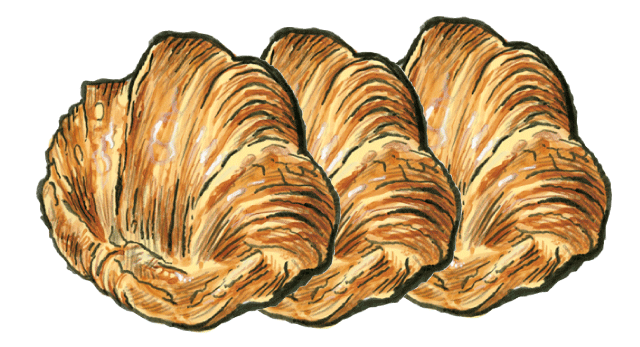
Recently, I attended the puff pastry class at BAKE!, the baking school run by Zingerman’s Bakehouse. I learned a lot about how to make great puff pastry and what to do with it, and I’ll have more to say about that soon. But for now, let’s start with the basics.
How is puff pastry different from regular pie dough?
Ingredient-wise, they’re very similar: butter, flour, water, salt, and a smidgen of lemon juice. The difference is in how the ingredients are mixed together. In standard pie dough, you cut the butter into the flour, then stir in ice water until it forms a dough. For puff pastry, you make a butter-based dough, and a flour-based dough, and then you wrap the flour-dough around the butter-dough. Then you roll out the dough into a long, thin rectangle, fold it in three like a letter, and repeat. In total, you roll and fold five times. Fewer than five rounds won’t make enough layers; more than five and the layers will start to smudge into each other.
What makes the pastry puff?
All that folding creates the dozens of paper-thin layers of flaky pastry. It’s those layers that make the pastry puff: when it bakes, water evaporates from the dough and tries to rise as steam, but it gets trapped between the layers of dough, creating the rise.
As you work with the dough, the butter gets warmer. If the butter melts, it will mix into the flour dough, combining the distinct layers you’ve worked so hard to create. If the layers meld together, the pastry won’t puff. To avoid this, it’s good practice to let the dough rest in the fridge between rounds of folding and rolling.
Month: May 2012
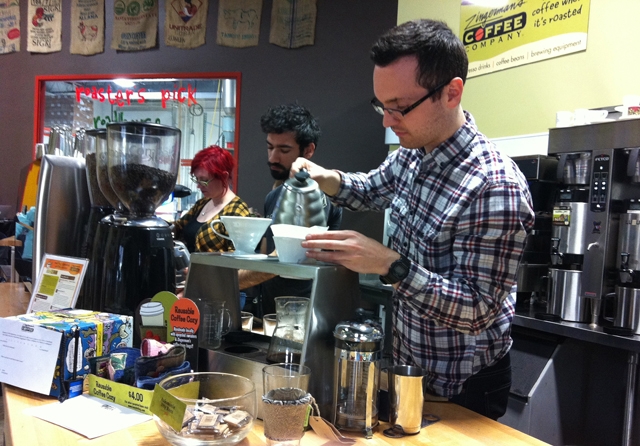
The baristas at Zingerman’s Coffee Company at the Southside are a fun bunch of people to hang with during a mid-afternoon break. We found them all working today so we took the opportunity to ask them a few silly questions.
How do you like your coffee?
Nathan: Espresso.
Matt: Right side up.
Anya: At 2pm.
Chris: Unground green eaten like popcorn.
Har har. Okay, now seriously.
Nathan: Honduran Finca Liquidambar using an inverted AeroPress with a metal filter.
Matt: Guatemalan in a press pot.
Anya: Monsoon Malabar Indian as a Turkish coffee without sugar.
Chris: Depends on the coffee, but I’ve been high on the Ethiopian as a Clever recently.
How long have you been a barista?
Nathan: 4 years.
Matt: 9 months.
Anya: 6 years.
Chris: 2 years.
Any interesting stories from behind the counter?
Matt: An AeroPress exploded on Nathan once.
Nathan: Always make sure the filter is locked.
Chris: Mostly just shaming Nathan with my obvious super skills (sarcasm).
Anya: One time I pulled a ton of espresso shots and had to drink every shot. I lost count after 18.
Why would you do something like that??
Anya: I had to do it until it was good.
When you visit a cafe, what do you look for?
Anya: Jazz music playing. Only jazz music. Also I found that if a place smells like cigarette smoke, the espresso is usually good.
Matt: A bathroom.
Chris: This is kind of shameful, but I immediately look at the espresso machine and whether or not they have manual brew methods.
Nathan: Tight jeans, plaid shirt, forearm tattoos. Oddly enough, none of the above applies to me.
(Matt has two out of three today.)
If baristas were rockstars, what would your names be?
Nathan: Natro the Destroyer.
Anya: Big muscle-y barista girl?
Matt: I don’t have a name yet.
Anya: Matt needs a title. We should give him one right now.
Nathan: Long pour.
Matt: Yeah. Matthew “Long Pour” Bodary.
Nathan: Chris already has one. He’s Denver. A customer said he looked like a Denver and it stuck.
Chris: Though I’ve been called “The Kid” occasionally as well.
What other cool skills do you have other than making awesome coffee?
Matt: I can play the guitar. Chris can do nunchucks.
Anya: And the lindy hop.
Chris: And bike repair. And gee-tar.
Anya: I can do a fireman’s carry in wrestling.
Nathan: I’m a hopper. I can hop over stuff really good.
Anya: He has natural born parkour skills.
Next time you come in, stump them with an interesting question of your own!