
Month: February 2013
 2012 has been a year of much change at ZingTrain. We moved into our first-ever dedicated training space. We hired two wonderful new folks to join the ZingTrain team. We hosted our first guest speaker. And launched our series of free monthly call-ins. And that’s just listing the big stuff!
What has remained reassuringly consistent in 2012 is the core curriculum of our training, the foundation of all that we do here at ZingTrain – sharing Zingerman’s unique and uniquely successful approach to business through our seminars, workshops, and custom training.
It has been absolutely wonderful – during this time of much change – to hear over and over from our clients and seminar attendees that they find our training relevant, resonant and applicable, no matter what industry they work in.
Curricular Core and Constancy.
The intent behind ZingTrain and the ZingTrain curriculum has always been to share the tried and tested recipes, tips, techniques, and concepts that have worked for us over the years, and that we believe to be key to Zingerman’s success as a business.
Not surprisingly, the core content of our seminars and work- shops comes from material that is already being taught – formally and informally – to our staff. For our external seminars, we add content (and behind-the-scenes tours of our businesses) to make the Zingerman’s mission, values and culture explicit so that you can absorb our materials in the appropriate context – something we don’t do as formally in our internal training since our staff live in, are part of, and in fact create, our culture.
“Such an exceptional class. I loved the panel, Ann and Joanie did a wonderful job. Both days. Food was great. Room was comfortable. Information was life changing and applicable to all areas of my life.” – Seminar attendee from U of M Hospitals and Health
Way back then, when we opened our doors 18 years ago, the ZingTrain seminars focused on the content we felt most confident in: The Zingerman’s Experience seminar – an overview of who we are and what makes us tick. The Art of Giving Great Service, which is based on an internal class of the same name that is still taught to every single employee we hire. Bottom Line Training, where we reveal our Training Compact, which is all about how to develop and administer training that positively affects your bottom lines and Award-Winning Merchandising, which was all about how we create our unique, nationally recognized look and feel.
Curricular Change.
With time, came change. In several different ways.
Teaching is the fourth level of learning. A happy outcome of creating and teaching our seminars was that as we taught the material, we learned it in a new way! So we tweaked the material to make it better – and then realized that we could and should – make those same changes to our internal training. And so the material evolved.
Some of the curricular changes were driven by recurring questions from seminar attendees that we did not have the time to answer meaningfully during the seminar. For example, Working with Zing!, which addresses HR related questions, was born from questions that we encountered most often in the Art of Giving Great Service and Bottom Line Training seminars.
But, true to our core intent, it wasn’t until we had had a strong Human Resources manager at Zingerman’s for several years that we launched a seminar that shared our (now tried and validated) HR systems with other businesses. It was much the same with our Fun, Flavorful Finance seminar. To launch that one, we waited until we had successfully practiced Open Book Management for a few years and deeply and organizationally understood the resources and training needed to make it succeed.
“Good practical solutions. Very welcoming and a great positive environment. Nice to be around other like minded people with similar issues.” - Seminar attendee, June 2011
Other Changes Are Driven By, Well, Change.
In 2010, Ari wrote the first book in the Lapsed Anarchist Series: Zingerman’s Guide to Good Leading – A Lapsed Anarchists Approach to Building a Great Business. In it, he articulated the 12 Natural Laws of Business. The more we used and taught the 12 Natural Laws within the day-to-day work we were doing at Zingerman’s, the more we realized that they were the distillation of all that we were doing here. And so The Zingerman’s Experience seminar was redesigned to be based on the foundation of the 12 Natural Laws of Business.
Evolution is also how the Award-Winning Merchandising seminar became the Zingerman’s Marketing Secrets seminar. When we first offered the seminar, it was focused on merchandising because merchandising was what we did. We barely did any intentional marketing – a few ads here and there – but really much more of a focus on in-store displays and signage. Over the years we started doing more Marketing (though not advertising, we’re still not big on that). We hired a Marketing Manager and became far more intentional about our presence in the media and leveraging it. And as we evolved, the seminar evolved too.
As media evolves yet again, we’re getting more and more questions about online and web-based marketing. While we can share our approach to those in the seminar, we know we are not the experts – so we are partnering with an Ann Arbor company, The Whole Brain Group, whose primary business is helping companies attract clients and customers online.
And So, Back To The Curricular Core.
The more we teach, the more we recognize that there is never enough time to cover every single thing we want to teach in any one seminar. We strive, then, to identify what information will create the most value to the most diverse group of attendees. And then we design the presentation of that content so that during any given seminar we have the flexibility to present additional material or explore a slightly different path to suit the inclinations of a certain seminar audience or client.
At the end of the day, however, the core of what we are trying to do here at ZingTrain is not at all about telling you what you should do. It’s all about telling you what we do, why we do it, and how we do it. And we want to tell you in a way that makes it easy for you to absorb it and then adapt it, and if it is a good fit, apply it when you go back to your business.
“These 2 days have clarified who I am, what I do best, and how I’ll be moving forward in my next 5 years of business and life, and I am incredibly thankful. Thank-you!!! I can- not recommend them highly enough. Plus, the food will rock your world. — Mark Matson, Norwegian Squeegee – Meticulous Window & Gutter Cleaning, www.hireaviking.com
And what we like best about having that as the core of who we are is this: when you go back and apply what you’ve learned to your business, and then tell us all about it, we see our own systems and tools used in a whole new way, and then we learn from you! And implement your learning to our business, and a brilliant cycle continues …
Join us for a seminar in 2013. Connect with us and tell us how you’ve implemented what you learned from us. Feed the learning cycle!

Month: February 2013
Zingerman’s Food Tours is about connecting with people and places through the food. We take a small group, settle in, and explore a cuisine and culture. We eat, we talk with the locals, and we learn directly from the artisanal food and wine producers about what they do. On our tours, you’ll go behind the scenes and learn from the locals about what makes the food so special. Come find out for yourself!
2013 Tours
Traverse City/ Leelanau Peninsula, MI
*Our first domestic tour!
May 17-19
A very special 3-day tour, packed full of tasting, eating, drinking, and learning about great food and beverages directly from the artisans who make them! These producers will open their workshops to us and share their passion for what they do. The local food scene up there is thriving – from farmers and cheesemakers to chefs and winemakers, everyone we talk to in that area is really excited about what’s happening and how vibrant, and delicious, their local food web has become.
Piedmont,Italy
September 25-October 3
We’ll dine on regional specialties, and we’ll
go behind the scenes and learn about some of the wonderful products of the region, such as risotto, chocolate and nougat, cheese, polenta, grass-fed beef, the elusive white truffle, grappa, and of course the wide variety of wines, from the big reds such as Barolo, to the sparkling whites. And we’ll put on our aprons and get
a hands-on cooking class directly from a Piedmontese chef!
Tuscany
October 6-14
We’ll visit traditional small producers of some of the region’s finest foods – from the massive wheels of Parmigiano-Reggiano, to the beautiful, small bottles of real balsamic vinegar, from Chianti Classico wines and artisanal olive oil to the melt-in-your-mouth prosciutto crudo. And we’ll roll up our sleeves and enjoy Tuscan cooking lessons in a 15th century villa in the rolling hills outside of Florence.
Hungary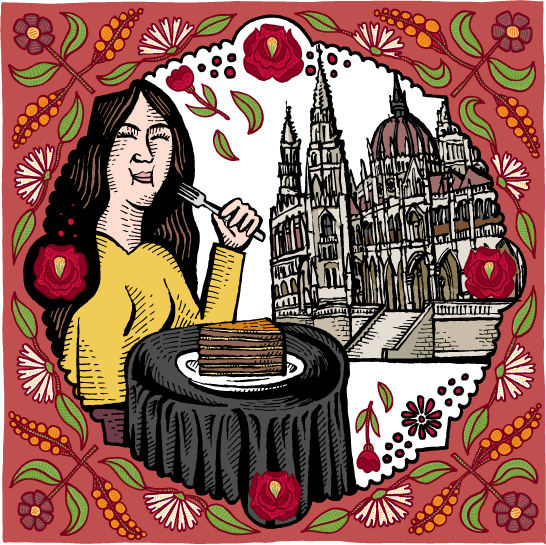
October 15-25
We’ve been blown away by the amazing artisanal food of Hungary and by the warm welcome of its people, and we want to share them with you! Hungary has an incredibly rich and varied food tradition reaching back at
least 1500 years, including an Eastern
European Jewish influence. From the regional cheeses, wines, cured meats, and bountiful produce, to the incredible breads, pastries,
and elegant multi-layered tortas, Hungary has
it all.
Visit our website for more information about our tours. Or find us on Facebook. We’d love to hear from you!
Zingerman’s Food Tours
phone: 888-316-2736
email: foodtours AT zingermans dot com

Month: February 2013
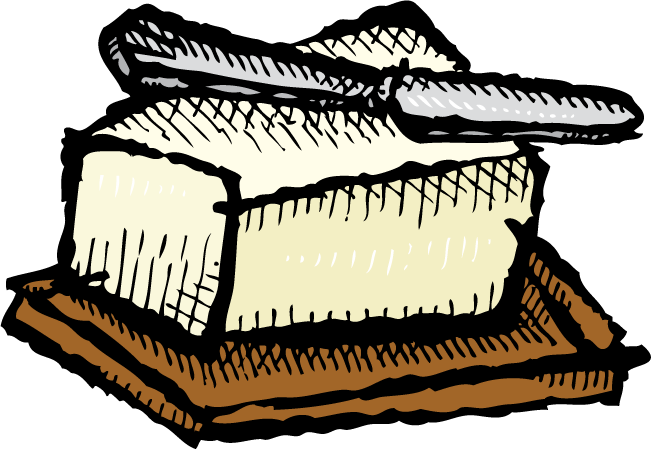 Add this new arrival from Western Wisconsin to the already long list of delicious butters we’ve got at the Zingerman’s Deli. This one comes from the Alcam Creamery in the town of Richland Center about an hour northwest of Madison. The creamery was started in 1946 by Cameron Peckham and is run by his son Gary. The butter is still all hand rolled and paper wrapped in the old style which means that, even before you taste it, it definitely looks appealingly old-school!
More importantly it tastes great. It’s got a very big flavor, one of the biggest I’ve had in a butter. The whey cream makes a big difference—because the whey is taken off after the cheese curd has been set, all of the cultures and flavor development from the cheese will be carried out in the whey as well. when the whey solids are formed (through slow cooking of the whey) they have a whole lot of flavor. Ultimately, this is butter so tasty you could probably eat it by the piece sans bread. In fact, I find myself putting it on bread in much bigger quantities than I normally would. Less of a spread, more of a slice—in a good way, this may be the cheesiest butter you’ve tried.
No need, I don’t think to tell you what you can do with it. Anything you do with butter . .. will be better with better butter. So whether it’s this wonderful offering from western Wisconsin or the Kerrygold butter from Ireland or the cultured butter from our friends at Vermont butter and cheese, the main this is to eat it! cook with it! Bake with it! Roast with it! Whatever you do, better butter will be sure to taste better!
Month: February 2013
This month’s Roaster’s Pick, Honduran Microlot-Filadelfo Jaurez, comes via our friends at Union Microfinanza.
This is the second year that we’ve worked with our friends at Union Microfinanza to directly purchase Filadelfo Juarez’s crop. We continued to taste coffees from many small producers in the same region and once again this was our favorite. This delicious coffee features notes of grapefruit, honeysuckle and tropical fruit.
It is a good example of “direct trade.” What that means to us is that Union Microfinanza has showed us the contracts with the farmers. We know what the farmer was paid, what the mill was paid, and what the exporter was paid.
More importantly, we are purchasing the lot from a single farmer, and his work with Union Microfinanza has led to better quality for which he is a paid a premium by us. It’s a true success story.
Below, you’ll see a transcript of a video made by Union Microfinanza. In it, Filadelfo is trying a cup of his very own coffee crop, roasted by Zingerman’s Coffee Company, for the first time. The link to the video is below the transcript.
The three of us stand outside his doorway, armed with a Chemex coffee maker, a scale, a blender, and Filadelfo Juarez’s Zingerman’s-roasted coffee tucked away in our bag. I’m with Patrick and Martir, members of the Unión MicroFinanza team in Honduras, and we’re about to have a cup of coffee with Filadelfo Juarez.
Filadelfo, or Fito, works for the public schools in the area of La Unión, Lempira, Honduras. He was an elementary teacher for eleven years and now holds an administrative position. He also grows coffee. Good coffee. He owns a small amount of land outside of town and harvests it during the school break. That means that during his vacation, he’s up at 5, kisses his wife and two young kids goodbye, piles coffee pickers into his truck, and drives up through the lush mountains to his fields. We are at his house to give him some of the coffee picked last year, roasted by Zingerman’s in Ann Arbor, Michigan.
He invites us into his home, with simple concrete walls, humble furnishings, and a telenovela playing on the TV in the background. His two children run up to greet us. All shake hands, exchange greetings, and then we tell him why we’re here. We bought coffee from him last year, which means his hard work was rewarded with a fair price instead of the tragically low prices imposed on farmers here in Honduras. Moreover, his coffee was roasted and sold at a fantastic store in the United States, in Michigan.
That’s when we pull out the bag, the 12-ounce brightly colored Zingerman’s bag with Fito’s name written across the front label. His face lights up as he gingerly takes the bag from Patrick, runs his fingers across his name, and asks us in Spanish, “This is my coffee?” Farmers in Honduras usually don’t know where their coffee ends up in the world, let alone get to see it beautifully packaged with their own name right on the bag.
Fito’s grinning, and we are too.
He calls his wife over to look at his coffee and they both touch it, ask more questions about it. Where exactly is it sold? This is the coffee we sold you last year? Bags just like this are sold in Michigan? I mention how his coffee was actually the coffee of the month at Zingerman’s, and Patrick describes the sign in the store that says “Honduran Microlot-Filadelfo Juarez”.
We decide to prepare some coffee then and there, and Fito has the honor of opening the bag. He tears it open with a knife and smells it, inhaling deeply. He passes it to his wife so she can smell it too, and then they scoop some out in a spoon for their little girl. She stands on her tiptoes to smell her dad’s roasted coffee. Still grinning, Fito says that it smells delicious.
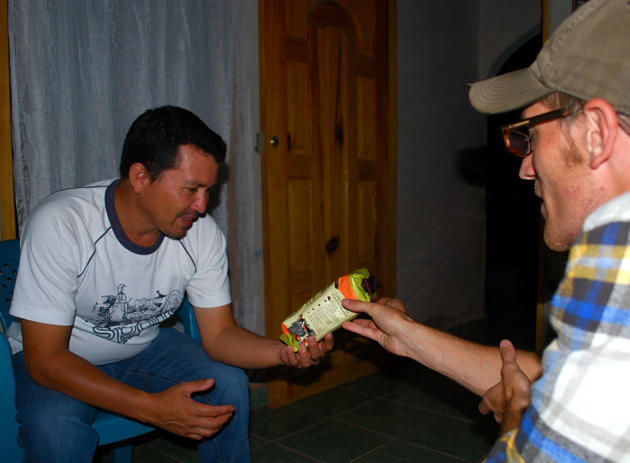
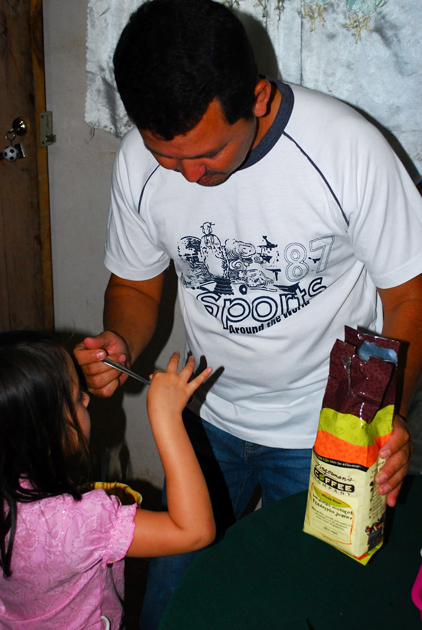
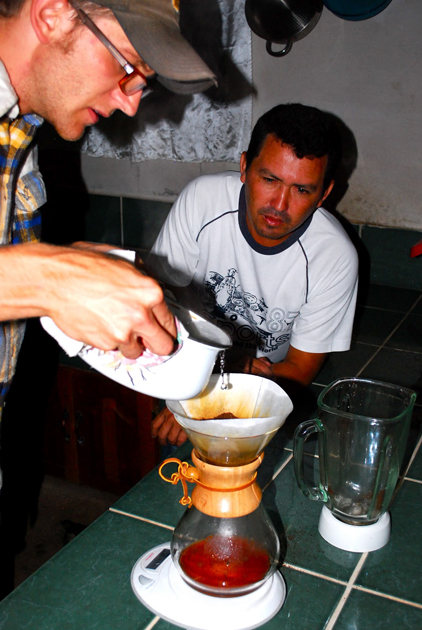
Fito is first. He sips carefully and smiles, and then we give his wife the next cup. Our cups come next. I ask Fito what he thinks his coffee tastes like. Before he responds, his wife claims in surprise that the coffee isn’t bitter at all, that it’s remarkably smooth. We all agree. We acknowledge the floral hint of honeysuckle, giving the coffee a delicate sweetness. And then we turn to Fito for his response.“
Well, this isn’t café de bolsa.” Fito is chuckling, and we are too.
We stand around the kitchen, savoring what is surely the best coffee this household has ever had. We review the flavors, the grapefruit, the honeysuckle again, and over and over they mention how unbelievably smooth this coffee is. No sugar needed. We’ll leave the rest of the coffee with Fito, so he and his family can continue to smell it, drink it, display it, enjoy it. I’m glad I tucked his coffee into my suitcase the day before I left; seeing Fito and his family’s reaction to their own coffee, beautifully roasted and packaged and prepared, is a humbling experience.
We settle into the small patio outside, chatting as we sit on plastic chairs. Fito tells us about how he’s going back to work in a week and describes this year’s harvest. Instead of the gradual maturation of his coffee, all of it seems to have matured at once. While that means he gets to pick almost all of his coffee before returning to work, if rain comes in and delays coffee picking, his livelihood could be destroyed in a matter of days.
The fragility of it all strikes me. It’s especially powerful to process while I’m sitting in Fito’s house, accepting coffee and fresh watermelon from his wife, watching his children play, realizing that much of this situation would be different and could be different due to a few days of rain, sun, or any other small and uncontrollable circumstance. Fito’s hopeful that the weather will hold out. He’s especially excited, too, because he claims that this year’s harvest is going to be even better than last year’s. I think of the amazing coffee we just shared with him and imagine the possibility.
I cannot wait for my next cup of coffee with Filadelfo Juarez.
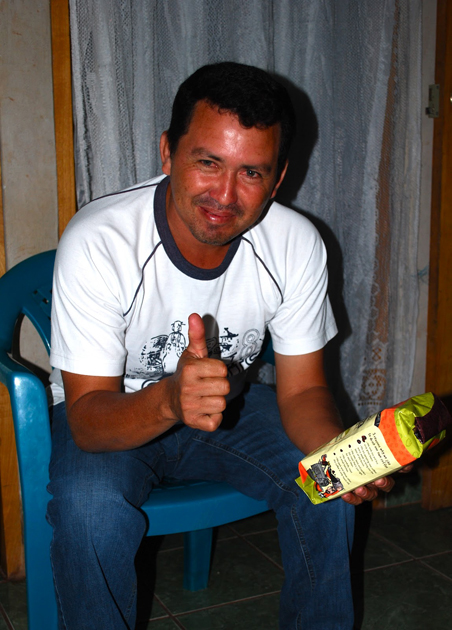
Watch the video here.
Month: February 2013
Join Zingerman’s Creamery Managing Partner Aubrey Thomason this coming Friday, February 15, 7 p.m. at the Ugly Mug Cafe & Roastery for a very special presentation on the process of traditional cheese making using locally sourced Michigan milk.
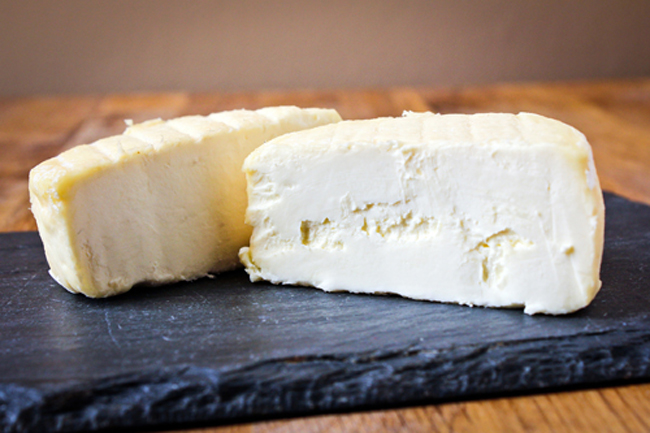
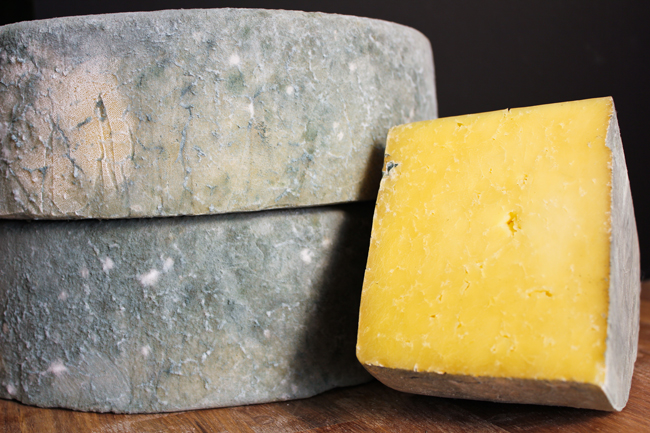
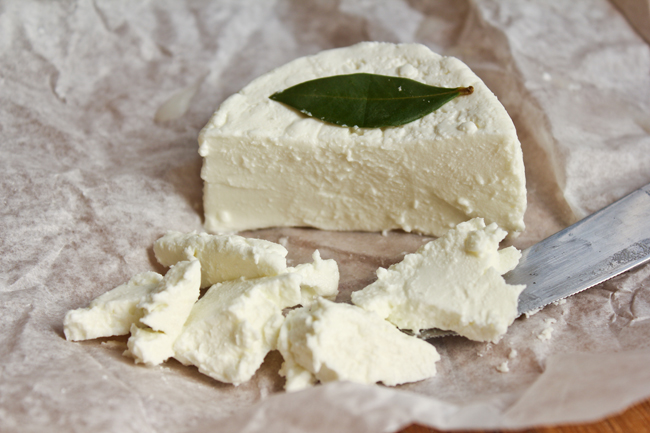
Aubrey will bring cheeses made at the Zingerman’s Creamery using milk sourced from small-scale goat, and rare breed cow’s milk dairies. Among the cheeses available at the tasting will be our delicious Chelsea, City Goat, Manchester, Cheshire, and Detroit Street Brick.
Learn about the science behind handcrafted cheese making, and sample some of best cheeses available from the Creamery.
Please RSVP with Kayj Michelle: [email protected]
There is a suggested $5 donation per person, but you get free cheese!
Month: February 2013
“So, fall asleep love, loved by me… for I know love, I am loved by thee. ”
— Robert Browning
This coming Thursday, February 14th, is Valentine’s Day, a holiday that we associate with romantic love, flowers, and candy. But, how and when did this holiday begin? And why do we celebrate l’amour with Valentine’s Day cards and gifts of sweets?
Valentine’s Day, or more accurately, Saint Valentine’s Day, (or the Feast of Saint Valentine) began as a liturgical festival celebrating the life of one or more early Christian saints named Valentinus. According to early church history, there were several martyrs who went by the name Valentinus, but there are three specifically celebrated on February 14:
- Valentine of Rome was a priest in Rome was martyred about AD 269. His flower-crowned Skullof Saint Valentine is exhibited in the Basilica of Santa Maria in Cosmedin, Rome.
- Valentine of Terni became bishop of Interamna, and was martyred about AD 197 by Emperor Aurelian.
- The Catholic Encyclopedia also speaks of a third saint named Valentine who was martyred in Africa on February 14. Not much else is known about him other than his head was preserved in the abbey of New Minster, Winchester and venerated as a holy relic.
A popular legend surrounding Saint Valentine concerns his arrest for performing Christian marriages and spreading the ministry. Condemned to death, he was imprisoned, and while awaiting execution he is said to have healed the blind daughter of his jailer. Just before he was led away, he wrote her a farewell note, which he signed, “Your Valentine,” thus providing the inspiration for our tradition of Valentine’s Day notes.
Another legend says that Saint Valentine performed clandestine marriages for Roman soldiers, who were forbidden to marry at that time. In order to remind the soldiers of God’s love and to remind them of their Christian vows, Valentine cut paper hearts out of parchment, giving them to the soldiers and other persecuted Christians. This is often cited as a possible source for our use of the heart as a symbol of Saint Valentine’s Day.
The first recorded association of Saint Valentine’s Day with romantic love comes from the medieval English poet Geoffrey Chaucer in his Parlement of Foules (1382):
“For this was on seynt Volantynys day
Whan euery bryd comyth there to chese his make.”
(“For this was on Saint Valentine’s Day, when every bird cometh there to choose his mate.”)
Chaucer wrote the poem to commemorate the first anniversary of the engagement of King Richard II of England to Anne of Bohemia, both just 15 years old at the time of their wedding. Several other medieval authors mention Saint Valentine’s Day, including Shakespeare, and John Donne. But, it was Edmund Spenser in The Faerie Queene (1590), who supplied the an early version of ‘roses are red’:
“She bath’d with roses red, and violets blew,
And all the sweetest flowres, that in the forrest grew.”
Clearly, the words resonated, because we then see the recognizable form in Gammer Gurton’s Garland (1784), a collection of English nursery rhymes:
 “The rose is red, the violet’s blue,
The honey’s sweet, and so are you.
Thou art my love and I am thine;
I drew thee to my Valentine:
The lot was cast and then I drew,
And Fortune said it shou’d be you.”
From there, it was just a small step to 1797’s The Young Man’s Valentine Writer, a compilation of verses intended for use by those unable to compose their own sentiments. Eventually, printers began to reproduce these verses on card stock with romantic illustrations, creating the first direct ancestor of our modern Valentine’s Day card.
Since that time, Saint Valentine’s Day has established itself as a significant holiday, and traditions have expanded to include gifts of flowers, candy, treats, and many other affectionate tokens. And while the focus of the holiday may have shifted over the centuries from a liturgical expression to a gesture of love and affection, the current sentiment is clearly a treasured tradition that shows no signs of fading.
We’ll leave the flowers and cards to their respective industries, but we know a little something about good food. And Zingerman’s has many delicious sweets and treats available to help make your Valentine’s Day memorable.
The Zingerman’s Bakehouse will make you a delicious Valentine’s Day Cake, completely covered in hand-piped pink butter cream rosettes and a sprinkle of sparkle. Inside are tempting layers of buttermilk chocolate cake and a kiss of strawberry butter cream filling. We also have Valentine’s Day Heart Cookies, delicious butter cookies with a hint of fresh citrus zest, and adorably decorated with fresh vanilla fondant that spells out expressions of love and affection. Or, perhaps a loaf of heavenly Chocolate Cherry bread, made with the best Belgian and French chocolates and dozens of Michigan dried cherries!
The Zingerman’s Deli has more delectable Valentine’s Day sweets than a person could possibly eat in a sitting – but it would sure be fun to try! We’re currently taking pre-orders for our wonderful Chocolate Dipped fresh strawberries and Chocolate Covered fresh vanilla marshmallows from the Zingerman’s Candy Manufactory. Available for pickup at Zingerman’s Next Door 2/12, 2/13, & 2/14. Call 734-663-3354 to pre-order.

The Deli also carries a huge selection of luscious chocolates, bonbons, truffles, and many other distinctive confections from Grocer’s Daughter, Chocolate Moderne, Sweet Gem Confections, Chocolate in Chelsea, and Fran’s Chocolates, and, of course, Zingerman’s Candy Manufactory. Let us create a custom gift box for your sweetie!
Don’t forget, you can find Zzang Bars and other Candy Manufactory delights at any of the Zingerman’s businesses! Adopt a delicious Zzang bar today!
“All you need is love. But a little chocolate now and then doesn’t hurt. “
— Charles M. Schulz