
Tag: soup

Featuring incredible red-black pepper from Sanliurfa
While the Bakehouse is known, of course, for amazing artisan bread and pastry, there is a whole other area of culinary activity in which the Bakehouse team quietly excels: soup! While many people around the country can enjoy the Bakehouse bread and pastry through the good work of Mail Order, the soup specialties are solely available to locals! All of the Bakehouse soups are pretty sensational, but my personal favorite over all these years is the Turkey Urfa Chili. For starters, it tastes terrific. Every time I think about making a turkey chili (the soup) with a Turkey chile (the pepper), the double meanings of the words get me going! I love this almost as much as the soup itself!
Urfa pepper, if you don’t know it, is one of the least known, yet most intriguingly delicious, spices on our shelves. If you like big flavor and a compelling but still very manageable bit of heat, come by and taste this terrific product. It’s interesting. It’s intriguing. It’s exceptional. It’s great eating! And it makes magic in this wonderful chili.
In over 40 years of cooking, I’ve seriously never tasted anything like these red-black pepper flakes from the town of Sanliurfa. The town itself is a mix of diverse peoples and cultures: Kurds, Turks, Muslims, and Christians. It has an ancient history and is mentioned in the Bible many times. I first heard about Urfa pepper nearly 30 years ago now, from the amazing cookbook writer Paula Wolfert. (Paula’s books were some of the first that I used decades ago when I started cooking professionally. They remain wholly remarkable today.) Back then, Urfa and many other foods that are now commonly available in North America couldn’t be found outside their home countries.
This Urfa starts with the special large, deep purple peppers (sort of like rounder poblanos) that are typical to the region. They’re picked each autumn when ripe, then cut and slowly dried in the sun. In the evening, they’re wrapped up in blankets or tarps so that they sweat through the night. The process is repeated daily for over a week until the peppers turn almost black. In the process, the peppers pick up a rich, earthy flavor and smoky aroma. The color is deep and dark—like the darkest red wine you can imagine. The fully dried peppers are crushed, rubbed lightly with oil, and then seasoned with just a pinch of salt.
Aside from the chili, Urfa has been on my mind a lot as of late because it comes from the Kurdish community in Turkey. As some of you know, I have been appreciating the remarkable work of the Kurds who live in Rojava. They have created an amazing non-state entity in northern Syria, a place where women are treated with dignity, where consensus is used in local councils, where they have effectively brought democratic constructs into play in inspiring ways. Unfortunately, that community is at risk right now. Former British Foreign Service member Carne Ross wrote about the situation on his Substack recently.
The Bakehouse’s Turkey Urfa Chili takes all this and puts it together into a delicious, hearty, heart-warming, and wonderfully delicious dish! Organic turkey, tomatoes, and kidney beans seasoned with New Mexico green chili powder and a whole bunch of the Urfa pepper flakes makes for one truly fine chili. It’s also great as a pasta sauce and for making chili-cheese fries. Turkey Urfa Chili dogs, even better still! A wonderful way to warm yourself, your friends, and your family during these cold winter months. Given the extreme cold weather, what more can I say? Swing by soon, buy a pint or a quart, take it home, heat it up, eat, and enjoy!
See the soup schedule
On one hand, I’m not a classically trained chef. On the other hand, being nerdy comes pretty naturally for me, so I get inspired and research a lot. That the research requires lots of eating, exploring and reading just makes it that much more of a joy.
One of the major inspirations for Miss Kim’s menu is Korean Buddhist cuisine. There are so many tenets of Korean Buddhist cuisine that speak to me, like creating as little waste as possible, or that you should cook with so much love and care, as a parent cooks for a child. Being lucky enough to have a mom who cooked everything from scratch even after working 14 hour days, I really feel that I know what food made with love and care tastes like.
I am always delighted to find a common thread in historic dishes, which I also study, and today’s Buddhist dishes. Sansho pepper was more prevalent than black peppercorn in historic cuisine, for instance, and now you see almost exclusively in Buddhist cuisine.
Another tenet is that you cook with very local, seasonal ingredients. That one is a really great one. Cooking with local ingredients in-season is a hallmark for any traditional cuisine, right? And it really is a foundation Miss Kim is built on. I research traditional Korean dishes, then I ask myself what these dishes would look like if Michigan was a region in Korea. I go out to the Kerrytown Farmers’ Market every week and pick up vegetables in season. Braving the weather to see my favorite farmers and chatting with them, and picking up beautiful vegetables in season, even in the middle of winter, is one of very best parts of my job. This tenet makes me feel confident that if my grandmother or a great Korean Buddhist nun had lived in Michigan they wouldn’t hesitate to use beets from Ann Arbor Seed Company or Goetz Farm, even though beets are not native to Korea. It is native to where we live.
Living in Michigan through long winter months also makes me appreciate cooking with a bit of limitation. Not only is Korean Buddhist cuisine vegan (completely free of any ingredients produced by animals), it also prohibits the use of most of vegetables in the allium family, such as garlic, spring onion, garlic chives, wild chives, and asafoetida (a sort of herb similar to leeks in aroma), along with onions. These vegetables are thought to induce too much passion and are therefore not suitable for meditation. This one is a hard for me, as I love all those pungent things, but putting up such boundaries can make you think outside of the box and find unusual ways to make things delicious—and Korean Buddhist cuisine is famously delicious.
One of the Buddhist dishes that really shines in spite of these limitations is also one of the simplest to make: Silken Tofu and Herbs in Vegetable Broth. The depth of flavor for such a simple dish is surprising, especially if you have labored many hours making vegetable broth. It is soothing and complex and warm, bursting with freshness from the herbs and aromatic oil. This recipe is based on Wookwan Sunim’s recipe, one of the most well known Buddhist nun-chefs in Korea.
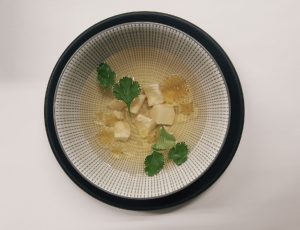
Buddhist Silken Tofu Soup
Make the vegetable stock:
1 gallon water
5 pieces dried shiitake mushrooms
1 cup diced Korean moo radish or daikon radish
6-inch piece dashima or kombu seaweed
Put water, mushrooms and radishes into a pot and bring to boil.
Simmer for about 30 minutes.
Add dashima seaweed into the pot and simmer for another 10 minutes.
Strain and cool the vegetable stock until needed.
Make soup broth:
3 cups vegetable stock
1 ¼ cups silken tofu
½ teaspoon sea salt
1 teaspoon soy sauce
Put the vegetable stock in a pot and bring to boil. Add sea salt and soy sauce.
Using a spoon, add silken tofu to the pot. The smaller the tofu pieces, the better.
Bring the broth back to boil, then take it off the stove.
Put in a soup bowl.
Garnish and enjoy!
1 oz chopped fresh cilantro
1 tablespoon perilla oil (can be found at Korean grocery stores, may substitute sesame or other aromatic oils)
I have to confess that I often play fast and loose with this recipe, throwing in whichever vegetable ends and peels I have around, including some of the forbidden vegetables like leeks and green onions. I figured it helps to eliminate waste. Feel free to do the same—it will be delicious, warm and soothing, and may even be passion inducing. Isn’t that what we all really need for the Michigan winter?
Ji Hye Kim
Chef and Managing Partner
Miss Kim Korean Restaurant