
Tag: ZINGERMAN’S BAKEHOUSE
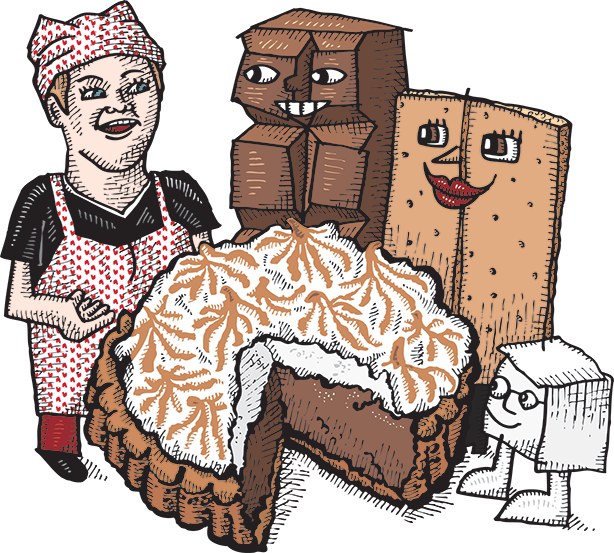
It’s not every day you have a pastry named after you. And it is definitely not everyday you have TWO pastries named after you. Unless you work at Zingerman’s Bakehouse.
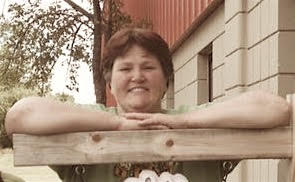
ong time baker, Patti Weaks, is one such baker, leaving her stamp on our line up. It makes sense. She has been working here for nearly two decades after all.
Patti has been instrumental in our team’s baking success, developing some new recipes and making sure we’re doing things right. It seemed fitting to honor her and use her namesake, like we have done with many others.
Back in September of 1997, Patti’s best friend was working at the Bakehouse, leading her to apply. According to Patti, “Best decision I ever made.” Definitely a great thing for us, as well. Now, 19 years later, both Patti and her son Jeremy work here at the Bakehouse. Patti will be the first to admit, “Baking does run in the family.”
Okay, let’s get to the goods!!!! (you’re probably shouting at your computer screen right now). Raspberry Patti Pockets and Patti’s Gimme S’more Tart. Both delightfully unique.
The Patti Pocket, before it was called a Patti Pocket, was a recipe we taught at BAKE!, our hands-on baking school. One of our classes included making homemade toaster pastries. We loved them so much that in 2014, Patti and other bakers worked on perfecting the recipe on a larger scale so we could sell them around Ann Arbor. That testing included sampling a number of different filling flavors (tough job we know). Raspberry was the clear favorite. That’s how it works around here. We practice and we taste until we know we have something really special.
After working closely with Amy Emerling, Bakehouse co-owner, to ultimately perfect this recipe in our eyes, there still was one big surprise in store for Patti. We named this scrumptious hand-pie after her. “Amy is the one who came up with the name. I didn’t even know about it.” It needed a stand out name. We just thought it sounded cute and more fun.
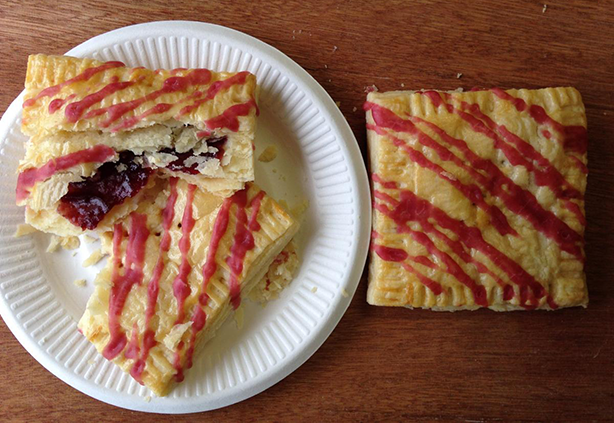
So, what exactly is a Patti Pocket? It truly is the ideal breakfast pastry, lunch dessert, mid-day snack, tea time partner… You get the idea. We start with a flaky butter pie dough, fill it with seedless raspberry preserves, bake it until it is a beautiful golden color and then drizzle a little raspberry glaze on top. The texture of the crust is delicate and tender, but the whole thing packs a wallop of flavor too. It’s a little messy, but that’s part of what makes it so good. Besides, that’s what napkins are for (right?)
The other pastry naming was a little less of a surprise. Patti’s Gimme S’more Tart actually started off as one of her own homemade desserts to pass at a staff holiday party. “One year I made them for a company Christmas party. I wanted to bring something different that we all didn’t bake everyday. The idea just popped into my head.”
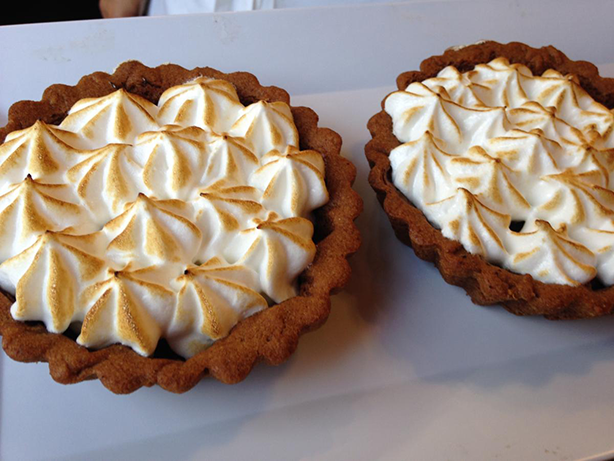
This creative and original and absolutely scrumptious idea quickly turned into a Bakehouse reality. It all starts with a graham cracker shell. But no store bought graham cracker crumbs here- we’re using Bakehouse sweet spicy graham cracker dough. After it’s baked until mahogany brown, it is filled with a soft dark chocolate ganache. Then it’s crowned with toasted peaks of Italian meringue. Try it served slightly warm for the ultimate experience. Words to describe it: insanely good with intense flavor.
Have a hankering for these treats? We understand why. Well, you’re in luck! The Patti Pockets are available each and every morning, at Zingerman’s Bakehouse, Roadshow or Delicatessen.
While they last, of course.As for the Patti’s Gimme S’more Tarts… Well, those are a rare treat these days that we bring back for a weekend from time to time! Keep a lookout for the next time they will be making an appearance on our special bakes web page or sign up for our enews!
And, you can learn how to make Patti Pockets in our Pies version 3.14 class, too! Check out when we will be offering it next on our BAKE! calendar.
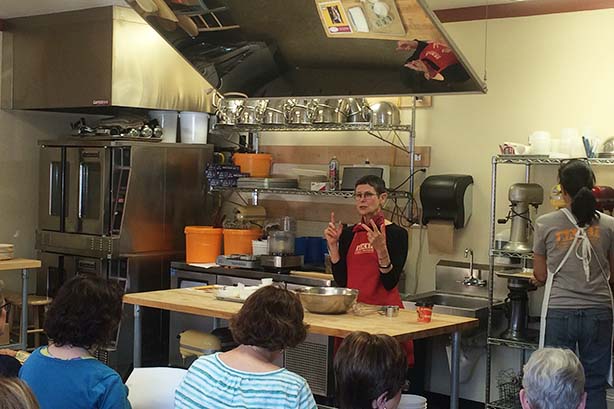
“It’s very sweet and surprising and fulfilling. I can’t believe it’s been 10 years!” says Amy Emberling, co-founder of BAKE!
This summer marked a decade in business for the hands-on teaching bakery at Zingerman’s Bakehouse. To celebrate the anniversary, BAKE! hosted special events and welcomed some exciting guests, including James Beard Award-winning cookbook author Dorie Greenspan, who demoed her famous Jammers among other signature treats, and Alejandro Ramon, a beloved instructor who was instrumental in designing the original program—he taught a Mexican Dinner class, where he shared his family’s mole recipe and lead a group in flan and enchilada making.
When BAKE! first began, the vision was simple: take the mystery out of baking and inspire people to do it at home. The goal was to provide rich learning in a fun, informal environment that encouraged students to engage with each other and, by extension, grow a community of home bakers.
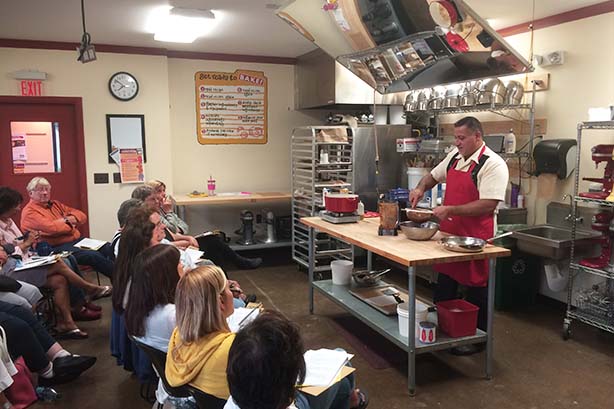
“It’s really special because we did it totally from our hearts because we thought it could contribute to people’s lives, and we wanted to engage with customers in a more personal way,” says Amy. “We had no idea if people would come. We didn’t run any numbers, and we didn’t even think about the money and the investment. Then, it was sort of amazing—people liked it.”
While attendance was light in the beginning, the feedback was positive. As word got out, BAKE! attracted more and more new students and regulars (some of whom have taken as many as 100 classes!). “It kept on going, and it’s really become what we made the mission statement to be,” explains Amy.
To salute those who’ve come to learn over the years, the celebration included two installments of “Open Mic Night.” For the events, BAKE! turned the stage over to student teachers, who gave half-hour demonstrations while telling their own stories. The volunteers whipped up everything from New York cheese cake to Chinese steamed buns. Many brought family and friends along, making for a lively time. Admission was $10, and all proceeds went to benefit the Ann Arbor chapter of Les Dames d’ Escoffier International, an organization of women leaders in food, beverage and hospitality whose mission is education and philanthropy.
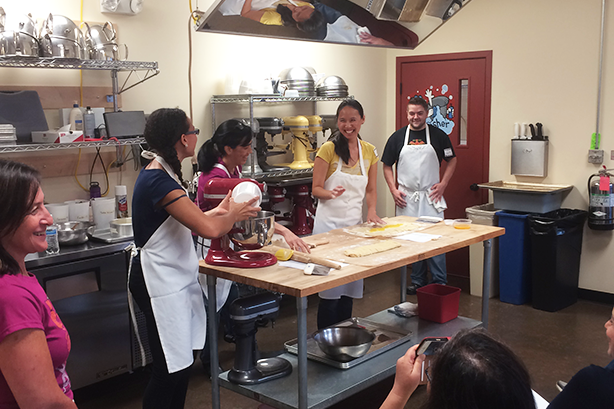
So, what does the next ten years hold for BAKE!? “To expand the community, and give people the opportunity—both customers and the chefs and bakers—to be in touch with one another,” says Amy. A big part of that will be to bring in more local professional chefs and bakers to teach and connect with their customers. To facilitate this, building a proper demonstration space that’s comfortable for students and effective for presenters is being considered
You can be part of the next chapter. BAKE! currently teaches classes a wide variety of classes in pastry, cakes, pies, bread and more. And it’s not just all about sweets—there are also plenty of sessions that cover pizza making, savory baking, and pasta. International cuisines are on the roster, too. Think breads from Transylvania, stews from the British Isles, Southern brunch, risotto from Sicily. There’s also the closer-to-home Detroit Classics session that covers Detroit deep dish pizza and coffee cake. You don’t need any experience, just a desire to learn and eat!
Classes are offered daily. See the full list and calendar on our BAKE! website.
Louis Pasteur said, “…chance favors the prepared mind.”
And in the case of Zingerman’s Bakehouse this is certainly true.
Early last spring, Bakehouse managing partner, Frank Carollo, received an email that would ultimately lead to a new relationship, a new source of Michigan-grown whole wheat, and a brand new variety of bread. The email came from a canola farmer named Bill Koucky (“koos-kee”) in Michigan’s Leelanau Peninsula, just north of Traverse City. Bill is part of a network of farmers in the area who grow non-GMO canola and sunflowers under the umbrella of Grand Traverse Culinary Oils. The farmers carefully cultivate their seeds, then mechanically cold-press them to extract the oil. GTCO uses no chemicals whatsoever, and the canola and sunflower oils are 100% natural.
In order to maintain the correct nutritional balance in their fields, the Grand Traverse farmers network rotates their crops (as traditional farmers have been doing for thousands of years). So they grow things like clover, rye, corn, and oats to replenish the nutrients used by the canola and sunflower crops. One of their off-year crops was a sturdy whole wheat that thrived in the colder climate of Michigan’s Northwest. The wheat was good – high-quality, high-protein – perfect for making bread. It was so good, in fact, that until last year the bakeries in the Leelanau/Traverse City area bought out Bill’s entire wheat crop. In addition, the rise of the craft beer and distillery movement has created a demand for high-quality grains in the state. Bill and his partners established Grand Traverse Culinary Flours, increased their wheat yield, and began seeking out possible customers further south. Which is how he came to send an email to Frank.
Fast forward. Bill drove down, dropped off some samples, and took a tour of the Bakehouse. Afterward, baked about a dozen test loaves using the new Leelanau flour, and the results were very promising. So, the Bakehouse crew adjusted the recipe a bit, then baked another dozen loaves. And they repeated the process until they got the recipe just right, tweaking the ingredients, changing the dough-proofing duration, and watching the loaves very closely during their time in the ovens. So was it worth all the time and effort? “The bread was very good,” says Frank with a smile on his face. And the Zingerman’s Bakehouse True North Bread was born. “We started selling the True North Bread at the beginning of March, and we’ve been pleased at how well it’s been received,” Frank says.
Zingerman’s Bakehouse has been on the hunt for high-quality, locally grown wheat flour for some time, so this new relationship with Bill is timely. The search has been a challenge, as Frank is looking for a suitable wheat raised using traditional, sustainable methods. And it hasn’t been easy. For decades, farmers in Michigan have been incentivized by higher market prices to grow low-protein wheat, which produces a softer flour that’s perfect for making cakes and pastries. But to make good bread, a baker needs a flour with a higher protein content (a “hard” flour) to form the gluten that’s necessary to create the loaf’s dense, chewy structure.
So, to encourage farmers to grow higher protein wheat, Frank uses his own incentive. He guarantees a certain return, or price, for the crops in order to offset the risks that come with growing wheat using traditional and sustainable practices. In years when farmers have a successful harvest, it’s likely that other growers in the region are experiencing the same. This translates to a local market that’s enjoying a saturation of goods from these farmers. Unfortunately, this abundance can also drive down the selling price of the for farmers, so the Bakehouse locks in a fair price ahead of time that’s often better than the market price. And this is good for farmers in years of low crop yield as well. With the price guarantee in place, the farmer can be secure in the knowledge that the year will not be a total loss. Up in the Leelanau, Bill Koucky incents the farmers in his network in much the same manner.
The other challenge facing a bakery that’s been successful in finding a source for good wheat is finding a place to mill and store the wheat after harvest. In the case of a conventionally grown flour, the major players in the flour market have the facilities to mill and store their wares until they’re ordered and shipped. Smaller growers do not have such facilities at their disposal. So Frank must pick up the cost of first shipping the wheat to a mill, then pay for grinding and storage, and then once again assume the cost of shipping the ground flour to the Bakehouse. This can quickly become prohibitively expensive.
Ideally, Frank would like to see a local processing mill and storage facility located a bit closer to the Bakehouse. “A hundred years ago, every town had its own mill, so this wasn’t an issue. You’d simply harvest your grains and drive them to the local mill.” Frank confesses that he’d personally love to learn the art of milling good flour from Michigan-grown grains, and probably would do just that, “If I didn’t have a busy bakehouse to run…” Fortunately, for Frank, Bill Koucky and his partners at Grand Traverse Culinary Flours have got him covered. Bill’s facility features it’s very own stone grinding mill that can be adapted to produce a variety of grades, from coarse to very fine. And Bill has plenty of storage space.
In March, Frank headed up to Bellaire, MI for to the Crosshatch Center for Art & Ecology, a nonprofit organization dedicated to exploring the intersections of the two. As their website says, “Crosshatch provides resources for our community to become stronger, more self-reliant, and more native to place.” The group organizes workshops, courses, and conferences that “…teach our neighbors how to do things like: become a beekeeper, care for goats, build a brick oven, graft fruit trees, manage soil effectively, preserve food, and more.” The Center partnered with Bill and Grand Traverse Culinary Flours to host a ‘Grain Day’ seminar. The day included breakout sessions for attendees with topics such as “The Big Picture of Growing Grain,” “Integrating Grain onto your Farm,” “Harvesting and Processing (with guest speaker Bill Koucky),” and “Growing Grain for Market, featuring a local business owner panel.”
Big things are obviously happening in the Northern Michigan world of grain, and Frank is hopeful that they continue to enjoy the success of the past few growing seasons. In the past year, the southern end Michigan’s Lower Peninsula saw more rainfall than usual in the early season. The wetter-than-normal environment was unfortunately favorable to certain kinds of crop blight, and a lot of growers farmers saw their season fail as a result. By contrast, the micro-climate in the Northwest region of the state has been much more hospitable to farmers in recent years, and the very good yields seen by Bill and his partners are establishing the area as a potential new source for quality grains.
The immediate result of this new connection with our Northern neighbors is a fantastic new bread now available at Zingerman’s Bakehouse. After harvest, Bill sends their red spring wheat through the stone grinding mill to produce a flour that contains more wheat germ and bran. This wheat flour, in turn, produces a bread with great natural flavor and texture.
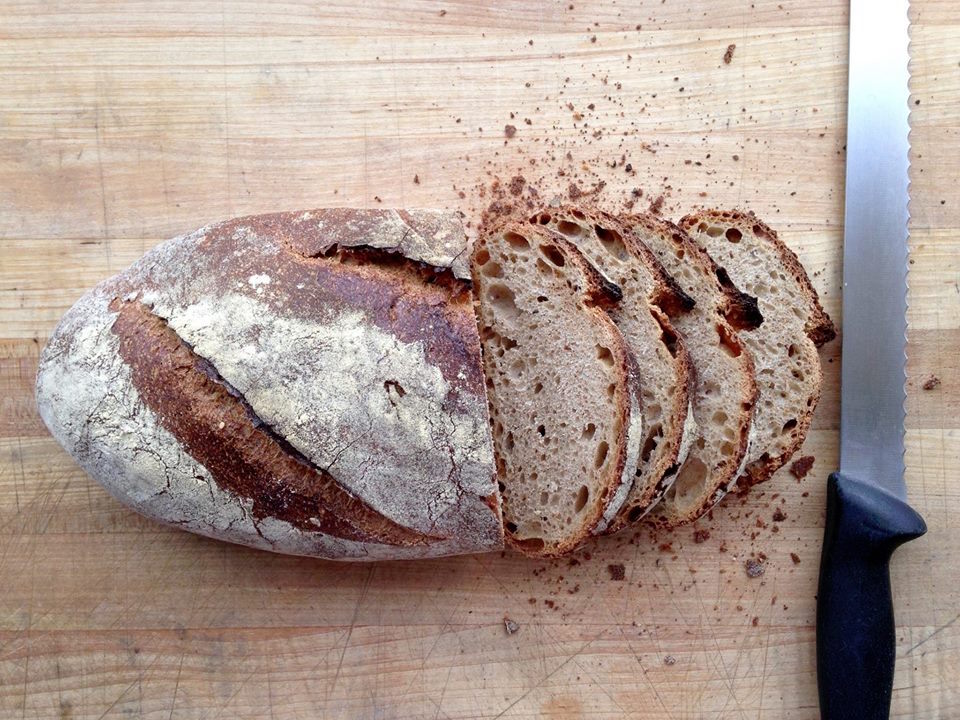
True North is a whole wheat bread with a nice, dark crust, and a slightly dense crumb. The bread has the sweetness of whole wheat balanced with the slightly sour note of its naturally leavening. The taste is rich and full, with the texture lying somewhere in the middle of the bread density spectrum. It’s a very satisfying bread that’s delicious simply toasted and enjoyed on its own, savoring the wonderful wheat flavor. As Frank says, “It’s a really great-tasting bread.”
And in the end, that’s what is most important.
BIG NEWS!
The new BAKE! schedule has arrived!
Classes now thru Jan 2017 are available.
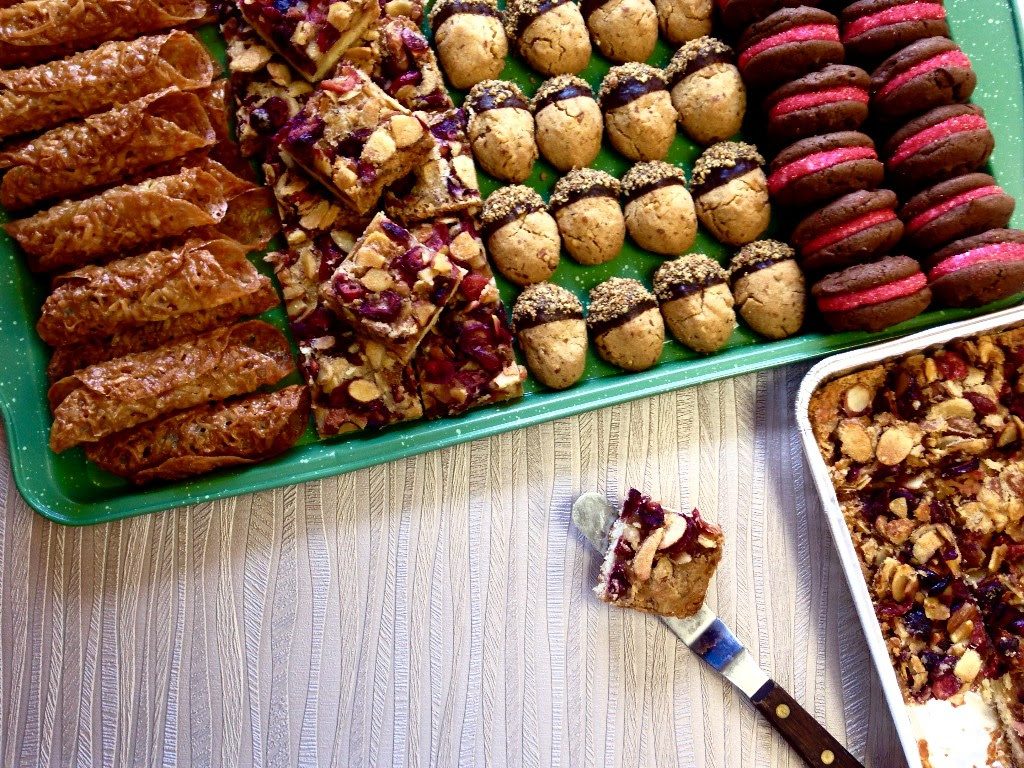
Fancy Schmancy Holiday Cookies 2016 edition!
Our most popular class of the year! Join us to get into the holiday spirit and bake up four varieties of festive cookies worthy of your family cookie plate. In this hands-on class you’ll make mint chocolate whoopie pies, coconut brandy snaps, chocolate walnut acorns, and cranberry orange almond bars. It’s guaranteed fun and is known to inspire new family traditions! We’re offering more dates than ever, but don’t delay signing up!
Reserve my spot(s) at the cookie party!
Other Holiday Classes
–Buche de Noel: Create a French Yule Log Cake
–Holiday Sweet Breads: Bake German Stollen & Hungarian Beigli
What Else Is New?
–Dinner Series: American 2.0. Learn caramelized onion pasties, salad with homemade dressing & pecan diamonds.
–Dinner Series: Siciliano. Make radicchio and pistachio risotto, pane nero rolls & amaretti morbidi almond cookies
-Rodger Bowser returns for another hands-on Pot Pies class for adults and a new Teen Cooking class for 14 to 17 year olds.
Are You New To BAKE!?
Start with the classics!

See you in class!
An Interview with Frank Carollo,managing partner at Zingerman’s Bakehouse
Frank Carollo wants his guests at Zingerman’s Bakehouse to taste the state of Michigan.
So about seven years ago, he started working with a fellow from Michigan State University who wondered if the Bakehouse might be interested in buying some wheat grown by a local farmer. After baking a few test loaves, Frank began buying the flour. “I think we bought some-thing like 100-200 lbs in the first year.” He liked the idea of using Michigan-grown wheat flour, and it was of a high enough quality that they used it to make the Bakehouse Farm bread. “We had enough to make it through most of the month before we ran out.”

The experiment was a success, and soon Frank was scouring the Michigan countryside in search of a suitable wheat raised using traditional, sustainable methods. It wasn’t easy. For decades now, farmers in the state have been incentivized by higher market prices to grow low-protein wheat, which pro-duces a softer flour that works well for making cakes and pastries. Bread, however, requires the higher protein content in a “hard” flour to form the gluten necessary for a loaf’s dense, chewy structure. “A hundred years ago, people grew one kind of wheat and just baked everything with it,” says Frank. “There weren’t any other options. So, you might make bread that’s nutritious and edible, but may not have the volume and the characteristics of a modern bread that we look for, and our customers expect.”
Frank is trying incentives of his own to help convince farmers to grow higher protein wheat for his bread. When he contracts with a farmer, he guarantees a certain return, or price, for the crops in order to offset the risks inherent to growing without chemical pesticides or fertilizers. In many cases, if a farmer has a successful year, it’s likely that other farmers are experiencing the same, and it can actually drive down the price due to market saturation. So, the Bakehouse locks in a fair price ahead of time that’s often better than the market price. If, on the other hand, the farmer has a bad year and his crop fails, Frank’s guaranteed return ensures that the year is not a complete loss for the farmer. In this way, Zingerman’s Bakehouse provides a bit of insurance for local farmers who plant high-quality, yet potentially riskier wheat crops.
And although the search for the right high-protein flour grown in Michigan remains a challenge, there’s evidence that things might be changing as the demand for naturally and locally made bread grows. About nine years ago, the Bakehouse connected with Westwind Milling in Linden, MI, and began buying a small quantity of their organic whole wheat flour. The quality of the flour was very good and the grinding process in the old-fashioned mill left more wheat germ and bran in the flour, instilling a better flavor and texture in the finished bread. A few test loaves later, the Westwind bread was born.
Yet, even working with an established mill like Westwind, regular deliveries of quality organic flour may be difficult to maintain. This can be due to the effects of weather on a grow-ing season, but also because a naturally raised wheat is a bit more delicate than conventional wheat. Westwind Milling grows their grains without the use of synthetic fertilizers or pesticides, so they’re unfortunately more vulnerable to blights or pests. If a crop is so affected, the Bakehouse may not be able to get the Westwind flour. An unfortunate situation, but it’s part of the trade-off for a naturally grown food with better flavor. That means Frank is always on the lookout for other sources that might help fill the gap.
He recently crossed paths with a wheat-grower from the Traverse City area who’s had a very successful year. Last year, the southern end of Michigan’s Lower Peninsula experienced a higher-than-average rainfall in the critical early part of the season. The water saturation created a very hospitable environment for certain kinds of blight, and many farmers saw all of their hard work go for nought. This past year, the Bakehouse had arranged for the growing of seventy acres in Saline, MI, as well as eleven acres in Eaton Rapids, MI. Unfortunately, the crops were afflicted with a blight that left the wheat inedible. In the Northwest region of the state, however, the micro-climate was favorable to the growers and their crop yield was very successful. Frank was given samples of flour ground from the Traverse City wheat, and plans to bake test loaves very soon. He also plans to attend a growers conference in that area to explore the possibility of sourcing wheat from the North.
But simply growing a successful wheat crop isn’t the only challenge. For example, to find good, conventionally grown wheat flour, all Frank has to do is make a phone call to his baking supply company. The company then sources flour from places like Kansas or Nebraska, where the growing season is longer. The flour is milled and stored until it’s ready to be shipped. On the other hand, with Michigan-grown organic wheat the Bakehouse must pay for transportation from the field to a mill, where the wheat is ground into flour. Then they must pay to have the flour stored until its needed, and then pay once again for delivery. In the past, Purity Mills has helped out, but the logistics of this operation are expensive and time-consuming.
Ideally, Frank would like to see a semi-local storage location with a mill in which to process the grains.“A hundred years ago, every town had its own mill, so this wasn’t an issue. You’d simply harvest your grains and drive them to the local mill.” But, as we know all too well, times have changed and the majority of local mills were closed decades ago in favor of large, centralized processing facilities. “If I were still 20,” smiles Frank, “and didn’t have a busy bakehouse to run, I’d love to learn the craft of milling.” He hopes that an enterprising younger person will come along and make this vision a reality. This also fits nicely into his long-term vision for establishing closer relationships with local farmers. “I look forward to the day when we have several breads where we know exactly where the flour comes from – even the field where the wheat was grown – ideally within a couple hours of here.”
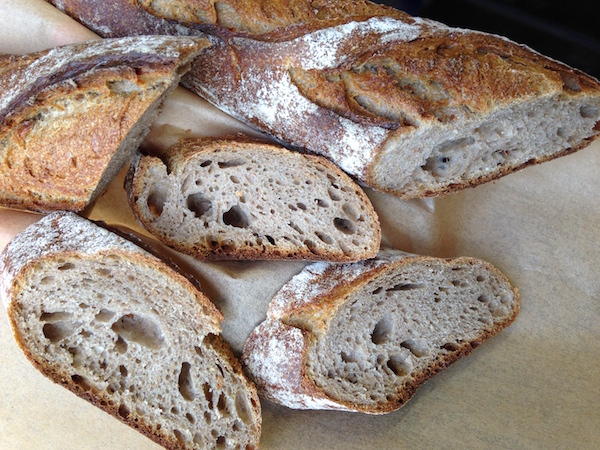
And Frank has plans for these special wheat flours. We’ve already talked about the delicious Westwind bread, which was the first to use organic wheat flour. Then last year, the Bakehouse debuted another unique bread: the Michigan Chestnut Baguette. Inspired by Zingerman’s Deli chef Rodger Bowser’s work help promote Michigan chestnuts, as well as by the abundance of chestnuts in the Bakehouse Hungarian foods, the Michigan Chestnut Baguette has proven to be a crowd-pleaser of the first order. The recipe calls for chestnut flour from Michigan Chestnut Growers in Grand Haven, MI, as well as wheat flour from Westwind Milling. The result is a lovely bread with a dense tan and purple crumb, and a beautiful dark crust.
And although Frank has a yen for local grains, he doesn’t always mean local to Michigan. Flavor and tradition are a major part of the Bakehouse vision. And this will be evident in the forthcoming Pane Nero bread expected to hit Bakehouse shelves very soon. This traditional Sicilian loaf was first tasted (enthusiastically) by Zingerman’s founder Ari Weinzweig over twenty years ago on a trip overseas, and had achieved an almost mythic quality at Zingerman’s in the ensuing decades. That was until Frank took a trip back to his family’s home-land of Sicily a couple of years back, and happened to meet the owner of Molini del Ponte, Filippo Drago. Molini del Ponte is a traditional mill in Castelvetrano that produces very high-quality ancient whole wheat Durum flour, which just happens to be the primary ingredient in the legendary Pane Nero (“the black bread of Sicily”). The two men talked, and Frank walked away with a couple of pounds of the Durum, and plans to ship more to the Bakehouse. When Frank returned from Sicily, he promptly baked a few test loaves, and Pane Nero came to the Zingerman’s Bakehouse for the first time. The grain of the flour is coarse, and a light, speckled yellow in color. The resulting loaf is dark brown, with a dense, compact crumb and topped with sesame seeds. The bread was met with enthusiastic response among Zingerman’s staff, and guests can expect to see the delicious Pane Nero in Zingerman’s businesses in the coming months.
Although the Pane Nero flour comes from far away, Frank’s dream of a deeper connection to the growers is present in that bread. He can tell his guests exactly where their bread comes from. Frank knows the farmer, he knows the land, and the wheat. He knows the miller, and his methods. In the dream, the bread is a perfect expression of the relationship between the land, and the people who appreciate its bounty.
See you soon!
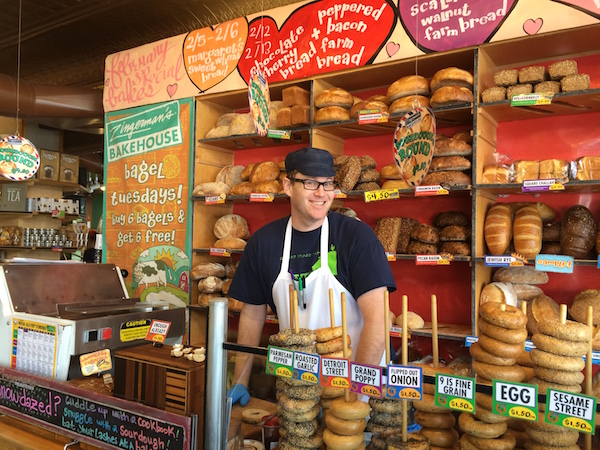
Each morning, when Zingerman’s Deli opens its doors bright and early at 7 a.m., the first thing that guests see is a friendly face in the Bread Box. The first bread delivery is trundled in the door, and people stop to take a deep breath of fresh-baked bread from Zingerman’s Bakehouse. Guests line up for still-warm bagels, French Baguettes, and Bakehouse White. From the smiles of anticipation on their faces, we can see it’s a great way to start the day.
After three decades in business, Zingerman’s has a large population of regulars, all of whom have a particular way they’d like their loaves sliced, halved, or even cubed. “I had one customer ask for a loaf of Bakehouse White with the crust completely removed,” says Deli staffer Phil. “I think they were making cucumber sandwiches or hors d’oeuvres.” Then there are the packaging details (“short trip or long trip?”), which are important for keeping the bread and fresh and delicious as possible on its journey.
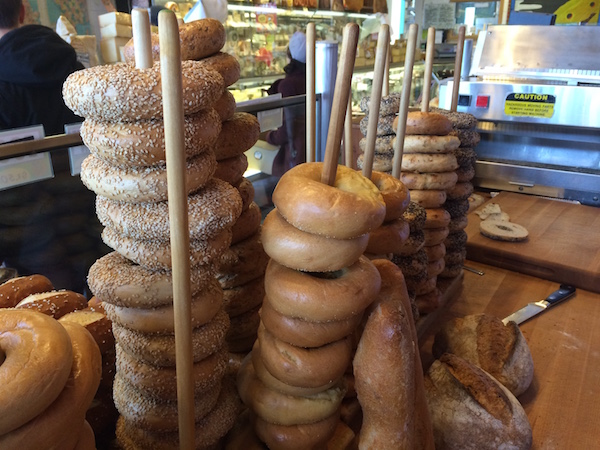
Around 11 a.m., the fresh Challahs come in, followed about 2 p.m. by rye breads, Sesame Semolina, and Rustic Italians, among others. The shelves of the Bread Box are full to bursting now with beautiful loaves of all sizes and shapes. At 7 p.m. the last delivery of the day brings the sourdoughs and a few others. But they won’t last long. Each day, the Deli sells through most of its inventory, and any loaves remaining at closing time are sold the following morning as day-old.
A quick poll of Deli staff favorites includes Pecan Raisin, Sesame Semolina, and Dinkelbrot, to name just a few. But it’s not an easy choice. “There are so many,” laments one staff member, clearly agonized at having to choose. This is a sentiment shared by the Zingerman’s regulars and favorites tend to change on daily basis, depending on the weather, the season, or just what sounds good. Mary, who describes herself as a “big fan” of Zingerman’s describes it this way: “Today, the Jewish Rye, and bagels for the morning. And a Pecan Raisin for out-of-town guests. Next week, I’ll let the universe tell me. It’s all good!” And she heads off in search of fresh cream cheese from Zingerman’s Creamery for the morning bagels.
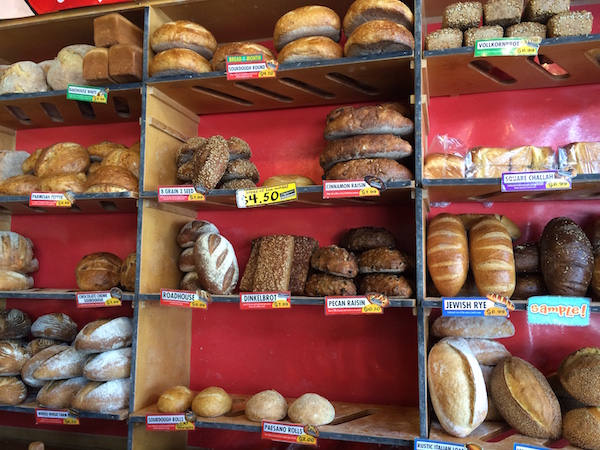
A few more guests arrive, already pointing to their loaves. “I can taste it already,” says one man, closing his eyes with a smile. The continuous flow of bread leaving the shelves will continue for the rest of the day. It all happens again tomorrow, and the day after that, as well. And the reason?
“Our bread is the best I’ve tasted anywhere in the country,” says Phil, while a customer standing behind him nods vigorously in agreement, a big grin on her face. The grin says it all.