
Tag: ZINGERMAN’S BAKEHOUSE
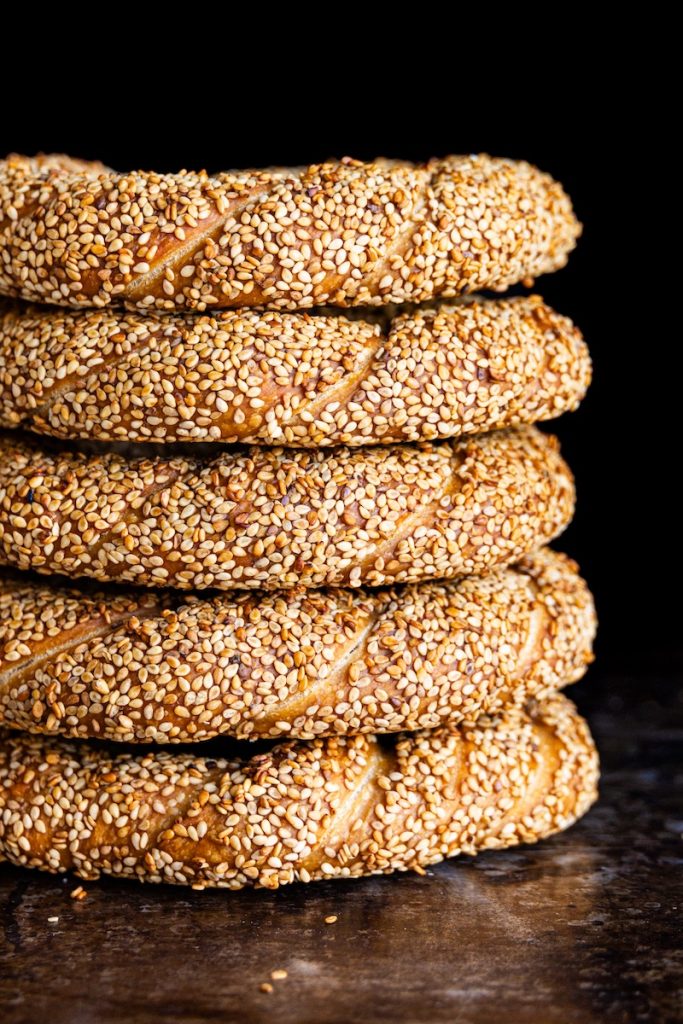
A Special Bake of the bread of Turkey on 4/17 & 4/18
I know I wrote about these terrific Turkish treats a few months ago. But, man, they’re so good, and so special that I want to spend some time here on them again!
In the January 1995 issue of The Atlantic, friend and food writer Corby Kummer published a long piece about his visit to Istanbul the previous year. He opened by sharing all the downsides of the city, but then, in a lovely authorial about-face, announced to everyone, “I’d go back in a minute. In the course of a 10-day visit I recently made, Istanbul lodged in my soul.” After detailing a number of the cultural and culinary highlights of the visit, Corby got to the heart of the culinary matter:
My survival food was simit, big dark rings of sesame-covered bread stacked on pushcarts all over the city: vendors carrying wooden trays laden with them, often still warm, are a frequent and welcome sight. A simit is more than a sesame bagel ever dreamed it could be.
All these years later, simit is still going strong. Travel writer Laura McVeigh, in a February 2026 piece titled “What the Ottomans Knew About Sustainability,” shares her experience of simit in the 21st century and also of its history.
Simit is warm, topped with crunchy sesame seeds. Found all over the city today, they’re just one of many reminders of the Ottoman past. The first simit being enjoyed in the 16th century, and according to 17th-century explorer and travel writer Evliya Çelebi, by the 1630s, over 70 simit bakeries had opened up in the city, such was the Turkish demand.
In Turkey, as Corby said, Simit is a critical component of everyday eating. Simit is a single word that conveys the baker’s art and instantly evokes a sense of community, country, and culture for anyone who is either from Turkey or has spent meaningful time there. The last time I was in Istanbul was many decades ago, well before we opened the Deli in 1982. And yet, like Corby, I still remember the simit. Hazim Tugun, longtime Bakehouse bread specialist, grew up in Turkish Cyprus, where simit is standard fare. (The last time I wrote about simit, Hazim shared his experience with it and described how it takes him back to his childhood.)
You can’t yet survive on simit here in Ann Arbor, but maybe you’ll be able to soon enough. I’m ready! In under a year, the Bakehouse’s Simit has become the no-longer-secret, great new product in the ZCoB. We’ve got them as a Special Bake at the Bakehouse this weekend, Friday the 23rd and Saturday the 24th. I’d say either get to the Bakeshop early (they come out of the oven at 11 am) or order ahead. I have a feeling that, as the weather warms up around here, even with us making more of them than ever, they’re going to sell out quickly. They are, quite simply, super good!
If you lived in Turkey, of course, simit would be the everyday and everywhere fare for walking to work, riding the subway, or sitting down to a lovely meal. Here, they’re still new to most folks who are neither Turkish nor have traveled to Turkey, but as I said, they’re already catching on quickly!
Here at the Bakehouse, we’re beyond excited to bring simit into our repertoire. A wonderful taste of Turkey that anyone who’s intrigued—or, like me, already in love—can try out this coming weekend!
Order ahead
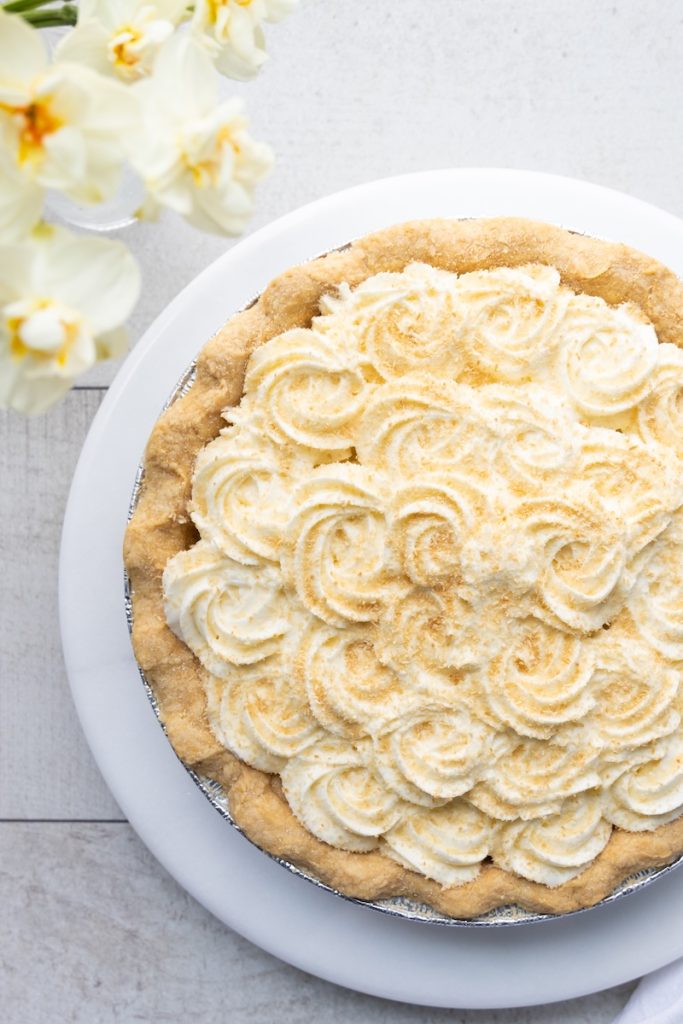
Creamy, coconutty goodness from the Bakehouse
Coconut cream pie seems such a staple of American eating that it’s hard for me to imagine that it hasn’t been part of Anglo-American baking for centuries. In fact, though, the recipe is only about 100 years old.
Coconuts have been a fundamental part of daily life in the tropics. They were traded widely and often used as currency. Growing near water and producing very hardy seeds that can float in the oceans, coconuts traveled well—so well that they are ubiquitous in the tropics and no one is certain about their actual origins.
Coconuts entered European awareness in the early 19th century when J.W. Bennett, an Englishman, wrote A Treatise on the Coco-nut Tree and the Many Valuable Properties Possessed by the Splendid Palm. At the same time that coconut was entering the European market, sugar was also becoming much more available. The candy and pastry business increased dramatically in this period, and all sorts of fruits and nuts were incorporated into confections, including coconut. It was at this time that a French company figured out how to shred and dry coconut meat, making it much easier to ship to Europe without spoiling. By the early 1890s, the company was shipping 6,000 tons of dried coconut a year. By 1900, the quantity had increased tenfold. Coconut had become a big hit in Europe.
Coconut finally entered the American market in 1895, when Franklin Baker received a shipment, really by accident. Mr. Baker, a Philadelphia flour miller, received a boatload of coconuts in payment for a debt from a Cuban businessman. After unsuccessfully trying to sell them fresh before the nuts spoiled, he made a decision that put coconuts into the hands of home cooks, commercial confectioners, and pastry chefs—he set up a factory for shredding and drying the coconut meat. Within two years, the coconut business was going so well for him that he sold his flour mill and established the Franklin Baker Co., selling exclusively coconut meat. By the early 1900s, coconut recipes became very popular in the United States, with coconut cream pie being one of them.
Inverting the idea of the Bakehouse’s wonderful Summer Fling Coffee Cake—a lime-scented all-butter coffee cake with a generous dose of coconut—the thought occurred to me this week to try the Bakehouse’s Coconut Cream Pie with a spoonful or two of lime curd on the side. I’m gonna try it soon! Either way, come and enjoy a flavorful bite of American business ingenuity with a slice of our version of Coconut Cream Pie! Large and small pies are available on Tuesdays, Thursdays, and Sundays all month during April.
Preorder a pie
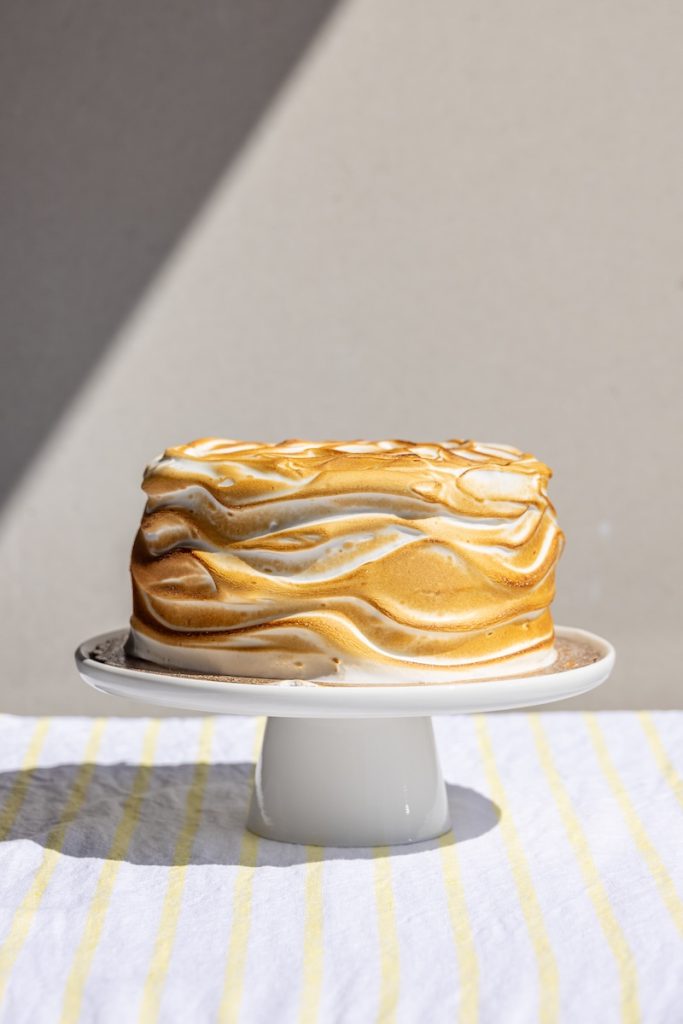
Light, delicious, and made without wheat, starting Friday, March 27
Over the course of the coming eight days of Passover, the Bakehouse’s lovely Lemon Sponge Cake will be gracing any number of local tables. That said, you don’t have to be Jewish or celebrate Passover to enjoy it—Rachel Seng, marvelous manager of the Roadshow, says this has long been one of her favorite Bakehouse offerings! This lemon sponge cake, made by hand with great skill, has a LOT of loyal fans.
Sponge cakes, leavened as these are only with beaten eggs, go back centuries in culinary history, perhaps to medieval Spain. They gained popularity in England, and the first written recipes appeared in the poet Gervase Markham’s early-17th-century book The English Huswife. To this day, sponge cake serves as the base for jelly rolls, Swiss rolls, bûche de Noël, and tres leches, and, I realize now, is the source of the Twinkies I used to eat regularly when I was a kid!
Made without flour, sponge cake has long been a Jewish Passover tradition. In 1903 (the year after the Deli’s building was built), Milwaukee social worker Lizzie Kander put out the second edition of The Settlement Cookbook. The book was based on recipes from Settlement House, a Milwaukee institution set up to help immigrant families, many of whom were—like Kander—Jewish. The book was created to raise money, but the board of trustees refused to invest the $18 to have an initial 1000 copies made. Determined to get her book out into the world, Kander decided to accept advertising to fund the printing. The book sold for 50 cents, and it sold remarkably well. The second edition—which included the sponge cake recipe—had a bigger print run of 1500. Today, it’s in its 33rd edition.
The Bakehouse crew describes this delicious offering as a “light and lemony sponge cake with lemon curd between the layers and a caramelized meringue exterior. A pretty, flavorful, and light ending to any feast. Plus, it’s wheat-free!” (The Bakehouse itself is anything but wheat-free, so please use appropriate nutritional or religious caution that’s right for you and yours.) Back when I was a kid, Passover meant a very dry sponge cake baked from a Manischewitz mix. I’m happy to have learned in recent years that there’s a lot more to it than that! The Bakehouse’s version is terrific—light and lemony, not overly sweet, with a lovely, long finish.
You’ll find the Lemon Sponge Cake at the Bakeshop, Deli, and, during Passover, on the dessert menu at the Roadhouse as well. Sip some of the Guatemala El Regalito coffee, savor small slices of Lemon Sponge Cake, and see what wonderful things might come during the course of the day!
Place an order for Passover
A two-day-only Special Bake coming up this weekend
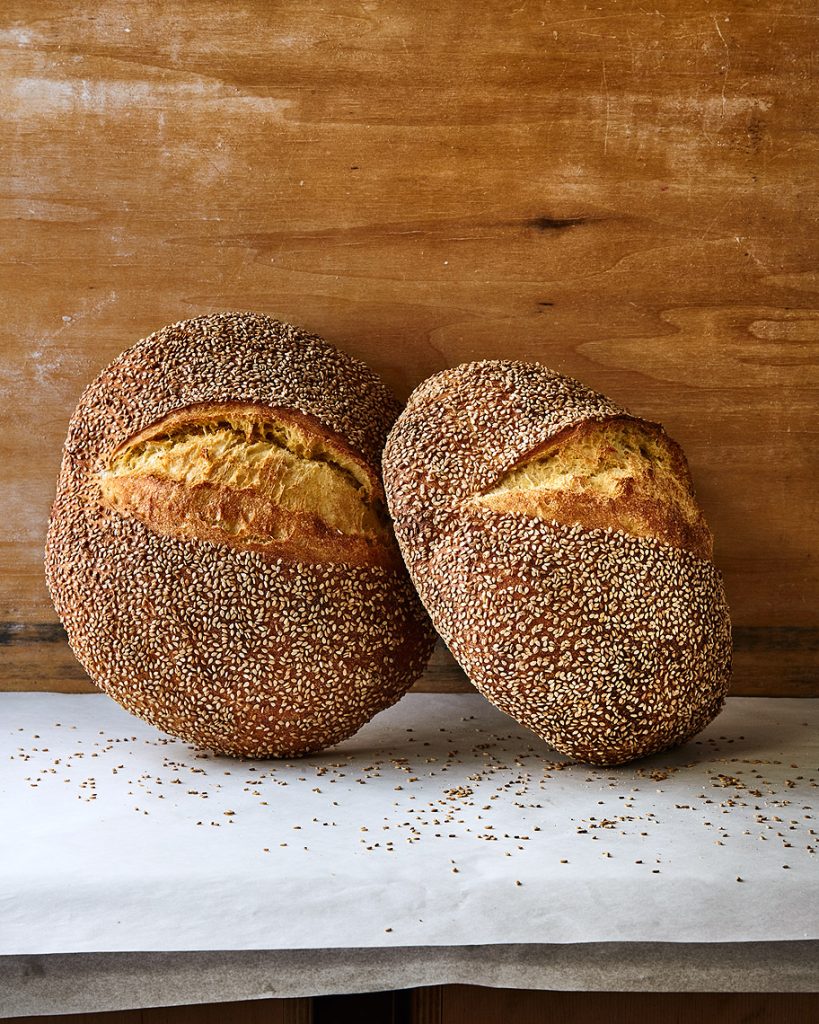
Exciting news for anyone who’s been missing it: the Bakehouse’s Sicilian Sesame Semolina is back for a special two-day appearance this weekend! If you love it like I do, swing by and grab a loaf—or three—it freezes beautifully. Don’t hesitate to order ahead; we’d be thrilled to hold some for you!
For those who don’t know it well, semolina is the bread of Sicily. Made from silky, finely milled golden semolina and baked with a sesame-coated crust, you’ll find it in most every bakery on the island. For many Sicilians, it is, literally, their daily bread. I agree with Bakehouse co-managing partner Amy Emberling, who says, “I really enjoy that bread—to eat and just to look at. The color of the crumb is so beautiful!”
A few years ago, we set out to make our Sesame Semolina bread even better by baking it with flour milled fresh right here at the Bakehouse. The experiment elicited excellent results—as we often say, “You really can taste the difference.” In this case, the difference that fresh milling makes. The bread was already excellent, but milling the grain on-site took it to an entirely new level. The move, a few years back, to begin milling the semolina here at the Bakehouse is right in line with Natural Law #8: “To get to greatness you’ve got to keep getting better, all the time!”
We’ve gradually added more items to the “milled right here” list—at this point, most of our breads and many of our pastries now benefit from the full flavor of freshly milled grain. The Sesame Semolina bread is the latest bread to benefit. Hazim Tugun, who’s helped lead this fresh milling project from the get-go, says:
It’s a perfect example of how we can take an already great food to the next level. And it shows how freshly milled whole grain flours can do that. In this case, our current Sesame Semolina is mostly made of durum wheat flour that comes from the heart (or the starchy endosperm) of the golden durum wheat berry, hence the bread’s golden color—it is a combination of coarsely milled semolina and finely milled durum flours. With an overnight preferment (poolish) and a long fermentation the day that the dough is mixed coupled with toasted sesame seeds on the outside, you get an irresistible bread that gives you the distinct flavors of the durum wheat, the chew from the hardness of this wheat (after all, it is the wheat of choice for pasta), and it’s a wonderful combination with the toasted sesame seeds.
For the new Sesame Semolina, we are stone-milling Montana-grown organic durum wheat that we are getting from our friends at Janie’s Mill and using this finely milled fresh flour to replace one-third of all the flour that goes into the bread. That means we are getting the wonderful flavor and nutrition benefits of the bran and the germ as well—aromatic oils, minerals, and fiber, to name a few. On the inside, this new version has a slightly more moist and relatively softer crumb with a richer hue of yellow thanks to the addition of the fresh durum flour. Now, you can simply taste and smell more of the grain that this bread is named after … it’s sweeter, a bit nuttier, and to me, more satisfying.
What do you do with Sesame Semolina? Toast it—great with Coffee Blossom Honey (read on!), Zingerman’s Cream Cheese, olive oil, and fresh ricotta, or that apricot jam from France I wrote about a few months ago.
You can also make, as I like to do, a winter version of pane al pomodoro in the style of the southern Italian town of Altamura—famous throughout Italy for its distinctive bread: very large loaves (anywhere from 5 to 55 pounds!) that are not dissimilar in flavor and texture to Sesame Semolina. To make the dish, toast the bread, though if you prefer, using it fresh, just as it is, works well too. Pour on a reasonably generous amount of good olive oil and sprinkle with sea salt. Take some super-high-quality canned tomatoes—out of both a commitment to full flavor and friendship, I’m loyal to the lovely Bianco di Napoli tomatoes from my friend Chris Bianco (whose pizza in Phoenix is well worth going out of your way for). The Miragallo or Gentile tomatoes we have on hand from Italy are outstanding as well. Cut the tomatoes in half with a paring knife and press the cut side into the bread. Push gently so the bread absorbs the juices without tearing. Place the squeezed tomato pieces on the slice. Finish with a sprinkle of high-quality dried oregano—we have an especially great one at the Deli right now, hand-picked in Turkey just before the flowers open.
You can get the Sicilian Sesame Semolina Bread this coming weekend at the Bakeshop and Deli.
Or learn how to make it yourself
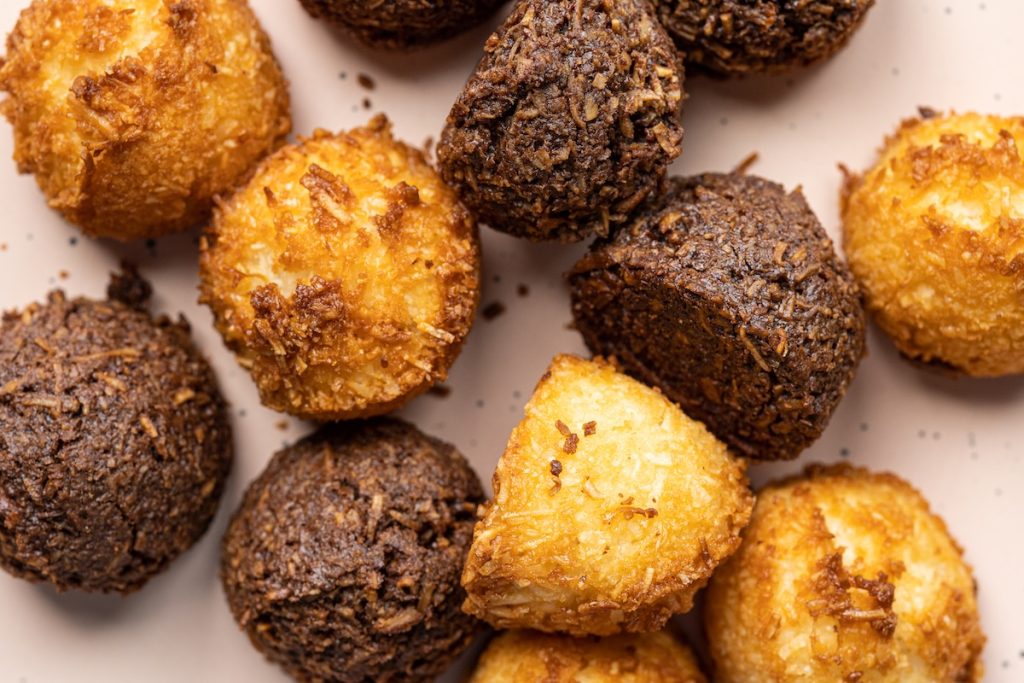
A classic Jewish American Passover pastry we make every day!
Passover is still about three weeks away, but I’m happy to say that we’ll be making macaroons all through the month of March! Nearly 20 years ago, the Chicago Tribune described these as “more humble than haute.” It’s still true in 2026. They’re terrific!
The Bakehouse Coconut Macaroons are lightyears better than what I grew up with. My experience was very much what writer Leah Koenig shared in Kveller a few years ago:
For most of my life, I loathed macaroons—and from the evidence I gathered, so did the rest of my family. Every year around Passover an aluminum cylinder of Manischewitz coconut macaroons would show up amongst the overflowing bags … my mother brought home from Chicago’s kosher supermarket. And every year … the cylinder would remain, virtually untouched. … Despite my family’s shared loathing of the tinny, cloyingly sweet cookies, they were so iconic that the holiday simply did not feel complete without them.
The company was started in 1888 in Cincinnati, where Rabbi Dov Behr Manischewitz came to the U.S. in 1885 from the region of Kovno in Lithuania (the same town and the same time that Emma Goldman did as well). Born Dov Baer Abramson, he got into the U.S. by making use of the passport of a dead man named Manischewitz. He worked first as a peddler but entrepreneurially embarked on a project to make matzo in his basement when he realized that there was none in the community. In the spirit of the ever-growing Industrial Revolution, Manischewitz switched his hand production to be mechanized and produced en masse, a move that at the time was quite controversial.
When it comes to the Bakehouse’s macaroons, I’ll just say here that the chocolate are deeply chocolaty; the vanilla have that creamy complexity that makes vanilla so special. In Zingerman’s Bakehouse, they’re very accurately described as having “a crisp exterior and a dreamily moist interior.”
Because the Bakehouse’s Coconut Macaroons happen to be gluten-free, they are also a wonderful option for anyone steering clear of grain. They’re terrific, I’ll add too, dipped in the marvelous Noccioliva chocolate hazelnut spread we get from Italy! Spread a bit of the Noccioliva on a plate and place a macaroon on top, and it will be both beautiful and delicious. You can craft another quick, fun, and delicious dessert by gently smashing a macaroon so it opens up like a fried artichoke, then set a small scoop of Zingerman’s gelato on top and drizzle on a small bit of chocolate sauce. Or if you’re doing it with a vanilla macaroon, maple syrup is super tasty too!
You can make off with some of the great-tasting macaroons at the Bakeshop, Deli, and Roadhouse for all of March! And, as I said above, you can also ship these great macaroons to a friend or family member somewhere else in the country (especially to spots where they’re still stuck only with the ones in the can!). Delicious any day of the week, I say! Enjoy now, and then pick up more in a few weeks when Passover starts up!
Macaroon or two?
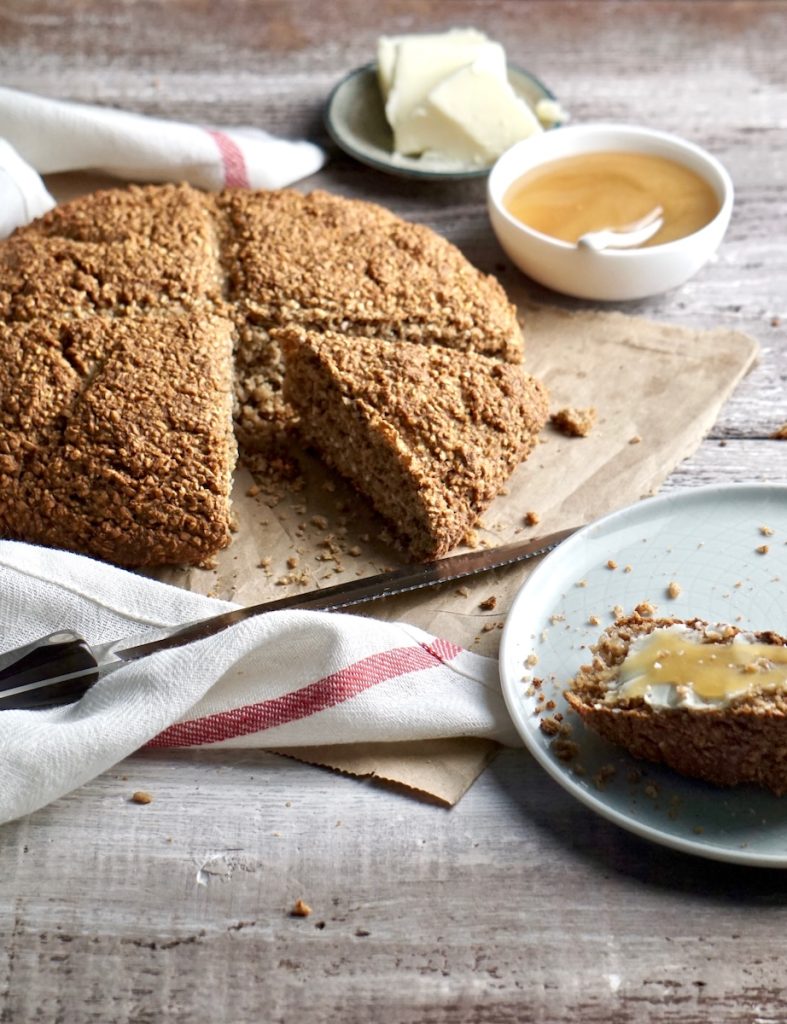
The country bread of Ireland emerges soon from Bakehouse ovens
As we enter the final weeks of winter—still cold, with days growing longer but not yet as bright as they will be soon—I wait eagerly for the annual March arrival of the Bakehouse’s delicious Irish Brown Soda Bread.
As you can almost certainly tell from what I’ve written below, I love this bread, its history, and the fact that we make such a fine, great-tasting, traditional version of it. I have such an affinity that I’m always anxious for it to arrive from the Bakehouse ovens in the 10 days prior to St. Patrick’s Day. Some folks get excited about baseball season; I’m on the edge of my seat about the impending arrival of Irish Brown Soda Bread. While we have it, I’m gonna eat as much of it as I can! With that Vermont Creamery Cultured Butter spread thickly, it’s over the top.
Although many Americans have heard of Irish soda bread, few know it well, and fewer still have experienced a well-made loaf of traditional brown soda bread like this. The Society for the Preservation of Irish Soda Bread says that the first recipe in Ireland was published in 1836, a few years after the farmhouse at Cornman Farms was built. The Society proclaims proudly: “Flour, Salt, Baking Soda, Buttermilk. Anything else added makes it a ‘Tea Cake!’”
Every loaf has steel-cut oats, loads of rich local buttermilk from Guernsey farms, and specially milled flours from the stone mills at the Bakehouse. Baker and author David Lebovitz says, “Because the wheat is milled in such a way … it remains very coarse, giving the breads their special hardy texture and flavor. Bread made with coarse-milled flour actually crunches when you bite into it. I love it!” Co-managing partner Amy Emberling adds, “We are milling grain ourselves for each loaf—soft white wheat from Kischnick and hard red spring wheat from Janie’s mill—both of these are included as a coarse grind and a fine grind to get that crunchy texture.”
The Brown Eyed Baker blog says, “It doesn’t get better than a warm slice of Irish Brown Bread served with a slather of butter.” I’m inclined to agree. Which is one of the reasons that this year I’m even more excited than I usually am with that Vermont Creamery Cultured Butter on hand at the Roadhouse, Deli, and Bakeshop. I stand by what the late Ivan Allen of Ballymaloe taught me 30 years ago on my first trip to Ireland: “When your teeth hit the bread, your gums better be hittin’ the butter!”
If you’re at the Roadhouse or your house, add some slices of smoked salmon! It’s delicious with Zingerman’s Cream Cheese, with eggs and bacon for breakfast, or with jam and butter for afternoon tea. And, I should also say, the Irish Brown Soda Bread is a delicious treat when lightly toasted too—in fact, it might be my favorite.
The Irish Brown Soda bread is available from March 9 through the 17th of the month at the Bakehouse.