
Tag: MATZO BALL SOUP
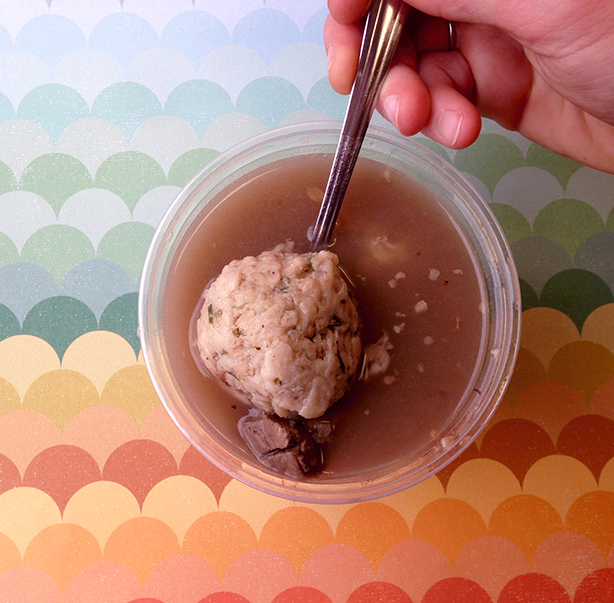
During the holidays, we read an interesting New York Times article from writer Jeffrey Yoskowitz titled “Goose: A Hanukkah Tradition”. In the piece, he talked about a forgotten tradition—the Chanukah goose:
When Hanukkah fell on the Sabbath, Jewish families of means would host a feast with roast goose, latkes fried in its schmaltz and most likely pickled vegetables. ‘The smell of smoking goose fat became the traditional scent’ of Hanukkah, Michael Wex says in his book ‘Rhapsody in Schmaltz.’
Yoskowitz goes on to say that goose was once a focal point of European Jewish cooking even beyond Chanukah, but the tradition didn’t withstand migration to America. The main reason being that geese and their notoriously belligerent dispositions aren’t conducive to the modern factory farm. Chickens, on the other hand, are easier to confine and breed, making them a cheaper, more accessible recipe alternative. These days, buying a goose is more expensive that ever, and Yoskowitz reports that the nine-pounder he recently purchased was a whopping $250!
Here at Zingerman’s we’re passionate about traditional full-flavored foods, so it shouldn’t be a big surprise that, yes, we still use goose and goose fat. In fact, it’s a prized ingredient at the Bakehouse.
Bakehouse co-managing partner Amy Emberling says that the business starting using goose fat while studying Hungarian Jewish cooking. “We were making traditional Hungarian foods, and then we made things that Jews in Hungary made,” explains Amy. “Jews were the goose farmers in Hungary, and I think it was because there was a lot of pork, and they weren’t going to be the pig farmers, so they raised the geese, and they used goose fat in a lot of their foods. That’s why we’ve put it into a couple of our recipes.”
Goose is still prevalent in Hungary. In the markets and in kitchens, you’ll find goose fat and goose lard. Instead of butter, diners are often served a mound of goose fat in Hungarian restaurants.
Currently, we use goose products in our Matzo Ball Soup and cabbage Rétes (a strudel). The inspiration for using goose broth in the soup came from a visit to a restaurant of a famous Hungarian chef—goose leg is also a common addition in Hungary. We source whole geese (along with tubs of goose fat) from local purveyor Schiltz Food, which we roast, putting the meat into the soup and using the bones for the broth.
When we asked Yoskowitz what he thought about us keeping up the tradition, he had this to say: “I was surprised to learn that you use goose fat in your chicken soup and strudel, but not surprised to learn the reason: over the years I’ve come to expect that Zingernman’s cares deeply about such details. I was also a bit surprised since goose fat isn’t that easy to come by, though sources have told me that goose farms are more common in the Midwest. And, yes, it played an incredibly important role in Jewish cuisine across central and eastern Europe. I’m so delighted to know that the tradition continues in the Bakehouse.”
Come get in on the tradition. We serve our Tibor’s Goose & Matzo Ball soup every Friday in the Bakeshop and our Rétes are available daily.
And check out Jefferey Yoskowitz and Liz Alpern’s book The Gefilte Manifesto and online shop.
*From time to time, we share the writing of our friends and co-workers on this site. Today’s guest post comes from Zingerman’s Bakehouse staffer Chrissy Abe.
Upon arrival on her first visit to Hungary, Zingerman’s Bakehouse Partner Amy Emberling wanted what any weary, jet-lagged person would want – a meal. Any meal. It needn’t even be a good meal, just something to begin the assimilation process after touching down in another country. So, when Amy, Bakehouse Partner Frank Carollo and Zingerman’s founder, Ari Weinzweig, ended up at Duna Corso, a restaurant in a touristy part of Budapest, they were pleasantly surprised to find good food in a family-style restaurant.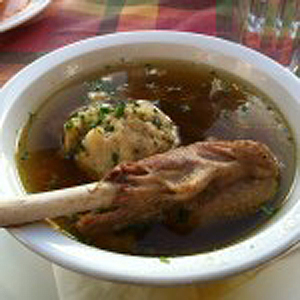
Seeing matzo ball soup on the menu, with no mention of it being a Jewish dish, was intriguing to them. Even more interesting was that the matzo balls were swimming in goose broth instead of the chicken broth usually found in the U.S. version. The goose broth was rich and complex, and was served along with an entire goose leg as a garnish. Then there was the matzo ball itself: It was much coarser in texture than any the Bakehouse crew had previously experienced, and it was flavored with fresh ginger root! (Don’t let your bubbe read this…)
“The food that warms your soul is what makes an impression…”
Interestingly, Hungarian cuisine and Jewish cuisine are quite intertwined today. Matzo ball soup is often on menus, latkes are readily available and cholent, often served with pork, is surprisingly common. Jewish communities have existed in Hungary since at least the 1100s and their impact on the nation’s cultural landscape is significant. World War II brought the same fate to Hungarian Jews as it did other European Jews. But this occurred much later in the war since Hungary was an ally of Germany, and maintained its independence until the spring of 1944. Some Hungarian Jews fortunate enough to survive the Holocaust returned after the war, only to find themselves living under repressive Communist rule.
After the fall of the Berlin Wall in 1989, the community became more visible and vibrant. Budapest now has the largest and most active Jewish community in Eastern Europe, and 90% of Hungary’s Jewish population lives in the capital. The result of 900 years of Jewish/Magyar co-existence is an interesting assimilation of Jewish foods into the Hungarian standard cuisine. What we might think of as Jewish food here in the U.S. is simply considered Hungarian food in that country.
One of the goals of the spring 2012 trip was to explore Jewish cuisine in Hungary, which makes sense as Zingerman’s has its roots in Jewish food. Toward that end, the group decided to pay a visit to Tibor Rosenstein. Tibor is the chef and owner of Rosenstein, one of a handful of restaurants in Budapest known for their Jewish offerings. He survived the Holocaust as a baby, and was raised, along with his sister, by resourceful elderly grandparents. After finishing middle school, he chose cooking as a trade because “eating is good, and everyone must eat.”
Tibor built on what his aging grandmothers had taught him: cook what is locally available with love and great care. He opened his restaurant in the early 1990s, and he cooks what his grandmothers cooked. The food that warms your soul is what makes an impression, and his restaurant is a wonderful representation of Jewish and Hungarian traditional dishes served in an elegant setting. One of the best parts of the restaurant is Tibor himself. He is an energetic, smiling, and passionate chef. Truly inspiring!
Returning to the matzo ball soup… At his restaurant, Tibor makes a flavorful goose stock using a mix of vegetables such as mushrooms, parsnips, celery root and Savoy cabbage. But the crowning jewels are the matzo balls. Tibor welcomed the Bakehouse group into his small, but efficient kitchen to show us how he makes his matzo balls, using coarsely crumbled whole matzos, whole eggs, goose fat, fresh parsley, and fresh grated ginger root. We left his kitchen prepared to bring Hungarian matzo ball soup to Ann Arbor.
Intrigued? We promise a tasty experience whether you’re a matzo ball soup novice or connoisseur. Come and see us at the Bakehouse on Fridays and try our tribute to Tibor’s soup.