Mancini Farmstead Pasta from the Marche Region
Remarkable artisan pasta from Italy’s east coast
Over the nearly 44 years that we have been working with traditional full-flavored foods, so much has grown, changed, and improved. There is far, far wider recognition of what goes into making well-crafted artisan foods so amazing. Seasonality is now, in our corner of the culinary world, well understood. People understand that olive oil and wine have annual harvests, and that each year brings somewhat different quality, flavor characteristics, and quantity. The 2025 olive oils that will be harvested and pressed in the coming months will, by definition, taste different from the 2024 oils from the same estates.
I don’t think this understanding has been carried forward, though, to wheat and pasta production. Our friends at Mancini Pasta in the Marche region of Italy are on a mission to change that. They recently shared this about the state of this year’s harvest, completed a couple of months ago now:
With the new “vintage” of Pasta Mancini—Harvest 2025 now in production, we are very keen to share with you the very positive characteristics of our new harvest.
On July 13th, we concluded our annual harvest of the Mancini wheat. This season was characterized by very favorable weather conditions, which contributed to a particularly good harvest.
Specifically, we would like to highlight:
HEALTH – zero chemical residue.
QUALITY – high protein content.
QUANTITY – 6,400 tons harvested from the 1,157 cultivated hectares, with an average of 5,5 tons per hectare, and peaks of as much as 8 tons per hectare in coastal areas.
(For more info on Mancini’s 2025 harvest, go to the Notebook on their website.)
Artisan pasta has long been one of the greatest contributors to the quality of my culinary life. Rustichella, Martelli, Cavalieri, Gentile, Faella … all have enhanced my pasta-eating enjoyment for many years now. Six or seven years ago, I added a new-to-me arrival to that list. Pasta Mancini, from the Marche region on Italy’s east coast, has become a regular item at our house, and on our shelves at the Deli. It is also the pasta in the Roadhouse’s remarkable and widely praised Macaroni and Cheese. If you like eating artisan pasta even an eighth as much as I do, consider giving it a try.
Mancini is unique among my favorites because it is the only farmstead pasta maker in Italy, meaning that the pasta is made in the same place that the wheat is grown. In fact, if you go on their website, you can see an aerial map of the fields. This might help you picture where the wheat that’s cooking in your pasta pot came from.
Four varieties of wheat go into the pasta: Maestà, Nazareno, Farah, and Nonno Mariano (the latter is named for Massimo Mancini’s grandfather and developed with agronomist Oriana Porfiri). The family has been farming this land for nearly ninety years now—Lorenzo Mancini, the fourth generation to help lead the family business, says, “We are first farmers, then pasta makers.” They began growing wheat in 1938, right before World War II. Nearly 20 years ago now, the family built a pastificio (pasta factory) right in the middle of the wheat fields! The design of the building was done, effectively, I think, to be in harmony with the surrounding fields.
All the same important techniques that go into any great artisan pasta are at play here, too—low-temperature mixing, bronze die extrusion (properly made pasta should have a very rough surface), and slow drying (48 hours for the long cuts). Mancini keeps the grain in cold storage at 18° Celsius and blends the various wheat varietals each year to get the flavor they’re looking for in the finished pasta. With that in mind, each year’s pasta will, indeed, be slightly different in flavor, just as one would expect with an estate olive oil or wine. The aromas of the grain will fill your kitchen while you’re cooking, and the perfume of the pasta will peak if you pour out the pasta water (be sure to use a bit of it to thicken your sauce first). The palate-catching quality particulars that make Mancini so good must, by definition, be directly related to the quality and types of wheat they’re growing, and then the skills and styles of their milling and making procedures. The pasta really is fantastic. Great chewy texture (be sure to cook very al dente) and great flavor. Remember, with all artisan pasta, the pasta itself, not the sauce, is supposed to be the star of your supper.
One other indicator of pasta excellence: Taste it a day or two after you cooked it, cold. Industrial pasta will have all the appeal of soggy commercial white bread. Great artisan pasta, on the other hand, will taste like a bit of well-made sourdough bread.
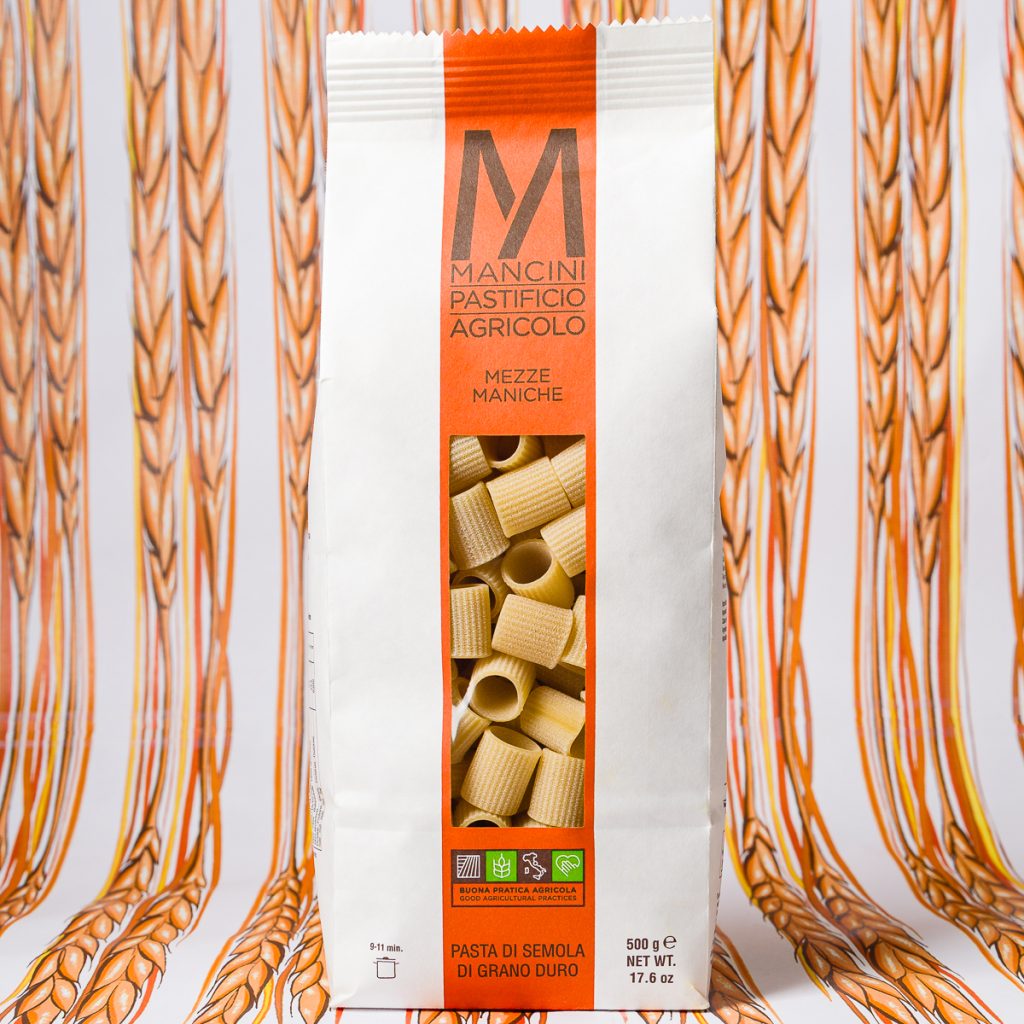
We have five shapes on hand to get going—mezze maniche, fusilli, maccheroni, penne, and spaghetti. The Mezze Maniche are the favorite at our house. They are short and stubby, 1 inch or so long and nearly as wide, “tubettes” of pasta, and their name means “short sleeves.” The Maccheroni are what we use the most of. The Roadhouse goes through about 500 pounds a week all on its own!
All the Mancini offerings are marvelous. I learned years ago that a bowl of just-cooked artisan pasta, topped simply with great olive oil and Parmigiano Reggiano or Pecorino, gives you a world-class meal in under 15 minutes. Same goes for a just-cooked Mancini pasta tossed with room-temperature butter, coarsely ground black pepper, and grated Parmigiano-Reggiano. Easy, remarkable, and, although your serving plates are almost certainly much simpler, a better meal shall not be had at Buckingham Palace.