Revisiting and Appreciating Rereading
Learning anew and renewing an end-of-year tradition
Two years ago, I decided to try starting a tradition. Or, if you prefer, a ritual.
The first time you do something, there’s absolutely nothing traditional about it. The idea has yet to sink roots into the cultural context in which it’s being planted. If it takes, then, by the second or third or fourth year, it might have gained a bit of momentum.
The tradition I’m talking about is a late-December invitation to reread some of the other 51 essays that have come out in this enews earlier in the year. And also to celebrate the import of rereading. Rereading, I’ve come to believe, is significantly more important in our current era of social media scrolling, when far too many people seem to spend about 20 seconds on something before moving on. The idea is to go back and pull out some of the essays I’ve written over the last year, the ones that feel most worthy of rereading, and then share them here for folks to dig into in the downtime many find themselves with during the week of the holidays.
Rereading, I’ll suggest, comes up a lot less often than it ought to. I wonder, now and then, why we tend to listen to our favorite records over and over again, often one time immediately after another, without thinking twice about why we do it. Almost everyone (me included) listens to music they like multiple times. The written word, by contrast, is seen as a one-and-done experience more often than not. One reads, one learns, one leaves it behind.
My hope here is to encourage all of us (me included) to take up rereading as a much more regular activity. Our lives, our learning, our companies, and the country, I believe, would be better off for it! The poet Sonia Sanchez once advised, “In order to survive, you should reread Toni Morrison every 10 years.” I’ll take her wise words one step further. I’m going to track down one of Toni Morrison’s many great books from my shelves and return to what I have already read and learned from once before.
The benefit of doing this is not, of course, limited to books by Toni Morrison. In order to thrive, we would be wise to reread the work of writers we learn from far more frequently than most of us are inclined to do. New insights, creative connections, inspiring ideas, and then some are almost certain to emerge.
The poet Joseph Brodsky, who taught at the University of Michigan here in Ann Arbor for many years after escaping from the autocratic oppression of the Soviet Union, wrote that “Man is what he reads.” Those of us who have committed ourselves to living reflective lives would be wise to remember to do regular rounds of rereading! In which context, I’d now consider paraphrasing Brodsky: Reflective man is what he rereads! (I let Brodsky’s use of “man” stand, but of course the point is relevant to all human beings who like to learn.) The books and essays that have influenced me most are the ones I have reread. I find new insights and much more.
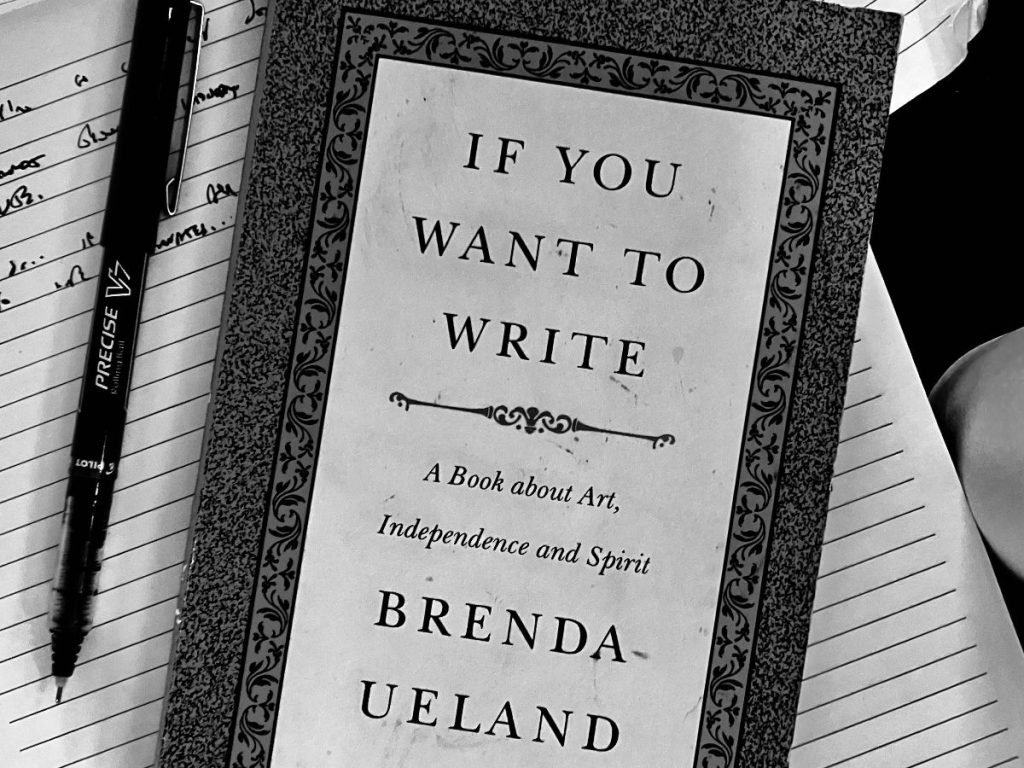
I have said many times, and will almost certainly say many times again, that the writer Brenda Ueland changed my life. When I first read her 1938 book, If You Want to Write, about 30 years ago, it blew my mind and altered almost every belief I had about writing. I’ve lost track of how many times I’ve read its 175-or-so pages, but it’s probably somewhere close to 10. The other day, I picked up Ueland’s book once again because … why not? Brenda Ueland has never let me down. I learn something new every time I go through If You Want to Write. My copy is heavily underlined and bookmarked, to the point of being unworkable, but still, when I reread, I learn anew what I know that I once knew. Often, it’s something I liked early on but had forgotten about. Other times, it’s something I’d missed in my many reads.
The other day I did it again and was rewarded. When I began to reread If You Want to Write, I was reminded of the inspiring message that’s square in the middle of the first page. It’s a line that fits wonderfully well with my anarchist studies and that, to this day, informs a lot of my own belief system:
Everybody is talented, original and has something important to say.
That belief underlies everything we do in our organization, so I was grateful to read it again. It’s what I found so inspiring about last week’s huddle for the entire Zingerman’s Community of Businesses (ZCoB). It underlies my beliefs about democracy, why it is both possible and practical and why I decided to get to work on a pamphlet that I hope to have out for sale soon. Autocratic leaders, in companies or countries, generally believe the inverse: In the absence of humility, they work with the belief that they themselves are incredibly talented, that they are original in ways no one else can match, and that they have a wealth of wonderfully important things to say that a whole company, or whole country, needs to hear. By contrast, the way we work here in the ZCoB, is based, essentially, on what Ueland wrote back in 1938.
I have tried to train myself to pay attention to each person I meet—young or old—in the belief that what they are about to tell me might inform what we do in new ways or offer insights that spark further thoughts that help me process the world in new ways. That is, in fact, exactly what happened with the piece I wrote about regenerative studying a few weeks ago. Talking to Fionna Gault about salt and pepper shakers led to a whole new way to look at what I’ve actually been doing my whole life.
What is true of regenerative studying is equally true with rereading. I have noticed several parallels:
- I am reminded of insights I had long since forgotten about.
- Because I underline when I read, I can see what was interesting to me back at the time I first read the material.
- I learn new things every time I do it. I can’t imagine I’ve ever gotten every possible learning out of any book, and rereading helps me notice descriptions, observations, connections, and more that I completely missed the first time through. Writer Clifton Fadiman—who famously once wrote that cheese is “milk’s leap into immortality”—was a big believer in rereading for this reason. As he puts it:When you reread a classic you do not see more in the book than you did before; you see more in you than there was before.
It’s certainly true for me. Rereading Brenda Ueland recently, I stumbled on a second line that I had totally spaced on, one that remains remarkably good advice nonetheless, advice I try to live every day and every week in this enews: “Write only what you think.” Ueland’s directive reinforces my long-standing resistance to write about anything I don’t believe. It’s also, I can see now, an invitation to revisit the piece I did last spring on the idea of meaningful and regenerative marketing, marketing that, unlike so much mass marketing in the modern era, is based on telling the truth.
What I think here is that taking time to reread is a really good idea! I’m aligned with Ciflton Fadiman’s daughter, the writer Anne Fadiman, who echoed her father’s feelings on the subject:
The reader who plucks a book from her shelf only once is as deprived as the listener who, after attending a single performance of a Beethoven symphony, never hears it again.
The reader who plucks a book from her shelf only once is as deprived as the listener who, after attending a single performance of a Beethoven symphony, never hears it again.
The Fadimans are hardly the only folks who feel this way. The other afternoon I was chatting casually with ZingTrain Co-Managing Partner Joanie Hales. She told me that the ZingTrain team is starting its own version of the Leaders Are Readers program that the Roadhouse managers started five or six years ago and are still doing regularly. Last week all the Roadhouse managers read and then discussed “Secret #42: “It’s All About Alignment.” During the course of the conversation, Joanie shared thoughts on the idea with ZingTrain’s Kerstin Woodside, who will be co-leading the ZingTrain reading program. Joanie said this:
When I need to retain information, I find it helpful to revisit a section multiple times. Similarly, when I’m seeking an extra boost of inspiration, returning to something I’ve found meaningful in the past often helps. I think of rereading like watching a movie for a second time: I already know the major plot points, but I notice the smaller details with greater depth and appreciation.
I’jaaz Tello, who works in the Bakehouse, offered another wonderful take on rereading, sort of a voyeuristic version (in a good way). It’s certainly something that had never crossed my mind, but now that I’jaaz shared it, I’m intrigued. “I like to buy used books,” he told me, “and I’m always hoping that I’ll get one that was underlined by whoever owned it before me. I love seeing what they marked.”
Part of what I value so much about doing this writing every week is the interaction that it initiates with so many of you. After last year’s piece on rereading, Kate Mueller, a longtime ZingTrain client who lives in Maine and writes Live with Sass, shared some great insights on her own learnings from rerereading:
For a whole variety of reasons, [last] December I decided to resume rereading. I’m reading the books in roughly the order I very first experienced them in, over a decade ago.
They are all heavily underlined, annotated, and dog-eared.
It is a lot like catching up with an old friend, to see the familiar passages and to remember a bit about who I was when these resonated.
But it’s also been fascinating to discover that there are new passages that resonate now, some that I hadn’t previously underlined or annotated.
It’s a bit of a relief, to be honest, to discover that the reading is giving me things again. Or to feel that I’m open enough to hear them.
Sometimes it feels to me as if this is the one true measure I have of seeing how much I’ve grown or changed as a person, to discover the books that do (or don’t) still resonate with me, and which parts of them do. As if it’s an acknowledgement of where I was stuck or the problems I was facing before, and how I’ve moved past those into new problems or sticking points.
With all of Kate’s wise words in mind, in rereading, I was reminded that on the final page of If You Want to Write, Brenda Ueland makes this point:
The best way to know the Truth or Beauty is to try to express it. And what is the purpose of existence … but to discover truth and beauty and express it, i.e., share it with others?
Which, I realize now, sort of sums up what I try to do every week with writing. To know some new truth and beauty, to understand better so that I can do better, to share my own learnings so that they can illuminate your life and work as well. I never take for granted how great it is to be part of such a positive, interesting, and insightful community. To be able to learn from people like Brenda Ueland, Joanie Hales, and Kate Mueller, to be able to really write, as Brenda Ueland and I believe best, only what I really think. To make, serve, and sell only products that I—or, in many cases, we—really believe in. To be part of a community, both inside the ZCoB and in Washtenaw County, that is so caring, so thoughtful, so supportive, and so patient.
The first piece on the rereading list below is “Living Customer Service as a Love Story.” In the spirit of which, much love and appreciation to you all for making all that we do at Zingerman’s possible. A thousand thanks for all your caring support! It means the world!
Reread! Rejoice! Return over and over again to what you believe. Remember, as Brenda Ueland emphasized:
Everybody is talented, original and has something important to say.
10 Top 5s to Reread
- “Living Customer Service as a Love Story: Seventh Stories, Patti Smith, and a 1932 Sōetsu Yanagi essay on patterns“
- “Using Frameworks to Foster Free Thinking: Helping everyone we hire learn how to think for themselves”
- “An Appreciation for Apricity and the Story of the Serbian Students: Finding hope and inspired resistance in wholly unexpected places”
- “Lessons from the Dust Bowl—How Humility Can Change the World: Learning from “wrong side up” and the wisdom of Woody Guthrie”
- “Trying to Do Right by Democracy in Difficult Times: Maybe apricots are the answer”
- “Helping Others Become Themselves: Learning to ‘fill oneself with oneself’ could change the world”
- “Owning Our Lives Opens the Door to Making a Meaningful Difference: The inspiration of two ‘extra-ordinary’ women”
- “Small Actions Matter in Much Bigger Ways Than We Might Imagine: Pint-sized ideas, the struggle of self-doubt, and learning to take action anyway”
- “The Beauty and Benefit of Regenerative Studying: Digging into any subject yields fascinating results”
- “The Power of Joy to Transform Our Organizations: Cut-up poetry and prioritizing joyfulness even in the face of pain”
Actually, here’s one more that I almost forgot to include:
“Learning to Lead While Feeling Lost: Life Lessons from The Tao of Archibald Tiny”
“Learning to Lead While Feeling Lost” shares life lessons from the blind and deaf senior Shih Tzu that Tammie rescued in August of 2024. At the time, he was very thin and barely able to walk. She named him Archie. Tammie told me later that he was in such bad shape that she didn’t think he’d live two weeks. Sixteen months later, Archie is an inspiration. He’s healthy: He has gained weight, eats home-cooked meals, and happily walks all over the house.
I realized this week that Archie is happily “rereading” the smells of the house to go to where he knows the water bowls are, or to his bed, or to the spot in the living room where he likes to lie in the sun. Archie inspires me anew every night. Even though he can neither see nor hear, within minutes of me coming home, he’s caught my scent and begins barking for me to pick him up and hold him. In fact, he’s sitting on my lap right now while I write. When I’ve felt down, anxious, or unsure of how to go forward in recent months, I reread this essay. If Archie can do it, I can do it, too!
Be well! Happy everything!
Sign up to get my weekly e-news in your inbox
P.S. If you want to reread even more, check out last year’s piece on rereading, and keep scrolling for earlier write-ups about really terrific items we carry at the Deli, Bakeshop, Roadhouse, and Mail Order!
P.P.S. For those who might be looking for a great gift, or just a way to keep warm, the Apricots for Democracy and Dignity t-shirt site I set up with Rishi Narayan of Underground Printing here in Ann Arbor, now has Carhartt jackets we can order with apricots embroidered on the breast pocket! Scroll down a small bit to find the Carhartt stuff. I just ordered two! Plus, there are now apricot beanies and baseball caps to boot! Join us, if you’d like, in sending a quiet, inclusive, and inspiring positive message to the world. All proceeds are donated to Democracy Now!