The Magical Movement That Comes from Momentum
A Belgian painter, an Alabama artist, and Vermont cultured butter
In the notes that accompany his 2002 painting “The Cape of Good Hope,” the Belgian artist Erik Pevernagie writes:
When treasured moments arise in the jungle of our personal history during a visual or aural encounter, we capture magic sparks from our past … These instants of recognition can kindle enthralling emotion and fulfilling inspiration.
We all, I believe, have many of those moments over the course of our lives. Some of the most obvious occur when we find ourselves in a sudden state of awe and wonder—the most remarkable meal we’ve ever eaten, our first glimpse of the Grand Canyon, or maybe a loved one’s wedding at Cornman Farms on a cool, sunny summer day. Other times, though, the sources of those “instants of recognition” and “fulfilling inspiration” are far more mundane. The sort of potentially magical stuff that most people probably miss.
The trick, of course, is to stay tuned in, even when there are a thousand reasons to turn away or tune out from painful realities, the repetitive nature of daily routines, or both. As Pevernagie writes in the notes to his recently released painting, “Love Lying Fallow,” “If we don’t stay hungry for attention and awareness, our life is doomed to remain bare and fallow.” When we do tune in, though, all sorts of interesting things are almost certain to open up. Ideas emerge, energy shifts, excitement starts to rise.
You really never know, after all, where momentum will come from next.
The momentum I’m feeling right now started up two weeks or so ago with what seemed at first to be a positive, if not particularly remarkable, exchange of texts. I was messaging one morning with my friend Natalie Chanin. She was in her hometown of Florence, Alabama—where the weather was unseasonably warm and sunny—while I was sitting here in the cold and snow of our Ann Arbor winter. The weather gap, though, didn’t get in the way of our words. Good things almost always emerge from our conversations, and this one was no exception.
I’ve written a lot about Natalie and the terrific work she and her team do at Alabama Chanin (beautiful, non-culinary gift ideas, anyone?) and about their relatively new nonprofit, Project Threadways. A few years ago, I put together this piece about what Natalie taught me to call “the Living Arts”—for her it’s making clothes by hand, for us it could be baking artisan bread or cooking. Natalie’s team also puts on the annual Project Threadways Symposium in Florence in the spring. I spoke briefly about dignity at the event last year and have already bought my ticket to go again this year. (If you’re thinking of attending, buy a seat soon. There’s more and more buzz building about the Symposium, so it’s sure to sell out.)
Natalie is a wonderful human and a good friend. She’s also an amazing artist and a caring creative who is always, literally and figuratively, on the cutting edge! We had been texting back and forth about any number of things that morning, including the anxiety and uncertainty we’ve both been feeling about how to respond to the rise of autocracy in this country. The negative implications autocracy has both for our organizations, our communities, and for the country as a whole, we have long agreed, are significant.
Many people we know seem to be feeling something akin to what Erik Pevernagie once described in a different context as “a sense of quiet desolation.” Natalie and I, though, are not in that camp. Neither of us is the type of person who stays down for too long. When I do feel distress and despair, one way I get my energy back up, as I wrote about in the pamphlet “Working Through Hard Times,” is to reach out with ever greater frequency to friends. Texting, as Natalie and I were doing that morning, can work, but for me, phone calls are more fulfilling. I rarely have any particular agenda or request to make when I reach out like that. It’s just for the sake of communing and conversating with like-minded comrades. Without question, the calls help me stay centered. They show me new things. Ideas emerge. I almost always leave them calmer; considering different angles on any issues I’m struggling with. It’s very much as Erik Pevernagie writes: Even while “our mindset is besieged by a revolving burst of emotion,” if we pay attention, we’ll repeatedly find that “our world is ultimately opening up.”
At some point in our ongoing but not particularly linear exchange, after we’d briefly lamented the increasing presence of autocratic power in the U.S., Natalie wrote:
I sense a change in the temperature of the world. It won’t all happen at once, but some good things are coming.
She wasn’t, to be clear, talking about the weather, but rather about the national climate—what some might call the mood or the energy and direction of the country. Her comment caught my attention. I’d had a similar feeling, but I hadn’t yet found the courage to say anything about it to anyone. Natalie speaking the words out loud was what I needed to hear. I was on board. I believe the national momentum has started to slowly but surely shift away from autocracy, in the direction of more dignity-focused and democratic ways of working. It’s not always easy to see. The shift is subtle. But as Natalie says, if you sift through the various dramas that dominate the news and tune into what’s happening away from the headlines, something feels like it’s starting to shift. This, it seems, is how momentum begins—one person speaks something aloud, a second concurs, and then … only time will tell.
Over the last couple of weeks, the idea of momentum has gained a lot of momentum in my mind. Here are a few thoughts on the subject.
Everyone knows that momentum matters. It comes up constantly in commentary during athletic competitions and also in politics—which, for me at least, is covered far too often as if it were an athletic competition and not a deep, caring, and thoughtful conversation about our collective future. We know momentum makes a big difference to anyone who tracks fashion trends or the popularity of a song. And we certainly see it in business as well. Without momentum, most every leader knows, it’s hard to make something meaningful happen over the long term. In a sense, the story of Zingerman’s is 44 years of slowly, surely, imperfectly building momentum for what we do every day. It’s safe to say that there is a lot more of it for our work today than there was back in those tentative first months of 1982, when most of the town figured we wouldn’t last two years.
All that said, hardly anyone I’ve asked, me included, can explain much about momentum. All of which got me incredibly curious. As Belgian art critic Paul Piron says of Pevernagie, “The artist asks questions that the spectator can interpret.” So, I’ve been asking myself: What is momentum? Where does it come from? What can we do to make it happen? How does it fit into the work we do every day?
Long before I had momentum in mind, Erik Pevernagie was creatively identifying some of its impact. Pevernagie, who turned 86 last spring, was born near Brussels in 1939, at the start of what would become WWII. He grew up with art. His father was the acclaimed impressionist painter Louis Pevernagie.
Although I’ve only recently stumbled on his work, I love Erik Pevernagie’s painting. There’s something about the way he takes what most would see as mundane and then turns it into a beautiful piece of art. Even his approach to painting is thought-provoking. He sketches first and then builds up his colors and images texturally as well as visually by laying on small quantities of sand, ash, or metal. His 1998 work, “Why Can’t We Talk” could be seen as summing up the state of the country, and 2007’s “Thank God for Belgian Chocolate” got me smiling. His 2010 piece, “Finally Things Had Lost Their Weightiness,” is wonderful, encapsulating, in a way, my conversation a couple weeks ago with Natalie Chanin. Per Pevernagie’s notes:
Three brightly colored balloons—to explore a profound philosophical paradox: the coexistence of lightness and gravity within the human condition. Through this deceptively playful motif, he captures the tension between the transient and the eternal, between our capacity for joy and our inclination toward burden.
As you can probably tell, in the spirit of regenerative studying, the more I looked and learned about Pevernagie’s remarkable art, the more the momentum built in my mind and pushed me to study even further. Paul Piron says that “Bridging the gaps between generations, social strata and nationalities is a tricky business. However, Erik Pevernagie may have hit upon a workable formula to ease the alienation.” It makes sense. Scrolling through Pevernagie’s paintings online, I’ve noticed that there’s a painting that speaks to almost every part of human existence. He took seemingly mundane subjects and made them into something magical. In the notes from his April 2011 painting, “Trompe le Pied – Trompe l’Oeil,” Pevernagie wrote what he felt about the piece. His words seem right for the moment that Natalie texted me about. They also describe what it takes to manage momentum:
We cannot control external events, but we can control how we respond to them. If we maintain emotional resilience and clarity of thought, we can reconcile practicality and motivation, common sense and momentum.
The “angularity” of “Trompe le Pied – Trompe l’Oeil,” Pevernagie says, shows “zigzagging lines, sharp peaks and valleys, fragments of momentum.” “Fragments” is probably the best description of the way we have used momentum here in the Zingerman’s Community of Businesses (ZCoB) over the years. Unlike some businesses, musicians, and fashion trends, very little that we have done at Zingerman’s has really taken off in a big way right off the bat. Even things that were received reasonably well initially, have built up their import in our ecosystem, only bit by bit, over extended periods of time. A lot of work gets done to make them what they are. And as we move forward with them, slowly but surely, they pick up “fragments of momentum.” In the end, more often than not, things have worked out in ways that are inspiringly close to what we originally imagined. The process, here, is not based on big national marketing campaigns, but rather steadily building momentum.
Managing momentum like this is tricky. It takes tenacity. It’s clear to me that it’s a craft, not a science. All of which means that building momentum is as much about feel as it is about tactics and tools. It is a craft, not a science, and there are no momentum meters. In his notes for “Trompe le Pied – Trompe l’Oeil,” Pevernagie writes about what he calls “A Dance Across Unstable Ground”:
Ultimately, [the painting] invites the viewer into a delicate choreography—moving through a world of shifting meanings and uncertain footholds. In that sense, “Trompe le Pied – Trompe l’Oeil” is not merely a visual puzzle but a philosophical compass, reminding us: to look twice, to step mindfully, and to question the paths that appear smooth, bright, or confident. This is a painting about the fragility of perception and the courage of discernment—a call to walk with awareness.
Pevernagie’s description strikes me as very much the dance, a kind of “delicate choreography” that we as leaders do when we work to build momentum in ways that are aligned with our values, vision, and beliefs. Mindfully managing momentum is, then, “a call to walk with awareness.” And, I’ll add, effectiveness.
At the bottom of the notes he diligently wrote for each of his art pieces, Pevernagie would include two bullet points: the “phenomenon” at hand and the “factual starting point.” In the story that follows, the phenomenon is momentum. The factual starting point, though, is butter. It’s a look at what is now a six-year-long walk—a walk made with a wealth of awareness and a fair bit of effectiveness as well, I believe.
The story is about how we slowly but surely made the wonderfully delicious Cultured Butter from Vermont Creamery into a key ingredient in a whole bunch of our cooking and baking here in the ZCoB. And about how we have effectively built a great deal of momentum for this work. The buzz, as I write right now, is already pretty big, and I’m confident that in the coming months and years it will get butter—I mean better—still! 🙂
Two things happened in the course of the last week to get me thinking about the butter in the context of momentum. Each seemed an indicator that we have successfully built solid, grounded, and meaningful momentum for a project that began with a lot of uncertainty. The first event arrived in the form of an email from Harry Kahn, the kind and creative general manager at Vermont Creamery. He had ordered himself one of the Bakehouse’s Sour Cream Coffee Cakes from Mail Order. (If you live here in Ann Arbor, you can just grab one at the Bakeshop, Roadhouse or Deli.) Harry wrote:
Had the coffee cake this evening with the family, with some healthy dollops of [Vermont Creamery] crème fraîche on top. So good!
I smiled as soon as I saw his note. It made me really happy on a whole bunch of levels. For starters, it reinforced for me the effectiveness of building momentum in fragments, of working slowly but steadily rather than rushing to an early peak of attention. It took years to get there, but as of this past October, we began using their truly delicious cultured butter in our Coffee Cake. As we had hoped, it really improved the coffee cake’s already excellent flavor. Tasting how much better the cultured butter made this classic Zingerman’s baked good was another manifestation of that line from avant-garde composer John Cage that I referenced a few weeks ago: “Ideas are one thing and what happens is another. For me the surprise of what happens is the real joy.” Harry’s unexpected email was just that kind of joy. The joy of knowing that years of hard work by a hundred different people here in the ZCoB were working out!
Then, less than two days later, this past Sunday, friends and fellow ZCoBbers started emailing and texting me early in the morning. They all wanted me to know that Wirecutter journalist Hannah Morrill, writing in The New York Times, had sung the praises of the same, newly upgraded Sour Cream Coffee Cake that Harry Kahn and his family were enjoying. Morrill wrote:
The sweet and savory Zingerman’s [gift box], which has a transcendent sour cream coffee cake and excellent Maine Cheddar, is particularly nice to share.
This sort of national recognition, I know, doesn’t make the Coffee Cake taste any better (the primary focus for me), but it definitely helps build momentum for the project. People who work here are understandably excited to see our name in The New York Times. The recommendation from a well-known writer in a national newspaper is another confirmation that we are doing the right thing. Customers will also notice the Times’ reference, which will likely lead to more orders, which in turn reaffirms the excellence of the product. All of which builds more momentum.
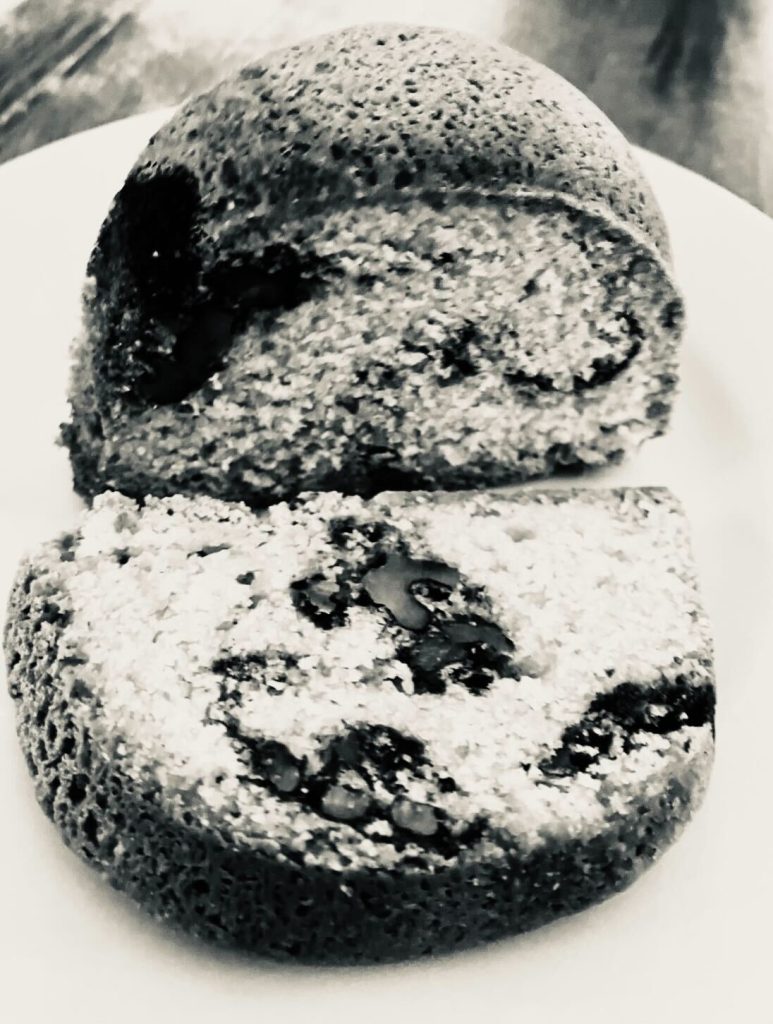
Although the addition of the Vermont Creamery Cultured Butter is new, the Sour Cream Coffee Cake itself is anything but. As many of you know, we’ve been making it—and building momentum for it—for close to 40 years now. It all began in the late ’80s, back when we would make it in the prep kitchen in the basement of the Deli. At the time, we made one Coffee Cake on weekdays and two or three on Saturday and Sunday. Today, it’s one of our biggest sellers, to the tune of over 60,000 a year. (That’s not counting 40,000 Gingerbread Cake, Lemon Poppyseed Cake, Hot Cocoa Cake, and Jumbleberry Cake! ) With the improvement in flavor and texture from the new butter, I’m betting it’s gonna get bigger still.
The Sour Cream Coffee Cake is a top seller that gets almost universal raves. It’s a great gift for your grandmother, a gourmet, or even a butter-loving visitor from Brittany. Six-year-olds are just as into it as savvy world travelers. In other words, there was zero “market pressure” to make it better. Nevertheless, on October 1, we upgraded the butter we use in the recipe, going from the high-quality mass-market product we’d been using for many years to the Cultured Butter from Vermont Creamery. Not accounting for the months of testing work by the bakers, what had been outstanding for ages became even more so, practically overnight. Enthusiastic responses ensued almost immediately. A wealth of “wows” and “wonderfuls” have been rolling in over the past few weeks. Momentum, naturally, is building—around the exceptional flavor and aroma of the cake itself, and around the Cultured Butter that we’ve used to make it better.
So how did all this get started? The work it took to make Harry’s email and the Times’ mention happen actually began six years ago when we started looking for a higher-quality butter to serve with remarkable Bakehouse bread at the Roadhouse. Although our guests already liked the perfectly fine, commercially available butter we were using, we had been grappling for a while with the knowledge that there was better butter out there for us to be buying. We had countless conversations and tasted probably two or three dozen different butters. As is true of pretty much every new project working in an inclusive, democratically oriented organization, the work did not start smoothly. To the contrary, there was probably far more pushback than there was support. Garry Ridge, the now-retired CEO of WD-40 writes, “The opposite of momentum is friction.” Friction was, indeed, a lot of the response we faced.
That initial 2019 conversation got cut off, of course, when Covid came to town in mid-March of the following year. When the pandemic hit, the last thing on anyone’s mind was improving butter quality. It was all we could do to just stay in business. Happily, we did. Nearly four years later, in 2023, the idea of using better butter was put back on the table by the Roadhouse management team. This time, we turned all our tasting and talking into action. A “Bottom Line Change” was drafted, discussed, worked over, and reworked, and finally, in the summer of that year, implemented. We began, for the first time, to serve the Vermont Creamery Cultured Butter with the Bakehouse bread at the Roadhouse. Awkward at first, as all changes are, we stayed with it. Momentum slowly began to build. As you can tell from what I’ve written above, it’s still going strong.
What did we do to make it happen? The list below is not all that glamorous, but that’s kind of the point. Though the rush of full momentum can be exciting, the work that creates that momentum is just as important. Like one of Erik Pevernagie’s paintings, the amazing end result comes from hours of preparation, thousands of unseen-by-others brush strokes, and more. Each of these actions steps alone, I’ll add, would not have been a big deal. Together, though, great things are coming to fruition! Here’s a look at how we made the change and built so much momentum:
- Identifying a logistical challenge: After spending years deciding on “just the right butter,” we had to figure out how to get it here so we could serve it! At the time, Vermont Creamery Cultured Butter was simply not available in our area. Over a period of many, many months and a bunch of back-and-forth messages, we worked with Vermont Creamery and a distributor to get it here.
- Communicating about the change: We shared our vision and compelling reasons for the change (steps 1 and 2 in “Bottom Line Change”) so everyone at the Roadhouse and around the organization at large could see both why we were doing it and where we were headed with it. As we did, more and more people slowly began to get involved with the work! We needed to help everyone understand that because the butter is made from higher-quality cream, because the cream is cultured by letting natural bacteria develop as was always done up until the end of the 19th century, because it’s much higher in butterfat, because it’s made with French sea salt, and so on, you really can taste the difference!
- Sampling a lot: Because the butter tastes so much better, a big part of the momentum building for us was to get the product into people’s mouths. That meant lots of tasting for the staff in various settings, and then sending samples to tables of customers. The response, not surprisingly, was really good.
- Sharing success stories: Customer compliments, steadily increasing sales levels, and the like helped to show that this change would be a positive one.
- Creating in-person learning opportunities: We had Harry Kahn come to the Roadhouse All Staff huddle to do a 15-minute talk about the story behind the butter. In a nutshell, Vermont Creamery co-founder Allison Hooper first made this product to recreate the great cultured butter she’d grown accustomed to when she lived on a French farm as a young woman. Harry shared loads of great detail and his passion for the product. The passion of a craft producer has a big impact!
- Partnering with Vermont Creamery for an event: We asked Vermont Creamery if they would sponsor our annual Jelly Bean Jump Up fundraising dinner for SafeHouse Center. Harry and his colleagues agreed. Roadhouse head chef Bob Bennett made the whole menu so every dish featured the butter. Harry Kahn came out to speak at the event. The whole thing was a huge hit, and we raised money for SafeHouse Center. A whole host of folks, customers and coworkers both, bought the butter to take home.
- Finding new selling points: As we get it, the butter is designed only for food-service use. It’s in one-pound logs. Vermont Creamery does not sell it this way at retailers. Over time, we turned its limited availability into a selling point. More momentum.
- Making Vermont Creamery Cultured Butter more available at retail: Both the Bakehouse and Deli began to sell the same butter out of their cold cases.
- Sharing our story of better butter: I began to write about the butter regularly and also included it on my list of Top 30 products for 2024. These products were mentioned in our print newsletter and at two in-person tasting events we did at the Deli. To keep the momentum going, I put it on my list for 2025, too. Having just done two “best of” tastings in the last two weeks, both to about 80 people, I can say that the butter was one of the biggest hits of each evening’s event.
- Baking the cultured butter into the biscuits: The Roadhouse chefs decided to try this better butter in their top-selling buttermilk biscuits. The biscuits quickly started accruing a lot more compliments. The staff excitement increased and sales went up, as, once again, did our momentum.
- Harnessing momentum to create new possibilities: With increased usage, the Roadhouse crew were able to buy butter directly from Vermont Creamery. Improved costs resulted. This meant we could use the butter without having to raise prices as much as we would if we were still buying it through a middleman. With a more accessible price point for us, someone suggested putting the butter into the Roadhouse mashed potatoes. It was magical. Already hugely popular, the mashed potatoes started eliciting audible oohs and aahs. Then it was the Roadhouse Grits, and then the Brown Butter Vinaigrette, and then the Butterscotch Pudding. The pudding, which had also already been popular, began to blow people’s minds.
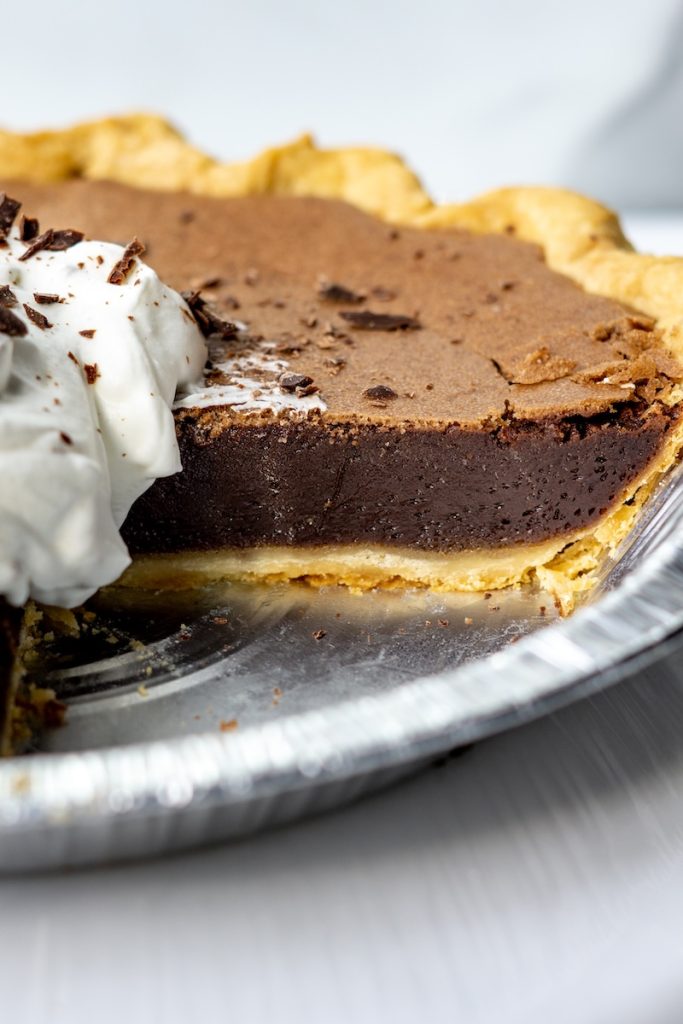
- Putting it into baked goods: This fall, the Bakehouse undertook many weeks of recipe testing to begin using the butter in some of our best-selling items: the Sour Cream Coffee Cake, the scones, the croissants, the Patti Pockets, and all the pie crusts (see below).
- Spreading the butter love even more: The butter is now featured in the November-December 2025 issue of our print newsletter, Zingerman’s News! And while I was working on this essay, we began using it at the Coffee Company on our terrific toasts!
All of which, you’ve probably guessed, adds up to a pretty solid level of momentum moving in the right direction. A more buttery and flavorful direction, too. What started as a somewhat controversial idea with only spotty support is now a very significant contributor to the quality, flavor, and aroma of close to 30 different Zingerman’s products. The impact of each alone would have been good. The impact of all of them together—given that each on its own was only another fragment in the momentum-building work—is huge! And for many years to come, this story will be told to illustrate the kind of quality-focused culture we’ve worked so hard to create.
This was, as you can tell, not a quick process. Writer Rebecca Makkai reminds us that momentum rarely happens in a hurry. Too many people, inexpert in the art of momentum building, try to force the issues. They move too fast. They make noise and may get a headline, but the momentum is neither solid nor lasting. As Makkai makes clear, the opposite approach is often preferable: “Counterintuitively, slowing down and giving us a character’s real interiority is often the fuel for that momentum,” she said in a Literary Hub interview with Brad Listi. The interiority here is the quality of the butter, the story behind it, why it tastes so much better. The flavor, not flash, is what’s driving this whole thing!
With higher quality in hand (and in the products), we can talk about this with considered grounded confidence, never trying to trick anyone. We just get to tell the truth! Which improves energy and then, in turn, improves sales. Other tips on building momentum? Sure! Here you go:
- Early successes, even if small, matter in a big way. As my friend, fitness entrepreneur and speaker Vince Gabriele, says, “A quick win builds confidence and creates momentum by showing visible progress right away. That small success makes it easier to take on the next step with more energy and belief.”
- Staying focused helps a lot. Leadership coach Daniel Marcos writes that we need to learn to say no to build momentum for what we care most about. As he pointed out in an Inc. article back in October, “Resist the temptation to chase every new trend—pivots without purpose kill momentum.” (Here’s a whole lot more from me on the value of sometimes saying no!)
- Generosity is a great way to start. Giving to others from whom you would ideally like help in the long run, can really help! Restaurateur Danny Meyer, who’s a friend of mine, says that “Over time, I’ve learned that giving first creates more trust and momentum than holding everything close.”
- Awareness of alternatives can be important. Sometimes knowing that the alternative to success is really bad for all involved helps keep folks focused. I prefer to begin with the positive, but if there is a risk involved, it works well for leaders to tap into it. As Ukrainian poet and rock musician Serhiy Zhadan told the Kyiv Independent about why Ukrainians still have so much momentum after almost four years of fighting, “If Russia wins, there will be no literature, no culture, nothing.”
- A strong, passionate leader is key. Momentum for a positive change like this one nearly always requires someone who is passionate about the possible change and who is willing to push past friction and resistance, sticking with the vision of the whole thing long enough to see it through. As leadership coach Gavin McMahon writes, “Movements don’t start alone.They need a spark.” People like Erik Pevernagie and Natalie Chanin, and the team working with the Cultured Butter, all demonstrate this reality. As Pevernagie writes in the notes from his 2002 painting, “The Umbrella of Our Imagination,” “We do not merely absorb reality: we can shape reality. Our consciousness is … creates space for momentum and original undertakings.”
On the website I.C.A. artcritics, Dutch art critic Wim Toebasch, who knew Pervenagie well, describes the artist’s impact on the world:
Erik Pevernagie paints for a generation. Our world has been decomposed, fallen into pieces, and become uncertain and unseizable. But art and poetry are ultimate recourses. Erik Pevernagie’s work is thrilling. With him, we enter a totally different universe than the recognizable and readable reality. It’s a universe we can interpret. … He has a vision of man and the world. This artist is captivated by his topics and by the way he is painting them. He brings about a change in our way of looking at the world.
That last line encapsulates all of this really nicely. Momentum is merely a tool. We can sail with or against its winds, and. It’s like a current in a river that can help us or hinder our progress. When it works, and when we work at it consistently over long periods of time, amazing changes can take place. The Zingerman’s world looks different entering 2026 than it did six years ago because of all the work done by many dozens of people. And as you can tell, it includes a whole lot more Cultured Butter!
Coming back to the shift in the national climate that Natalie Chanin noted, as we all consider the state of the country and the idea of shifting momentum, I will close with some words by the remarkable historian and writer, Heather Cox Richardson. She reminds me, Natalie, and maybe you:
Now is not the time to despair. The momentum has shifted toward the people who are pushing back.
I’m in. Time to get to work!
Create Bottom Line Change
P.S. You won’t see the Vermont Creamery Cultured Butter on the Zingerman’s Mail Order website, but we’re happy to ship you some. Just email us at [email protected]!
P.P.S. For those who have been asking, the new Apricots for Dignity and Democracy T-shirts, sweatshirts, et al are all available from Underground Printing!