L’Etivaz: Little-Known, Much-Loved Mountain Cheese
An exceptional taste of 19th-century Switzerland
Once upon a culinary time, a time when attention spans were not in the news very often, a time before websites, cell phones, Instagram, and almost every secret on the planet could seemingly be made visible to anyone willing to sit and scroll long enough, there was an array of unknown treasures one might discover in the course of food-focused world travels. Over 30 years ago, I stumbled upon L’Etivaz cheese while traveling with a small band of cheese aficionados. L’Etivaz was absolutely not on our list of things to check out during the trip. In fact, we’d never even heard of it. Like the white parrot, we spotted it completely unexpectedly. And in the best possible way, both that magical memory and the cheese are still very much with me all these years later.
L’Etivaz was formally brought into existence in 1932. While most of the cheese world back then was becoming more industrialized, around 76 families who farmed the land near the town of L’Etivaz decided to go in the other direction. They turned back toward tradition. Following the frame above, they:
- Knew and cared deeply about their history and tradition.
- Had a clear sense of their values and philosophy.
- Found a way to make this long-aged mountain cheese that kept it very alive, drawing on the old ways for crafting it.
With all that in mind, the families decided to withdraw from what they felt was an increasingly mass-market-focused, government-managed Gruyère program to create their own cheese. They turned away from significant government subsidies, opting instead to keep the magic and lose the “benefits” that modernization promised to bring to the market.
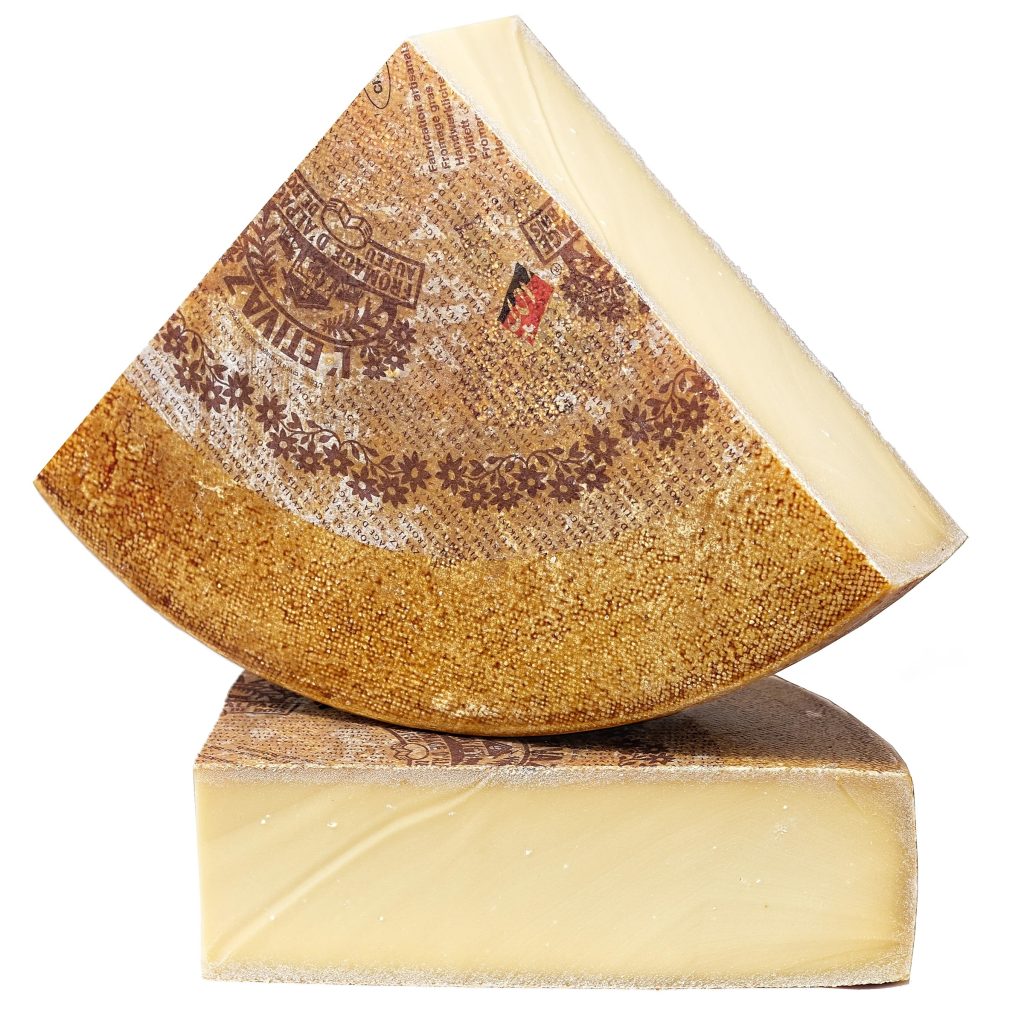
To this day, the production of L’Etivaz remains highly restricted. Interestingly, 72 of the original 76 farms are still making cheese today. Together, they produce just 19,000 wheels of cheese a year. L’Etivaz, by law, can be made only in spring, summer, and early autumn, when the cows are at high altitudes, between 3,500 and 6,500 feet above sea level. The cheese can be made only by those farms, and each farm can use only the milk of its own herd—no milk is ever purchased to make L’Etivaz. The high altitude ensures that the cows are grazing on an amazing array of wild herbs, tiny mountain flowers, and assorted green grasses. No chemicals are allowed at any point in the process, from field to finished cheese, so L’Etivaz is always essentially organic. The cheese must be made using raw milk, which has to be warmed in traditional copper kettles. True to tradition, the heat for the kettles must come from open wood fires!
This newly arrived batch of L’Etivaz that’s on the counter at the Deli this week is particularly special. It’s made by Frédéric and Marina Rosat and their family, high in what’s known in Switzerland as “the Alpage.” Our wonderful importer, Gourmino, who makes so many of our amazing artisan Swiss cheeses possible, shared this: “At the age of 15, Frédéric discovered the magic of making L’Etivaz AOP by helping producers.” Today, Frédéric and Marina have a herd of 45 Brown Swiss cows whose milk they use to make this magical cheese at an altitude of over 4,500 feet. From May 10 to October 10, they craft at most two 80-pound wheels of this artisan specialty each day. They number the wheels throughout the season. The first wheel is No. 1, and they make up to 290 wheels for the whole year. Gourmino selects only wheels from an even narrower production window: June to September, when the grasses and herbs in the Alpage are at their best. The newly made wheels are all hand-salted with Alpine salt for seven days on the mountain and then shipped down to the L’Etivaz co-op building, where all the producers’ cheese goes into the same decades-old brine solution. No other mountain cheese uses this process.
The Rosats have three huts they work out of in the mountains, gradually shifting to higher altitudes to make cheese until the height of summer. Then, they slowly work their way back down the mountains. Doing this keeps their herd on new grass, which must be the grazing equivalent of dining on olio nuovo (really green, new harvest olive oil). They manage grazing and milking in the mornings, then make cheese (over the open fire, of course) in the afternoons.
At just over a year and a half old, the current batch of L’Etivaz has a wonderfully balanced, beautifully full flavor. This wheel is markedly more fruit-forward but is still smooth and creamy, with a hint of brown butter, a lovely bit of salt, and a super-clean, long finish. Surprisingly, it’s subtly sweet in the most balanced way. Not at all salty or bitter, with a smattering of those crunchy bits of crystallized amino acids that some well-aged cheeses tend to get.
You can eat the L’Etivaz on its own. It’s also great on a slice of the Bakehouse’s Vollkornbrot, Dinkelbrot, or Country Miche. Spread on Vermont Creamery Cultured Butter and add a good bit of freshly ground black pepper. Make fondue. Put it in a salad. Eat, enjoy, and help engender the continued health of these deeply committed mountain cheesemakers.
A cheese worth choosing
Ship some to someone special