The Art of Appreciations and Living Democracy Daily
A new pamphlet, the impact of inches, and more
In Steven Spielberg’s now-famous 1999 film Any Given Sunday, the coach, played by Al Pacino, gives an inspirational pre-game speech. The players have been struggling, and he knows that they need to get their act together to get out of the hole they have dug for themselves. There’s no quick fix, but, he assures them, it can be done:
We’re in hell right now, gentlemen, believe me. And, we can stay here … or we can fight our way back into the light. We can climb outta hell one inch at a time.
Thirty years earlier, on New Year’s Day 1970, Wendell Berry published a piece in Orion that strikes me as similar to Pacino’s pep talk: State the difficult reality, offer the positive path forward, which, though it’s hard to make happen, is nevertheless still possible. The Orion essay opens with five words in all caps, in which Berry states, bluntly and boldly: “WE ARE DESTROYING OUR COUNTRY.” He emphasizes that, as grim as things are getting, we retain the power to change course. The decision, like the one Pacino frames for his football team, Berry says clearly, is ours to make:
If we decide to continue the destruction, that will not be because we have no other choice. This destruction is not necessary. It is not inevitable, except that by our submissiveness we make it so.
Whether you’re inspired by a fictional football coach, one of the most amazing American thinkers of the modern era, or both, the message is pretty much the same. Things around us may look grim on any given day, but we always have the freedom and power to choose what we’re going to do about the situation going forward.
The following year, Wendell Berry released his third book, The Unforeseen Wilderness. (He’s gone on to publish nearly 50 more!) The second chapter is entitled “The One-Inch Journey.” In it, Berry suggests that one way to stop the destruction he’s warning us about is to engage anew with “lessons in what to look for and how to see,” lessons that help us regain “access of delight, vision, beauty, joy that entice us to keep alive and reward us for living.” All of which, I’m reminded here, are regular subjects for anyone who becomes accustomed to what we’ve long called Appreciations here in the Zingerman’s Community of Businesses (ZCoB). We’ve been using Appreciations as an end-of-meeting ritual for over 30 years now. The more consistently we do Appreciations, the more delight, vision, beauty, and joy we experience.
The remarkable writer, friend, and all-around wise human being Peter Block reminds me regularly that despite our best efforts to the contrary, “Cooperation never makes the news.” It does, though, make this enews all the time. This week will add one more positive piece of cooperative newscraft to my very long list. Regardless of what may be going on in the world around us, here in the ZCoB, our situation feels far more positive than the ones Al Pacino and Wendell Berry were framing. We may want to improve in many areas of our work, but we are definitely not “in hell,” nor are we “destroying” our companies. As I wrote last week, we’re mostly just working hard to make more magic happen.
Josef Albers, the artist who led Black Mountain College from 1933 (less than a year before Wendell Berry was born) until 1949, made so much magic through painting, writing, and teaching. He once penned a poem entitled “More or Less.” In it is this lovely set of lines:
To distribute material possessions
is to divide them
to distribute spiritual possessions
is to multiply them
I’ll leave the work of division to those who are currently leading the country and focus instead on what seems much more meaningful to me: multiplying our spiritual possessions. In this case, that multiplication is made to happen without drama or difficulty or really any cost, through the practical practice of ending ZCoB meetings with a few minutes of Appreciations.
What follows is, in a sense, the sort of writing and reflection that Manchán Magan, of whom I wrote so much last week in my essay on magic and loss, had mastered so thoroughly. Manchán’s Deep Understanding came out of his extensive studies of the Irish language; mine right now is emerging from studying what it means to make democratic practices part of our daily lives within our organizations. An example of Regenerative Study, that work has me paying attention anew, excited about the future, and taking notice now of things that would otherwise have gone past unremarked upon. In this case, how a seemingly small, easily missed, and almost irrelevant-seeming (to the unknowing) organizational practice can change a company, a community, and maybe even a country. If I were to write a headline about cooperation here, it would be something like “Doing Appreciations Regularly is Even More Important Than I’d Ever Imagined!”
To be clear, I’ve long known—and written about—how great the practice of Appreciations is. They are certainly not new news to anyone who’s been around the ZCoB. That said, I had two eye-openingly positive insights about Appreciations, both within a period of two days last week, that struck me as newsworthy. I want to start a new statement for Peter Block to share: “Cooperation regularly makes for good news.” Here are those insights:
- Appreciations are an awesome, down-to-earth, easy-to-implement democratic practice. That’s right: This simple end-of-the-meeting ritual every ZCoBber knows so well is a great way to make democracy come alive! Our practice of Appreciations is many decades old, but the understanding of it as an implicitly effective democratic practice has been with me for only the last couple days. I’m still sort of in shock about it, but in the best and most inspiring of ways!
- Appreciations are one of the most effective ways to spread dignity and democracy through communities. Peter Block is probably right that cooperation may not make the news very often, but it does, most definitely, make for healthier organizational cultures! When we do Appreciations for five minutes at the end of a meeting, we multiply spiritual possessions. The appreciated, the appreciator, their colleagues, the organization, and the community at large all come out ahead.
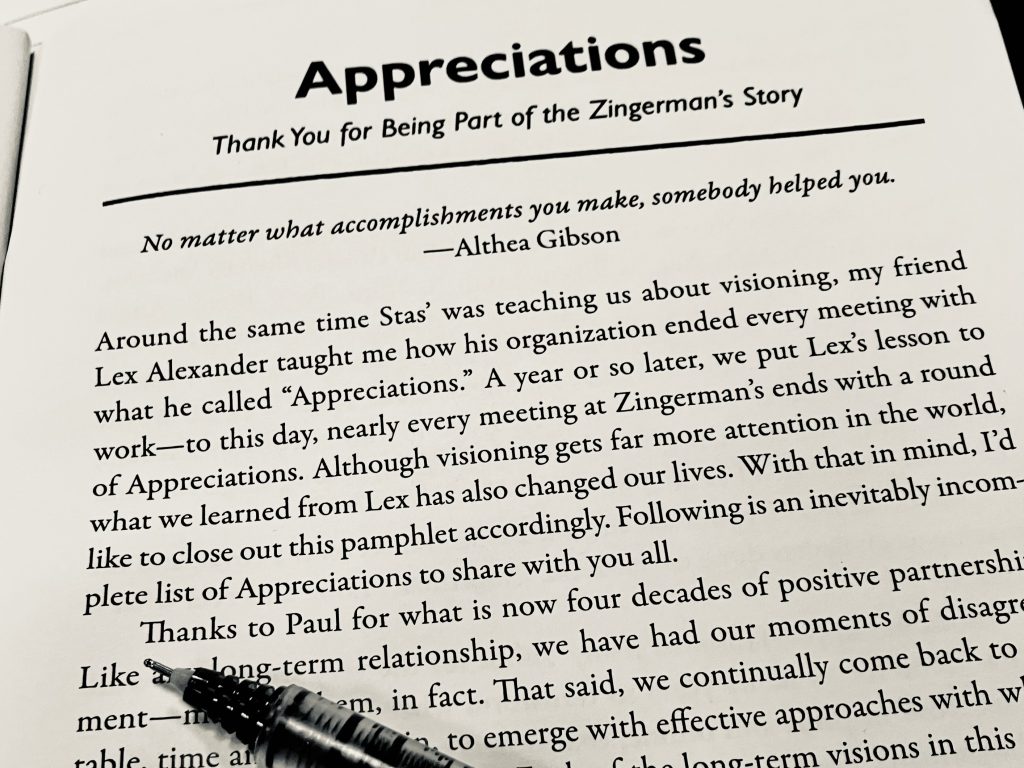
What are Appreciations? I learned about them oh so long ago—back in the early 1990s—from my good friend Lex Alexander. He’s the one who taught me to call them Appreciations, and we still use that name all these years later. Doing them couldn’t be much simpler. Formal meetings will have “Appreciations” written on the agenda. More informal sessions will likely just have someone bring it up: “Appreciations?” Either way, we take at least a few minutes to let anyone present who feels inspired to appreciate anyone or anything they want. It may be work-related, it may not; it may be appreciating someone who’s in the room or someone who isn’t. It may be something that seems huge or someone who brought them coffee a couple days earlier.
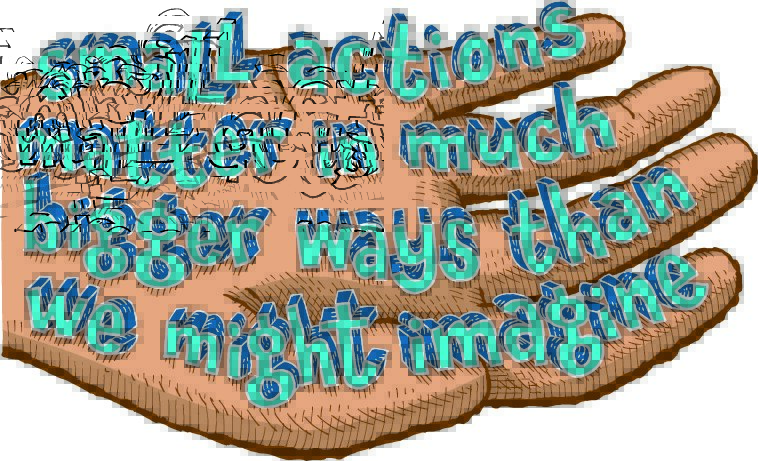
Newcomers or meeting attendees who are in a hurry, I’ve found over the years, may well suggest skipping Appreciations. When that happens, someone who knows better will nearly always remind them that, though they’re welcome to head out, it’s important for us to devote at least a couple minutes to Appreciations. The process is remarkably simple, but it’s hugely powerful. To an untrained outsider, it may seem as if there’s really no overtly big action involved, but almost everything feels different after we do them. The whole energy of the room can shift in what we might think of as only a metaphorical emotional inch.
The value of doing Appreciations is not just anecdotal, and it’s not only an organizational flight of fancy. There are reams of data in neuroscience and psychology that speak to the enormous benefits of gratitude practices. In “The Neuroscience of Gratitude and Its Effects on the Brain,” a PositivePsychology.com piece published last fall, psychologist Melissa Madeson writes extensively about the impact of regular application of gratitude practices like Appreciations. The studies Madeson points to in her article have found associations between gratitude and lower cortisol levels, better cardiac function, more emotional resilience, higher levels of happiness and well-being, increased levels of gray matter in the brain, better immune system functioning, higher levels of creativity, and more.
The point, then, is simply that by inserting Appreciations into your meetings and sticking with the ritual of it for a few years, you can have all of these benefits accrue in your organization. And you don’t need me to calculate what all of those things could mean: fewer sick calls, lower turnover, increased interest in the organization’s work, not to mention long-term lowering of health care costs. All for a few minutes of “work” at the end of the meeting. I’d take that deal in a heartbeat. Oh yeah, I already did, 30 years ago!
While that Appreciative magic is being made here in the ZCoB, it’s critical to remain realistic about the challenges we are facing right now as a country. The health of the greater ecosystem around us seems neither awesome nor appreciative, and whether we like it or not, context always counts. It would be both naïve and eminently unhelpful to gloss over the glaring tensions that are dominating international relations—and making headlines—right now. In fact, that difficulty of dealing with what’s going on around us makes the work of Appreciations all the more important. It grounds us away from the negative, bringing us back into the many positives of our own ecosystem.
Although the particulars of our present national situation do seem to be unique, to my sense of things as a history major, this is hardly the first time the country has been under duress. The great investigative reporter Sy Hersh, still actively reporting at the age of 88, has been through any number of national challenges before. His investigations, his courage, and his often-unorthodox perspectives have earned my respect over the years. Last week, in an insightful and inspiring interview with The Ink, Hersh did not hesitate to share his deep concern about the current state of the country: “It’s chaos. We’re in a total crisis.”
Hersh is a marvelous role model, pushing forward even when there are a hundred good reasons to hide. He is not put off or overwhelmed by the challenges at hand. To the contrary, Hersh adds with adamance, “You have to keep at it. How can you not have that fire? I don’t get why people don’t understand the extent to which we’re in an existential crisis.” Crisis or not, I, for one, am committed to keep going. Appreciations alone aren’t going to fix the whole situation, but they are, I’ve come to see, a meaningful small step—or at least a shift of a couple inches—in a better direction.
While the state of the nation does, indeed, seem to be as Sy Hersh says it is, here inside the ZCoB, there is neither chaos nor crisis. There are always, of course, shortfalls and problems to work through, but mostly there’s calm determination and a continued effort to make meaningful magic happen every day. Which is, I suppose, part of why I’m able to both absorb the terrible truth of what Sy Hersh is telling us and, at the same time, study the quiet but powerfully creative impact of Appreciations playing out here in the ZCoB. What’s more, they’re a meaningfully effective, very grassroots democratic practice. I can put the two together to remind myself, and maybe you, that we don’t have to despair when faced with autocratic cruelty and indignity. As folksinger and artist Carrie Newcomer writes:
Living well with gratitude and joy is an act of resistance, a claiming and affirmation of all that is still good and still true.
I don’t have any tattoos, but if I were gonna get a couple right now, they could well be the two phrases that have been serving as my mantras in recent months. Each has been helping me stay centered and inspired while the world is swirling around us, yet still focused on moving forward in the face of whatever adversity appears.
The first line, which you’ve likely heard me say many times by now, is from the theologian Richard Rohr: “The best criticism of the bad is the practice of the better.” Rohr’s words remind me that simply doing the work that we do here in the ZCoB, in the dignity-focused, caring, gentle, honest way that we try to do it every day, is in itself a meaningful act of resistance against the imposition of autocracy. Kind of like ending meetings with Appreciations.
The other words are from above-mentioned Mr. Berry, a greatly respected figure in the world of those who are trying to improve the health of our communities, planet, the people we work with, and ourselves. Berry reminds me that, although I, like many others, want the people in charge of the country to get their collective act together, that’s not how real democracy is likely to work. Rather, as Berry puts it, “The leaders will have to be led.”
Berry’s line comes from a terrific talk that he gave to the Kentuckians for the Commonwealth back in the summer of 2013. For context, that means he was already aware of and addressing this issue long before the ascent of autocracy that is now so readily apparent:
We must reject the idea—promoted by politicians, commentators, and various experts—that the ultimate reality is political, and therefore that the ultimate solutions are political. If our project is to save the land and the people, the real work will have to be done locally. Obviously we could use political help, if we had it. Mostly, we don’t have it. There is, even so, a lot that can be done without waiting on the politicians. It seems likely that politics will improve after the people have improved, not before. The “leaders” will have to be led.
Leading with appreciation instead of antipathy and anger is a wonderful way to do that. Spiritual possessions really do multiply, almost magically so. Or, one could bring the worlds of profit and magic together and say that, when we do them regularly, Appreciations appreciate.
Going back to the two stories that got me into this appreciative rabbit hole in the first place. This first serves, for me, as a bit of evidence of said Appreciations. It drives home just how much cultural impact we can have through these sorts of small, undramatic, dignity-centered actions. The story unfolded this past Friday, a bit after midday, when a group of us came together at the public library for what was something like our 100th construction meeting for the Roadhouse over the course of the last couple years. The sessions bring together a series of Roadhouse leaders (managing partner Lisa Schultz, longtime head chef Bob Bennett, and more), plus our builders, our architect, our finance crew, my business partner Paul Saginaw, and Paul’s talented wife, Lori Saginaw, who’s doing the design work in the dining room. Because our meetings are open, various ZCoB folks will show up on occasion. As one example, Yvo from our IT team came once, got into the conversation, and just started showing up every week. Before we knew it, he was integral to the work, making sure that all the wiring for the computers was going to be correct and more. (I appreciate the beauty of making our meetings open so that Yvo could even consider coming in the first place!)
Even though ⅓ to ½ of the folks in attendance are not formally part of the ZCoB, we continue to run the renovation meetings the way we run all of our other meetings. The Roadhouse’s Felipe Diaz is doing a fantastic job with facilitation. We end these meetings, as we do all our other gatherings, with a chance for people to share announcements, and then, last but not least, Appreciations. In a seriously magical moment on Friday, I noted that, of the 15 or so folks at the meeting, the first person to offer an Appreciation was Mark Hiser, owner of Phoenix Construction. He shared a beautiful and powerful Appreciation for the crew, both the Roadhouse team and everyone working on the construction end of things. It was awesome, all the more so coming from someone who’s not really part of the ZCoB. Before anyone else could say anything, Louie Marr, our longtime construction manager and liaison, chimed in with another Appreciation. With magic on my mind, I smiled inside. Seriously, if you’d have told me 30 years ago that a construction crew would be leading the way with Appreciations at the end of a meeting, I don’t know that I’d have believed you! Which reminds me that although the national news may now be grim, the best criticism of that “bad” can simply be to continue to do real, good, and very caring work. (Oh yeah, the big material news from the meeting is that the renovation project remains on time, so we’re still scheduled to reopen the Roadhouse in mid-February. Fingers all crossed!)
The second story is about how, after many months of trying to work to get the project going, we are now nearing completion of the next pamphlet in the Zingerman’s Guide to Good Leading Series. The title is “Why Democracy Matters: A Deep Understanding of Democracy in Our Everyday Lives.” As is always the case, I have learned an enormous amount in the process of writing. The great writer Joan Didion once noted what I also have experienced many times over: “I don’t know what I think until I write it down.” Writing opens intellectual and emotional doors to new understandings of the world. It’s helped me see how much of a difference down-to-earth and democratic practices can make in the world, how big a part they have played in making the ZCoB what it has become, and how we can use them to make those tattoo-worthy lines I mentioned earlier a reality. The new pamphlet, at its core, is all about committing to the practice of the better, no matter what else is going on around us. And it’s all about moving ahead, without waiting for higher-ups in the social hierarchy to start the process for us. All of which means that people like you and I, and maybe your great aunt in Arizona, can start to lead the leaders in far more positive directions!
Another one of the beauties of writing, for me, is that a book or pamphlet coming back from the printer means that I will get to teach from it soon thereafter. The learning experience, with a generous dose of magic, comes next. In my head, I’ve been working to clarify the main messages about my new beliefs about democracy. While I’ve been doing this, the amazing artist Jerry Zeniuk has given me even more insight still. Zeniuk, a lifelong adherent of Josef Albers’ philosophies around art, has seen a great deal of both magic and loss over the course of his 80 years on the planet. His beliefs and painting practice have helped me better understand the impact of Appreciations, both inside our organization and out.
Jerry Zeniuk was born sometime in 1945, in a refugee camp near the north German town of Luneberg, to parents who had escaped Ukraine during the war. Later, like millions of others, the family was displaced by the war. When Jerry was 5 years old, the family moved from Germany to the U.S. He grew up in Colorado and went to work in New York in 1969. In 1992, he moved to Munich, where he has lived and painted ever since. Zeniuk’s abstract work, which is often referred to as Radical Painting, is an inspiration, and his 2017 book How to Paint quickly became a classic for people interested in avant-garde and unorthodox approaches to art. In a brief period of time, I’ve already learned a bundle of things from his philosophy. For instance, Zeniuk says that making sense of what you see in a painting requires patience:
To look at a painting, to understand what you see, takes time. Since we look at images from before we can remember, we think we know how to look. But there comes a time when we realize that there is more to see than we are used to seeing.
I think what Zeniuk says about painting is also true for organizational frameworks. If we stick with them long enough and pay close attention, there comes a time when we suddenly see that there is way more to them than we’d ever imagined in the first place. When Zeniuk says it “takes time,” he means years. Maybe many years. I see now that that’s what happened to me last week with Appreciations: Sure enough, after doing them regularly for over 30 years, I suddenly saw Appreciations in a whole new way. It happened when I was working on what seemed like they might be the final paragraphs of the pamphlet this past Saturday morning. For the first time in my life, I realized that Appreciations are one of the quiet but effective ways we make democratic practice a gentle daily reality in our lives here at Zingerman’s.
Appreciations are, I see now with surprising clarity, an awesome example of down-to-earth democracy in action. They involve everyone—no one is excluded, all are welcome. At the same time, no one has to say anything. Some people appreciate just one other person; others mention 10 or 15. Some people appreciate folks they know at work, but others will appreciate their family, friends, suppliers, etc. Others still, their dogs. It’s all free choice, it’s all collaborative, it’s all about the collective.
In the new pamphlet, I write extensively about how integral the practice of day-to-day dignity is to making democracy happen. And when I check the Appreciation process against the six elements of dignity, this gratitude practice seems to answer the call quite beautifully:
- Appreciations are all about honoring the humanity of both the appreciated and the appreciator.
- Appreciations are very authentic and real. People often tear up, even though they’re smiling when they speak. Folks take this sharing very seriously.
- Everyone gets a voice since anyone who feels moved can speak.
- Appreciations are all about positive beliefs!
- Appreciations support people’s effort to get to greatness. The more Appreciations we share, the more other people’s positive beliefs about themselves improve, the more confidence increases, and the higher the odds they will get to greatness.
- We do Appreciations in a way that actualizes equity. People don’t share in order of rank or anything to do with an org chart—rather, it’s done only in the order that moves them or the order that the facilitator calls on them.
Jerry Zeniuk’s artwork is, in a way, also very democratic. The artist Michael Brennan, whose paintings hang in some classic California restaurants, writes of Zeniuk’s pieces:
It is interesting how generous these paintings appear, particularly in light of their context. … These paintings in their incomplete manner allow the viewer considerable room to move about, and perhaps even enter these works more deeply.
This seems very much aligned with some of what I’ve learned about democracy. What matters most isn’t who gets the headlines, but rather how you and I behave every day. Democracy, in the context I have focused on in the new pamphlet, is not about politics; it’s about people and ethics and everyday activity. It doesn’t give answers; it opens doors to conversation, to caring, and to connection. Using effective frameworks like the six elements of dignity can and does guide us in designing our organizations and our lives in ever more connected and collaborative ways.
Zeniuk really got me thinking, though, with this line:
The painting is not about the color. It’s about the space between the colors. And the painting is not about paint, it’s about the space I create.
Most people are, per Zeniuk’s point, looking at the world’s metaphorical equivalent of the colors in a painting. They see newly appointed CEOs, record profits, leveraged buyouts—or big crises, failures, falloffs. They look to bold achievements like “Best Reuben,” or our incredible Sour Cream Coffee Cake made better by Vermont Creamery Cultured Butter, or the dramatic downsides of financial collapse or ethical failure. It’s becoming ever clearer to me that democracy lives, per Zeniuk’s point, in the spaces in between those attention-grabbers! Which is why the democratic work that made them possible—the meetings, the emails, the non-hierarchical thinking that went into the conversations, etc.—is missed by most folks.
Appreciations are one of the most awesome examples around. In that sense, they are hugely powerful, but they aren’t what gets in the headlines. The Roadhouse renovation work is akin to Zeniuk’s use of color. It’s what people will look at. Mark Hiser’s Appreciation at the meeting last week lives in the space in between. Few people would notice its deeply democratic, humble nature, yet it is a big part of what is making the project go as well as it is going.
In “Democracy,” an essay in the Fall 2020 issue of Lapham’s Quarterly, the anarchist anthropologist David Graeber wonders what would happen if we were to shift our focus away from the darkness, drama, divisiveness, and the drive to dominate that fills the headlines—or, as we might say in the context of what I wrote last week, to focus first on making magic. It’s a call to shift from problems to possibilities, away from waiting for heroes to show up and settle instead into what we can do ourselves in the here and now. According to Graeber:
One result is that the human past would start to look very different, because once you begin searching for it, evidence of democratic practice is actually much more common than one might think … Often it is hiding in plain sight.
And sure enough, after 30 years of using them, Appreciations are a deeply democratic practice of the sort Graeber is writing about. It’s very clear to me now. It’s also clear that by doing Appreciations diligently, consistently, and caringly over time, we have a positive impact on the organizational cultures of others around us.
With both of those insights in mind, I see that, per David Graeber’s observation, democracy breaks out somewhere in the ZCoB every day! More power to voting on election day, but why wait for that infrequent opportunity to actualize democracy when we could just be democratic this afternoon? Appreciations are a great way to practice. While headlines are swirling, we can get centered. Appreciations, I know, are not enough to singlehandedly right the course of the national ship. But they are a start, a bigger one by far than I’d understood up until last week. When you use them regularly, it’s hard to imagine not wanting to do Appreciations forever. They move us forward just an inch or at a time, but those inches, over time, absolutely add up.
The point of the “Why Democracy Matters” pamphlet really is my own shift to understand that democracy is mostly not about voting (but please do vote). It’s about what you and I do every day. It’s about making democratic practice part of our daily routines. It’s about building democratically oriented organizations, organizations in which people are encouraged to think for themselves, to participate, to push for what they believe in, to engage in conversation even when there is conflict. To care. To come with compassion. To make cooperation a big part of the daily news. It’s also that:
- We can start where we are and make democracy the lived experience of more and more people rather than waiting for the right leader to take charge.
- While the loss and darkness do exist, and, as Sy Hersh has said, absolutely need to be dealt with, they do not have to dominate our days.
- Appreciation and joy and dignity are acts of healthy resistance, and we can use them to model that the best criticism of the bad is indeed the practice of the better.
- By modeling things like Appreciations at the end of meetings, we can help to lead the leaders. Though 18 Appreciations at the end of a Zingerman’s huddle will not, on their own, make the state of the country do a 180, they’re a step in the right direction.
In the current national context, the work of Appreciations also reminds me of these lovely lyrics from the ’60s jazz singer Jeanne Lee:
In these last days
of total
disintegration
where every day
is a struggle
against becoming
an object in
someone else’s nightmare
there is great joy
in being
Naima’s mother
and unassailable strength
in being
in the way.
While I know that Appreciations are exceptionally effective here in the ZCoB, I do, on occasion, like to imagine what would happen in other settings. If the leaders are going to be led, what would it be like if every congressional session concluded with Appreciations? If everyone in the room, not just the congresspeople, could participate, meaning that staff members and court reporters could also raise their hands and be called on to appreciate others? If congresspeople who were full of bravado 15 minutes earlier would suddenly show vulnerability and appreciate their mothers for all they’ve done, or someone on the other side of the aisle for showing compassion as their child deals with cancer? If tears could be shed, voices could quaver, joy could become normal, not at the expense of someone else, but in honest, heartfelt appreciation for how others have been of help? It can’t hurt to hope, right?
The fact that two years of study, writing, and reflection about democracy has brought me back to a practice we’ve used every day for decades does make me chuckle. It took all of this to get me to appreciate this long-standing organizational ritual in a whole new way. It all makes me appreciate Appreciations even more than I already did. And it gets smiling over this other insightful observation from Wendell Berry’s The Unforeseen Wilderness:
And the world cannot be discovered by a journey of miles, no matter how long, but only by a spiritual journey, a journey of one inch, very arduous and humbling and joyful, by which we arrive at the ground at our own feet, and learn to be at home.
Jerry Zeniuk says that “A masterpiece never seems to have been painted, but rather to have always existed.” And that is certainly what it feels like to reexamine the impact of Appreciations at the start of 2026—a practical democratic practice, a positive way to model what we do. It’s a future I look forward to inching my way into and being Appreciatively part of for many years to come.
Don’t forget, we’re all in this together! I appreciate you!
Create a culture of appreciation
P.S. While we’re not quite done with “Why Democracy Matters,” we are close enough to put it up online for pre-order now! Order today, and as soon as it comes in, we’ll mail it to you!
P.P.S. Speaking of tattoos, one of the very good vendors at the Specialty Food Association’s Winter FancyFaire in San Diego, Sam from Burlap and Barrel, was especially excited about the Apricots for Dignity and Democracy project. So much so, she told me, that she’s contemplating adding an apricot tattoo to her already impressive ink! Darned good idea, I thought! If you do the same, be sure to send photos! And by the way, if you live, like I do, in cold-weather country, we now have Carhartt jackets available on the site! I’ve been wearing mine regularly in recent weeks. The embroidered apricot drawing by Ian Nagy regularly invites cool and caring conversations!