Mézes Krémes Torta from the Bakehouse
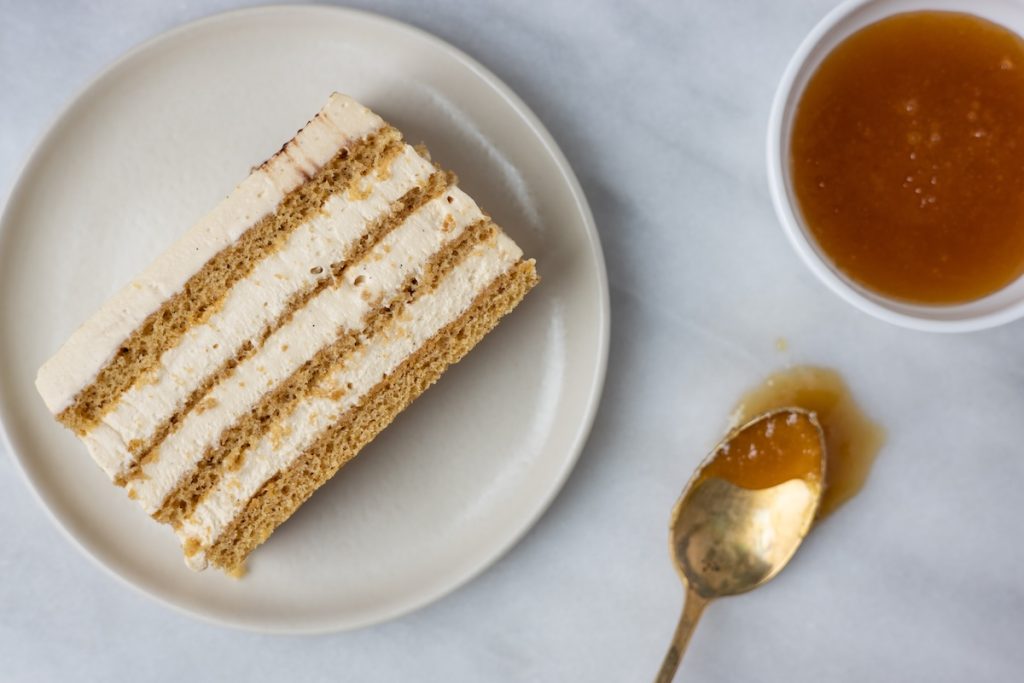
Incredible caramelized Hungarian honey cream cake
One of Budapest’s best-loved treats is rarely seen outside its cream- and pastry-loving homeland! Happily, thanks to the passion, skill, and dedication of the Bakehouse pastry crew, you and I can partake in this delicious dessert without going all the way to Budapest. Mézes Krémes (may-zesh krem-esh) has joined our ever-growing and ever-more-popular selection of traditional Hungarian pastries. It is a delicious and inspiringly iconic taste of this beautiful city.
First off, the cake itself is awesome. I’m not a big cake eater, but this one is seriously terrific, as in “I could eat a whole slice in about two minutes.” Light and elegant with an exceptional caramelly honey frosting and filling. Tammie Gilfoyle, my longtime significant other, says it reminds her of dulce de leche—not as rich as straight caramel and with a near-perfect cake-to-frosting ratio. Our Mézes Krémes has four layers of tender, sweet honey sponge cake, lightly spiced with cinnamon and sandwiched between luscious layers of cream infused with “burnt” (i.e., caramelized) honey, dulce de leche, sour cream, and a hint of orange zest. The sweetness blended with the delicate bitterness of the burnt sugar seems to be a pastry parallel to the Extra Aged Dutch Gouda from the De Graafstroom Co-op that we have at the Deli.
All traditions move and weave and evolve over time, and this cake is no exception. Mézes Krémes came to Hungary during the painful 20th-century period of colonial Soviet rule, which stretched from the end of World War II through October 23, 1989. The cake was invented in Russia over two centuries ago by a chef for the Empress Elizabeth Alexeievna, wife of Tsar Alexander I. Alexander I ruled Russia from the time of the American Revolution until his death in 1825. In Russian, the cake’s name is Medovik. (“Honey” in Russian is med, and “bear” is medved.) Alexander’s death was followed by the Decembrist Revolt, one of many failed attempts to bring democratic governance to Russia over the centuries (On a small note, the Revolt did inspire the name of the American rock band The Decemberists.) The Decembrists (the democratically inclined army officers, not the modern-day band) were fighting against the same brutality, inhumanity, and determination to keep taking, the dignity of others be damned, that led the Ukrainian poet Lyuba Yakimchuk to write the beautiful line “Where no more apricots grow, Russia starts.” Yakimchuk’s poetry inspired me to start a line of Apricots for Dignity and Democracy t-shirts, hoodies, hats, Carhartt jackets, and more. All of our proceeds get donated to Democracy Now!
It’s easy to imagine this elegant pastry being served in St. Petersburg back in the early 19th century, probably with tea rather than coffee. You can absolutely eat it anytime, and with the beverage of your choice. It’s great paired with the Honduras coffee that’s the current Roaster’s Pick at the Coffee Company. I think this Mézes Krémes would be beautiful at breakfast, too!
Take in some torta history