The Wheeler Latte at the Coffee Company
Paying homage to one of Ann Arbor’s great leaders
A super-tasty coffee drink. An important part of Ann Arbor history. The practical application of a promise beyond ableness. An homage to Ann Arbor’s first Black mayor. A way to support a good cause in the process! It all comes together in the Coffee Company’s Wheeler Latte.
On Monday, April 7, 1975, Albert Wheeler was elected mayor of Ann Arbor. Wheeler’s election was historic. He was the city’s first—and so far, only—Black mayor.
Many non-Black residents of the city may not realize that, in the years leading up to Wheeler’s election, Ann Arbor remained segregated through a series of largely unspoken social norms that are still not talked about much today. As an Ann Arbor News reporter later wrote:
Far away from the segregated lunch counters and water fountains of the Deep South, Ann Arbor was wrestling with its own brand of racism in the 1940s and 1950s. Blacks moving to town were only shown houses in the North Fourth Avenue area, a grimy neighborhood heavy with the odor of slaughterhouses and coal-fired plants. Jobs for African Americans at the University of Michigan usually got no better than cleaning floors or operating elevators.
Mayor Wheeler was born in St. Louis in 1915. He studied biology at Lincoln University, an HBCU (historically Black colleges and universities) in Pennsylvania, and then came to Ann Arbor in the late 1930s to study at the University of Michigan’s School of Public Health. When he moved to Ann Arbor, the Great Depression was winding down and the geopolitical tension in Europe that was about to turn into World War II was increasing. In 1945, when Wheeler and his wife, Emma, attempted to buy a house, the banker urged them to consider only Black neighborhoods. Nevertheless, the couple persevered in pursuing the home they hoped to live in. In 1952, Dr. Wheeler became the first Black professor at the university to gain tenure and went on to have a remarkable career as an educator and researcher.
The Wheelers, motivated in part by the poor treatment they received as they tried to purchase property, would go on to be instrumental in founding Ann Arbor’s chapter of the NAACP. Al first ran for mayor, unsuccessfully, in 1970. He then ran again in 1975 and won. As mayor, Wheeler worked to change beliefs about what a city government is supposed to do. Many have credited him with instilling the idea that city government should be involved in human services. He assisted disadvantaged citizens and advocated for significantly increased services for all residents. Wheeler’s path was not an easy one. To connect this idea to the essay above, I’ll mention that a PBA drove his work. He was determined to make a positive difference for people of color both at the university and throughout town.
Even in our fairly “liberal” city, Wheeler faced verbal and physical threats. He pushed forward anyway, especially in improving public housing. The Ann Arbor News noted that “a pattern of scattered public housing on small sites throughout Ann Arbor is another Wheeler legacy” and that Wheeler “worked to avoid the large, isolated housing projects that other cities built with public funds.”
Wheeler explained his deep dedication to working for civil rights in the city in terms of dignity: “I thought I was working for what I was entitled to as a human being.” His daughter Mary McDade, an appellate court judge in my home state of Illinois, told Michigan Public Radio about how her father consistently led with positive beliefs: “He recognized that as women and as Black people, it was going to be an uphill struggle to do anything in this life.” And yet, McDade says, “he was constantly reminding us that if you used your brains, if you applied yourself, there was nothing that you couldn’t do.”
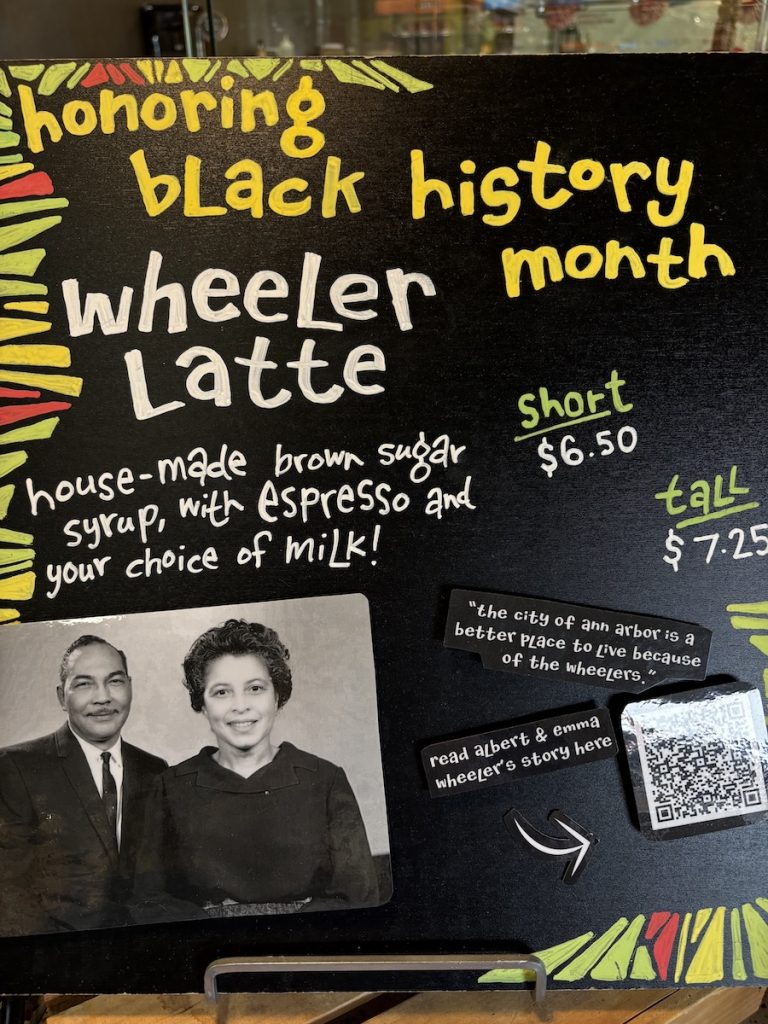
In 1987, five years after we opened the Deli, Summit Park, located a few blocks to the north of us, became Wheeler Park. The plaque at the park says it well: “The city of Ann Arbor is a better place to live because of the Wheelers.” Albert Wheeler passed away in 1994, at the age of 78.
To mark the 51st anniversary of Al Wheeler becoming mayor, the Coffee Company created the Wheeler Latte. It’s a super-tasty coming-together of the Coffee Company’s Espresso Blend #1, a house-made Demerara brown sugar syrup, and steamed milk from Calder Dairy in Carleton, Michigan.
As we see it, the Wheeler Latte is a tribute to Mayor Wheeler’s wonderful work in the 20th century and a recognition of what we can all do to build on his caring community contributions. Order one up this week and toast the mayor’s memory. It’s a great way to salute the social improvements that he worked so hard to make happen—and that all of us remain responsible for today! To sweeten the deal, the Coffee Company is donating $1 from every Wheeler Latte to the local chapter of the NAACP.
Have one ready and waiting