Greek Mountain Tea
The beautiful herbal hot brew of the Greek countryside
It’s been many years now, but I still vividly remember sitting in a café in Northern Greece a few decades ago with my late and much-loved friend Daphne Zepos. (See the Epilogue of Zingerman’s Guide to Good Leading, Part 3: A Lapsed Anarchist’s Approach to Managing Ourselves for more on Daphne.) I innocently ordered tea, expecting the usual uninteresting black tea bag one gets in casual cafés. Before the waiter could leave the table, though, Daphne turned and asked me if I wanted “regular tea or mountain tea.” Never having heard of the latter but ever the inquisitive eater, I shrugged my shoulders and said, “Mountain tea—why not?” I’m glad I did. It turned out to be a terrific herbal infusion that I’ve been drinking—when I can get it—ever since. It’s one of many great gifts Daphne left in my life.
In Greek, mountain tea is known as tsai tou vounou. The Latin/English name is sideritis. It grows at a high altitude—generally over 3,000 feet—so this really is mountain tea. Loaded with antioxidants and antimicrobials, it’s touted for possessing a wide range of health benefits, including lowering blood pressure and supporting the digestive tract. Some studies even show success in using mountain tea to treat Alzheimer’s. In Greece, if you start getting sick, you’ll soon find yourself being served cups of this restorative herbal brew to help bring you back to good health. Plus it contains no caffeine, making it easy to drink all day!
Our Greek mountain tea at the Deli comes to us from the wise women at Daphnis and Chloe, who source much of their tea from Mount Olympus and from Mount Parnon in the southeastern part of the Peloponnese. In Greek mythology, this was the home of Saturn and the place of prayer for Artemis, and Dionysus lived there as a youth as well. More than a dozen monasteries have been located on the mountain over the centuries, and it’s safe to say that monks were—and still are—meditating over this tea regularly. (Remember that what we know now as black and green tea didn’t arrive from China until the 16th or 17th century.) During the Greek Revolution in the early 19th century, Parnon was one of the centers of resistance. Again, it’s safe to say that freedom fighters in hiding would have been brewing this tea to stay warm in the winter months.
The offering we currently have on hand hails from an organic farm in Grevena, in Northern Greece. Daphnis and Chloe share:
Our supplier was among the first to cultivate the green-and-purple-hued variety of the area, which has a significantly higher concentration of flavonoids, antioxidants, and phenolic content than its commercially available rivals. … It takes one hour to assemble just 15 bouquets, making it one of the most elaborate products we produce here.
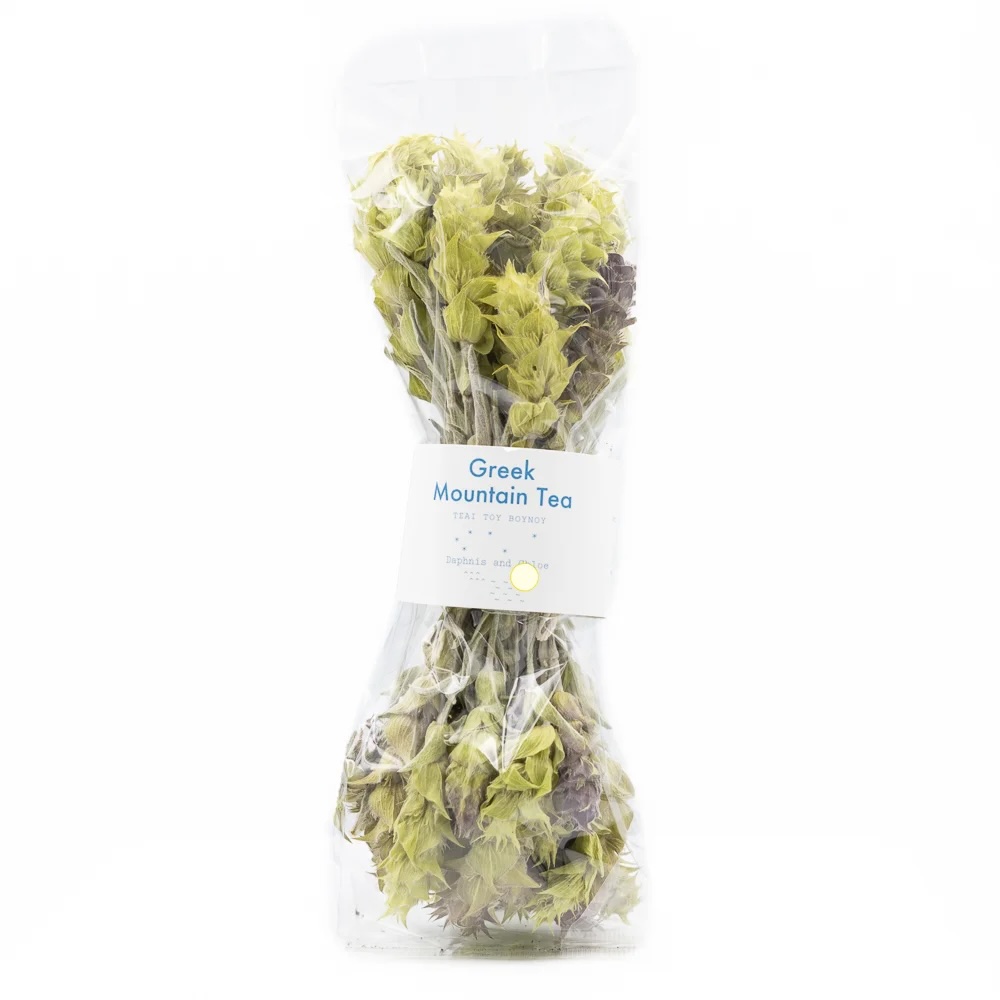
Greek mountain tea typically comes in the form of a bouquet of long, light green stalks with tiny flowers and buds attached. To brew it, you simply break up the branches and infuse them in very hot, but not quite boiling, water (about 195°F). Use the stems, too—they have as much flavor as the beautiful buds—and enjoy the tea’s compellingly sweet perfume. For optimal storage, keep the stuff out of direct sunlight (yes, it grows well there, but it doesn’t store well there) and humidity.
You can do some further study on the health benefits of this tea while I test it out by sipping live in real time! Appreciate the beauty, take in the aroma, savor the flavor, relax, and enjoy.
Try some tea