Run for the Roses Pie at the Bakehouse (April 30-May 2)
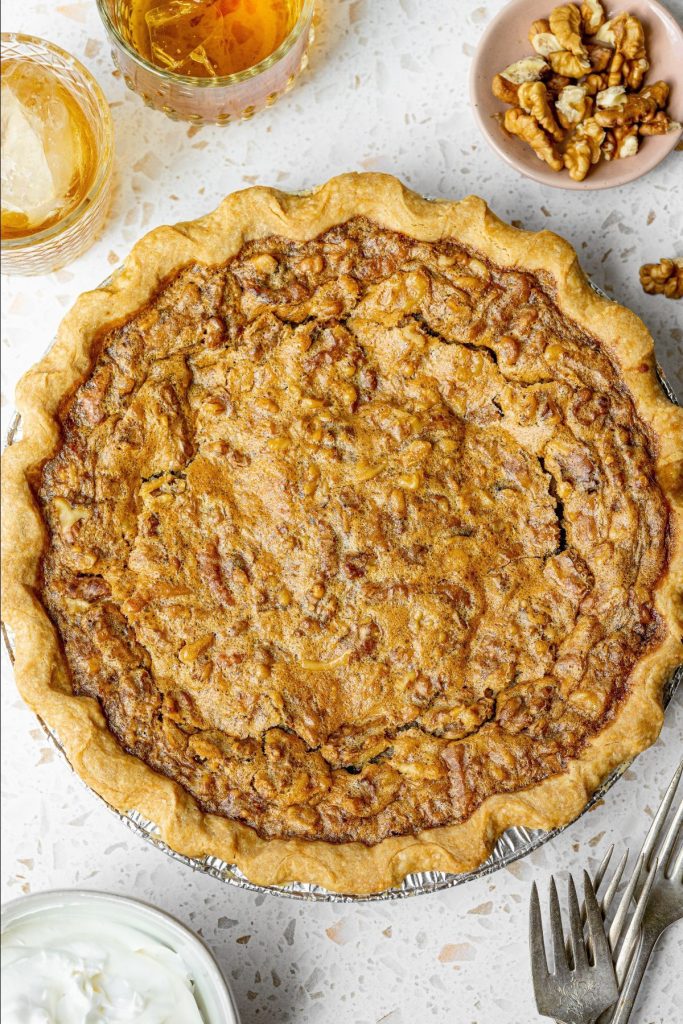
Can’t get down to Churchill Downs? No worries—pie awaits!
Around Ann Arbor this coming Saturday, it’s going to be pretty darned obvious to anyone who lives in the area that the dominant activity of the day is the University of Michigan commencement ceremony. More than 50,000 people will gather at Michigan Stadium for the event. And so far, thankfully, the weather forecast is good: sunny and in the 50s.
Eleven years ago, in 2015, Paul and I were the commencement speakers. Given that I had never attended any of my own graduation ceremonies, I knew we were going to have the odd experience of finally seeing what it’s like to graduate from the stage at the center of the “Big House” in front of thousands of people. (Our commencement speech is at the back of Zingerman’s Guide to Good Leading, Part 4: A Lapsed Anarchist’s Approach to the Power of Beliefs in Business [page 533].)
This Saturday, 350 miles to the south, 18 of the best horses in the world will step up to the starting line of the Kentucky Derby at Churchill Downs, near Louisville. While the Derby may be way more “important” on a national level, in our little corner of the world, commencement is the order of the day. It pretty much takes over the whole town—like the academic version of a football weekend.
Whichever event you’re celebrating (or even if you’re celebrating neither), you can do so while enjoying a slice of the super delicious Run for the Roses Pie from the Bakehouse. Vermont Creamery Cultured Butter pie crust, dark chocolate, bourbon, dark brown sugar—so good. Let’s go, team!
The U of M commencement starts at 10 a.m. and usually runs about two hours. So, in theory, you could go to the Big House, listen to Jalen Rose’s speech, grab a Zingerman’s lunch to go, and get down to Louisville for the start of the Derby. You can also pick up a couple of these remarkably delicious Run for the Roses Pies to take with you—one for the car and one for later in the day, too! Maybe even a third for the drive back, depending on how driven you are to eat delicious handmade pie on the regular.
Now for some intriguing background: Iconic as the Kentucky Derby is, its history—like most history—is hardly straightforward. To the contrary, the story of the Derby, as with nearly every other business I know, is a lengthy tale of ups and downs, of short-term highs and a whole host of long-forgotten lows. To the outside observer, it’s hard to imagine a more solid American sports institution. But when you go behind the scenes, you find an event that both succeeded and came close to collapsing almost half a dozen times over the last 150 years.
Col. Meriwether Lewis Clark Jr. had the initial idea to launch the horse race on a piece of land south of Louisville in 1875. As is the case with every startup—including ours in 1982—it was an iffy proposition. (Later, of course, everyone “knew” from the get-go that it was going to be a success.) Clark called his new race the “Kentucky Derby.”
For context, this was not even 10 years past the Civil War. The entire United States had less than 40 million people, and Louisville had only about 100,000. The first transcontinental railroad route had arrived in 1869—costing the lives of thousands of Irish and Chinese immigrants who spent long shifts toiling under the Western sun—and steam engines and fresh track meant people could travel coast to coast in about four days, fundamentally changing the way Americans thought about the size of their country. In Louisville, the last track in town had failed in 1872.
In that era, jockeying in horse races was considered undignified for white Americans—thus nearly all the original jockeys in those early years were Black. It was gambling that attracted Americans of European origin—jockeys, owners, and viewers—to the Derby. As white jockeys started to join the ranks, they would sabotage the Black jockeys and their horses, fomenting violence on and around the track. By 1911, what had begun as an all-Black profession had inverted to be all white. Still, 15 of the first 28 Derbies were won by Black jockeys. (A similar pattern occurred with cheesemaking—done at home by women for no pay until the 1850s—and with banjo playing—the banjo being an indigenous African instrument played as a form of creative expression by enslaved Africans. When it became clear that money could be made from these pursuits, white European men gradually took over, and took credit to boot.)
Clark created the Derby when he was just 26, and his approach was similar to the way people pitch sports stadiums today—essentially, “You all pay for this, and then over time it’s going to pay dividends by bringing so much tourism and business to the region.” In an early version of crowdfunding, 320 individuals put up $100 each to finance the competition, and the first race, held in 1875, drew a crowd of 7,500. It’s been a singular event ever since. As John Steinbeck once wrote, “This Kentucky Derby, whatever it is—a race, an emotion, a turbulence, an explosion—is one of the most beautiful and violent and satisfying things I have ever experienced.”
(A fascinating side note: Sixty-five years ago, in 1971, when the U.S. and Venezuela’s relations were rather less contentious, a Venezuelan colt called Cañonero II shocked the racing world by winning the Derby after an amazingly strong finish. The race was in disarray that year: the owner of the previous year’s winner had donated his prize money to Coretta Scott King to advance civil rights work [three years after Dr. King was shot], and people tried to sabotage both him and his horses. Cañonero II and his team were also the target of racism. And yet, at the end of the race, the colt came from behind to win by four lengths. No one had calculated the positive impact of training in high mountain air in Venezuela and how much better Cañonero II would do when the other horses tired. He became a cult hero!)
Had the Bakehouse existed at the inception of the Kentucky Derby, I’m confident that our handcrafted Run for the Roses Pie would have been a hit right from the firing of the opening gun.
As for the pie’s origin story, it’s really not too complex—just delicious! As Amy Emberling, longtime co-managing partner at the Bakehouse and co-author of Zingerman’s Celebrate Every Day, says, “It’s just fun to bake something created for an iconic American spring sports tradition.” And so it goes: dark chocolate, Kentucky bourbon, muscovado dark brown sugar from Mauritius, and walnuts in a compellingly flavorful crust consisting of Vermont Creamery Cultured Butter and 80% high-extraction (in other words, closer to whole wheat than not) flour made from local wheat. The bourbon is a special one! Felipe Diez, bar manager and sommelier at the Roadhouse, shares the backstory:
Christi Lower, the owner and master blender for Highline Spirits, invited me to blend a custom bourbon for the Roadhouse. I was thrilled! She brings an artistic approach to blending, and is making some of the best blended spirits in the world (Highline’s Triple Rye won the best in category at the 2025 World Whiskey Awards!). After walking me through the basics of the blending process, we started tasting, choosing base products, and mixing. Our final result combines three different bourbons, including a 37% high rye bourbon. Notes of citrus, baking spices, leather, and butterscotch shine through.
It’s a truly terrific pie—so good that I kind of wish we “might could” make it a few more times a year (though I know I can always freeze some for future use).
Wherever you have the Run for the Roses Pie—in Ann Arbor, Kentucky, or anywhere else—enjoy it. It’s a treat equally worthy of graduating from baking school with honors and finishing in the money in any culinary competition.
Pick up a pie