Weird, True, and Beautiful
Life lessons from an Alabama folk artist and musician
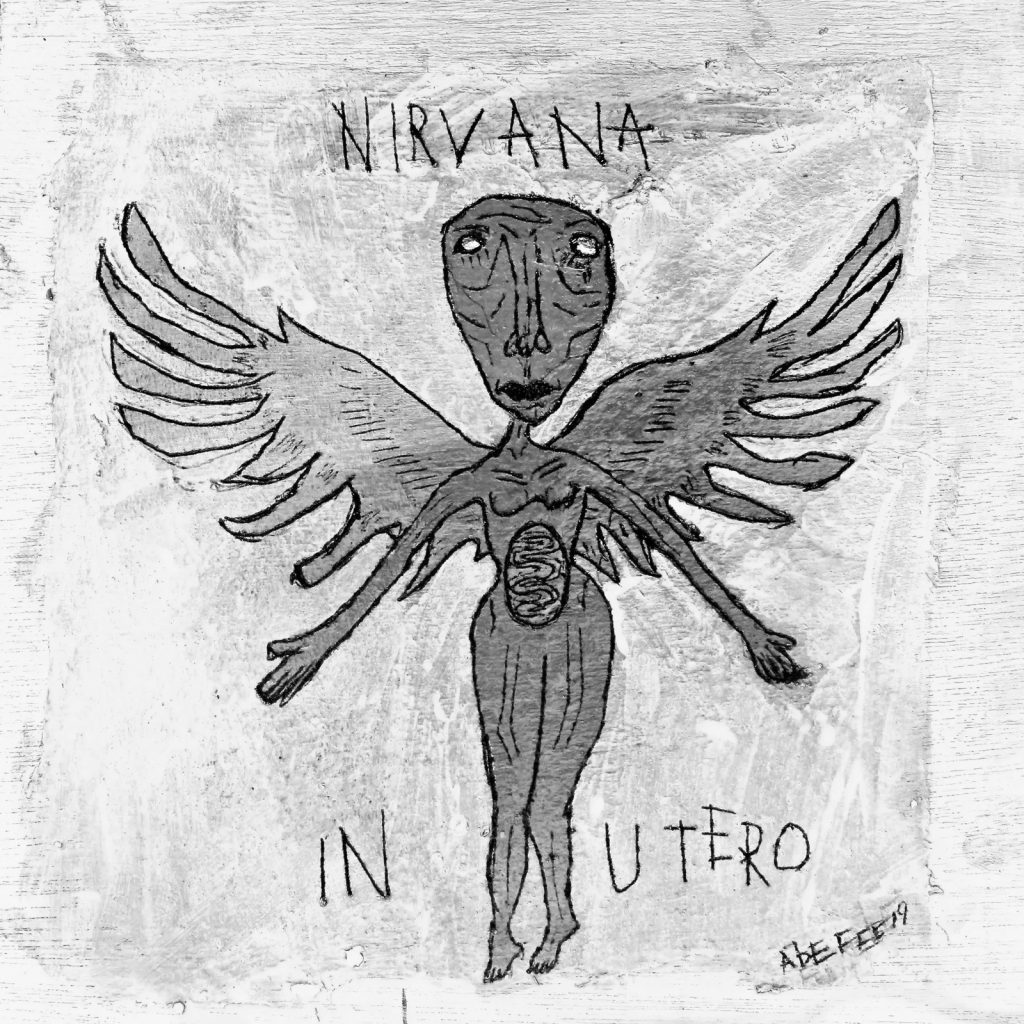
I suppose it might sound sort of silly to admit, but the truth is that this entire essay—and all the learnings contained within—emerged from the wholly unsought, completely unexpected discovery of a cover version of the classic 1993 Nirvana song “Dumb.” When I listened to it for the first time several weeks ago, I liked it—a lot. I knew nothing about the man who made it, and I had no idea whatsoever where it might lead me. But hey, for a buck, I bought it on Bandcamp. In the days that followed, I listened to the tune multiple times. I’m still listening—and learning—many weeks later.
The creator of the cover is Alabama singer-songwriter and visual artist Abe Partridge—whom I’d never heard of until I stumbled upon the song. Now I know that the amazing artwork that accompanies his version of “Dumb” belongs to Partridge as well. I’ve begun a journey of studying his life and work, and as I dig deeper, more insights and inspiration continue to appear. I love Partridge’s music and his paintings. And as you’ll soon see, his story is a pretty darned remarkable one.
What’s so exciting about all this? Well, for me at least, it’s incredibly heartening to remember that at any given moment, I might well happen upon some seriously good learning—and that a mentor in the making might be waiting just around the next intellectual corner. Despite the off-putting title of Nirvana’s song, keeping our mental door open to this kind of learning—learning that could light the way for us as we sort out how to live our lives every day—is actually anything but dumb.
Like Ruth Adler Schnee, about whom I wrote a whole lot last week, Partridge has shown me how much wisdom I can glean from someone I wasn’t even aware of until recently. Whereas Adler Schnee, who passed away in January 2023, was a mentor from the past, Partridge, who is younger than I am and very much alive, illustrates that this sort of mentorship is not tied to age. Insight can come from anywhere. When I feel down, anxious, uncertain, or overwhelmed by what’s going on in the world (all of which can come up within about 18 minutes of each other), I’m lifted up by folks like Partridge and Adler Schnee—inspirational leaders who remind me of what is possible in the most positive of ways. And although figures like Partridge may not (yet) be widely known, they’re out there, telling us, in his words, “You’ve gotta put your antennae up. There’s stuff going on all around you.”
“Antennae” makes me think of outer space, and sure enough, Partridge has a song that’s a pretty perfect fit for that subject. In the chorus of his rousing “Alabama Astronauts,” he sings with courage and enthusiasm, “I’ve been waiting for those aliens to come.” He’s loaded up and ready to hold his ground! The rest of us, I believe, can stop waiting, though. Partridge is a more than suitable stand-in—a little bit of an alien, something of an “inner space” astronaut, an artist with the ability to transform his life into wonderfully weird songs and paintings. His work has had me laughing, crying, and learning all at the same time. Like that of Adler Schnee, it’s wholly unique and a reminder that any of us who put our minds to it and put in the required effort can make great things happen.
Both Partridge and Adler Schnee demonstrate how creativity can be brought to life in meaningful ways, and how one can effectively access the unique essence that is deeply ensconced in each of us. Adler Schnee did so in a cultural milieu I can pretty easily relate to—namely, formally educated, middle-class Jewish immigrant families making their way through the American Midwest in the middle of the 20th century. If someone told me my mother had met Adler Schnee, I wouldn’t have been surprised in the least.
Conversely, I’m very confident that my mother did not ever come into contact with anyone from Abe Partridge’s family, nor sit in attendance at their church. In the Northern, urban Jewish immigrant world in which I grew up, the idea of a close-knit Baptist community in Mobile, Alabama, would have been as alien as the otherworldly folks Partridge writes about. And yet I love breaking down these silos and opening up to new connections—as different as they are, learning from Adler Schnee and from Partridge is an equally deep experience!
At the end of his song “What Good Is Art?”, Partridge sings, “What good is art if you don’t know how to use it?” He, it turns out, is quite adept at using art to produce learnings that have changed the course of his own life—and the lives of others—into an avenue for good in the world.
It wasn’t always that way for Partridge. Here’s one version of his life story he often includes when performing his great song “No Teacher Blues”:
I grew up in Mobile, Alabama, where we moved to a new school every year.
I left Mobile when I was 18 years old to become a Baptist preacher.
I went to four different Bible colleges in four years, and I married my wife on the day I graduated.
When I was 25, I started pastoring at a little Independent Baptist church in the mountains of Kentucky.
Then, when I was 27, I lost my mind.
During this period of “losing his mind” and questioning his path in the church, Partridge encountered music he’d never known about before. As he told The Bitter Southerner:
When I was 27 was the first time I had high-speed internet. And I started hearing all sorts of music for the first time. When I heard Townes Van Zandt singing “Waiting Around to Die” when I was waiting around to die, I could totally relate. …
I started writing songs while up there losing my mind, still in the ministry, and that’s when I started painting. That’s when I started all my art. It was an avenue, a way I could get all of it out because I didn’t have anybody I could talk to. I had no friends. …
For years I just played them at home, to my wife. But then, in 2015, I decided to play them in public at a songwriting contest in Mobile. And that changed my life.
Partridge’s story does not, of course, end there. But I want to segue for a moment because it’s actually a near-ideal example of a phenomenon that ethicist and essayist David Brooks described in a 2019 New York Times Op-Ed entitled “The Moral Peril of Meritocracy”:
Many of the people I admire lead lives that have a two-mountain shape. They got out of school, began their career, started a family and identified the mountain they thought they were meant to climb—I’m going to be an entrepreneur, a doctor, a cop. They did the things society encourages us to do, like make a mark, become successful, buy a home, raise a family, pursue happiness.
For Partridge, the “first mountain” was, of course, his ultimately unsuccessful attempt to become a Baptist preacher. As Brooks explains, the first mountain is almost always some sort of significant but finally unfulfilling pursuit:
People on the first mountain spend a lot of time on reputation management. They ask: What do people think of me? Where do I rank? They’re trying to win the victories the ego enjoys.
These hustling years are also powerfully shaped by our individualistic and meritocratic culture. People operate under this assumption: I can make myself happy. If I achieve excellence, lose more weight, follow this self-improvement technique, fulfillment will follow.
While Partridge doesn’t use these exact words, the model clearly fits his trajectory. Pastoring did not work out well for him. Brooks, though, opens our minds to the second part of the story—the part that Partridge’s life illustrates so beautifully: after the despair, after the feelings of worthlessness, helplessness, and hollowness, there is still an awesome and inspiring “second mountain” for us to climb.
This is one of the most powerful messages I take away from studying Abe Partridge’s fascinating life and art. As my friend Gareth Higgins, the Irish author and activist, taught me, “You never know when a story is over, especially when you’re in it.” So when things look grim, don’t give up—there’s a positive story still waiting to play out! For Partridge, that second mountain is the magic of painting and playing music, of being a storyteller. As Brooks writes,
In the lives of the people I’m talking about—the ones I really admire—something happened that interrupted the linear existence they had imagined for themselves. Something happened that exposed the problem with living according to individualistic, meritocratic values.
This “interruption” in Partridge’s existence came in large part from enlisting in the Air Force after leaving the ministry—and being sent to fight in Iraq. The experience changed him, and pushed him to put himself out there artistically:
I saw a lot of stuff over there that I had suspected before. But when you’re looking at it right square in the eye, and you see the B-2s [the stealth bombers], and you see six of them in this 12-hour shift come and go and come and go, I realized that basically, the only thing I had ever done with my adult life was brought negativity into the world through the type of preaching I did, and bring violence into the world through the military. …
In the meantime, I was making this art: I was writing these songs, and I was painting these pictures, and I told God that if He’d just let me get home, that I would do my best to try to bring beauty into the world.
The war, it seems, was one of the last low points in the valley before Partridge began to climb the second mountain. He put the pain of this ordeal into a bracing song called “Undisclosed Location in Southwest Asia Killing Floor Blues.”
Each of us, of course, has our own personal version of life in the wilderness before the second mountain. I describe my own period of struggle, and the accompanying emotional challenges I faced, in Zingerman’s Guide to Good Leading, Part 3: A Lapsed Anarchist’s Approach to Managing Ourselves. In many ways, those were the hardest years of my life. But it’s also clear to me now that without that struggle—and the deep reflection and learning that emerged from it—I would not be who I am today, doing what I do the way I do it. I see a strong parallel in Partridge’s story, as expressed in his artist statement:
When I was 27 years old, I became acquainted with a horrible depression. I left the ministry and turned to Art. I had written songs and made paintings like these for years. Only after joining the military and going to war did I decide to begin sharing my art with the world. I never took a songwriting class, nor have I ever had an art class. I always just thought I was weird …
Partridge effectively figured out how to turn his strangeness into specialness—to use art to, as he says, convert “what was really chaotic into something that was really beautiful.” And that, I suppose, is one of my key takeaways from all this as well. Why? Because any of us can learn to do it. No matter the form it takes, making art—or, indeed, doing anything creative—can have the same transformative effect for any of us who are willing to work at it, and to do the kind of self-reflection and reassessment that Partridge undertook. And when we create from the heart, with passion and skill put together wisely and well, the results can be truly astonishing.
These principles from Partridge’s artist statement frame his work—and they could, for that matter, frame mine, too:
Rethink preconceived notions.
Question authority.
Create new methods of survival.
See beauty.
As much as Partridge may have struggled in life, that was only the dark before a new dawn. He found focus, purpose, connection, and passion; he discovered his vocation, and it worked out. His painting, his music, his podcast—all he does, to my eye—are disarmingly down to earth and equally excellent. And he makes his points in the process. As he exclaims partway through “No Teacher Blues,” “Somebody’s gotta stand against the mainstream.” He’s in. So am I.
Partridge is not alone in this antiestablishment position. Eve L. Ewing, a sociologist at the University of Chicago and the author of Electric Archesandthe epically stirring poem “I saw Emmett Till this week at the grocery store,” writes,
We need the arts because they make us full human beings. But we also need the arts as a protective factor against authoritarianism. In saving the arts, we save ourselves from a society where creative production is permissible only insofar as it serves the instruments of power. When the canary in the coal mine goes silent, we should be very afraid—not only because its song was so beautiful, but also because it was the only sign that we still had a chance to see daylight again.
Along similar lines, Partridge says, “To endure as an artist is my act of resistance.” So if, as I write in “The Art of Business,” everything we do is art—life and business included—then simply being true to ourselves and making the “art” that is uniquely ours is some seriously solid resistance.
As I move toward wrapping up, I want to return to the fact that my engagement with Abe Partridge—as with Ruth Adler Schnee—began completely by chance, through an accidental encounter with a cover of a Nirvana song. Life is almost always like that. Straight lines sound great, but they don’t really exist in nature. Another example of this unpredictability: I was recently reminded of the true story of a Deli line cook back in our first years in business who made a well-intentioned but not very sound decision and almost burned down our building—and who today is the beloved Episcopal bishop of a major American city!
Strange things connect in unexpected places, paths unfold, shit happens—and the next thing you know, a random mention or a seemingly insignificant tangent turns into artistic mentorship worthy of deep reflection. Such inspiration and insight can come from anywhere: Southeast Michigan or Mobile, Alabama; the Bauhaus or a local dive bar.
Developing this piece, I started to put together a whole new list of life lessons drawn from Abe Partridge’s life’s work. But I realized halfway through that they were pretty much the same as the dozen I detailed last week from studying Ruth Adler Schnee. Still, I’ve found over the years that there’s often great value in repeating important messages—especially ones we can go out and apply ourselves. Here, then, is a variation on last week’s learnings:
A Dozen Life Lessons Inspired by Ruth Adler Schnee, Effectively Echoed by Abe Partridge
1. Find joy. Just listen to Partridge sing or speak—he exudes joy everywhere!
2. Live your values. Don’t do work you don’t believe in.Partridge has said, “I can’t listen to the radio, dude. It just doesn’t feel like reality. It’s written by people using artificial intelligence to tell them the right words to put in a song. I’d rather listen to someone who isn’t that talented sing something they feel passionately from the heart.”
3. Go where you want, but start with what you have. This is the very definition of folk art. Partridge paints on a piece of board he’s smeared with tar pitch—can’t get much more basic than that. Simple origins, outstanding results. And when it comes to ideas, he says, “I cherish every idea because I feel like they’re gifts. They’re like a spark. … I don’t know if they’re coming from within or without.”
4. Pursue your dreams regardless of what others tell you. I can only imagine the dissonance Partridge encountered as he began to shift his life’s focus from religion to art.
5. Don’t get caught up in limiting beliefs that society has set for “people like you.” Partridge had long been on the path to becoming one kind of person—namely, a Baptist minister—but he had the courage to depart from it to find his deeper calling as an artist.
6. Pay attention and seek beauty. As Partridge puts it, “Beauty lies outside the rules.” And giving credit where credit is due, he adds, “I learned that from Sonic Youth.”
7. Align with essence. “I don’t put on any masks,” Partridge says. “I don’t do anything fake. I just am who I am.” In other words, he’s true to himself and his soul’s essence.
8. Learn from the edges. When he left the pastorship, “for the first time in seven years, I was outside of that echo chamber,” Partridge explains. “I had the mental space to realize that I didn’t know everything. I didn’t have all the answers. When you’re in a belief structure like that, where everything is based on certainty, and doubt is a sin, as soon as you admit that you’re uncertain, it all comes crumbling down.” But outside that rigid structure, the edges—the periphery, the “alternative” spaces—have so much to teach us. (It’s a whole ’nother essay unto itself, but Partridge has dedicated a great deal of time and energy in recent years to documenting the rituals, beliefs, and music of the snake-handling churches of Appalachia. You can learn a lot more from his podcast, Alabama Astronauts.)
9. Push for greatness—but within your own framework, not as society defines it. Partridge may be a so-called “outsider artist,” but the art he’s making is reaching people in profound ways. If that’s not greatness, I don’t know what is.
10. Find ways to turn your vocation into a living. This Partridge has clearly done—just check out his website to see everything he has going on.
11. Design for both medium and means. Partridge doesn’t talk about anarchism a lot, but to me, it’s spiritually embedded in his freewheeling, freethinking work. And as he sings in the stunning “Abe Partridge’s 403d Freakout,” “I found hope in anarchy.”
12. If you love what you do, and you don’t want to stop, don’t! Partridge is just in his 40s now, but there are certainly no signs of him letting up anytime soon. When you love what you do, doing it is fun—I can absolutely relate!
I need only listen to a few minutes of Abe Partridge’s singular music or sit with a couple of his compelling works of art to increase my personal level of hope. For me, people like Partridge are proof positive that we’re going to get to the other side of our current tenuous national situation.
The Black Mountain College artist I quoted last week, Kenneth Noland, says about making art, “You can say after the fact what you’re doing, but, believe me, you can’t project it ahead. … It’s a search … it comes out of the practice of painting, the practice of your art.” And that restless search, to my eye and ear, is exactly what Abe Partridge has spent the second part of his life committed to. Or, as he sings in “No Teacher Blues” (which, to be clear, is about how he learned to play without a teacher, not about a dislike for teachers):
I’ll just play it like I feel it
Let it come from soul
Cause you don’t need no teacher
To rock ’n’ roll
Perhaps my favorite Partridge song right now remains “What Good Is Art?” from his album Suwanee. It sort of sums up this entire essay. “They don’t teach our kids to create; they’re taught to follow the rules,” he sings. But we don’t need to take that instruction passively. Again, “Somebody’s gotta stand against the mainstream.” And the tune’s closing line brings us back to the dual personal and political value of artistic practice: “What good is art if you don’t know how to use it?”
(Oh—and if you’re curious what Partridge’s music sounds like, I can offer a whole list of folks you might consider if you were constructing a sonic collage: Vic Chesnutt, for sure, and definitely some early Bob Dylan. A little Loudon Wainwright, and some Tom Waits, too. Maybe a bit of Lou Reed here and there, and some rocking Southern band, like the Red Clay Strays or Drive-By Truckers. In Partridge’s songs, humor and pathos exist side by side. As Cracked put it, “This Dude Is Either the Funniest Folk Singer or the Most Serious Humorist I’ve Ever Seen.”)
In closing, don’t forget to keep those antennae up! Inspiration may come from a cover of a now 30-plus-year-old song, from a painting or collage or comment, from Ruth Adler Schnee or Abe Partridge—who knows where! But the last words here must, by rights, belong to Partridge, who encapsulates all I’ve written this week (and last week), and, for that matter, all I’ve endeavored to do for my whole working life. I’m fully and passionately aligned with him when he says,
I’ll paint whatever my heart needs to paint, and I ain’t scared to say anything that my heart needs to say. If anybody says I can’t say what I feel, well, it’s not their heart in my chest, it’s mine. I just have to be true to myself.
Turn life and business into art
P.S. If you pay attention, I’ll wager that you, too, will find an unexpected mentor or two to help inspire you in the days and weeks to come. Let me know what you discover!