Approaching Business as a Craft
Doing our work as well as we can for its own sake
In his e-news earlier this week, nationally known business writer Loren Feldman, founder of the terrific 21 Hats, wrote,
Small business owners have plenty to worry about these days. … Optimism is slipping as owners grapple with soaring health-insurance premiums, rising energy costs, and the higher price of imported goods. And yet, the wave of entrepreneurship that began during the pandemic hasn’t faded. In fact, it’s still growing. So what’s going on? … And perhaps the more important question: What can we do to improve their odds of success?
One answer to that last question could be to encourage people to reflect meaningfully on their beliefs. In fact, as I shared in the book The Power of Beliefs in Business, one of the most impactful learnings I’ve had in the last 15 years or so has revolved around the realization that when we change a belief, our whole world looks, and works, differently. As psychologist William James once wrote, “Belief creates the actual fact.”
With that context in mind, it’s my strongly held belief that a different—nonstandard—set of beliefs might be one of the things that would really help these new-to-business folks avoid failure and, instead, make something truly special and long-lasting out of their startups. Unlike the studies Loren cites in his essay, I’m optimistic about the possibilities.
What follows is an exploration of what could well come from adopting this alternative belief system—a philosophical approach to business that I think would benefit any caring person who engages with it. Certainly, some of the new business owners Loren describes might feel better about what they’re undertaking in this context, rather than in the more common race to get rich and reach the top of everyone’s rankings. It may not lead to the ginormous financial transactions that make the front page of The Wall Street Journal, but it does have the potential to produce a beautiful life’s work that benefits all involved.
It’s a suggestion that fits well with ZingTrain’s primary message that “you really can do business differently!” As my friend Abe Partridge, the Alabama musician, says in his amazing song “What Good Is Art,” “Somebody’s gotta stand against the mainstream. And beauty lies outside the rules.” This is about a positive, caring, and creative way to do just that.
On page 9 of the prologue to his terrific 2008 book, The Craftsman, writer and historian Richard Sennett says,
“Craftsmanship” may suggest a way of life that waned with the advent of industrial society—but this is misleading. Craftsmanship names an enduring, basic human impulse, the desire to do a job well for its own sake.
That last sentence, simple and direct, sure got me thinking—about doing what we do, not to get paid, but because we believe in it and because we love doing it.
Every craftsperson, of course, still needs to make a living. But their decision to do good work emerges not out of economics, but rather from the desire to do their work well for its own sake. No doubt about it—I can definitely relate! Business writer Josh Kaufman created what he calls his “Craftsman’s Creed.” It’s well in line with Richard Sennett’s writing, and I certainly connect to Kaufman’s commitment:
I am a craftsman. I am dedicated to perfecting the art and science of my craft, which I have chosen freely. …
Anything that I can do to improve my craft, I will do. This will keep me busy until the end of my days: a challenge I gladly accept. I am a craftsman, and always shall be.
All of which got me wondering: what if, in the context Sennett shares, we were to reframe our beliefs about business—not seeing it first and foremost as an engine for economic gain, but instead as a craft we care deeply about every day? As work in which we actively seek mastery, knowing all the while that imperfection is inevitable but trying to appreciate the artfulness of what we do anyway. What if we adapt to the belief that Sennett shares, to create a construct in which we pursue excellence not as a strategic means to a financial end, but as an inspirational end unto itself? Work we do simply because we believe in running a business as if it were a world-class craft will be a beautiful thing to behold. And that beauty will almost certainly benefit all those who come into contact with it.
Adopting a new belief like this may not be easy—if you’re ready to explore the idea, though, check out “Secret #43: A Recipe for Changing a Belief.” Sennett acknowledges the social pressure to conform with the mainstream:
How do we decide what is of lasting value in ourselves in a society which is impatient, which focuses on the immediate moment? How can long-term goals be pursued in an economy devoted to the short term? How can mutual loyalties and commitments be sustained in institutions which are constantly breaking apart or continually being redesigned?
Approaching our businesses as if we were striving to become world-class craftspeople is one wonderfully workable, positive answer to Sennett’s questions. It leads us to pursue excellence, beauty, and good work expressly because doing so is, in itself, the point of the work. In this model, the motivation to do well every day shifts from outside comparison and competition to a grounded internal drive. To my line cook’s eye, this is a better and radically more rewarding way to work. Instead of the all-too-common business focus on maximum extraction and making a quick exit, this is about an enlightened, enriching, ecologically sound, and soul-fulfilling approach. As Richard Sennett writes, “Craftsmanship shows the continuum between the organic and the social put into action.” Inspiringly, that sounds a whole lot like what we do here in the ZCoB (Zingerman’s Community of Businesses)!
Imagining our organizations as craft workshops allows us to still operate in the free market while remaining focused first and foremost, though, on doing good work just because we’re drawn by and driven to do it. Craftsmen, Sennett says, “hold themselves to account and can also see what the work means to others. Standards comprehensible to nonexperts raise quality in the organization as a whole.” It’s work that’s not primarily about dollars (we need those, too—don’t get me wrong) but about spreading dignity in every direction. As Sennett notes, “The craftsman has been able to call to his or her aid a capacity and a dignity ingrained in the human body.”
Sennett also points out something I’ve often felt about most people’s (mis)understanding of anarchism (see “Secret 43.5: What I Believe About Anarchism” for more clarity on that concept): “Craftsmanship is poorly understood.” His book is one attempt to change that unfortunate reality. As he explains, “All craftsmanship is founded on skill developed to a high degree.” Very clearly, it takes long, patient, and persistent effort by a leader who leans into this idea to make it work: “By one commonly used measure,” Sennett says, “about ten thousand hours of experience are required to produce a master carpenter or musician.” This is certainly aligned with the way we’ve approached business here for 44-plus years now. Sennett describes craftsmanship as embodying
dimensions of skill, commitment, and judgement in a particular way. It focuses on the intimate connection between hand and head. Every good craftsman conducts a dialogue between concrete practices and thinking; this dialogue evolves into sustaining habits, and these habits establish a rhythm between problem solving and problem finding.
All of which, in my experience, is totally true of business, too.
“Business” in the typical 20th/21st-century sense is of interest mainly just to people who want to be entrepreneurs, or to those who may be curious about a company they patronize as customers. Business in the context of craft becomes a whole different thing. I experienced this the other morning while teaching our “Welcome to ZCoB” staff orientation class, listening to the reflective class-closing comments from the 10 new ZCoBbers in attendance. One part-time staffer, whose main “work” right now is to be a full-time student, observed, “It’s interesting to see how the finance works. I remember you saying the other day at the [Roadhouse] huddle that beef prices were going up a lot, and that, as an experiment, you had taste tested some less expensive beef. But because ours tastes so much better, there’s no way we would switch to a lower-quality meat. And that’s why we are who we are—that we stick to quality even if it costs more!” The new team member’s understanding and enthusiasm were inspiring. And her energy around it all told me that she “got it” in ways that even many experienced businesspeople—caught up in conserving cash and focused solely on short-term gains—do not. They say the word “quality,” but I don’t think most of them get it as deeply as she did.
Mid-20th-century sociologist C. Wright Mills (the 110th anniversary of whose birth will come at the end of August) describes the origin of craftsmanship well in his 1951 book White Collar: The American Middle Classes:
The laborer with a sense of craft becomes engaged in the work in and for itself; the satisfactions of working are their own reward; the details of daily labor are connected in the worker’s mind to the end product; the worker can control his or her own actions at work; skill develops within the work process; work is connected to the freedom to experiment.
In this sense, craftsmanship exists at the very center of oneself, and one is personally involved in every product to which one contributes. “Certainly, [this] seldom occurs without a great deal of often routine work,” Mills writes in his 1959 essay “On Intellectual Craftsmanship.” “Yet there is an unexpected quality about it, perhaps because its essence is the combination of ideas that no one expected were combinable.”
Sennett discusses the artificial boundaries that have arisen to distance us from the original ethos of the craftsperson:
History has drawn fault lines dividing practice and theory, technique and expression, craftsman and artist, maker and user; modern society suffers from this historical inheritance. But the past life of craft and craftsmen also suggests ways of using tools, organizing bodily movements, thinking about materials that remain alternative, viable proposals about how to conduct life with skill.
Sennett’s approach offers us a different—and, I believe, better—way to do business.
Here’s what Lewis Hyde, author of the incredible book The Gift, had to say in his 2008 New York Times review of The Craftsman:
And what is it that such [craft]persons know? They know how to negotiate between autonomy and authority (as one must in any workshop); how to work not against resistant forces but with them (as did the engineers who first drilled tunnels beneath the Thames); how to complete their tasks using “minimum force” (as do all chefs who must chop vegetables); how to meet people and things with sympathetic imagination (as does the glassblower whose “corporeal anticipation” lets her stay one step ahead of the molten glass); and above all they know how to play, for it is in play that we find “the origin of the dialogue the craftsman conducts with materials like clay and glass.”
In this context, I share Sennett’s belief that “nearly anyone can become a good craftsman”—read good businessperson—and also that being a part of a business built with craft in mind creates an ecosystem in which “learning to work well enables people to govern themselves and so become good citizens.” Skilled, caring craftspeople create caring communities. The inverse of craft is, I can see, the industrial model, in which people don’t really matter—only their economic output does.
In The Corrosion of Character: The Personal Consequences of Work in the New Capitalism, Sennett writes extensively about the relationship between craft and the construct of modern society, the negative impact of the latter on the people who are part of it, and how a craft mindset might help:
“Who needs me?” is a question of character which suffers a radical challenge in modern capitalism. The system radiates indifference. It does so in terms of the outcomes of human striving, as in winner-take-all markets, where there is little connection between risk and reward. It radiates indifference in the organization of absence and trust, where there is no reason to be needed. And it does so through reengineering of institutions in which people are treated as disposable. Such practices obviously and brutally diminish the sense of mattering as a person, of being necessary to others.
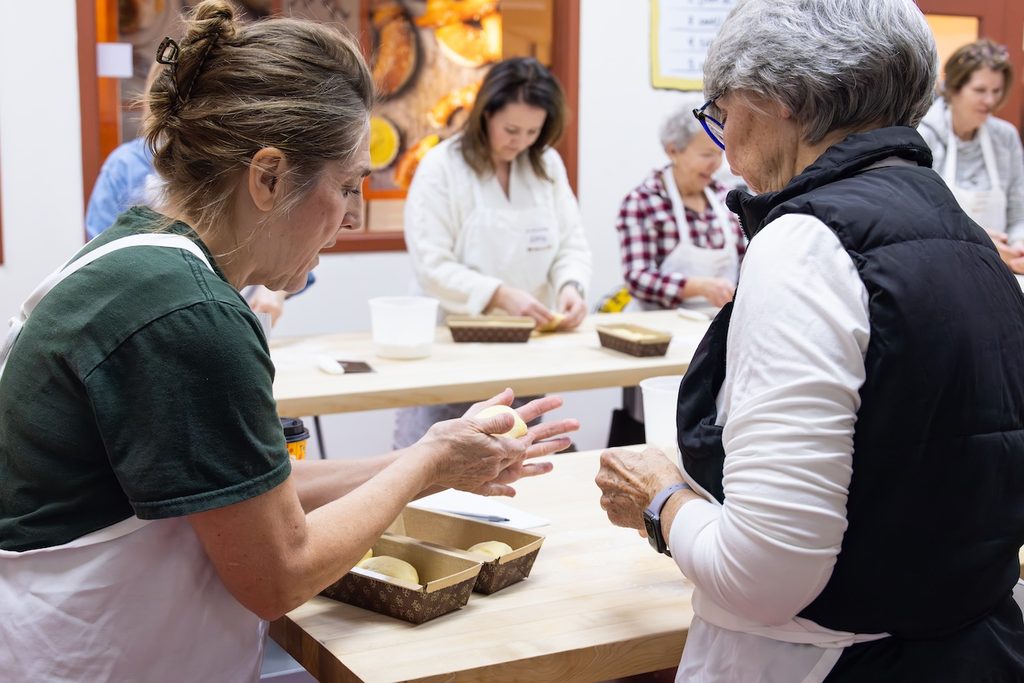
Here in the “craft workshop” that we call the ZCoB, people do matter. A big part of that, in practice, is to support their growth and development as the unique human beings they are. I talked about this the other day with one of the servers at the Roadhouse. He started here when he was about 17. Over the last few years, he said, he’s grown in confidence enormously. He’s a better communicator, more at peace within himself, and much more able to talk business concepts with friends, co-workers, customers.
Last winter, I shared the truth that I never went into business simply for the money. What I really wanted, I’d begun to realize, even right from the get-go in mid-March 1982, was to make magic. But magic, too, it turns out, is also a craft. In the 1984 book The Craft of Magic, Eugene Burger writes, “All magic is about transformation. … The performance magician is telling you that you are the magician in your own life. You are the agent of transformation, your own transformation.”If that’s true for the craft of magic, it seems reasonable that it would also be applicable to a business, like ours, that’s focused on craft and making magic! If we do our work well, each member of the organization can benefit. As Richard Sennett remarks, “The emotional rewards craftsmanship holds out for attaining skill are twofold: people are anchored in tangible reality, and they can take pride in the work.”
In hisShop Class as Soulcraft: An Inquiry into the Value of Work, Matthew B. Crawford, a senior fellow at the University of Virginia’s Institute for Advanced Studies in Culture, writes, “Craftsmanship means dwelling on a task for a long time and going deeply into it, because you want to get it right.” It’s based on the belief that work as craft is of value for its own sake, and is valuable to the community in which it’s being done.
Glenn Adamson is an amazing historian of craft who offers great insight into what it’s all about—insight that helps me to better understand the idea of business in this context:
I do think there’s something inherently relational about craft. Because it’s generous, inevitably. Like even when you sell something to someone; if you’ve spent a lot of time and care on it, then you’re also giving them a part of yourself, a part of your own past. And you’re making a connection to them. But to me, certainly, at its best, it’s specific. It’s about real people actually dealing with one another, with all the great and problematic things that happen when you try to deal with someone else. So for me, it’s not just about relationships but about tenderness; it’s about feeling that sense of exposure and vulnerability. …
Craft was invented as a separate field of practice in the late 18th, early 19th century. After that you have this great divergence between craft and art, and industry. They are separated from one another. What I think we are living through now is a great convergence of these things into one undifferentiated field.
So how do we make that convergence come alive? What would one do as a great businessperson/craftsperson? Here are 10 suggestions:
1. Commit to what you care about even if others don’t believe in it. A great craftsperson doesn’t wait for permission to pursue their passion. They go after what they believe regardless of what others tell them. Yes, they need people to purchase their work in order to pay the bills, but their belief in it is unconditional. Duluth, Minnesota–based musician Charlie Parr, whose work I’ve loved listening to for years, is a great example of this sort of freethinking. Richard Sennett makes a point of including musicians on his list of artisans because, he writes, “they are dedicated to good work for its own sake.” That’s something Parr epitomizes. Writing in Folk Alley, Linda Fahey calls Parr “a craftsman utterly devoted to the task at hand.” He has definitely achieved the 10,000 hours of experience that Richard Sennett references above. In a 2021 article in Guitar World, Matt Parker writes,
As a kid, when other children were asking for electric guitars, Parr wanted a National. Since he got his first resonator, he’s spent the better part of his life dedicated to touring the contemporary country blues music for which he has slowly and steadily become renowned.
Parr’s a unique, idiosyncratic songwriter. He works in homeless outreach and he notices things that others don’t. He documents stories and personal reflections that feel palpably real, woven from the frayed edges of America’s social fabric.
Parr’s determination to stay true to what he wants to do is an inspiration.
2. Consistently apply passion for craftsmanship to your product and/or service. The craft furniture company Penny Mustard writes on its blog, “A true craftsman must be passionate about their work, especially in a trade where creativity and ingenuity are essential. The passion behind each piece of furniture results in statement pieces that reflect the craftsman’s dedication.” We take the same passionate approach to food and service here in the ZCoB.
3. Think long term and work in regenerative ways. As philosopher Alain de Botton writes in The Pleasures and Sorrows of Work,
How different everything is for the craftsman who transforms a part of the world with his own hands, who can see his work as emanating from his being and can step back at the end of a day or lifetime and point to an object … and see it as a stable repository of his skills and an accurate record of his years.
4. Pay attention to detail, with an eye for excellence. Artisans are always all about the details—salt levels, color matches, the sound of a new guitar—and their meticulousness is a continuous source of pride. As Richard Sennett says, “Pride in one’s work lies at the heart of craftsmanship as the reward for the skill.”
5. Have a plethora of patience. Craft production is, by definition, a far, far slower process than making things in the mass market. It’s also, I believe, infinitely more rewarding. In Sennett’s words: “The slowness of craft serves as a source of satisfaction; the skill has to evolve.”
6. Shore up a wealth of resilience. Becoming a great craftsperson, like becoming a top neurosurgeon or any other challenging path, takes years and the ability to navigate ups and downs alike.
7. Maintain an abundance mentality. As novelist Lloyd Alexander writes, “Craftsmanship isn’t like water in an earthen pot, to be taken out by the dipperful until it’s empty. No, the more drawn out, the more remains.” One thing I was reminded of while attending the American Cheese Society conference in Louisville the week before last is just how darned generous the group is. A thousand people who, by all rights, might be hiding the secrets of what makes their cheese so special seem almost universally open to sharing them!
8. Keep a deep curiosity about the world in general, and the work you do in particular. In “An Essay on Craftsmanship,” Bill Gould points out one of the most important components of becoming a craftsperson:
An insatiable curiosity about the world around us, and what makes it work. The marvel and mystery of tools, machinery, processes, materials, and how to put them together is at the core of almost all invention and discovery.
9. Remember: authenticity all the way. When I think about authentic artisans, my mind goes again to Charlie Parr. As one of his good friends says about him in the documentary Meeting Charlie Parr – The Movie,
Everything that Charlie does feels so honest and authentic. … I think he’s an honest guy and he’s an honest musician and he’s an honest songwriter. … And I think there’s a high degree of integrity in what he does. You know, he feels what he does. And I think that’s pretty unique.
What Parr does with his music is, I believe, what we can also do with business: stick to our values and make the “art” we believe in, staying true to what’s in our hearts even when there’s more money to be made by compromising.
10. Do your work well just for its own sake. Once again, I return to the central idea of Richard Sennett’s The Craftsman. It’s an idea that Charlie Parr embodies. Parr’s ex-wife, Emily Parr (who still sings backup vocals on some of his recordings), says with a smile in the documentary, “He doesn’t compromise what he likes for anybody.” Another friend and fan comments, “He just plays music because he likes to, and it shows.” Yes, he—like me and, I’d imagine, you—has to make a living; we all have bills to pay. But money is not Charlie Parr’s driver. To the contrary, he continuously recommits to a style of playing—and a way of being in the world—that is (a) totally true to him and (b) not what the mainstream music world (where the money is) wants to hear. He does it anyway.
Through business, as with any craft, we can better get to know ourselves. Or, as Sennett puts it, “making is thinking.” Which basically means that we can use business as a craft to gain clarity on our philosophy and how to constructively implement it. It makes sense—after all, it’s through the shared conversations and the coming together of caring co-workers trying to figure out complex situations that we grow and develop. We learn to think—effectively and collaboratively—by figuring out how to run our business.
George Nakashima was a nisei—a Japanese American born here in the U.S. to Japanese immigrant parents—who went on to become one of the world’s most remarkable woodworkers. Like Richard Sennett, Nakashima saw being a craftsperson as a philosophical approach to the world—a way of life. In connection with a 1972 exhibition of his work, he said,
Craftsmanship is not only a creative force, but a moral idea. … Design is only something to realize a way of life. … We feel that we should give value. … We follow these precepts of doing a good job, which is rather important in our age.
What he described is, I believe, exactly what we are doing with the ZCoB here in Tree Town.
After he passed away in late spring 1990 at the age of 85, his daughter Mira Nakashima and the Nakashima team took over the family business. Like the child of any artisan who moves into their parents’ profession, she is ably carrying on her father’s legacy:
Once you start focusing [only] on the bottom line and productivity, you lose the quality, and you lose the craftsmanship and the camaraderie of craftsmanship, which is what makes us go. And the people that we have with us now are sensitive to that.
In the commencement speech he gave at Syracuse in 2013, author George Saunders urged the graduates:
Do those things that incline you toward the big questions, and avoid the things that would reduce you and make you trivial. That luminous part of you that exists beyond personality—your soul, if you will—is as bright and shining as any that has ever been. … Clear away everything that keeps you separate from this secret luminous place. Believe it exists, come to know it better, nurture it, share its fruits tirelessly.
This is, I think, one of the things that business as craft can help us do. Not only does it help us think, but, done well, it inclines us toward the “big questions,” it can bring out the luminous parts of our personality, and it can help us become ourselves in ways that work well with our values and our vision. When we approach business as craft, we seek not to master the marketplace but to tap the creative spirit—our essence—in ways that we believe in and that still allow us to make a living.
A craft approach to business, per Sennett’s beliefs, would also incline us toward dignity and democracy. “Learning to work well enables people to govern themselves and become good citizens,” he writes. “We want the shared ability to work to teach us how to govern ourselves and connect to other citizens on common ground.” In the end, working with craft in mind helps everyone come out ahead. As Sennett reminds us,
Most people want to believe that their lives add up to more than a random series of disconnected events. The well-crafted institution wants to respond to this desire, once it decides that loyalty matters. … Figuring out how to build on existing skills—to expand them or use them as the base for acquiring other skills—is a strategy that helps orient individuals in time. The well-crafted organization will want to pursue this strategy to keep itself together.