Grilled Organic Carolina Gourdseed Grits at the Roadhouse
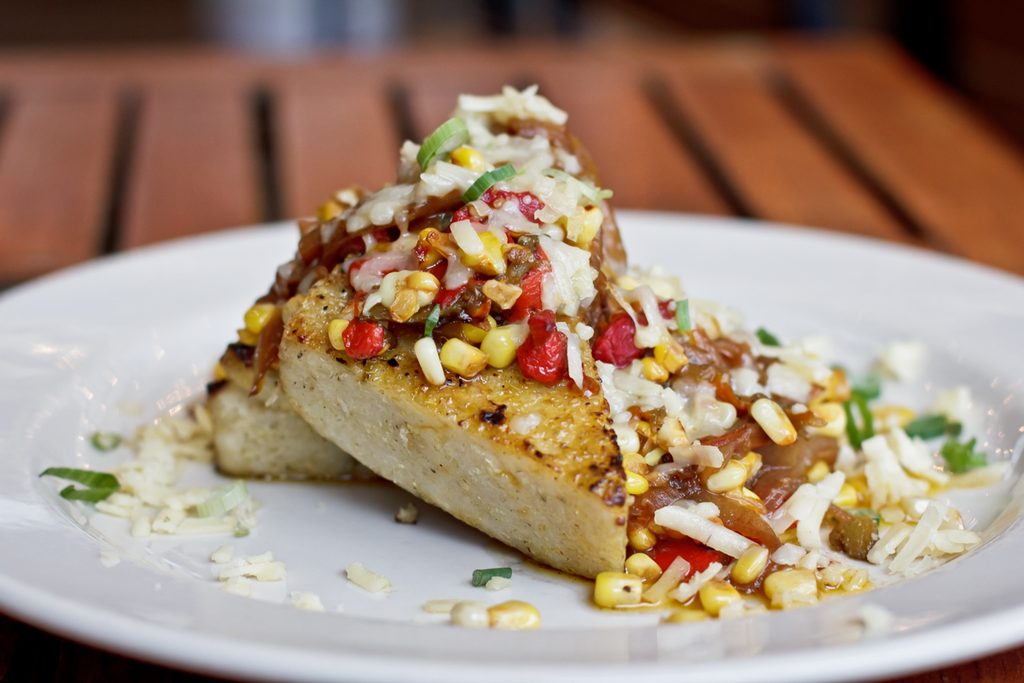
Slices of cooled and cut grits grilled with an array of terrific toppings
Having just written a bunch about Angela Duckworth’s inspiring insights in her books Grit and Situated, it was too hard to pass up the chance to rave about this great grits dish at the Roadhouse. Swing by for lunch or dinner, situate yourself in the Roadhouse dining room, and get some Grilled Grits! They’re so terrific, I thought I’d write them up in honor of Angela’s brilliant work.
Anson Mills grits are a textbook example of what we’ve been working to do for nearly 45 years now at Zingerman’s: find amazing sources for traditional, full-flavored food (or make our own at the same level of excellence); keep it simple; and end up with something so good that once you eat it, it sets the standard. These grits cover all the bases beautifully: They’re excellent as a main course or as a side dish—they can be the star, but they don’t mind playing a backup role when another food is being featured. They go with everything from fish and meat to vegetables and cheese. They’re nutritious. And they heat up well when you have leftovers.
There are a number of factors that go into making the Anson Mills grits so special. They’re made primarily of Carolina Gourdseed, an old variety that’s exceptionally flavorful and bred to ripen in the field on the stalk, not in a silo. The old varieties, like this one, yield about a quarter to a third of what modern strains do—which means the cost of producing this kind of corn for grinding is many times that of commercial corn!
The milling plays a big role in the quality of these grits as well. Most commercial milling today starts with steaming corn kernels to get their hulls off; in that process, the germ is removed, along with most of the flavor. Commercial corn is then ground with steel roller mills, so that friction can heat the grain to above room temperature. The heat basically “cooks” the corn during the milling, killing all the live enzymes and what’s left of the flavor. By contrast, Anson Mills never lets the corn get above 58 °F. Carbon dioxide is used to keep oxygen off the corn, preventing oxidation and protecting flavor (much the same as is done with wine by using nitrogen). The freshly milled corn is sifted into four different-sized particles and then reblended—with the diversity of texture leading to a more interesting eating experience. The corn’s natural germ is also left in, radically enhancing the flavor. Good grits like these are a fresh product—we ship them and store them under refrigeration.
Speaking of heating up well, let me get back to the fantastic Grilled Grits at the Roadhouse, which have been on our menu ever since the Roadhouse opened its doors for the first time 23 years ago last week! The dish starts with the Anson Mills grits, which we cook, cool, and then cut into thick slices. Just as many folks in Italy are enamored of grilled slices of polenta, that’s what happens here, too!
We then take a couple of those thick slices of grits and grill them over oakwood logs until they’re hot. They pick up a bit of the wonderful smokiness from the grill, so the flavor is a bit like that of corn cooked on an open fire. When they come off the grill, we top them with an abundant amount of sautéed fresh corn kernels, fire-roasted and hand-peeled New Mexico green chiles, caramelized onions, and roasted peppers, plus a good bit of grated aged cheddar from Cabot Creamery in Vermont.
While the dish itself is vegetarian, if you want a vegan version, we can use our Carolina Gold rice rather than the grits (which are made with Vermont Creamery’s very fine cultured butter). Or go the other way, and order it topped with grilled Amish chicken breast, Bay of Fundy salmon, or—my personal preference—wild-caught Carolina shrimp!
P.S. Come by the Roadhouse for happy hour (Monday to Friday, 2 to 6 p.m.) and start yourself off with a bunch of oysters, ’cause they’re only $2!