Why Helping People Become Themselves Makes Such a Big Difference
Self-actualization, anarchism, and an avenue to healthier organizations
Some days, it sure seems that the world begins to feel more than a bit overwhelming. How we lead within that high-pressure construct is a challenge that pretty much everyone I know is struggling with.
Historian Timothy Snyder, author of On Tyranny and a host of other terrific books—formerly of Yale, now teaching at the University of Toronto—offers some helpful context:
To resist doesn’t mean that you alone or your group has to do everything. We get demoralized by the Hollywood notion that there’s a happy ending that’s going to solve it all. It creates the impression that you, today, have to solve it all. You don’t.
Nor, I’ve come to understand, is there any one singular solution. We did not get in this situation in a week, and we aren’t going to get out of it in a week either. So, although the fantasy of finding a fantastical happy ending is indeed appealing, the reality is that we have years of work to do—work we can, and need, to do together to make the kind of difference we dream of.
The other day, I was feeling a little down, but pushing ahead anyway with my work, when a staff member stopped to chat. At the end of our relatively quick conversation, he lowered his voice a bit, looked me in the eye, and shared, “I really appreciate working here. I really appreciate the chance to learn and to grow. I appreciate how much everyone cares. It really makes a difference.”
His comments completely raised the quality of my day.
And, I’ll add, they also got me thinking.
What, I began to wonder, would it be like if one of the unexpected benefits of getting a job was that your workplace helped you grow into an ever-healthier human being? That you didn’t just get paid (not that that’s a bad thing), but also blossomed as a person? If people were successfully becoming ever more themselves, what would the impact be on our organizations? On our communities? On the country?
We can’t, I know, change the world entirely on our own, but we can certainly have a significant influence on how things go inside our own workplaces. What follows is an exploration of the effect that a commitment to creating such an organization could well have.
Reflecting on the state of the world around her, a well-traveled, terrifically insightful 68-year-old activist and author offered her own assessment of the situation:
The minds of men are in confusion, for the very foundations of our civilization seem to be tottering. People are losing faith in the existing institutions. … The world is at a loss for a way out. Parliamentarism and democracy are on the decline. Salvation is being sought in Fascism and other forms of “strong” government.
With some small tweaks to make the language true to 21st-century speech patterns, her words could well have been written in a column in last week’s Contrarian. In truth, though, the piece from which those lines were taken was published nearly 90 years ago. The author was Emma Goldman; the year was 1937.
At that time, Emma was living in Toronto, less than two miles from where Timothy Snyder teaches today, in 2026. Despite her protestations, she had been exiled by American authorities from the United States, to which she had immigrated in 1885 at the age of 16. Frustrated, she finally settled on the idea of moving to Toronto, where there was a healthy anarchist community and a large population of Eastern European Jewish immigrants.
In 1936, the year before she wrote the above, Emma had traveled to Barcelona to both witness and encourage the anarchists there in fighting against the Fascist forces of Francisco Franco. She’d had an exhilarating experience in Catalonia: “In all my life,” she wrote about her trip, “I have not met with such warm hospitality, comradeship, and solidarity.”
If we do our work well as an organization, this is very much what I hope new members of the ZCoB (Zingerman’s Community of Businesses) will say after they join up. That sort of welcome, it seems clear, would increase the odds that anyone coming to work here would go on to grow ever more meaningfully into themselves.
By the following year, 1937, Emma’s enthusiasm had evolved into anxiety. The freedom that seemed to be flowering so fully in Catalonia around the time of her trip had begun to erode. In April, the German Luftwaffe had bombed the Spanish town of Guernica (the horror of which Picasso would go on to paint in a six-week period after the attack). In Germany, the Buchenwald concentration camp had been opened in July, and a few months later, the Italian dictator Mussolini had gone to Berlin to build an authoritarian bond with Adolf Hitler.
Emma’s solution to the stressful situation of 1937? On the broad scale, as those of you who know her work will already have guessed, it was to advocate anarchism. Always an activist, she put pen to paper, as she so often did, and published a pamphlet. More specifically, she explored the impact and import of the health of the individual in what would go to print with the title “The Individual, Society, and the State.” As Emma had been attempting to explain to anyone who would listen throughout her life, healthy individuals are a prerequisite for healthy organizations.
My good friend Shawn Askinosie, the bean-to-bar chocolate maker (you’ll find his amazing chocolate bars in abundance at the Candy Manufactory, Deli, and Roadhouse), says that our childhood wound later becomes our vocation. It makes total sense in Emma Goldman’s case—her father harshly ignored her desire to study and grow her mind, repeatedly admonishing her that girls were good for little other than housekeeping. (Translated from Yiddish to English, his exact words, as she would later relate them, were, “All a Jewish daughter needs to know is how to prepare gefilte fish, cut noodles fine, and give the man plenty of children.”) Ignored and shunted aside as a child, she then spent the rest of her life fighting to honor every human being for the unique individual they were.
What Emma Goldman elucidated in “The Individual, Society, and the State” was not a totally new point of view for her. To the contrary, it was completely congruous with what she and her colleague Max Baginski had to say on the subject of “Individuality, Autonomy, and Organization” at the International Anarchist Congress in Amsterdam in 1907:
There exists an erroneous conviction that organization does not encourage individual freedom and that, on the contrary, it causes a decay of individual personality. The reality is, however, that the true function of organization lies in personal development and growth. …
An organization … must be made up of self-conscious and intelligent persons. In fact, the sum of the possibilities and activities of an organization is represented by the expression of the single energies [of the group].
It follows logically that the greater the number of strong, self-conscious individuals in an organization, the lesser the danger of stagnation and the more intense its vital element.
Straighten up the language and shift 75 years into the future, and those words could well have come from Paul and me when we opened the Deli in the winter of 1982. From the beginning, we have worked with the strongly held belief that
The more our business helped the people who were part of it to live meaningful lives, lives that were true to who they were as human beings, the better the business would do.
Yes, of course, piled-high corned beef and pastrami were on the menu, but as Emma had already explained to the world in 1907 (just five years after Rocco and Katherine Disderide had built what’s now the Deli’s building in 1902), “the reality is … that the true function of organization lies in personal development and growth.”
To be meaningfully effective, that work, of course, needs to go in both directions: the healthier we could make the organization, the more we could also increase the odds of the people in it feeling better about themselves in the process. And at the same time, the more the people who are part of the organization are living and working in ways that are true to themselves, engaged in effective self-development, the better the business would do. That we are still here 44 and a half years later, doing what we do, is, I suppose, a testament to the (ever-imperfect) ways we go about practicing this!
Here’s how Emma assessed the situation in 1937:
The individual is the true reality in life. … Man, the individual, has always been and necessarily is the sole source and motive power of evolution and progress. … Individuality may be described as the consciousness of the individual as to what he is and how he lives. It is inherent in every human being and is a thing of growth.… The very essence of individuality is expression; the sense of dignity and independence is the soil wherein it thrives. … The individual is not merely the result of heredity and environment, of cause and effect. He is that and a great deal more, a great deal else. … He is a whole, an individual whole, a growing, changing, yet always constant whole.
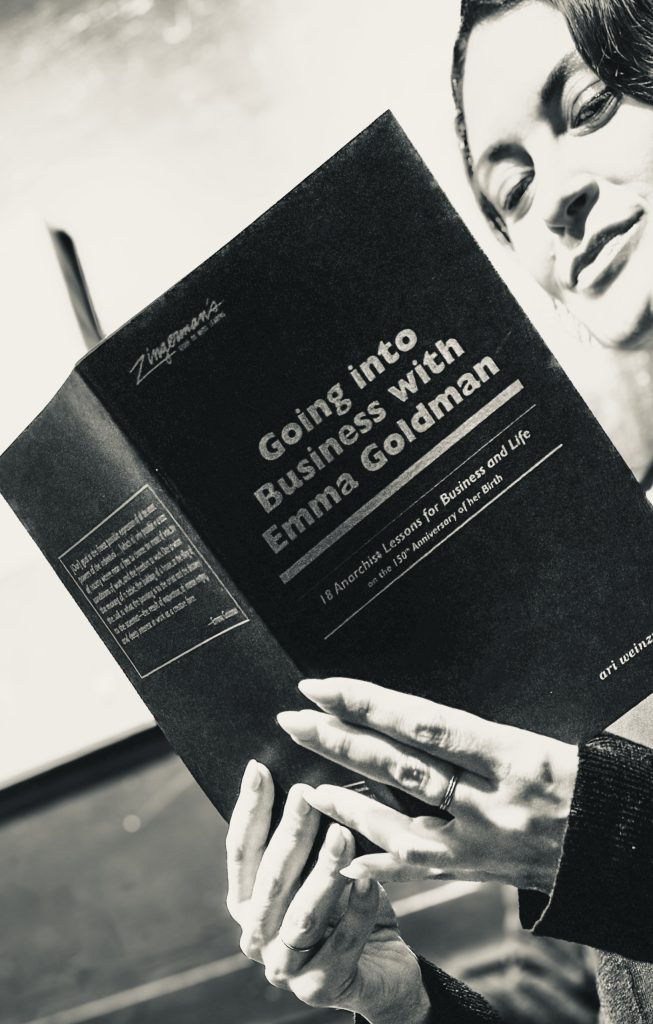
In all honesty, this entire essay was inspired by an off-the-cuff remark from just such a “growing” and “changing” individual. Kendall Monaghan, a front-of-house manager at the Roadhouse, has worked in the ZCoB for about four years now. She’s become an active and important member of our Planet Zing work group, which focuses on our efforts to reduce our ecological footprint. And, of late, she’s led the way in starting a new Roadhouse Book Club.
Kendall’s comments about her experience here, and the opportunity to work in ways that are true to who she really is, form the philosophical core of this essay. They strike me as an example of Emma Goldman’s now 90-year-old point of view coming alive in down-to-earth and eminently practical ways here in our own era:
[Working here] honestly makes such a difference. Especially as someone who is neurodivergent. I’m an intelligent person—I’ve rationally always known this—but so much of my brainpower was allocated to “fitting in” and “being normal/acceptable” for so long that I was never able to put even close to my full potential toward anything. This led to the ever-present, always looming feelings of inadequacy, of failing, of being a failure. Therapy helped me separate what I rationally know from the constant, nagging doubts and fears, sure. But since coming to the Roadhouse, though it took a little time, I’ve stopped masking. Stopped trying to “be normal.” I’ve become comfortable showing up to work as the bookish, whimsical sci-fi nerd; the mother; AND the manager. I’ve become comfortable being all of myself at once, in harmony, rather than at odds. I’ve learned to accept myself as I am, acknowledge what doesn’t serve me and work on it, rather than hiding from it.
This has freed up A LOT of brain space. To take chances, learn new things, pursue passion projects, build relationships with staff, and see the connectivity in every action we take, and the ripple effects it can have. And it’s so much less exhausting. That’s my own personal experience, but I also see how it affects the staff. How everyone gets to show up as their authentic self and we work to protect and nurture that as a leadership team. That allows all of us to use all of ourselves to move forward in life in a way that inspires us as individuals. There’s so much about the Roadhouse that our guests love, but I think that’s the one they FEEL the most. We talk about energy so much, and I think it’s core to the energy we have at the Roadhouse. The dignity we all are shown by being trusted to do great work as our authentic selves rather than just being cogs within a machine.
Kendall’s concluding line, not surprisingly to me, echoes something Emma Goldman wrote over a century ago: “Every sensitive being abhors the idea of being treated as a mere machine or as a mere parrot of conventionality and respectability, the human being craves recognition of his kind.” And, in fact, that is Kendall in the photo above doing one of her favorite things—holding a book!
Anarchist Joseph Cohen, born in 1878 in what would now be known as Belarus, was inspired by hearing Emma Goldman speak in Philadelphia back in 1904. (Cohen had arrived in the city as a new immigrant the previous year, during which he began to immerse himself in anarchist studies and the community. He would later share the story of the local bakers’ union leading a labor parade with a float that featured a challah “the size of a house.”) He and his wife, Sophie, even named one of their daughters Emma.
In his 1945 book,The Jewish Anarchist Movement in America (published originally in Yiddish), Cohen writes:
As anarchists we have one task … we must keep our eyes on the future. We must look back to the future, with a clearer understanding of our task formed in light of our long years of experience.
Cohen’s point, transposed 90-some years into the future, remains the same today, here in the 21st century. If we can create organizations that foster self-actualization and personal development with dignity and purpose, then a feeling of deep meaning can become more the norm than not. All involved are likely to lead more rewarding lives, and our organizations are almost certain to become healthier, more holistically sound workplaces in the process.
Joseph Cohen comments in The Jewish Anarchist Movement, “Our comrades did not write history; they made history.” Which is, I believe, what Kendall and her ZCoB compatriots are actively engaged in doing—they are demonstrating daily that one really can do business differently. When it comes down to it, I’m in complete alignment with what Cohen says: “We believe in people, in their healthy social instincts, in their ability to create and regulate their own lives.”
People who have been trained at work, or in other parts of their lives, to defer to their “dear leader,” or to await orders from an authoritarian autocrat on high, live with what the late, great University of Michigan psychologist Chris Peterson described as “learned helplessness.” As the brilliant writer Rebecca Solnit notes, “Sometimes birds return to their cages when the door is open, sometimes people free to make their own choices [still] choose to abandon [their] power.” People who are living lives they feel really good about are the opposite—they’re all about inspiration, taking appropriate action, and the belief that they can make a positive impact on the world.
In 1954, 14 years after Emma Goldman died in Toronto in the spring of 1940, the then 46-year-old psychologist Abraham Maslow published his second book, Motivation and Personality. The son of Ukrainian Jewish immigrants, Maslow was well on the way to becoming one of the most prominent psychologists in the US when the book came out. He was also more than a bit inclined toward anarchism. He wrote in his 1971 classic, The Farther Reaches of Human Nature, that unfortunately most of the people he found in his fieldwork “know little or nothing about philosophical anarchism.”
Motivation and Personality built on the pioneering work Maslow had already published about his pyramid-shaped “Hierarchy of Needs”—thinking he had detailed in the 1943 paper “A Theory of Human Motivation.” The book carried the conversation further, including a great deal of insight into what it means to be “self-actualized” in the sort of way that Kendall Monaghan conveyed so movingly above. “The self-actualized person,” Maslow writes, “sees reality more clearly … they can accept their own human nature.” To be clear, he makes the point that self-actualized folks are not perfect, observing, “There are no perfect human beings.” They are, though, wonderfully unique.
In the process of becoming self-actualized, Maslow explains, people become less defensive, more spontaneous, and more ethical. They are “problem-centered rather than ego-centered,” they become comfortable with (and enjoy) solitude, and they are more effectively focused on free will. They are, he writes, “propelled by growth motivation rather than by deficiency motivation,” seeking greater stability and modeling “the wonderful capacity to appreciate again and again, freshly and naively, the basic goods of life with awe, pleasure, wonder, and ecstasy.” Things that quickly become “stale” to others, he says, are the ones that self-actualized individuals delight in. They have more mystical experiences and are more affectionate and empathic, developing “deeper and more profound interpersonal relations” with other humans. They are also more actively creative and less likely to get pulled into groupthink or unhealthy patterns. In summing up, Maslow finds that self-actualized folks lead lives that are, quite simply, “qualitatively different.”
Not only do self-actualized people feel and do better on their own, but they also tend to make everyone around them better in the process. In a paragraph with the subheading “The Democratic Character Structure”—and in the spirit of what I lay out in the “Why Democracy Matters” pamphlet—Maslow writes in his essay “Humility and Respect,”
All my subjects without exception may be said to be democratic people in the deepest possible sense. … They can be and are friendly with anyone of suitable character regardless of class, education, political belief, race, or color. … Their democratic feeling goes deeper as well. … They find it possible to learn from anyone who has something to teach them. … They are honestly respectful and humble before people who can teach them something they do not know or who have a skill they do not possess.
They are absolutely not, though, what an autocratic leader would want in a workplace, community, or country.
Maslow emphasizes the uniqueness of every human, saying, “Self-actualization is actualization of a self, and no two selves are altogether alike.” That last bit, I believe, is kind of the point. If we treat people like machine parts, we are, almost inevitably, encouraging them to withdraw into emotional isolation in ways that discourage them from doing anything to go above and beyond. By contrast, the more we can help people to grow into the lives they want to lead, the more systems like fascism will fail, and the better democracies are going to do. While autocratic rule prefers to push down the personalities of the people who are part of the community, democratic environments are designed to do the opposite.
What do we do in the ZCoB to support all this? That’s a good question to which I have no simple or singular answer. Here’s a list to get you, and me, thinking about what we already do—and how we can do it even better going forward:
For openers, self-actualization is abundantly present in our 2032 Vision. In the section entitled “A Great Place to Work: Bring Our Whole Selves to Work,” we share:
The sense of being seen, welcomed, and appreciated starts on Day One in the ZCoB. We help new staff feel included more effectively and quickly than ever. Every person experiences from all others an acceptance and a rightful sense of belonging. We have achieved a level of trust in our organization that enables individuals to be able to speak frankly and be confident that their contribution will be heard, acknowledged, and valued.
To be clear, this appeal to develop into ourselves is definitely not a call to uncaringly say whatever comes to your mind; we are also committed to working to create a healthy whole of an organization, to honoring the dignity of everyone we interact with, to giving great service to customers and co-workers alike, and to living our guiding principles. Still, I’m super confident that one can almost certainly stay true to oneself while embodying all those other frameworks.
We practice servant leadership—the fifth element of which, as we define it, is to help staff members “get to greatness.”
We uphold dignity. It’s a similar story here—the fifth of the six elements that make up our conception of dignity is also about “helping everyone get to greatness.”
We teach visioning and create a culture where being oneself is encouraged. Probably more than any other factor, our deliberate culture of empowering people to be who they are plays a huge role in all of this. As Maria Popova writes in The Marginalian,
We [all] live in culture—encoded in each language are a culture’s parameters of what it is permissible to feel, which we internalize as the parameters of what it is possible to feel.
We teach classes for the crew on self-management and self-awareness.
We encourage reading and learning, so that people begin to explore broader possibilities.
We model being true to oneself, so that new staff members can see that shutting down their personalities at work is not the way it needs to be.
We use frameworks to cultivate freethinking and help people learn to make better decisions.
We encourage people to think for themselves. The ZCoB is a place where people have autonomy to act in alignment with their understanding of the guiding principles, mission, values, and vision of the organization. We have a positive belief in everyone’s ability to be a thoughtful and responsible “citizen.” As record producer Rick Rubin writes, “If you want creators to bring all of themselves to something, give them the most freedom to create.”
Needless to say, it’s not as if we simply hire someone and self-actualization follows within a matter of days. This work is ongoing. And when times are tough, it’s easy to want to withdraw. I lean, though, toward leaning in. In “The Individual, Society, and the State,” Emma Goldman offers a strong summation of all of this, articulating in 1937 what Kendall at the Roadhouse is caringly engaged in doing today:
Real freedom, true liberty is positive: it is freedom to something; it is the liberty to be, to do; in short, the liberty of actual and active opportunity. … Rebellion and revolution are the more or less conscious attempt to achieve it. Those manifestations, individual and social, are fundamentally expressions of the values of man. That those values may be nurtured, the community must realize that its greatest and most lasting asset is the unit—the individual.
Build a healthier organization