
Tag: ANN ARBOR

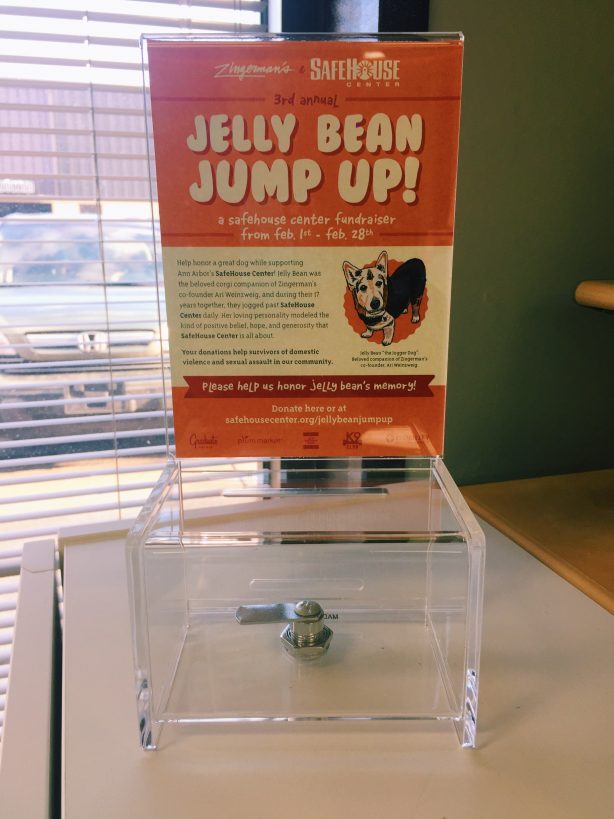
It’s February, and that means it’s Jelly Bean Jump Up time! This will be the third year for this fundraiser, and we’re hoping it will be our best yet. Every penny you give goes directly to SafeHouse Center.
Jelly Bean Jump Up is our annual fundraiser to raise money for SafeHouse Center, which offers support to those impacted by domestic violence and sexual assault. The Ann Arbor organization provides free and confidential services, including emergency shelter, counseling, legal advocacy and more, for anyone who lives or works in Washtenaw County.
The name Jelly Bean Jump Up refers to our co-founder Ari Weinzweig’s beloved Corgi, who passed away in 2015. “When Jelly Bean died I wanted to take the sadness and turn it toward something positive,” says Ari. “Something to honor her positive contribution to my life, and really to the life of so many others over the years. Jelly Bean was a very special dog and such a big part of my life for so many years. And SafeHouse is an even more special cause.”
Pets can play a special role in the lives of those suffering domestic violence, too, says Deborah Kern, SafeHouse’s Development Director. “People experiencing the betrayal of domestic violence often seek the comfort and companionship they deserve in their furry family member. Dogs and cats help us relax, provide unconditional love and provide emotional healing,” she says. Sadly, it is also not uncommon for abusers to threaten the well being of beloved pets to control their victims, and it’s estimated that almost half of people attempting to escape abuse will decide to stay because they are afraid of what will happen to their pets if they leave.
When you make a contribution to the Jelly Bean Jump Up fundraiser, you are helping to ease this roadblock because in addition to all their other life-saving services, SafeHouse Center works with local organizations to provide free boarding to pets, so that survivors don’t have to have this added anxiety.
Donations from the Jelly Bean Jump Up fundraiser in February will help keep programs and services like these 100 percent free of charge for all survivors of domestic violence and sexual assault. We love this organization, and we believe that the work they do makes our communities safer—everyone deserves to live their life free of fear.
Giving to Jelly Bean Jump U is easy. You’ll find donation boxes for cash and check (please make checks out to SafeHouse Center/Jelly Bean Jump Up) donations in every Zingerman’s business, as well as Probility Physical Therapy, Old National Bank and K9 Clubs. Shop at Plum Market? They’ll round up your purchase at the register throughout February. You can also give to SafeHouse online.
Thanks for helping us honor a great dog and a worthy cause!
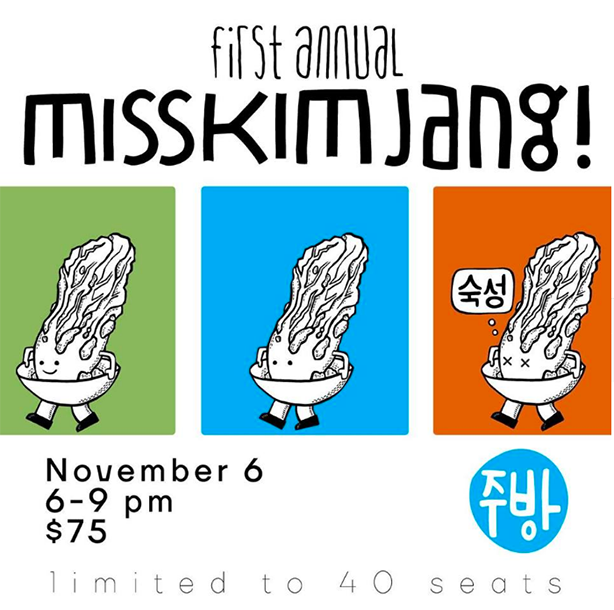
Our first annual MissKimJang is Monday, November 6 at Miss Kim. We’ll be celebrating our one year anniversary with this very special Korean tradition. Chef Ji Hye Kim will kick off the event by sharing her deep personal and culinary knowledge of kimchi and KimJang. Attendees will get to make their own kimchi, and we’ll have lots of food, too! Grab a seat before it sells out.
Here’s a preview from Ji-Hye Kim:
KimJang is the annual making and sharing of kimchi. It is an annual event that is at the very core of Korean community. In fact, in some ways almost the entire Korean year is marked by preparations for the annual ritual of KimJang. In spring, shrimp, anchovy and other seafood is set for salting and fermenting. In summer, sea salt is bought for the brine. In late summer, red chili peppers are dried and ground into powder. Finally, in late autumn, or the tenth moon of the Korean Lunar Calendar, it’s KimJang time! Communities coming together to work on the harvest and to make massive amounts of kimchi. Communities working hard together, all hands on deck, to ensure that every home has enough for the long, harsh winter to come.
At Miss Kim, we’re pretty passionate about kimchi and KimJang. In our minds, both are at the very core of what we’re trying to do at Miss Kim—to respectfully represent the Korean cuisine and culture and honor Korean traditions. Kimchi is an inexorable part of the former and KimJang an inexorable part of the latter.
Here’s what she had to say:
G: Why is making kimchi during KimJang relatable to life and death?
JI HYE KIM: The answer to that question starts in Rome. Yes. A story about kimchi and KimJang starts in Rome, Italy. Right before I opened the restaurant, I was living in an extended internship of sorts at the American Academy in Rome. The program was called the Rome Sustainable Food Project—Alice Waters’ brainchild and a brilliant experience.
In that way that life works, one of my fellow travelers at the American Academy was a Korean-American woman—a painter who just happened to be deeply interested in food!
I’d impulsively made a small batch of kimchi for one of the interns who was leaving the program—and now I wanted to make more. My new- found friend and I decided we’d have our own little version of KimJang right there in Rome.
We got all the vegetables we needed from the amazing Mercato Esquilino in Piazza Vittorio. It is one of the largest markets in Rome and is some- times called the immigrant’s market because you can get just about everything there—from traditional Italian produce and delicacies to mangoes and avocados. Then we went to a Korean shop for the ingredients of the filling and we got down to making kimchi.
It was while we were chatting and making kimchi that she said to me:“When you’re making, you have to walk the fine line between life and death.”Those words really resonated with me.Today, we make kimchi at Miss Kim all the time and those words ring even truer.When you brine the cabbage, it is no longer fresh and alive—the real skill in making kimchi is to preserve the crunchiness that the leaves have when the cabbage is alive. In doing so, we prolong its life. Or you could say, we suspend its death.
When I think of the tradition of KimJang, I think it is also walking the fine line between life and death. It’s a communal tradition that goes back so many centuries but it is also so individualistic—an ingenious form of self-expression while also creating community. But it is also a dying tradition. Making kimchi is really hard work— people don’t have the time or energy for all the prepping, brining and dressing that the process requires. The family recipes that were the vehicles for that self expression are being lost.
But, I firmly believe that the tradition of KimJang still has the capacity to survive, and thrive! As long as kimchi remains an essential part of Korean cuisine, KimJang will have a way to be part of Korean culture. Much like we do with the food and our local ingredients at Miss Kim, I’d like to inter- pret the tradition of KimJang and keep it alive in the restaurant.
G: You mentioned individualism and family recipes. At least in the west, kimchi is most popularly thought of as one thing. That red condiment that is served with Korean food. Explain it to us.
JHK: When we say “in the West,” we’re talking about Napa Cabbage kimchi. That’s the kimchi everyone thinks about when they think about Korean food. But kimchi in Korean food can be made of any number of salted and fermented vegetables. Kimchi is the idea of preserving vegetables when they are in season so that they can be eaten all year long. Just about every culture has this tradition of preservation to prepare for the winter months—be it vegetables, meats, or milk.
The most common and the most consumed form of kimchi, is indeed, Napa cabbage kimchi. KimJang occurs in late autumn because it’s when the Napa cabbage and Mu radish are in season. But even within Napa cabbage kimchi, there are variations. Hundreds, if not thousands of recipes, varying by region, wealth, family and ultimately, the individual making the kimchi. Even when the ingredients are exactly the same, self-expression comes through the proportion of the ingredients. There are over 200 documented recipes for kimchi because every fam- ily does it differently.
My mother’s kimchi was her signature. And it said a lot about her. She preferred to honor the flavors of the ingredients rather than subdue them with seasoning. That she came from a region of Korea (around Seoul) where they emphasize clean, subtle flavors, tend to serve small- er portions and have a keen eye for presentation. There’s a definite regionality to kimchi. The farther south you go, the spicier, funkier and punchier the kimchi gets. The farther north you go, the milder it gets.
G: Tell us your very first memory of KimJang.
JHK: I remember my mother sitting in a room and kind of think- ing out loud. It was the day before KimJang. Should we do 50 heads of cabbage or 100 heads of cabbage? My child brain might very well be embellishing or exaggerating those numbers but I was tiny back then—maybe 4 or 5 years old…
This was in Seoul. Back then we lived in an old fashioned house in one of the crowded, older neighborhoods. Our house was old and needed updating. My mother just about hated it, but I have a lot of great memories of that house. My mom’s little outdoor area where she kept her fermented sauces and pastes—witches potions they looked like, with mold and floating bits—brewing in those rustic black pots of hers. Miso pastes, soy sauce, you name it. I remember the feeling of abundance that KimJang brought. There were so, so many heads of Napa cabbage. The kimchi was made outside on the veranda, not in the kitchen. All the women and all the cabbage wouldn’t have fit in our kitchen!
I remember women coming to our house from the neighborhood. I remember them squatting in the yard. The piles and piles of Napa cabbage—heads cut in half. Brine. Drain. Make the filling separate- ly. Fish sauce. Mu Radish—sweet and juicy from the cooler fall tem- peratures, unlike the spicier summer radish. Four or five women to a large mixing bowl—more like a big tub when I think about it.
I remember the vibrant colors. White. Purple. Green. Bright red plastic gloves bought by the dozen. All the women wearing them. I remember the searing red of the chile flakes—my mother would sun dry the chiles on picnic mats all summer while they were in season. But most of all, I remember the feeling of community. The laughing and talking. The hard, hard work. I remember how there was this unspoken but very tangible awareness that we would be eating what was being made for months and months and months.
G: What does KimJang mean to you?
JHK: Back then, when I was a little kid, what I recall is that KimJang was a lot of work but I didn’t do any. I remember my mother, fingers glistening with spices, popping these bite sized Napa cabbage wraps into my mouth. ‘It’s delicious,’ she’d say, which was strange because it was that spicy, pungent, salty filling and cabbage. But I always obediently opened my mouth. Later we’d have it with braised pork belly for dinner.
I remember that when it was KimJang time, my mom didn’t seem as stressed out as usual, even when she was planning it. She would catch me stealing the sweet mu radishes and eating them like Asian pears and teasingly warn me about the terrible flatulence it was going to give me.
And I remember there was just a lot of talking and laughter and it was really powerful to see all these women do their work. It was their day. Unlike when they cooked for the Korean festivals, there wasn’t any- one to serve afterwards, even them- selves. And the social and cultural hierarchy didn’t matter. There were all equals, hanging out and having fun. I loved witnessing that and now I long to recreate it.
G: How has KimJang changed?
JHK : When I was in the second grade we moved from our traditional house in the old neighborhood to an apartment complex in a more modern neighborhood. We still did KimJang but the community thing was hard to pull off in an apartment complex. I don’t remember those magical moments in the yard but I do remember this—I remember being asked to keep watch while my mom and my aunties [the bio- logical variety and the neighborhood variety!] dug a hole in the flower beds of the apartment complex and buried these giant jars of kimchi (I could have fit in them) and then cover them with leaves.
The story of KimJang when we came to America? [laughs] It gets really sad. My mother worked 18 hours a day. She still did KimJang but it was completely different. Back in Seoul, during KimJang season, guys would appear in our neighborhood with pickup trucks and megaphones to announce their presence. My mom would go out and get our Napa cabbage from them. Or she would go to the largest vegetable market in Seoul to get the cabbage—imagine a farmer’s market on steroids! Needless to say, this is not what happened once we moved to America. Instead, most Korean Americans we knew just drove a few miles to a Korean grocery store and bought jars of pre-made kimchi.
Even in Korea, there are now a million sources of pre-made kimchi— kimchi factories! And for the slightly more diligent or picky, thousands of sources of the components of kimchi. You can just make the filling at home and buy pre-brined cabbage.
No matter if in America or Korea, I cannot imagine my mother buying pre-made kimchi. She knows too well that the texture and flavor of kimchi is all in the brining, so even when we came to America, she still made our kimchi from scratch but it was not seasonal and definitely not as communal. She might have had help from my brother and shared it with my aunt but it didn’t feel like the magical communal event we used to have when we were in Seoul.
G: You’re hosting your own version of KimJang, MissKimJang, in the restaurant in November. What are you trying to do with it? What are you trying to make of it?
JHK: In some ways, we’re trying to do the same thing that we do with the food. Honor Korean cuisine and tradition in our little corner of Michigan—with its signature seasons and produce. We try to study and read as much as we can so that we might understand the intent behind and evolution of the recipes and be able to thoughtfully interpret and evolve them for Michigan. We try to serve food that evokes feelings just as much as we’re trying to authentically represent the flavors.
And I’d say, that’s what we’re trying to do with this annual tradition of MissKimJang.
Don’t miss a chance to experience this fun, cultural event. We only have 40 spots for MissKimJang, so grab yours today!
(republished from March 24, 2017)
“We at Zingerman’s Bakehouse are passionately committed to the relentless pursuit of being the best bakery we can imagine.”
The mission of the Bakehouse has always been twofold. Of course, we are committed to making the best-tasting breads (and pastries and cakes), but we are also committed to challenging ourselves and our recipes, limiting ourselves only to our imagination.
How do we do that? We taste and evaluate. We try new methods of baking, different ingredients. We are constantly moving. Because it’s hard to get better if you’re sitting still.
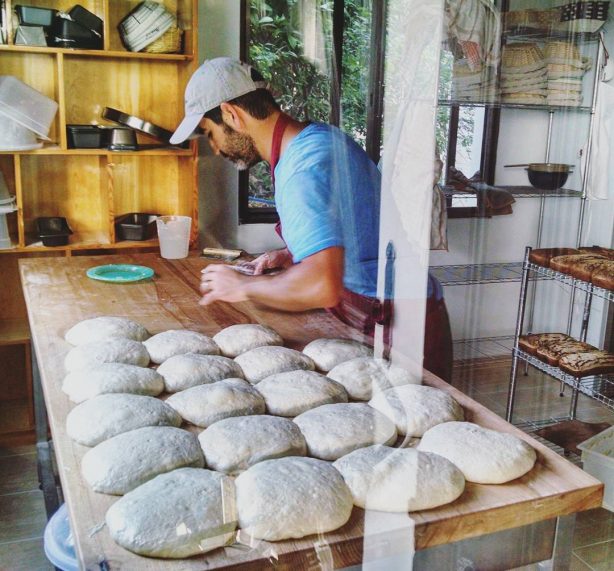
With that in mind, let us introduce you to one of the newer members of Bakehouse team- Hazim Tugun. His passion for bread baking and his long history with the craft is what led him to the Bakehouse. And here, he is putting those passions to work, helping us fine-tune recipes and try new methods of baking and continue living our commitment to excellence.
Laying the foundation
Now a passionate bread baker, this was not Hazim’s original career path. When he was about 17 years old, Hazim moved to the United States from Cyprus (an island in the Mediterranean) to study civil engineering. He studied engineering in Austin, Texas and, after graduating, moved to the San Francisco Bay Area to work as a consultant.
While living there, he described himself growing antsy. “While I was working in the Bay Area, I started feeling antsy. My training was as a civil and environmental engineer. But that was not what I wanted to do in the long run.”
Cooking quickly became a passion of his outside of working. He found himself looking for more avenues to learn and practice. As luck would have it, one of his good friends took him to a Sicilian restaurant in Oakland called Dopo. That friend knew the chef and introduced them. Hazim remembers this time as his official entry into the professional world of cooking and baking. From that one introduction, he began working at the restaurant on Saturdays, helping with prep and just learning about the processes.
“I did this for two, maybe three years. And I learned a lot, it was fascinating. During that time, I took a course from Peter Reinhart. He wrote the book ‘The Bread Baker’s Apprentice.’ It was a couple of hours and I learned a lot more about baking.”
After taking that course, Hazim began practicing his baking more at home. Up until that time, he was much more comfortable with cooking. But his experience at Dopo, as well as Peter Reinhart’s class led him to pursue home baking further.
Then, after a couple of years in the Bay Area, Hazim moved back to Cyprus. He was there for about two years, still doing consulting engineering work. This was a perfect opportunity for him to continue learning about baking.
He describes one of the biggest differences between the US and Cyprus. “In Cyprus, time is slow. People take their time, have more time. It’s not like here in the US where everyone is busy and moving fast. In Cyprus, you can enjoy your time.”
With that extra time to enjoy, Hazim practiced baking. “I started to try to bake bread, baking just for my family. We had a traditional mud oven in the backyard, so I used that to bake.”
The Zingerman’s experience
It wasn’t until he moved to Michigan with his wife in 2011 that he first heard about Zingerman’s. And, truthfully, it was a bit of a shock moving from a place like the Bay Area to where they were living in Novi, Michigan.
“Coming from the Bay Area, I was disappointed with the food culture in Novi. It was pretty depressing for me. When I worked in San Francisco, lunch in the office would be fresh Banh Mi sandwiches or other great food. Working in Novi, lunch was usually a sub-par sandwich from a chain. It was pretty depressing for me. I was thinking, where is the good food?”
So, when he and his wife were looking for Cowgirl Creamery cheese, a friend of theirs recommended they check out Zingerman’s. Luckily, Ann Arbor isn’t too far of a commute from Novi. He remembers thinking, “this is it, this is where the food is,” while sitting at a table in the Coffee Company, and exploring the other Zingerman’s South Side businesses. Even though he was still working as an engineer, bread was still on Hazim’s mind. He remembers, “In early 2012, I was really getting antsy about bread again. I knew I really wanted to bake and I knew I needed to get more experience.”
Enter… Zingerman’s Bakehouse
Finding great food at Zingerman’s while living in Michigan led him to seek out his continued education and experience with us here at the bakery. He explains, “I came to the Bakehouse and asked if I could talk to a manager. I was looking for something like I had in California, where I worked on the weekends, learning about baking and cooking.”
And that is exactly what he did. Hazim started coming in on Saturdays, learning about baking bread. He did this for a few months before eventually quitting his engineering job and moving back to Cyprus with his family.
Dreaming of naturally leavened breads
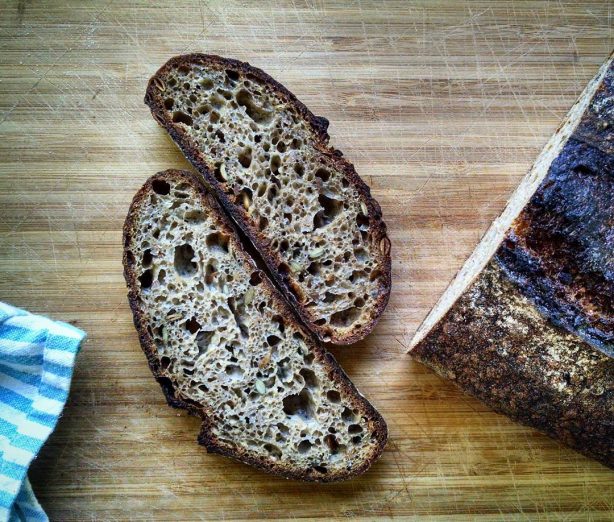
In Cyprus, his dream was to open up a bakery. “What I wanted to do is naturally leavened breads. Nothing else. And to just do a few breads, very high quality breads. When we moved back in 2014, I converted one of our rooms into a bakery and started selling breads.”
Baking on a small scale and focusing on just a few, high quality breads, gave Hazim the opportunity to focus all of his time and energy on perfecting the craft. He remembers that it took him a while to fine tune his process. “I was able to be very intimate with it. To see what kind of changes affect the process. I had the privilege to do that on my own, and I learned by doing it over and over and over again.”
After baking for his village in Cyprus for about a year and a half, he moved back to the US. But a change of location did not get in the way of his dream. “I knew I wanted to continue this. Either I was going to do my own thing or I was going to team up with a great team of bakers.”
Pursuing this dream was not always easy, especially starting out. As you can imagine, introducing a new style of baking bread, ones made with a natural leavening process over multiple days, is not always the easiest.
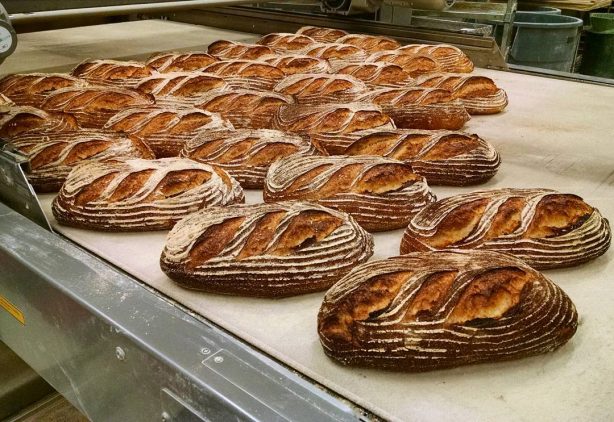
Hazim described how he introduced his breads to Cyprus, “The breads I was making were very different from what was offered on the market. Mine were very moist breads with a dark crust and had a lot of flavor. I tried to explain my philosophy behind baking to people, and it wasn’t that easy. Fortunately though, the breads did speak for themselves, and I had a good following. I was essentially testing the waters, and I did well.”
That time was one of growth and learning for Hazim. “I think I did a lot of growing, being able to bake solo, questioning, learning about and tinkering with every step of the baking process, using flours and grains that did not come with consistency, quality or specifications that one could find here in the US or Europe. I was also able to make friends and reach out to mentors throughout the world”
His time of growth, learning and, even, experimenting with various baking methods left him with a strong customer base in Cyprus. He remembers how many of his ‘regulars’ were sad to see him go. “I baked till my last day for friends and family. What really made me happy though is that I think I touched a lot of people in the sense that they learned what bread could be. I am proud to say I have a couple of friends who now bake sourdough breads in their homes.”
While leaving his hometown (and loyal customers) behind was definitely bittersweet, moving back to the US has been a huge benefit to us and, to his growth as a bread baker.
Back to Ann Arbor
Now, we are back to present day. After moving back to Michigan, Hazim began reaching out to Frank. “I had a vision and I shared that with Frank. I used Ari’s book (A Lapsed Anarchist’s Approach To Building A Great Business by Zingerman’s co-founder Ari Weinzweig) to help me write my vision, too. I was like, I want to do this.”
His vision of using freshly milled flours to craft high-quality naturally leavened breads (among other things) seemed a natural fit at the Bakehouse. After talking to Frank and Amy, they asked him to join the Bakehouse team to help the continual improvement of the quality of the breads we bake here.
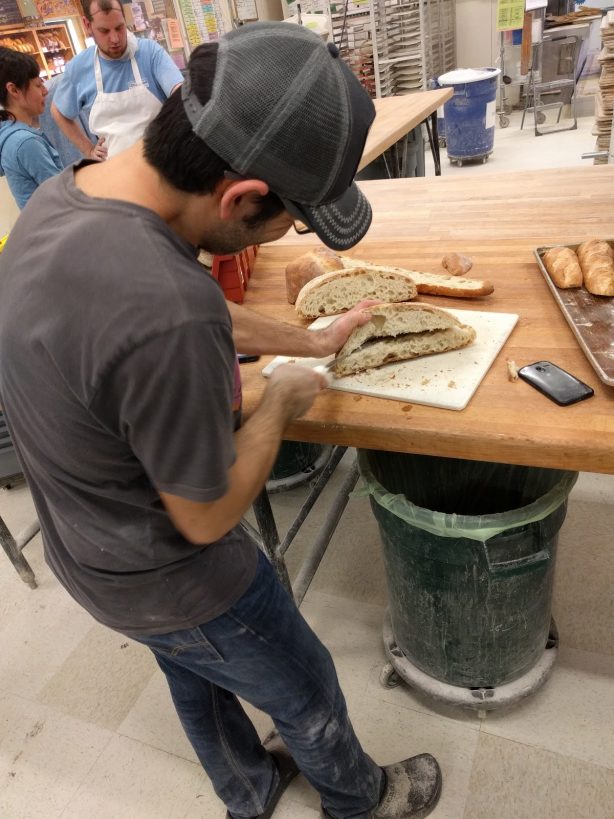
For Hazim, he views a big part of his job here as asking questions. “From day one, I immediately started asking questions: why is the dough like this, why are we rolling it like this, why are we shaping it like this? That is the perspective I look at it from. When we work together, I help contribute from the craftsmanship perspective. And I am looking forward to learning more.”
Hazim & the Bakehouse
Having Hazim in our bread bakery has given us another way to continue on in our passionate pursuit of baking great bread.
One of the ways he does this is by participating in our daily bread tastings. These tastings are something we do in both the bread bakery and pastry kitchen to taste the different things we are making. It helps keep us in tip top shape, ensuring our end product is something beautiful and very flavorful. During these tastings, Hazim has brought his unique perspective to the table.
“The tastings have been a lot of fun and a great learning experience. First of all, I am learning more and more about Zingerman’s breads during these tastings- their nuances and what they are supposed to taste like. With that in mind, I am trying to bring my own passion and experience about bread into this role, looking at each bread through my own eyes, as well as a potential guest’s eyes.”
The things he considers? How does it feel to bite into this bread? Is the crust too chewy or perfectly crisp? Is the crust dark enough to contribute to the overall flavor of the bread with its wonderful caramelization/Maillard reaction aromas? Is the crumb tender or tough? It is open enough? Does the flavor have the depth or acidity we are looking for? How is the shape and size?
These are just some of the questions he thinks about during the tastings.
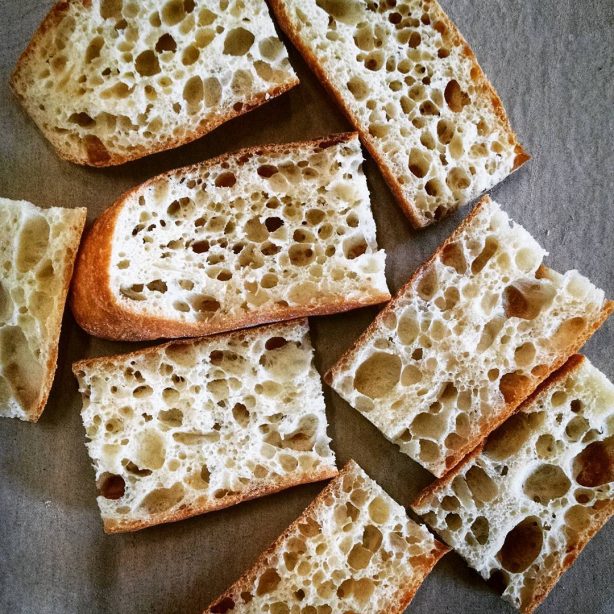
“During each tasting, I am trying to think about and answer these questions. I try to picture the recipe and the process that went into making the bread. To me, that is probably one of the most fun aspects of doing the tastings, but also one of the most challenging, mainly because each bread we make here is an amazing example of teamwork. So many hands touch the dough to make that one bread. There is already a great level of communication happening between everyone.”
These tastings, of course, help facilitate that conversation, as well as the overall development of recipes and methods of baking.
Additionally, he is working on a few, special new recipes. One of those is a rice baguette. The inspiration behind it was, actually, for the new Zingerman’s restaurant, Miss Kim. For a Korean restaurant serving really good, traditional Korean food, rice baguettes were the perfect fit.
“They were a recipe the Bakehouse had made for a short time long before I joined the team. I tweaked it a bit, increasing the amount of the amazing stone-ground whole-grain rice flour from Anson Mills, toasting some of the rice flour used in the recipe for added flavor, and adding a touch of levain for a bit of depth and acidity.”
Rice baguettes are not his only venture, though. Another bread he wants to focus on is the True North.
“I want to continue tweaking the True North to coax more flavor and even better texture out of that grain. It is a local grain, which makes it more likely to deviate from the predictable baking performance of the more industrialized flours and grains. More flavor, more fun and challenge to work with.”
Working here at the Bakehouse, learning the ins and the outs of bread baking is Hazim’s dream. The experience he is gaining here at the Bakehouse, as well as the knowledge he has accumulated over his years of baking bread are getting him closer and closer to perfecting his process of producing naturally leavened breads. And he is a true asset to the Zingerman’s bread bakery.
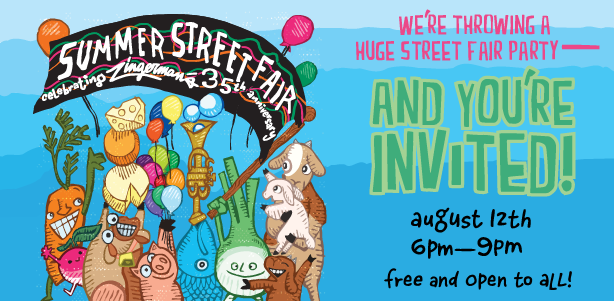
Zingerman’s 35th Anniversary Summer Street Fair Party is a food fantasy come true!
Date: August 12, 2017
Time: 6pm-9pm
Location: Ann Arbor Farmers’ Market, 315 Detroit St, Ann Arbor
It’s only Monday, but we’ve already got some exciting plans for you this weekend! This Saturday, from 6pm-9pm, Zingerman’s is celebrating over three decades of great food and community with an epic gathering of artisan food makers. We’ve got an unprecedented collection of some of the world’s best food producers coming to Ann Arbor Farmers’ Market at Kerrytown for Zingerman’s 35th Anniversary Street Fair for what promises to be an evening of great food, fascinating stories, good music and the debut of a great new brewing company!
The best part? Admission and samples are free, and everyone is welcome.
All participating vendors scheduled to attend—over 35, in addition to Zingerman’s own food businesses—have played an important part in the history of the Zingerman’s and its reputation for excellent food. We are so excited to host local and international makers, including The Brinery, La Quercia, Nueske’s, La Vecchia Dispensa, Rustic Bakery and many more (see the full list here). The Ann Arbor community will have a chance to hobnob with makers of their favorite cheeses, meats, chocolate, and more. Added bonus: the new Edelbrau Brewing Company will be debuting some of their delicious beer to the public for the first time at this event!
You can RSVP for the Street Party right here!
Food fans can also take a piece of Zingerman’s home with them. Our staff artists will be customizing locally screen printed posters of our most iconic Deli imagery on the spot—with our classic Muno font.
The evening promises to be even grander and more memorable than Zingerman’s 25th anniversary celebration. The Zingerman’s community looks forward to hosting its neighbors and friends for a wonderful night of delicious food and fantastic music from DJ Jeremy Wheeler.
Come one, come all! We’re going to be a great time!
You can RSVP for the 35th Anniversary Street Fair party right here. And don’t forget to sign up for #Zing35 updates. We can’t wait to see you!
Zingerman’s Roadhouse, which has spent the last fourteen years bringing really good American food to Ann Arbor, ups its game in August—the restaurant will celebrate the diversity of cooking in US by welcoming two American culinary luminaries from opposite ends of the food world. One is a famous pitmaster, practicing a rare bar-b-que tradition, and the other is one of the most respected Jewish chefs in the country—both will create unforgettable menus for the restaurant’s popular Special Dinner series in August.
BBQ Special Dinner: A Meditation on Tennessee Tradition
August 8, 2017 at 7pm. $75 per person
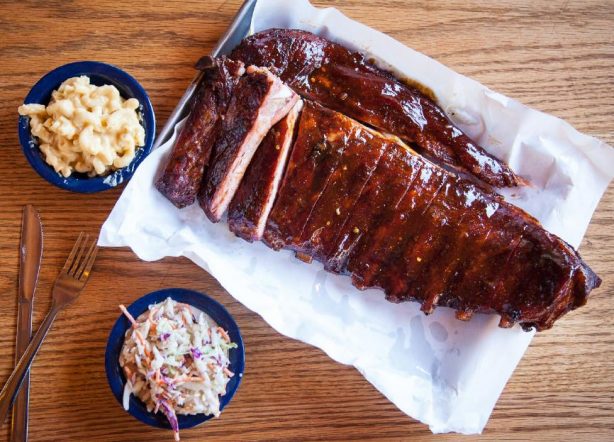
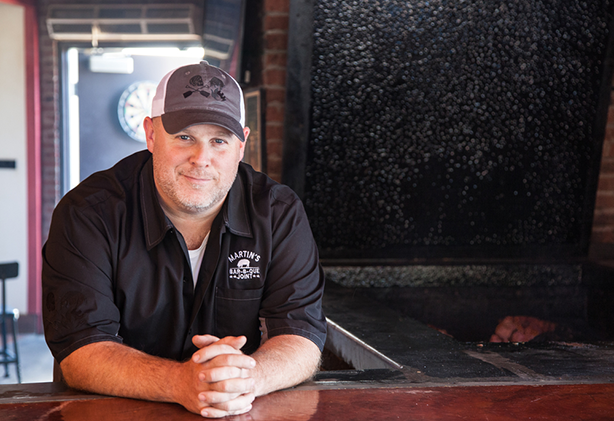
Whole hog BBQ is a craft, and the mindfulness for perfecting the method is not gained overnight. Practicing a rare BBQ technique that only three people in the country can claim expertise in, Pitmaster Pat Martin smokes the hogs he serves at Martin’s Bar-B-Que Joint in West Tennessee for 24 hours. The result is falling-off-the-bone tender, moist, smoky meat. Starting work every day at 5am, he and his crew make everything from scratch, and on August 8, Ann Arbor will get a taste of the treasured tradition. Pat will be on hand to share his passion for this long-time Tennessee tradition. Menu will include West Tennessee whole hog bbq, Redneck Tacos, Bar-B-Que Baked potatoes and much more. SEE THE FULL MENU AND RESERVE SEATS HERE.

Harvest Special Dinner: An Evening with Joan Nathan
August 28, 2017 at 7pm. $75 per person
James Beard Award winning cookbook author Joan Nathan, called the “queen of American Jewish cooking” by the Houston Chronicle, will be sharing stories and flavors from her brand new release King Solomon’s Table: A Culinary Exploration of Jewish Cooking from Around the World. Recipes from the new book, her 11th title, will be the centerpiece of the dinner, which will explore dishes from Israel to Italy to India and beyond. Featured dishes will include a Georgian beef stew, Indian Chicken, Tunisian Carrot Salad, and much more. Nathan will be signing copies of the book at the dinner. The L.A. Times writes, “With a mix of deep historical research combined with personal anecdotes of her many friends, relatives and colleagues around the world, her book… combines Nathan’s celebrated knowledge of all things related to Jewish food with her accessible storytelling voice.” A University of Michigan alum with long time ties to both Ann Arbor and to Zingerman’s, Joan is excited to return to town. SEE THE FULL MENU AND RESERVE SEATS HERE.
Seats for both events are limited and likely to sell out! Reserve your spot today.

It’s almost time for Paczki, those fried, filled pillows of deliciousness that are utterly irresistible. Zingerman’s Bakehouse makes them every year for Fat Tuesday, and this year the gluttonous day falls on Tuesday, February 28.
Our Paczki are only available for one day and sell out every year, so place an order for yours today to guarantee you don’t miss out! They come in five different filling flavors: Raspberry Preserves, Chocolate Pudding, Sweet Ricotta Cheese, Rose Hip Jam and Lemon Cream.
They’re available for pre-order and pick up at the Bakeshop (734-761-2095 ) or Zingerman’s Next Door (734-663-3354). Call or stop in at either location to place your order.