
Tag: ARI WEINZWEIG
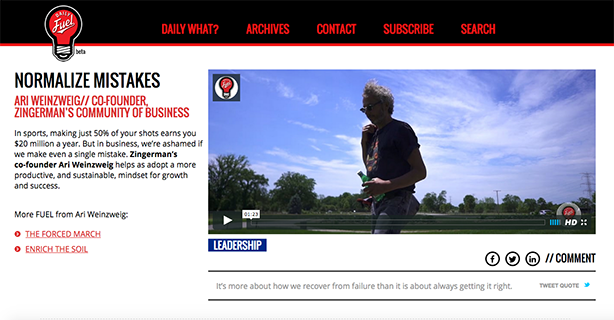
Daily Fuel offers inspiration videos from a wide range of successful people, on topics like entrepreneurship, marketing, and leading, that run two minutes or less. Ari is featured in three new clips–in them, he encourages normalizing mistakes in business, makes a case against military-style leadership, and talks about creating a company culture that fosters creativity.
Check out all three here.
Tag: ARI WEINZWEIG
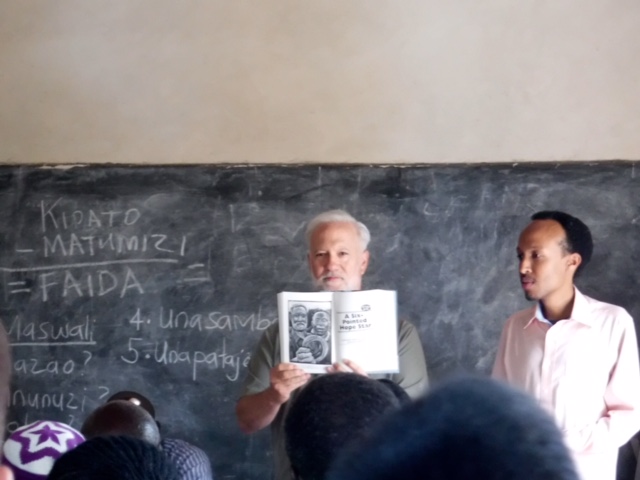
Socially-conscious chocolate maker, Shawn Askinosie shared Ari Weinzweig’s latest business book with his partners in Tanzania today!
For more information on the book visit: https://www.zingtrain.com/power-beliefs-in-business
Tag: ARI WEINZWEIG

The energy was palpable. Between the unveiling of a new venue and the buzz around a highly anticipated new book, the energy in the room was electric. The bustling city views of Ann Arbor and its passersby served as the perfect backdrop to explain what was happening in that room.
The attendees came from all walks of life. Jane and Paul Jones had travelled from Grand Rapids. “We’re probably aren’t the ones who had to travel the farthest; people come from all over the country to hear Ari speak!”, Judy told me. There were entrepreneurs and sociologists and social workers and professors. There were people from all walks and stages of life. The youngest attendee, Luell, came with his dad, who helped Ari with the book. When asked why he was excited to attend the event, Luell said: “I get to be someone. I get to be the youngest person here and I get to see what older people do!” Luell’s father, Teddy Araya, is the founder of the Center for African Leadership Studies and is mentioned in the new book. A few other attendees were also referenced in the new book including Hannah McNaughton, founder and Chief Envisionary at Envision Marketing.
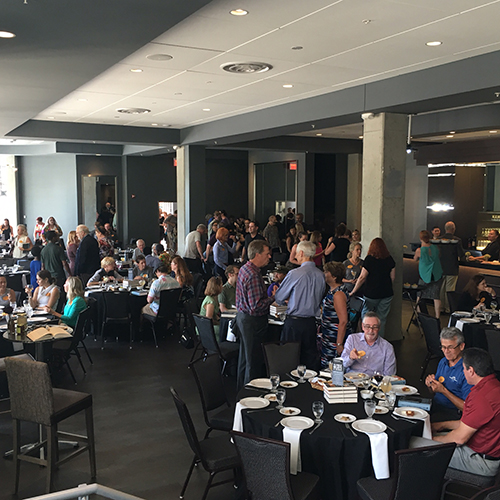
The sleek lines of the Greyline, Zingerman’s newest, downtown event space, were reminiscent of the Art Deco style of the historic Ann Arbor Bus Depot it now occupies. The style of the Art Deco era used lines to create a sense of speed, of movement. It’s a perfect match for the Greyline, a new space that represents the movement of Zingerman’s Community of Businesses – expanding and moving into the future with a recognizable and influential style.
The event held at the brand new venue was a public introduction to co-founder and CEO of Zingerman’s Community of Businesses Ari Weinzweig’s newest book; the fourth in a series of books expounding Zingerman’s unique approach to business.
As the attendees were taking their seats and discussing the space and what brought them to the event, a woman from the University of Michigan relayed that what she was curious about Ari’s choice to focus on the concept of beliefs. She asked aloud: “Why did he pick the word belief instead of any other words? I’m just curious because I think that’s what’s most powerful. Beliefs are more than values, it’s about something more empowering in yourself. And feeling an external spiritual connection to something outside of yourself.”
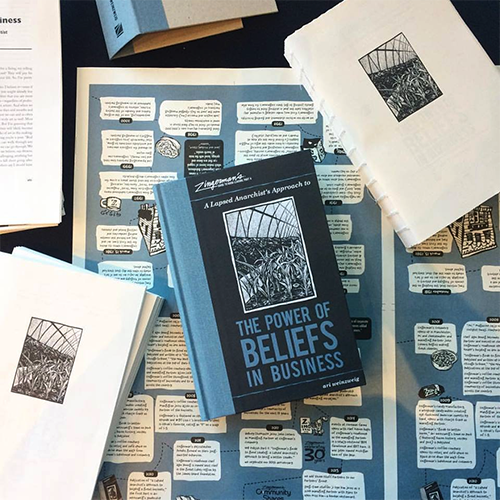
Ari’s newest book, Zingerman’s Guide to Good Leading, Part 4: A Lapsed Anarchist’s Approach to the Power of Beliefs in Business, is a new approach and a breath of fresh air in the world of business writing. The book is a detailed analysis of how our personal beliefs color our personal world and affect the changeable outcomes of our work. “Beliefs are the root system. They are what’s happening beneath the surface, that directly impacts what’s happening above ground.” Ari describes his newest work as his most personal yet. His early personal beliefs in the late 1970’s about business were negative until he realized that business is just a tool “that can be applied with harm or kindness”. Four years later he would be starting his first business.
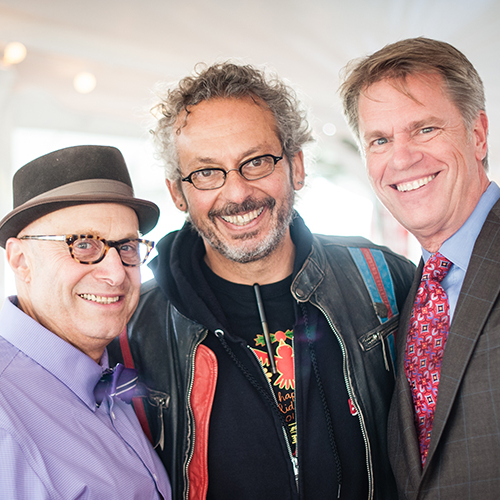
The interview was facilitated by Vic Strecher, author of On Purpose: A Graphic Novel, and a professor at the University of Michigan’s School of Public Health. “Why beliefs? Why not things that people hold very dear to them, very close to them like their core values?” Vic asked. To which Ari responded: “All values are beliefs, but not all beliefs are values.” Ari went on to describe how even the information around us is colored by our preconceived or unconscious beliefs: the data we take in is radically altered by our beliefs.” Vic confirms the notion that humans are swayed by beliefs and experience: “We filter out information that doesn’t fit with our beliefs. We live in a ‘filter bubble'”. Ari pointed out that although many of us regularly say, ‘I’ll believe it when I see it’… it’s actually the other way around. “We’ll see it when we believe it.
After discussing the book and its roots with Vic, the event was opened to audience questions. A young entrepreneur, Holly Rutt of The Little Flower Soap Co. and Sweet Pea Floral Design, thanked Ari for giving her the courage to pursue her entrepreneurial passion while disregarding all of the negative feedback people had tried to feed her about business. “I think as a business owner and a woman, the powers that be wanted to tell me that I couldn’t be myself. I’m very philosophical and very hopeful, that’s definitely a part of me. But I’m also interested in business and a business owner, and I felt like I was being told, other peoples’ beliefs, that those things were mutually exclusive. I feel like all of your books, and I’m excited to read this one, are giving me the permission to be all of those and fuse them together.”
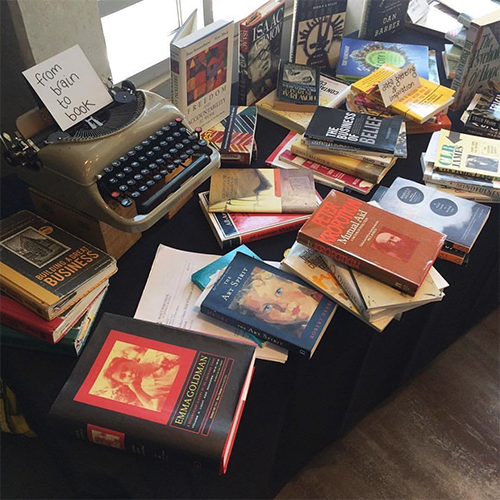
Walking away from the event that evening, I could feel how Ari had not only touched on an important part of growing and steering a company (the beliefs with which they are founded and maintained), but I felt he was tapping into a theory about our cultural moment in time. How do our collective beliefs, or perhaps more importantly, the beliefs all of smaller groups hold maintain or change the status quo? How could we as individuals work to change our beliefs to create the outcomes we’re seeking? It’s an incredibly large question that Ari has tried to distill into 600 pages. I have a feeling there’s probably a second volume on his computer.
However, the opportunity to learn from Ari, one of Ann Arbor’s preeminent thought leaders is not limited to reading his work. From his employees to his customers to the people he meets throughout his travels, Ari is an open book. And he writes books. A winning combination.
Tag: ARI WEINZWEIG
Part 4 in the Guide to Good Leading series shares 11 more “Secrets” from of one of the country’s most progressive companies!

Thirty-four years ago Paul Saginaw and Ari Weinzweig opened Zingerman’s Delicatessen with a staff of two and a $20,000 bank loan. Today Zingerman’s—a place Inc. magazine called “The Coolest Small Company in America”— is a creative collaborative of ten different businesses in the Ann Arbor area, employing over 700 people and doing sales of about $60,000,000 a year. With the release of Ari’s new book, Zingerman’s Guide to Good Leading, Part 4: A Lapsed Anarchist’s Approach to the Power of Beliefs in Business, more of the secrets behind the business’ success are now available to the world.
Parts 1, 2, and 3 have gained wide acclaim from progressive business leaders—and readers—over the last seven years. Part 1, A Lapsed Anarchist’s Approach to Building a Great Business, explores Zingerman’s unique approaches to organizational visioning, values, mission, systems and culture. Part 2, Being a Better Leader, dives deep into subjects like Servant Leadership, Stewardship, and energy management, as well as an in-depth look at Ari’s beliefs about anarchism’s application in 21st century progressive business. Part 3, Managing Ourselves, examines Ari’s experiences with mindfulness, self-management, personal visioning, time management, free choice, creativity and more. All have become essential reading for leaders looking to leave behind the old mainstream business models and create progressive, forward thinking organizations.
And now the eagerly-awaited fourth volume in the series is hot off the local presses and on the shelves at Zingerman’s. Some of the country’s foremost thought leaders have already weighed in. Business philosopher and author Peter Koestenbaum says, “Ari’s new book is a gem in today’s revolutionary leadership movement.” Dr. Michael D. Amos adds, “I love the first three books in the series. But I believe this new volume is Ari’s greatest work.”
As with all of the books in this series, the essays in Part 4 are guaranteed to get the reader thinking in new and creative ways. John U. Bacon, author of the New York Times bestseller, Endzone: The Rise, Fall and Return of Michigan Football, writes: “Some business leaders know practice. Some know theory. Ari Weinzweig is one of the few who knows both. He and his partners have built a famously successful organization, while giving it more thought than the business gurus who merely philosophize about such things. The insights Ari shares here are both deeply perceptive and highly practical, from the ideas of Howard Zinn, Viktor Frankl, and Anaïs Nin on one page, to the importance of learning your employees’ names on the next. Like its author, this book is uncommonly smart, helpful, and just plain fun.”
The insights in Part 4 illuminate a transformative new way of looking at—and working in—the world. What we believe about our organization, ourselves, our products, customers, coworkers, and the world at large is impacting every decision we make and action we take. Most of us though, all too often, aren’t aware of what we believe, let alone understand the impact our beliefs have on our lives at work. Dr. Amos writes of the new book, “Examining the power of beliefs as Ari has done is the missing link to understanding the power of harnessing higher levels of human performance and engaging in the spirit of strategy.”

Ari writes about the eye-opening effect that the increased awareness of beliefs has had on his own life. In studying the subject, he shares in the book’s Introduction: “It turns out that I’d ‘discovered’ a major player in the drama and dreams that make up my life, both personally and professionally. It was as if I’d been focusing on the play itself, the lines of the script, and the way actors sounded from the stage, but altogether ignoring the playwright who wrote the words and set the stage—literally and figuratively—for them to all be there doing what they do.”
As with the other three volumes in the series, Part 4 is framed around individual essays, each labeled (with Ari’s usual tongue-in-cheek humor) as “Secrets.” Parts 1, 2 and 3 in the Guide to Good Leading series (see zingermanspress.com) contain Secrets #1 through #39. The new volume, Part 4, showcases Secrets #40-49.
The first four of those Secrets take a deep dive into Ari’s new learnings about beliefs—how they underlie every decision we make; how our beliefs create the realities around us (even the problems we profess not to like); why we will only get to organizational greatness when we root our work and our worldview in positive beliefs; and, as with all the books in the series, a practical, and well-practiced recipe, in this case, for changing our beliefs. Part 4 also includes essays that detail Ari’s approaches on how to build hope and the spirit of generosity in the workplace. There’s more on Ari’s expanding and innovative beliefs about anarchism in business. For those who like to learn the practical application of the theory, the book includes three Secrets on particularly effective ways in which Zingerman’s builds positive beliefs, hope, and generosity into its organizational fabric—its new staff orientation class, its engaging approach to One + One work, and Zingerman’s unique visioning process.
While the two essays in the book on hope in the workplace don’t get title status, they may be just as powerful as the pieces about beliefs. Innovative, socially-conscious, chocolate maker Shawn Askinosie says, “Ari’s new work on hope is one of those rare essays that speak to my soul. This project on hope gives me practical real world applications to the principles Ari sets forth. All I have to do is take a deep breath, sit down, pick up this essay and I feel hope knowing that it’s possible to serve joyfully in the midst of chaos.”
Other experts around the country have also weighed in with high praise. Restaurateur and writer Danny Meyer adds, “The Power of Beliefs in Business is chock full of fresh wisdom—and enough memorable ‘Ari-isms’—to set anyone up to be a champion.” Adam Grant, Wharton professor and New York Times bestselling author of Give and Take and Originals, says: “With a tablespoon of generosity and history, a dash of food, and a pinch of art and anarchism, Ari delivers a tasty recipe for building healthy organizations.”
As with all of Ari’s written work on leadership, the book brings together the voices of progressive business writers, anarchists, philosophers, poets, painters, and a healthy peppering of Zingerman’s partners, staff, customers, and suppliers. Written in his distinctive, conversational style, with plenty of good quotes and quips, the material in the book will challenge the beliefs of any business thinker and progressive leader. As Ari writes in the Introduction, “as you read and reflect on what follows, it’s likely that some of your beliefs will be challenged—even changed.” And from that, your actions, and hence, your life, as well.
Peter Koestenbaum concludes: “Ari’s writing is very readable and continually it is spot-on wise.” And, he makes clear, “Ari’s writing will change the reader.”
For more on this, or any of Ari’s books, see www.zingtrain.com. Or contact Jenny Tubbs at 734-786-1625.
Tag: ARI WEINZWEIG
Getting a bit jaded by election politics? Ready for a fresh perspective? Like history, love to laugh, appreciate good food? This article is for you! Adrian Miller will be presenting at this year’s 7th Annual Camp Bacon®. His subject: “Pork: The Perennial Dark Horse Presidential Candidate.” I’m forecasting it will help put some of those less-than-inspiring presidential debates out of your mind. And I guarantee you will know a lot more about pork and its historical presence in the White House over the past 216 years.
I first met Adrian many years ago at the Southern Foodways Alliance symposium in Oxford, Mississippi. Paul, Alex and I flew down the year before we were going to open the Zingerman’s Roadhouse. This was fall of 2002, and the theme that year was BBQ, something we were pretty sure was going to be a key piece of our menu. And as high as my initial expectations might have been, they were exceeded. The food, the people, the learning, and inspiration were all exceptional. I heard Adrian speak at the symposium that year, and then again a few years later after he’d joined the board of SFA. He caught my attention with the depth of his historical knowledge, and I laughed almost as much as I learned.
That trip was, in hindsight, a life-altering event. It was the beginning of a nearly 15-year long relationship with an amazing non-profit, and a connection with a region of the country of which, honestly, I’d previously known relatively little. Southern Foodways does fantastic work to bring together people of all backgrounds to study, share, and learn from the traditional foodways of the American South. They’ve put subjects on the table like race and food, the changing face of the South in the 21st century, the role of women, pop culture, and much more. I’ve been to just about every symposium since.
It was with all of those fantastic foods and great people in mind that we decided to create Camp Bacon® as a fundraiser for SFA seven years ago. It seemed an appropriate way to help return the generosity of spirit that we’d encountered there, and to help raise a bit of money to fund further work so that others around the country could benefit as well. If you don’t know much about SFA, by all means log onto southernfoodways.org and do some scoping. The oral histories, the short films – it’s all amazing! You can’t help but be engaged by their exceptional work.
You can also come to the 7th Annual Camp Bacon® this year and hear what Adrian Miller has to say. You might actually have already heard him—he’s been the guest speaker at two of our 11th annual African American Foodways dinners at the Roadhouse. I’ll never ever forget the feeling the night he did his “Black Chefs in the White House” event on the same exact evening of President Obama’s first inauguration. When we’d set up the event nearly a year earlier, neither of us had much thought that then Senator Obama was likely to be nominated, let alone win the general election. What a wonderful and inspiring evening! You might have read his great book, Soul Food: The Surprising Story of an American Cuisine, One Plate at a Time. If you like food and history, it’s highly recommended!

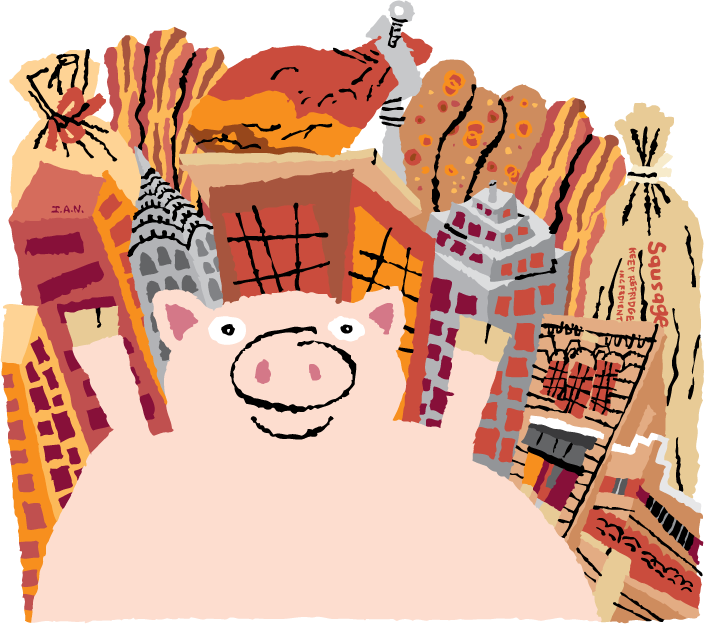
PORK: THE PERENNIAL DARK HORSE PRESIDENTIAL CANDIDATE | By Adrian Miller
Adrian Miller is an attorney, food writer, and former Special Assistant to President Bill Clinton. Adrian’s first book, Soul Food: The Surprising Story of an American Cuisine, One Plate at a Time, won the 2014 James Beard Foundation Book Award for Outstanding Reference and Scholarship. Adrian’s next book on African American presidential chefs will be published in Spring 2017.
Our presidents, from George Washington to Barack Obama, have had their share of food fights. I don’t mean that they actually threw food at other people, but they have figuratively and self-consciously used to create and maintain their public image and wrest control of it from others when necessary. It’s astonishing how fervently the American public believes that what a president likes, and dislikes, to eat somehow opens a window on the presidential soul. This is why in recent presidential memory, we’ve learned how much Ronald Reagan loved jelly beans, how much George H.W. Bush hated broccoli, when Bill Clinton jogged to a McDonald’s, how George W. Bush loves his barbecue and how Barack Obama likes to gulp down a good beer. The stakes can be high when using food to craft a presidential persona because it all comes down to getting votes, and pork has played a pivotal role in such endeavors.
You think I’m exaggerating? I offer as Exhibit 1 the case of President Martin Van Buren who was successfully tarred by his political enemies as a French food-loving elitist who used golden utensils. President Van Buren’s presidential rival, William Henry Harrison, drew a sharp contrast to the incumbent president by promoting himself as someone who loved “hog, hominy and hard cider”— a meal combination that appealed to the masses of common people. Harrison’s negative political campaign was so successful that he beat the incumbent Van Buren and won the presidency. It was the most serious case of political indigestion in presidential history. Though Harrison used pork for electoral good or evil, depending upon your perspective, pork has not received as much presidential press as other proteins. That’s mainly because pork has lost significant status in American meals since colonial times, mainly due to the growing popularity of beef.
Pork had some early advantages over beef in terms of making a regular appearance on the dining tables of European colonists. Pigs are lower maintenance animals to raise than cattle. One can feed them almost anything, they can forage for themselves in a variety of environments, they have a lot more offspring than cattle, and almost every part of their bodies can be used for some purpose after butchering. For these reasons, though beef was more highly prized, pork was more regularly utilized by colonists. Thus, in the seventeenth and eighteenth centuries, pork had a well-earned reputation for being a subsistence-level meat, a consistent source of protein even in lean times. This doesn’t mean that all pork products were considered to be poverty food. Wealthy colonists relished eating hams and pork shoulder as premium cuts of meat, and such preferences gave rise to the expression “eating high on the hog.” This was reference to where these cuts of meat were located on the pig as compared to bacon, ham hocks and the feet. It’s no wonder that pork cemented its “common person” status in the American public’s imagination, and that politicians recognized the benefits of larding their public image with references to pork. After all, the masses were mostly eating pork, or could relate to eating pork, and that’s where the votes where.
In terms of its culinary and political reputation, pork started to wane in the nineteenth century. Let’s first look at pork’s culinary status. Though beef was an uncommon treat on American tables before the 1800s, it became more widely available and cheaper thanks to advances in cattle ranching, industrial butchering and commercial transportation. Beef also became the food of successful elites—an edible example of social aspiration. This only further marginalized pork’s status as a poverty or subsistence food. As Harvey Levenstein wrote in Revolution at the Table:
“The supremacy of beef provided grist for the mills of those who complained that the middle-class American diet was too restricted… The beef and potatoes syndrome was reinforced by a disdain for pork, almost universally available in antebellum days. Here too, the middle class followed their social superiors, who shunned fresh and salted pork and deigned only to eat an occasional slice of smoked ham. Although its low price induced them to consume much more pork than it did the rich, in middle-class eyes pork ranked far below not just beef, but lamb, poultry, and game as well.”
Flip though the indexes of the existing cookbooks written by presidential chefs, and the latter point made by Levenstein is painfully true. Pork dishes usually get a few lines compared to the other meats. Even the presidential barbecue book authored by Walter Jetton, Lyndon Johnson’s barbecue-in-chief, only has a few pork recipes. Presidential food is at its best for state dinners at the White House, and beef is the overwhelming centerpiece of such meals. Pork makes an occasional appearance, but it is something that is eaten more frequently during the president’s private meals in the executive residence, out of the public spotlight.
In the nineteenth century, pork’s reputation also took a political hit because it was associated with an unseemly political practice known as “pork barrel politics.” In its earliest incarnation, the pork barrel was literally a wood barrel full of salted pork that was stored for use as needed. Though many associate its use with feeding enslaved people on plantations, the pork barrel was also used on many farms and also to feed military personnel. According to the Oxford English Dictionary, the pork barrel became a metaphor in the 1870s for the pot of government money that is set aside to pay for public projects. Soon, an odious practice arose in the U.S. Congress and state legislatures where elected officials were promised, in exchange for their votes, that money would be appropriated to pay for projects in the district they represented. The logic is that by pleasing their constituents with such projects, the elected officials would get re-elected. This was very sound logic, for many elected officials enjoyed lengthy political careers based on their ability to spend government money in their district. Thus, “pork barrel politics” was born, and symbolized government abuse and waste. In time, people dropped “barrel” and “politics,” and “pork” became short hand for bad government.
Despite the negativity thrown its way, pork has been able to rise to the culinary occasion. The following is a compilation of several great moments in presidential pork history:
January 1, 1842
President Martin Van Buren begins annual tradition of serving roast pork at New Year’s Day receptions.
Circa December 1890
Famed Kentucky cook Dollie Johnson, an African American woman, begins making sausage rolls (small sausages encased in pastry)—a favorite of First Lady Caroline Harrison.
Early 1920s
President Warren Harding grubs on knockwurst sausage and sauerkraut at stag parties he hosted at the White House for his buddies.
February 21, 1929
President Herbert Hoover changes the regular White House breakfast to bacon and eggs from the sausage and wheat cakes served in the Calvin Coolidge administration.
March 1934
“Winks,” President Franklin Delano Roosevelt’s Llewellin setter eats all of the ham and eggs breakfast set out for the White House residence staff. Winks soon left the White House to “spend more time with his family.” This event, along with others, cleared the way for Fala to become FDR’s favorite dog.
May 8, 1939
President Roosevelt, Eleanor Roosevelt, Crown Prince Frederik and Crown Princess Ingrid of Denmark dine on hot dogs for lunch.
June 10, 1939
President Roosevelt, Eleanor Roosevelt, King George VI and Queen Elizabeth of Great Britain dine on hot dogs for lunch.
Circa December 1941
President Franklin Delano Roosevelt and British Prime Minister Winston Churchill dine on sweet and sour pig’s feet at the White House. Churchill was not too pleased with the “texture” of this delicacy.
Circa 1967
A ham prepared for a White House residence staff dinner went missing. Mary Kaltman, President Lyndon Johnson’s White House Food Coordinator informed White House Chief Usher J. B. West of this predicament. At first, the employees were suspected, but no one was implicated in the crime. A few months later, an awful smell emanated from the staff dining room, but no one could pinpoint the source. Eventually, the White House engineers removed the paneling from one of the dining room walls to discover a decomposing ham bone. Those involved quickly surmised that some rats must have dragged it off the table and absconded with the ham.
December 1, 1975
The organizers of the annual Salley (South Carolina) Chitlin Strut sent five pounds of uncooked, frozen chitlins (pig intestines) to President Gerald Ford.
2000s
President George W. Bush regularly gets takeout from his favorite Texas barbecue joints for the ride on Air Force One from his ranch in Crawford, Texas back to Washington, D.C.
Tag: ARI WEINZWEIG

The authentic Jewish answer to bacon?
The first time I went to Montréal, many years ago, I was somewhat shocked to discover that corned beef and pastrami were almost nonexistent on deli menus. The cornerstones of American deli eating were pretty much persona non grata. When corned beef or pastrami did show up on menus it was almost as an afterthought, listed down in a corner somewhere, clearly not important enough to earn itself a prominent placement. Instead there was simply something the locals referred to both reverently, and at the same time, matter of factly, as “smoked meat.” Smoked meat was it. Menus featured smoked meat sandwiches, smoked meat Reubens, smoked meat hash, smoked meat on, or in, just about anything else you can think of. (One well-known spot even served smoked meat egg rolls.) Montréal is indisputably THE smoked meat city.
Corned beef, smoked meat, and pastrami all have their origins in poverty. The core of Eastern European Jewish cooking in the second half of the 19th century and in the early years of arrival in New York and the rest of the United States was mostly one of poverty. Rye bread (much more affordable in northern and eastern Europe than the comparatively costly wheat), herring and mamaliga (essentially, Romanian polenta), were a few of the staples of Eastern European Jewish eating. Most Jews arrived in North America with little in the way of finances. Corned beef and company were what poor people could afford to purchase. When it came to cuts of meat, brisket (for corned beef and smoked meat), and navel plate (for pastrami), were all at the bottom of the list of desirability. In their natural state, all are tough, fairly fatty, hard to prepare, and far from graceful on the table. To make either cut tender enough to serve, takes a good deal of effort. Long curing and long cooking combine to make otherwise stringy, tough meat as tender and tasty as can be. Low cost, a lot of work, wonderful flavor. Perfect products for people on limited budgets.
Legend has it that what’s now known as Montréal smoked meat started with the Lithuanian tradition of curing beef brisket. It’s pickled like corned beef, then lightly spiced and lightly smoked, à la pastrami. Look at it as a continuum: corned beef on one end—not smoked, not spiced; pastrami on the other—heavily smoked and very spicy; smoked meat somewhere in the middle—a little smoked, a little spicy. At its best, like corned beef and pastrami, it’s pretty darned delicious. Schwartz’s in Montréal was always my favorite. I ordered mine “fatty,” old-school. Just a stack of fairly thickly sliced smoked meat between two slices of rye with yellow mustard. The bread, to be honest, wasn’t anything to write home about. But the smoked meat was marvelously memorable.
Every time since then that I went back to Montréal, I made my pilgrimage to Schwartz’s to eat some smoked meat. And every time on the way home, I’d lament that we simply could never find a Montréal Smoked Meat to sell in Ann Arbor that even came close to Schwartz’s. USDA regulations made it impossible to import the real thing. And the folks in the States who were making it, while their offerings were okay, they just didn’t have that “man I want more right now!” kind of flavor and texture.
Until now! Finally, I feel like we have a smoked meat on hand at the Deli that makes me want more. That stands, as it should, with our pastrami and our corned beef. The third leg in the deli world’s triumvirate of terrific cured sandwich meats. Thanks to the Fuchs family who own the venerable Wagshal’s in Washington, DC, I can now eat smoked meat as much as I like.
Bill Fuch’s seems to have had much the same experience I had in Montréal—while visiting the city for work, he too fell in love with smoked meat. Over the years he’d go back and forth and never found anything at home in D.C. that even came close to what’d he’d get when he was up in Quebec. Finally, he decided that he was gonna figure it out for himself. He spent close to three years testing recipes. I think he succeeded! What the Fuchs family are making at Wagshal’s is darned delicious. So much so that we now have it regularly on the Deli’s menu.
The Wagshal’s smoked meat starts solely with prime beef—Bill’s adamant that that’s the only beef good enough. They dry-age it for over a month, which reduces the weight drastically and intensifies flavor significantly. Dry-aging is what we do at the Roadhouse—a good four or five weeks—to achieve that same effect. Up until 50 years or so ago, it was the norm with all great butchers and steak houses. Unfortunately, very few places still stick with the old methods. To save money, they switched first to “wet aging” (where the meat is trapped inside plastic and doesn’t lose much weight), or to no aging at all. Everyone in the industry knows it makes a big difference. It just costs more.
After the beef has aged, the Fuchs then coat the brisket in a dry 16-ingredient spice rub, let it marinate for another month, and then smoke it for about 12 hours. The result is excellent! Tender, smoky, a bit spicy, but in a mellow sort of way. Really, it’s pretty fantastic. It’s got plenty of fat on it, just the way I used to order it up in Montréal. If you were really old school, you’d stand back by the meat slicer and grab any fat that got trimmed off and pop it right in your mouth. As with prosciutto, bacon, or Iberico bellota ham, the fat is where the flavor is!
I still want to go to Montréal—it’s a beautiful city! But all I have to do now to get really great smoked meat is drive the ten minutes from my house to the Deli. Eat a smoked meat sandwich on-site if you like. Put it between two slices of the Bakehouse’s Jewish rye. Or try it on a Reuben, a #13, or any other sandwich on the menu. Alternatively, buy a pound (or two) to take home. If you do the latter, be sure to heat it up before you serve so that all-important fat is soft, tender and succulent the way Bill Fuchs and a half a million or so people in Montréal love it best! Fortunately, now we won’t have to fly all the way to Montréal to get it!
SMOKED MEAT MIGHT JUST BE THE JEWISH EQUIVALENT OF BACON!!
When I was a kid growing up in a kosher home, the only bacon they let us have was “beef bacon.” I’m not even sure which cut was used for it, but I don’t remember it being anything remarkable (which I suppose says a lot). Although it was probably meant to pacify poor, deprived Jewish kids eating in kosher kitchens and living in a bacon-centric society, it didn’t work. Beef bacon was a sad ruse, a façade, a phony. I know now it was a bit like sending someone to a tanning parlor when they really longed to go the beach in Baja—nothing like the real thing and about as compelling as a trip to the post office.
But while eating this new arrival of Wagshal’s Montréal Smoked Meat and, at the same time, working to get ready for this year’s Camp Bacon®, it dawned on me that they could have given us a better alternative. One that might not have totally erased the drive to be intimately up close with cured and smoked, salty, slightly sweet bacon, but may have actually made the grade. See, a nice warm, really fatty, thick delicious, moist slice of this Montréal smoked meat provides, I would argue, the same sort of enticing, ethereal, nearly erotic, eating experience as bacon does. It’s simultaneously smoky, fatty, slightly salty, rich, a teeny touch sweet, warm, melt-in-your-mouth marvelousness that all of us expect from great bacon.
It is, of course, a completely different product. Beef brisket vs. pork belly. Sliced hot out of the steamer instead of sizzled on the grill. And yet, I’m telling you, it brings that same sort of culinary buzz. That “wow, man, I could eat this stuff all day! can I have another piece please!” sort of impact that bacon brings. The good news is that unless you’re on a pork-free diet, you don’t have to choose—you can have both! One next to the other! In fact, now that I’m writing this, I think I’m going to have to test out a smoked meat sandwich with bacon on it. There’s a lot to be said, especially here in Ann Arbor, for the beauty of cross-cultural experiences!