
Tag: ARI WEINZWEIG
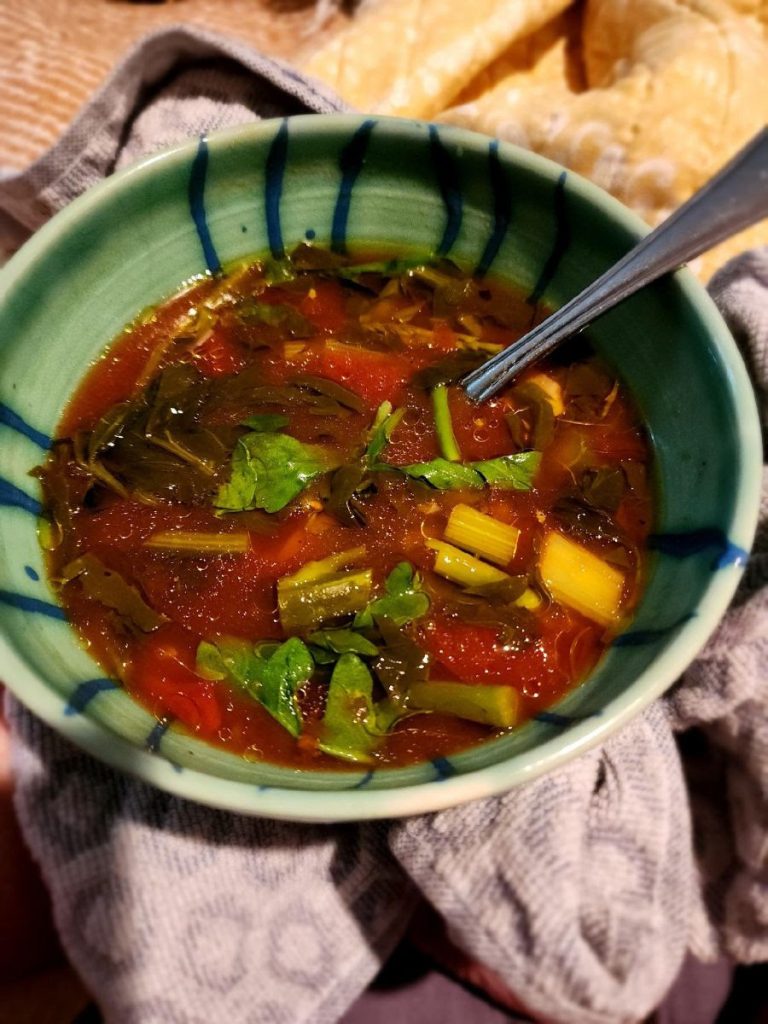
A lovely, gentle “green minestrone” to make at home
As the seasons change even here in Southeast Michigan, I was reminded of a wonderful fresh vegetable soup that my good friend Rolando Beramendi, the Italian fine food importer, cooked for Tammie and me at his Florence apartment in the winter of 2021. We were a year into the pandemic, but things seemed to have calmed enough by March for us to make the trip to Italy. A highlight of the whole experience was visiting Rolando—and this soup! (It was also during this trip that he turned me on to the amazing IASA peperoncino, now a staple at our house, the Roadhouse, and hundreds of other spice-loving houses around town.)
Many Americans have an image of minestrone as a standard-issue vegetable soup of little culinary importance, often made to use up veggies that are about to go bad. What Rolando has written up in his fantastic book, Autentico, is actually the opposite of that sort of stereotypical minestrone. Instead of being thick with beans and vegetables, it’s a lovely, light, brothy way to feature the season’s best veggies—in fact, the quality of the vegetables is what it’s all about!
The soup really is remarkable. The freshness of the flavors makes it so delicious that it’s been on my mind ever since I first tried it in Florence. The recipe for “green minestrone” is in Rolando’s book, and I recently made it in just a little over half an hour. It was so good, and so easy to prepare, that Tammie decided to make it again two days later!
In Autentico, Rolando does the soup in two steps: making a quick vegetable broth (which you can freeze if you like), then simmering it with an array of other fresh vegetables. I brought the two parts of the process together, simply starting the soup as soon as the broth was done.
The broth is made with large tomatoes, cherry tomatoes, parsley, garlic, basil, scallions, and sea salt. Since there are no good tomatoes to be found in the spring in Southeast Michigan, I used a half dozen terrific canned Italian plum tomatoes.
To follow Rolando’s recipe, start with six cups of fresh water, then add the tomatoes, herbs, scallions, and salt. (In his book, he writes about learning to toss in fresh tomato leaves to enrich the broth, but then again, he lives in Florence … and most of us do not!) Bring to a boil, reduce the heat, and simmer for about 10 minutes. I added the cherry tomatoes—which I sliced in two to release their juices—about halfway through. You can strain and freeze the brodetto at this point if you like, to have it on hand for future cooking. Or, as I did, you can push ahead and prepare your dinner!
To make the soup, you’ll want a wide range of fresh seasonal vegetables: celery (if it’s local and really good), fresh herbs, plenty of flat-leaf Italian parsley, zucchini, etc. Here’s what I use: a lot of very coarsely chopped fresh parsley; chopped fresh, tender spring turnips and their greens; fresh basil; fresh thyme; fresh spinach; a little local lovage; some broccolini (the stems went in before the flowers); and, naturally, asparagus when it starts coming in (any minute now around here). Plus some sea salt. Rolando likes scallions, but I pass.
You, of course, can add anything you want. The key is the quality of the seasonal vegetables and, as per Rolando’s recipe, a relatively short cook to highlight their freshness. Rolando writes that the only “rule” is not to cut everything to the same size before boiling until tender in the brodetto. It’s all about the “textures and surprising bites with every spoonful.”
As soon as the soup is ready, add a bunch of freshly ground Tellicherry black pepper and serve it in warm bowls. Garnish with a good bit of full-flavored, fruity Tuscan extra virgin olive oil—which is an important ingredient, so be generous! Put the pepper grinder on the table, too, for those (like me) who enjoy a lot of it. Rolando recommends serving the soup with focaccia, which is easy for us here since the Bakehouse’s has been really lovely of late. The soup also does reheat pretty well, so don’t be afraid of leftovers.
(Rolando’s recipe for this spring minestrone uses no cheese, but I have seen many others—including one from Rolando’s and my friend Elizabeth Minchilli—that do suggest either adding a piece of rind to the broth while it’s cooking and/or grating some Parmigiano Reggiano atop each bowl when you serve the soup. It’s good that way as well, but I prefer the fresh simplicity of Rolando’s approach—great vegetables simmered slowly with water and sea salt, and dressed with full-flavored olive oil.)
Shop for supplies
Tag: ARI WEINZWEIG
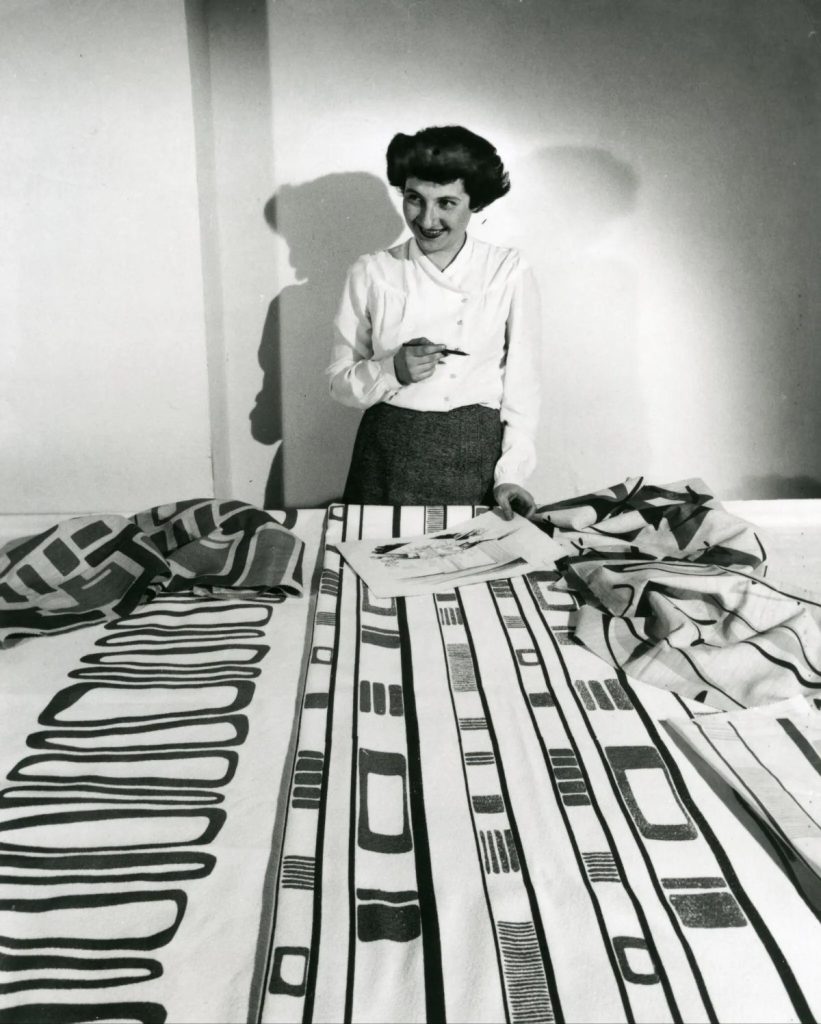
Lessons from a woman who created exceptional design well into her 90s
The artist and master colorist Kenneth Noland—whose 112th birthday would have been last week—studied and worked at the remarkable Black Mountain College in North Carolina for a number of years. Noland was a native of Asheville, the next town over from Black Mountain, so it was geographically easy for him to decide to attend, as well as artistically and ethically appealing. Black Mountain College was the place in the 1930s, ’40s, and ’50s for freethinking spirits like Noland (and me—I’m 80 years too late, but I’m ready to enroll!). There, Noland was greatly influenced by the color theories of the brilliant German American, Bauhaus-trained painter, sculptor, poet, and teacher Josef Albers. While Noland is hardly a household name, within the world of avant-garde art and thought, his work is most definitely noteworthy. The New York gallery Yares Art describes him as “one of the 20th century’s most radical and influential American painters.” (As we come to the end of the month, here’s a link to one of his best-known pieces, April.)
Reflecting on his personal journey as an artist, Noland once said, “For me, context is the key—from that comes the understanding of everything. … Context begins with other artists—seniors and mentors.” In other words, context gives us the historical and social framing for what we’re doing, and seniors and mentors allow us to see what is possible in the long run. Coming before us, they open doors to what we might decide to do with our lives moving forward. We try things, we make discoveries, and, slowly, we figure out our own unique paths. The middle element in that list, it turns out, is especially important. Noland affirms this, commenting about art, “If it isn’t a process of discovery, it shows.”
Noland’s contemporary, the remarkable American textile artist Sheila Hicks, now 91, also trained with Albers at Black Mountain College. Like Noland, Hicks may not be well known in the wider world, but in the places where people pay attention to thoughtful and thought-provoking art, it’s acknowledged that she has had a transformative impact on sculpture through her innovative work with yarn and string. “In the world we live in,” Hicks says, “with so many hard things that we touch, we’re crying for softness. We’re all yearning for something that is warm, welcoming, and soft in the hard, hard world.” Coming to this understanding was part of the discovery process that has made Hicks’ life and art what they are. As she asserts, “To be alive is to discover.”
Discovery is certainly a key aspect of what makes my life so interesting. Not too long ago, I discovered another incredible artist, Ruth Adler Schnee. Of course, like Columbus’s “discovery” of America, what I “discovered” was already very well known to others; it was new only to me. Adler Schnee is, after all, hardly a secret figure. In fact, although I wasn’t aware of her until very recently, she remains one of the most highly regarded modern designers. Having spent the past few weeks studying her life and work, I’m so inspired that I’m now intent on adding Adler Schnee’s upbeat, insightful, creative, and caring voice to the “huddle in my head.”
Backing up a bit: Ruth Adler was born to a German Jewish family in Frankfurt in 1923—this coming May 13 would have been her 113th birthday. Her father, Joseph, was a well-known and respected antiquarian book dealer; her mother, Marie, was an artist who’d attended the Bauhaus in its original German home. The Adler family later moved to Düsseldorf, where a young Paul Klee, the renowned artist, was both their neighbor and Ruth’s babysitter! During the Nazis’ Kristallnacht pogrom in 1938, Joseph Adler was arrested and detained at Dachau. Understanding what was at risk, Marie went to the camp gate and, calmly and firmly, talked her way into getting her husband freed. The Adlers had seen enough; there was no reasonable life left for Jews in Nazi Germany. They began the process of immigrating to the United States and eventually came to Detroit—what would now be about an hour or so east of the Deli.
As a teenager, Ruth Adler attended Cass Tech, and then she traveled east for college to the Rhode Island School of Design. After a few years in Providence, she returned to the Detroit area and earned an MFA from Cranbrook Academy of Art in 1946. Two years later, she married Edward Schnee, and in September 1949, the young couple opened a consulting business and a retail design shop in Detroit. Like most startups, the store faced struggles in the beginning, but over time, it moved into a former factory location and developed into a retail jewel of the city. Through the years, Adler Schnee got to know designer Minoru Yamasaki, the man who made the original World Trade Center what it was. Sure enough, Yamasaki called her for help with the color palette of the building’s all-important lobby.
What makes me so intrigued by Ruth Adler Schnee? In large part, it’s the unexpected but exciting alignment between our values—and our parallel approaches to engaging with the world in what I’ve come to believe are the most wonderful of ways. Studying Adler Schnee’s life story, looking at photos of her prolific work, and being exposed to her energy—indirectly, of course, since she passed away in January 2023 at the age of 99—I realize that, for me, she fits well into Kenneth Noland’s category of “seniors and mentors.”
Oprah Winfrey writes that “a mentor is someone who allows you to see the hope inside yourself.” Through her example, Ruth Adler Schnee does that for me. Below are some life lessons I’ve drawn from her legacy. You can, of course, take away your own—and there’s a whole world full of seniors and mentors to glean even more lessons from. Some, like Emma Goldman, have come to me through reading and reflecting—others, like Peter Block, through writing, conversation, and long-standing friendship.
A Dozen Life Lessons Inspired by Ruth Adler Schnee
1. Find joy. Adler Schnee was seemingly very happy to work hard, to create great design, and to find joy in her work all the way through to the end. How can you argue with the names of some of her most famous patterns: “Fission Chips,” “Slits and Slats,” “Pits and Pods,” “Slinky Shadows,” and “Bugs in Booby Traps”? Granted, most of these names came from her husband, but Adler Schnee let them be released to the public when she could have easily objected to their “unseriousness” and said such “silly” names were unworthy of her good work. Over and over again, whimsy won the day. I love it.
2. Live your values—don’t do work you don’t believe in. Rip Ripson, writing in a retrospective on Adler Schnee’s life for the Kresge Foundation, says that Adler Schnee’s “story speaks to the value of inclusiveness, to the entrepreneurial spirit, and to the profound role the arts play in nurturing our souls.” Indeed, these were her values, and she embodied them each and every day.
3. Go where you want, but start with what you have. No matter where she was, Adler Schnee found ways to create and design from virtually nothing. She never wallowed in whatever hardship confronted her, and she didn’t get stuck on what was wrong. Instead, she poured her energy into constant creativity. As she said, “Patterns, colors, textures, furnishings—everything had a necessary role to play in the larger architectural environment of a space.”
4. Pursue your dreams regardless of what others tell you. It’s deeply moving to read how, at the age of 14, Adler Schnee had the courage to attend the Nazis’ so-called Degenerate Art exhibit in Düsseldorf so she could see the modern art she was already obsessed with. “I just loved what I was doing, and I wasn’t scared,” she told the Detroit Metro Times in 2000. “My parents absolutely did not want me to go to that exhibit.” (This dynamic may sound familiar to any parents of teenagers.) But yes, she went anyway!
5. Don’t get caught up in limiting beliefs that society has set for “people like you.” Stereotypes are an obstacle that can keep us from achieving what we’re truly capable of, and Adler Schnee overcame them time and time again. As a young, freethinking Jewish woman in Nazi society—and as a woman in a world that was, like so many then and still now, dominated by men—she never let the barriers halt her progress. She shared later, “When I studied architecture, the field was not open to women … and I found myself, all the time, to be the only one that was interested in that. But that didn’t seem to stop me.”
6. Pay attention and seek beauty. As Adler Schnee reminds us, “We all make our own environment in which we are comfortable, and beauty is a great part of it.” She also emphasized that finding beauty is much easier than many of us have been led to believe. “You just have to look at things. Everything is designed. My biggest criticism of American education is the schools don’t teach children to look and to see things, because design is all around us. You just have to go outside and look.”
Nancy Villa Bryk, assistant professor of historic preservation and museum practice right here at Eastern Michigan University, writes of Adler Schnee:
I learned she drew her designs from the life she saw around her. She could see beauty in the most ordinary things: layers of sediment rocks, cordwood stacks, a field of weeds, railroad tracks.
7. Align with essence. Adler Schnee was, it seems, very assuredly herself throughout her long life. She brooked no bullshit, but she did so from a place that was always joyful and true to who she was. As Ana Gavrilovska writes in the Metro Times, “Adler Schnee’s radiance has never dimmed. Asked during an interview what inspires her, Adler Schnee answers simply: ‘Everything.’” She said this something like 25 years ago, but I’m smiling now as I read it again for about the 18th time in the past few days. This sense of being inspired by everything is pretty much where I have arrived myself.
In a 2017 post on Adler Schnee, the blog Fishink wrote:
Now at 93, she continues to work most of the year from her studio in Southfield. She still designs custom fabrics for Knoll Textiles, where she holds a 20-year contract, and with Anzea Textiles, an upholstery company. “I do the work because I love it.” … She believes the best lesson to learn about creativity is being observant. “You have to look at things, see things,” she says. “Everything around us is a design that can be put on paper.”
8. Learn from the edges. Remember that Nazi art exhibit in Germany that Adler Schnee’s parents didn’t want her to attend? When she went as a 14-year-old, the experience altered her entire sense of the world:
The exhibit was supposed to back up the Nazis’ claim that modern art was degrading German culture. Once I got to see the art, I was beside myself. I had never seen colors so brilliant and so unusually put together as in the Kandinsky paintings. It was as though I had been introduced to a new world. And I came home just totally transported by that.
9. Push for greatness. Never settling or falling into complacency is another lesson I take from Adler Schnee’s long, productive working life. She “could spend several years on some designs, reworking until she was satisfied to the best degree,” Gavrilovska writes in the Metro Times. “How did she know when a design was finished? ‘Well, you’ll probably laugh at this, but somehow it sings to me,’ she says. She laughs when I tell her I find that wonderful, but it even makes a kind of aesthetic sense; some of her patterns have a decidedly musical quality to their appearance.”
10. Find ways to turn your vocation into a living. Adler Schnee’s store gradually developed into a Detroit institution for those in the know when it came to modern design. In an artist’s statement for a commemorative monograph published by the Kresge Foundation in 2015, she writes of how she managed to transform her personal passion into a viable career:
Good design is my life. It must be discernable to the observant eye. But recognition comes slowly. … Sixty-eight years ago, when I first thought of designing abstract-patterned drapery fabrics in brilliant colors, there was great opposition by purist architects and the public. This pursuit did not provide a living to support our family. I returned to architectural design, my other love. Within the heart of my clients’ culture, I could create aesthetic unity, which addressed their human need for space.
11. Design for both medium and means. Anarchist philosophy has taught me that whatever I (or you) want to do well, our ends must be aligned with the means we use to make them an effective reality. For example, yelling at people to be kinder is, of course, incongruous and doesn’t work. To her credit, Adler Schnee lived and worked in harmonious alignment with the kind of caring, creative, useful design she was crafting.
12. If you love what you do, and you don’t want to stop, don’t! In the Kresge Foundation monograph honoring Adler Schnee, Gerhardt Knoedel, director emeritus of Cranbrook Academy of Art, writes:
The miracle of Ruth Adler Schnee is that at 92 years young, she is a beacon of inspiration to all who refuse to accept a notion of “retirement.” No doubt that is because at an important moment in her life, the road forked and she took the less expected alternative, leading to future happiness and fulfillment in the field of textile design.
If you know me at all, you already know how driven I am by her example of continuing to work rather than retiring just because it’s what you’re “supposed to do” at a certain age.
As I’m sure you can tell by now, Adler Schnee is, for me, a source of both inspiration and aspiration—a practical artist and businessperson who showed you could do great work and enjoy life enormously at the same time. Someone who, in Oprah’s words, helps me see the hope I have in myself.
The British writer Paul Kingsnorth says in a 2021 essay, “This is our faith: that breaking boundaries leads to happiness.” Ruth Adler Schnee certainly broke a lot of them. As a woman, she succeeded as an artist and a businessperson in a male-dominated world. As a German Jew, she overcame anti-Semitism and escaped Germany—though many of her extended family did not and instead died in the concentration camps. Having lost these relatives in the Holocaust, she still remained impressively positive, engaged with the world and its most urgent challenges.
By sheer coincidence, I received an email Monday morning from a former ZCoB (Zingerman’s Community of Businesses) staffer that, to me, affirms what is possible when we allow people—like Ruth Adler Schnee, like you and me, like anyone we just hired in the last couple of days to work the summer—to grow fully and successfully into themselves. We’re always better off for it, and so is the world around us. Here’s a small part of what I thought was a mind-blowing note:
Hi Ari, I am a former ZCoB employee and someone who spent lots of time in Ann Arbor. I’m sure you’ll remember me but I still wanted to make sure I introduced who I am as I’ve added to that. I am now set to graduate from Michigan State University this coming Friday, May 1st.
I wanted to reach out and say thank you. During my time at Zingerman’s I received words of wisdom and support from yourself and many others. I honestly don’t know if I would have made it this far without the Zingerman’s community. I had an opportunity to learn from intelligent, creative, driven and confident individuals. I spent just under four years of my time learning so, so much. I just want to say thank you for being a part of it and most importantly continuing to be an inspiration for me. I hope you’re well and I look forward to seeing you again soon.
As I said in my response, yes, of course I remember her! Like Ruth Adler Schnee, she was and is an inspiration to me and many others, and I’m honored that we contributed in some small way to helping her see the hope inside herself.
Finally, Dor and Tay of Good Food Jobs, one of my favorite weekly e-news reads, write:
There is … a spiritual energy in the world that tells me something I believe is true: that everything is in balance. When we see the too-muchness, or the not-enoughness, at any given time, it is rightfully distressing. I think that’s our call to notice where we may be able to play our own small part in the balancing.
I would suggest that the story of Ruth Adler Schnee demonstrates this balance—a life filled with joy, beauty, hard work, and so much more. Now I feel ready to really get down to work myself; there are so many great things still to be done. I’m going to start by having someone more skilled than me make “Fission Chips” my screen saver! A little joy will surely follow.
Explore the art of business
P.S. Anyone looking for the beautiful Apricots for Dignity and Democracy T-shirts, tank tops, hoodies, hats, etc., can find them all here thanks to the good folks at Underground Printing. And you can learn the backstory of why the apricot became a powerful symbol here. A great gift for Mother’s Day, Father’s Day, or really any day!
Tag: ARI WEINZWEIG

Why better questions matter more than most of us might believe
While researching vulnerability for last week’s essay, I stumbled across a directive from Ocean Vuong—the celebrated poet, novelist, and teacher—that urges us to “learn to question the questions.”
I’ve been thinking about his statement ever since.
Along similar lines, my friend Peter Block, the remarkable writer and philosopher, posits, “A good question works on you.” Here are a handful that have been working on me all week:
- Why does the quality of our questions have such an impact on the quality of our work?
- How can I learn, as Ocean Vuong advised, to better question the questions?
- What can I do over time to get better at asking better questions?
- What happens when an organization can collectively improve the quality of the questions it asks?
In his exceptional book Community (which I’ve read something like six times), Block writes that a great question is “ambiguous, personal, and stressful.” This has certainly been my experience with each of the four questions above. That said, I’m striving every day to accept that there will be no easy or quick answers to any of them. In fact, I have the feeling I’ll be at this work for the rest of my life.
What follows is an exploration of my own curiosity about questions, and about the impact of having an organization that learns to ask them ever more effectively.
To be clear, this is not the kind of essay that will arrive at a finite set of conclusions. My emphasis, instead, is my imperfect effort to better understand the import of asking better questions. The essay is only an entrée—a beginning—for a curious human (namely, me) who, in the spirit of vulnerability, has spent a lifetime both asking and being asked questions, yet has given relatively little thought over all those years to the craft of asking them well. If some clarity arises in the form of answers, that’s awesome. If not, then I’m working to align myself more closely with Peter Block’s wise words: “Questions bring us together. Answers divide us.”
Avoiding my own impulse to offer immediate answers is anything but easy for me. As the oldest kid in my family, I grew up feeling as if I was “supposed” to have an answer to nearly anything anyone asked. It’s not hard to see why, then, as an adult, my instinct still leans toward coming up with those answers. Undoing decades of conditioning will not, I know, be a quick process—but I’m committed to doing the work!
Why is it so important to take on this challenge? Nationally known speaker, leadership coach, and author Tony Robbins puts it pretty succinctly: “The quality of your questions determines the quality of your life.” Which means, then, the more effectively I can learn to bring better-quality questions to the fore—and come up with them when I’m feeling pressured and on the spot—the better my life and leadership are likely to be.
In the context of what I wrote about beliefs a few weeks back, what we believe has a huge influence on the kinds of questions we will ask. The insightful writer and environmentalist Wendell Berry demonstrates this well in his classic work The Unsettling of America, drawing the distinction between a person who comes to exploit the land and another who arrives instead as a nurturer:
I conceive a strip-miner to be a model exploiter, and as a model nurturer I take the old-fashioned idea or ideal of a farmer. The exploiter is a specialist, an expert; the nurturer is not. The standard of the exploiter is efficiency; the standard of the nurturer is care. The exploiter’s goal is money, profit; the nurturer’s goal is health—his land’s health, his own, his family’s, his community’s, his country’s. Whereas the exploiter asks of a piece of land only how much and how quickly it can be made to produce, the nurturer asks a question that is much more complex and difficult: What is its carrying capacity? (That is: How much can be taken from it without diminishing it? What can it produce dependably for an indefinite time?)
Berry’s framing helped me see clearly how changing the question can completely alter the way things unfold. Two different approaches, with very different questions, driving diametrically different outcomes. Not surprisingly, I see our organization as a nurturer. As Berry explains,
The exploiter wishes to earn as much as possible by as little work as possible; the nurturer expects, certainly, to have a decent living from his work, but his characteristic wish is to work as well as possible.
In another of his wonderful books, The Answer to How Is Yes: Acting on What Matters, Peter Block writes that a question that begins with the word “how” “looks for the answer outside of us. It is an indirect expression of our doubts.” With that in mind, Block offers a very helpful set of half a dozen questions to stop asking (I have certainly asked them all many times over the years), and also, for each, a more effective way to ask a comparable question.
How do you do it? becomes What refusal have I been postponing?
How long will it take? becomes What commitment am I willing to make?
How much does it cost? becomes What is the price I am willing to pay?
How do you get those people to change? becomes What is my contribution to the problem I am concerned with?
How do we measure it? becomes What is the crossroad at which I find myself at this point in my life/work?
How are other people doing it successfully? becomes What do we want to create together?
While each of the six original questions has some merit on its own, they are not, per Peter Block, anywhere close to optimal. The “how” questions, I can see now, all seem to lead in impersonal directions. The answers may be interesting, but soon enough, they almost always invite disagreement—even argument. They’re not the kinds of questions that can bring together disparate views to cast things in a whole new light.
All of which now leaves me wondering: How many times over the years have I and others here fallen into exactly this kind of rut, asking the narrow, controversy-causing “hows” that Block is trying to teach us to avoid?
By contrast, the questions he suggests in place of the “hows” drive us to dig deeper—to explore our hopes, dreams, fears, and insecurities. In this spirit, he challenges us:
If we could agree that for six months we would not ask How?, something in our lives, our institutions, and our culture might shift for the better. It would force us to engage in conversations about why we do what we do, as individuals and as institutions. It would create the space for longer discussions about purpose, about what is worth doing. It would refocus our attention on deciding what is the right question, rather than what is the right answer.
I can’t help but smile imagining the response I would get if I were to propose that everyone at Zingerman’s avoid the word “how” for half a year! So rather than propose this, I’ll start by practicing it. At the very least, I can explore how well I do with this challenge personally before I try to take it to the next, collective level. The work is about reframing and rethinking—building new intellectual habits and better question-asking discipline.
Writing about his longtime friend Peter Koestenbaum, the business philosopher and writer who died in 2024 at the age of 96, Peter Block says,
It is [his] willingness to reframe, turn, and even invert a question that creates the depth and opening for authentic change. Questions take on an almost sacred dimension when they are valued for their own sake. This is in stark contrast to the common need for answers and quick formulaic action.
Reflecting on all this, I realize that from the get-go back in 1982, we were already asking questions that were quite different from those of the mainstream business community. Looking back, here’s a list of what it seems we were asking of ourselves—and the world—when we were preparing to open the Deli 44 years ago:
- What if we didn’t try to grow our business as large as possible, as fast as possible?
- Why do so many other food businesses assume that customers can’t tell the difference between truly great food and only so-so fare?
- … And what makes them believe that people aren’t willing to pay for higher quality?
- What if, instead of settling for what’s working well enough to get by, we continuously pushed ourselves to make everything better?
- What if we treated everyone with dignity and care, rather than acting as if they’re just another interaction/transaction on the way to making more money?
- What if we committed to creating uniqueness—instead of the replication that has become so common in the Industrial Era? (Or, as Wendell Berry pithily puts it, “plopping a cookie cutter down on dough.”)
As organizations evolve over time, and the greater ecosystem around us does the same, the questions we pose need to evolve as well. Moving into the present moment, I find myself thinking about the questions I and others here have been asking in recent years:
- When it comes time to consider succession planning, what do you do with your business if you want to keep it local and within the community that made it possible for you to stay in operation for so many years? Our answer was to create the Perpetual Purpose Trust.
- Do you have to consolidate ownership the way we read about over and over again in the business pages? Our answer: you don’t. We now have 18 Managing Partners and over 300 staff members who own what we call a “Community Share.”
- Do you need to think and make decisions hierarchically? Our answer, again, is you don’t—hence, we have been running the Zingerman’s Community of Businesses by consensus of our Partners Group for 31 years.
- What if you decided to engage with everyone—regardless of position—as if they were a partner? (This is the idea embedded in Peter Block’s superb Stewardship.)
- What do we do when autocracy is on the rise all around us and we continue to try to be more and more democratic in the way we work? My answer is in the “Why Democracy Matters” pamphlet.
In the coming weeks, I’ll keep reflecting on other questions that have been unconsciously driving our work over the years, while also exploring tools to help us ask better ones. I believe this could become a meaningful part of what we do.
In this context, the work of a leader becomes to help reshape, reframe, and rewrite the suboptimal questions that so many are stuck with. Peter Koestenbaum shares more:
People come to me because they want to make more money. I ask questions like, “Who are you?” “What are you?” Ultimately, the toughest question is, “What kind of a person are you going to be?”
The latter strikes me as a better question to ask in an interview or a performance review—or, really, any difficult conversation—than the more typical, “How do you handle stressful situations?”
Questions, I’m seeing now, can be a critical means of accessing new insight. When we’re faced with a challenging situation, it’s important to turn away from the anxiety of arriving at quick answers and, instead, to get more curious about the questions themselves. As Ocean Vuong writes,
You’re working on a poem or a story, when you’re hitting a dead end, when it’s not going, take it with you. Get away from the desk. Now you have to work with your body. Maybe there’s questions you’re not asking.
Jacqueline Rose’s most recent book, On Violence and On Violence Against Women, explores this subject in intriguing ways. In The New York Review of Books, Christine Smallwood writes,
What has the most force in Rose’s thinking are not her conclusions but her questions. “What, in moments of historical crisis, is being passed down from one generation to the next?” she asks in a chapter on Rhodes Must Fall. “What do we not want to know about the past? What do we not want to know about ourselves?” … The question “What do we not want to know about the past?” has no single or definitive answer, and no book can resolve it. But we must keep asking the question.
Rose’s question regarding what we don’t want to know about the past seems apt on many levels—certainly in the context of the vulnerability I wrote about last week, and my own understanding of the way my personal past influences how I show up in the world every day. It’s also vitally relevant for all of us in this country. Until we can come to agreement on what happened in the past, it’s hard to imagine being able to effectively move forward together into a positive future.
It comes as no coincidence that the most creative people—the people I’ve learned the most from over the years—are those who are themselves asking better questions. One of them is On Being’s Krista Tippett, who has been doing this for decades now on her award-winning podcast, and who offers some great insights into the power and significance of asking better questions:
I also find a question to be a mighty form of words, and I have learned a few things about questions. I have learned that questions elicit answers in their likeness—that answers rise or fall to the questions they meet. We’ve all seen this. We’ve all experienced it. It’s very hard to respond to a combative question with anything but a combative answer. It’s almost impossible to transcend a simplistic question with anything but a simplistic answer. But the opposite is also true: it’s hard to resist a generous question. This is a skill that needs relearning, but I believe that we all have it in us to ask questions that invite, that draw forth searching in dignity and revelation. There is something redemptive and lifegiving about asking a better question.
Better questions, I’m realizing, create more authentic engagement and more thoughtful answers. They call for the kind of purposeful reflection Peter Block believes is possible, rather than the rushed action of simply pushing for an answer. Exploring the ethics of a situation becomes more important than mere effectiveness. Block reiterates his core point here:
The right questions are about values, purpose, aesthetics, human connection, and deeper philosophical inquiry. To experience the fullness of working and living, we need to be willing to address questions that we know have no answer. When we ask How? we limit ourselves to questions for which there is likely to be an answer, and this has major implications for all that we care about. The goal is to balance a life that works with a life that counts. The challenge is to acknowledge that just because something works, it doesn’t mean that it matters.
If “how” has such a narrowing effect, then what word opens us up to new possibilities? Block says,
Yes is the answer—if not the antithesis—to How? Yes expresses our willingness to claim our freedom and use it to discover the real meaning of commitment, which is to say Yes to causes that make no clear offer of a return, to say Yes when we do not have the mastery, or the methodology, to know how to get where we want to go. Yes affirms the value of participation, of being a player instead of a spectator to our own experience. Yes affirms the existence of a destination beyond material gain, for organizations as well as individuals.
A poem I love by singer-songwriter Carrie Newcomer offers an artistic perspective on all this. These are the opening lines (and you can read the whole piece here):
“A Box with No Sides”
I have never written a song because
I had an answer.
I write songs because I have questions.
I write questions because
An answer presumes an ending,
This is this and that is that.
An answer alone has very few open spaces
With no room for returning to the well
For checking the map
Maybe retracing my steps
To walk the same path
But to see with new eyes …
Newcomer’s framing is, indeed, aligned with this exploration—and also, I recognize now, with my two most recent pamphlets. Both are based on, and built out of, questions that were very close to my heart—questions that pushed me to research and reflect for months and years before arriving at enough clarity to put something in print. “A Revolution of Dignity in the Twenty-First Century Workplace” emerged from a question that was essentially, “How do I deal with despair over the violent, heartless act of an authoritarian leader over whom I have no influence?” Similarly, “Why Democracy Matters” arose from my struggle to deal with the coming apart of the rule of law and the democratic constructs that I, for one, have taken for granted for far too long in our civic life. I can say now that although there was no clear answer to either question up front, over many months of study and reflection, I truly learned a lot. Those learnings have already influenced my own thinking enormously, and they’ve begun to sink roots into our organizational culture as well as the keynotes and training work I do through ZingTrain.
I’ll close with the beautiful, inspiring words of the Austrian poet Rainer Maria Rilke, from his Letters to a Young Poet, written in the early 20th century. I’ve read this passage countless times before, but in the context of all I’ve gleaned working on this week’s essay, I see it now in a much deeper and more meaningful light.
Be patient towards all that is unsolved in your heart and try to love the questions themselves as if they were locked rooms or books written in a very foreign language. Don’t search for the answers, which could not be given to you now because you would not be able to live them. And the point is to live everything. Live the questions now. Perhaps then, someday far in the future, you will gradually, without even noticing it, live your way into the answer.
It’s clear I have many new questions to consider throughout my days, and I will need to remind myself regularly to stop stressing out when I don’t have an immediate answer. (To the eight-year-old, answer-focused child in me, I offer Peter Block’s sage words: “There is always something that cannot be explained.”) Instead, I will lean lovingly and gently into the questions, and I look forward to all the compelling, curiosity-driven learning to come.
Lean in. Live the questions. See what comes of it. Let me know what you learn!
Find some answers
P.S. All this reminds me now of a framework I developed for helping new leaders to succeed. It’s called “Twenty Questions for Managers.” I haven’t used it in ages, but now I’m wondering if I ought to bring it back! Email me at [email protected] if you’d like a copy.
Tag: ARI WEINZWEIG


Baguette, hand-cut prosciutto, cultured butter, and Emmentaler
If you’re looking for a remarkable sandwich you can whip up at home in minutes, something so tasty you might well be thinking about it many days after you eat, try this. I’ve eaten it four times in the last few weeks. Terrifically tasty!
As with pretty much all the food we make and eat around here, the key is the quality of the ingredients. Each of these four is world-class on its own—together they really make for a magical symphony of flavors.
The French Baguette from the Bakehouse is the base of the whole thing. When I teach the “Welcome to ZCoB” new staff orientation class, we do a quick product tasting to demonstrate to folks how much difference there is between what’s typically sold in supermarkets and what we do at the Bakehouse. It really is night and day, and the tasting quickly makes an impression on everyone! Sweeter (even though no sugar is added), butterier (even though we use no dairy in it).
Hand-cut, three-year-old Prosciutto di Parma at the Deli right now is from the family-owned and run Pio Tosini. The hams are all made by hand at the Pio Tosini plant. Carefully hand-salted, turned regularly, slowly matured as they have been for 150 years, and checked closely before they’re shipped. Delicate, a bit nutty, lovely finish. Because the Deli staff still hand-slices, the texture and flavor are protected right up until you buy some.
Vermont Creamery Cultured Butter has been a hugely positive addition to our food in the last few years here in the ZCoB. The cream, all from local farms, is allowed to ripen as it would have done centuries ago. Be sure the butter is at room temperature so it’s easily spreadable and its full flavor comes to the fore.
Last but not least, the Emmentaler Réserve cheese. This is the real thing, and man, it is really good! The current wheel we have at the Deli is especially delicious. Over 19 months of maturing, it’s got a lovely nuttiness, a sprinkling of those tyrosine crystals that develop naturally after the sort of long aging this cheese has. It’s a particularly dense and delicious batch of the cheese, so even if you aren’t going to make this sandwich, it’s still worth checking out!
Putting all four together is pretty straightforward. Slice the fresh baguette horizontally. Spread both sides with a generous amount of butter. You can decide how much, but for context, this is a European-style sandwich, not a Deli Reuben, so the amount of butter you use might seem like a lot. Then add a few slices of ham and cheese. Great with a salad of spring greens!
Shop for supplies
Tag: ARI WEINZWEIG
Sharing struggles can change lives and organizations for the better
In a piece published in the winter issue of The Boston Review, author Vivian Gornick (whose work on Emma Goldman and on the topic of rereading I’ve found wonderfully helpful) shares the story of an interaction she had many years ago with one Mr. Sperber, a Polish-Jewish émigré who was living in her building in Manhattan. The two, the older émigré and the young writer recently moved to the city, found themselves riding in the elevator together. The elevator stopped at a floor before the lobby, and the door opened. A teenaged Black resident was waiting to get on. For whatever reason, a young Gornick acted in one of those small, easily dismissed ways that actually push others away—she made a face that clearly conveyed a negative reaction. The unspoken racism so common in that era (and now) came through in a matter of seconds. The young man responded with dignity: “I’ll wait.” Her reaction wasn’t purposefully intended to cause harm, but nevertheless, it did.
Mr. Sperber could, as I might well have done when I was young, have said nothing at all and let the incident pass without comment or controversy. Instead, he decided to make himself vulnerable by sharing uninvited insight. In doing so, he gracefully and powerfully made Ms. Gornick aware of the painful impact that her unconscious beliefs had just had. He shared one line of pointed insight: “One must remain human until the last moment.” She saw things, suddenly, in a new light. In essence, Mr. Sperber effectively changed Vivian Gornick’s nascent beliefs. Half a century later, Sperber’s quiet, dignified response has continued to illuminate Gornick’s life and her writing.
Part of being human, I have learned over the years, is learning to be meaningfully vulnerable, both at work and out of work. We all have embarrassing, anxious, and uncertain moments in our lives. Whether we have the courage to share them constructively is another story altogether. By continuing to tell the story of Mr. Sperber all these years later, a story in which her own embarrassing ethical error is at the center, Gornick is demonstrating the import of vulnerability, which seems certain to have contributed to her own successful work as a writer over the years. As critic Clem Cecil says of Gornick, “her writing is all about getting to the vulnerable heart of things.” She certainly did here, and she regularly writes about her own shortfalls. I, with Mr. Sperber’s sentence in my head, keep thinking back on any number of situations where I acted, unthinkingly, unintentionally, in similarly uncaring ways. Like Gornick, my intentions weren’t bad, but my impact certainly was.
While most Americans have been trained to hide it, vulnerability could well be a key to a more positive future for all of us. In an article in the Harvard Gazette, poet Tracy K. Smith says,
In order to get to community, we have to go quiet, slow down, allow ourselves to be both vulnerable and brave.
Bringing bravery and vulnerability into one holistic and healthy existence is no small achievement. While it sounds straightforward, it is, in my experience, far harder to do than it is to suggest. And although bravery hits the headlines regularly, and the stories of seemingly heroic, brilliant entrepreneurial business leaders get a great deal of attention, the vulnerability part gets far less notice. We would be wise to work to bring the balance that Smith’s lovingly written sentence implies.
Back around the time we opened the Deli, in 1982, when I was roughly the same age as Vivian Gornick was when she got to know Mr. Sperber, I’m pretty sure I would have failed to succeed in Smith’s simple framework of courage and bravery. Well, at least on one level, we had had the guts to open our own business, all the more notable because we’d done it smack dab in the middle of such difficult economic times (interest rates were 18%; unemployment was very high). As for the other half of Smith’s call to action, vulnerability, I’m completely confident that it was in my vocabulary. It was not, though, on the list of leadership “tools” I could then call on.
Of course, to be clear, at some point early in my life, I did have it. Being vulnerable is an inherent element of being human. Like all infants, I was born vulnerable. Looking back now, I believe I lost my ability to express it effectively pretty early on in my life. Being the oldest kid with parents who got divorced when I was only three didn’t help. Neither did the fact that I grew up in a family that showed very little emotion. Nor did the reality of the stereotypical, unexpressive American male of that era. I can see now that, like it or not, I lost my natural vulnerability pretty quickly. It took me many years to get it back. By the time I realized that I had a really hard time being vulnerable, I was probably around 30. Therapy, a lot of reading, a men’s group, journaling, and learning how to have a different kind of conversation—one in which vulnerability was the norm—all helped me grow close to the sort of blend of bravery and courage that Tracy Smith speaks about.
What follows here is a first, and inevitably highly imperfect, attempt to both gain and then give some more clarity to the role that vulnerability plays in our organizations. To get at it, I drew, of course, on some of my own experience, along with insights from a pair of poets, an 84-year-old Dutch management consultant, a couple of really cool rock stars, and an array of wise and well-researched writers from whom I learn a lot. One of them, of course, is Brene Brown, whose 2012 book, Daring Greatly, was, in many ways, the insight that brought the idea that vulnerability is an essential element of healthy, everyday living out into the open. As Brown says, “Vulnerability is not knowing victory or defeat, it’s understanding the necessity of both; it’s engaging. It’s being all in.” Her TEDx talk “The Power of Vulnerability,” recorded in her hometown of Houston back in 2010, remains one of the five most-watched in history.
Last fall, I was a participant in a pretty high-level meeting. That alone, of course, is hardly remarkable. It’s a rare day I’m not part of one or two. With pretty much all our meetings here at Zingerman’s, we open up with some sort of icebreaker, a way to get “everyone’s voice in the room.” Sometimes it’s a simple, “What’s your energy, 0 to 10?” In other instances, it’s more engaged—an intro that may well still start with an energy score (it’s very helpful to hear where each other is at, the better to know how to be patient and kind to each other), but also a few minutes for each person to share how they’re really doing. The latter, in the interest of meaningful connection, is by far my personal preference—over the course of a couple of minutes, I can learn a lot about what’s going on with each person, and I can share my own ups and downs. In my experience, that kind of connection makes it infinitely easier for those in the group to be supportive, empathic, and compassionate with each other. How much each person shares is, of course, up to them, though I would forecast that in general, given the openness and emphasis on emotional intelligence that we have here in our culture, people tend to share much more than they would in most organizations.
Anyway, in this meeting, my attention was grabbed when, about halfway through everyone answering the icebreaker, one of the participants, someone who I would not have expected to share at this level, opened up with the group about the challenges she’s dealing with right now with one of her kids. “It’s a lot harder than I thought it was going to be,” she added. The response from the group couldn’t have been better. Support and empathy in the moment, and offers of additional help and support continued to come during the day.
In stereotypical corporate cultures, someone who spoke publicly like that might well be quietly referred to HR to learn how to keep her problems out of the workplace and develop better boundaries. Here in the ZCoB (Zingerman’s Community of Businesses), it’s essentially the opposite. Her story and struggle were welcomed. To my eye, her vulnerability elevated her standing with the group and generated even more support than she’d always had.
To me, it was all a really positive sign about the health of our culture and a testament to what so many people are working to create. I did not understand it all back when we opened in the ’80s, but it’s now very clear to me that effective expression of vulnerability is an essential element to living a healthy and rewarding life. Doing it reasonably well in a group is a critical component for any democratic construct, practiced either in companies or in countries. We cannot have an effective democracy without vulnerability.
That story is hardly the only example of ZCoBbers being vulnerable like that. In fact, around here, 44 years after we opened, vulnerability is probably more the norm than not. People will share during icebreakers about what they’re dealing with—their aging parents’ health, kids’ struggles in school, challenges and achievements at work, etc. There’s no drama really. It’s just on the level, shared and heard, far more often than not, with love.
This is not, though, I know, the norm in other places. One Zingerman’s alum is currently working in Minneapolis at a large bank. When tensions were at their peak with ICE incursions into the city, around here, it was not uncommon for folks to mention their anxiety about the situation. When I asked our former coworker what people were saying, his response shocked me: “Honestly, people in the office aren’t even talking about it. It’s like it’s not happening, even though it’s all around us.”
In a fall 2022 film from the remarkable Danish nonprofit Louisiana Channel, poet and author Ocean Vuong offers, “My vulnerability is my power.” Lo, that we were living in communities, companies, and countries where Vuong’s words would already be true for all involved. In a 2023 interview with Service 95, Vuong elaborated on the impact of vulnerability:
I think when we approach vulnerability as a common and perhaps even natural condition of our species (we are, after all, a relatively soft and physically defenceless species, hardy in groups and wilting when isolated), we’re able to connect with each other in a less superficial way. You realise that, especially in adults, when the masks of strength have been forced on us, or when we’ve calcified them through conditioning, we mostly operate in the community with performances of strength and success—when, in fact, we might very well be full of doubts, anger, fear, and grief. So giving each other permission to put down the shields in order to see each other’s faces more clearly is a gift. Vulnerability is as true and connected to us as our skin. Everything else is fabric.
As different as my life story is from Ocean Vuong’s, what he writes is very much applicable to my own childhood experience.
While we don’t necessarily call it out all that often, the truth, I’ve been realizing, is that a significant part of what has made our organization what it is is that we have made it possible for people to be vulnerable in their work. As Ocean Vuong alludes, vulnerability in this context is a strength, not a weakness. David Whyte, the insightful writer whose work on the idea of “Unordinary” I wrote a bunch about a few weeks ago, affirms Vuong’s views, saying:
Vulnerability is not a weakness, a passing indisposition, or something we can arrange to do without, vulnerability is not a choice, vulnerability is the underlying, ever present and abiding undercurrent of our natural state. To run from vulnerability is to run from the essence of our nature, the attempt to be invulnerable is the vain attempt to become something we are not and most especially, to close off our understanding of the grief of others. More seriously, in refusing our vulnerability we refuse the help needed at every turn of our existence and immobilize the essential, tidal and conversational foundations of our identity.
Running from vulnerability is probably how I spent the first half of my life. When I was somewhere around 30 years old, I realized there was actually another way, a way that helped me start to make Tracy K. Smith’s call to blend bravery and courage into a reality. As Whyte writes,
The only choice we have as we mature is how we inhabit our vulnerability—how we become larger and more courageous and more compassionate through our intimacy with disappearance. Our choice is to inhabit vulnerability as generous citizens of loss, robustly and fully, or conversely, as misers and complainers, reluctant, and fearful, always at the gates of existence, but never bravely and completely attempting to enter, never wanting to risk ourselves, never walking fully through the door.
How would people learn to practice vulnerability, to walk wholeheartedly through David Whyte’s metaphorical door and make it happen? It’s a good question and one that, to be honest, I’d never thought much about until the last few weeks. In great part, much of the learning about vulnerability has to be cultural. People see other people being real and opening their hearts, while retaining their professionalism, and still getting a lot of work done. Over time, I imagine, they pick up on the reality that it’s okay to share more openly than they might have in other jobs. It’s also, I see now, developed in our systems and frameworks:
- In our Statement of Beliefs, we state specifically that we believe in humility and also in the value of asking for help.
- Open-book management means that new staff see numbers shared that are both good and bad. And at huddles, people will regularly talk about the stress of not being as profitable as they would prefer, sales falling short, etc.
- Visioning, by definition, is about putting one’s heart and soul out on paper. Done well, it’s always a bit scary (and always powerful)!
- The six elements of dignity call for honoring the humanity of everyone we work with (including our own) and being authentic without acting out.
- Our Courageous Conversations class calls on all of us to be vulnerable in the interest of having better conversations and deeper, more effective connections.
Part of what’s drawn me to this conversation of late is the realization that, in a sense, democracy and autocracy are key players in a struggle between organizational structures: one in which healthy vulnerability is encouraged and honored as important (democracy) and constructs in which vulnerability from leaders is anything but okay (autocratic settings). Which means that if we want to work and live in democratic constructs, we would be wise to talk about vulnerability a lot more often than most of us do!
Autocrats, of course, have a strong aversion to showing vulnerability. While they are happy to have everyone they dominate be vulnerable, they themselves generally project images of perfection, the heroic leader who saves—and dominates—the day. Dutch author and consultant Manfred F. R. Kets de Vries, born in 1942 during WWII and now 84 years old, has authored just under 50 books. Depending on your life priorities, you might be even more impressed that he was apparently the first fly fisherman in Outer Mongolia. He has some of the most insightful work I’ve found on how and why autocrats are almost unable to express vulnerability. That doesn’t mean they aren’t vulnerable—clearly, Jung and Robert Bly’s shadow work taught me that what I/we/anyone hides is almost always the part of themselves they need to let out. Clearly, history tells us that in time, all authoritarians eventually fall. Sunday’s elections in Hungary evidenced that in real time!
Kets de Vries has decades of experience to draw on, and he sees the situation quite clearly: autocracy and vulnerability do not go well together. In an interview with INSEAD, he helps to illustrate clearly and directly why it becomes almost impossible to run a healthy, emotionally intelligent organization in which vulnerability is encouraged inside an autocratic ecosystem. To create a healthy organization, Kets de Vries says, “You need to be somewhat open and vulnerable in front of other people.” To do that, though, many of us, me included, have to overcome suboptimal experiences with vulnerability from back when we were kids. As Kets de Vries goes on to explain,
Many bullies had a disturbed childhood. They often grew up in homes with little warmth and positive adult attention, raised by emotionally and physically abusive caretakers. Such an environment would have quickly taught them that vulnerability leads to abuse and that the best defence is to lash out. By becoming bullies themselves, they gain more control over their lives and compensate for the lack of attention (or the abuse) they experienced at home.
…
Autocratic leaders … may also be projecting their own feelings of vulnerability onto their victims. In order to avoid feeling ashamed and humiliated for their own shortcomings, they go to great lengths to shame and humiliate others.
I’ve seen all this, I’m sorry to say, in up-close action over the years, even inside our own organization. They are nearly always well-meaning people who are drawn to our values, but have unresolved childhood challenges—often challenges they aren’t even open with themselves about—that lead them to take actions that are way out of alignment. Like Vivian Gornick and the elevator incident, intellectual intentions are positive, but unconscious beliefs and the actions that come out of them are anything but. It rarely goes well. They hide their vulnerability and then act out unproductively on those around them. The results are never good. In the end, they either arrive at a personal epiphany and shift their direction or they end up leaving the organization. What Kets de Vries describes here sounds a lot like what we’ve seen in the news in any number of countries, and it’s all too common in companies, too:
This fantasy of omnipotence often coexists with a profound fear of dependency. Dictators frequently experience reliance on others—institutions, advisors, expertise—as humiliating or even dangerous. Dependency implies vulnerability, and vulnerability threatens their grandiose self. The solution to these uncomfortable feelings is domination. Institutions are hollowed out. Independent courts, media, and bureaucracies are subordinated or destroyed. Advisors are chosen for loyalty rather than competence. Authority becomes personalized.
Here in the ZCoB, given our efforts to think and work in non-hierarchical ways, it’s probably a bit easier to explore vulnerability. We stress regularly that managers and partners are also just people, flawed and trying to figure things out. Still, I know, it can be awkward. Where does one draw the line? How much sharing is too much? How little is too little? Does not sharing make a manager seem aloof and egocentric? If they make themselves very vulnerable, will staff lose respect or take advantage?
Around here, though, I’d say, we benefit most of the time from erring on the side of being slightly too open. In his book Norwegian Wood, writer Haruki Murakami, who I quoted quite a bit in my “Why Democracy Matters” pamphlet, asks, “What happens when people open their hearts?” His answer is simple and direct, and really, all the evidence I need to embrace the belief that regular and effectively expressed vulnerability leads to improvements at every level: “They get better.”
Musician David Bowie might not have been who I would have thought to look to for insight on this subject, but upon further reflection, it makes complete sense. Art, by definition, draws on vulnerability. As Brene Brown says, “There is no creativity without vulnerability,” and I will say from my extensive writing experience that that could not be more true. Artists like Bowie who work so well at the creative edge do it even more so. Bowie observes:
If you feel safe in the area that you’re working in, you’re not working in the right area. Always go a little further into the water than you feel you’re capable of being in. Go a little bit out of your depth, and when you don’t feel that your feet are quite touching the bottom, you’re just about in the right place to do something exciting.
My own experience with vulnerability seems very aligned with what Australian musician and writer Nick Cave posits. To be real, to share openly and effectively, to do it in ways that enhance connection, strengthen relationships, and open doors to new possibilities and creative connections. Cave, whose been very open in writing and talking about the pain of losing his son in 2022,
I like the idea of a robust vulnerability. That seems to make sense to me—the notion that there is a certain power or strength that can be obtained from opening oneself to the world, or by laying things bare. …
What is virtually impossible to see within a mirror is that the very essence of our humanness, our vulnerability and fragility, is the most beautiful thing we possess. … But those who have no awareness of their own fragility, who present themselves as overconfident, armoured-up and invulnerable, sacrifice the essence of what makes them both human and beautiful. … Vulnerability is the very thing that permits us to connect with each other, to recognise in others the same discomfort they have with themselves and with their place in the world. Vulnerability is the engine of compassion, and can be a superpower, a special vision that allows us to see the quivering, wounded inner world that most of us possess.
Even in non-autocratic settings, there remains the reality that it’s difficult for most leaders and managers to be effectively vulnerable with their staff. The more hierarchical the organization, the more difficult it is to do well. In a 2019 article entitled “The Cure for the Loneliness of Command,” Manfred Kets de Vries observes:
Hierarchy creates a power distance. The weight of responsibility for others makes it harder to speak to anyone with vulnerability and true honesty. This unease goes both ways: Even if CEOs try to minimise the distance, their subordinates will always be cognisant of their boss’ ability to make decisions that can dramatically affect their careers. CEOs must be close enough to relate to their subordinates, but also distanced enough to motivate them. It’s a delicate dance.
As you can tell, this is not easy work to do. It begins, I believe, with a better understanding of ourselves. The more effectively we get in touch with ourselves, access our essence, and feel grounded in our own dignity, the more effectively we can do it. As Tracy K. Smith says, effectively blending and balancing courage and vulnerability. In fact, it dawned on me that the way we define “full flavor” here at Zingerman’s—complexity, balance, and finish—is wholly applicable to effective expression! A well-shared message honors the complexity of nearly every situation, does so in a reasonably balanced way, and self-manages into a long and healthy “finish.”
Author Audre Lord advises, “That visibility which makes us most vulnerable is that which also is the source of our greatest strength.” And when we do it with dignity, it all gets more powerful still. Her words resonate. All these years later, it is still hard for me to do. To talk about parts of my past that I’m not the proudest of. Getting divorced. Closing a business. Bad customer complaints. Partnerships that didn’t work out. Decisions I felt good about, but that turned out to be suboptimal. Bad grades on papers I can still remember from when I was in school. Recipes published that I later realized could have been written better. Getting caught cutting corners when I was a kid after I’d promised I wouldn’t. Typos in books. Fear of failure. Snippets of cynicism spoken aloud when I wish I’d kept my mouth shut.
I will, I know now, struggle with this sort of stuff for the rest of my life. I miss my friend Melvin. Every time I release new print pieces—books, pamphlets, this enews every week—it is, as David Bowie described so well, a time when my “feet are barely touching the bottom.” As you know, I live with uncertainty about the seeming state of our country, and also about the economic issues we all face every day.
Intellectually, I know that we’re all imperfect and that, however I’ve erred, it could have been far, far worse. I have trained myself to talk about all of them in the right settings (I think at least). It remains awkward, no matter how much I know in my head that there’s no shame now in any of them. Intellectual understanding, of course, does not immediately equate to emotional intelligence. And even though I know what author, sculptor, and painter Anne Truitt says, that “vulnerability is a guardian of integrity,” to be true, it all remains rather awkward and uncomfortable.
Vulnerability, even when it’s well-expressed, rarely emerges into the world in a linear form. And it certainly doesn’t fit mainstream stereotypes of what strong leaders are like. John Moriarty, the Irish writer and philosopher of whom I wrote so much last week, shares a lovely story that helped me settle into the idea of what vulnerability might mean in the context of an organization. While watching handyman Bill Joyce cutting stone at Ballinahinch Castle, Moriarty became convinced that Bill was cutting it crooked. He mentioned it to him as diplomatically and in as dignified a way as he could. Taking his time and very reflectively, Bill answered, “This is a grand old castle, John, a grand old place, and in a grand old place like this, the only way to cut anything straight is to cut it crooked.” We are all, in that sense, imperfectly crooked stones trying to fit into some great, grand old castles.
I’ll leave the last words here for Brene Brown, who remains something of a guru on the subject:
Owning our story can be hard but not nearly as difficult as spending our lives running from it. Embracing our vulnerabilities is risky but not nearly as dangerous as giving up on love and belonging and joy—the experiences that make us the most vulnerable. Only when we are brave enough to explore the darkness will we discover the infinite power of our light.
And these days, to my eye, we can use all the light we can get!
Mindful management
P.S. I will be sharing thoughts on subjects like the value of vulnerability with Chip Conley on our late May retreat at Chip’s Modern Elder Academy in Santa Fe, Radical Wisdom: The Natural Laws of Business & A Meaningful Life. It runs from May 24–28. This is a one-time-only event, a coming together of two long-time friends who share values, a belief in writing, teaching, and sharing what we’ve learned in the hopes of helping others.
P.P.S. Speaking of Chip, sharing and vulnerability, here’s a short clip of a conversation with Seth Godin, where he shares how Chip, when he was his fellow student at Stanford, really helped Seth move forward with his life in business.
P.P.P.S. And here’s a podcast I did with Chip. The opening line: “Anarchism isn’t chaos. It might be the key to better leadership.”
Tag: ARI WEINZWEIG
Making a healthier organization in the process
When you know what to look for, the impact of beliefs on everything we do and experience is impossible to miss. Unfortunately, most of the world isn’t looking.
Fifteen years ago, I was still a member of the latter. I was going about my days with no idea of the power of beliefs in business or in my life in general. I realize now that I could easily have missed the opportunity altogether. It’s only because of my lifelong beliefs that a) there’s always more to learn and and b) we can learn from anyone and anywhere that I was even open to the opportunity. At the time, learning the self-fulfilling belief cycle seemed like a small thing. All these years later, I can see that small learning lifted up every aspect of my life.
To be clear, my life was already pretty good back when I began learning about beliefs; understanding the impact our beliefs have and realizing that we can change our beliefs if they aren’t contributing to the reality we seek, simply made my life, my leadership, and my work significantly better still. The benefits are already big, and they continue to get bigger all the time.
In the 1967 book, Conversations in Maine, activist and author Grace Lee Boggs writes that “we are creating the ideas for the next historical moment in history.”
The work with the beliefs is, without doubt, one of those ideas.
Scientist Bruce Lipton, in his book, The Biology of Belief, sums up some of the impact of beliefs work quite well:
I was exhilarated by the new realization that I could change the character of my life by changing my beliefs. I was instantly energized because I realized that there was a science-based path that would take me from my job as a perennial “victim” to my new position as “co-creator” of my destiny.
To be clear, what I have learned about beliefs over the years, and what we have put to work here at Zingerman’s, is just as available to anyone else who’s interested as it has been for us here. What follows is my appeal to anyone who’s even the least bit intrigued to examine, explore, and experiment with what the understanding of beliefs can mean in your own life. Beliefs, to be blunt, are a big deal. And in the chaotic, challenging world in which we’re living, we could use and benefit from that work now more than ever.
This focus on beliefs is the understanding that as the “root system of our lives,” they are a critical part of any personal or organizational ecosystem. No one would suggest farming without attending to the roots of the plants we’re planning to grow. This work, though, is hardly mainstream. I don’t think I’ve seen or heard anyone on national news suggesting that more attention to the role of beliefs would help to bring countries and companies together far more effectively and ethically. And yet, I will suggest, working with beliefs can have a really big impact (at no really no financial cost whatsoever!).
The Irish poet, mystic, and writer John Moriarty was one of the few people I’ve come across who understood the import of beliefs many years ago. Of course, insightful and way out of the mainstream thinker that he was, the power of beliefs was only one of many things he understood with amazing insight.
In 2007, Lilliput Press published a posthumous collection of essays by Moriarty, entitled A Hut at the Edge of the Village. In a comment that seems well-suited to my anarchist orientation, Moriarty makes a statement in the book that can guide us all, both in our companies, our communities, and our country. It seems as true today as it was when he wrote it many years ago:
When culture is in woeful crisis, the insights rarely come from parliament, senate, or committee, they tend to come from a hut at the edge of the village. Let’s go there. There is tremendous, unexpected hope waiting.
The import of beliefs, I believe, is one of those insights. Help and hope are both waiting.
If you don’t already know John Moriarty’s work, let me be clear: it is not your everyday writing. Moriarty wrote a lot, but he was not cranking out page-turning mystery novels. Martin Shaw, who wrote the foreword for A Hut at the Edge of the Village, says of Moriarty’s work, “His writing is a massive thing to approach. Out where the buses don’t park.” The great Irish writer of the 21st century, Manchán Magan, who passed away at the age of 50 this past fall, would say that Moriarty’s work was where he would turn any time he felt clueless about how to go forward. Moriarty, Manchán says, is “Ireland’s most underrated deep thinker, a philosopher of the ditches and bog in the hedgerow, a druid or a mad Gaelic shaman.” Moriarty’s writing is weighty, the kind of stuff that makes you take pause, consider, go back, reread, and reconsider. A bit at times like listening to someone describe a waking dream, Moriarty brings together ancient Irish culture, pre-modern Christianity, Native American traditions he learned while teaching in Western Canada, and his own insightful sense of the world. Moriarty (and Manchán for that matter) is the sort of thinker and writer who just might get you to change some of your long-held beliefs.
I never had the honor of meeting John Moriarty in person, but I’ve read enough and heard sufficient stories from those who did to know that he was a very special human being. When he was interviewed by Andy O’Mahony of RTÉ Radio 1 in Ireland in 1985, O’Mahony, who had been doing interviews professionally for 25 years at that point, introduced Moriarty, saying: “My guest tonight is the most remarkable person I have ever met.” In Moriarty’s obituary in 2007, The Guardian called him, “A mystic and prophet in the Old Testament meaning of the word, his was an inspiring vision of a world and a culture that is truly healing.” Martin Shaw says that when you read Moriarty, “there is a continual emphasis on how we move from seeing to beholding the world around us. This move is the key to spiritual progress and mythic deepening. It changes everything.”
All of which is, I believe, also true of the work about beliefs that follows. It has, absolutely, significantly altered both the way I see the world and the way I behave, and it has definitely been a key to spiritual progress and mythic deepening. And when it comes to my work, my leadership, my life, and my sense of the world, it has absolutely changed everything!
So, what’s the main message here?
Simply that starting to share the way beliefs work in our lives more widely, and then doing thoughtful and meaningful self-reflection, will make a big difference. Since so few people understand that they even have beliefs about things like asking for help or women in leadership, awareness alone is a positive step forward. Understanding that we can change our beliefs in order to get different outcomes might be even more surprising to many people. As far as I know, the work is not taught or talked about in business schools, but it could not be clearer to me that making beliefs work a regular part of our days can make all the difference. And in that sense, we don’t need to wait for others to make our world right. We can get to work today and make better organizational health and resistance to autocracy wherever they might appear in effective daily realities. Per Grace Lee Boggs’ comment above, this is one of those ideas that can prepare us to think more effectively in the uncertain historical time in which we are living.
Over the last month or so, the impact of beliefs—built up over the last 10 or 12 years—has been front and center for me. So much so that I wanted to bring it in from the edges toward the center, where, I believe, anyone who’s interested in engaging with the power of beliefs can benefit big time, whether the tourist buses park there or not! As you’ll see in the various stories below, beliefs seem to keep showing up for me almost everywhere I turn. A keynote to a large group of physicians, an aha moment for a good friend who has decades of experience in business, the history of Ukrainian Easter eggs, and a young Czech writer’s efforts to make the music world a much more positive place to be. In short, it sure seems like everywhere I turn, I see the impact of the beliefs we work on here. I take the length of the list as a sign that the work is gaining momentum.
This string of belief-centered stories started a couple weeks ago, when I flew down to Atlanta to give the opening keynote to 1000-plus people at the Association of Academic Radiologists annual conference. The topic for the one-hour talk was, of course, “The Power of Beliefs.” After I spoke, I had a lot of one-on-one interactions where folks shared how impactful the work was for them. One attendee was in tears. Curious, I gently asked if he’d be willing to share more about what had been so meaningful about the learning. He shook his head to show me he didn’t want to get into it, and just said, “It really helped me a lot with something I’ve been struggling with.”
Later that evening, I did a book event at my friend Michael Shemtov’s Atlanta coffee shop, The Daily. Michael interviewed me for an hour or so, and then the group of attendees turned the gathering into a lively and engaging conversation. We talked primarily about the new pamphlet, “Why Democracy Matters,” but I touched on all the various books and pamphlets I’ve written, including The Power of Beliefs in Business. A week or so later, Michael messaged me to say how much he enjoyed the conversation. “The biggest takeaway I had was that you can’t get positive outcomes from negative beliefs. I’ve been telling everyone I talk to!”
The following Sunday, I taught Welcome to the ZCoB, our new staff orientation class, as I do regularly throughout the year. At the end, we have everyone in the class share their biggest learning from the session. The most common answer that morning? You guessed it. The work around what I’d taught them about our Self-Fulfilling Belief Cycle (more on this in a minute).
Two weeks later, I spent a couple of days co-teaching here in Ann Arbor at ZingTrain with my friend, the Irish writer and story activist, Gareth Higgins. Our topic? The impact of stories and beliefs on our leadership, our lives, and our work. As it has been the other two times we taught it (the seminar debuted at ZingTrain at the end of 2024), the work, for many, is literally life-changing. During the seminar, Gareth referenced John Moriarty a number of times, including sharing a story about a guy walking past John Moriarty on a back road in Connemara who, out of habit, asked, “How are you?” As Gareth tells it, “Moriarty stopped and kept the chap for 10 minutes talking about the metaphysical/cosmic/quantum physical/poetic aspects of that reality!” Which in turn reminded me to go back and restudy some of Moriarty’s work. Fascinated by the philosopher’s free thinking, I pulled out my old books and started to sift my way through the many videos that are up online.
While I was mulling over Moriarty’s writing, one of the attendees from the seminar that Gareth and I had co-taught texted me a week later to share:
Wanted to let you know that I used the “This I Believe” exercise in a tough meeting that was very heated with emotion. I started everybody off with a three-minute hot pen on everything they believed about the situation, positive and negative. Then I had them start—their positive responses and add three more. We each shared one of our positive beliefs and found a lot of common ground. I told them that was the mindset we needed to enter this meeting and share our thoughts with each other. It really helped to diffuse the emotions and get everybody in the right mindset.
I was happily surprised to hear how quickly what we’d taught only the week before was having a positive impact on an already healthy organization, trying, as it always has, to get better still.
Following Gareth’s lead, I took a deep dive back into John Moriarty’s work. In a tape titled with what Moriarty said many times was his goal in life (“Seeking to walk beautifully on the earth”), and recorded long before I’d given an iota of thought to the power of beliefs, Moriarty was talking through a version of the belief cycle in action:
Beliefs aren’t just movements in my mind that don’t leave my mind. Beliefs are actions. Beliefs about the Irish, they became actions in Drogheda. ….Nazi German beliefs about Jewish persons, they became actions, so beliefs are actions.
(Drogheda is a reference to the events in September 1649, when Oliver Cromwell’s English forces killed between 2,000 and 4,000 innocent Irish in the town in an act of angry revenge. If you’ve heard American leaders use the phrase “no quarter” in recent weeks during the war in Iran, situations like Drogheda are what they’re talking about—the idea of taking revenge and acting out their anger by killing everyone they could get their hands on.)
As you can tell, the presence and impact of beliefs kept growing bigger and bigger. Which is why, to be honest, I’m writing about it here. All of these stories about how much difference the work around beliefs has made makes me want to share it again here in the hopes that it might help a handful or two of others.
How does all this belief cycle stuff work? In a nutshell, for those who aren’t yet familiar with it, it goes like this:
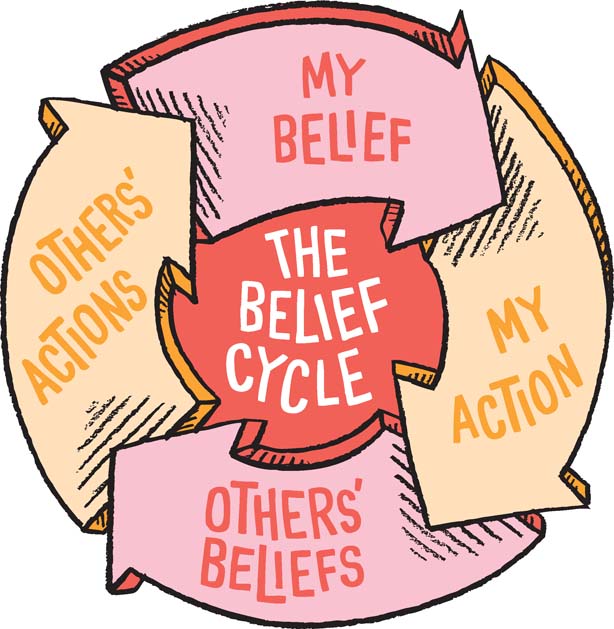
Starting at the top (thinking about the illustration as a clock, we’re at 12:00), we all have thousands of beliefs. Beliefs about everything from books to bread, ways to work to days of the week. Based on our beliefs, we take action (at 3:00). And it turns out every action we take, other than an instinct like ducking if a ball is thrown at us, is based on our beliefs. Based on our actions, the people around us form beliefs of their own (6:00), and based on their beliefs, they too will take action. AND … here’s the big insight for me: 95% or so of the time, their action will reinforce the original belief. As late 19th-/early 20th-century psychologist William James once wrote, “Belief creates the actual fact.” Adding to that short synopsis, between 12:00 and 3:00, there’s what I call a filter—scientists would call it confirmation bias. We all filter out what does not support our beliefs. And we take in what does support them. Which is why, I learned, the saying, “I’ll believe it when I see it,” is backwards. It ought to say the inverse: “I’ll see it when I believe it.”
The beautiful thing about the beliefs work for me is that the learnings keep coming. Here’s one I stumbled on last week, something that helped explain why so many people are impacted so quickly by the belief cycle.
In a 2010 article entitled “Learning By Doing: A Theory Of Learning Which Advocates Reading How-To Manuals, Only After Extensive Hands-On Direct Experience, And Then Only When There Is Need For Help & Guidance,” Professor Henry Gurr explains how humans generally learn best by doing, and only really by doing when there is a relevant situation in which try out the learning at hand. Gurr was a huge fan of and advocate for the writing about quality done by Robert Pirsig’s 1974 Zen and the Art of Motorcycle Maintenance: An Inquiry into Values. (I wrote a bunch about it a few years ago.)
Gurr’s “real job” (his quotes, not mine) was in experimental nuclear and neutrino physics, as well as a university professor and physics teacher. Gurr’s beliefs were so impacted by Pirsig’s book when he read it in 1995 that he essentially built the rest of his life around it, devoting years to retracing every bit of the Minneapolis to San Francisco motorcycle journey that’s the focus of the book. Later, Gurr applied Pirsig’s beliefs about quality to learning processes. Gurr writes,
Learning by doing at its best. You learn faster this way!! And you remember more this way!!! … And as you are doing this, of course => Watch How Your Mind Works!
I realized that one of the reasons the beliefs work connects with people is that it’s almost always “learning by doing.” It’s not just an academic exercise. Everyone has beliefs that are helping them already.
One of Gurr’s main areas of study was what he called “Flashes of Insight.” The realization that a very high percentage of really important learning comes up quickly, essentially out of the blue, not from the long-term linear approach to learning that’s encouraged in our educational system. By contrast, epiphanies of the sort Gurr is focused on often emerge quickly in moments we weren’t expecting them. This is, I’m sure, what happened that morning in Atlanta when the physician who thanked me with tears in his eyes—I doubt he came to the conference expecting that to happen.
A “Flash of Insight” is absolutely what happened to me when I learned this work 15 or so years ago. I was reading Bob and Judith Wright’s book Transformed. There were plenty of good learnings to be found. I like the Wrights’ work and have benefited from other insights of theirs in the past. Still, I was not expecting to have my world changed while I was reading. But sure enough, out of the blue, on page 109, I came across the visual model—the self-fulfilling belief cycle that we have now been teaching here for over a decade.
It was one of those situations akin to what John Moriarty once described about coming upon a door where we didn’t expect to find anything.
And now … a door, and we lift the latch. And how strange is it to stumble on the path that takes us to that door. And how strange it is to lift that latch. And how strange it is to hear that voice. And how strange it is to discover we were always so near home.
It sounds silly to me to say it now, but the truth is that I had never thought about the impact our beliefs have on our lives. This is, I realize too, what happens to a whole host of people when they hear me teach it too. Once one has the “Flash of Insight,” everything suddenly shifts. Things that were confusing for ages now appear in a way that makes total sense. In a talk given four years ago next week at the University of South Carolina Aiken, “An Explanation of Best Available Theory of ‘How Our Mind Works,” Gurr said, “Spontaneous insight comes out of unconscious broad brain processes, and you only know it when you have the flash of insight or mental arrival.”
For me, the flash of insight was just how HUGE this new learning was. Once I grasped what the self-fulfilling belief cycle was all about, it almost immediately became clear how hugely impactful the idea was. I started studying and realized it was even more impactful than I’d initially imagined. Which in turn brought more flashes of insight, more studying, more flashes, more insight. The belief cycle, I could suddenly see, was everywhere. I studied and had more flashes of insight, more reflection, studied more, and over the ensuing few years, it turned into a 600-page book, The Power of Beliefs in Business.
What I realized that week is that so many of the people who learn the belief cycle model for the first time experience the same sort of “Flash of Insight.” Why? Because, to Henry Gurr’s good point, nearly everyone who learns it can immediately apply it to a real-life practical situation they’re struggling with. Unlike many learnings that begin with an academic explanation that only later might be applied to real life, the belief cycle is at work all day, every day in all of our lives.
John Moriarty used to say, “The quest for the greater world is a request for a greater vision of the world we already live in.” The beliefs work, I believe, allows us to do just that. It opens the door for anyone interested to make a positive difference in every part of their lives—to self-manage more effectively, reduce stress, increase influence, and enhance enjoyment.
What can you do to make the work on beliefs come alive in your organization?
It’s more straightforward than many might think:
- Start teaching the belief cycle to everyone in your organization The reality is that so few people even know that they have beliefs, that just sharing the model alone can be a big eye-opener!
- Bring up beliefs in conversations. Rather than getting stuck in arguments and thoughts, as I learned how to do so well growing up, you’ll see that conversations start to shift in good ways when beliefs are woven in. What long-standing belief of yours is causing problems? What beliefs are really benefiting? Which beliefs might need to change?
- Gently highlight areas of different beliefs. This is a way to show folks what you’re talking about. No judgement. It can be done with grace by simply asking questions: What do you believe about this situation? What do you believe about yourself? Where did those beliefs come from?
- Remind everyone that beliefs can be changed. Secret #43 is “A Recipe for Changing a Belief.” The new “Why Democracy Matters” is a written reflection of my much-changed beliefs on the subject.
- Consider writing a Statement of Beliefs. I believe ever more strongly that the work on a Statement of Beliefs can be as positively impactful as doing a long-term vision. The good news is that we can do both!
With beliefs in mind, I was happily surprised to get this seasonally timely learning on the history of Ukrainian Easter eggs, or pysanky, from the wonderful writer Darya Zorka. You can read her whole essay here. I thought it was a fascinating example of how beliefs play out in quiet ways in our lives, more often than not, without people even realizing it. As you’ll see, the social beliefs about the eggs changed significantly over time, but the belief that the eggs themselves were incredibly meaningful was so deeply held that it outlasted a whole host of very significant social changes.
Pysanky are no ordinary Easter eggs. As Zorka writes, “Ukrainian pysanky are among the most extraordinary Easter eggs in the world.” In ancient Ukrainian societies, the sun was seen as the most important of all the gods. And because birds were the only animals that could fly closer to the sun, they—and their eggs—were believed to have magical powers. When Christianity came to Kievan Rus in 988, the importance of eggs shifted from the sun to Jesus’ resurrection. In other words, the belief supporting the import of pysanky changed, but the import of the beautifully decorated Easter eggs was unchanged. When the Bolsheviks took power and the Soviet regime tried to eradicate Ukrainian culture, pysanky were banned. It was Ukrainians who lived, metaphorically, at the “edge of the village” in remote communities in the mountains. Their devotion and their belief in the import of pysanky kept the tradition going even when they risked going to jail for making them. In 1991, the Soviet Union fell and Ukraine regained its independence. And as Zorka writes, “When the Soviet Union collapsed, pysanky began their revival. Right now, it is one of the most cherished Ukrainian traditions and is deservedly recognized as the cultural heritage of humanity.” Bottom line? Over the course of history, beliefs changed plenty of times, but the pysanky stayed a critical component of Ukrainian culture.
The fact that we can build momentum around the power of positive beliefs and that those beliefs can make a difference was reaffirmed for me this past weekend when I read the enews from Filip at Start Trak. The founder of Z Tapes in Prague, which puts out music from an array of little-known Eastern European artists (he’s Slovak), Filip writes quite insightfully about the music world. And this week’s column is all about choosing positive beliefs. Writing about record reviews and music journalism, Filip encourages us all to begin our work with positive beliefs:
When I look around, I see a lot of negativity surrounding me in music-related topics. The critique or negativity is appropriate, as many things suck. Streaming, AI in music, major labels, shipping costs, social media platforms, living costs, and more. The reasons to be sad or discouraged are so many that you might think there is not an inch of positivity in the music world. I must admit that often, I contribute my negative thoughts to the pool of negativity. … However, I would love for us to take a step back and start thinking more positively.
Instead of writing a post about the streaming situation, you could write one promoting your friend’s music. Instead of feeling hopeless and seeing everything around you crumbling, think about how you can contribute to making the lives of other musicians better. Buy a tape or music on Bandcamp and write them a nice note. You could send them an email expressing how much their music means to you. You could start a blog or write for a blog like ours to share your passion for music.
In Night Journey to Buddh Gaia, John Moriarty writes, “A graffito on a gable in Spain reads, ‘How sad to be young and not want to change the world.’” He adapted it to: “How sad to be any age, nine or ninety, and not want to change the world.”
The work around beliefs, I am confident, is one way to make those changes happen. The fact that the changes are coming from the metaphorical huts at the edges of our villages rather than national headlines only reaffirms my belief that this is the route to positive change. Who knows how many great doors might open. The work around beliefs, as I said up top, has already improved my own life and our organization enormously. It has the power to do the same for countless others. There’s so much to learn, so many flashes of insight to have, so many epiphanies to experience, so many beliefs to be changed for the better. The immensity of the opportunity leads me to something John Moriarty used to say,
When people ask me are you happy, I’d say that isn’t quite the question. The real question is, am I still growing? Have I become a finished creation? Am I dead or am I still growing? Is my life still an adventure, an adventure full of trouble, full of joy, full of pain, full of cataclysm? Am I still living dangerously? So, “Am I still growing?” is the real question.
I realize that I can say with confidence that, thanks in great part to the impact of beliefs work, my answer to that last question is an adamant, “Absolutely!” Take a little time, explore the work around beliefs, either some of what I’ve written, or elsewhere, and examine what it might mean in your own life. Let me know what you learn.
A bundle of beliefs
P.S. The Power of Beliefs in Business book, as well as the various single essay pamphlets from the book, and our Statement of Beliefs are all on ZingermansPress.com and ZingTrain.com.