
Tag: ARI WEINZWEIG
Celebrating France’s Wonderful comté cheese
When you travel in the Franche-Comté region in eastern France, you’ll see dozens of green and white road signs for the “Route de Comté,” pointing you toward the village cheese makers where you can buy well-made local cheese. They pop up on the road every couple of miles – there’s a Comté maker in most every village in the region, and the Comtois people take great pride in their cheese.
Though it’s got about as much name recognition around here as Dry Jack does in Outer Mongolia, Comté is a great, grand cheese. Above and beyond all the other stuff I’m about to tell you below, there are a trio of really big reasons why you should know about this cheese and why it’s so deserving of a chapter in this book.
- There’s more traditional Comté being made than any other French cheese. That’s right. More on this in a minute. But to get the point out front, while Brie, Camembert, Roquefort and various versions of traditional French goat cheeses usually get the big press, there is actually more Comté made using traditional methods than there is of any other cheese in France.
- Comte is the cheese by which French cheese mongers judge another cheese shop. Why? Because there’s so much fairly traditional Comté still being made there’s a lot more room to move in the way one buys it. So when a French cheese pro wants to judge the true quality of a shop, she starts by buying some Comté.
- All else aside, at it’s best it’s simply a great tasting cheese, one that anyone who likes good food should get the chance to savor at its best a few times before they die. Eating some Comté right now. It’s buttery, smooth, soft but masculine at the same time. This is not timid cheese. It’s just not one that has to hit you over the head. At the more forceful end of its spectrum—which is where I like it, it’s got a great balance of bigness and bashfulness. It’s been ten minutes since I ate it and the flavors are staying right with me, as much in balance now as they were when I first started eating it. Buttery, nutty, nice nose, croissant?
Not Just the French Version of Gruyere
Comté (which the French pronounce “Con-tay”) has been made in the Jura mountains for centuries, long before there was a country called France; without question, it is the cheese of the Franche-Comté, the district of France which butts up against the Swiss border.
In France, the cheese’s formal name is “Gruyere de Comté.” Over there, they use the term Gruyere as a generic for any mountain cheese. But in North America the use of the word Gruyere has resulted in its often being dismissed as “a French copy of the Swiss.” This is wholly inaccurate. While they have similarities, Comté has a flavor all its own—smoother on the tongue, less salty, rounder in flavor, with less of a “nose” and not as much of the fruitiness that is so characteristic of its Swiss cousin.
Comté has more than enough history and heritage to stand on its own. In fact, it was the first of France’s cheeses to be recognized and rewarded with an “AOC”—an “appellation d’origine controllee”—to guarantee its makers and eaters’ authenticity. No small achievement in a country that takes its food and itself as seriously as France.
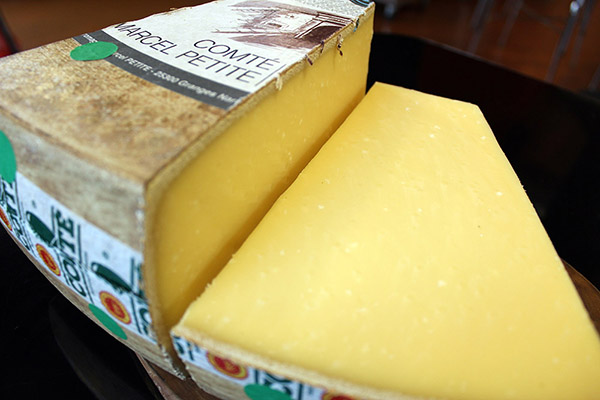
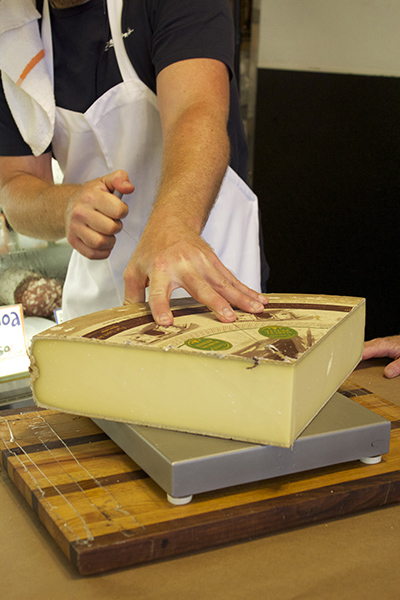
Made into large, flat 75-pound wheels, Comté has a rough dimpled brownish rind, and a smooth, firm white to yellow interior. The best Comté has a wonderful nutty, buttery flavor. Unlike our usual image of large holed Swiss-type cheeses, Comté has only an occasional pea sized “eye” (what we call holes). In fact many of the best tasting Comtés have almost no holes at all, but rather long fissures or cracks (known as “lenure”) that run through the paste of the cheese. In its home region, Comté seems to find its way onto the table in just about every way you can think of; on sandwiches, in fondue, melted into omelets, in sauces, on salads, after dinner. Or, of course, eaten just as it is.
Who Cares About Comté?
My first hint that there was more to Comté cheese than I might have thought, came in over two decades ago, when I visited the Franche-Comté for the first time back in 1984. I have vivid memories of walking the market in the mountain town of Besancon, blue skies overhead, the rustling of the river Doubs in the background. Almost everywhere I looked, long lean two-foot high triangular wedges of well-aged Comté cheese stood, reaching skyward, like pointed, symmetrical mountains. Tasting Comté from those cheese counters made me realize that (as usual) what was being shipped over to us in America was the youngest, blandest version available of what was really a cheese of great character – no wonder no one in the U.S. was taking notice. But the Comté I bit into in Besancon was beautiful, buttery, well-aged and richly flavored.
That first visit piqued my interest. But it was my second visit to the Franche-Comté, a decade later, that made me a devoted follower of this fantastic French cheese. And my third, just a few years ago, reaffirmed everything I learned and believed after the first two trips. This is a great cheese.
7 Generations of Cheese
The highlight of that second trip was a day with Jean-Charles Arnaud, affineur (cheese ager) and a man on a mission. He is one of half a dozen affineurs who mature top-notch Comté cheese. On my recent visit I spent the day with the folks at the Fort St. Antoine, the maturing company of Marcel Petit. Most everything I learned from Jean-Charles years earlier, the men and women at Petit echoed on this most recent trip. They have a bit of a different approach to maturing the cheese (more on that in a minute) but the passion for tradition is equally solid.
Jean-Charles is so connected to the Franche-Comté you could film a French version of Roots with him as the lead. He’s the seventh generation of his family to work with cheese. One of his grandfathers was a cheesemaker, the other a winemaker. At the time I visited in the mid-90s, Jean-Charles was in his early thirties, but despite his youth he was already running the family firm, guiding the buying, aging, and selling of nearly 20 percent of the entire production of Comté cheese.
Tall, thin, and energetic, he is a font of knowledge about the cheese he cares for so much. He comes on pretty casually, gentle, happy, a man who likes his life and likes what he’s doing. For a while he had me fooled—worried I guess if I’m honest about it—into thinking that I was in for a rather superficial day of the usual legends and lore of Comté. But beneath the soft surface, Jean-Charles is a man of deep devotion, with a core of emotional connection to the land and the cheese on which he was raised. Just as I was starting to wonder if I was in for a day of Comté cliches, he caught me with a sudden seriousness, a sense of gravity that literally made my eyes tear up (remember to imagine the French accent):
“Really my goal in my lifetime is to help preserve the integrity and quality of Comté cheese. Sometimes we add some equipment here and there, to help make it a little easier for the people, to make sure they stay in business. But the important things—the freshness of the milk, the raw milk, the Montbelliard cows, copper kettles, no silage, real rennet—these things we must preserve.”
The man meant what he was saying. To preserve the tradition for another generation, to pass the torch of craft and Comté to the eight generation of Arnaud’s is akin to an American fighting to save a piece of Redwood forest. Traditions take centuries to build up, but they can unravel at an alarming speed. Jean-Charles has undertaken a trust of great magnitude.
Unlike so many heirs to family businesses who have little enthusiasm for their work, Jean-Charles is a man with great passion and love for everything about Comté cheese; the mountains, the people who make it, the land it comes from. He seems to know all his producers intimately. When we ran into one of the local farmers delivering milk, he knew him, too. Wherever we went, he knew the cheesemakers, greeted them with enthusiasm. He knew their children. He knew their cheese.
Arriving in Comté Country
In school we used to sing “purple mountains majesty” and I used to wonder what it meant. In the Franche-Comté the mountains in May were majestic in yellow. When we arrived, they were covered with millions of yellow, yellow dandelions, looking like the poppy fields Dorothy landed in on her way from Kansas to Oz. The locals say that the Comté cheese from the first eight days of May is very, vibrantly yellow, the inevitable and very natural result of cows munching mouthfuls of the yellow flowers.
Being a city boy, I love to hear about life in the mountains. Jean-Charles obliged me:
“I remember when I was about ten years old and I was visiting with my grandfather in his village and there was so much snow that we were completely cut off from communications for eight days. No telephone. Nothing. But every day the farmers brought the milk—with sleds, with dogs, with horses—and everyday my grandfather made cheese.”
The mountains mystify me. As a kid I was terrified of getting lost, separated from my mother when we went to big public places like the beach, or downtown department stores. But it’s almost impossible for me to imagine being completely cut off, left behind by the rest of the world in a village with 22 homes for eight snow-drifted days, no outside world, no newspapers, no mail, no TV, no nothing. Just the family, the Comté cheese, bread, dried country ham, wine, and some potatoes to get by on.
Tied to the Region
During the cold winter months in the mountains, cheese was one of—or often the only—serious source of protein available. Cheesemaking is woven into the fabric of life in ways which are not easily abandoned. Jean-Charles explained, “The Comté cheese was made in this area because we have everything you need to make it in the Jura mountains. The cows, the milk, the wood to make the fire, the salt.”
We take salt for granted nowadays, but in days of yore, salt was hard to come by. You’d never know it from the cheap cardboard drum of Morton’s, but salt was once something people fought wars over. The Franche-Comté was once one of the most important sources of non-sea salt to be found in Europe. For more on this, see Mark Kurlansky’s excellent book, “Salt.” To this day, large storage buildings, including one of the Arnaud cellars, can still be found that only a few hundred years ago were used exclusively to house salt.
Without trying to sound like a commercial, I can tell you that the best Comté cheese today is still made much as it was when Jean-Charles’ grandfather was making cheese. Milk is still delivered twice a day, real rennet is prepared only from local calves, and the curd is cooked in copper kettles. The copper contributes to the flavor of the finished cheese. In the smaller dairies the cheesemakers still pull the finished curd from the kettles the old fashioned way. They tie two corners of a large cheesecloth like a giant lobster bib around their necks. Then, bracing their feet against the wall, they lean over the kettle like one of the Flying Wallendas preparing to leap. Reaching deep into the hot cauldron, they drag the other two corners down across the bottom of the kettle to pull out the curd. Remember these are 75-pound wheels of cheese.
The Milk
As we were driving into the village of Arbois for what was to be an incredible lunch at the Taverne La Finette, Jean-Charles mentioned that, “this is the home of Pasteur.” He waited a minute or two, chuckled a little Comtois chuckle, and added, “But we don’t pasteurize the milk here.” There are no coincidences. Instead of pasteurizing, the Comtois have gone to great lengths to make pasteurization irrelevant, by setting up standards for milk production that make a mockery of what we tolerate in our bacteria phobic, hi-tech society. There’s an arm long list of rules and regulations set up to insure that the milk that goes into Comté is exceptional.
It starts, of course, with the cows. By law, they must be the traditional local breed of Montbelliards. A beautiful russet and white, they have been the main milk producers in the Franche-Comté for centuries. In the Comté cows are treated with the care and concern that we normally associate with the Hindu. Cars stop as the bovines parade across country roads, strutting like the local gentry that they are, cowbells ringing off leather collars. Strict codes dictate what the cows are allowed to eat (no silage), and where they can eat it.
Every facet of the milk handling is monitored. No pumping of the milk is allowed, in order to protect the delicate fat globules so crucial to good cheesemaking. The milk must be fresh (from the morning the cheese is made and the previous evening) and unpasteurized. Bacteria counts must be very, very low.
It’s interesting that in the U.S. cheese made from unpasteurized milk has been wrongly accused of being a health hazard. Jean-Charles thew up his hands in frustration at the mere mention of it. “In America the laws require a bacteria count of less than 1,000,000. One million! This is ridiculous. But because they pasteurize the milk no one knows or cares that it is of such poor quality. To make Comté cheese we must have milk with a bacteria count no higher than 2,000!”
Fruitieres
If you journeyed back into the cheesemaking world of 200 years ago, you’d find that most every farm in Europe and North America would have been independently making its own cheese. Comté is—and always has been—an exception. Since the middle of the 13th century Comté has been made, not on farms, but in fruitieres; small village dairies which are found throughout the region. What brought about such a unique system? The cold mountain climate and difficult terrain led the Franco-Comtois people to make large well, aged cheeses which could be stored for eating in the long winter months. The emphasis is on “large.” A wheel of Comté cheese takes about 600 liters of milk, much more than the average small-holder’s herds could come up with in a day’s “work.” The result was a natural movement towards cooperative cheesemaking.
The fruitiere system has a simple elegance to it. Each village would have a fruitiere, and each fruitiere has a cheesemaker. Each morning and each afternoon farmers from the surrounding countryside would bring fresh milk to the fruitiere. Each morning the cheesemaker mixes morning and evening milk, adds the rennet and starts the process of making Comté cheese. The fruitiere keeps the new cheeses for only a few days. The cheeses are then taken to an affineur (an “ager,” like Jean-Charles) who cares for the cheeses from then until the time they are sold – anywhere from three months on up. Affinage is a profession that has only recently been revived in the U.S., but in France it is an accepted and essential part of the cheese world.
The fruitiere today remains a critical part of maintaining the viability of village life in the Franche-Comté. To this day it dominates the agricultural life of the region. Letitia, who works at Marcel Petit, told me that she grew up nearby on a dairy farm. I asked if her parents had sold the milk to a fruitiere for Comte making. “Here if you produce milk, you sell it for Comté,” she answered matter of factly. “That’s just what you do.” In total there are about 3200 farms contributing the milk of their Montbelliard herds (the only type of cows one can use to make Comté) to the system. The average herd is still very small, many having only 15 or so cows. The Comté codes require at least one hectare of land per animal in order to allow sustainable grazing without overburdening the pastures. Since a single wheel of the cheese takes about 530 liters—the yield of about 30 cows—the system is set up to support the small farms while still making traditional large wheels of cheese a daily reality.
Jean-Charles is dedicated to preserving as many of the fruitieres and the farms as possible, a commitment that comes from a common care for the quality of his cheese and for the quality of traditional life in the Franc-Comtois countryside. As we drove he spoke with passion: “In the village now there is only the fruitiere. There is no more school, no more church, only the cheese making. If we lose the fruitiere, we will lose the village.”
An Ancient Tradition with a Modern Business Bent
As old as it is, there is a compelling, cooperative genius in the fruitiere system, one which we in our “progressive” wisdom are working hard to reinvent in the modern American business world. The Comtois system is set up so that all three of its components (“stakeholders” we might call them in business school these days) have their success interlinked. The affineur depends on the cheesemaker to deliver a well-made young cheese. The cheesemaker relies on the farmer to bring in the best quality milk. While each is free to pursue his (and it is a predominantly male world from what I saw) particular passion and style, none of the three can be successful without comparable efforts from the other two links in the chain.
To seal the shared “stake” in the deal, the final price that the milk producer and cheesemaker are paid is linked to the price the affineur gets for the cheese when it is sold. The better the quality of the cheese, the better the price, the more everyone makes. Voila. What goes around comes around. A medieval system where stakeholders are working cooperatively to create quality, where the reward system reinforces the drive for quality, where all hold a shared vision of what success and quality is. Who says history doesn’t repeat itself?
A Living Tradition
Part of what made such an impression on me is how much the Comté producers have done to make their tradition a living, and thriving modern enterprise. There are nearly 200 fruitieres left in the Franche-Comté. This is truly a phenomenal number of small dairies still operating. By comparison, there are only about 500 dairies left in the whole rest of France! To give you a frame of reference, in Somerset, home of English cheddar there are fewer than a half dozen dairies left making traditional raw milk cheese! What accounts for this? Since the Swiss have accomplished a similar feat, it seems to me it must be something about the mountain cultures (Rootedness? Separateness? Distance created by mountain barriers?) that has kept more of the cheesemaking traditions intact than in any other area. Whatever it is we ought to learn from it. They have done so much to preserve the integrity of their tradition, yet they’ve done so in a way that’s not stubbornly opposed to modernity, or to making an effort to learn, to grow and to improve.
There are two ways you can learn to become a cheesemaker in a Comté fruitiere, and both require a good bit of time in the school. The “short route” is that you can go to work for your father who, in this case would have to be a cheesemaker, for two years of apprenticing. Then you go to the dairy school in Poligny, the capital of Comté country, for two years (along with upwardly mobile cheesemakers from all over the world), then out to do an apprenticeship in another fruitiere for a year. Finally you go back to Poligny for final year of formal schooling. In total it’s six years training! And if your father isn’t a Comté cheesemaker? Then you need to go to the school for an even longer run of study and apprenticeship.
Proper Aging in the Caves
Comté aging caves (or “cellars”) are quite a sight. Thousands upon thousands of wheels of Comté carefully laid flat, like thin milky millstones, on unfinished wooden shelves. The shelves, which by law must be made from local pine, reach up a good twenty five feet high, and stretch fifty yards or so across the rooms. There are a dozen different enormous aging rooms, each with its own unique combination of temperature and humidity. The affineur moves the cheeses through the rooms at various stages of aging, to bring out the best in each wheel of cheese.
To reach the apex, the mountain peak of majestic flavor, that makes it worth paying the higher prices charged the cheese, Comté has to be aged for, to my taste, at least ten or twelve months. Only then is it really ready to be savored. Best of all really are wheels that have been in the caves for over eighteen months.
To properly age a wheel of good Comté cheese takes more than just patience. After the young wheels arrive at the Arnaud cellars, each wheel is turned 3 times a week for 3 weeks, then twice a week for the rest of its stay on the aging shelves. By my rough calculations, that would mean that before it gets to us at 12 months age, each wheel is rubbed, washed and turned about 107 times! On top of that each and every wheel is tapped with a hammer, plugged and tasted two or three times during the aging to check it for quality, and class it accordingly. Compare that to the average American factory cheese whose only turning comes as cardboard cases of it are loaded and unloaded from sixty foot semi-trailers, cheeses that are tasted for the first and last time by the unsuspecting consumer that bought them.
A Trained Comté Palate
Although the cheese of many dairies is aged in the same cave, each retains its original character. “Every fruitiere makes cheese with its own flavor,” Jean-Charles told me. “And each wheel is slightly different. If you give me Comté cheese to taste (at random) from the caves, 95 percent of the time I can tell you from which fruitiere it comes, and when it was made. But,” he hastened to add before I might conclude he was bragging, “so can this man over here (the taster working his way down the rows). I must. It’s my job.” That may not seem all that impressive until I tell you that the Arnaud caves are filled with about 70,000 wheels of Comté cheese made by 60 different fruitieres.
In search of the “perfect” Comté, I tasted, and tasted, and tasted some more. Well over 25 different cheeses by the time we were done. I treasure the opportunity to taste like this, because it’s the only way to truly appreciate how significant the differences are between one wheel of Comté and another. Finally we settled on the cheeses from a particular dairy one of Jean-Charles favorites. Since the cheese varies from day to day, and year to year with the vagaries of weather, dairy farming, and cheesemaker job continuity, it really doesn’t much matter which dairy it was. What does matter is that it was one of the fruitieres which makes cheese only in the summer months, when the cows are high in the mountain pastures eating the wild flowers, herbs, and greens. This is the kind of cheese that makes good Comté a favorite of connoisseurs.
Marcel Petite: Long Aging, Cooler Temperatures
I first learned about the Comté of Marcel Petit from Jason Hinds, who’s long been a key component of the crew at Neals’ Yard Dairy in London, where traditional cheese is as much of a religion as anything else. I can’t remember how Jason first hooked up with them, but generous spirit that he is, he’s been selling their cheese, and telling everyone else he knows in the cheese world, about it for a number of years now.
Visiting the Fort St. Antoine to see the folks who make Marcel Petite’s cheese a reality today, it’s easy to see the same passions, and the same expert palates that impressed me a decade earlier in meeting Jean-Charles Arnaud. While I’m sure there’s a level of competitive spirit in the region amongst the various affineurs, the great thing for the rest of us is that the competition seems to be taking place on a very, very high level of quality.
Petit started his business up in 1966 and from everything I saw on my visit, he did a great job of founding an exceptional company that stands behind his values and commitment to quality. His biggest conceptual contribution to the world of Comté though was to create what he called “affinage longue.” What M. Petite did was to lower the temperature at which Comté was being aged from the then typical 15°C to a much cooler 7-8°C. The reduced temperature allowed the cheeses more time to develop at a gentler pace, maximizing flavor while holding on to moisture and butter fat that might otherwise be more quickly lost. He also had the foresight to buy the Fort St. Antoine, a huge stone structure buit in the 1870s that had been abandoned since WWII. Of course the thick stone walls and high vaulted ceilings of the Fort made it ideal for maturing large wheels of cheese and today it’s filled with roughly 65,000 75-pound rounds, stacked neatly on spruce shelves all the way up to the 30-foot high ceilings. The company buys from about 35 different fruitieres, of which 13 are considered good enough to have their cheeses aged in the Fort.
Of course, stone walls alone aren’t enough to mature the cheese properly. Affinage remains very much a craft, and the quality of the affinage is very much dependent on the skill of the man or woman doing the work. In this case, that would be Claude Querry. Quite a guy. Small and thin but with an enormous energy coming out of him. About 5’ 7”, maybe in his mid thirties, with a thin Van Dyke beard, long sideburns and bold, almond-shaped brown eyes. I’d been warned before meeting him that his style is often to grill visitors to see if they’re really serious about Comté before he’ll share his secrets with them. For whatever reason—I was with Jason, our time was tight—I was spared any interrogation. We got right into cheese. Although there are 65,000 wheels of cheese under Claude’s command, amazingly he seems to know most everyone. His work is first to maximize the flavor of each cheese, and then, of equal import to match the tastes of Petite’s customers with the cheeses.
To that end, we tasted twenty different cheeses within an hour. Walking down row after row of cheese, he would stop for reasons known only to him to taste and take notes. Our purpose was two fold really—Jason was choosing cheese for his Burrough Market stall in London, and, at the same time, Claude was trying to get a handle on what I was looking for. We met both goals, and at the same time I got a very good sense of why Claude is so damned good at what he does.
As we walked he’d slow down to rub any number of cheeses, first with his hands, then often tapping with the handle of his cheese tryer. “This is still really a mystery,” he reminded us early on. “We don’t know a fraction of what we want to know.” And, I can safely say, the rest of don’t know a fraction of what Claude knows. Many of the wheels we walked by had a series of scratches in them. Why? I asked. We mark each cheese after we taste. And we don’t want to pull from the same cheese too many times.
He’s also something of artist. Every once in a while he stops to scratch a drawing into the rind of a wheel of cheese, sort of cave art of a more modern sort than what Claude’s Gallic ancestors might have been doing a few million years ago. The first was a four axis sketch of the flavors we taste—bitter, salty, sour and sweet at each end of each of the two axes. “I am an architect of flavor,” he explains, using the diagram to show how he must manage the various natural flavors in the cheese to develop them properly.
Perhaps more than anything else, I was blown away by Claude’s palate and his ability to put amazingly precise and often unusual flavor descriptors onto what we were tasting. While the words may seem off the wall, the truth is that the flavors were there in the cheese. I kept looking up at him with amazement but sure enough he was right on in what he was saying. “Buttery, nutty .. . these are typical descriptors. Accurate but not surprising. Claude started in with stuff like “citrus,” “cacao,” “cooked cream,” “grapefruit,” “smoked ham,” “dried fruit,” “hazelnuts,” “peanuts.” Damn the guy is good. But then he really blew me away when he said—totally accurately—that one particularly good cheese had the aroma of “croissants, of fresh patisserie.”
As we move forward tasting young cheeses someone asks if a particular 10-month old cheese is going to mature out to be really great at two years. He shakes his head. I can’t tell if it’s with humor, cynicism, or . .. . Regardless, he scratches another of his diagrams in the rind of the cheese in question. This one shows how some cheeses peak out at 10 or 12 months, while a minority of other wheels go on to mature more meaningfully. Then he adds with a touch of a cynical smile, “If you can predict scientifically where the cheese will be in three years from where it is now, then shut the Fort and I retire.”
The great thing about tasting like this is that there is a good cheese for most every palate and that most every palate likes a different style of cheese. Jason I know likes his Comte softer, gentler, sweeter. These are the kinds of cheeses I think you could eat every day and that’s exactly what he’s doing with the cheese so successfully in London—selling it at the market at a rate and in away that’s fast making it every eating for food lovers in the area. Me, on the other hand, I like my Comté with more guts, more earthiness. We tasted together until we found something I liked. Loved is probably better. My notes, a conglomeration of my own comments and Claude’s, say it was “Big, long, round, a bit of leathery blue Stilton, nuts, walnuts. Butter, hint of butterscotch, but it’s not sweet. This is what I like!” Claude nodded, smiled a small smile, put his fist up to tap his chest and said, “This is a cheese for a montagnard..” I’m not sure, but I think that’s something I like. I know I like the cheese. I know I like good Comte. I hope you do, too.
![ari's-signature-[Converted]](https://www.zingermanscommunity.com/app/uploads/2013/08/aris-signature-Converted.png)
Tag: ARI WEINZWEIG
Zingerman’s 5th Annual Camp Bacon gets underway in just a couple short weeks. To help you prepare for our annual celebration of all things pork, we’re posting excerpts from the Zingerman’s Guide to Better Bacon.
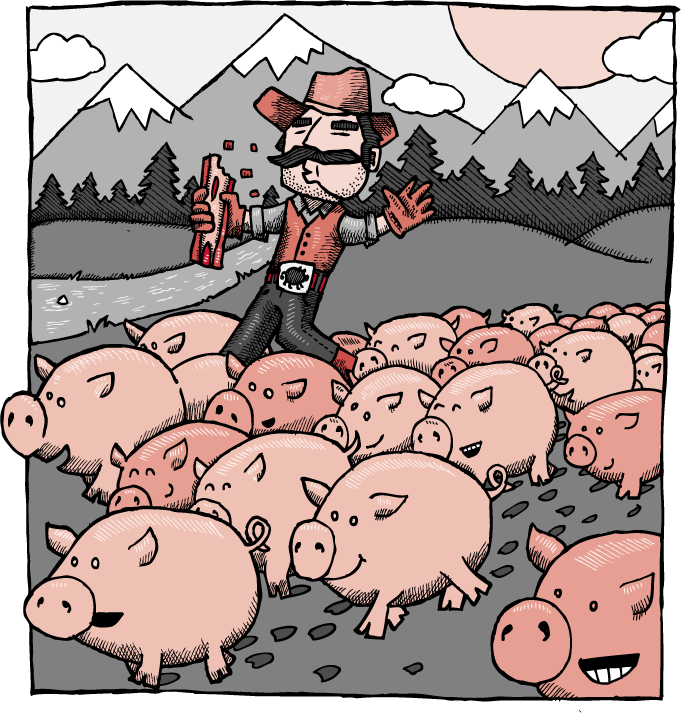
Sorry, I can’t resist the subtitle—the tune slipped into my head while I was out running one day, and I couldn’t get it out. So . . . if Peter, Paul and Mary had lived in the second half of the nineteenth century instead of the twentieth, their big hit could well have been, “Where Have All the Drovers Gone?” While you most certainly won’t see any such openings on Craig’s List, thousands of Americans once worked as drovers, the less glamorous (but probably more important) eighteenth-century piggy equivalent of cowboys like Rowdy Yates and Gil Favor from Rawhide.
In one of those interesting, now all-but-forgotten footnotes of history there was once an entire profession having to do with pork that’s completely lost to us today. It’s a line of work I certainly would never have thought about had I not come across it while doing some reading on nineteenth-century American agriculture. But once you read about drovers, the need for them seems obvious: in order for urban dwellers to get fresh pork to eat, pigs had to be brought from the farms on which they were raised in the rural areas of North America to the cities where they could be slaughtered, sold and served. Before the introduction of the railroads, there was really only one practical way to do so: the hogs had to walk. And since the very valuable pigs weren’t going to be allowed to make the trip un-chaperoned, they were shepherded along their routes by men known as “drovers.” Without the drovers there would have been no American pork industry. Bacon would have been forever limited to on-the-family-farm consumption.
While I’m sure others were at it in less recognizable places, the first formal record of North American drovers that I’ve found concerns William and John Pynchon. The Pynchon brothers started taking livestock from Springfield, Massachusetts, into Boston in 1655. By the end of the seventeenth century theirs had become a well-accepted profession. Farmers driving their own hogs generally had an easier time of it because the animals were comfortable with them. But more often, professional drovers went around the countryside buying a few hogs from each farmer they encountered (most farmers had only four or five pigs, one or two of which were typically to be kept for the family) and gradually gathering them up into a single, large herd. While the boss might ride a horse or wagon, most men walked their way through the hog drives.
Long-distance driving began in 1800 and probably reached its peak by about 1825. A long drive in those days could take three months—the herd made five to ten miles a day if they were doing well. To keep them moving effectively, domesticated pigs were trained to respond to the blowing of a conch shell. En route, drovers risked theft, porcine illness and bad weather: thunderstorms could cause the hogs to panic and stampede. And even under the best of circumstances weight loss was always an issue: pigs often dropped ten to twelve pounds during a drive (I’d guess the drovers lost some weight, as well).
A whole industry grew up around the drives. Drovers had to pay tolls on each hog whenever they traveled on a turnpike (in 1817 the Philadelphia-Pittsburgh route charged a toll of six cents per 20 hogs). A well-positioned stock stand on the turnpike might see a few hundred thousand pigs pass through in a year. The biggest season for driving was late fall, just before slaughtering time. Spring was popular as well, whereas summer heat and winter cold made the long cross-country walks almost impossibly difficult in those seasons. Innkeepers along the route were often paid in lame hogs, which could be turned into provisions for the table. Nor was droving an exclusively American occupation: a great tradition of bacon-making sprang up around Wiltshire, England, in part because the area was a resting point for drovers moving Irish pigs from the port of Bristol up to London.
The demand for drovers—here, in Britain, and probably everywhere else—began to drop off as the railroads came to dominate commercial transportation in the second half of the nineteenth century. Not surprisingly there was a great deal of opposition to the railroads along the driving routes. As you already know, the railroads won out and the drovers disappeared—as did other once-essential and now-unneeded occupations like ice harvesting and stagecoach driving. The only modern reference I’ve ever seen to drovers is the name of a Chicago-based band.
We’ll see you at Camp Bacon 2014!

 The Bacon Ball at Zingerman’s Roadhouse
On Thursday, May 29, 7pm, Camp kicks off with a very special event featuring “the Ham Lady,” Nancy Newsom who will oversee a feast centered on ham, bacon, and all the good things that come from a pig. Nancy’s lauded country ham and aged prosciutto will be the star attractions, and James Beard award-winning chef Alex Young will prepare a menu highlighting Newsom’s delicious meats! This dinner brings in bacon and ham lovers from all over the country!
SORRY, THIS EVENT IS ALREADY FULL.
 Bakin’ With Bacon at Zingerman’s BAKE!
On Friday, May 30, instructors at our hands-on teaching bakery at Zingerman’s Bakehouse will share the finer points of baking with everyone’s favorite meat. Guests will use the power of bacon to flavor amazing baked goods including a version of our popular peppered bacon farm bread, bacon cheddar scones, and bacon pecan sandy cookies. Attendees will leave BAKE! with tested recipes, the knowledge to recreate them at home, and everything they made in class.
 Camp Bacon Main Event at Zingerman’s Cornman Farms
On Saturday, May 31, the Main Eventis changing venues this year and moving out to Cornman Farms in Dexter, MI. The festivities begin at 7:30 am with an amazing breakfast featuring plenty of bacon! We have a full day planned with special guests Bob and Tanya Nueske, Raul Martin, Amy Emberling, Nancy Newsom and more. The Main Event is a fundraiser for the Southern Foodways Alliance, an organization based at the University of Mississippi that documents, studies, and celebrates the diverse food cultures of the changing American South. “It’s my favorite food-based educational non-profit by a mile,” says Ari.
 Bacon Street Fair at the Ann Arbor Farmer’s Market
On Sunday, June 1, 11am – 2pm, vendors from Zingerman’s and many other businesses will be on hand sampling and selling their favorite bacon inspired creations and the event will benefit Washtenaw County 4H, an organization near and dear to Zingerman’s Roadhouse managing partner and chef Alex Young. “If you’d told me 10 years ago that I’d add farmer to my list of job titles I would’ve said you’re crazy. But, well, now I’m a farmer and the partnership we’ve developed with 4H has been indispensable for us at Cornman Farms and a big thing for my family, too. I’m really happy to help support them.”
This event is FREE!
Tag: ARI WEINZWEIG

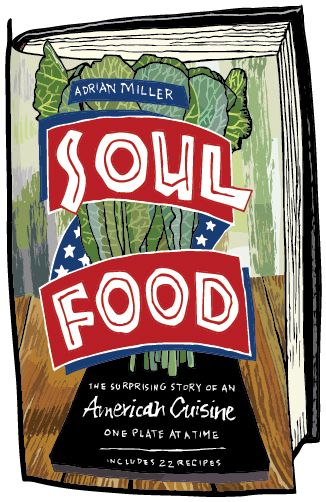 On Tuesday, April 22 at 7pm Zingerman’s Roadhouse will host a very special dinner with Adrian Miller, author of Soul Food: The Surprising Story of An American Cuisine, One Plate at a Time. Chef Alex has created a menu direct from the chapters of Soul Food and Adrian will share his knowledge and the history of the foods we’ll be eating at the dinner.
Ari and Adrian recently chatted about the book:
I loved the book. I think anyone who’s interested in food and history should definitely read it. Can you give folks a sense of what the book covers?
The book is an edible tour of African American history from West Africa to the American West. Since culinary history can be a vast subject, I thought the best way to tell a concise story was by way of an “anatomy of a meal.” I created a representative soul food meal, and I wrote a chapter on every part of the meal and explain what it is, how it got on the soul food plate and what it means for the culture. In most chapters, I include traditional, health-conscious and fancy recipes. One of my main objectives is that people get in the kitchen and cook soul food.
How do you think this historically accurate description of soul food differs from what the average American thinks about it?
In my experience, the average American has maybe heard the words “soul food,” but they really don’t know what it is. For those in the know, they think of something boiled for hours, deep fried or gloriously sweet that ultimately is unhealthy eating. It raises the questions the food writer Donna Pierce asked more than a decade ago: Does soul food need a warning label? Others have adopted the narrative that soul food is the master’s unwanted food or leftovers.
I learned so much from it. If writing is at all you for you like it is for me, I’m guessing you learned a lot too. What are some of the learnings that surprised you during the writing?
Yes, we are kindred spirits, my man! Three big things jump out at me right away. The first surprise is that when I discovered what enslaved African Americans actually ate, the cuisine came close to what we now call “vegan.” They were eating vegetables in season, there was very little meat, and processed foods were a luxury. The second surprise is that, in most situations, master and slave were eating from the same pot. That information completely upends the idea that soul food is slave food. The third surprise is the high-class pedigree of so many soul foods. We tend to think of foods that black people eat as “poverty food” but rich folks were grubbing on it too. Context is important.
You say that the book is a love letter .. . say more about that?
Soul food has such a horrible reputation that I believe it causes people to discount the culinary genius of soul food cooks. I thought it was high time that some celebrated these cooks instead of denigrating them.
What are some of the roots of soul food that go back to African culture and cooking?
Jessica B. Harris has done a lot to show the culinary connections between West Africa and the Americas. In terms of the soul food story, we see similar food habits from West Africa replicated here in what would eventually become the United States. Soul food meals usually involve more fish, more green, leafy vegetables and more seasoning with chillis than the typical American meal.
Greens seem particularly important! Can you say a bit more about them?
West Africans figured out a long time ago that eating green, leafy vegetables were good for you, and that culinary legacy is very strong in soul food cooking. Just as tropical climate bitter greens are consumed in West Africa, temperate climate bitter greens get top billing in soul food circles. The most popular are cabbage, collards, kale, mustard and turnip greens. Now that the mainstream has discovered the nutritional benefits of this food, what used to be called “weeds” when African Americans primarily ate them is now called a “superfood.” When I speak on my book tour, I tell kale lovers “Welcome to the party, black folks have been eating that for at least three centuries.”
Catfish?
As I mentioned earlier, West Africans are big fish eaters. I had no idea that there were species of catfish in West Africa, and that smoked catfish is essential to many stews. Knowing this partly negates the idea that enslaved West Africans arrived to the Americas and were forced to eat completely foreign foods. Now we see that were some things that they would have recognized, thus continuing a West African food tradition in a different part of the world. Anyway, African Americans remain big fish eaters to this day, and catfish is the connoisseur’s choice.
To be clear the life of enslaved people was very, very difficult. Can you talk more about it and what it meant for people’s cooking and eating?
Yes, the difficulty for most enslaved people was getting enough food to eat that was edible. Enslaved people were given, on average, a weekly ration of 5 pounds of cornmeal (or some other starch), a couple of pounds of meat that was dried, salted or smoked and a jug of molasses. That’s it. Thus, the enslaved had to figure out how to supplement their diet by fishing, foraging, gardening and hunting outside of the sunup-to-sundown work schedule. They managed successful strategies to survive, but persistent hunger is a consistent theme in slave narratives.
What about mac and cheese – how that get in there?
Yes, another surprise because there’s not a lot of dairy in soul food and this is clearly an Italian dish. Though, I must tell you that there are several older African Americans who believe that white people “stole” this dish from us just like they did rock ‘n’ roll. Mac ‘n’ cheese gets onto the soul food plate by way of the African Americans who cooked in the Big House. Mac ‘n’ cheese was royalty food as far back as the 1300s and remained a prestige dish for centuries, ultimately making its way to the American South. When the plantation owners entertained with mac ‘n’ cheese, it was the enslaved cooks who often made the dish. After Emancipation, it became a popular item for Sunday meals and special occasions.
And it sounds like it’s a similar story with pound cake and peach cobbler?
It is! These desserts are made from ingredients—white flour, white sugar, whole milk–of which enslaved cooks had little access. In the antebellum South, cakes, cobblers and pies were dishes that appeared on African American tables only on the weekends and on special occasions. Just like other high-end dishes, enslaved African Americans were often the ones tasked to do the cooking.
This is your third trip to the Roadhouse to do one of these special dinners. Excited to be coming back?
Definitely! I had such a great time when I did my “Black Chefs in the White House” event on the night of President Obama’s first inauguration. It was a lively crowd, and it just an enjoyable evening. The same was true when I did the tribute to street vendors. On each occasion, Chef Alex “put his foot in it” so the food was wonderful.
Some of your research was done here at the Longone collection at U of M on your trips to Ann Arbor. How was that experience?
The Longone collection is such an incredible resource! For a researching geek like me, it’s akin to going to Disneyland with an E ticket—you can go on any ride through history with the rare cookbooks in that collections. It helped me connect some dots in my research.
How did the Great Migration impact African American cooking?
I firmly believe that the movement of people from the American South to other parts of the country is the key part of the soul food story, more so than the migration from West Africa. Soul food is really the cuisine of migrants who left a particular part of the South (the Deep South) and tried to recreate home—just as other migrants do. They tried to procure, cook and eat the familiar foods of the South, but when they couldn’t they made substitutions and also picked up a few things from their foreign neighbors. Soul food, at its core, is really a limited repertoire of southern cuisine that draws heavily on the celebration foods of the South.
Your family went west rather than to the north. Can you give us a bit of your personal history?
I’m born and raised in the Denver, Colorado area. This information immediately loses me street cred in soul food circles. I win most of them back by sharing that my mother is from Chattanooga, Tennessee and my father is from Helena, Arkansas. My mother followed an older sister to Denver and my father was in the military and came out here because of the Air Force base. They met in church in the late 1960s, and that union brought me into the world. Because I had southern-born parents who embraced the region’s food rather than distancing themselves, I grew up eating soul food.
In reading the book it struck me that nearly every single item you described is either a regular on the Roadhouse menu or appears fairly often as a special. I realized we actually have a darned good soul food restaurant on our hands!!
Ha! That’s good to know. I believe that if soul food is to survive, it has become accessible. That means people who are not African American need to feel comfortable making and eating this cuisine at home and in restaurants. Some African Americans will have to let go of the notion that white people can’t cook in general, and in particular with this cuisine. I heard that a lot in interviews! Accessibility explains the profound popularity of other ethnic cuisines like Chinese, Italian and Mexican (really Tex-Mex). Much like African Americans, these ethnic groups were at the margins but their food became socially acceptable.
You and I have known each other ten years ever since we met at the Southern Foodways Alliance symposium. We’re both big believers in the work of the organization. Can you tell folks a bit about it?
I love the Southern Foodways Alliance! Not only because it celebrates the diverse food cultures of the South, but also because it creates a space for very different people to connect through food. It shows that if we just took a moment to learn more about what we cook and eat, we’ll see that we have a lot more in common than what supposedly divides us.
The weekend of May 31 and June 1 we have our 5th annual Camp Bacon which is a fundraiser for SFA. Maybe you should come back for it?
I would love that! Dig this, I never went to camp when I was a kid. It would be awesome to go to a really fun camp when I’m an adult!
What else would you like us to know about Soul Food the book, or the food?
I want people to understand that soul food deserves much more appreciation that it currently gets. Soul food doesn’t need a warning label…it needs more love. African American cooks belong to a very rich culinary tradition, and I hope that my work is an appetizer for more investigation into this unique heritage.
Tag: ARI WEINZWEIG
enjoy an inspiring breakfast with zingerman’s co-founder Ari Weinzweig

Please join us this coming Friday, April 4, 730am-9am, at the Zingerman’s Roadhouse for a very special breakfast.
Ari will discuss his latest book, Part 3 of the Zingerman’s Guide to Good Leading series, A Lapsed Anarchist’s Approach to Managing Ourselves. The latest book continues to share the “secrets” that have helped take Zingerman’s from a 25-seat, 4-person start up to a nationally known, $49,000,000-organization employing over 600 people. The book includes Secrets #30-39, and explores our belief that some of the most important work we do to build great organizations and lead rewarding lives is the work we need to do inside. The book includes essays on our approach to managing ourselves, mindfulness, leadership at the four levels of organizational growth, personal visioning, why the way the leader thinks will be manifested in the way the organization runs, creating a creative organization and more.
You’ll also hear from Zingerman’s staff, we’ll be inviting employees from around the organization to engage Ari in a dialogue about Zingerman’s, building the business, being part of this organization and how you can apply Zingerman’s approaches to help strengthen your organization. Don’t miss it!
Event is from 8:00 am to 9:00 am, Breakfast served at 7:30 am.
$20 for breakfast or $45 for breakfast and a copy of Zingerman’s Guide to Good Leading, Part 3: A Lapsed Anarchist’s Approach to Managing Ourselves
RESERVE A SEAT AND ORDER THE BOOK
Tag: ARI WEINZWEIG
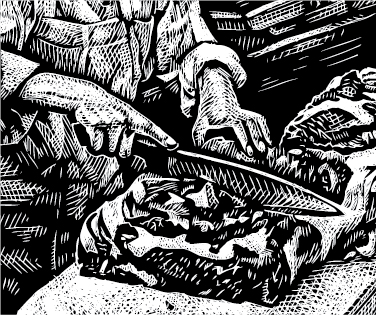 Ari talks meat with Joel at Zingerman’s Roadhouse
Ari: How did you get so enamored of butchery?
Joel: One of my very first jobs was at a little market in Chelsea, Michigan. It’s not there any more. But I loved it so much. I never, ever, ever was like “I have to go to work.” It was a butcher shop. They had some produce and some dry goods and stuff. It’d been there forever. We had great relationships with customers. There were all these regulars that came in all the time. It was like a conversation that continued for years.
A: So you’ve been around meat for a long time?
J: Yeah. I’m a meatasaurus. I probably eat more meat than I should. But I love it. I brought this in for you to look at. [Hands Ari a book.] It’s called The Hotel Butcher and Garde Manger and Carver; Suggestions for the Buying, Handling, Sale and Service of Meats, Poultry and Fish for Hotels, Restaurants, Clubs and Institutions. “An expression of the practical experience of one who has spent thirty years in all branches of kitchen, pantry and storeroom work; also as steward and buyer.” It’s from 1935. I love this book.
A: What do you think about the beef at the Roadhouse?
J: The meats are fantastic here. All of the steers we’re buying are out in the pasture the whole time. No feedlot beef. I think that we’re so incredibly fortunate to get the beef that we get in. Our meat supplier says that he hasn’t had beef this good come in this regularly ever. One of our family farmers goes out to 20 something farms and hand selects the animals. And he loads them up and works with them in the field. Making sure that the fields are being rotated properly. He does meticulous beautiful work. Better treatment of the animals too. I went down there and it was very refreshing to see that it was exactly what I was hoping for. I got to meet all the people who do the slaughtering. The holding pen lets them chill out and be comfortable for their last few days. When I visited they made sure that we were very quiet—even talking about them, they wanted us to move fifty yards away. They want them to be relaxed and not stressed out. Plus, we have 6 to 8 steer a year are coming off our own Cornman Farms in Dexter. It’s raised by us on Island Lake Road. Some of it comes to the farm from 4H auctions and we finish them the last 4-6 months in our fields.
A: What makes the difference between this beef and what other restaurants are serving?
J: Our dry aging program is pretty neat. It’s certainly a more expensive way to prepare and serve beef but the flavor’s well worth it. The dry aging . . . I like to use the analogy of cooking stock down to concentrate its flavor.
A: I often compare it to aging cheese. Does that make sense?
J: Yeah. The more moisture is lost the more you concentrate the flavors. We age the beef for burgers for two weeks. The flavors are already concentrated. With the steaks we continue to age up to about four weeks. I like ‘em a bit older even. But this is a good place to be.
A: And we’re only buying whole animals right?
J: Yeah, all the beef that goes onto the Zingerman’s Roadhouse menu is butchered in the back off the side. We don’t really buy boxed (pre-cut) beef the way most restaurants do. We’re one of the only places that’s buying whole animals. We work with the whole side of beef. We have a whole cooler for the aging. It could be bigger though! We’re serving so much.
A: Given the variability of the food business it can’t be that easy to manage the supply?
J: One of the trickiest parts of my job is to maintain a steady flow of meat. We use almost two steers worth in a week. We have to have burgers and barbecue all the time. So we have to manage the menu for all the other cuts. It’s kind of like a chess match.
A: What does the aging process do for the meat?
J: In the beginning the sides lose one pound or so of water a day. At that stage they’re about 700-800 pounds. The first week to ten days is when you’re losing the most. So by the time we get the beef, it’s been aged two weeks and it might have already lost nearly twenty pounds of weight. And then it keeps losing weight as we age it longer. After you’ve aged an animal the surface has to be cut off. So you lose that too.
A: What do you like about cutting meat?
J: It’s an art form for me. I really enjoy making things. I really enjoy taking something big, a side of beef that’s one big piece and then making all these beautiful steaks and cuts of meat out of it. I have a lot of fond memories of cutting meat from my first job at that market. It’s something that for me is comforting. I also really enjoy the logic puzzle that you have to be able to piece together what cuts to use in order to manage the menu and not have any waste.
A: So with all that work can you really taste the difference?
J: You really can taste the beef. You take a nibble of this and twenty minutes later you’re still tasting really good flavors. The burger is also a very tricky thing. There’s a certain amount that you need to have every day. We only have x amount of animal. You have to be creative and understand what the different parts of the beef will do. I make a blend of the different cuts. It’s got great flavor. And then we cook over oak on the grill.
A: Anything else you want us to know?
J: To be able to use a whole animal this way is pretty neat. Most places they’re getting in boxes of beef and putting it through the grinder. It’s not very traditional. The box beef came in in the late 70s. The craft that is butchery is a dying art now. It’s so neat to be a part of place that nurtures that tradition and encourages it. That makes it not just a thing of the past. There’s maybe three hundred people in the state that can break a steer down. People think meat just mysteriously shows up in the store. But people work hard for it. I’m just grateful to be in a spot where I can do this kind of work with this quality of meat.
A: I think it’s almost a little floral. Does that sound right?
J: Yeah, absolutely. It is quite a bit of difference. The average meat that you buy at the supermarket is a “wet age” where they’ll take the animal right to the cutting room floor. They have a team of folks that are systematically breaking the animals down and the meat goes right into the plastic cryovac seal. It will “age” there. There are a number of studies that show that in the plastic the beef can gain tenderness, but you don’t gain any flavor. In fact sometimes you get some off flavor from the plastic. But you’re not losing the water you do with dry-aging the way we do it. So the cost is lower. You’re taking a 776 pounds of steer and you’re selling it in 776 pounds of product. They sell the bones too.
A: What about the burger?
J: We grind it every day. It’s always freshly ground. And we do all our patties by hand—most places force the meat out through into the patty shape. But that breaks down the fats and the texture. We grind it a bit coarser so you have to chew the meat and get the full flavor. We have a recipe, but it’s not a science. It’s a craft. We use the trimmings from the steaks. One batch of burger is 11 pounds of which 2-3 are aged steak trimming. It’s more flavorful meat at that point. We want to keep the aged flavor but in a burger we don’t want it take over the flavor completely.
Stop by the Roadhouse and taste it for yourself!
Tag: ARI WEINZWEIG
This past Wednesday, Zingerman’s Roadhouse was honored to host the 9th Annual African American Dinner. The event was a benefit for the African American Cultural and Historical Museum of Washtenaw County. The AACHM was established in 1993 to research, collect, preserve and exhibit cultural and historical materials about the life and work of Black Americans in Washtenaw County.
The menu for the dinner was comprised of dishes that are part of the traditional African American food pantheon, and reflect the wide and varied origins of these foods. Ari described the origins of these staples, both from the new world, as well as Africa and Asia. For more about the foods served at the dinner, check out Ari’s description of the menu.
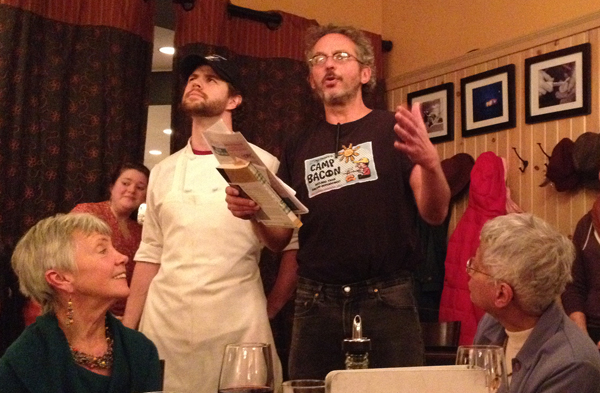
Next, Ari turned over the mic to Dr. Willis Patterson University of Michigan Professor Emeritus of Voice. Dr Patterson is the founder of the Our Own Thing Chorale an Ann Arbor choral organization that has provided free voice lessons for promising Ann Arbor youth for over 30 years. Dr. Patterson was also one of the subjects of the AACHM’s Living History Project in conjunction with the Ann Arbor District Library.
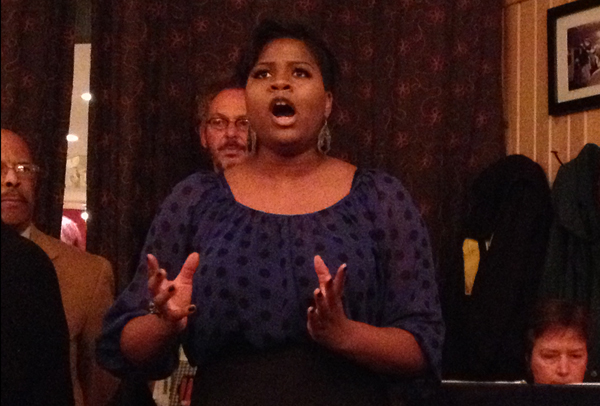
Dr. Patterson introduced Kiera Turner, who sung a traditional spiritual titled, “I Talked to God Last Night.” The spiritual, said Dr. Patterson, served as a fitting benediction before the meal.
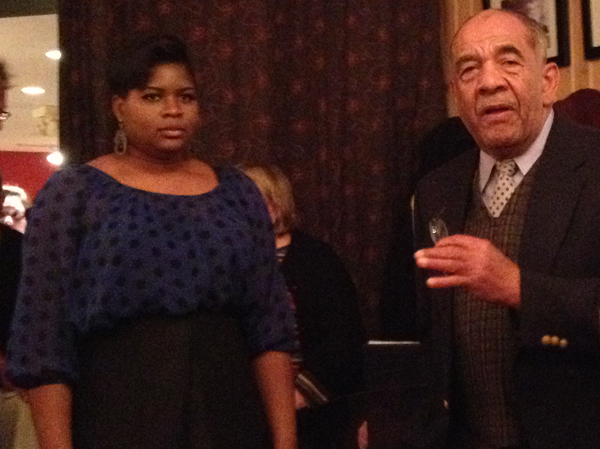
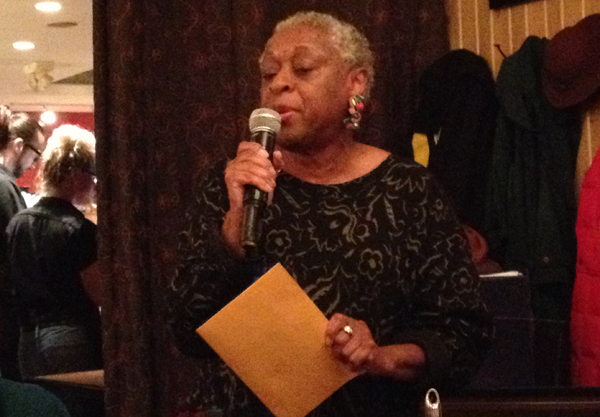
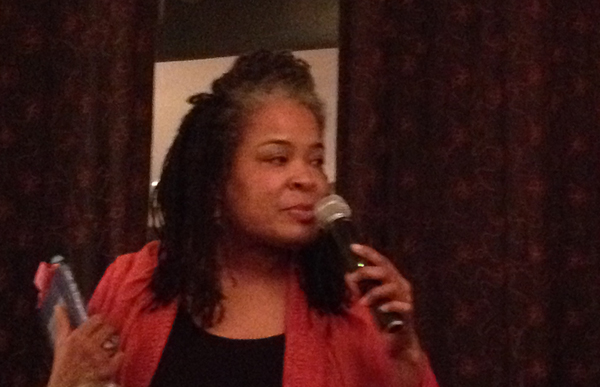
Next, Joyce Hunter and Deborah Meadows, President and Vice-President of the AACHM respectively, talked about the history of the museum, it’s long search for a suitable permanent home, and the museum’s Living History Project and Tours of Underground Railroad sites in Washtenaw County.
After the speakers, dinner was served!
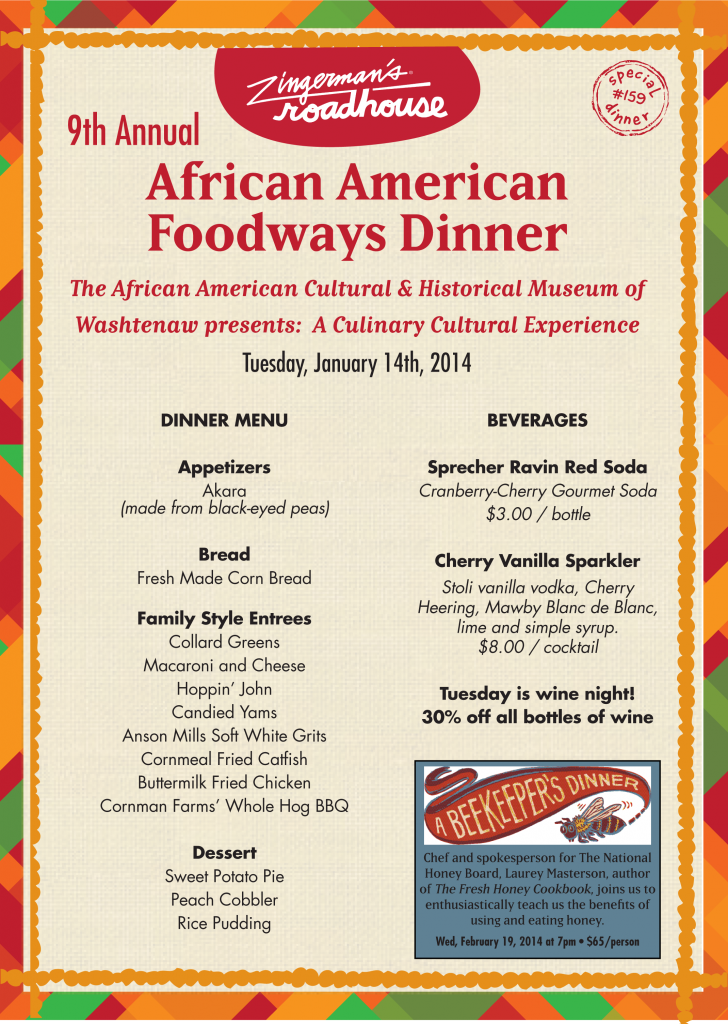
After a sumptuous feast of heart, traditional foods, we were treated to an array of desserts. Interestingly, the historic sweet potato pie recipe called for the filling to made with sliced, rather than mashed, sweet potatoes, in the same manner as an apple pie! We also tasted thick rice pudding, and a wonderful peach cobbler.
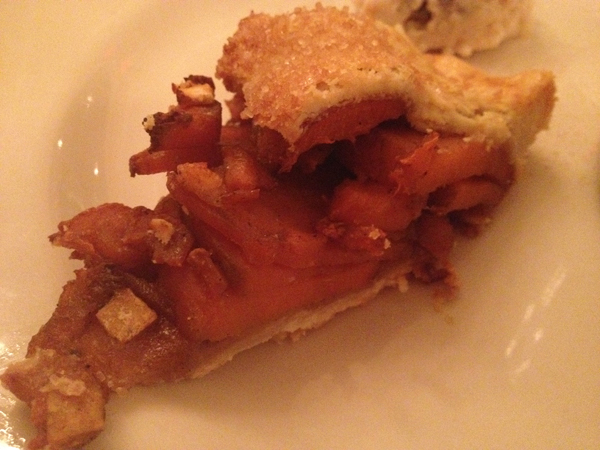
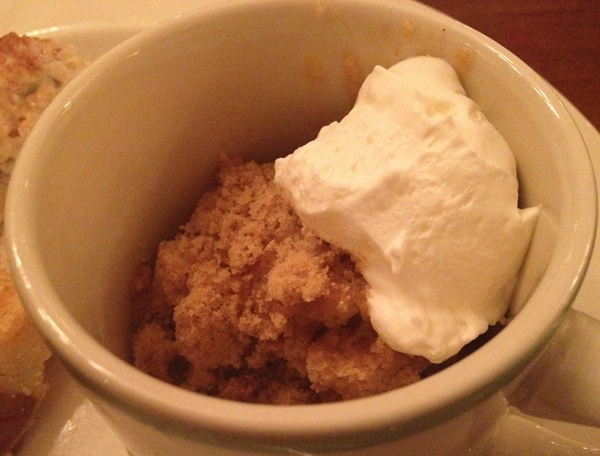
Like all good meals, it was a time for greeting old friends and meeting new people.

And, of course, for lots of photos to revisit the dinner later on.
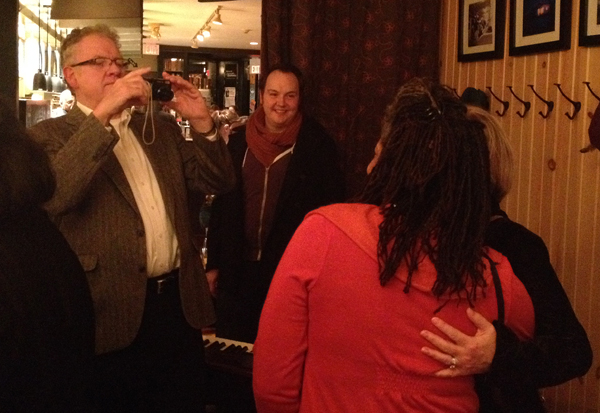
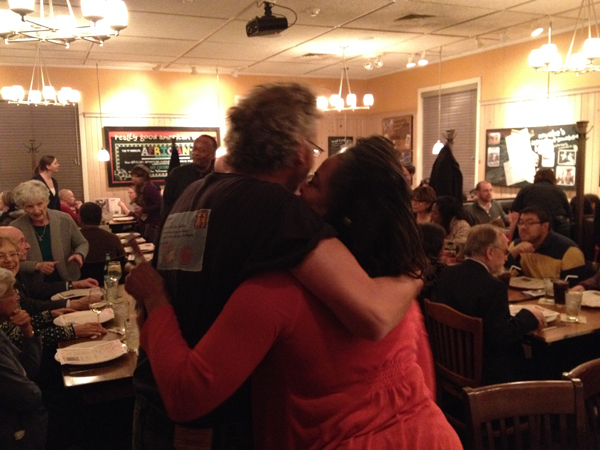
Want to help the AACHM reach it’s goals? Every contribution helps!
Here are five ways you can help today!
See you next year for our 10-year anniversary!