photo by Benjamin-Weatherstonenjoy an inspiring breakfast with zingerman’s co-founder Ari Weinzweig
Please join us on Thursday, January 16 at the Zingerman’s Roadhouse for a very special breakfast.
Ari will discuss his latest book, Part 3 of the Zingerman’s Guide to Good Leading series, A Lapsed Anarchist’s Approach to Managing Ourselves.The latest book continues to share the “secrets” that have helped take Zingerman’s from a 25-seat, 4-person start up to a nationally known, $49,000,000-organization employing over 600 people. The book includes Secrets #30-39, and explores our belief that some of the most important work we do to build great organizations and lead rewarding lives is the work we need to do inside. The book includes essays on our approach to managing ourselves, mindfulness, leadership at the four levels of organizational growth, personal visioning, why the way the leader thinks will be manifested in the way the organization runs, creating a creative organization and more.
You’ll also hear from Zingerman’s staff, we’ll be inviting employees from around the organization to engage Ari in a dialogue about Zingerman’s, building the business, being part of this organization and how you can apply Zingerman’s approaches to help strengthen your organization.Don’t miss it!
Event is from 8:00 am to 9:00 am, Breakfast served at 7:30 am. Call 734-663-FOOD (3663), or reserve your seat online!
$20 for breakfast or $45 for breakfast and a copy of Zingerman’s Guide to Good Leading, Part 3: A Lapsed Anarchist’s Approach to Managing Ourselves
It seems reasonable to assume that experience and education would make for better-rounded, more effective individuals. But when it comes to creativity, the data is that advanced degrees, seniority, and impressive titles make no difference whatsoever. Steven Johnson shows statistically that there’s absolutely no correlation between creativity quotients and any of the usual credentials that earn people social and organizational status. Moving up the org chart, growing older, having a bigger office or a fancier car may matter to some, but they count for naught when it comes to being creative.
To the contrary, if we’re not careful, creativity levels can actually decrease as we mature and move up the corporate ladder. Old-school organizations still tend to confine creative activity to a certain department, or to owners and managers; everyone else is instructed to just implement the ideas the elites initiate. Since so much is filtered out and lost as it moves up through the hierarchy, there’s actually limited access to real-life information from the front lines. As people grow more attached to the status quo, it becomes harder to bust out and break down barriers everyone has accepted for so long. If you sketched out a creativity pyramid, it would probably work in reverse to the way the hierarchical organization operates. Decisions are mostly made at the top, but the potential for innovation and insight are more readily found at the wider base.
Jonah Lehrer, in his book Imagine, makes a comparable case. “The people deep inside a domain often suffer from a kind of intellectual handicap. As a result, the impossible problem stays impossible. It’s not until the challenge is shared with motivated outsiders that the solution can be found.” In the old model, the people “inside the domain” are those at the top of the organization. The “outsiders” are all around them—the front line folks they employ but rarely engage with. Instead, upper level execs hire high-end firms and spend big bucks to gain innovative insight. I’d suggest at least experimenting with a lower cost option: creating a constructive framework in which everyone in the organization is involved. As Whyte writes, “Companies need the contributing vitality of all the individuals who work for them in order to stay alive in the sea of changeability in which they find themselves. They must find a real way of asking people to bring these hidden, heartfelt qualities into the workplace.” Or, as Pablo Picasso famously said, “All children are artists. The problem is how to remain an artist once he grows up.”
What all of this comes down to is bad organizational algebra— if all of the insights are supposed to come from the top of an organization (small or large, for- or not-for-profit), then by definition we’re missing out on the majority of our collective creative ability. As Sir Kenneth Robinson says, “The role of a creative leader is not to have all the ideas; it’s to create a culture where everyone can have ideas and feel that they’re valued.” Business writer Steven Johnson (sounding very much like an anarchist) maintains, “Hierarchical filtering of ideas constricts creativity…. No matter how smart the ‘authorities’ may be, if they are outnumbered a thousand to one…there will be more good ideas lurking in the market than in the feudal castle.” And anarchist Colin Ward warns, “the knowledge and wisdom of the people at the bottom of the pyramid finds no place in the decision making leadership hierarchy of the institution. If ideas are your business, you cannot afford to condemn most of the people in the organization to being merely machines programmed by somebody else.”
Conclusion: A Quick Look at Leaders and Creativity
Personally I’ve started to focus particular attention on how we attempt to spread our creative mindset, optimistic outlook, and openness to ideas to people we’ve newly hired into our organization. The way we welcome them into the organization makes an enormous difference. Many will unknowingly have been taught that they have no influence over anything in their organization. In which case, why get creative?
This helpless feeling is, unfortunately, endemic. It feels more and more to me then that the most important creative work we can undertake is an effort to encourage those who are new to our organizations, our social circles, or our families, to undo that difficult state of mind. We can teach people that rather than wait for their bosses to make things better, they’d do better to think boldly, to go for greatness, to wonder why, and to release a bit of their natural wildness into the world. Whether your organization employs five people or fifty, five hundred or five thousand, think of what amazing things might happen if we could unleash all of their naturally occurring creative abilities.
Pulling a couple of my favorite themes together, maybe I’ll leave you with this thought from Basque performance artist Esther Ferrer. Writing to composer John Cage, she articulated that anarchism, like creativity, is “choice, which engages only yourself and which you decided to practice. . . . One can practice it alone, even if others are not at all interested. . . . These ideas, John, at bottom, are simply natural creations of free thought . . . capable of inventing imaginative and joyful solutions.”
So, I say, let’s get to work and have some fun while we’re at it. Go wild, read books, connect all the dots you can, and “embrace the anarchist.” Whatever you do, don’t worry—the creativity will come, and when it does it’s sure to raise our spirits, our effectiveness and our enjoyment of life. At the least we’ll breathe better. As Julia Cameron says, “Creativity is oxygen for our souls.”
In truth, I couldn’t understand how it could be otherwise. How could you have an even kind of successful company, or employees who you thought were doing a good job, if creativity weren’t involved? The question caused me consternation, but it also made realize that we must have a different definition of what it means to do a “good job” than most mainstream organizations. The difference I realized was partly in the wording. When you hear about someone who does a “good job,” more often than not they’re being praised for follow- ing orders, completing tasks they’ve been assigned by their “superiors.” But, I realized, what we’re trying to do here at Zingerman’s is to provide more than a good job—we’ve set our organizational sights on good work!
Good work, to me, means doing work we love, defined in part as a challenge we freely and mindfully choose to take on. By definition it requires focus. According to Mihaly Csikszentmihalyi, “People seem to concentrate best when the demands on them are a bit greater than usual, and they are able to give more than usual. If there is too little demand on them, people are bored. If there is too much for them to handle, they get anxious.” When the demands are perfectly in synch, and we’re working “in the zone,” or, as Csikszentmihalyi calls it, “flow.” As he defines it, flow is basically the best of good work—it’s fun, it’s fantastic, it’s educational and entertaining and exhilarating all at once. I work hard to have as many moments in that state as I possibly can. It’s immersion learning at its most inspiring. And, as Csikszentmihalyi says, “Creative achievements depend on a single-minded immersion.”
Good work like this is, by definition, all about creative energy. It’s work that helps people be themselves, that taps their natural abilities, work people care about, in a workplace that cares about them. When people do good work, they’re enjoying what they do and feeling fulfilled and rewarded by it. As Sir Kenneth Robinson writes in Out of Our Minds, “Real creativity comes from finding your medium, from being in your element.” It happens best, I believe, when we work in harmony with the Natural Laws of Business. When people are doing good work, feeling good about themselves and what they do, in an environment that encourages them to think freely and be frank about both their fears and their fantasies, creativity comes naturally. So much so that most people who are doing good work in this context don’t even know they’re being creative! They, like me, and most of the folks who work at Zingerman’s, probably can’t imagine life any other way.
Everyone Is Creative
On the surface at least, nearly all the social credit for creativity seems to be given to the superstars. Media focus is almost always on the talented artists, the brilliant writers, the prize-winning scientists; the people who cut the edge and then sew it back together in unique, attention-getting, world-changing ways. In the corporate world, creativity is often attributed to “R & D,” “marketing,” or maybe a carefully cultivated “innovation team.” These folks are treated as if they’re some special “creative class,” privileged enough to have been given some innovation gene that the rest of us don’t have access to. While much of what comes from that upper class of creativity is certainly worth admiring, I’m far more focused on everyone else. The creative organizational edge, I would argue, isn’t to be found by CEOs getting more brilliant or by innovation experts being more insightful—it’s in tapping the generally under utilized creative force of the folks on the front lines.
Although skill levels in most fields may range widely from one person to the next, we’re actually all pretty equally endowed when it comes to creativity. I like the way writer Hugh MacLeod, in his excellent book Ignore Everybody, puts it: “Everyone is born creative; everyone is given a box of crayons in kindergarten. Then when you hit puberty they take the crayons away and replace them with dry, uninspiring books on algebra, history, etc. Being suddenly hit years later with the ‘creative bug’ is just a wee voice telling you, ‘I’d like my crayons back, please.’”
Which is hilarious because one night not too long ago, a guest at the Zingerman’s Roadhouse told me that when they got seated for dinner, the hostess gave her artistically oriented child three or four crayons to draw with. When the hostess walked back by a few minutes later, the kid politely asked for a few more. And, his mother explained, “She came back and gave him a whole box! He was thrilled. And I realized right then that that was my metaphor for coming to Zingerman’s. Everywhere else you go, they just give you a couple of crayons to work with. But when you come to Zingerman’s, it’s like you get a whole box of cray- ons to color with every time you come in!”
Brenda Ueland, whose insights changed the way I write, had this to say on the subject: “Everybody is original, if he tells the truth, if he speaks from himself. But it must be from his true self and not from the self he thinks he should be.” Left to play on their own children consistently prove them- selves way more creative than the average adult; playfulness provokes positive energy, which in turn cultivates creativity. Science fiction writer Rod Serling, who I’m sure knew more about UFOs than IPOs, said, “Ideas are probably in the air, like little tiny items of ozone. That’s the easiest thing on earth, to come up with an idea.”
Which brings me back to Emma Goldman’s great line: “Anarchism is the spirit of youth against outworn tradition.” Thinking creatively, she clearly knew, need not depend on chronological age. It’s all about attitude. Acting young, thinking youthfully and anarchistically, without the standard constraints of a conservative adulthood, consistently brings about the kind of positive energy that underlies pretty much everything good you can imagine. When it comes to creativity, the people really do have the power!
Creativity is a nearly universally sought-after attribute. I really can’t think of anyone I’ve ever met that didn’t want to have more of it. The funny thing is that unlike baking a cake or building a cathedral, you can’t really design and create creativity—it kind of just happens. What you can do, though, is actively build an environment in which creativity, encouraged rather than encumbered, is much more likely to occur.
The interesting thing, though, is that until I started work on this essay, I really couldn’t have explained to you what it was we were doing to make that happen. But having given it much more thought of late, it’s clear to me that we were all, by training standards, unconsciously competent: good at being creative but clueless about what we were doing that was making it happen.
One caveat before we begin. Although everyone is interested in the idea of being in a creative setting and living a creative life, I’m not sure that all of us are ready to do what it takes to really increase the odds of it happening: sharing information widely; releasing control; encouraging the crazy, can’t-quite-figure-out-what-to-do-with-them kind of ideas that challenge the status quo and our existing realities. The essay that follows, then, is my only recently realized take on how we, and other creative companies and individuals I know, have cultivated our minds and our methods to make creativity an everyday, even ordinary, occurrence.
Calling for Creativity
Let me take you back a few years, to the dark days of the economic morass of 2009-10. After fifteen years of doing ZingTrain work and speaking all over the country, we suddenly started getting a whole mess of requests for me to present on a subject I’d never ever spoken on. You guessed it—the calls were all about creativity. Each was some version of, “With the economy tanking like this we really need to crank up our creativity! You guys are so great at it. We want you to come speak and share your secrets.” Or, “We want you to help our people learn how to build an innovative organization the way you guys have!” I was honored, but at the same time caught off guard. The problem was that we’d never done a day—or an hour, or even ten minutes—of training, teaching, or writing specifically focused on the subject of creativity.
Over the years we’d developed effective organizational “recipes” for service, quality, and complaint handling. I’d presented extensively—both within our own organization and around the country—on visioning, customer service, servant leader- ship, Open Book finance, training techniques, marketing, and management. But we had nothing—not even an idea of an outline—on innovation. How, I wondered to myself, could we have been so out of it that we’d completely missed such an important concept? Stumped, then, I decided I’d spend some time talking to the clients from whom we’d gotten the inquiries to find out more about what they wanted.
The good news was that they were quite enthused about the idea of me coming to talk. One said, “Just tell ‘em what you do!” Others asked more specific questions. One guy who runs an innovation department at a big company wondered, “Who at Zingerman’s is responsible for innovation?” Heck. I had no idea.
Who was responsible for our creativity? It’s as if he’d asked me who was responsible for breathing. I stuttered and stumbled a bit before muttering, “Everyone, I guess.” (It turns out that was totally the right answer, but at the time, I was very unsure of what I was saying.) “Do you give people dedicated time for innovation?” another woman wanted to know. That really left me feeling foolish—we didn’t set aside any time at all. I’d never realized we should. “But don’t you teach classes on it?” still another person asked. “Well, no,” was my honest answer. “We’ve never taught one at all.”
I was starting to feel like an innovation impostor. Clearly, our clients were convinced that we were really creative, and that we had the kind of caring-capitalist-cool they were looking for. And yet, here I was, basically coming up empty when it came to talking about it. We had no constructs designed for creativity, no corporate program for it, no classes to teach it. Somehow, though, we’d made it happen anyways.
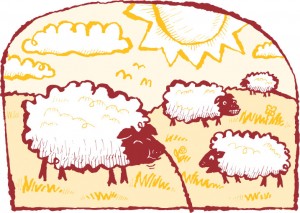
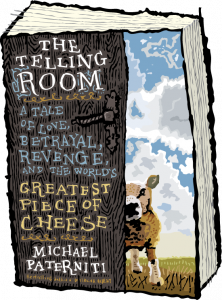
Michael Paterniti’s book The Telling Roomdocuments his pursuit of an obscure Spanish cheese – a cheese he first encountered while working at the Zingerman’s Deli back in 1991.
On Thursday, September 26, 6:30pm, Mike will visit the Deli and tell the story himself. He’ll sign copies of the book, as well as copies of the Zingerman’s newsletter that features the book’s release. We’ll also taste a delicious selection of fine Spanish foods, including many of our favorite traditional cheeses. Copies of Michael’s new book are available at fine bookstores everywhere, but seats at the event are limited. Reserve a seat online or call 734-663-3400!
You’ve created a great non-profit in Portland Maine called the Telling Room. Can you share with folks what it’s about?
Thanks so much for asking! We’re coming up on our tenth anniversary, and it’s just been amazing to be a part of this organization that has about 200 volunteers, and serves roughly 2,500 kids a year. Among other things, we offer writing and storytelling workshops, in all genres and media. And we work with wonderfully diverse storytellers, who constantly blow our minds. When my wife and I came back from living in Spain in 2003, we decided we wanted to try to make a telling room in Portland, to mimic Ambrosio’s in Guzmán, a space where people could tell their stories and secrets and dreams. That’s where we began, and today it’s grown into this wonderful nexus in our community. And I’m always awed and inspired by how courageous the kids are, what natural storytellers we all are if given some guidance and an audience. We’re at www.tellingroom.org, for anyone who might want to know more. I can say, though, that it’s been one of the best things in my life.
Talking about storytelling and sharing tradition, Gary Snyder, the Beat poet, wrote that “Books are our grandparents.” It struck me that, in the same way Ambrosio was hoping each successive batch of cheese would “remember” him and his family, that the books we write them are as much our children as they are “our grandparents” later when we read them. You worked to give birth to this book for a long time. Is it like a child?
I’m gonna go with that! I haven’t given birth myself, but man, at times it felt as if I was. I think of books as having a birthing process but maybe emerging as grandparents. Does that work?
Ambrosio says at one point, “When you put love and care and hundreds of years of history into a product like this one, you can taste all of it.” He goes on to say, “. . . if you asked me the secret, I’d say it was because we made it in our home, the old way, the way it had been made for hundreds of years. Perhaps in the United States you don’t know what it’s like to have old flavors, flavors from the past, from centuries before. But we lived with them every day here. My children know those flavors.” And then he finishes the point: “My mission is to make sure we don’t forget the old way.” It’s a great bit of the book for me. It makes me realize why I was so drawn to Páramo de Guzmán cheese back in the early ‘90s. He’s really summed up what we believe at Zingerman’s and about our pursuit of traditional food and flavor. Thoughts?
I think it’s absolutely no coincidence that I found this cheese here at Zingerman’s. I’m not sure many, if anyone else, in the country was selling Páramo de Guzmán at the time. You and Ambrosio are simpatico brothers, for sure.
You write about Ambrosio’s tale as being “the kind of fable in which everything, especially the hero, is bigger than life and thus takes on the quality of legend.” I think that kind of sums up the spirit of the whole story. Is Ambrosio a man of almost mythical proportion?
For years, he was exactly that to me. And in order to finish the book, my greatest struggle was forcing myself to try to see him as a man, a person with flaws like all of us, but who as you say had this “mythical proportion,” and life philosophy, that I really needed to believe in.
You write that Páramo de Guzmán “was a visionary’s cheese: It cut to the heart of how (Ambrosio) felt a human being should eat.” It’s funny that twenty years later, here we are at Zingerman’s teaching visioning to the rest of the world, and this cheese that resonated with you and with me so long ago was very much a cheese that fits with that model. What makes you say it was a visionary’s cheese?
Because it was an impossible cheese, too. It took some years to recover the recipe because it wasn’t written down. And it was hard to make. It relied on local sheep, Churra sheep, that produce less milk. And the milk was then rushed a quarter mile from the barn to the stable where they first made the cheese. And the curd of the cheese was cut quite small, which was time-consuming and made it very dense. Ambrosio would take the cheese up to the cave for aging, but then he’d show up every day, to turn the wheels, too. The process of making the cheese required care and attention, from the be- ginning to the end. And as Ambrosio said, this process of pouring your love and care into something was also what you tasted when you tasted Páramo de Guzmán. It was the classic case of one person, rebelling, looking at a culture fattened on industrialized food, on cheese products spelled C-H-E-E-Z (Cheez Whiz, Cheez Doodles) and asking, Why can’t we make it like this, by hand, the old way? I think people tasted that in the cheese—and fell in love with it, too.
What’s it been like to come back to Zingerman’s twenty years later?
Fantastic—and a bit of a mind-bend! I mean, look at this place. The Roadhouse. The Creamery. All the things you have going on. It feels as if that original seed, planted all those years ago, spurred an American movement that coincided with these bigger ideas about food that we now hold more commonplace. We want to know where our food comes from, and what the stories are. Talk about visionary: You guys really were here at the beginning, preaching all of this before it was fashionable!
When all else is said and done, what would you like people to know about the book?
In reading it, I’d love for them to feel that sense of awe I have every time I go back to Guzmán, and spend time in Ambrosio’s presence because he’s such an immense, compelling character. I’d love for people to feel they’ve escaped the digital speed of our lives for a little bit, and been transported to a pretty magical place that exists up there on those Castilian highlands. I would hope that they might be embraced inside this story the way I was—as if sitting in a real telling room, listening to Ambrosio—and then feel the trapdoors open, until they’re lost in this otherworld where nothing really is exactly as it seems, where some of the deeper pains of life are alleviated by the pleasure of the stories that get told.
See you at the event!
Tag: ARI WEINZWEIG
Michael Paterniti’s book The Telling Roomdocuments his pursuit of an obscure Spanish cheese – a cheese he first encountered while working at the Zingerman’s Deli back in 1991.
On Thursday, September 26, 6:30pm, Mike will visit the Deli and tell the story himself. He’ll sign copies of the book, as well as copies of the Zingerman’s newsletter that features the book’s release. We’ll also taste a delicious selection of fine Spanish foods, including many of our favorite traditional cheeses. Copies of Michael’s new book are available at fine bookstores everywhere, but seats at the event are limited. Reserve a seat online or call 734-663-3400!
You spent nearly a decade pursuing this cheese and the man who had made it. I’d imagine you caught a bit of grief, or at least disbelief, from people you knew during that time?
All the time. On those occasions when I told people I was writing about cheese, some were quick to say, “Oh, like ‘Who Moved My Cheese?’” And I would respond, “Sorta—but with a Shakespearean murder plot.” I think, in the end, time was a friend to the book. I was waiting to see what would happen between Ambrosio and Julian, the man he claimed had stolen his cheese. To see how that murder plot would really unfold, but I also came to this realization that what I was doing was Slow Reporting, too. And some Slow Living. In my job as a magazine journalist, I never quite had that luxury. You might land in Cambodia or India or the Sudan and have X days to get your story—and then get out. I loved the idea of sinking in a little. Our family lived there for a summer, too, and those are some of my best memories of the kids.
I love all the footnotes in the book. Can you share the story behind them?
Castilian storytelling is a wild business, full of digressions and asides, historical footnotes and factoids. Often, it’s what gets said in the marginalia, or that excursion away from the story itself, that reflects the truth of the story being told. The legend of the great Castilian hero, El Cid, says as much, for instance, about Ambrosio’s blood feud with his best friend, Julian. I’ve sat in Ambrosio’s telling room for an entire days, listening to him tell a story so full of digressions that even by midnight, he still might not be done. So I wanted the book to reflect the spirit not just of Slow Food but Slow Storytelling, the way it’s practiced in Guzmán. Besides that, they were a blast to write!
Early in the book, Ambrosio tells you about eating in an “ancient way”—probably what we at Zingerman’s would call traditional. He says, “You start by eating good beans and a good lettuce salad with olive oil and tender lamb chop or fresh rabbit. Everything is accompanied by a good piece of wheat bread and a good wine and good friends and, at the end, a sip of brandy.” It sounds fabulous. Have you had that meal? Maybe we should recreate it?
I had that meal—and many others like it! Each awesome in their own way. If you re-create it, I’ll be there!
One of the things I’ve learned about writing is to push forward and let the seed of what’s inspiring grow and develop and see where it takes me. You wrote, “The story itself spoke, calling out for a teller and a hero. It craved a dramatic ending, even if the truth needed tweaking or the lead needed revising.” What have you learned about writing from pursuing the cheese and the story? About life?
That everything—a political campaign, marriage, family dinner—is a narrative collaboration, or battle. And that you need great patience in order to deconstruct someone’s story or legend or myth, to find the truth. Or your truth. You need great patience to figure out what it is you mean to say—and what you believe. What I learned about writing is that on certain days you find yourself on a very lonely island, feeling a little betrayed by your own limitations, and the only way off is to keep writing the words that become the bridge that lead eventually to the epiphanies that make it all worthwhile again.
Food plays a pretty different role in the rural Spain in which Ambrosio grew up than in the America that we were raised in. Can you talk a bit about that?
Ambrosio describes the lost art of eating like this: “As a child, I lived an old kind of life. Not like people living in Madrid or Tokyo or New York. It was a way of life that meant you raised chickens from the egg, you had a good relationship with your dog, you held your animals and prepared the animals for your table by giving them your love. It was the end of an era when everything was natural. There were no mad cows, there was no such thing as preservatives here. We ate in an ancient way.” I think the big thing is that the food grown there, and eaten there, is inextricably linked to their identity, to who they are, and their sense of themselves. Ambrosio describes what it was like in 1955, and he’s describing what it’s like for him today, too.
You wrote that making the cheese again “became Ambrosio’s overriding obsession.” Is it fair to say that that obsession passed through to you. Do you think you became a bit obsessed with the idea of telling the story of his obsession?
Exactly! And then after I’d faithfully laid down the legend of his cheese as he told it, I became obsessed with finding the truth behind it, too.
You share the story of Ambrosio and what he said as he would taste each successive batch of cheese in his drive to reproduce the family’s old recipe. “For this, he had a little ritual,” you wrote. “Before taking a bite, he’d ask the cheese, ‘Are you the one who’ll remember us?’” That’s a nice image—the idea of a mutually beneficial, meaningful relation- ship between traditional food and its maker.
I love that. And I love the way Ambrosio really does talk to his animals and to the grapes that make the wine, etc. Everything is animated in his world—and alive. And that forces a deeper kind of respect for everything.

 To the contrary, if we’re not careful, creativity levels can actually decrease as we mature and move up the corporate ladder. Old-school organizations still tend to confine creative activity to a certain department, or to owners and managers; everyone else is instructed to just implement the ideas the elites initiate. Since so much is filtered out and lost as it moves up through the hierarchy, there’s actually limited access to real-life information from the front lines. As people grow more attached to the status quo, it becomes harder to bust out and break down barriers everyone has accepted for so long. If you sketched out a creativity pyramid, it would probably work in reverse to the way the hierarchical organization operates. Decisions are mostly made at the top, but the potential for innovation and insight are more readily found at the wider base.