Tag: ARI WEINZWEIG
Zingerman’s 4th Annual Camp Bacon is coming soon and to help get everyone prepared, we’re sharing tasty excerpts and recipes from Ari’s book, Zingerman’s Guide to Better Bacon.
Emma Dencklau’s Iowa German Potato Salad
This recipe first came up courtesy of historian and long-time Zingerman’s customer Leo Landis, whom I met many years ago when he was working at the Henry Ford Museum in Dearborn. Leo moved back to his native Iowa a few years ago, but we’ve continued to correspond: I asked for his help in preparing a special “Foods of Iowa” dinner at the Zingerman’s Roadhouse, and in return he shared many lovely little bits of Iowa history and culture, one of which was this great bacon-powered potato salad.
The Dencklau recipe dates to the early part of the twentieth century and probably goes back to older roots in Germany. Emma’s family arrived here from Germany at the turn of the last century. According to the 1920 census she was born in 1902 in Webster County, about 100 miles north of Des Moines. Today the trip is about an hour and a half by car, but back then it would have been roughly two days each way on horseback. Looking down the census page you can see how many families in the area were of German origin, so it’s not surprising that potato salads like this were and are very common. Leo got the recipe from the grandson of the woman to whom it’s credited, which means it’s basically third-generation American by this point.
The vinegar is a key ingredient, whose quality is integral to the flavor of the finished dish. As I’ve said many times, I’m very high on the cider vinegar we get from Pierre Gingras in Quebec. It’s made from hand-picked apples, no windfalls, no dregs, then aged for over two years in oak barrels. In this dish it adds that lively vinegar zip, but because Gingras’ is so well-made and its flavor so well-rounded, the flavor of the finished dish is lively without seeming overly sharp. Rather than using tap water I used the cooking water from the potatoes, both because the starch in the water helps binds the sauce and because it brings its own flavor to the salad.
Emma’s exact recipe is below. I used the Nueske’s applewood-smoked bacon, since its roots are—as were Emma’s—both German and Midwestern. I’ve kept the original, large quantities because they more accurately reflect the way dishes were cooked back in Emma’s day. All the ingredients are portioned in nice round numbers, so you can easily halve or quarter the amounts if you want.
I personally don’t love sweet salads, so I when I make this at home I add almost none of the sugar that Emma calls for. By contrast I probably put in a bit more freshly ground black pepper. Regardless, the finished salad is darned delicious—very rich, but lightened on the palate by the goodly dose of vinegar.
Ingredients:
- 4 pounds potatoes (I prefer Yukon Golds or German butterballs because they’re delicious and buttery in their own right, and also because they absorb the bacon fat so beautifully)
- 1 pound sliced Nueske’s or comparable bacon (about 8 to 12 slices)
- 1 large onion, coarsely chopped
- 2 tablespoons flour
- ½ cup cider vinegar
- 2 tablespoons sugar (optional)
Procedure:
- 1. Steam the potatoes in their skins over salted water for 30 minutes or until well-cooked and fork tender. Remove them from the heat and allow to cool, reserving 1¼ cups of the cooking water.
- 2. Fry the bacon over medium heat until nearly crisp but still bendable, then remove it from the pan and cut it into 1-inch pieces. Leave the fat in the pan.
- 3. Reduce heat to low and add the onion to the pan. Cook over low heat until soft, stirring occasionally.
- 4. Raise heat to medium. Sift the flour over the onions, then stir steadily for about 5 minutes to make a roux. The flour and fat should become well bound and very lightly brown in color.
- 5. Slowly add the cider vinegar to the roux, stirring steadily until the sauce thickens. Repeat with the potato water, again stirring constantly until the sauce is thickened. Add the sugar if you like and, again, mix well. Remove from the heat.
- 6. Cut the cooked potatoes into 1-inch cubes and add them to the sauce along with the bacon pieces. Mix gently, but well.
- 7. Serve immediately, while the salad is still warm. It also keeps well in the refrigerator—you can serve it the next day and it’s still quite good, either cold or reheated.
Serves 4 to 6 as a main course, or 8 as a side dish.
see you at camp!
Tag: ARI WEINZWEIG
Zingerman’s 4th Annual Camp Bacon is coming soon and to help get everyone prepared, we’re sharing tasty excerpts and recipes from Ari’s book, Zingerman’s Guide to Better Bacon.
Wilted Salad
A great all-American dish dating back to the Colonial era, wilted salad uses bacon fat as the basis for a dressing in much the same way that olive oil is used to dress greens in the Mediterranean. The heat of the bacon dressing wilts the greens—hence the name. April McGreger, who grew up with bacon fat as the basis for a lot of her family’s food, told me that they called this “killt lettuce”—because the lettuce is “slain” by the hot fat, not because of any connection to Scottish menswear. The bacon’s flavor is a big part of the dish, so use whatever variety strikes your fancy. Because the fat will solidify once it cools, the dressing must be served warm.
Ingredients:
- 6 ounces mixed greens, washed and dried
- 6 ounces sliced bacon (about 3 to 4 slices)
- 2 scallions (greens and whites), thinly sliced
- 2 tablespoons cider vinegar
- ½ teaspoon sugar
- Coarse sea salt to taste
- 2 ounces cheddar cheese, diced (optional)
- ¼ cup walnuts or hickory nuts, lightly toasted and chopped (optional)
- Freshly ground Tellicherry black pepper to taste
Procedure:
- 1. Place the greens in a large, heat-proof serving bowl.
- 2. Fry the bacon in a heavy-bottomed skillet over medium heat until crisp. Remove from the skillet, drain and chop it. Reserve about 4 tablespoons of fat in the skillet (augment with a glug from your backup supply if necessary).
- 3. Add the sliced scallions to the pan and cook for a minute. Pour in the cider vinegar, sugar and a pinch of salt. Stir well and boil lightly for a minute.
- 4. If you’re using cheese or toasted nuts, distribute them over the greens. Pour the hot dressing over the top, toss well and sprinkle with the bits of cooked bacon and plenty of fresh pepper. Serve warm.
Serves 2 as a main course, or 4 as a side dish
See you at camp!
Tag: ARI WEINZWEIG
Ari recently talked with cured pork producer Herb Eckhouse, founder of La Quercia, about Iowa, pancetta, and the history of the Tamworth Hog .
Herb will be speaking at Zingerman’s 4th Annual Camp Bacon this summer. Please join us!
In Pursuit of World-Class Cured Pork
Herb and Kathy Eckhouse have been curing great air-dried hams, pancetta, guanciale and other fine meats for many years now. I wrote about him extensively in the bacon book—he and I actually went to high school about four miles apart back in suburban Chicago. The Deli sells a wide range of Herb’s really wonderful cured pork products. Their cured hams, lardo, guanciale, pancetta and other pork products have been acclaimed by aficionados all over America. The flavor of everything they make is pretty marvelous and their commitment to sustainable hog raising is pretty inspiring. Herb will be coming to speak at Camp Bacon June 1st!
Ari: Yours are unquestionably some of our favorite cured pork products at Zingerman’s. What are some of the key things that make them so special? 
Herb: It all starts with the pork. That’s 96 percent of what people eat when they eat our cured meats. We are committed to using pork from pigs NOT raised in confinement and that NEVER receive non-therapeutic antibiotics. This is a very elite level of pork quality—less than one half of one percent of the pork in the country meats these qualifications. In addition, we are working with our suppliers to provide continuous pasture access for the hogs throughout the year. We work with heritage breeds, like Berkshire and Tamworth, and we select for our own quality criteria within this group. Our real candidate pool is probably more like a third of one percent of the pork on the market!
We do this for many reasons—because these practices are more humane, because non-therapeutic antibiotics and confinement production have adverse environmental impacts (that we experience directly in Iowa because so many hogs are raised there), and, maybe most important, because we think that meat from animals who have experienced minimal stress ages and tastes better. It is more delicious. We carry this same level of obsessive attention to detail and willingness to commit resources to achieve higher quality through everything that we do.
Part of why we get along so well and love your products so much is that you’re going in pretty much the opposite direction of mainstream pork. How does it feel to be departing from what the mass-market producers are doing?
We are a small company hand crafting our meats. We knew we would be going in the opposite direction of the mainstream–we can’t and don’t want to do what the big companies do. But, just as American cheese and beer craftspeople have moved their mainstream industries, I believe that with our colleague companies, we will be able to do the same with pork curing. For example, we are seeing good growth in the production of antibiotic free pork. That’s a really good sign. Though most of it still doesn’t meet our standards, there’s movement in the right direction.
How have folks in Iowa responded to your work?
We’ve had a great reception in Iowa. You can probably find La Quercia Prosciutto more easily in Iowa than in any other state. We’ve worked on that, and local people have been very supportive.
Who raises the hogs for you?
Our closest relationships are with Russ Kremer who heads up Ozark Mountain Pork Producers Cooperative (they sell their pork through Heritage Acres) and Jude Becker of Becker Lane Farms. Russ tells me that we are some of his most demanding customers. Together we help move his program in the direction he would like to go. Our most exciting projects have come together with Russ. We worked with him for 5 years to get our Tamworth breed program goin’. The Tamworth is an endangered Heritage breed in the US, and now we are getting regular deliveries from him of this meat that has deep sweetness when you age it. This group, and the Berkshire-cross meat we get from him are due to qualify as continuous pasture access animals by September. That enables us to make all of our pancetta, guanciale, coppa, and lardo from pastured pork. We do our Woodland Acorn Tamworth program with him too—those are hogs that we finish each fall on Iowa acorns, much as happens in western Spain to make the (world famous) Iberico ham.
What’s the history of the Tamworth hog?
When you read about the Tamworth breed, you learn that it is known as the “Bacon Pig.” Why? Well its belly meat is supposed to be tender and it has good balance of fat and lean. From making the prosciutto, we found that when we dry and age it the meat is sweet, so I thought we had to try it. We had done some bacon with Berkshire cross meat in Spring 2009, but we really didn’t do that great a job with it and the bellies had that heavy, creamy rich Berkshire fat that can dominate. So we decided to commit to making bacon from the “Bacon Pig” without ever having had any–that was the act of faith. We didn’t get our first batch until about the end of 2010.
What we found was that the Tamworth belly meat was sweet. We use no sugar, dextrose, molasses, or any sweetening of any kind, yet that bacon is sweet. I love eating it—surprise! Plus the fat is softer and less rich and creamy than the Berkshire fat, so it plays a supporting role–not as up front and dominating as with the Berkshire. Probably as important as anything is the soft, smoky, very clean, no burn aftertaste–it just lingers. We use only pork, sea salt, and spices (black and white pepper, rosemary, bay leaf). Nitrates leave a taste–a hot, burning, peppery taste, and this bacon does not have it. Plus, since we make and preserve it the way we do all our meats–drying it to remove the moisture–it is shelf stable. You can enjoy “bacon sashimi” if you want. We recommend lower heat and less cooking for it.
What’s your favorite way to eat the Tamworth bacon?
Lightly cooked at low heat. When you eat it without cooking, you can really taste the sweetness of the meat. Light cooking is kind of the best of both worlds–the succulent melted fat with the sweet meat flavor. Because it is dry cured and low water content, the fat has a lower smoke point so however you cook it, we recommend doing so at low heat.
Are other farmers in the area taking notice?
We regularly get calls from individuals wanting to raise pigs the way we want them raised, and we typically refer them to Russ. I think that other farmers are taking notice.
Since you’re coming to camp bacon, let’s look at bacon for a minute. Tell us about your pancetta? And what makes it different from American bacon that most folks here are familiar with?
Again here, first I need to reference the meat–we use the high quality meat I talked about previously—the vast majority of American bacon makers do not. Second, all of our pancetta is air-dried. Almost all American bacon is sold at 90 to 95 percent of its original raw weight. Its raw meat and you need to cook it to eat it safely. Our pancetta typically has a 30 percent weight loss during the curing period. This means you can safely eat it raw. It also means that it has a deep rich flavor and when you cook it, you lose about half as much of what you bought as you do with all American bacon I’ve tested.
You’re doing some great work with the acorn feeding of hogs. How’s that going?
I am really excited about our Acorn Edition program. The woodland fed Tamworth hogs spend 4 months out foraging in the woods getting about 60 percent of their feed from acorns. The texture, fat and flavor are really different–you can taste it. People are responding very positively. It’s exciting for me because we are using American breeds produced with American acorn varieties to create a distinctive American version of these very traditional cured meats.
You’ve introduced a few really great new products in the last year or so. Can you tell us about them?
Something that is going great guns for us, and which was first picked up by Zingerman’s, is our Borsellino salami line. We ate some fuet in Spain, and thought why can’t we get these at home? So we started making them. Softer texture, easy because you just slice at home with a knife and eat ’em as they are. They’re in an edible natural casing, they’re a convenient size and packaging, with very low acidity. We really enjoy them. We offer the Borsellino (lightly spiced with fennel), the Spicy Borsellino (Pimenton de la Vera Picante and red chili) and the Smoky Borsellino. We named them Borsellino, which means little purse in Italian, because they are handy to slip into a pocket, a purse or a backpack and take with you. Also, Rob Borsellino was a good friend of mine who died from ALS, so once we get these going we are going to donate a portion of the proceeds to one of his favorite causes.
What are some of your favorite ways to eat your products?
I’ve been in Italy recently and my favorite way to eat our meats is on an affettato misto or charcuterie board. There’s a ton of flavor and texture to experience and this makes it completely accessible. A regular dish at our house is Pasta Alla Carbonara–my son Aaron’s is the current family standard. It’s great with our guanciale and great farm fresh eggs. We’ve also been doing pizza out of Jim Lahey’s My Pizza cookbook—lots of room to improvise with pork toppings there.
You’ve been to camp bacon once before. We’re excited to have you back. Any thoughts on heading out this way for this 4th annual fundraiser for Southern Foodways Alliance and 4H?
I totally admire the Zingerman’s spirit and zeitgest so it always pumps me up when I get around you and your colleagues. I love the bacon art and culture part of Camp Bacon too–Bacon poetry! Plus you always bring in great guests. It’s filled with bacon makers, bacon lovers, bacon stories and bacon history. You get all the bacon you can eat, and it’s all really high quality product. What’s not to like?
See you at camp!
Tag: ARI WEINZWEIG
Zingerman’s 4th Annual Camp Bacon is coming soon and to help get everyone prepared, we’re sharing tasty excerpts and recipes from Ari’s book, Zingerman’s Guide to Better Bacon.
BLT in a Bowl
Basically, it’s everything great about the sandwich but served in a bowl, inverting the normal ratios of a BLT in order to make the lettuce and tomato the feature. Use good cider vinegar—I’m very partial to the oak-barrel aged one we get from Pierre Gingras in Quebec, or the one from Albert Katz out in California.
Ingredients:
- 8 ounces sliced bacon (about 4 to 6 slices)
- 1 slice good bread of your choice, preferably a bit stale, cut into 1-inch cubes
- 6 ounces good greens, washed, well dried and coarsely chopped (I like mustard greens, but of course any good lettuce will work)
- 1 big or 2 medium or 4 small ripe, in-season tomatoes, cut into ½-inch chunks
- 1 ripe avocado, cubed
- 1 tablespoon cider vinegar
- Coarse sea salt to taste
- Plenty of freshly ground Tellicherry black pepper to taste
- 1 tablespoon white vinegar
- 2 eggs
Procedure:
- 1. Fry the bacon in a skillet over medium heat. Remove the bacon from the pan, leaving the fat. Add the bread cubes and stir well. Keep cooking, stirring occasionally, until golden brown on all sides.
- 2. Meanwhile, put the greens in a pair of chilled salad bowls and top with the tomatoes and avocado. Sprinkle with salt, pepper and cider vinegar and toss well.
- 3. Add white vinegar and two inches of cold water to a sauce pan and bring to a boil. Reduce the heat and carefully break the eggs directly into the liquid. Cook until the eggs are lightly poached. Turn off the heat and allow the eggs to rest in the warm liquid.
- 4. Chop the bacon and add it to the salad bowls. Sprinkle with the croutons and remaining bacon fat and toss well. (If there’s not enough bacon fat for your liking, add a glug from your stash or augment it with a good olive oil.)
- 5. Gently remove the eggs from the pan with a slotted spoon and spoon one over the top of each salad.
- 6. Option: Drop the egg (figuratively) from the recipe and substitute a handful of blue cheese broken into small bits. I like to put the cheese on the salad before I add the croutons, so that the heat of the hot bread softens the cheese.
Serves 2 as a main course, or 4 as a side dish
SEE YOU AT CAMP!
Tag: ARI WEINZWEIG
Zingerman’s 4th Annual Camp Bacon is coming soon and to help get everyone prepared, we’re sharing tasty excerpts and recipes from Ari’s book, Zingerman’s Guide to Better Bacon.
Kieron’s Grilled Plantain with Mustard and Bacon
When Kieron Hales, sous chef at the Zingerman’s Roadhouse, first told me about this recipe, I thought it sounded a bit crazy. But, lo and behold, it’s actually delicious. Kieron hails (sorry, couldn’t resist) from England, but he learned this dish while he was working in Maine, from a Jamaican-born chef. The recipe works either on the grill or under the broiler, and you can make it with either ripe plantains or bananas. The latter will of course be somewhat sweeter, but both versions are quite good. Kieron recommends making it with a thickly sliced, very smoky bacon—consider Broadbent’s, Edwards’ or Benton’s. It’s also very good with the long pepper bacon from Arkansas—the tropical flavors of the plantains and bananas go well with the equatorial accent of the long pepper.
So yeah, it sounds strange, but tastes darned good!
Ingredients:
- 2 tablespoons dried mustard (preferably Colman’s English)
- ¼ cup water
- 4 large ripe plantains (their skins will be mottled or black) or bananas
- 4 teaspoons freshly ground Tellicherry black pepper
- 8 to 12 slices bacon (each plantain requires 2 to 3 slices)
Procedure:
- 1. Soak a handful of wooden skewers in water for at least 1 hour or overnight. (I used 6-inch bamboo skewers, but toothpicks will work, as well.)
- 2. Mix the dried mustard and water together with a fork until it forms a paste. Let stand for 30 minutes so that the mustard’s flavor can “bloom.”
- 3. If using the grill, bring to medium-high heat. Alternatively, you can do the whole recipe, start to finish, under the broiler.
- 4. Rub each plantain with 1½ tablespoons of the mustard paste and sprinkle with 1 teaspoon pepper. Wrap each plantain in bacon slices, overlapping by one-third the width of each slice as you go. Secure bacon to the plantain by inserting skewers crosswise and at angles as necessary.
- 5. Place the dressed plantains atop an oiled grill. If the plantains are very ripe, grill them for about 5 minutes, then turn and repeat on the other side for another 5 minutes. If the plantains are less ripe—with yellower skins—you’ll want to keep them on the grill longer (about 8 to 9 minutes per side).
- 6. Carefully remove the plantains to a baking sheet and place under the broiler for another 15 minutes, or until the bacon is crisped and the plantains are caramelized.
- 7. Take the pan from the broiler, carefully remove the skewers and cut the plantains into chunks. Serve hot, with some English mustard on the side for dipping.
Serves 4 as a side dish, or 10 to 12 as an appetizer
SEE YOU AT CAMP!
Tag: ARI WEINZWEIG
Zingerman’s 4th Annual Camp Bacon is coming soon and to help get everyone prepared, we’re sharing tasty excerpts and recipes from Ari’s book, Zingerman’s Guide to Better Bacon.
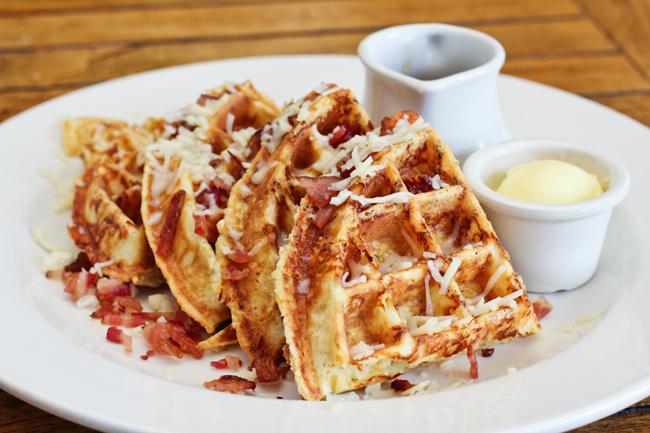
Grits & Bits Waffles
This old Georgia dish has long been one of the most popular items on the Zingerman’s Roadhouse brunch menu. The story is that the Dutch brought waffle irons here with them and that as they moved south from Manhattan they began to blend the local leftover grits that were so common into their waffles to make breakfast the next morning.
The dish really isn’t very hard to make, but by bringing together the flavors of wheat, corn, bacon and maple syrup you really get a great, unique way to start the day. As always I’ll recommend the Anson Mills grits, though other artisan offerings will also serve you well. The key is that the grits add flavor as well as texture to the dish. If you’re into sorghum or cane syrups, you could certainly use either one instead of the maple. When it comes to the bacon, I’d go with one of the dry-cured offerings—Broadbent’s, Edwards’ or Benton’s to stand up to all the other good flavors here.
Ingredients:
- 2 cups all-purpose flour
- 2 tablespoons sugar
- 1¼ teaspoons baking powder
- 2 cups water
- 6 tablespoons unsalted butter
- 1 cup Anson Mills (quick-cooking) grits
- 1 teaspoon coarse sea salt
- 4 eggs
- 1½ cups whole milk
- 1 pound sliced bacon (about 8 to 12 slices), cooked and coarsely chopped
- 6 ounces sharp cheddar (I’d recommend a nice two-year-old white cheddar like the one we get from Grafton Village in Vermont), shredded
- Maple syrup and butter to taste for serving
Procedure:
- 1. In a mixing bowl, combine the flour, sugar and baking powder and set aside.
- 2. In a saucepot, bring the water and butter to a simmer. Before the water comes to a boil start adding the grits, stirring steadily until incorporated. Add the salt and stir well. Reduce heat to low, cover and continue to simmer for 30 minutes, stirring occasionally. Add more water if needed.
- 3. While the grits are cooking, separate the eggs. Set the yolks aside in a dish, and refrigerate the whites.
- 4. When the grits are done (you can always cook them longer than half an hour—they’ll continue to get creamier the longer you cook them), remove them from the heat; transfer to a large mixing bowl and let cool to 110°F. Stir the egg yolks into the grits one at a time, mixing well after each addition.
- 5. Add the milk and mix well.
- 6. Add the flour mixture, mixing until just combined.
- 7. Beat the cold egg whites in a mixer or with a hand beater to medium peaks. Gently fold the whites into the batter and mix gently. Chill for at least 1 hour prior to cooking. (Note: the batter can be made the night before and stored in the refrigerator until you’re ready to start cooking.)
- 8. When you’re ready to eat, pour the batter into a preheated and well-oiled Belgian-style waffle iron, and add a generous bit of chopped bacon and shredded cheddar. (We use 1 cup of batter with ¼ cup each of bacon and cheddar.) Close the waffle iron and cook until golden brown. Remove the waffles from the iron and place on warm plates. Sprinkle more chopped bacon and shredded cheddar over the top of the waffles. Serve with good butter and real maple syrup.
- 9. Repeat until all the batter, chopped bacon and grated cheddar have been used.
Serves 4 to 6 as a main dish.