
Tag: ARI WEINZWEIG
An Interview with Natalie Chanin
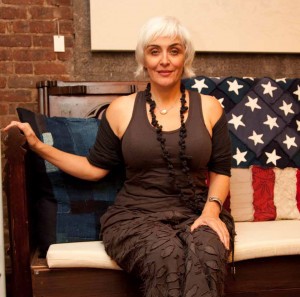
I first met Natalie Chanin at Southern Foodways Alliance. I don’t know Natalie that well but I do know her enough to say with confidence that pretty much everything she touches is very special, and that she moves through the world with a light and elegant energy the likes of which I’ve rarely experienced in the world. In the small northern Alabama town of Florence she and her staff do an amazing job of cutting, sewing and reconstructing clothing to make some beautiful, limited edition items. They do for clothing what our the artisan food producers we work with do for bread, cheese, olive oil and bacon—take great raw materials, traditional techniques, and a lot of careful hand work to make really excellent, limited edition items. If you don’t know her work, check it out at her website. While she’s not directly in the food business, Natalie is a BIG supporter of Southern Foodways. And on top of all that, Natalie will be coming up our way for the weekend of Camp Bacon!
On Saturday, June 1st, Natalie will be speaking—and sewing—as part of Camp Bacon’s main event. She’ll be doing a segment on Sewing with Bacon (you read that right!) that I’m personally really looking forward to! To cap off her Zingerman’s Experience Seminar she’ll be staying after Camp to come to the ZingTrain two-day, Creating a Vision of Greatness seminar. -Ari
Ari: I’m really excited that you’re coming to Ann Arbor to be part of Camp Bacon and to share your artisan approaches to clothing. Since most folks up here won’t know you yet, can you tell us a bit about your business?
Natalie: Alabama Chanin is an artisan-based company based in Florence, Alabama. We make clothing, accessories, and home goods primarily by-hand, using the most ethical and sustainable methods possible. We have also published three craft books, have an ongoing dinnerware collaboration with Heath Ceramics, and, of course, have a deep appreciation for the food that goes onto those plates.
Ari: I’m sure you’ve told the story six thousand times by now but it’s a good one—how did you get the company started?
Natalie: I worked as a designer and stylist in Vienna, Austria, where I really got my education in style and design. My first Alabama Chanin-style garments I made for myself. The positive response I received from wearing those pieces gave me the idea to begin a clothing line. The company has continued to grow and expand and we hope to keep growing.
Ari: What’s drawing you to Camp Bacon?
Natalie: Other than the smell of sizzling bacon? I am looking forward to seeing all of my Southern Foodways Alliance friends and making new ones, and I believe that there is talk of some sort of bacon/sewing moment… Just saying.
Ari: What’s your experience with Southern Foodways Alliance?
Natalie: I’ve been involved with the Southern Foodways Alliance for almost a decade now. I admire their mission and goal because I feel that we believe in many of the same things—education, community, sustainability, individuality. I try to support the organization however I can, attend as many events as I can fit into my schedule, and I get a lot of love back (and a lot of food).
Ari: Was bacon a big part of what you ate as a kid?
Natalie: Growing up, we ate bacon and eggs for breakfast every day. Most days we ate toast, but on really good days there were biscuits. Bacon, eggs, and biscuits—the perfect breakfast. My daughter Maggie and I still use this format on many days (although she adores sausage as well).
Ari: Tell us about the sewing class/workshop that you’re going to be teaching while you’re here?
Natalie: The workshop we’re hosting allows each participant to select an Alabama Chanin DIY project to create. Then we bring all of the prepared materials and tools to complete the project. We’ll talk a little about Alabama Chanin, demonstrate different techniques and stitches, help one another with our projects, laugh, and tell stories… and, of course, eat good food.
Ari: You’re also staying over for the ZingTrain Creating a Vision of Greatness session on the Monday and Tuesday after Camp Bacon. what’s drawing you to it?
Natalie: I am just looking forward to having two days to sit and think about the company. As an entrepreneur, it happens so often that you get so busy running the day-to-day that you don’t really have a change to sit down and be creative with the company itself. Can’t wait to do a bit of brainstorming on that…
SEE YOU AT CAMP!
Tag: ARI WEINZWEIG
Zingerman’s 4th Annual Camp Bacon is coming soon and to help get everyone prepared, we’re sharing tasty excerpts and recipes from Ari’s book, Zingerman’s Guide to Better Bacon.
 American Fried Bread
I learned this really simple dish from the book Things Mother Used to Make, published in 1914 by Lydia Maria Gurney. It’s probably as down-to-earth, backwoods American cooking as you’re going to get. You can serve it as is for breakfast or add a bit sorghum syrup, maple syrup, or molasses drizzled on top. It’s also good sitting next to a salad for lunch or a light supper.
If you have reserved bacon fat on hand already you can just use that. If not, start by frying some bacon (let’s say one slice per slice of bread) in a skillet. Remove the bacon, leaving the fat in the pan. (In tight time, the meat would have been used for other purposes later, but I’d say chop it and serve it on a salad alongside the bread.)
Keeping the fat hot, put slices of stale bread into the pan. You can, of course, use most any bread, but my current favorite is a Zingerman’s Bakehouse mainstay and longtime American classic. Around here we call it Roadhouse Bread, but it was known in the eighteenth and nineteenth centuries as Rye ‘n’ Injun, or, at times, Thirded Bread. It’s made with a mix of rye, wheat, and corn (hence the reference to thirds) and has a bit of molasses in it, as well. It’s great on its own, and better still with bacon.
While the bread is frying add a couple of teaspoonfuls of either warm water or milk to the pan, and, if you like, flip it and cook until it’s nicely browned on the other side. As Mrs. Gurney said at the start of the last century, “This is a very appetizing dish.”
SEE YOU AT CAMP!
Tag: ARI WEINZWEIG
Zingerman’s 4th Annual Camp Bacon is coming soon and to help get everyone prepared, we’re sharing tasty excerpts and recipes from Ari’s book, Zingerman’s Guide to Better Bacon.
 Bacon hash
This hash has turned out to be a big hit with most everyone who’s had it. It’s an excellent way to take advantage of the big flavor of top-of-the-line bacons. The bacon is the headliner rather than just a couple of strips alongside another main dish. I like making it with the dry-cured intensity of the Broadbent’s, Benton’s, Father’s, or Edwards’, but it would really work with any good bacon.
You can make the recipe a day or tow in advance if you like, then reheat it in a skillet when you’re ready to serve. Regardless, you’ll want to cook both the bacon and potatoes and let them cool before you move on to the rest of the recipe. Serve with rye toast and a couple of poached eggs if you like, as well.
Ingredients:
- 4 tablespoons rendered bacon fat
- 1 medium onion, coarsely chopped
- 1 medium red bell pepper, coarsely chopped
- 1 stalk celery, coarsely chopped
- 2 tablespoons flour
- 1 1/2 cups chicken broth
- 2 tablespoons Worcestershire sauce
- 10 ounces sliced bacon (about 5 to 7 slices), lightly cooked and shopped
- 2 pounds potatoes (I like Yukon Golds, German Butterballs, or others of that ilk), steamed over salted water until tender, then diced with the skins on
- 1/4 cup heavy cream
- Coarse sea salt to taste
- Freshly ground Tellicherry black pepper to taste
Procedure:
Melt the bacon fat in a large skillet over moderate heat. Add the onion, bell pepper, and celery, and cook, covered, for 5 to 6 minutes, until soft.
Sprinkle the flour over the wilted vegetables and stir well to avoid lumps. Cook for another 4 to 5 minutes, stirring constantly to keep from sticking, until the flour blends with the bacon fat into a thickened roux.
Add the broth, a bit at a time, stirring well after each addition so the mixture stays smooth and creamy. The sauce should coat the back of your spoon before you add more liquid. Stir in the Worcestershire sauce.
Continue simmering the sauce over moderate heat until it thickens, about 5 minutes. Add the bacon and potatoes and mix well. Add the cream and cook, stirring, a few more minutes. Stir in salt and freshly ground pepper tot taste.
Serve immediately, or cool and reheat in a skillet until you get a nice golden brown crust.
Serves 4 to 6 as a main dish.
SEE YOU AT CAMP!
Tag: ARI WEINZWEIG
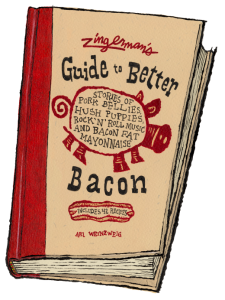 Zingerman’s 4th Annual Camp Bacon is coming soon and to help get everyone prepared, we’re sharing tasty excerpts and recipes from Ari’s book, Zingerman’s Guide to Better Bacon.
Death of a Slaughterman
In Adventures of a Bacon Curer, one-named British author Maynard (“may-NARD”) mentions a no-longer-existent pig-related profession: the journeyman-curer. In early 20-century England this was the man who “would come down and kill the pig. He would stop overnight and cure the pig the next day, and that was the ritual. It was important that he did it correctly as that was the main meat source for the winter.”
In her Irish Traditional Cooking, Darina Allen describes a similar scene: “…on my relative’s farm in Tipperary,” she writes, “a local man skilled in the killing of pigs would arrive on an ass’s cart, bringing all the tools of the trade — a mallet, a knife, a saw, an apron, and a galvanized bath. He was highly thought of and had to be booked ahead.” I can’t say that these journeymen have disappeared entirely, but I’ve not (yet!) heard tell of one still in business.
No one I’ve asked in the U.S. remembers such curers here. The closest I came was in a story from baconmaker extraordinaire, Allen Benton: “In the hills of Virginia, it was common to have someone in the community who would go around at hog butchering time and help the neighbors slaughter the hogs and help work up the meat. They were usually paid either money or in fresh pork.”
Back in Britain, Maynard writes that there are quite a few stories about the old journeyman-curers and how they were compensated. “Sometimes they were paid in surprising ways,” he writes, “And sometimes,” he goes on, “they left a few children behind.”
See you at camp!
Tag: ARI WEINZWEIG
Zingerman’s 4th Annual Camp Bacon is coming soon and to help get everyone prepared, we’re sharing tasty excerpts and recipes from Ari’s book, Zingerman’s Guide to Better Bacon.
Saltines and Bacon
In a hurry, but just have to have that bacon fix? Here’s a Southern sidebar courtesy of Mississippi native April McGreger, currently living up in North Carolina. When we got to talking about this book, April ‘fessed up that her favorite appetizer/snack was “bacon-wrapped Saltine crackers.” Given that Saltines are often referred to only somewhat facetiously as “the traditional bread of the South,” her confession surprised me more that it might have otherwise. Still, I can’t say that I’d ever given much thought to this combination.
I’ll have to do some experimenting to be sure which bacon goes best with the crackers. I should say, too, that although April likes to microwave them, the norm is apparently to eat one’s pork-wrapped crackers at room temperature, “when they are the most crispy.”
For information on April’s very nice line of jams, chutneys, and pickles, check out her site.
For Saltines, see the cracker aisle at the supermarket.
See you at camp!
Tag: ARI WEINZWEIG
Zingerman’s 4th Annual Camp Bacon is coming soon and to help get everyone prepared, we’re sharing tasty excerpts and recipes from Ari’s book, Zingerman’s Guide to Better Bacon.
 Since we’re going to be talking about bacon, we thought it might be helpful for everyone to understand the terminology.
Here’s Ari’s Bacon Glossary:
- Bacon: Over here in the U.S., cured and usually, though not always, smoked pork belly.
- British Bacon: Today, this generally refers to the back and not the belly, cured in brine solution but not smoked.
- Canadian Peameal Bacon: Pork loin cured in a wet brine solution and then rolled in cornmeal. The real thing is sold raw and never smoked.
- Dry Cure (a.k.a. Country Cure): Raw pork rubbed and then set into a dry solution of salt, sugar, and spices (instead of a brine) to cure the pork before it’s smoke.
- Fatback: The strip of fat from the top of a hog’s back, above the loin. Used extensively in old-style American cooking, it really has no meat on it whatsoever. In the South you’ll see places selling fried fatback. Typically used to make lard and cracklins.
- Flitch: The old English word for a side of bacon.
- Green: The British term for cured but unsmoked bacon.
- Guanciale: Italian-style pork jowl, dry-cured and unsmoked.
- Irish Bacon: Same as British bacon, but often used for boiling.
- Lardo: Italian-style pork back fat, dry-cured in slabs for months. Sliced and eaten raw.
- Long Back or Long Middle: Used in England to describe bacon sold as loin with belly still attached.
- Pancetta: Dry-cured but unsmoked Italian-style bacon made form pork belly.
- Rashers: Slices of bacon, to a Brit.
- Streak o’ Lean: Like fatback, but with (at most) a small strip of meat in it. Michael Stern, writing in Roadfood, says, “streak o’ lean provides the maximum piggy flavor. If you can never get enough bacon, it’s the breakfast meat for you.” Sometimes smoked, sometimes not. Also, like fatback, streak o’ lean can be floured and deep-fried to make a crisp little bacony snack.
- Streaky Bacon: What British people ask for when they want American-style belly bacon.
- Wet Cure: Bacon that spends a good bit of time in a saltwater brine, most often, though not always, with sugar and spices.
- Wide: The wide side of the pork loin as it’s used for bacon – it’s from further up the top loin, toward the shoulder.