
Tag: ARI WEINZWEIG

Well-run, inclusive meetings offer a constructive act of resistance
This Thursday morning, from nine to noon, I’ll join about 80 coworkers for our monthly Zingerman’s Community of Businesses (ZCoB) huddle in the ZingTrain conference room. While a three-hour meeting might sound off-putting to many, I genuinely look forward to it. For me, the huddle is theologian Richard Rohr’s statement—“The best criticism of the bad is the practice of the better”—put into real-life action. It is tangible evidence that people of different ages, backgrounds, job descriptions, levels of authority, and daily responsibilities can consistently gather to demonstrate what anarchist anthropologist David Graeber called “our capacity to come together as reasonable human beings and work out the resulting common problems.” In its own imperfect way, the huddle is a down-to-earth application of democratic practice, demonstrating, as Graeber writes, that each of us can quietly be “people who can make a difference in world events.”
To be clear, multi-hour-long meetings were not always events I was eager to attend. Like many folks who start small businesses, I spent years caught up in my distaste for the idea—and the reality—of spending much time in meetings. Start-ups, after all, are about action. New businesses—especially those fortunate enough to be busy from the get-go, as we were with the Deli—don’t offer much opportunity for sitting around the table talking. As I would have said at the time, not entirely inaccurately, we had much more “important” work to do.
That was then, but it is not, as you can already tell, now. As I explain in The Power of Beliefs in Business, negative beliefs of the sort I once held will always lead to negative outcomes. Great organizations, great lives—great anything—I now know, cannot be built on negative beliefs. I’m happy to say I have successfully changed my mind. Today, in 2025, I have a whole host of positive beliefs about what well-run meetings can make possible. Over the years, it has become eminently clear to me that effective, inclusive, collaborative meeting management—as we work hard to practice here in the ZCoB—is:
- An essential ingredient of running any organization and, more broadly, a cornerstone of healthy democratic constructs.
- A quiet but powerful form of positive resistance—when autocracy is on the rise, open, dignity-centered meetings counter the arbitrariness of behind-closed-doors autocratic rule and help to lay the foundation for healthier societies.
This last part, especially, is something I’ve only recently come to understand. Others, though, have seen it clearly for years. Journalist David Frum said it succinctly in 2017:
Democracy … is about meetings.
Years ago, I would have taken Frum’s statement in the context of what gets done in Congress. Today, I view it from a quite different perspective. Most of the meetings that make up the democracy David Frum is describing actually begin, not in Washington, but rather with what you and I do at work every day. In a country full of inclusive, dignity-based, effective meetings, Congressional hearings would look and sound far more constructive than they do currently. As my business partner of four-plus decades, Paul Saginaw, always says, one can learn to “disagree without being disagreeable.”
In this sense, our ZCoB-wide Thursday morning meeting is a small but meaningful contribution to making this an effectively operating, inclusively democratic country. Jason Stanley, professor at the University of Toronto and author of How Fascism Works, recently wrote me,
Workplace democracy is one of the central and most important topics in democratic political philosophy. It’s where the battle over authoritarianism is fought. … Democracy takes work.
In the free, “non-state,” democratic space of Kurdish Rojava (in Northern Syria), there is a widely repeated Kurdish expression: “Resistance is Life.” Which means that one way to resist, in troubled times when autocracy is on the rise, is to continue to live life in constructive, collaborative, inclusive, and effective ways—rather than slide into the sort of defensive reactivity and passive disengagement that dictators dream of. In Rojava, meetings akin to the one we will have on Thursday morning are also the norm. Writing about the Kurds’ work there, journalist Harry Waveney observed, “The most precious thing they have offered us is the truth that things can be different” from the way they are in most countries. That is very much my hope for our organization, too—that we show, despite the seemingly monolithic mainstream you see in most business news, that business really can be done differently.
A seemingly small but significant part of what makes our work work in the Zingerman’s Community of Businesses is that we long ago learned to value what it takes to run a good meeting. When experts talk about why the ZCoB works as it does, they usually point to stuff like high-quality products, great customer service, memorable marketing, or maybe even Servant Leadership or Visioning. Good meeting management almost never makes the list!
The reality is that the hard work it takes to prepare and run a meeting is now so deeply embedded in our culture that casual observers barely notice it. Here, though, we don’t take it for granted. Leading and participating in well-run meetings are skills people learn through both formal systems and informal practice. I don’t think it’s an exaggeration to say that most folks who’ve been here five or six months—and have chosen to actively engage in our work (I know not everyone does)—can step into a range of meeting roles and, on the spot, start to do a solid job. They’re also well accustomed to being effective participants. And when we mess up, that shared skill set usually helps us quickly see where we went astray.
Much of the world, I know, skips right past this stuff. Photographer Tomasz Trzebiatowski, the founder of Frames, gave me a good way to understand the situation through the lens of photography. The work the public pays attention to—like reubens and rye bread, food tours and fried tofu—is centered in the light. But, as Trzebiatowski points out, light only makes sense in relation to what we usually miss: the shadows that give it shape and meaning:
We always say photography is about light, but maybe it’s really about shadows. … Light is obvious, right? It illuminates. It reveals. But without shadow, light is just brightness, flat, directionless, empty. Every photograph you have ever loved has shadows in it.
They shape the scene. They carve out the space. They give depth, drama, and tension. … Shadows are not the absence of light. They are the evidence that light has form, direction, and meaning.
So … don’t just chase the light. Listen for the shadows because they are the ones that make the photograph speak.
Well-run meetings, in this context, happen in the shadows of organizational life—they’re the behind-the-scenes infrastructure that’s essential but almost invisible to the average consumer. They aren’t actually hard to see; it’s just that hardly anyone looks. Most people are understandably drawn to the light—great products, profit-and-loss statements, inspiring speeches by bosses. But off to the side, in the organizational equivalent of the shadows, it’s the imperfect but consistent effectiveness of our meetings that makes everything else possible. The public takes no notice, but I know the reality: no good meetings, no pastrami, no profit, no people!
It is my strong belief that anyone who is a part of an organization that aspires to excellence would be wise to master good meeting skills. And, if people want to be part of a democratic construct—either at work or in the world around them—they, too, will need to learn them. Democracy, it turns out, doesn’t turn on what happens in Congress; to the contrary, it’s about how we run our Student Council when we’re in grade school. And as David Frum says, “The Parent-Teacher Association (PTA) … is the incubator of democracy.” What we do in our workplaces makes a difference in the world. All of which means that if we want an inclusive society, dedicated to due process and dignity, well-run business meetings are a really good place to begin.
Recent evidence for this fact of organizational life is coming in abundance right now from a fairly unlikely spot: Serbia. The student-led meetings and the pro-democracy demonstrations that emerge from them are remarkable. Of this grassroots work the Serbs are doing, historian Timothy Snyder wrote this past weekend, “Those who care about the future of democracy should know about them.”
The story in Serbia started last November, when the concrete canopy of the main railway station in Novi Sad, the country’s second largest city, collapsed onto the busy pavement below, killing 16 people and severely injuring another. In the aftermath, local students gathered to protest, demanding accountability and safer public infrastructure. Those first early acts of resistance have evolved into a mass movement actively advocating for the end of autocratic rule and the reinstatement of democratic norms and due process in the country. They have been doing this work, impressively and very effectively, for over 10 months now.
Unfortunately, the Serbian government has often responded to these peaceful demonstrations with violence and provocation. In a panel discussion held in Brno in the Czech Republic last spring, one Serb student caught my attention when she commented on the government’s actions,
Something really scary, really terrifying happened in our country.
While the situation here in the U.S. is not the same as in Serbia, I can still relate to what she says. Scary and strange things seem to be happening here in our country almost every day. In that sense, we are all faced with the same situation the students in Serbia were—we can stand aside, or we can find peaceful, positive ways to stand up and be seen.
How can we do that? Good meetings aren’t glamorous, but they are a good way to stick to our principles. Timothy Snyder recently urged, “Resistance requires an openness to learning from others.” While we seem to be unsure of what to do, the student-led movement in Serbia has organized itself by running hundreds of regular open meetings—what they call plenums—in which inclusion and consensus are very much the norm. Instead of becoming more militant in response to autocratic attacks, they have put their energies into holding remarkable meetings.
Who knew? Running good meetings can be seen as an act of meaningful resistance. In early June, the Serb Student u svakom selu (“A student in every village”) program posted a message on its Instagram that we could all take to heart: “Ask yourself a question—Who is ‘building’ your future? So exercise your right, be a part of the change!”
There’s a lot to be said for the impact of their approach. The journal Balkan Insight titled a long article about the movement: “Serbia’s Student Plenums: A Blueprint for Renewing Democracy.” In April, Serbian sociologist at the University of Belgrade, Suzana Ignjatović, wrote about the students’ good work: “Through plenums and public gatherings, people involved in Serbia’s protest movement are trying to reclaim public institutions.” The impact has far exceeded what most observers might have imagined. Plenums, she points out,
… are not just a technical tool, but the ideological pillar of the student movement. In the manual for plenums, students encourage people to organise zborovi, or public gatherings, as “plenums for citizens,” and even offer training. In this sense, direct democracy has been rediscovered as a long-forgotten political method. … All important decisions are made in plenums, including on strategy going forward. … A plenum-type gathering is a first-aid kit for patchwork democracy, rooted in the belief that political change from below is possible.
Learning to run effective, inclusive, equitable meetings helps you, and it helps the people you work with. It helps your organization to function far more effectively. And learning to be an effective participant in those meetings is, I have learned, a prerequisite for being a good long-term citizen. When we do it well, the world around us is made better in the process. Artist and head of Black Mountain College for many years, Josef Albers—who escaped from Germany in the years before the Nazis took power—wrote,
To distribute material possessions
Is to divide them
to distribute spiritual possessions
is to multiply them
This multiplication is what is happening in well-run meetings in healthy organizations. Everyone involved comes out ahead. People do productive work and learn how to be active, constructive citizens at the same time.
What the Serbs are doing is parallel, in a positive way, to what is happening in the Kurdish communities of Northern Syria. In the above-mentioned article entitled “Resistance is Life” in the journal Planet, Welsh writer Harry Waveney describes the Kurdish concept of hevaltî. One Kurdish friend here called it “comradeship.” Waveney compares it to the idea of peer-to-peer friendship and support. Hevaltî, not competition and conflict, is what the Kurdish resistance movement is organized around. Like the plenums in Serbia, the Kurds have woven effective, equity-based meeting management into the way they work. It is how they run their lives. Author Janet Biehl, who has written a number of books about Rojava, says, “There are many meetings, of course. … it’s a very communal society, a very communitarian society, so it’s part and parcel of their life.” This is pretty much how I would describe life in the ZCoB as well.
Through these meetings, the Kurds in Rojava are changing lives and running their country. Waveney writes,
The Rojava revolution is hevaltî generalised, and it is not limited to the borders of Northeast Syria. It exists within those who fight for it, worldwide. It is friendship rendered at the level of politics.
These are not mere romantic affectations but how the Kurds and their allies will often describe their achievements, and the key to their success. Their goal is nothing less than the total transformation of life. … The Rojava revolution gives ordinary people the freedom and power to say, I am here.
Showing up to participate in the day-to-day governance of their communities—or in our case, our company—makes a huge difference. It is an entrée to dignity, an act of active inclusion in all directions, a way to learn to participate and to own one’s own power.
This work of effective meeting management is not as easy to do well as cynics on the outside might imagine. Running good meetings is hard work, but it’s good work. And it demonstrates in a down-to-earth, wonderfully humble way that no matter what happens around us, we are here doing good, inclusive work every day. It makes real what Kurds in Rojava say regularly: “We’re here because we’re here because we’re here because we’re here.” Good meetings aren’t magic. As Kurdish sociologist Dilar Dirik writes, we do them, “Not because these things are perfect, but because things are possible—through faith and struggle.”
Anarchist Howard Ehrlich writes, “If we are not actively involved in building the new society today, it is unlikely that we will be involved tomorrow.” In the context of which, inclusive, well-run meetings show—on a small scale—what is possible. They invite and organize the kind of constructive conversation that is critical to this work. And they make happen what Ehrlich is advocating: “The goal of organizing ourselves collectively is to empower each and every member of the collective.” Thursday’s meeting is open to anyone who works in the ZCoB. And, even if they’ve only worked with us for a couple of weeks, we pay them to come and participate.
If you think what you do at work won’t make much difference, take note that what started as small student gatherings in Serbia is now a mass movement. In March, over half a million people marched together, peacefully, in the capital city of Belgrade. Essentially, the way the students in Serbia are bringing democratic practice to their day-to-day decision-making is changing the culture of the country. The practice of the plenum is spreading. As Timothy Snyder writes, “Serbs did not have to be students to understand the students. And the students gave them something to understand.”
In only 10 months, the impact has been significant in ways I don’t think anyone would have imagined a year ago at this time. The Serbian sociologist Suzana Ignjatović says,
Plenums have become popular across Serbian society—among schoolteachers, parents of schoolchildren, public libraries, university professors, and local communities. Everyone has been encouraged by students to exercise direct democracy. … Almost every public protest can turn into a plenum about some issue.
When all is said and done, if we want to have democratic constructs—in companies or countries—it is imperative that we learn how to run a good meeting. Susan Griffin, writing in Wrestling with the Angel of Democracy, says, “It is perhaps what democracy is in the end: a meeting.” Running meetings is not what most people go into business to do, but it is what anyone who wants their business to run well—and to model what’s possible in the most positive way—needs to learn.
In 1965, the Students for a Democratic Society, which was founded here in Ann Arbor five years earlier, put out a photocopied pamphlet called A Movement of Many Voices, written “for those who wish to devote themselves to organizing activity for a summer or longer.” In it, they remind us that, “Movements begin when people get together to think out loud about the kind of city they might help create.” One person in the piece came up with a quip that has had me smiling for days:
Freedom is an endless meeting.
Democratic engagement of diverse voices—here in the ZCoB or anywhere—can only happen if there is a near-constant conversation. Done well, it’s remarkably effective: different perspectives are processed with dignity, clear decisions are made, meaningful notes taken, plans shaped, and business gets done. Done poorly … you don’t need me to tell you—it’s a mess.
Learning to do this work is not something that’s just for a handful of leaders. To the contrary, knowing what I know now, I wish we had learned it when we were little kids in school. After all, if we can’t get together and converse constructively, make meaningful decisions, and get moving in an agreed-upon direction, things—quite simply—won’t work. As Nigerian author and poet Chinua Achebe once wrote, “A functioning, robust democracy requires a healthy, educated, participatory followership, and an educated, morally grounded leadership.” The same holds true in organizations: if we don’t actively teach people how to participate in governance, what they learn—or don’t learn—will make a huge difference.
In an era in which civics classes have been just another victim of budget cuts and focus on science and math, many people have nowhere in which they can learn these critical community-building skills. The good news, organizations like ours can do it, right now!
John Tropman, University of Michigan professor of Social Work, writes in Fixing Broken Meetings, “Decisions are the lifeblood of organizational jobs, tasks, and work. … [and] there is a deeper structure to decision making than most people appreciate.” That structure is what learning to run good meetings makes possible.
Next week, I will share a lot more about the basics of how we run meetings—as I’ve said, it’s not all that glamorous, but it’s something no organization, of any size, should work without. Their impact on our work, as you can tell from all of that I’ve written here, has been enormous. Sticking to our inclusive, dignity-centric practices of gathering consistently and constructively is an act of quiet but meaningful resistance. The news is all over the place, but we are still right here, getting together and doing our work as we have done for many years now. As the Kurds in Rojava say, “We’re here because we’re here because we’re here because we’re here.”
In his terrific small book, On Tyranny, Timothy Snyder’s second lesson for those who want to resist the imposition of authoritarian rule is “Defend institutions.” He says,
It is institutions that help us to preserve decency. They need our help as well. Do not speak of “our institutions” unless you make them yours by acting on their behalf. Institutions do not protect themselves. They fall one after the other unless each is defended from the beginning. So choose an institution you care about—a court, a newspaper, a law, a labor union—and take its side.
Continuing to run good meetings, as Thursday morning’s ZCoB-wide gathering at ZingTrain will surely be, is our effort to defend our own institution. Many companies have made clear that they did not really mean it when they posted their “principles” online. We, I believe, are quietly working hard to stick to ours. And lo and behold, I now see, well-run meetings are actually at the center of that work.
I would never have imagined 43 years ago that we would be known here at Zingerman’s for the quality and effectiveness of our meetings—imperfect but nevertheless important models of what some form of democratic engagement can look like in practice. When they write our history, it may certainly say that we had a great corned beef sandwich, we could bake some delicious bread, and that we were deeply dedicated to both customer service and community. It would make me smile if some history student half a century into the future added in at least a footnote: “They ran some darned good meetings.”
P.S. Next month, on Wednesday, October 15, and Thursday, October 16, I’ll be co-leading the Zingerman’s Experience Seminar with ZingTrain managing partner Katie Frank. It is, I believe, one of the best ways to understand what makes the culture here in the ZCoB unique—to see what, in the words of photographer Tomasz Trzebiatowski, is in the “light” of organizational life as well as what usually remains in the “shadows,” only for insiders to experience. Lots of great learning—and plenty of delicious food to boot!
Tag: ARI WEINZWEIG

Small is beautiful at our amazing space in Dexter
Been thinking about a wedding that feels magical and meaningful for you and the one you love? A lot of couples dream of a one-of-a-kind, exceptionally heartfelt, beautiful ceremony. What they don’t dream about, though, is the mountain of stress that often comes with a big wedding. Guest lists running into the hundreds, endless seating charts, skyrocketing budgets, and the pressure of orchestrating an all-day production can quickly turn much-anticipated joy into agonizing overwhelm. After hearing those struggles from guests for years, the caring crew at Corman Farms created a very special style of small wedding with big impact: “The Tiny Weddings are essentially an elopement for the couple who wants the simplicity of a courthouse wedding but envisions a beautifully curated experience.”
In his classic 1973 business book, Small is Beautiful, progressive business thinker E.F. Schumacher famously says, “Any fool can make things complicated; it requires a genius to make things simple.” In the last couple years, the crew at Cornman Farms has figured out how to do the latter when it comes to getting married. Make it much simpler, but without sacrificing any of the majesty, beauty, and grace that can get lost when one gets married quickly at City Hall.
A Tiny Wedding at Cornman means the two of you, the loving couple, along with a handful of friends and family, coming together to joyfully celebrate the big day. It is both small and beautiful! The whole of a Tiny Wedding takes place over the course of an hour and a half, and it’s all done with far less complexity than the more typical big ceremony. When it’s over, you will have celebrated your love and life commitments at the award-winning, beautifully restored 1830s farmhouse at Cornman Farms in Dexter. A 15-to-20-minute drive west from the Deli, and not far up the road from the Roadhouse, Cornman has that remarkable combination of being both easy access from town, but in a setting that is still really quite rural.
The Tiny Weddings are small in size (2-10 people), but could be the quickest-growing category at Cornman. Tabitha Mason, one of the two co-managing partners, says, “Over the years, we’ve marked off more and more days to host this series of all-inclusive micro weddings in partnership with the best local Michigan wedding vendors.”
What’s included in The Tiny Wedding package? A really wonderful little wedding ceremony with a totally official officiant and so much more. The key thing to get across is that if you want to get married in a small, intimate context, at a compellingly beautiful place, this is your shot. It is surely a less stressful way to tie the knot, and still make the event marvelously memorable. Smaller size, lower cost, fewer logistics, and less lead time mean you’ll have more time, money, and energy to invest in other ways. Click the button below to get on the list for notification when the Winter 2026 Tiny Weddings are available.
P.S. Want to do something bigger in size? Cornman also does wonderful weddings for up to 75 people!
Tag: ARI WEINZWEIG

The case for building a curious organization
In a compelling essay published this past weekend—about the Palestinian author Omar El Akkad, the humanitarian crisis in Gaza, and the student-led protests in Serbia—Swedish translator and author Sara Stridsberg recalls that the French writer Marguerite Duras once said, “We always miss the most important thing.”
Stridsberg’s entire essay got me thinking. I ordered Omar El Akkad’s book, One Day, Everyone Will Have Always Been Against This. And I’ve been following the pro-democracy demonstrations in Serbia; last March, nearly a million people marched together in the capital city of Belgrade. That line from Duras—one of the most important French writers of the 20th century—especially caught my attention, though. Trying to satisfy my curiosity, I spent quite a while online searching for the quote before finally getting back to what I was supposed to be doing. In the process, I did learn a lot about Duras—and I’m intrigued to learn more. My curiosity has been piqued.
In line with the anarchist belief that the means we use must align with the ends we want to achieve, that same curiosity feels consistent with the subject at hand. Daniel Gunn, Professor of English at the American University in Paris, writes, “In her nonfiction as well as her fiction, Marguerite Duras’s curiosity was endless.” I’m starting to realize I might say much the same about my own. I’m determined to figure out where that quote came from.
What follows is, indeed, about curiosity. What it is, why it matters, and why some people seem to have it in abundance while, for others, it seems all too often absent. Curious? I know I am!
This current curiosity kick, to be clear, did not come out of nowhere. It was initiated by someone I consider one of the great “wonderers” of the modern American workplace: Jack Stack. I’ve known Jack for over 30 years now. He’s the man who, in the same period of national economic crisis in which we also opened the Deli in the early 1980s, kept asking simple questions no one else seemed to ask. In the process, he developed the life-changing approach that we all know now as Open Book Management. With Bo Burlingham, he co-authored the 1992 classic The Great Game of Business.
Last week, I had the honor of being the opening keynote at the annual Great Game of Business conference in Dallas. This gathering brings together open-book practitioners—like us here in the Zingerman’s Community of Businesses (ZCoB)—from pretty much every business you can imagine, and from all over the country. Some attendees had arrived from as far away as Brazil and Bulgaria. About 500 highly motivated folks were in the room that morning when I presented for an hour on the subject of dignity, drawing heavily on the pamphlet, “A Revolution of Dignity in the Twenty-First Century Workplace.” The talk, I’m happy to say, was well received. What stood out most for me, though, were the conversations that followed over the next couple days. The most common comments? Some version of, “You really got people thinking.”
In hindsight, what I seem to have done was spark attendees’ curiosity—leaving many eager to learn more about a word nearly everyone in attendance knew well, but only a handful had given much thought to. I can relate. That’s exactly where I was before I began the exploration and exposition that eventually became the dignity pamphlet, and most importantly, a discipline and a practice that I now work diligently to make real every single day.
After the keynote was completed, and most everyone else had left the auditorium to move into their various breakout sessions, Jack Stack ambled over to shake my hand and express his appreciation. He and I have known each other for many years now, but he hadn’t previously heard me present this new work I’d done around dignity. Jack said, “I love how you just keep learning new approaches, and that you can turn them into these models that people can really implement. You have this drive, that I love, to just keep learning.”
I have enormous respect for Jack, who tells it like it is. He doesn’t give compliments when he doesn’t mean them. And, in this case, he’s correct. I do have an enormous drive to keep learning new things, to understand the world at large, as well as our world at Zingerman’s, ever more effectively. He and I, without question, have that characteristic in common—the belief that there is always more to figure out, new understandings to arrive at, ways to make systems and products better by learning more about them. As Jack and I walked together, he said, “The one thing I keep trying to figure out is how do you get other people to have that drive for learning? I keep wondering: Can you teach people to be curious?”
As usual, Jack’s casually asked question was a good one. He certainly made me curious—I’ve been thinking about the subject ever since.
What happened to me in the following days with curiosity is consistent with the same positive pattern of inquiry I’ve initiated thousands of times in my life now. My personal experience of curiosity is a lot like scientist and author Richard Feynman, who writes, “Everything is interesting if you go into it deeply enough.” Something sparks a small bit of interest—not especially enormous at first—and I start to study. Almost every time, the more I study, the more my curiosity grows. What begins as a small interest often becomes an intense fascination. My connection to curiosity is, we could say, akin to “compound interest”: what starts as a side-note worthy of a little investigation grows more engaging with each new learning I come across. In the case of The Power of Beliefs in Business, the curiosity, sparked originally by a couple of pages in Bob and Judith Wright’s Transformed! eventually evolved into a 600-page book.
In this case, my studies quickly showed me that curiosity is a super critical skill for anyone who aspires to lead more meaningfully, and/or live a more engaged, rewarding life. I like the life-framing that the great Finnish author and artist Tove Jansson shares in her book, Fair Play:
It is simply this: do not tire, never lose interest, never grow indifferent—lose your invaluable curiosity and you let yourself die. It’s as simple as that.
Jansson—also well known for her Moomins series of children’s books—wrote Fair Play in the early ’80s, the same era in which we were opening the Deli and Jack Stack was working on open book management. Sure enough, Jansson’s wise words could well apply to both Paul and me—and Jack as well.
Creative people who do compelling work, like Jansson and Stack, are very curious souls. They like to learn. They want to understand better, see more clearly. And they enjoy working really hard to get to that kind of clarity. Asked about the three most important qualities for any aspiring artist to develop, the remarkable Romanian-born, Alabama-living poet Alina Stefamescu—who has described herself at times as an “idealist anarchist”—recommends very much the same approach to life and work as Tove Jansson: “Relentless curiosity and the desire to be surprised by thinking.” After all, Stefanescu wonders aloud, “What can we know for certain?”
Designer and writer Leigh Patterson created an online construct called Moon Lists to help people enhance their curiosity. Patterson’s design and marketing clients include a number of folks I admire: Rishi Tea, Jacobsen Salt, Bunkhouse Hotels, Bumble and Bumble. Author Mary Bryce credits Patterson’s ability to effectively manage her curiosity as a key to the quality of her work: “Her curiosity and ability to frame ideas visually, as well as her obvious love for what is simple and true quietly remind me that there is no such thing as the mundane, if you pay attention.” This pattern is also consistent—many people are curious, but it’s the ability to turn that curiosity into meaningful learnings and practical applications that really makes the difference.
Like all of us, Patterson says, she can slip out of being curious. Her self-awareness helps her get back on track:
Like anyone I have lulls and days where I feel depleted. … I do my best to recognize these patterns and not sit around feeling defeated; I do something to mix it up and change my frame of mind. Go for a walk, go to the coffee shop, call a friend, do a headstand.
Curiosity, in this context, can often require a bit of time and space to cultivate. Those who rush to judgment and quick certainty, I’m realizing, are rarely coming from a place of curiosity. As Tove Jansson writes in Fair Play, “There are empty spaces that must be respected—those often long periods when a person can’t see the pictures or find the words and needs to be left alone.” Cultivating curiosity in our organizational culture means leaving time and creating spaces for that curiosity to come to fruition. It is, more often than not, not an overnight event.
With the state of the world being what it is, leaning into the hard-to-deal-with realities of trying to lead in difficult times, I feel a sense of urgency to find positive, productive, inclusive, and dignity-focused ways to help me and the Zingerman’s Community of Businesses get through all this with our ethics and integrity intact. I suppose that’s a long way to say I’m seriously curious about what the heck to do when it feels like a lot of things around us are coming apart. Staying calm is, of course, critical. So, too, I can see now, is curiosity. What once showed up for me mostly in childhood favorites like Curious George has revealed itself as an essential skill for anyone who wants to lead well and live a full, rewarding life.
Curiosity, when it’s used well, can also become a small but meaningful act of resistance against authoritarianism or long-standing, but maybe now out-of-date, social norms. In the same article I mentioned in the opening paragraph above, Sara Strindberg shares the story of Serbian artist Marija Ratković. Ratković, referencing the current moment of peaceful but powerful mass-resistance in her homeland, expresses her own sense of urgency: “This is our only chance. Our only moment to change anything.” In an interview from six years ago, Ratković talked about her determination to make a difference, and not to simply descend into the short-term comfort of indifference: “Faced with a wall, I had options—either I leave and change my citizenship, or I change this society. I chose the latter.”
In Marguerite Duras’ native French, société means “company.” What Ratković is writing about is indeed a challenge that we all face in our workplaces, in the ecosystems of our minds, or in the world around us. I feel a similar sense of urgency. Curiosity is a key tool to making this kind of change that Ratković is referring to actually happen. Dictators do not like curiosity. At least not in anyone who’s outside of their inner circle. Curiosity, they understand, can cause trouble. It leads people to wonder, to ask questions, to seek better answers, to try to figure out the mysterious “most important thing we’re missing” that Marguerite Duras wrote about. Curious people do not fall quickly into line, and many refuse to keep quiet. They seek to understand, to see if there are better ways to work and live. They do not generally follow orders blindly, the way “true believers” do. If they combine curiosity with courage and the ability to do creative work, they end up as active resistors.
Poet, playwright, and outspoken advocate for Ukrainian independence from late 19th-century Russian rule, Lesya Ukrainka (whom I wrote about this summer), was one of those people. Alex Scalzitti writes that, despite the physical and social hardships she endured throughout her life, “Ukrainka’s intellectual curiosity and determination never faltered.” This was the case, too, with Marguerite Duras. During WWII, she joined the French resistance. Her biographer Laure Adler says she was perpetually seeking to understand, “How can the human condition be changed? What was culture doing to alleviate the suffering of man?” In The Nation, Gili Ostield notes that “Duras famously considered writing to be a revolutionary act.”
The charge to get curious as an act of resistance is, in fact, ensconced in Timothy Snyder’s small but powerful book, On Tyranny. Snyder’s Lesson #11 is “Investigate”:
Figure things out for yourself. Spend more time with long articles. Subsidize investigative journalism by subscribing to print media. Realize that some of what is on the internet is there to harm you. … Take responsibility for what you communicate with others.
It is your ability to discern facts that makes you an individual, and our collective trust in common knowledge that makes us a society. The individual who investigates is also the citizen who builds.
In other words, get curious and start studying. Don’t settle for dictatorial directives that don’t make sense. Instead, seek the truth. Snyder’s directive is just as important in companies as it is in countries. Organizations composed of curious people have something of an edge on their competitors. If they’re both courageous and disciplined enough to turn their curiosity-driven learning into work that others can learn from—something everyone I’ve cited in this essay has done in abundance—Snyder says, one can make a meaningful difference in the world.
Emma Goldman, in her own anarchistic way, was exceptionally curious. She was also exceptional in her ability to convert that curiosity into cutting insights, along with practical, powerful, and inspiring life lessons. After Emma died in May of 1940 in Toronto, her friend, the designer Freda Diamond, observed, “She opened your mind and made you think about things you never thought about before. That was her outstanding characteristic. She made people think!” She was, in other words, able to consistently call up people’s naturally present curiosity.
In her autobiography, Living My Life, Goldman cites French socialist-anarchist writer and philosopher Augustin Frédéric Adolphe Hamon, who paints curiosity as the core of anarchist practice:
The typical Anarchist, then, may be defined as follows: A man perceptible by the spirit of revolt under one or more of its forms—opposition, investigation, criticism, innovation—endowed with a strong love of liberty, egoistic or individualistic, and possessed of great curiosity, a keen desire to know.
In the absence of curiosity, what takes its place is indifference, apathy, and disengagement—the “Energy Crisis in the American Workplace” I wrote about in Secret #19. This sort of indifference, Russian democracy advocate Vladimir Kara-Murza says regularly, is a big part of what makes the rise of authoritarianism possible. Asked about what it was like being such an active voice for democracy, putting his own freedom and life on the line over and over again, while watching Vladimir Putin continue to consolidate power, Kara-Murza shared, “What was most agonizing and exasperating for us in the Russian Democratic opposition was to watch the indifference with which this authoritarian slide was being met by the majority of Russian citizens.”
So, back to Jack Stack’s question: “Can you teach people to be curious?” My answer is, “Yes.”
It also seems to be a naturally occurring characteristic, at least when we’re young kids! Human beings, it seems, are born curious. Anyone with little kids knows that they are constantly asking, “Why?” In the right setting, that curiosity can be supported and encouraged. Christina Clemer, parent and Montessori teacher, writes, “I want my child to be curious, to be a relentless learner, a constant seeker of new information. As a teacher, it’s one of the things I want most.” She wrote a whole article in Motherly about how to encourage that curiosity and guide it in constructive ways. Unfortunately, far too many kids don’t have a Christina Clemer shaping their childhood learnings; social and parental pressure pushes them to skip their own curiosity and instead get clear on the “right answers” that others have prescribed for them.
Peter Senge said it well in the MIT Sloan Management Review 25 years ago:
Children come fully equipped with an insatiable drive to explore and experiment. Unfortunately, the primary institutions of our society are oriented predominantly toward controlling rather than learning, rewarding individuals for performing for others rather than for cultivating their natural curiosity and impulse to learn. The young child entering school discovers quickly that the name of the game is getting the right answer and avoiding mistakes—a mandate no less compelling to the aspiring manager.
In the worst cases, this crisis of curiosity can be what artist and musician Lonnie Holley, who grew up in Birmingham, Alabama, in deep poverty under Jim Crow, experienced:
We weren’t allowed to enjoy the same things others were allowed to enjoy. No one was standing around saying, “This boy seems really curious. Let’s teach him things so he can be a great leader in the future.” They tried to beat that curiosity out of me!
My own upbringing, in a middle-class, academically oriented Jewish family, was, in many ways, the opposite of what Lonnie Holley had to overcome. Like every family, we had our issues, but stifling curiosity was never among them. On the contrary, the culture I grew up in—flawed though it surely was—revolved around learning. Libraries, books, school, college, advanced degrees. In our world, curiosity and the learning it was meant to spark mattered more than money. In some sense, this essay is simply a continuation of what I was already practicing when I was six.
Teaching people to be curious depends in part on the systems in which they work. Structures that encourage people to ask questions create curiosity. Frameworks, or what we’ve long thought of here at Zingerman’s as “organizational recipes,” are a great way to do that. Like Emma Goldman, they make people think. In a sense, all of the dozens of frameworks and recipes we use so regularly here really require at least a modicum of curiosity in order to work. Our Training Compact, 3 Steps to Great Service, 5 Steps to Handling Customer Complaints, 6 Elements of Dignity, Lean, the “5 Whys,” 3 Types of Beliefs (positive, negative, neutral), and more. All of them invite the user to ask questions, of themselves and/or of others as well. All encourage people to explore what something means, what is possible, and what a positive solution would look like. Our long-standing belief in the value of continuous improvement and Bottom-Line Change® encourages us to apply our curiosity as well. We have, I see now, been curating curiosity in the ZCoB for decades now!
Although I only found her work 15 months ago, creative business writer Carol Sanford’s focus is well aligned with these approaches. In No More Gold Stars Sanford states with passion that her focus is on “helping people learn to think for themselves.” The quality of our lives, our workplaces, and our world, she writes, depends on it:
I believe it is necessary because so many of us have been trained out of this fundamental capacity. We are born with innate creativity, filled with the potential to become independent and innovative human beings who can exercise discernment and critical thinking. … Most of us are conditioned to look to others to do our thinking for us. … The consequences of this conditioning are beginning to shake the foundations of democracies around the world.
All of Sanford’s seven books, all of her talks and articles are, one way or another, about learning to think for ourselves, to be curious and ask questions instead of simply following orders and falling quietly into line. In Indirect Work, she says,
Collectively, we are trapped in a mechanistic (or even more archaic) paradigm, and this causes us to make seemingly logical and ethical choices that actually produce destructive results. The urgent question now is how to provide leadership that is more appropriate to the world we find ourselves in, a world that is in crisis precisely because of the paradigms from which we’ve been operating.
(In fact, writing this essay made me curious about my childhood hero, Curious George. In a New York Times article published 20 years ago this week and entitled “How Curious George Escaped the Nazis,” journalist Dinitia Smith explains how the original book, first published in 1941, was written by H.A. Rey and Margret Rey. The couple, it turns out, were German Jews who had escaped Germany for Brazil. Later, they came back to Paris for their honeymoon, and were in the French capital working when the Nazis quickly took control of the French capital on June 14, 1940, a month to the day after Emma Goldman had died in Canada. The honeymooning couple managed to escape, riding their way quietly out of Nazi-controlled Paris on bicycles. The draft of the first manuscript for the book was in their backpacks. Reaching Allied territory, a border policeman, worried that the two were spies, let them go after finding the draft of an illustrated children’s book in their luggage.)
Curiosity, it seems, is sort of like any other skill. To get good at it, we have to practice. Some of us have the benefit of having been brought up in cultures and communities in which curiosity was actively encouraged and supported. Others have had to push past settings in which “too much” curiosity can get you ostracized, or in harder situations still, incarcerated. Practice won’t ever make perfect, but it does sort of make permanent. When something—curiosity in this case—is in our regular routine, it shapes our brains accordingly. Each of us will, of course, have our own way of doing the work. You can see some of my ways in this essay. I encourage you to explore and develop your own.
In all this exploration, I came across Tomas Chamorro-Premuzic’s piece in the Harvard Business Review—“How to Strengthen Your Curiosity Muscle”—and a lot of what he laid out resonated. Among the “five science-based recommendations” he shares, he points out that curiosity grows when we’re willing to shake up our routines, carve out space to think more deeply, or even just start asking “why” a little more often.
I’ve been playing with these ideas in my own way. Here are some of the ways I’ve tried to put his techniques to work:
- Cut out all excuses. I work hard to learn to simply take responsibility, and then move right into starting to understand what went wrong.
- Change routines to see things in new ways—Try new things to get you thinking. Write a poem. Read a book. Take a short trip. Talk to folks you don’t usually talk to.
- Experiment with new approaches. Spend time in solitude. Try journaling. Read in an area of study you aren’t familiar with. Get to know a new culture.
- Find a better angle from which to enter a conversation. Telling ourselves a different story about a situation can often lead us to understand at a whole new level. It’s a call to get curious and explore the beliefs we’re using to frame the situation. Change the story, we change our beliefs; change our beliefs, we change the story. In either case, it’s an invitation to get curious and seek new insights.
- Try learning about something you’re not yet familiar with. When feeling anxious, disengaged, bored, or burnt out, start studying. For me at least, nine times out of ten, in a matter of minutes, I find myself fascinated with a subject I’d been wholly unfamiliar with even an hour earlier. Follow the threads. See what you learn. And then be curious—what can you do with what you’ve been learning? How does it relate back to what you already do every day?
- Practice Stephen Covey’s “5th Habit” and always “seek first to understand.” When we’re frustrated, slowing down, making time to reconsider, and leaning in to learn from others can all help.
It’s possible that one of the best, most practical suggestions I’ve ever gotten on this subject—one my business partner Paul Saginaw has been using for more than 40 years—came from back when we first opened the Deli in the ’80s. It goes like this: “When furious, get curious!”
I smile, still, every time I think about it. And, I can say with confidence all these years later, although it’s not part of any formal training we do at Zingerman’s, nearly everyone who has worked here for more than a few weeks has probably heard it. It works. People also learn to be curious by spending time in cultures that encourage curiosity. Now, though, I’m curious. Where did Paul learn it in the first place? Stay tuned. In the meantime, let me know what you learn about curiosity! While you’re doing that, I’m gonna see if I can find that darned Marguerite Duras quote!
Tag: ARI WEINZWEIG
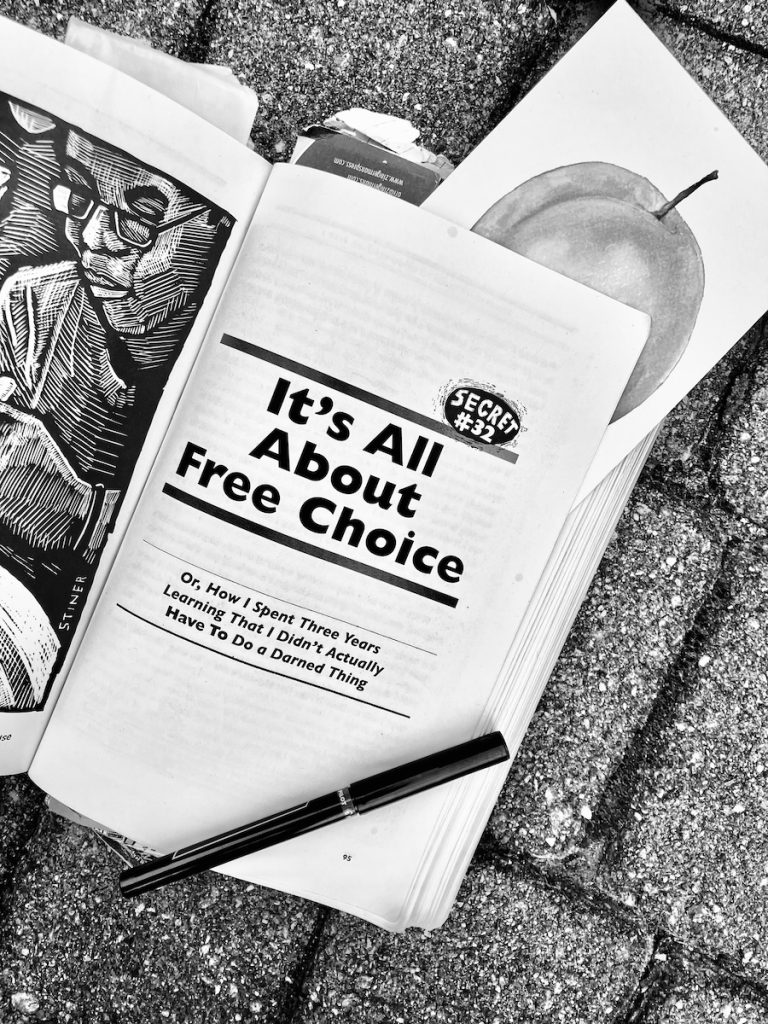
Embracing our freedom from the inside out
In his latest book, On Freedom, historian Timothy Snyder says, “Our problem is not the world; our problem is us. And so, we can solve it. We can be free, if we see what freedom is.” Snyder’s statement may sound simple, but the work of making it happen is often anything but. For me, the sort of deeply felt, inside-out freedom that Snyder is writing about took me the first 30 years of my life to figure out.
The subtitle of Peter Koestenbaum’s 2003 book The Philosophic Consultant reads: “Revolutionizing Organizations with Ideas.” What follows is about one of those ideas. It’s one way to access the sort of meaningful, grounded freedom that Timothy Snyder is writing about.
The idea I have in mind, best I can tell, is rarely taught in business schools. It is, nevertheless, incredibly important: all day, every day—counter to what most of us have been taught by our culture—we have the ability to make our own decisions. To embrace that, while yes, there are always outside pressures—fear of failure, concern over how our families might react, the weight of cultural norms we feel compelled to follow—at the end of the day, the decision to act or not is ours. Speaking for myself, I know it can be hard to remember. But the truth remains: the only one making my decisions … is me.
While the sort of shift that comes from all this inner work is quiet, it is far more significant than many people might imagine. I believe it’s a great example of what Catholic anarchist Ammon Hennacy said back in 1970:
We really can’t change the world. We really can’t change other people! The best we can do is to start a few thinking here and there. The best way to do this, if we are sincere, is to change ourselves! … [T]he only revolution worthwhile, is the one-man revolution within the heart. Each one could make this by himself and not need to wait on a majority.
Effectively owning our decisions is one of the best ways I know to begin to make the one-person revolution a reality. When I first took on this challenge in my early 30s, I was already considered “successful” by conventional social standards. Yet it was still a revolution in the sense Hennacy described—one that required no one else to change but me. The hard part was all on the inside.
In fact, the power of choice is on the list of 12 additional Natural Laws of Business (and life):
#23. Work powered by free choice is far more powerful.
If we want a thriving organization—if we want to live a genuinely rewarding life—we need to come clean with ourselves and take ownership of the many choices we make every day. Do we feel pressure to decide a certain way? Of course. Do we have to? My belief is clear: No. We don’t.
To be certain, I do understand that those who have less, have more pressure, fewer clear options, and potentially bigger consequences to the decisions they make. The point of this piece, though, is not about the breadth and depth of options that are available. Instead, it’s about the attitude, the energy, and the mindset that goes with making a decision of any sort. Even under pressure, even when there are no great options on the table, we are the ones making our decisions. As Edith Eva Eger—psychologist, Holocaust survivor, speaker, and author of The Choice—writes,
We cannot choose to have a life free of hurt. But we can choose to be free, to escape the past, no matter what befalls us, and to embrace the possible. I invite you to make the choice to be free.
You may be asking: Isn’t “free choice” already the everyday norm? After all, aren’t Americans already “free”? In theory, yes. But in practice, most of us—including me, for the first half of my life—have been trained to act as if we have no choice. We have to go to work. We have to go home. We can’t take the day off. We can’t say anything. We should go to this event. I’m not pointing fingers with any of those—I’ve said all of them many times myself. They are not, I learned the hard way, helpful in the least. While all of these pressures to conform and fit in are real—I’ve certainly felt them—the reality is that we still get to make the decision.
Understanding this reality and actually acting on it are not the same thing. Even after I realized it was an issue for me, it still took two or three years of hard inner work before I stopped behaving as if someone else was making me go to work, sit through meetings, make difficult calls, get up early, or stay up late. Gradually, though, I managed to successfully “change my mind.” Over time, I began to internalize and act on the truth that—whatever it was I was doing or not doing—I was the one deciding. Yes, there were always consequences for the choices I made, but the decision itself was still mine.
That shift—owning my decisions—changed my life.
I wrote a good bit about all this in Secret #32 in the book Managing Ourselves. I was reminded of it all, though, unexpectedly, the other afternoon. Author Paul Auster says, “Stories happen only to those who are able to tell them.” Here’s one that recently happened to me.
I was in a meeting with Ji Hye Kim, the widely acclaimed chef and managing partner of Miss Kim (and the newly opened vegetarian Little Kim right across the walkway). In a conversation where others began talking about how they had no choice in the situation at hand, Ji Hye responded with a strongly felt statement that spontaneously reaffirmed for me just how much personal power comes from owning one’s choices:
Owning a business is stressful. It’s every minute, everywhere with me. You don’t get to clock out. But that’s also the joy of it. Everywhere I go, everything I eat, everything I do, I see inspiration for my business.
You can see that as stress, or you can choose to see it as joy.
There are days that I don’t want to do it. But every day I make a choice to come in, step up, and do my best. There is power in making that conscious choice every day. I made a choice to open a business. And there is responsibility to that choice, and everything ends with me.
Ji Hye’s comments, shared with so much grounded passion, reminded me that learning to own our decisions isn’t just work that benefits us as individuals. Her heartfelt words made clear, once again, that it is also hugely powerful on an organizational level. When most of an organization owns its decisions—when people understand that, while there is always pressure, they themselves are, as Ji Hye says, making conscious choices—the energy of the entire business shifts for the better. As Peter Koestenbaum writes, it’s an idea that can “revolutionize an organization.”
The consequences of not making this shift are significant. Peter Koestenbaum gets right to the point. If we don’t own our decisions, he declares, “You are not really a leader.” He continues,
The fulcrum of leadership is freedom. Leadership begins with your unshakeable conviction—and feeling—that you are in charge of your life, that you are responsible for your actions, that you are accountable for the consequences of your deeds, intended or not. This shows in how you walk, talk, stand up to stress. … As you live you also choose. … The world responds to you. … This is how it feels to be free. That is the experience of freedom. It is exactly the same as the experience of responsibility. And accountability is simply the public version of it.
It’s hard to convey how much my life shifted when I began to regularly own my decisions in this way. My internal energy increased significantly, and I’m pretty sure my vibrational energy improved in the process as well. To Timothy Snyder’s point, I started to really feel free. Peter Koestenbaum illustrates this:
Talk like this, think like this, feel like this, have this attitude, exhibit this behavior, teach this, connect this with our business, be like this with your customers and you will be empowered—the world around you will welcome your impact! This is the power of freedom.
Are you struggling to make a decision that you can own outright? I’ve been there. Often it comes when we are unclear on our vision, mission, values, or beliefs, i.e., our philosophy. Other times, it’s a sign that we aren’t in touch with our inner voice—Peter Koestenbaum says that “the indecision is really waiting for the unconscious to speak.” When that happens to me, there are a number of ways that I know to get at it and make decisions that I’m able to more effectively own in grounded ways:
- Draft a vision.
- Do the “This I Believe” exercise that I laid out at the end of Secret #40 in The Power of Beliefs in Business: Start with the phrase “This I believe …” and write continuously for 10–15 minutes without overthinking, allowing thoughts to flow freely. It’s an effective technique for encouraging self-awareness and can reveal underlying beliefs that influence our decisions and behaviors.
- Talk to caring folks you can count on to share a good perspective, the kind of people that, in The Artist’s Way, author Julia Cameron calls “believing mirrors”: those who reflect back to you the best of what you’re capable of, affirming your potential while helping you see clearly.
- Reflect in ways that work for you—as I wrote about the pamphlet “Working Through Hard Times,” my morning journaling is a huge help.
- Tune into your intuition—or, as some people like to say, listen to what’s in your heart.
Like making cappuccino at the Coffee Company or rolling dough at the Bakehouse, learning to own our decisions is something that can be taught and learned. Many well-meaning people never even realize that they’re acting as if someone else is making their decisions for them. In fact, most people we hire probably have little awareness of the issue when they enter the organization. I certainly didn’t. Even at 30, five years into owning a business that was growing quite steadily and successfully, my conversations were peppered with those problematic phrases that I referenced above: “I have to.” “I should.” “I can’t.” We’ve been teaching the idea of free choice and the import of eliminating those phrases from our language regularly—in our internal two-hour Managing Ourselves class, in the two-day ZingTrain Managing Ourselves seminar, and in custom sessions like the one I recently led in Boston, where I taught Managing Ourselves to about 60 people. Boston-based restaurant consultant Sara Fetbroth—recently featured in a full-page Boston Globe article—says that learning to change her language and own her decisions were, by far, her biggest and most beneficial takeaways from ZingTrain’s teaching.
It is through this kind of training, and also through quiet cultural transmission, that we have created an organization in which owning one’s decisions is more the norm than not. It definitely makes a big difference. And it is, I’ve come to believe, one of the lasting benefits that anyone open to the learning that happens here will carry with them, whatever they do, for the rest of their lives. Without it, we lose out on much of what’s possible for us going forward. As 19th-century English anarchist Edward Carpenter—sometimes called “the English Tolstoy”—wrote so powerfully in his late 19th-century essay The Art of Life: “To pass through one’s mortal days … like a slave under continual compulsion from others, is not to live; it is only to exist.”
In an organizational context, it might be easy to dismiss the idea of truly owning our choices as too abstract or intangible to matter. But in my experience, it’s one of the most foundational shifts a person—or a business—can make. While it may seem small or subtle to an outside observer, its impact is profound. Peter Koestenbaum captures the power of this idea directly:
What has this got to do with business? Responsibility starts when we understand the consequences of making a free decision. When bringing free will to business, it translates into responsibility and accountability and therefore the three key ensuing themes are
- Increasing personal responsibility
- Holding people accountable, and
- Making it clear to people that there are consequences.
This is how discipline and dignity are introduced into business environments.
We do not create this discipline and dignity through force, but through the everyday exercise of free choice. In the model Peter Koestenbaum is putting forward—the framework in which I’ve tried to teach myself to function over the years—we freely opt into responsibility and accountability.
This way of working is, I’ll point out, the opposite of the typical authoritarian approach, as detailed by McCarthy-era attorney Roy Cohn. Part of the 1950s campaign to spread fear about communists around every corner, Cohn’s approach has been adapted by any number of authoritarian leaders today. While it may help people hold onto power in the short term, it cannot create positive outcomes in the long run. Rather than own their decisions—both internally and in terms of taking responsibility to the world around them—students of Cohn’s approach stick diligently to his advice to: “Never apologize or admit wrongdoing, ever,” and, “Always counter-attack, and always with greater force than you received.” You can see those two tactics in action in authoritarian settings—in families, companies, and countries—all over the world. If I’m not careful, I can slip into them as well. Clearly, though, they are not the way we want to work here.
Living Peter Koestenbaum’s principles about owning our decisions as he details, then, we would actually do just the opposite of Cohn’s approach. Rather than deflect, deny, and attack strategy, owning our decisions would mean:
- We acknowledge what went wrong and, when appropriate, offer a sincere apology.
- We get curious—working to understand more deeply and seeking common ground that helps everyone move forward together.
The benefit, in my experience, is enormous: improved self-image, increased energy, lower stress, less worrying, greater effectiveness, and better relationships. Doing that well can be uncomfortable, but it is infinitely more effective. Koestenbaum says,
The upside of freedom is that it makes you into a you. It is the very essence of what makes you real.… In your leadership story it is dwelling in your freedom and adorned with anxiety that makes you real.
…
Being in charge of who we are is the essence of being human. … To feel this, to live this, to experience its weight, and to communicate it readily—those are the inner sensations of the authentic leader
Cohn’s confrontational approach, by contrast, creates a kind of bullying inauthenticity. Leaders who adopt it aim to dominate, but the ecosystem around them can never thrive with the widespread health and vitality we aspire to—unless they begin to own their decisions rather than place blame. As Peter Koestenbaum says, “I have never met a successful executive who was not also totally sold on the idea of freedom, freedom inside and freedom to be used on the outside.” When it comes right down to it, he reminds us, “The responsibility is mine. The initiative is mine.”
I know that there are those, including big thinkers and scientists, who believe we do not, in fact, have free choice. I’m not here to argue. I have been working with the belief that I have free choice, and I have no question that it has improved the quality of my life significantly. I can smile now and go with what Peter Koestenbaum says:
The very heart of courage, the philosophical core, is our human freedom … It is your most precious possession. Freedom is the fact inside your heart. It gives you the benefit of being responsible for your own existence and accountable for your life. Free will cannot be explained scientifically—only philosophically, poetically, religiously or mythologically. Claiming your freedom is the ultimate secret for mastering your life. To discover your freedom inside your heart is an exuberant experience of both exhilaration and hope, and that freedom can never be extinguished.
If you’re looking for a more succinct—and smile-inducing—expression of the same idea, here’s one from Yiddish writer Isaac Bashevis Singer: “We have to believe in free will. We have no choice.”
All of this work around free choice is, of course, at the core of anarchist thinking. Anarchist author Harold E. French Jr. says, “Anyone can tell you how to live your life, but only you can live your life. … The act of choosing … is extremely important.” Martha Ackelsberg, historian and author of Free Women of Spain: Anarchism and the Struggle for the Emancipation of Women, writes,
People learn how to be free only by exercising freedom: … Without the continued exercise of their faculties, there will be no free people … The external revolution and the internal revolution presuppose one another, and they must be simultaneous in order to be successful.
To be clear, this idea of free choice isn’t about reacting rebelliously or rejecting those around us just to prove a point. Rather, it’s about honoring the ecosystems we’re part of, thoughtfully weighing the issues, and arriving—as best we can—at decisions that are right for us while taking others’ needs seriously into account. That kind of care and consideration is central to anarchist thinking. As Ackelsberg explains,
Spanish anarchists were firmly rooted in the communalist-anarchist tradition. For them, freedom was fundamentally a social product: the fullest expression of individuality and of creativity can be achieved only in and through community. … I don’t exist without your existence, but my existence is also indispensable to yours.
This tension—trying to figure out what’s best for us while also honoring what’s right for those around us—is always present. We decide all day, in small and large ways, whether we will take the easier route by just going along, or when and if we will hold to our values and do what feels right to us—even if no one else agrees.
How does one put all that into practice? A lot of it for me came simply from changing my language. Over time, I successfully shifted out of all the old language I was so accustomed to into a more empowered way of speaking.
Rather than “I have to,” I started saying more affirmatively, “I’m going to.”
Rather than “I should,” which implies someone else is “making me,” I moved into “I choose to,” or “I will.”
Instead of “I can’t,” I began to say, “I’m not going to.”
These simple wording shifts, as I said, can seem small, but it’s attention to small details like this that often makes the biggest difference. As the Greek writer Constantine Cavafy, in his poem “Of Colored Glass,” writes, “I am much moved by a detail.” In fact, this focus on seemingly small details, like owning our decisions—as well as the work to train people in the organization to implement it—is very much what Carol Sanford is working to convey in her book Indirect Work. It’s work that most organizations ignore because it won’t immediately yield obvious results. But in the long run, it is exactly the sort of work that can open the organizational door to excellence. Of indirect work of this sort, Sanford writes,
It is about change inside each of us, in the ways we perceive and understand the world and our roles and responsibilities within it. … indirect work is inner work, and the most profound inner work that we can do is to transform our theory of knowledge.
Sanford writes about her mentor, Charlie Krone, teaching her to develop her mind and then to see a world that others don’t. That’s exactly what this is an example of.
This work around owning our decisions, I believe, becomes all the more important when democratic freedoms are at risk. We do not need to simply go with the flow. Peter Koestenbaum conveys the message:
Some people are more talented than others. Some are more educationally privileged than others. But we all have the capacity to be great. Greatness comes with recognizing that your potential is limited only by how you choose, how you use your freedom, how resolute you are, in short, by your attitude. And we are all free to choose our attitude.
…
Courage begins with the decision to face the ultimate truth about existence: the dirty little secret that we are free. It requires an understanding of free will at the archetypal level—an understanding that we are free to define who we are at every moment. We are not what society and randomness have made us; we are what we have chosen to be from the depth of our being. We are product of our will. We are self-made in the deepest sense.
…
People who achieve access to the deepest roots of their freedom can completely change.
Part of owning our decisions in this way is learning to say “no” to things that aren’t aligned with our values, to hold true to our vision, mission, and principles even in the face of adversity or the all-too-common pressure to conform. When we find the courage to turn away from paths that might be profitable but are untrue, we begin to feel at peace within ourselves. Sometimes it’s the awkward act of choosing what aligns with our values rather than what the mainstream says we should do—in other words, saying “no” to what others quietly go along with.
In an era of rising authoritarian activity, getting clear on where I will say “no” has been much on my mind. I met a man the other morning named Noel. He shared a bit of his story—one that’s, sadly, not all that unusual. While the finance world isn’t always like this, all too often, people’s work experiences echo what he told me:
I worked in finance, in one of those businesses that buys and sells businesses. I was good at it, but I hated it. It kills your soul. They don’t care about people. Just the profits. Finally, I couldn’t take it anymore. I quit.
When we actively own our decisions, I believe we begin to feel at home, both in ourselves and in the world. As writer and translator Ilan Stavans (see last week’s piece) suggests,
Home is also where we resist, where we become ourselves, the way Native Americans, brushed aside by the European colonizers, maneuvered to survive by speaking their name to the wind from one generation to the next.
I particularly enjoy teaching the classics. I love the fact that as an immigrant, I get to introduce Americans (most of my students have been born in the United States) to the literary tradition that defines them. I approach these books as an outsider who has entered the banquet. I do so by choice.
Like Edith Eva Eger, Ji Hye Kim, Peter Koestenbaum, and all the other inspiring folks I’ve cited here, I choose choice. My decisions won’t always work out as I hope, but whether it’s attending a meeting, handling a hard dilemma, or responding to the rise of autocracy in our midst, the decisions remain mine to make. As Peter Koestenbaum writes,
Freedom is a reality within your heart. Know it, acknowledge it, claim it, use it.
Sign up to hear from Ari every week
Tag: ARI WEINZWEIG
New Award-Winning Batch of Pleasant Ridge Reserve Cheese
Carefully crafted by Uplands Cheese in Southwest Wisconsin

One of the best cheeses in the world has been made in the south-central Wisconsin town of Dodgeville for nearly thirty years now. Pleasant Ridge Reserve is made—as cheese used to be a hundred and fifty years ago—strictly seasonally. It’s done only in the spring, summer, and autumn when the cows are out in the pasture grazing and the variety of the grasses makes for an exceptionally interesting set of flavors. Each year, a small subset of the skilled Zingerman’s cheese sits down to taste and compare a range of Pleasant Ridge—because each day’s milk is different so too is the cheese that’s made from it. We select a couple of days’ “make” that we like best and then the Uplands crew set those aside just for us. This year, the selection turned out to be even more special: In July at the American Cheese Society, Pleasant Ridge won a whole range of awards, most of which were for the cheeses our crew had chosen! Which means that when you come into the Deli, Creamery, Roadhouse, or Mail Order and buy Pleasant Ridge you will literally be buying a slice of an award-winning cheese!
German Challah from the Bakehouse
A new nod to German Jewish cooking

Most American Jews—and for that matter, most Americans—are familiar with challah, the traditional bread baked for Sabbath and holidays. As most of us know it, and as we’ve long made it at the Bakehouse, it’s lightly sweetened honey and enriched with eggs, and also hugely popular. There is though, another kind of challah, one that is little known in the U.S. but has long been the norm in the German Jewish community. What most German Jews will know as berches is made without eggs and it’s even more subtly sweet, so much so that savory food lovers like me might not even notice the small bit of honey we use in the recipe. Food writer Joan Nathan, whose work has been an enormous influence on us over the years, is part of a German Jewish family in which berches is the norm! And now, after all these years, we’ve begun to bake it here! Whether you want a new way to celebrate the Sabbath, or you want to experience a bit of Jewish cultural diversity, or whether, like me, you just like to eat good bread, swing by and grab a loaf or two of German Challah soon!
Pulled Pork at the Roadhouse with Red Wattle Hogs
A long-time big seller gets better still
If you love pulled pork barbecue, here’s some big news. The always excellent pulled pork at the Roadhouse, long one of the biggest selling items in the building, just got notably better! Thanks to some seriously positive homework by head chef Bob Bennett, we’ve scored a source for Red Wattle hogs. And, sure enough, what was already really, really good is now … a whole lot better still! I had a bite about half an hour ago as prep for writing this piece and its richness, complex flavor, and super long finish are still lingering in the loveliest of ways. To be honest, I don’t generally eat a whole lot of meat but the flavor of the new Red Wattle pork is so good I’m eager to eat more!
Askinosie Chocolate’s Artisan Malted Milk Balls
A classic American confection taken to the next level

The crew at Askinosie Chocolate has transformed the classic sweet treat of the American movie theater into a world-class confection that serious chocolate lovers will love! Making them requires eight hours of spinning the malted milk centers in dark, direct-sourced-by-Askinosie, Tanzania chocolate so that thin layer after thin layer of cacao covers the soft, crumbly, off-white colored centers. Unlike commercial versions, they have none of that all-too-common industrial stuff added to give that shiny smooth look. Left unpolished, the malt balls have a rustic look and feel. The aroma is amazing—when you open the package, you’ll immediately be hit with the smell of good chocolate. Crisp, light, and not at all too sweet, they have a really great flavor!
Traditional Turkish Bulgur
Exceptional heirloom wheat makes for some great meals

The folks at Koy Pantry have been doing great work to bring ever-tastier traditional Turkish foods to the U.S. for us to enjoy! Last spring we started to get some of this terrific bulgur. Made from the Karakilcik variety of ancient wheat; a wheat that has been grown and eaten for thousands of years now. It’s much darker in color, higher in fiber and protein, and according to many who have trouble eating industrial American wheat, easier to digest due to the lower gluten content. From my end, it tastes GREAT! Wheaty, nutty, wonderful! It’s super easy to cook—I just boiled it in salted water til tender, drained it, and ate it with olive oil and vegetables. That said, there are thousands of Turkish dishes that call for this great ingredient! A wonderful addition to my weekly cooking routines and maybe to yours too!
Coming Soon—a New Hand-sewn Chapbook from Zingerman’s Press
“Life Lessons I Learned from Being a Line Cook”
Joining our hand-sewn chapbooks all about Wisconsin Cheese and the wonders of sardines, this new little chapbook shares a plateful of life lessons that I began to learn all those years ago when I took up work as a restaurant line cook. I had kind of figured my formal education had ended when I graduated from the University of Michigan, but it turned out my learning work had only just begun. Connecting with community, humility, appreciating beauty, learning to deal with grief and loss, and living more productively with paradox are just a few of the 17 lessons I share in the chapbook! All, I’m confident, will be meaningful to anyone who wants to lean into well-being and be a better human being!
Oat-rageous Funky Chunky Cookies from the Bakehouse
Loaded with oats, freshly milled whole grains & chocolate chunks (no nuts!)

A wonderful and wholly unexpectedly excellent culinary combo from the Bakehouse pastry crew! Oat-rageous Funky Chunky cookies are loaded with chocolate chunks and chewy, whole grain toasted oats! The oats come from the good folks at Janie’s Mill in Ashkum, Illinois, and Kishnick Family Farm not far from Ann Arbor in Vassar, Michigan. Food writer and long-time friend of the ZCoB Martha Rose Shulman says cookies like these offer a delicious and more flavorful cookie alternative. They’re a real winner, she writes, “If you want to indulge in chocolate-chip cookies that taste like chocolate-chip cookies but have some wholesome ingredients thrown in.” I say give ’em a try! Tasty, terrific, and too good to turn down!
Jumbleberry Coffee Cake from the Bakehouse
A swirl of juicy berries in a sweet butter tea cake

For nearly 40 years now, our Sour Cream Coffee Cake has been a staple of Zingerman’s eating. As we approach the final year of the first quarter of the 21st century, it’s selling better than ever—literally, almost everyone who tries it loves it! And now, I’m excited about our newest variation. A special version of the Sour Cream Coffee Cake that’s juiced up with what we call Jumbleberry—a blend we assemble at the Bakehouse of raspberries, blackberries, blueberries, and cranberries. You get a whole set of superfine flavors in every slice of Jumbleberry Coffee Cake—buttery, creamy, tart, lively, elegant, and excellent. Pick one up at the Bakeshop or Deli!
Oktoberfest at Cornman Farms
Three festive, flavorful, fall pop-ups
Why Oktoberfest celebrations? Co-managing partner Tabitha Mason told me, “Oktoberfest originated in Munich, Germany in 1810 to celebrate the marriage of Crown Prince Ludwig, who later became King Louis I, to Princess Therese. It’s the ultimate wedding party, which seems fitting for us, especially given my heritage!” Oktoberfest kicks off in Munich this year on September 21, so Cornman Farms will be offering three Sunday pop-ups in a row, from 12 to 6 pm, starting September 22:
- Sunday, September 22: Chicken Schnitzel, Potato Salad & Braised Red Cabbage
- Sunday, September 29: Currywurst & Fries
- Sunday, October 6: Jägerschnitzel with Mashed Potatoes & Sauerkraut
Guests pick up their pre-ordered meals (pre-orders are required—reserve yours now!) in the Farmhouse and then are encouraged to dine on the property or in the barn. There will also be a cash bar with some German specialties available. Cheers! Or rather, Prost!

Ari Weinzweig
Tag: ARI WEINZWEIG
 |
|
|
|
|