
Tag: ARI WEINZWEIG
Trying out a different way to stay centered
Last week, while struggling to sort through how to stay centered and lead effectively through the ongoing rise of autocracy on a national level—as well as work through some of the feelings of loss I’ve shared in recent weeks—I went back to Adam Gopnik’s October 2025 essay in The New Yorker, “How to Endure Authoritarianism.” In it, Gopnik takes a good, long look at the various beliefs and practices of an array of Eastern Europeans who effectively resisted Soviet and Russian rule:
The essential insight of the dissidents … was that resistance against authoritarianism begins as much in the pre-political or nonpolitical arenas as it does in politics. That was Václav Havel’s constant point in the former Czechoslovakia, about the necessity of building “parallel structures” to the centralized authoritarian one, writing that all attempts by society to resist the pressure of the system have their beginnings in the pre-political arena.
What follows is an exploration of one small technique that could help make some of what the Eastern European dissidents recommended possible. It aligns closely with the guidance from Gopnik’s interviewees: seek out small, practical, and positive ways to stay true to ourselves and our values.
On the surface, this process I’ve been exploring is not political in the least, though certainly many artists have used it to express their political views. It’s all about the creation of calm, centered spaces in our own minds—nurturing self-reflection and clarity—so that we can live better lives and lead more effectively while we’re at it.
In the spring of 1966, leadership guru Peter Drucker published The Effective Executive, the 9th of 40 books he would write over the course of his 94 years on the planet. I read it not long after we opened the Deli. It’s loaded with insightful ideas, including Drucker’s belief that effective leaders are not born knowing how to be great leaders. We all, he makes clear, need to learn leadership effectiveness:
I have not come across a single “natural”: an executive who was born to be effective. All the effective ones had to learn to be effective. And all of them had to practice effectiveness until it became a habit. But all the ones who worked to make themselves effective executives succeeded in doing so. Effectiveness can be learned—and it also has to be learned.
Drucker also adds a reminder of what here in the Zingerman’s Community of Businesses (ZCoB) we would think of as Natural Law of Business #8: “To get to greatness you’ve got to keep getting better, all the time!” No matter how much good stuff I may have going, there’s always more out there to benefit from. “Knowledge,” Drucker reminds all who will listen, “has to be improved, challenged, and increased constantly, or it vanishes.”
I can’t honestly remember which experts I was listening to the other day, but as their conversation about the news grew ever grimmer, one speaker tried to frame things in a more hopeful light: “Look, things are starting to swing back. In five years, maybe 10, I’m really confident we’ll find ourselves in an age of national generosity and dignity.” I agree. Regardless of how things look today, we are headed in the right direction!
At the same time, I’m not sure I have the patience to sit back and wait. Five years may be short in the grand sweep of history, but it’s a really long time on a personal level—I need help a whole lot sooner than that! As you might know from reading Managing Ourselves, I already do many things to stay centered, but exceptional times call for extra self-management tools. Starting to work more with poetry and a poetic approach to leadership have absolutely been a plus. But still, I’ve found myself wanting for something else, another approach that wouldn’t take a ton of time, or cost a lot, and could be done regularly.
As I was reflecting on the idea of new skills I might want to explore, one suddenly jumped out at me that I had never given much thought to in my life: collage. It could well be, I began to realize, just what I’ve been looking for. Collage offers a path to put things together in new and often eye-opening ways, to reconsider well-accepted constructs, and to start to see new connections. The practice helps us improve our knowledge by adding another creative tool to our leadership toolkit.
It might be easy to dismiss collage as some silly thing we learned in school as sixth graders, but, I see now, there’s so much more to it. As I explored collage further and progressed in my studies, I came across a whole host of descriptions and histories about the high-art process of collage, introduced in its modern form in the early 20th century by artist friends Pablo Picasso and Georges Braque. It was actually the great American artist Robert Motherwell who most quickly caught my attention. In an interview I read from the early 1950s, he said,
Collage is the 20th century’s greatest innovation.
Coming from someone of Motherwell’s stature—a celebrated American artist of the modern era—that’s not a small statement. In 1943, arts patron and longtime supporter of radical artists Peggy Guggenheim announced plans for a major collage survey in New York City. The exhibition would bring together European pioneers like Braque and Picasso alongside a new generation of American artists. Guggenheim, who admired Motherwell’s work, encouraged him to try collage. Although Motherwell had spent many years focused on painting, he accepted her suggestion and began exploring the medium. The shift proved transformative, and he went on to become one of the most renowned collage artists in history:
I felt a magical release. I took to it, as they say, as a duck to water … Collage is the only way one can refer to everything one knows in a single picture. As [choreographer, George] Balanchine said, “None of us create. What we do is assemble what is out there.”
To be upfront, collage is not something I’d previously have considered doing in the slightest. Like journaling 35 years ago, I had low-grade negative beliefs about it. It seemed like something we were taught in school or at summer camp. In fact, I remembered while writing this, I still have the collage I made in my senior year of high school!
Starting to understand that an artist like Motherwell held collage in such high regard, with nothing to lose, no cost to speak of, and a lot to gain, I’ve decided to give collage a try in the coming weeks. I’ve certainly benefited enormously from a whole host of other “unorthodox” business practices like visioning, belief cycles, energy management, journaling, hot pen, and more. Thinking aloud in the moment of a collage I might create, I can imagine images of my good friend Melvin Parson’s smiling face, or Cornman Farms, of intense national headlines, an array of drawings of apricots, cut outs of articles I’ve been inspired by, and photos of Archie, the blind and deaf little senior Shih Tzu that Tammie rescued 18 months ago (he’s doing great!).
In a sense, I would suggest, collage is a wonderful way to put poetry on the page with images and words. In fact, Czech collagist Jiri Kolar imagined his collages as “non-verbal poems.” Robert Motherwell once shared his belief that “Everything can be collaged,” which helped me realize that, in a way, I write by collaging various ideas and insights from others as a way to come out and share my own. Even here, so far, it’s a diverse list of Adam Gopnik, Peter Drucker, Robert Motherwell, and more.
The more I’ve studied collage, the more it seems surprisingly well suited to our times—a way to bring together seemingly disparate ideas, beliefs, or people into one frame. Max Ernst, one of the great artists and collagists of the 20th century, says, “Collage is the noble conquest of the irrational, the coupling of two realities, irreconcilable in appearance, upon a plane which apparently does not suit them.” With the way divisiveness is playing out in the country, collage sounds like a creative tool that could help more people come together. After all, the origin of its name quite literally means “to stick together.” And it sure seems we could use a lot of that these days!
Pavel Zoubok, owner of the Zoubok Gallery in New York, which specializes in collage, says,
People are naturally drawn to the tradition [of collage] because it encompasses the things we know, the things we live with, and it embraces them out of a preservationist impulse—to save something that otherwise would be thrown away … It’s a more democratic medium—in theory we can all make a collage. … On the whole, culture has become increasingly collagelike, thanks largely to the Internet. The idea of thinking in layers and seeing in layers has become common currency.
To add to the mix, Motherwell also made clear his strong belief that painting, or in this case, collage, “is a medium in which the mind can actualize itself.” And self-understanding is certainly something I would always want to improve on. Intriguingly, the method Motherwell and many others of the era used to collage was developed by surrealist Andre Breton, which he called “automatism.” It’s essentially the idea that you select your “ingredients” for the collage quickly and make any initial marks on the page, all without using conscious thought to consider them. Then later, you return to the page to work and rework the creative pieces you put in place.
Those who’ve done visioning here at Zingerman’s may recognize that the idea is essentially the same as the “hot pen” we use to do visioning—the idea is to move your hands faster than your conscious mind can keep up in order to better access what’s in your heart. American author Flannery O’Connor said it well: “I write because I don’t know what I think until I read what I say.” In this case, it would be something like “I collage to gain clarity on what I think!”
In her memoir Crazy Brave, poet, author, and musician Joy Harjo—about whom I wrote last week—writes, “Though we have instructions and a map buried in our hearts when we enter this world, nothing quite prepares us for the abrupt shift to the breathing realm.” Collage, I’m convinced, can offer a bit of that map that’s buried in our hearts. The benefits of collage, like those of daily journaling, seem to go far beyond the seemingly simplistic views you might likely get from many engaged in modern business. Quebecois artist Benoit Depelteau, cofounder of the marvelous Kolaj Magazine—all about collage—is a huge believer in the value of collage. In an essay entitled “Why Collage?” he says,
When printed images are torn, when textures confront, when artefacts are assembled together, when ideas collide, there’s always something grandiose happening, the edification of a new world. It goes way beyond paper and ink, and I like it.
MARCH is an online magazine that “embraces publishing as an act of protest to address the critical social and political issues of our times.” In their January 2021 issue, writer Regan Golden writes about what she calls “Collage as a Way of Living.” Her title alone was an inspiration when I came across it. The essay provided good insight into its benefits as well. Writing about her own life, Golden says,
As an artist, I have been working in collage for more than twenty years, but only now has my daily life come to mirror my multi-layered compositions. …
… When materials are sparse, artists make do with whatever newspaper clippings or scraps of fabric are available. Meanwhile, We are flooded with information by the twenty-four hour news cycle. Faced with this heap of information, only an artist armed with a scissors can cut and paste it down to size, winnowing out what is most important in this time of crisis. Now is the time we need collage to make art from minimal means and make meaning from the excess of facts and opinions.
My longtime friend Patrick-Earl Barnes, who has two beautiful pieces hanging at the Roadhouse, and whom I wrote about in “The Art of Business” pamphlet, has long woven collage into much of his work. His artist statement shines a light on what collage can do:
In 1989, my heart and spirit were touched with an inspiration to create art. It provided a channel, as well as an obligation, for me to vividly communicate to the world and open new ways for a better understanding. A self-taught artist who spent 25 years of my life preparing for the American dream and the next 27 years redefining it. I pay homage with my ideas and labor to all of my spirits. To all of the people who have passed through me and made me the person I am and will be. I respect where I come from, where I have been and where I am to go. The art is a conjunction of found objects, free association, various styles and approaches. I work mostly with collage and decoupage. The artwork moves into the large arena of combining various isms and disciplines weaving history, social, cultural studies and literature into a blend of instinctive spontaneous creations of art.
In response to a particular question that I asked him last week about collage, he offered,
I love collage because I love reading—collage is a cousin to painting. Since I started clipping newspaper articles, I’ve been fascinated with the medium. I like to challenge my viewers to research the things I’ve glued to the surface. A collage can be whatever you want it to be or convey. I started collecting “ism” words—every time I saw one in a magazine, I’d cut it out and glue it with the others I’d already collected. You could take pieces from all the covers and arrange them on a surface like a puzzle.
In an essay entitled “Why do collage? Mental health benefits of collage,” Marianne, founder of Jonna Studios in Finland, offers four ways that collage has supported her mental health over the years. Inspired by Laurie Kanyer’s book, Collage Care: Transforming Emotions & Building Resilience, she identifies these benefits: a safe space for emotional expression, mindfulness through making, building resilience through creativity, and self-discovery and reflection. Building on Marianne’s insights, I’ve been playing with this list of my own—a list I may put into a collage:
- Effective emotional and creative expression.
Like poetry, photography, or other art forms, it can encourage us as leaders to lean into new and different ways to communicate. - An invitation to practice mindfulness.
Even writing this essay has me thinking anew about a whole range of images and ideas I might now repurpose into collage. - A prompt to take pause and think in new ways.
Once he got going on a collage quickly, Robert Motherwell would “revise, revise, revise.” Taking the rough beginnings of a collage and bringing them to fruition isn’t just hand work—it pushes us to think anew. - Building creativity with increased connections.
One of the main points of collage is to connect the otherwise unconnected, which is also a good way to define creativity. Even now just imagining this essay as a collage would bring together Peter Drucker and Robert Motherwell—which might not have happened before in the same piece. - Better understanding of ourselves.
After we cut out an ad or image, we can consider what it means to us. Why does a particular label evoke the emotion it does? Why put these two things together? Why do they matter to us so much? - Learning to develop leadership strategy.
In the fall of 2013, Catherine Craft, Adjunct Assistant Curator at the Nasher Sculpture Center in Dallas, summed up the process of collage as, “One cuts and chooses and shifts and pastes and sometimes tears off and begins again.” Which sure sounded a lot like the hard work of leadership to me. - Connecting the seemingly unconnectable.
A big part of what captures my attention about collage is that it allows—even invites—us to put together otherwise opposing forces onto the same page; to unite the disparate and imagine a coming together of what otherwise might not be present on the same positive page.
Of all of the various collagists I’ve connected with over the last couple of weeks, it’s a guy I had not heard of—Keith Waldrop—whose perspectives resonated most with me. Perhaps it started with his Ann Arbor connection, as well as the clarity of his message. Waldrop got his PhD here at the University of Michigan in the 1960s, and went on to become well known around the country for his creative work with collage, poetry, painting, and prose.
Collage, Waldrop makes clear, is as much about gaining clarity of the future as it is about understanding the past: “Collage is for me a way to explore, not necessarily the thing I am tearing up, but the thing I am contriving to build out of torn pieces.” His comments on collage struck me as especially well-suited to the awkwardness of our current national situation. When Waldrop writes, “On the not infrequent days of late when words don’t seem suffice … I turn to collage to get away from words.” Something in the visual piecing together of ordinarily disparate pieces helped him get his head into a better place. As he would say: “Collage, my great delight.”
Keith Waldrop grew up in rural Kansas, but left it behind for communities that felt more conducive to his less-than-orthodox way of thinking. He served in the military from 1953 to 1955, during which time he met Rosemarie Waldrop, a German-born poet, editor, translator, and writer in her own right. In 1962, the two started Burning Deck Press here in Ann Arbor. Which had a remarkable half-century of publishing nearly 250 influential and innovative works—primarily in the form of letterpress pamphlets. Waldrop received his PhD in comparative literature in 1964; Rosmarie followed in 1966. After a few years teaching in Detroit at Wayne State University, the couple moved to Rhode Island, and both taught at Brown for the rest of their lives. Over the years, he published two dozen books and pamphlets.
Writing about Keith, Ken Miklowski—a writer, poet, and co-founder of the Alternative Press here in town with his late wife, the amazing artist Ann Miklowski—shares his thoughts:
Keith was my poetry prof at Wayne State in the mid-sixties. I later helped him move his Burning Deck Press to Connecticut from Ann Arbor. That was the first time I ever saw a letterpress. Two years later we got our own and were completely self-taught on running it. Then later still we published him and his wife Rosemarie in The Alternative Press. We stayed in touch through the years.
To say that Keith Waldrop was one of a kind seems like an understatement. When he won the National Book Award, the judges said of his poetry: “If transcendental immanence were possible, it would be because Keith Waldrop had invented it.” In the press release for Waldrop’s book Several Gravities, the staff at Siglio Press gives us a good sense of what the collage-making process for Waldrop was like and why it (like poetry) can offer us new ways to approach what’s going on in the world around us:
In his poetry, Waldrop often purloins or salvages language from eclectic sources (religious books, novels, ticket stubs, scraps of paper, etc.), then “collages” phrases into poems at once philosophical and personal. Similarly, he captures images from old newspaper ads, early Renaissance paintings, comic strips, ancient maps, architectural illustrations, candy wrappers, etc. to create startlingly beautiful visual juxtapositions that delight in contradiction and ambiguity. In both poem and collage, the fragments themselves, the residue that clings to them, and the formal structures that bind them point to the condition of indeterminacy.
Robert Seydel, writing in Siglio in the summer of 2023—a few days after Waldrop passed away at the age of 90—describes Waldrop’s collages:
Registration marks on stamps are concrete evidence of flight; bodies in space and animal forms, the quick gestures of a calligraphic marking, free-floating alphabetic stutters, like small Dada sound phrasings, are all evidence against gravity and designate that in-between space, a liminality, that is so central to both his visual and poetic lexicon. Marvelous, romantic, and contradictory in their shapings, his pictures gesture toward, accommodate, and open up free territories of drift and dream. In their fullness they spell both an architecture of contemplation and a vision at odds with the solid structures of time.
Of Waldrop’s work, Seydel called his collage “a kind of aerial feat that attempts to delineate the unbridgeable spaces between things through the construction of artifacts into form, both visual and verbal.” The image of “unbridgeable” caught my attention. Maybe collage can do what so many other techniques seem unable to do, to bring the country together for that age of kindness and dignity that’s been forecasted for us five years down the road.
For Waldrop, collage was a lot about the spaces in-between, what he called “the unbeheld.” For me, this was an inspiring invitation within my exploration of collage to look for new angles, hear new approaches, find new commonalities, and new ways to connect. His way of thinking and connecting is intriguing to me. He’s certainly someone I wish I’d met—perhaps I can include his image in a coming collage.
In his article “How to Endure Authoritarianism,” Adam Gopnik writes about the great Polish dissident poet Wislawa Szymborska, explaining how “having seen all manner of extreme suffering from the Holocaust to Soviet rule, she turned to the heroism of daily life for succor and meaning.” Szymborska’s collage-like approach to poetry, in particular, caught my attention while writing this piece:
Granted, in daily speech, where we don’t stop to consider every word, we all use phrases like “the ordinary world,” “ordinary life,” “the ordinary course of events.” But in the language of poetry, where every word is weighed, nothing is usual or normal. Not a single stone and not a single cloud above it. Not a single day and not a single night after it. And, above all, not a single existence, not anyone’s existence in this world.
Szymborska’s approach helped her hold onto her heart through nearly 70 years of Soviet rule. All of what she describes about the making of a poem could also be said for collage. While we can look at newspapers, menus, kids’ artwork, theater programs, used concert ticket stubs, panels, paycheck stubs and the like, putting them into a collage makes space for a level of mindful attention that I look forward to practicing.
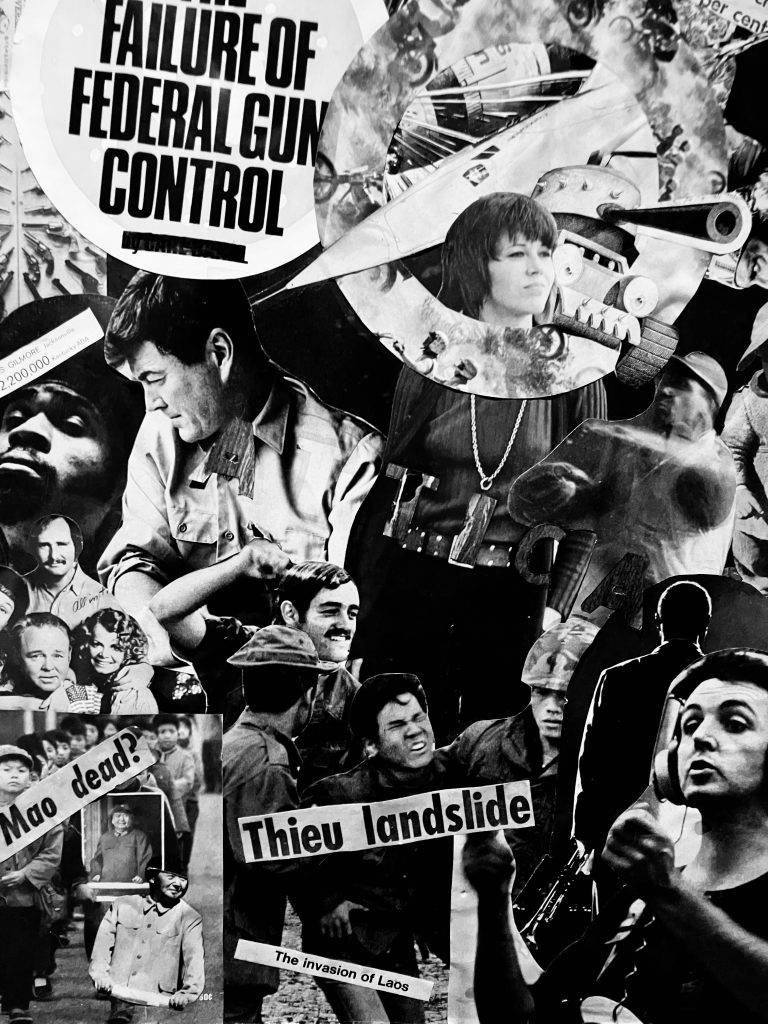
Doing collage with intention can become one of our key tools to help us keep things in context, to hold space so that our lives are lived—as Czech dissident, poet, playwright, and later president Václav Havel once said was so important—“in truth.” In the spirit of which, I was shocked to see how much of that collage I made in high school—entitled “The Seventies,” pictured above—reflects so many of the social issues I still think about today. It was, then and now, true to my truth, the map still buried in my heart.
If we embrace collage collectively, perhaps we can make real what art critic Clement Greenberg, writing in 1948, called “the pasted paper revolution.” A revolution in which we could call on scissors, glue, paper, hard work, creative connection, truth-telling, and a whole lot of heart.
Approaching our lives as artists
Tag: ARI WEINZWEIG
Honoring 44 years of Zingerman’s (and a bit of anarchism in action)
In her introduction to this week’s thought-provoking and highly recommended episode of On Being, Krista Tippett comments on the current state of our world:
Terrible ruptures and escalating violence are part of the truth of what we see ourselves capable. But they are not the whole truth, not the inevitable future. Courageous experiments in healing and transformation are also a reality of our time.
I hope that we in the Zingerman’s Community of Businesses (ZCoB) are effectively, if ever imperfectly, one of those courageous experiments.
Back when we opened the Deli in 1982, I could never have imagined that we would one day be working within the kind of national ecosystem we’re experiencing now. As I’ve shared at length in the new pamphlet, that reality has shifted my understanding of what democracy means—both to us as an organization and to those around us.
Today, my beliefs are very different from what they were even five or six years ago—about why democracy matters, what it looks like to practice it every day (not just every few years in a voting booth), and even about what we have already been doing for decades here in the ZCoB.
The focus of democracy, as I settled into my newly formed Deep Understanding, is not on politics, but rather on people: imperfect human beings like you and me working, however haltingly, to figure out how to live and work together with dignity and at least some modicum of effectiveness and meaningful collaboration. The work of bringing democracy to life doesn’t really begin in Washington. It begins much closer to home—in our workplaces and in our daily interactions with one another. Which means it’s up to ordinary folks like you and me to carry out the kind of caring experiments Krista Tippett is talking about.
A few weeks back, historian Ruth Ben-Ghiat, a specialist in both Italian history and autocracy, wrote,
Resistance rises when the toll of organized lying and negligent and malevolent governance becomes difficult to ignore. All of this is now unfolding … It is our turn to mobilize peacefully in the face of abuses of power.
In a way, her words are hard for me to hear, but I believe Ben-Ghiat’s got it right. Like it or not, it’s time to lean in and get going.
The encouraging part of that challenging framing is that “resistance,” in many ways, simply means doing our existing collective work especially well—staying true to our values and vision, and honoring our humanity in ways that are holistic and, ultimately, uplifting. As theologian Richard Rohr writes, “The best criticism of the bad is the practice of the better.”
In the fall of 1968, Erich Fromm—the German-Jewish psychologist who escaped his homeland for the U.S. shortly before the Nazis consolidated power in the 1930s—published his 22nd book, The Revolution of Hope. In it, he explores how the 20th century’s drift toward dehumanization—and the loss of hope that accompanies it—might be reversed, envisioning instead a future in which people are valued for who they are and can work together in collaborative, creative ways that benefit everyone involved. Fromm’s is a very hope-evoking image. In his conclusion, he writes about the sort of inspiring futures that free-thinking organizations can make real:
The need of the individual to work actively together with others, to talk, plan, and act together, to do something which is meaningful beyond money-making activities of everyday life. To relate in a less alienated fashion than is customary in most relations to others, to make sacrifices, to put into practice norms and values in everyday life, to be open and “vulnerable,” to be imaginative, to rely on one’s own judgment and decision, the formation of a new type of social group is necessary.
People in these imagined organizations of the future, Fromm adds,
… would attempt to achieve personal change. Becoming vulnerable, active, they would practice contemplation, meditation, the art of being quiet, undriven and ungreedy.
What Fromm is describing is essentially what we attempt to do here in the ZCoB every day. Given that you’re reading this, it’s likely that you’re working toward this as well. That correlation is not a coincidence. In the topsy-turvy world in which we’re all working right now, it is my belief that small businesses and similarly sized not-for-profits are the sorts of places best suited to making Fromm’s forecast a positive reality.
In difficult times like these, values-driven, democratically inclined organizations of any size can serve as modern versions of what early 20th-century German pacifist anarchist Gustav Landauer—one of Erich Fromm’s philosophical predecessors—urged people to create. Rather than getting swept up in the mainstream, Landauer called on communities to build “the institutions necessary for a true community and a true society of human beings.” As Landauer explained, calling up images of commerce as a catalyst for what was possible,
The following has always been true, is true now and will always be true: people live together in communities; people exchange goods and services over long distances; people are differentiated by language, custom, desire, and need; people believe that everyone looks out for his individual interest; however, some people stand up, make a change, and point the direction for the spirit and the courage of others. This is the reality that will always remain.
We have been working, always awkwardly and imperfectly, over the course of many years toward this spirit and courage. The shortfalls and struggles, I need to remind myself regularly, are part of the work. As the poet Robert Bly writes in one of my favorite books, A Little Book on the Human Shadow, “The imperfect is our paradise. … in this bitterness, delight.”
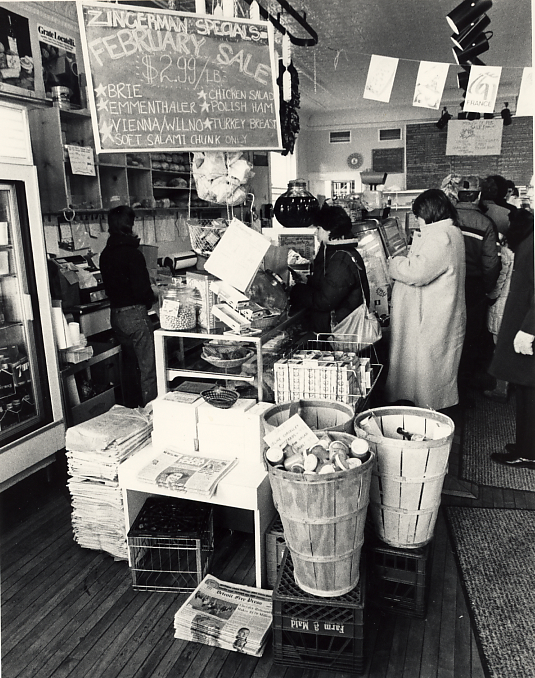
This past Sunday was our 44th anniversary here at Zingerman’s! Enormous thanks to everyone reading this and to the many thousands of others who have supported us, encouraged us, and stayed patient with us over the years. Reaching this milestone is statistically unlikely—and deeply meaningful. Like most things that matter, it’s the result of a collective effort. A thousand thanks, in every language we can imagine.
In the language of poet, writer, and musician Joy Harjo’s people, the Muscogee Nation, the word for “thank you” is mvto. That idea of gratitude as something both spoken and carried forward connects to something else Harjo has reflected on often: the power of story. In an interview from last fall titled “The Power of Poetry,” conducted by THE THREAD Documentary Series, she shared a range of insights about how humans make meaning. Reflecting on people across the world, Harjo said simply, “We are storytellers.” Storytelling, she suggests, is how we remember who we are and how we stay connected to one another. She recalled visiting cousins and listening to stories that stretched back into history—stories that helped people remember where they came from, invited them to think, and nurtured curiosity and a deep sense of belonging. When asked what kind of story she would most want to leave her students with, Harjo said,
I would want to give them a story in which they would see themselves as included. That would plant something in them that says, you are a human being… You are made of contradictions, you are made of beauty, you were made by a Creator who loved you. And I would want to plant opportunity in them. I would want them to see that no matter what is going on in the world or if things are being bombed … if they were refugees or having a hard time or even coming from the best families, I would want them to see that they were given gifts that are valuable and that when you have these gifts it’s important to take care of them even as it’s important to share them—that that’s essentially what we all came in to do. And there’s a lot of stories to get there.
This is also a good part of what I would want people to take away from the now 44-year-long Zingerman’s story. What Harjo has described fits well with our approach over all these years. We understand far better how to do it in 2026 than we did in 1982, but the spirit and intent remain the same: sharing stories—of food, people, and place—woven meaningfully with history so customers, coworkers, and communities feel far more connected to what they’re eating. That history, as Harjo says, provides context that can carry the experience to another level. In one form or another, we’ve been telling those stories since the middle of March 1982.
On March 25 and 26, I will be co-teaching with Gareth Higgins: “Reframing Our Leadership Stories and Beliefs.” The stories we tell shape our lives. Over our two days together, we will explore the beliefs and stories—first informally, and then, over the years, more formally—that underlie what we have made happen. These beliefs and stories are integral to what we have done and to what we continue to do today. Two of the many things that I have learned from Gareth over the years:
- The story we tell about our lives—individually or collectively—is the single most important factor in determining our happiness.
- A wonderfully effective framework for filtering any story we’re going to tell is to ask ourselves: a) Is it true—or at least the truest version we can tell in the given situation? And b) Is it helpful?
All of what follows—and really, all that I write—I try to run through those frames.
As I reflect on our story on the occasion of our 44th anniversary, it is increasingly clear to me that its importance goes far beyond food. In the context of all we’ve contributed and accomplished over the years, I see now that, in a way, it’s less about cakes (though we do make some amazing ones!) and more about collaboration and kindness. And it’s as much about dignity and democracy in imperfect action as it is about amazing deli sandwiches.
Over the years, I’ve noticed that just the act of sharing our “life story”—as truthfully and helpfully as we can—has a significant impact on people. In the context of Joy Harjo’s thoughts on storytelling, I’m struck by how even the story on its own can carry a message many people appear hungry to hear: that you really can do business differently. Because the story of Zingerman’s differs from nearly all of the high-drama, headline-grabbing tales most often told in the business world of the 21st century, it seems to open space for people to imagine other, more holistic, more personal, more hopeful possibilities.
I have both reflected and written in recent years about my realization that, back in the early ’80s, we were unknowingly and unwittingly a small part of a much larger revolution in the American food world. When I look at what people were eating then and what they’re eating now, it’s hard to deny the significance of that shift. Looking around today, at the start of the second quarter of the 21st century, I’m arriving at a comparable conclusion about the way we work: knowingly or not, we are part of a similarly positive revolution in the workplace. You may not notice it, I know, in the news, but it is happening. And it is significant.
In a sense, what’s happening is a manifestation of the revolution of hope that Erich Fromm was elucidating nearly 80 years ago. It’s also, I see, part of the revolution of dignity I wrote about in the pamphlet of that name. It calls up, too, humility, kindness, empathy, compassion, generosity, love, and much more. The reality is that in the workplace “of the future” Fromm envisioned, all of these elements of the organizational ecosystem can—and in truth, must—stand alongside profit as equally important parts of the organizational conversation. This, I hope, is the story of Zingerman’s that will still be told 44 years from now.
Part of what I think has helped us become who we are over the years—the kind of organization that tries to help people be themselves—is the diverse range of voices and sources that we study, and then work hard to adapt to what we do. This curiosity and search for new insights have been part of our approach since before we even opened. The list of people we’ve learned from is far too long to include here, though many of the names will be familiar. In the last few weeks, I’ve added the Ukrainian human rights activist and pacifist Maksym Butkevych to that list. Butkevych, reflecting on the two difficult years he spent in Russian prison camps, wrote that torture, as he came to understand it through painful experience, “was about the abolition of the capacity for choice. Torture was about the undoing of personhood itself, about turning a person into an object.” While the circumstances he endured are in no way comparable to ordinary working life, his insight about the importance of agency and personhood feels relevant in a different, far less extreme context.
In many large organizations, people can sometimes feel reduced to roles, metrics, or functions rather than recognized as whole human beings (check out Humanocracy by Gary Hamel and Michele Zanini). Writing 120 years ago, anarchist, activist, and author Emma Goldman was very blunt about it: “The worker who once took pride in the thoroughness and quality of his work, has been replaced by brainless, incompetent automatons, who turn out enormous quantities of things, valueless to themselves.” Together, these perspectives illustrate how essential it is for organizations to support dignity, choice, and meaningful participation in work.
The antidote, I want to suggest, is us—workplaces, large and small, that are intentionally organized around human dignity, with democratic practices within, and meaningfully positive engagement with the world around us. Workplaces where work is purposeful, where people care, where quality is a point of pride, not a shallow slogan. In our original unwritten vision in 1982, we knew from the get-go that we wanted to create a great place for people to work. I could say far, far more today about what that means, but from the first days of the Deli we were determined to treat people far better than most workplaces did—and, in many cases, still do.
Our work, clear enough in 1982 and clearer still with each passing year, is to do the opposite of what many people I know have experienced in well-known companies. Rather than shutting people out, we want to hold them up. Or better still, support them as they learn to hold themselves up. The more we honor the humanity of everyone we interact with, the better our work becomes. Yes, the finances need to be sound, but the two are not mutually exclusive: our Mission talks about bringing “great Zingerman’s experiences,” and “showing love and care in every interaction.”
I was reminded of the importance and active role of honoring humanity last Thursday morning at the ZCoB huddle. It really is inspiring to see so much meaningful human connection in action. People spent about a third of the three hours at the huddle talking about Cornman Farms—why the decision to wind down business in the fall was made, what went into it, how we can work collaboratively and supportively together in the coming months, its history, and a long list of special achievements. We heard deeply personal reflections from the two managing partners, Kieron Hales and Tabitha Mason. And a LOT of appreciations shared.
I tell the story of the huddle here because it was an inspiring real-life example of how a large group (about 50 in the room and 30 more online that day) can work together—with dignity in every direction, human to human, caring peer to caring peer—to deal with a difficult issue. No blaming, no shaming, no name-calling or finger-pointing. It was, to my sense, wholly human in the best possible way. That we have an organization that can have this kind of conversation in the open—caringly, honestly, and meaningfully—is, in and of itself, an uncommon and wonderful accomplishment. Psychologist Karla McLaren, who has written a lot about emotion, comments that “when your sadness is flowing and welcome in your life, then everything seems to go more easily.”
As is the case fairly frequently, an outside guest happened to attend that particular ZCoB huddle—a wonderful, hardworking, caring human being who’s been running his family’s manufacturing business here in town for longer than we’ve been in business. Much to his credit, he was curious enough to come across town to learn from what we do. After the huddle, he bought a couple of books from the ZingTrain shop and came over to me to thank me. “You guys really have the secret sauce,” he said with a big smile. “I mean, I know you work really hard for it! But you really do have the secret sauce!”
I thanked him profusely, appreciating that he recognized the work was not accidental and was actually the result of a whole lot of effort by a whole bunch of people. I assured him, though, that the sauce wasn’t secret—we teach it, write about it, and share it pretty darn widely.
Reflecting on it all later, I realized his kind comments brought me back to the subject I wrote about a few weeks ago: the David-Whyte-inspired belief about the “unordinary.” There’s a big difference between extraordinary—where someone does something exceptional that only they or a few others are capable of—and unordinary—where someone does something that essentially anyone could do, but hardly anyone actually does. Zingerman’s, I want to suggest, is wonderfully and inspiringly unordinary. Anyone who puts their mind to it could make something like what we do here happen in their own ecosystem: to be true to their essence, to honor humanity, to make money—but not at the expense of ethics; to include, to share, to support, to welcome; to dig into diversity, dignity, and democracy and make something special out of it in the process.
What makes the special sauce happen? As you likely know by now, I will always say there is no single perfectly reproducible recipe. Rather, woven into the Natural Laws of Business, our Vision, our Mission, our Values, our Statement of Beliefs, human connection is at the heart of what we do. Real people on site answer the phone. Live humans are working the chat. We encourage the people who work here to be true to themselves within the framework of our values and vision; to practice the second element of dignity daily by being authentic (without acting out) and by making space for customers and coworkers to do the same. When it works, you get the “special sauce.” Or maybe, I’ll say with a smile, a simple application of anarchism in action—beautifully blooming flowers. Emma Goldman—who writer Lydia Gans called the “Ultimate Humanist, a woman with a profound love for people and a commitment to make life better on this earth”—described a similarly hard-to-pin-down energy in her 1910 book Anarchism and Other Essays:
It is the harmony of organic growth which produces variety of color and form, the complete whole we admire in the flower. Analogously will the organized activity of free human beings, imbued with the spirit of solidarity, result in the perfection of social harmony, which we call Anarchism.
Or maybe it’s like a visit to a spiritual center in Ethiopia. In the book Ethiopia: The Journey, anarchist author Amastra (part of the inspiring work of Indigenous Resistance) says,
It’s hard for me to put into words the feeling that the land in Ethiopia evokes in me. It has such a distinct, unique feel. Something shimmering, a light feel and at the same time a feeling that one is in a place very profound and multi-layered that you could only just begin to scratch the layers to understand it.
Which sure seems to me like a lovely, poetic, and anarchistic description of “secret sauce.”
In a sense, all of these describe “whole human beings” working together—trying to be themselves, to learn, and to make a positive difference at the same time. It’s about working slowly, over time, to bring together the many diverse components of our personalities. This may sound simple to those who haven’t tried it, but in my experience, it is anything but easy. I’ve worked at it for years and still have much more to do. That same work, it strikes me, holds true for organizations as well. Robert Bly’s wonderfully insightful A Little Book About the Human Shadow helped me understand what was happening to us years ago:
Our culture teaches us from early infancy to split and polarize dark and light, which I call here “mother” and “father.” So some people admire the right-thinking, well-lit side of the personality, and that group one can associate with the father, if one wants to; and some admire the left-thinking, poorly-lit side, and that group one can associate with the mother, if one wants to, and mythologically with the Great Mother. Most artists, poets, and musicians belong to the second group and love intuition, music, the feminine, owls, and the ocean. The right-thinking group loves action, commerce, and Empire.
A healthy business, I’m positing here, brings both together effectively. How does one make it happen? Here are a few of the ways we can move in the right direction:
- Living the Natural Laws of Business significantly increases the odds we can make it happen. It sets the stage.
- The six elements of the revolution of dignity work too—each of the six is inclined towards honoring the humanity of everyone involved in the organization.
- Having a clear long-term vision that gets at all this, as well as mission, values, and beliefs.
- Honoring one’s essence in all aspects of work.
Doing this sort of work well is a slow, winding, and sometimes frustrating process—to come into ourselves, to effectively express our collective essence. These are not things that emerge from the drive for overnight fame and wealth. It’s what we here at Zingerman’s would call Natural Law #11: “It takes a lot longer to make something great happen than most people think.” Or what Palestinian peace activist, Arab Aramin, calls “T.T.T.” (Things Take Time).
We have done a lot in our first 44 years. I look forward to carrying forward Joy Harjo’s call in the years ahead. We can do this. Cruelty may be making the news, but meaningful efforts grounded in human dignity, kindness, and democracy continue to unfold right here in our imperfect organization that began with a small Deli 44 years ago this month. Together, we can slowly help to make collective organizational healing and transformation the reality of our time. And continue to create new stories—stories about the positive revolution in the workplace we are currently part of. Stories, with help, will still be told—human to human—another 44 years down the road. I feel confident we can make it happen. I’ll leave with you these lovely lines from Joy Harjo, whose Muscogee Nation has survived many a cataclysmic attack from the outside,
The theme of the age is how do we work together and move together with compassion and love or … with our differences. With our … different systems, how do we move collectively in a way that is nourishing?
Create lasting change
Tag: ARI WEINZWEIG
The death of a close friend and Cornman Farms’ final season
Musician Jamie Doe writes,
There are moments in life for which we cannot prepare. … Reacting in all our messy humanity to the shock of a world made new, in each case we confront a profound dislocation that upends fragile certainties.
This past week, for me, was one of those moments. It has left me trying hard, but not always succeeding, to handle some pretty profound dislocation and newly fragile uncertainties with grace and dignity.
Not many leaders I know, other than those who work with loss professionally, took their jobs in order to help guide their organizations through the grieving process. And yet, if one is in a leadership role for any length of time, it will almost inevitably, at some point, become a significant part of one’s work. That work, for me at least, is far, far harder when I, too, am grieving the losses at hand as I am here, not just supporting others as they struggle with the loss of a loved one.
To add to the challenge, grief generally shows up at wholly unexpected times. This week, it happened twice on what had begun as a rather innocuous day. By evening, though, I found myself dealing with two very different losses at once—the closing of a business and the death of a close friend.
While they are very different kinds of loss, the reality is that:
- Both events evoke a sense of grief and loss.
- Each of us is impacted differently by different losses; there is no “right” way to grieve.
- Dealing with grief—individually or collectively—is pretty much always difficult.
- Grief is not something to be disposed of as quickly as possible, nor, as neuroscientist and grief expert Mary-Frances O’Connor has taught, is it something we are meant to “overcome.” Grief, O’Connor says, can be especially difficult after a death that was wholly unexpected.
- As historian Yuval Noah Harari has written, there is no hierarchy of emotion. What one person is overwhelmed by, another may be oblivious to.
- Similarly, some people in the organization may be deeply affected. Our role as leaders is to help navigate during this time as well.
These are certainly not the first losses I’ve experienced in my life, nor, I know, will they be the last. While it would be understandable to approach each of the two on its own, given how different they are, I’ve chosen to address them here together since the reality of life is that they occurred within days of one another.
To be clear, I don’t like going through grief in any form. I’ve learned, though, to find ways to work through it anyway. And although it’s often hard for me to remember while I’m going through it, I’ve also learned that letting myself grieve loss is part of living and caring deeply. Hiding it—as I was raised to do as a kid—definitely does not help. Over time, engaging with grief effectively helps us to become more complete people. As author Elisabeth Knübler-Ross explains,
The most beautiful people we have known are those who have known defeat, known suffering, known struggle, known loss, and have found their way out of the depths. These persons have an appreciation, a sensitivity, and an understanding of life that fills them with compassion, gentleness, and a deep loving concern.
Even knowing that, as is often true for me when I experience significant loss, I’ve still been a bit in denial in recent days. Denial, I know, doesn’t alter the realities of the losses I’m beginning to grieve, but it does offer me a gentler runway into what I know will be an emotionally challenging time. Writing this piece is one way I know to wade into it all. Typing, quietly, can bring the tears.
Still, I’ve learned to lean in, to feel the pain, experience the sense of loss, and slowly, over time, to figure out how to go forward in positive ways. As spiritual leader Ram Dass reminds us,
No one can bypass the process, and everyone will have different karma around it. Grieving has to run its course. Just allow that pain of being human, and let it transform you. … It forces us to grow, to adapt, to learn resilience and compassion.
This work with grief is, in a sense, a journey that we have navigated many times over the course of our 44 years at Zingerman’s. Still, each time through is different. I haven’t really experienced either of these specific situations before, so I have a lot to learn in the coming weeks, months, and years.
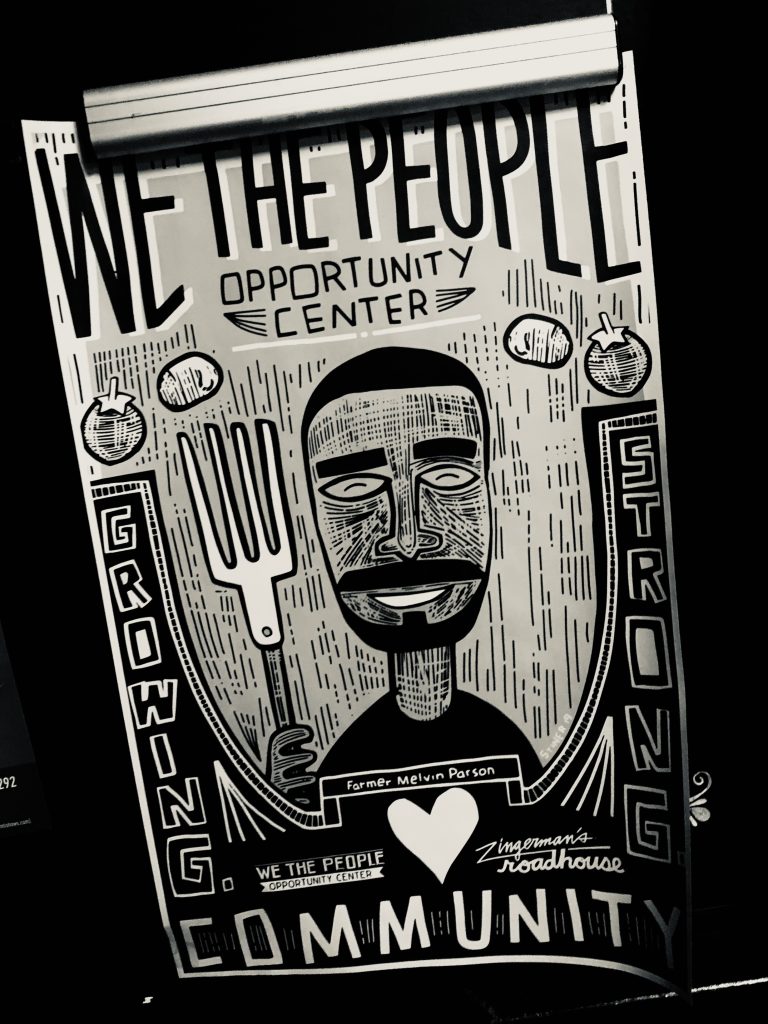
Writer Naomi Shihab Nye reminds me, “You are living in a poem.” In a sense, that gives me some solace, since poetry is one of the most positive ways people know to engage with the emotions of loss and grief. The poem being written right now, week by week, is about the decision to close Cornman Farms this coming fall, and, at the same time, the unexpected death of my good friend, Melvin Parson, founder of We the People Opportunity Farm and an amazing human being. The loss, in both cases, feels especially profound in the community—here in Washtenaw County and within the Zingerman’s Community—because both Cornman and Melvin were loved by so many.
Thinking about it all as a poem, I might title it then with the three-word suggestion I got from my Irish friend Aisling Rogerson, founder of the Fumbally Café in Dublin, who is herself navigating the deep loss of her partner, Manchán Magan, last fall. When I shared with her this past weekend that I felt neither emotionally prepared for the losses I was facing nor experienced in dealing with them, Aisling offered me a simple but wise message:
take your time
Xoxo
What follows, then, is only an entrée to what will surely be many years of learning to live with these new losses. As Mary-Frances O’Connor reminds us, “Grief never ends.” We do best when we own it, lean into it, and learn from it. The poem I have found myself living in—unexpectedly, this month of March 2026—could also draw on the essay I wrote last month (Magic and Loss) about Manchán’s painful passing at the far-too-early age of 55, and might be entitled. “More Magic and a Lot More Loss.”
As I wrote last month, one of the hardest parts of leadership life for me, at least, is that magic and loss nearly always coexist. While some in the organization will be mourning, many others will simply be going to work as usual. So while some of us are deep in grief, others may likely be, at the same time, really excited about our new work with Little Kim, and about nearly half a dozen potential new businesses that we’re in conversation about (no, of course, they won’t all work out). Others still will be jazzed about the wonderful weddings and other critical events for families at the Greyline, Roadhouse, Miss Kim, etc., and by crafting amazing wedding cakes from the Bakehouse’s Cake Studio. Grief, after all, does not make all the good things go away. Learning to work with both the ups and the downs at the same time is not an easy leadership task, but it is clearly a critical one.
These two stories of loss are very different, but since they arrived at almost the exact same unexpected time, my mind keeps moving back and forth from one to the other—reflecting on the amazing work that contributed to Cornman’s long run in Dexter and my friendship with Melvin and the way he contributed positively to so many people’s lives through his work with We the People Opportunity Farm. Both have been big parts of my life for many years. Experiencing the two losses in tandem has made this week particularly hard for me. Perhaps, though, the seeming coincidence of timing is less accidental than I imagined. The work that each of them contributed to our community both began, I realize now, in the same year. Cornman Farms opened its doors for the first time formally in May of 2014. And, later that summer, Melvin Parson began laying the early groundwork for what would become the deeply respected nonprofit, the We the People Opportunity Farm.
Forty years ago, in March of 1986, writer Judith Viorst released her now classic book, Necessary Losses. A few years later, as I was struggling with various forms of loss, the book was very helpful to me. This week, I find myself going back to it to help handle these two losses I’m working through. It’s filled with wise and insightful observations like this one:
… The people we are and the lives that we lead are determined, for better and worse, by our loss experiences
Which means that my own life, and the lives of the many thousands who loved both Cornman Farms and my good friend Melvin Parson, will be changed forever by the loss of each.
Over the years, Cornman Farms has been the site of many hundreds of beautiful farm weddings, private parties, fundraisers, and more. Its origin story goes back many years and includes our renovation of the 1834 farmhouse and 1837 barn (which won “Barn of the Year” from the Michigan Barn Preservation Network in 2015). I’ve heard stories from so many glowing brides, grooms, and parents about the love and care, attention to detail, and deep deliciousness of the amazing weddings they held at the Farm. I know, too, that our two managing partners, Kieron Hales and Tabitha Mason, have given a great deal of care to the decision to close—and that they take their responsibilities to clients and the Zingerman’s Community of Businesses very seriously. I could go on for many pages, but for the moment, I’ll just appreciate them for all they’ve done and are still going to do in the months ahead and beyond. Love letters and notes of appreciation have already begun to come in the last few days, and I’m sure that in the coming weeks and months, ever more folks will share stories as well. Closing Cornman will not cut off the memories. As the Irish writer and also good friend Gareth Higgins taught me many years ago, “You never know where a story will end, especially when you’re in it.”
It would be disingenuous for me to say that it wasn’t hard for me to hear about Cornman’s decision to close. Over our 44 years, we’ve had a pretty good track record. That said, Paul reminded me after we wrote the 2009 vision 32 years ago now, that if we were going to open a lot of businesses in the ZCoB, some would do well for a while, and then, years later, not so much so. We had a remarkable and very successful run for many years at Cornman Farms. Since COVID, though, the market for weddings seems to have shifted in ways that have made our work harder to make financially viable. And as Tabitha and Kieron have been reminding me and others here, not every business is meant to last forever, and even their deep, deep dedication and countless hours of hard work can’t make up for a large number of missing dollars in sales. During its 11 years of hosting amazing weddings and events, I am confident that Cornman has treated every guest’s event with dignity and grace and created a host of memorable events that will live in spirit for decades to come. I’m also confident that same heartfelt good work will continue until we wind down this coming fall as Cornman honors every single 2026 commitment with the same love, passion, and positive energy we’ve worked at since day one.
The first email I can find in my archive from Melvin Parson is a lovely one sent in the summer of 2013—one that, in hindsight, shaped a relationship, a friendship that grew ever stronger over the years. And really, reading that email again now, in the spirit of Naomi Shihab Nye, it very poetically shapes what things will look like going forward as I work through the grief and loss emerging from Melvin’s decision to take his own life. As another grief expert, the contemporary writer David Kessler, beautifully says,
Death can end a life
but it cannot end love or connection.
Our relationships don’t disappear when someone dies.
They change, but they still continue.
Even though Melvin and I were just getting to know each other at the time, the email really set the tone for the many years of friendship that were to follow:
Hello my friend
I just sent you an audio message and realized that I didn’t even say hello so please forgive me.
How are things? Hope all is well and that life continues to present to you challenges which offer up the opportunity to continue to grow as a person mentally, spiritually, and emotionally.
Take care my friend
Melvin
Melvin’s words remain true to this day. Melvin’s passing is leaving many of us, me included, with just what he suggested all those years ago when we were just getting to know each other. Opportunity that, to be honest, I didn’t want and don’t welcome, to continue to grow mentally, spiritually, and emotionally.
At the time he sent that email, Melvin was in the early stages of imagining the nonprofit for which he would soon become widely known, and that would benefit so many in the community. In March, 11 years ago now, many hundreds got this first formal email from Melvin. I can hear him saying all this with his big, welcoming, soft smile—beaming:
I believe that growing food grows communities. I want to use farming as a vehicle to create a different outlook for my community.
Last year was my first ever undertaking in growing vegetables. I inherited a 3’ x 20’ raised vegetable garden that had been tended to by a sweet woman named Verna. Sadly, Verna passed away last year and somehow I was chosen to grow vegetables in her stead; mind you I had no experience gardening. However, I was a gamer, so off I went preparing the soil; getting my hands dirty and loving every minute of it!
I dedicated my first experience with growing food to Verna. This vision has led me to form We The People Grower’s Association. This year will be our inaugural growing season, and we need not only seeds, but seed money to get started.
I don’t just want to grow food. I want to create a sense of empowerment in the community and educate the community about food sustainability, nutrition and other essential skills which promote a healthy outlook upon self and those about you.
…
Our motto is to Grow Food and Get Strong.
Your donation would be used to buy seed, seedlings, hand/ tools, compost and to cover miscellaneous costs. Throughout the season you will literally be able to watch your donation grow–grow into food, grow into wellness, and grow into a community.
Thanks for Your Help,
Melvin
And sure enough, he made every single thing he suggested in that email into a meaningful reality. Many talk a good game, but Melvin made things happen.
Melvin came into the world on New Year’s Day 1964 in Detroit. He was raised for much of his childhood by his grandparents, and he told me more than a few times over our years together how his grandmother had gotten him to be a big reader as a kid. Unfortunately, Melvin got in with the wrong crowd. Addiction and arrest followed. He was incarcerated for 13 years, and at some point down the road, became deeply engaged with the recovery community. When he and I met, he had been sober for quite a while and would regularly attend meetings. And he would always, always generously volunteer to talk to anyone I met who was trying to get sober—best I could tell, he was really never too busy to help someone who was struggling. In the years after incarceration, he moved to Washtenaw County, as he would tell me, to be in “cultural soil” that was better suited to what he wanted to do. He earned a bachelor’s degree in social work from Eastern Michigan University, and he would later win a wealth of awards and recognitions for his work with We the People. Shy and lover of solitude that he was, he never liked going to the ceremonies, but he would show up, share his story, wow folks there, and, in the process, win even more people over to his cause at We the People.
Being introverts, Melvin and I were quite adept at hanging out in the same space, each doing our own thing. He LOVED the Bakehouse’s Obama Buns—they were one of his regular treats, and we would meet up many a weekend out at Zingerman’s Southside, where he could pick one up. I remember when he first reconnected with his son, and then when he became a grandfather. We would chat on the phone and text regularly. It was rare, I think, that we went more than a couple of days without connecting. When we did, it seemed one or the other of us would reach out to make sure the other was okay. Since neither of us went anywhere on holidays, we would almost always speak by phone on Thanksgiving, Christmas, and the like. Judith Viorst writes, “Close friends contribute to our personal growth. They also contribute to our personal pleasure, making the music sound sweeter …. the laughter ring louder because they are there.” Melvin, for me, was most definitely one of those people.
Doing things well and receiving widespread recognition for his work does not mean Melvin’s life was easy. Yesterday, March 10, was the anniversary of Harriet Tubman’s death at the age of 90. It’s often said of her that she was “an organizer, a strategist, and a liberator,” and I would say the same descriptors apply to Melvin. He did all three with remarkable aplomb. Founder of the Elect Black Women PAC, Ruby Dennis-Powell observes that Tubman repeatedly chose to take risks for what she believed. As Dennis-Powell says, “She could have stayed safe in the North. She could have built a quiet life far from the violence and terror she’d survived. But she came back … Again and again and again.” From the outside looking in, it seems that Melvin did much the same, making himself emotionally vulnerable over and over again by expanding the scope of his work, by helping so many vulnerable people, by trying to raise money to support the work, and by living his values openly in a world that wasn’t always open to them.
Yodit Mesfin Johnson, friend and former director of NEW Center, knew Melvin well for many years and shared an important perspective that most people around him might never have seen:
Men like Melvin, a sensitive, brilliant, unconventional Black man, do not move through this country untouched. They move through a gauntlet.
This world does not know what to do with men who feel deeply. Boys like mine—who adored Mel—are taught early that softness is dangerous. Grief is weakness. Need is shame. Wonder is childish. Tenderness makes you vulnerable to ridicule, abandonment, or harm. … A man like Melvin, who felt the world around him deeply, was also resisting the script every day just by being himself. I see so many brothers doing this. That resistance is costly. It means feeling too much while having too few places where his full emotional life could be received without judgment.
He told us he was tired. Soul tired. He just wanted to be with his grandmother again. To be free.
Visionaries like Mel suffer from seeing too clearly. He could see the hypocrisy too sharply. He noticed the performance. The emptiness. The cruelty dressed up as normal life. Dignity and kindness were his antidote for this cruel world.
Over and over again during the years I knew him, I saw Melvin make it possible for people who doubted they would ever reenter mainstream society to feel better about themselves and to learn to make their way through the world with confidence and support. I met many of the amazing interns who came through We the People over the years, watching and trying to help from the sidelines as he gave them the support and guidance to move forward in a world that was often not very welcoming. Shihab Jackson worked on the farm for nearly two years. After Melvin’s passing, he shared the enormous significance of seeing someone like Melvin, having come out of incarceration and overcome serious substance issues, making his own way so positively in the world:
It can’t be understated how important and impactful it was to see myself in somebody else and vice versa. We got to witness that and be a part of that journey with him.
The Iranian-born American writer Azar Nafisi says there are books to read “in times of mourning and resistance.” To my sense of things, Judith Viorst’s Necessary Losses is one of those rare books. It taught me to lean into a lifetime of loss—none of which, until I read Viorst, had I ever really talked about: the loss of my father through divorce when I was a kid; the death of my uncle, whom I loved deeply, from a heart attack at age 48, just a week after we opened the Deli; the ending of relationships; the failure of projects at work. Viorst wrote, “Losing is the price we pay for living. It is also the source of much of our growth and gain.” Right now, wrapped up in the losses of the moment, it’s hard to feel excited about the gains that will eventually come—but Viorst’s wisdom has proven true for me many times before, and I’m confident it will again.
Viorst, who just celebrated her 95th birthday on the 2nd of February, was born in Newark. She got a BA close to home at Rutgers and then also graduated from the Washington Psychoanalytic Institute. Her first books were very popular and also very humorous. Necessary Losses was a serious turn in a different direction, but it turned out to be a classic. Viorst is unhesitatingly clear in how grief and loss like this work:
Throughout our life we grow by giving up. … no matter how clever we are, we must lose … It is only through our losses that we become fully developed human beings. … In fact, I would like to propose that central to understanding our lives is understanding how we deal with loss.
Looking back now, it’s my belief that Melvin, Tabitha, and Kieron have each, in their own way, shown real grace in difficult moments. I hope that going forward, I can learn from their good work.
Why am I sharing all this?
- First and foremost, to pay homage to the work that Kieron, Tabitha, and Melvin have contributed to the quality of life of many thousands of others. I, too, have benefited enormously from knowing them and from their deep dedication to doing what they believe in.
- To, once again, acknowledge grief when it comes in ways that impact not just me, but many thousands around me, and really, directly or indirectly, our entire organization.
- To help, imperfectly of course, create an organizational ecosystem where grief is something we can share productively, rather than hide it in some corporate closet.
- To remind myself—and maybe you—that great people doing great work still won’t always work out the way we want.
- To help myself to process these “necessary losses” that I know I find so painful. Writing is one way I’ve taught myself to slowly start to come to terms with the hard realities at hand, but each of us, of course, can and will come to our own conclusions.
As we piece all this together, Viorst gives me an artistic framework within which I can put the feelings that come up around all this:
We each are artists of the self, creating a collage—a new and original work of art—out of scraps and fragments of identifications. The people with whom we identify are, positively or negatively, always important to us. Our feelings toward them are, in some way, always intense.
Tabitha Mason, Kieron Hales, Cornman Farms, and Melvin Parson will all have prominent places on whatever I, and many thousands of others in our community, create. Their work will continue to be celebrated, I’m confident, for many years to come.
Working through hard times
P.S. I’m increasingly excited about the two days we’ll get to spend with my good friend Gareth Higgins later this month when he and I co-teach about stories and beliefs at ZingTrain. In fact, I reference Melvin, his good work and our friendship, a number of times in the book, The Power of Beliefs in Business, which serves as one of the framing texts for this terrific two-day session.
Tag: ARI WEINZWEIG
A wonderful winter recipe
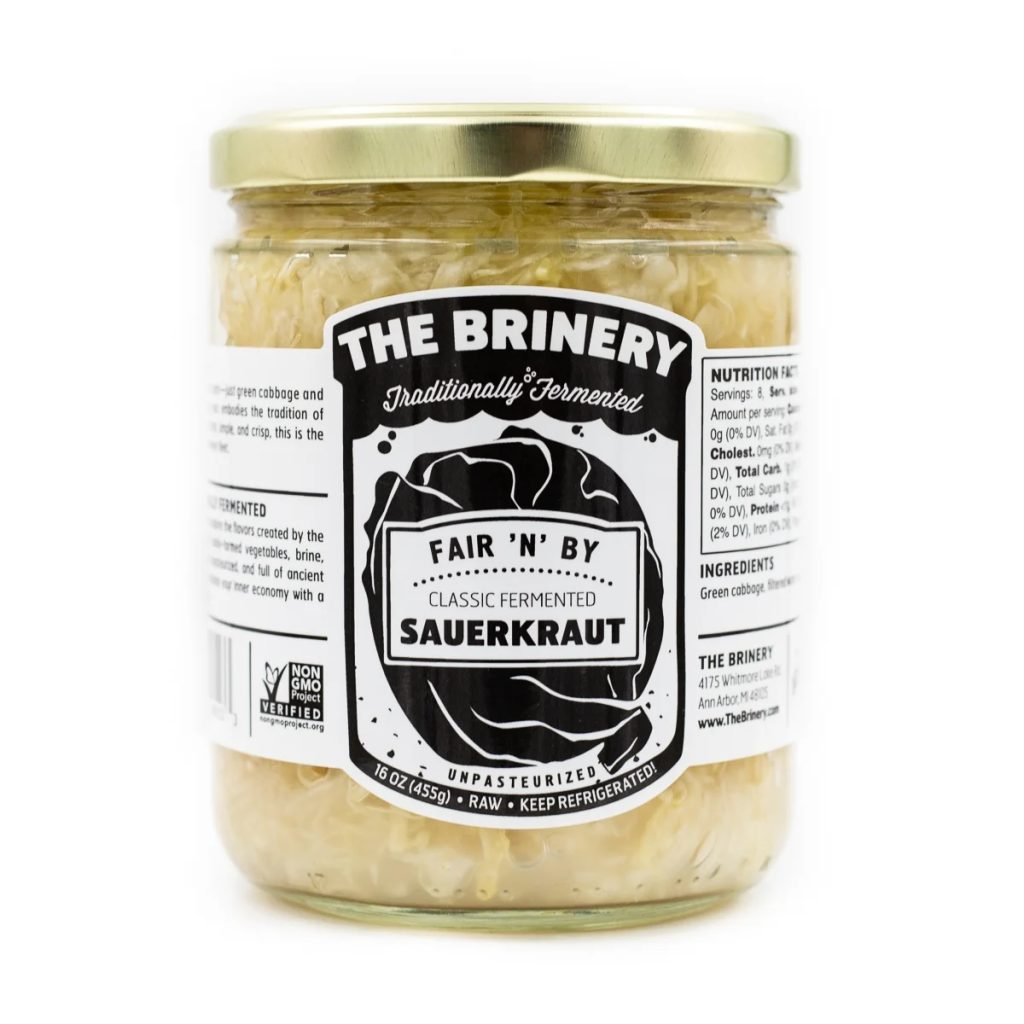
Soon enough, local spring produce will start showing up on our markets as spring is finally in sight for us. Before that happens, though, I want to share one of my favorite winter dishes—the delicious Sauerkraut SSoon enough, local spring produce will start showing up on our markets as spring is finally in sight for us. Before that happens, though, I want to share one of my favorite winter dishes—the delicious Sauerkraut Salad that’s in the back of the pamphlet “A Taste of Zingerman’s Food Philosophy.” I started making it two or three winters ago, and it remains one of my favorites for this time of year. After all, even when local vegetables are in short supply, we do have some world-class sauerkraut from David Klingenberger and the crew at the Brinery!
Sauerkraut Salad may sound a bit strange to most American ears, but seriously, it’s terrific. As the name implies, it starts with sauerkraut rather than salad greens. I use naturally fermented kraut from the Brinery. It’s what we use at the Deli on the Reuben and sell through Mail Order in the Reuben Kit. Seriously, the stuff is superb. And superbly good for us too. Dr. Zach Bush, whose work on holistic health strikes a deep chord with me, says:
Foods that undergo wild (air) fermentation are among the most ancient gut health tools. Wild and live fermented foods, such as sauerkraut, kavas, and kefirs gain much greater biodiversity than probiotics through the hundreds of species that are introduced to the fermenting crock from the ambient air environment.
All of which means that although I’ve really been making the salad for the flavor, it happens to be really good for our health as well! Over the years, I’ve used three different Brinery krauts, but any of their offerings would probably work well: Fair ’n’ By (green cabbage, filtered water, sea salt), Stimulus Package (green cabbage, filtered water, caraway seed, sea salt), and Galaxy Rose (green cabbage, watermelon radish, filtered water, sea salt). Both the company and the kraut are terrific and totally value-aligned for us here at Zingerman’s. As David says, they “aim to stimulate both your inner economy with living fermented foods, as well as the economy of our greater community and local food movement.”
To make the salad, start by putting a bunch of sauerkraut in a mixing bowl. A healthy handful per person would work. Add a good bit of fresh apple, cut into chunks, and then add an array of vegetables. You can use whatever you like—as I said above, winter vegetables work really well. I used fresh fennel, celery, and a carrot one night. The next night, I added bell pepper. Watermelon radishes are wonderful, and so is celeriac. Sprinkle on some sea salt and a grinding of black pepper. I added a bunch of caraway seeds. Sprinkle on some Gingras oak-barrel-aged organic apple cider vinegar, add a little extra virgin olive oil, and a bit more black pepper if you like. Mix well, then let the salad stand for a few minutes. Eat and enjoy. The sour crunch of the kraut, the sweet brightness of the apple, and the savory freshness of the vegetables all come together in a shockingly good way. Last but not least, I like it too, with chunks of a good mountain cheese mixed into the salad as well. We have an especially great selection of them in stock at the Deli right now—I’m partial to the Extra Aged Emmental (cut from the authentic, 180-pound wheel) and also the hard-to-get Schwagalp Alpkäse.
Shop for sauerkraut
Tag: ARI WEINZWEIG
A regenerative path toward healthy, enduring organizational futures
In her Sunday morning Substack, British-Turkish author Elif Shafak reflected—as so many of us are trying to do—on the uncertain state of the world. In her efforts to center herself, Shafak draws on the work of German-born American psychologist Erich Fromm. I’ve long found Fromm’s writing a helpful guide to what we’re living through. His insights into what was unfolding in his native Germany in the 1930s, as the Nazis rose to power—most notably in his 1941 book Escape from Freedom—have been especially clarifying for me as I try to make sense of what’s been happening here in the U.S. over the last decade. Shafak, who has lived through authoritarian rule in her native Turkey and fought hard for the right to make her literary art, concludes:
Art is how we tell the truth. … These days we need to remember this perhaps more profoundly than ever before as the world around us unravels with a bewildering speed and we seem to sink into some sort of collective madness. There is such a thing, after all.
… [Erich] Fromm observed that particularly in an anxiety-ridden age marked by uncertainty, insecurity and constant upheaval, individuals tend to surrender their independent judgement and their ability of critical reflection, succumbing to collective narcissism.
The world we live in is becoming increasingly more uncertain, worrying and difficult. We turn to art for light, to literature for wisdom, to nature for humility and to each other for strength.
The essay that follows is, indeed, about a form of art—in this case, an artistic approach to succession planning that has shaped how we think about the future of our organization here at Zingerman’s. If there is, as Shafak says, “collective madness,” this work could be said to be about “collective creativity.” It’s a long-term model for business ownership that calls up humility, images of nature, and the importance of collaboration and connection to community. Rather than retreating into the kind of “collective narcissism” that Erich Fromm wrote about, the Perpetual Purpose Trust (PPT) invites a collective coming together in a spirit of generosity—looking to the long-term health of the whole instead of the short-term enrichment of the few.
Seen through this lens, I believe PPTs fit well with the second of historian Timothy Snyder’s 20 tips for pushing back against autocracy in his book On Tyranny:
Defend institutions. It is institutions that help us to preserve decency. They need our help as well. Do not speak of “our institutions” unless you make them yours by acting on their behalf. Institutions do not protect themselves. So choose an institution you care about and take its side.
In this case, the institution in question would be the one you might have started, or that, perhaps, you play an integral and influential role in. When it comes to succession planning, PPTs protect high-quality local companies rooted in the community and help to defend them from getting sold off to bigger businesses for financial considerations that can seem “too good to pass up.” Every healthy local business that’s maintained is, after all, one less company that’s getting rolled up into the books of giant corporations run by far-away oligarchs with little connection to the community. And as economist Michael Shuman has demonstrated in The Local Economy Solution, strong local economies are foundational to quality of life in every direction. PPTs are one practical way to help make that happen.
Perpetual Purpose Trusts are not a new topic for me. We have, happily, had one in place for three years now—I wrote about what we were doing with ours back when we formally rolled it out in January of 2023. Having just spent two inspiring days at the Purpose Trust Ownership Conference in Austin at the end of last week, I was reminded that while the idea feels familiar to us here in the Zingerman’s Community of Businesses (ZCoB), it remains largely unknown in much of the broader business world. What we almost take for granted is still new to many modern-day business owners. I’m not suggesting a PPT is right for everyone. I do believe, though, that it’s a deeply holistic and healthy option for organizations that want to stay locally owned and closely connected to the people who work in the business and to the community around them. Three years in, we remain very happy that we chose this path.
What is a Perpetual Purpose Trust? It’s an ownership model that allows an organization to create healthy succession beyond its founders while keeping the company local and grounded in its essence. In a PPT, the organization’s purpose plays a meaningful legal role. The trust becomes an owner (in our case, a partial owner) and has a serious fiduciary responsibility to safeguard that purpose over time. Unlike a person, a purpose trust does not retire, relocate, or pass away. It can serve as an owner in perpetuity, helping protect the business from being sold off to outside buyers whose interests may not align with the organization’s long-term reason for being. It’s one thoughtful option to consider for anyone approaching succession in a spirit of generosity and stewardship. And it’s worth remembering that living with purpose brings a whole host of benefits. University of Michigan professor of public health Vic Strecher details many of those upsides in his book Life on Purpose: How Living for What Matters Most Changes Everything, and in this podcast from this past summer.
I first read about what we have come to call PPTs about 10 years ago in E.F. Schumacher’s amazing Small is Beautiful. While it’s not the main focus of the 1973 book, Schumacher does share the story of the Scott Bader Commonwealth in England, which started a program something like this about 75 years ago.
The idea of placing a business into a trust for the benefit of large numbers of people rests on a fundamentally different set of beliefs than the more common approach, where owners aim to extract as much value as possible and then exit at the peak by selling to a larger, cash-rich corporation. In fact, the PPT model is grounded in assumptions that are nearly the exact opposite. Schumacher framed his views on the issue:
Private enterprise claims that its profits are being earned by its own efforts, and that a substantial part of them is then taxed away by public authorities. This is not a correct reflection of the truth—generally speaking. The truth is that a large part of the costs of private enterprise has been borne by the public authorities—because they pay for the infrastructure—and that the profits of private enterprise therefore greatly overstate its achievement.
What Schumacher is saying is also aligned with what Paul’s grandfather told him (and then Paul told me) when we got going at the Deli in the early ’80s: “Half of what you earn rightly belongs to the community and the people who helped you get to where you’ve gotten.”
In his closing keynote at the end of the conference, Mark Clayton Hand—one of the country’s leading scholars on Perpetual Purpose Trusts and democratic practice in the workplace—beautifully wove together the significance of PPTs with the work of Native American writer and wisdom-keeper Steven Charleston. I knew a fair bit about PPTs, but nothing about Charleston. I’ve been studying his insightful work ever since.
Charleston, who just turned 77 on the 15th of February, was born into the Choctaw tribe in Duncan, Oklahoma, in the winter of 1949. He studied religion at college and received both undergraduate and graduate degrees in the subject before taking a position in the Anglican ministry. He has worked as both a professor and a minister ever since, and he currently serves as the Bishop of the Episcopal Church in Alaska. Charleston has written many books over the course of his career, the most recent of which is We Survived the End of the World: Lessons from Native America on Apocalypse and Hope. In it, Charleston reminds readers of the horror of the apocalyptic experience that Native American people underwent when Europeans arrived in the Americas. The resilience that helped his ancestors survive that painful apocalypse, Charleston believes, offers good, grounded lessons that can help anyone interested navigate our current national challenges.
The idea of a Perpetual Purpose Trust—to hold something important in a community collectively, so it stays rooted and works for the benefit of the whole rather than just a few—is very much in line with Native American philosophies. In that sense, Steven Charleston helped me see PPTs in a new light. Yes, PPTs are still fairly new in the U.S.—there are only about 50 in the country. But the principle behind them—the idea of giving back to the community, of keeping a company that really matters to the town, sharing profits and decision-making more widely rather than concentrating them in just a couple of hands—is far from new.
In today’s business climate, where extraction and consolidation often seem like the “norm,” a PPT feels radical. Yet in older, Indigenous traditions, something like a PPT simply makes sense, and while few have done it, anyone could. Seen through the lens Charleston provides, it’s actually the more common modern practice—extract and exit—that seems out of step. Which makes me realize it is far less extraordinary than I originally imagined. Instead, it seems more aligned with what I wrote last week about the “unordinary”—it’s actually a very natural way to pursue succession, but in our current socio-economic construct, few do. It is my hope and belief that in the coming years, PPTs will become quite common. Natalie Reitman-White, who’s been instrumental in getting the national work on PPTs to where it is, envisions 1000 of them in the U.S. by the year 2040.
Perpetual Purpose Trusts are a positive step in a sustainable, community-oriented direction—a direction that feels well-aligned with Indigenous insight Steven Charleston shared in a recent interview:
So many people are worried and anxious and fearful these days. I mean, we really are at a global turning point. And I don’t know if my books will help people … but if they can help at all, it’s incumbent upon me to speak up and try and offer something to help people through this difficult time and to reassure them, we’ll make it. We can do this. And … the spirit is with us. We don’t have to be afraid. We don’t ever have to be afraid. We need to stand up and be counted. Now’s our moment. We’re here for a reason. There’s a purpose for this. It’s not by accident. We didn’t ask to be born into interesting times like this. We didn’t ask to be at a hinge point of history, but we’re there and we’re there because the spirit wants us to do something collectively.
One way, I believe, that we can take the collective action Charleston is suggesting is to lean into the idea of Perpetual Purpose Trusts. For anyone focused on healthy, positive, regenerative ways to design ownership succession in your organization— as we have been here in the ZCoB for a number of years now—give some thought to creating a Perpetual Purpose Trust. As Steven Charleston says, “Celebrating what we hope for together is better than fighting over what we believe separately.”
FJ Intelligence is a progressive design firm based in the Eixample neighborhood of València. In a 2023 piece entitled “Everyone looks to the future: emerging technologies and disruptive innovation,” they share,
When we talk about emerging technologies, we often focus on specific terms such as artificial intelligence, blockchain, or the Internet of Things. But what truly matters is not the technology itself. What matters is the way these innovations can reshape how societies function, how value is created, and how resources are managed.
Disruptive innovation is structural. It affects business models, employment, regulation, infrastructure, and even how trust is built in digital environments.
And while some changes are already visible, others are only beginning to take shape.
…
The future is not predicted: it is built.
Emerging technologies and disruptive innovation will continue to reshape the world in ways we are only beginning to understand. The coming years will not only be defined by new breakthroughs, but by how societies and organizations respond to them.
Those who will lead this transformation will not necessarily be the ones who adopt technologies first, but the ones who understand them best. Those who can anticipate their impact, govern them responsibly, and integrate innovation into a long-term strategic vision. Because in a world driven by disruption, the future does not simply happen. It is built.
I wouldn’t have typically thought of a PPT as a “technology,” but upon further reflection, I realized it absolutely is. Merriam-Webster says technology is simply “the practical application of scientific knowledge especially in a particular area.” So, sure enough, the Perpetual Purpose Trust is a technology that can help reshape our world in positive ways. Six or seven years ago, after exploring any number of other options, both Paul and I agreed that it met our desire to keep what we had started together 44 years ago in March of 1982, when we opened the Deli, grounded in the community. We did not, we knew, want to watch it follow the path so many other great local businesses have taken—oft-told stories in which a much-loved local institution ends up owned and run by people who do not carry the spirit of its founding forward, with decision-making power and profits moving further and further afield. The name and the logo remain, but the essence that made the organization so special evaporates.
Those sorts of stories are, I’m sorry to say, all too common. I heard one such experience while I was at the Perpetual Purpose Trust conference: Joe Rogoff spent most of his career working in natural foods stores out west in California, places whose work he believed in and where he felt like he had the freedom and dignity to make a meaningfully positive difference. All that changed when the small chain he was working at was sold to a much bigger company. Sometimes those sales can work out well, but more often than not, the experience is more akin to what Joe describes. At first, things went fairly well, but soon enough, finances overran philosophy, and the people now in charge dictated a different direction:
The financial results were not making the shareholders happy, despite maintaining excellent results for a grocery chain. Cuts to labor restricted training and service. … Where we had once been encouraged to “run it like you own it,” we were now reminded that we were owned by money managers and shareholders who were most certainly not stewards. So the culture changed, doing business in any way with the company changed, and the experience of working there was changed so that the pride in the company, how it was positively impacting the world, and in the job itself evaporated …
It’s why my after-career (I’m too busy to call it retirement) has been focused on steward ownership [another name for Perpetual Purpose Trusts]. I serve on boards for co-ops, employee-owned businesses and purpose trusts because they seem the most reliable models for workplace equity and preservation of shared stakeholder values. They tend to be non-extractive and non-exploitive, and while it’s not necessarily required, also tend to be intent on doing something good for the world.
For us, the PPT is a way to do the opposite of what Joe witnessed as the grocery store to which he had devoted himself for so many years was sold. In the current national climate of uncertainty, it is a positive statement about the future, an overt commitment to community, to the belief that we are all in this together, and that founding owners (like Paul and me) can exit with grace while also giving the organization an opportunity to stay rooted in place for decades to come. I won’t be there, but the implementation of the PPT in 2021 has had me thinking regularly about the 100th anniversary of the ZCoB in 2082!
Mark Clayton Hand shared his learnings from Steven Charleston, who offers four approaches to help get through any apocalypse, including what we are currently experiencing:
“Radical change demands a radical response—turning the culture upside down.”
“The crumbling of the world we know demands that we build prototypes, or ‘lighthouses,’ that can show people an alternative potential future. ”
“It is imperative that we take into consideration the stakeholders that have historically had no voice or power in our economies.”
“The future can only be built together–co-created. We can’t do that without you, but with you, we are confident that we can co-create that better, alternative future.”
As Mark pointed out, the Perpetual Purpose Trust model does all four of these. It represents a significant shift in business culture—moving from “me first, me forever” toward an approach in which everyone can benefit, and the organization stays rooted in its community for the long term. It is absolutely an alternative model—a lighthouse, as Mark put it—showing what’s possible. It brings front-line staff and the broader community more meaningfully into the conversation. And finally, as Mark emphasized in his fourth point, it’s all about collaborative co-creation. Rather than taking out ever-increasing profits, trusts are designed to enhance purpose. Steven Charleston expresses this in a beautifully positive, community-centered way. While he wasn’t writing specifically about Perpetual Purpose Trusts, it’s clear from his reflections that his thinking aligns closely with what this model seeks to support:
Here is one way to look at yourself through spiritual eyes: you are a message. When you wonder what existence is all about, when you ask about your purpose in life, or when you feel small in comparison to the troubles of the world: remember that you are a message sent by the Spirit into creation. What you say, what you do, how you think and feel: your whole life is a long and sustained message for others to encounter, experience and receive. You are a living message: sent to touch more lives than you can imagine.
This is, I believe, with ever greater strength, what a Perpetual Purpose Trust can make possible—it’s our message to the future, our legacy, what we leave behind, a gift that we hope can keep on giving to the people who are part of it and the community it is in for years to come. As Charleston says, touching more lives than we can imagine.
In the Introduction to his new book, Founder to Future, John Abrams offers a perspective that is more explicitly grounded in business practice while still reflecting the same spirit shown in Steven Charleston’s insightful and inspiring comments:
Small businesses can be living systems that work for all the right reasons: to make people’s lives more meaningful and satisfying, to spread wealth more equitably, to treat the planet and each other better, and to protect mission and purpose. Making work that matters. This book is about reshaping tomorrow’s workplace for both individual fulfillment and the common good. Business can be at the heart of the great civilizational shift that we need today.
At the conference in Austin last week, about 150 others were in attendance, all at different stages of implementing versions of Perpetual Purpose Trusts in their own organizations. The range of attendees was wide—auto repair shops, assisted living facilities, manufacturers, a few fellow food businesses, as well as financial and legal service firms that support this work. I am not here to say that Perpetual Purpose Trusts are the right path for everyone. But I believe they are, as FJ Intelligence writes, an example of how “innovations can reshape how societies function, how value is created, and how resources are managed. … And while some changes are already visible, others are only beginning to take shape.” The PPT is a bit of both. As the sold-out conference—with a waiting list—would suggest, the model is already visible. And at the same time, I would argue that its broader impact is only just beginning to be seen. PPTs can work for everything from large manufacturing firms to independent musicians looking for a way to protect their legacy.
From our perspective, here’s what we hope and believe that the Zingerman’s Perpetual Purpose Trust (ZPPT) will make happen:
- Over the coming years, this program will make the Zingerman’s “intellectual property,” or “brand,” self-owned. ZPPT will ensure that Zingerman’s WILL NOT be sold to any outside company! No going public, no franchising, no selling the business to some big company that wants to buy us! It empowers and authorizes our “Purpose” (Mission, Guiding Principles, Beliefs) so that it takes precedence over profit. Profit is good too, of course, but NOT at the expense of values.
- Through this program, we will be paying out more and more of the profit from the intellectual property to Community Share owners—the Zingerman’s staff members who own a share in the business. Right now, there are over 300 of them! Over the next 20 years, that will gradually increase so that over half of the profit from our intellectual property will go to Community Share owners!
- ZPPT will help to make a sustainable, thoughtful, planned transition possible for Paul and me.
- This program will share ownership more and more widely. As Potawatomi botanist and author Robin Wall Kimmerer says, “the more something is shared, the greater its value becomes.”
- Make the ZCoB a more and more attractive place to come and work!
- Create a metaphorical “old-growth forest” that will continue to benefit the community of which we’re a part and the people in the ZCoB for decades to come. Forester, author, and professor Suzanne Simard says, An old growth forest “is a vast, ancient and intricate society. There is conflict in a forest, but there is also negotiation, reciprocity and perhaps even selflessness. The trees, understory plants, fungi and microbes in a forest are so thoroughly connected, communicative and codependent that some scientists have described them as superorganisms.
By doing this, we can keep Zingerman’s whole, healthy, and integrated into the community for decades to come, rather than sell it off—which can lead to transfer of wealth and power and influence outside the organization and outside the community. There’s much more to Ann Arbor, of course, than Zingerman’s. But over the last 40-plus years, we have grown to become a reasonably important part of this ecosystem. We are who we are, and have made it as far as we have, in great part because of that ecosystem. This is a way to keep that relationship going long after any one individual who may be part of the ZCoB is present.
I will say from experience that trying to plan organizational succession can be a lonely and sometimes scary path. Very few of us had a clear sense, early on, of what we’d want to do with our businesses many years down the road. Of those who did, in my anecdotal conversational experience, their vision was often to flip the business for a lot of money and “retire early.” There’s nothing inherently wrong with that vision, but it wasn’t the one many people—Paul and me included—had. We may not have been fully clear about what we did want to happen decades later, but we were clear that it wasn’t selling the business to some big company for a pile of cash.
As I wrote last week, the amazing Arab Israeli hip hop band System Ali sings about their belief that they can begin to create a new, more caring, more inclusive, more community-focused country. As they put in their song “Voyna,” they are “building the house anew.” The Perpetual Purpose Trust is, I believe, one of the ways I know to do that here—to seed a society which, per Steven Charleston, E.F. Schumacher, and Mark Clayton Hand’s teachings, would be grounded in community in ways that individuals can do well, and that also benefit the greater ecosystems of which they are a part at the same time. As Steven Charleston shares,
In the darkness, in the valley of shadow, we can feel isolated and afraid. But once we have the light of hope, we begin to see just how many people share in our struggle. The first step toward community is recognizing our common humanity. Instead of seeing strangers in the dark, we recognize fellow climbers in the light.
Hope booster
P.S. On March 25 and 26, I will be co-teaching with my good friend Gareth Higgins! Gareth authored the amazing How Not to Be Afraid and also co-wrote The Seventh Story with Brian McLaren. This will be the third straight year we’re doing this special two-day ZingTrain seminar, “Reframing Your Leadership Stories and Beliefs.” It is a rare opportunity to learn from Gareth’s great work on the power of storytelling in our lives and blend it with deep work on beliefs—the kind I detailed extensively in The Power of Beliefs in Business. Both Gareth and I speak and teach regularly around the world, but this is the only time we do it together. Telling better stories is a powerful way to support the start of what you want to create in your organization.
Tag: ARI WEINZWEIG
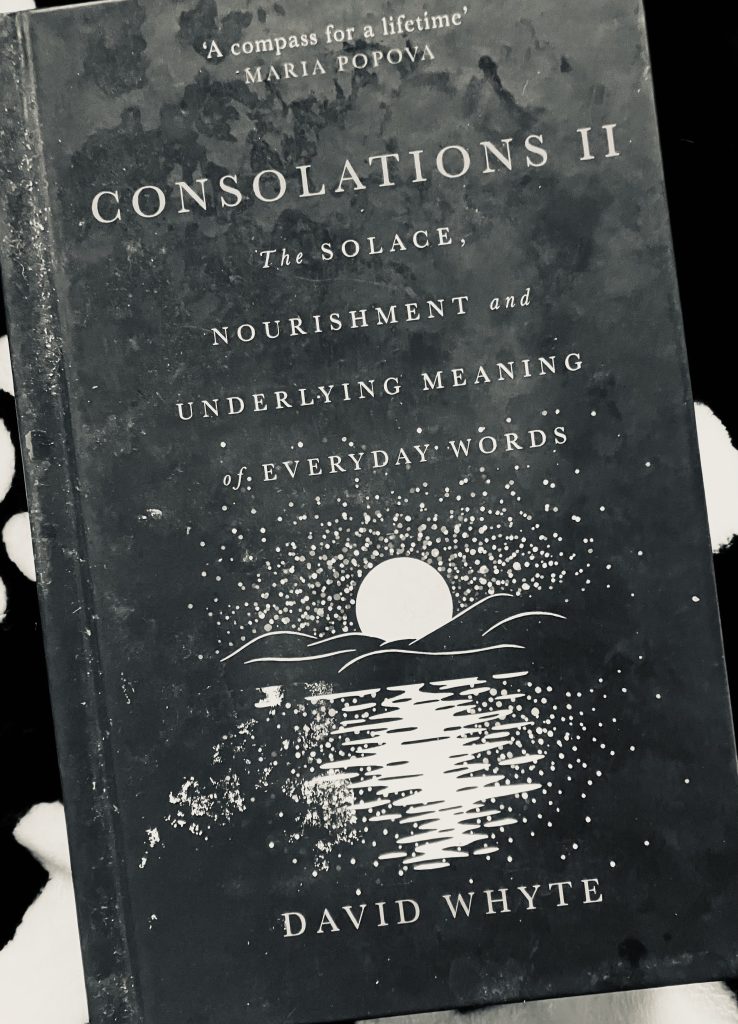
A judge’s call to action, a hip hop band’s act for justice, and other unordinary actions
Four years ago, Rabbi Lauren Holtzblatt, the same thoughtful and widely respected rabbi who officiated at Ruth Bader Ginsburg’s funeral in the fall of 2020, wrote in The New York Times,
Words matter. Every letter in the Torah is believed to have significance, and every word is essential. … There is a deep spiritual practice in combing through phrases, repetitions and words. We find meaning to justify each phrase; each phrase justifies its meaning.
Coming from a different place and different perspective, and in their own dub-centric way, the message on the second cut of the powerful new album from my friends at Indigenous Resistance says something similar:
Sometimes we can’t trust our own language.
That’s why it’s necessary to be hyper-vigilant when it comes to our own terminology.
Sometimes words, combined in just the right construct, can make a concept come clear in a completely new way. Other times, we look deep within a single word itself, understood differently, to gain clarity, meaning, and improved understanding.
This is one of the latter: a better understanding that’s beginning to come to me as I ponder the uncommon, if not super-intriguing, word unordinary.
In an era when ever more “urgent” breaking news dominates the headlines, when social media makes the world seem to rush past us faster by the day, it would be easy to miss writer David Whyte’s ideas about the importance of the “unordinary.” I almost did. It would have been my loss. As Whyte writes, “Unordinary is worthy of a lifetime’s dedication and a lifetime’s journey; and yet, in such an extraordinary way, unordinary is always, always, always, just a single step away from my ordinary, everyday life.”
The gentleness of this whole concept feels like an invitation to those of us who are intrigued—to slow down, lean in, listen to our hearts, and let it settle. The last piece of my own understanding of the impact of the unordinary clicked only as I was finishing the final bits of this enews. It happened when I was literally looking through a different lens, starting to shoot photos of the cover of Whyte’s book for this essay. I’d had the title—Consolations II—ensconced in my head for weeks. But through the camera lens, it was the subtitle that suddenly caught my attention. Under Consolations II, in much smaller white-on-black letters, I really read the subtitle for the first time and let it sink in: “The Solace, Nourishment and Underlying Meaning of Everyday Words.” Sure enough, it struck me—solace, emotional nourishment, and slowing down to attend to everyday things is what “unordinary” is all about.
Early last summer, I wrote a piece about how much difference ordinary people like us can make in the world. I stand by that belief—resistance is most powerful when it’s done by everyday people. If I were to change anything in that original essay, though, it would be my use of the word extra-ordinary, as in “ordinary people doing extra-ordinary things.” Writing now, I find I have a deeper respect for—and understanding of—another way of saying what I was trying to say back then. Speaking up peacefully for dignity and democracy is awesome, but it’s not, I would now say, an extraordinary action. Anyone who’s willing to be a tiny bit bold can do it. It remains special, but I would say now, instead, that it is inspiringly unordinary.
Before you (or even my own cynical self) decide I’m splitting linguistic hairs when there’s real work to be done in the world, let me say this—the shift in how I understand that one word is already changing the way I work. New understandings, I have learned over the years, bring new ways to stand in the world. This is no exception.
In 1921, Polish-born semanticist Alfred Korzybski offered one of his most memorable lines: “Definitions create conditions.” Which means that new definitions—of the sort I’ve been immersing myself in here—create new conditions. Change the definition of a word and, not surprisingly, you do things differently, too.
All of which brings me back to unordinary. It’s a word I’ve long known, but rarely used. What follows is an exploration of a new understanding of unordinary—and the wonderful new conditions that this different definition could well create.
In David Whyte’s Consolations II, “Unordinary” is the 48th of the 52 short pieces—each with a single-word title, one for every week of the year. It begins,
UNORDINARY is a word that belongs to our future, a word that could open up a different understanding of what it means to be singular, what it means to be communally human, and above all, what it means to be here, in this difficult world; all of us, every one of us, trying to live an extraordinary, ordinary life.
If, as Whyte writes, unordinary belongs to our future, then I’d say that future is already here, present in the midst of the everyday, ready to make a difference right now. We all have the ability to do meaningfully unordinary things right now. As Whyte writes, our unordinary is “something to be uncovered and perhaps at times, even unleashed.”
Last week, on February 17, conservative Judge J. Michael Luttig delivered a talk to the New York City Bar Association titled “America’s Time of Testing Has Come.” It was a very clear call to action—not only to the lawyers in the room, but to all of us who are paying attention around the country. Luttig spoke that evening directly, in a way that David Whyte might call “unleashed.” It was down-to-earth, direct, powerful, and compelling. And at the same time, it was deeply impactful and also wholly unordinary—there was nothing about the way Luttig addressed the audience that evening that many hundreds of other retired judges couldn’t already have done too.
Judge Luttig’s talk in New York laid out the challenge we all face right now in February 2026:
We must, finally, summon the courage that has eluded us in our all-consuming fear. Americans must summon from deep within the courage that was once our Founders’ courage. …
The time has come again, as it has come before, when the “appalling silence of the good people” is now “betrayal.”
We must stand, raise our voices, and speak out against what we are witnessing in America today. We must “break the silence of the night.”
For, as Dr. Martin Luther King, Jr., warned, “In the End, we will remember not the words of our enemies, but the silence of our friends.”
If we but find the courage to speak truth to power now, today, as did the Founders and our ancestors when their time of testing came, the United States of America will endure forever as the beacon of freedom and liberty to the world. America will once again be the envy of the world.
It would be hard for me not to take Judge Luttig’s call to action to heart. In an interview with Ali Velshi on MS Now a few days later, Luttig took a historian’s view of current events. To his mind, it’s clear that we are all being tested, but the tide is turning in the right direction. He cited the recent Super Bowl halftime show, the demonstrations in Minneapolis, along with the Supreme Court decision about tariffs, as evidence that the momentum for democratic direction is growing, sharing that:
For the first time in 10 years … I have confidence that America is going to prevail and long endure … I have not just hope, but I have the belief that we have come to the turning point and that America and Americans are going to answer the call from our founders and ancestors.
If history is calling, then I, for one, am ready to pick up the phone—to find the kind of courage Judge Luttig calls on us all to show. Once we do, the real question becomes how we will continue to both live our daily lives and, at the same time, find small but significant ways to make a meaningful difference. That question is part of what I’ve attempted to explore in the new pamphlet, “Why Democracy Matters: A Deep Understanding of Democracy in Our Everyday Lives.”
I realized in writing this piece, the inverse of Alfred Korzybski’s now classic statement is also true: Conditions can create definitions.
Sure enough, the social conditions in which we are living in the U.S. these days have me thinking about new definitions. As author Ursula K. Le Guin said in the fall of 2014, “Any human power can be resisted and changed by human beings. Resistance and change often begin in art. Very often in our art, the art of words.” Resistance. Art. The art of words. Unordinary actions taken by dozens of people—like Judge Luttig—by people like you and me answering the call to stand up for democracy. There’s no need to wait to be “extraordinary.” Unordinary is in each of us.
Unordinary is ordinary people doing something that matters—simple, available to all, but powerful in its intent. Becoming a federal judge, as Judge Luttig did, is extraordinary. Speaking out about what is ethically authentic? Unordinary. Any of us can do it.
In trying to play a small positive unordinary part in this work, I find myself returning again to Timothy Snyder’s slim and powerful book, On Tyranny: Twenty Lessons from the Twentieth Century. Each lesson is a modest but meaningful call to action. Lesson #9 reads:
Be Kind to Our Language. Avoid pronouncing the phrases everyone else does. Think up your own way of speaking, even if only to convey that thing you think everyone is saying. Make an effort to separate yourself from the internet. Read books.
This essay is, in its own way, an effort to take that advice. My new engagement with “unordinariness” is an attempt to understand a familiar word in an unfamiliar way, a way that regrounds me in the face of what could otherwise start to seem a paralyzing power grab by those who aspire to authoritarianism.
The idea of unordinary came clear to me in the context of a creative musical collective I stumbled upon last week called System Ali. A hip hop band from Israel, made up of both Arabs and Jews, speaking up and speaking out together about the injustice of the government’s actions. I was only half paying attention when their rendition of “Let My People Go” started playing.
Usually, I choose music on purpose. But sometimes, if I’m focused on something else, I tune out and just go with whatever starts playing on my phone. Something about System Ali caught my attention, though—I’ve replayed that unordinary moment a couple hundred times over the course of the last of couple days, so much so that I can hear it in my head even with no music actually playing.
It all starts with a gentle Arabic drone in the background. Soon it was joined by a wailing, Eastern European shtetl-style accordion in the foreground—two musical lineages that rarely share the same stage. A violin. More accordion. Then a sudden, unexpected shift into a bolder, more aggressive rhythm when band members began to rap, each in the language of their choosing—Arabic, Hebrew, Russian, English, Amharic, Yiddish. I kept listening, going from one song to the next: hip hop grooves layered with Arabic scales, Gypsy inflections, jazz phrasing, the polyphonic singing of Ethiopia, and a little rock and roll energy to boot. Wow. Arabs and Jews, immigrants and natives, all making music dignity-centered together in one ensemble.
System Ali’s songs deal with life under the definition of minorities in Israel, without hesitating to tackle the painful and sensitive issues in an honest, critical, quintessentially authentic way. As I said, System Ali is a mixed race, mixed religion, mixed gender group—which means the racism, separation, and fear that are so abundant in the region are nowhere to be seen, nor heard, in their work. Their album is an action towards building an alternative, wholly unordinary, reality.
To Judge Luttig’s point, they are not being silent: The band members sing about George Floyd, Black Lives Matter, the Nakba (the expulsion of so many Palestinian people from their land in 1948), the pain and loss and endless heartbreak that all peoples have experienced in the course of the history of their region. Without question, they challenge all of us who will listen to learn, and to be better at accessing our own unordinariness in the interest of making the kind of positive difference that both they and Judge Luttig have called on us to. On “Let My People Go,” the opening vocal sallies start—first in Arabic, then in Russian, and then move on to Hebrew and a little English—passing from one band member to the next with force, power, and feeling:
My heart is on fire
This situation is infuriating
Right to left so much pain
We want to live
But How?
Without an ability
Without an essence
I’m surrounded East to West South to North
I’m not about politics I’m all about myself
Because there’s a never-ending war in our home
I found myself thinking, Wow! System Ali is amazing. Diverse voices, diverse languages, diverse backgrounds, all playing together in a powerful, grounded, and meaningful way. It was really something so unusual to see—diverse bands singing protest songs are not easy to find in the region right now. The members of System Ali have taken a deep breath, answered their own call to action, and are speaking out—with unity in diversity—when so many others are staying silent.
It’s all so unordinary, in an absolutely wonderful way, that it’s gotten my attention. I’m not the only one. Journalist Ben Shalev, writing for the independent paper Haaretz, says,
An emotional declaration is in order. … let me put it this way:
“I think I saw what I would like to see as part of the future of Israeli music and its name is System Ali.”
I’ll add to Shalev’s statement: I would like to see a future in which the values of System Ali are very widespread. Not just of music in the Middle East—but the future, period. In our companies and communities, as well as our countries. Diverse, dignity-centered, and direct. Not afraid to speak up against war, indignity, and injustice. Eager to honor difference and put pain in the context of art, rather than inflict it aggressively onto others. Able to come together collaboratively to create one-of-a-kind art that makes a positive difference in the world!
In their song “I Can’t Breathe,” the band urges,
Don’t accept the lie,
don’t drink the poison.
Forgetting is a habit
The big learning of unordinary for me is about embracing that the diverse, ethically-based, inclusive, and encouraging reality that System Ali is creating with its music could actually be the norm. In a sense, what’s odd isn’t them—it’s the sad reality that a group of Arabs and Jews playing socially conscious, peace-focused, dignity-driven, and difference-making music together in one band that easily could and should be so ordinary we barely even notice anything beyond their tunes is, instead, so rare.
As I pondered the music of System Ali, it seemed an ideal example of what unordinary might be. It’s a way to live Timothy Snyder’s call to be kind to our language as an act of resistance against the numbing drama of authoritarianism.
Here’s a bit more about how I’m thinking about it. Extraordinary is when someone makes something rare, difficult, or almost impossible take place. It’s stuff that takes both a very special skillset and hard work. Olympic athletes—extraordinary. Michael Jordan—extraordinary. Climbing the Himalayas—extraordinary. Being a brain surgeon—definitely extraordinary. Timothy Snyder’s and Ursula K. Le Guin’s writing. I appreciate them as such. They are special. Definitely not ordinary.
The more I played with the idea of unordinary, the more it resonated. I began to see that, while the quality of our food may indeed be particularly special—extraordinary when we do it really well—most of what we do in our business practices, seen through my new lens of understanding, is definitely unordinary. They aren’t, I’m realizing, especially extraordinary at all. Anyone who wants to could do them. It takes neither a particularly special skill nor years of intensive formal training to learn to be kind. Kindness. Compassion. Dignity. Diversity. Humility. Empathy. Inclusion. Any eight-year-old could have their hand at them. Vision-writing. Extra-miling. Open-book management. Open meetings. Consensus. Also wonderful, but still, not really “extraordinary.” We have no special ingredient that makes us more able to do what we do than any other American organization.
All of those processes are really important to us, and I recommend them wholeheartedly to you too, but the truth is that anyone who decides to could do them. In that sense, I would now describe them as “unordinary.” Yes, uncommon, but not because of a rare ability that’s uniquely abundant in and around Ann Arbor. They’re hard to find because they’re not the norm—most people color within the same behavioral lines their colleagues do. They’re not the norm because, in current conditions, it may take a bit more attentiveness to take positive, dignity-based action. And, at the same time, they are absolutely unordinary.
As is so often the case, now that I’ve been thinking more and more about what it means to be unordinary, I’ve started to see evidence of it all around me. Just to give some context to the rest of the conversation, I’ll share a couple of examples here.
Unordinariness is what caught me a couple of days ago in this article about the late Reverend Jesse Jackson, who passed away last week. The headline of an article by reporter Madeline King in the Chicago Tribune conveyed the concept: “Neighbors remember Rev. Jesse Jackson as a ‘quiet reminder that greatness can live right next to you.’” All the stories illustrated the point further:
Although he worked alongside the Rev. Martin Luther King Jr., … to his neighbors, he was a friendly face who made others feel seen. …“Jackson was the type of neighbor to compliment your baby as you push her in a stroller and then stop by your house to celebrate her law school graduation decades later,” West said. … “He was absolutely wonderful,” Speller said. “Very personable, genuine, generous with his time.”
All of what’s being said about Jackson is wonderful and uplifting. Yet, in a way, it describes what any human is capable of. What made it remarkable was the authenticity he brought—it altered the energy of the moment—but at its core, it reminds us that this is something anyone could do. Once again, it’s wholly unordinary.
Unordinariness is, I realize, nearly all of what draws me to the writing of Wendell Berry. Berry’s actual writing, many say, is exceptional. The content, though, when it comes down to it, in this context, is more upliftingly unordinary than anything else. Rereading with this lens, there’s little Berry advocates that exceeds the normal bandwidth of any caring, thoughtful human being who might be living on the land.
Something similar, I realize, is also true of Peter Block’s writing. It is beautifully unordinary. In Community: The Structure of Belonging, he shares, “Being powerful means that my experience, my discovery, even my pleasure, are mine to create.” Extraordinary? Not really. Inspiringly, insightfully, unordinary? Absolutely. He goes on, “The shift toward citizenship is to take the stand that we are the creators of our world as well as the products of it.” It’s moving. It’s accurate. It’s definitely unordinary! It’s the choice that, in comparably unordinary ways, Judge Luttig and System Ali have both made. And that any of us who decide to step up as Judge Luttig has called on us to do, can make too.
I’m writing this and sharing my musings as one way to offer clearer language to use in the abundant, unordinary instances of life where that might really matter to folks. Why? Because with clearer language, we communicate more effectively, we think more clearly, and we make better decisions. We can embrace unordinariness and all that goes with it, and deal with it differently from the extraordinary work that goes into the work of Olympic athletes and trained virtuoso musicians.
To my eye, System Ali sets the pace. It’s wild how much they have done with their work. And will do. As Yonatan Kunda, one of the band’s vocalists and lyricists, explains, “This band is not about molding or combining everyone into one thing … It’s about keeping those [cultural] differences and embracing them for their individuality and uniqueness.” Muhammad Aguani, another lead member from Jaffa, shares, “When I’m with the band, I feel like I’m with my family,” he says. “I respect them and I’m proud of them. I love them very much.”
Looking from the outside, the members of System Ali seem able to turn normal, healthy disagreement into the kind of creative growth we all want. They run their band practices standing or sitting, but always facing each other in a circle, the better to facilitate mutual respect. They talk a lot about each band member’s need to protect, nurture, and grow within their own bayit, which means “house” in both Arabic and Hebrew. As Aguani adds, “We fight a lot. What he’s saying may make me angry, but then I write another verse.” What I’m learning from them now is to continue to lean into the unordinariness of the moment, and the magic that can be made from it. They are a reminder that no matter how bleak headlines may look—in a business or a bigger entity like a country—there is always positive, wonderfully unordinary resistance beneath the surface.
Ben Shalev, a journalist for Haaretz, describes the way the band works together while allowing each member to remain fully themselves. Writing about the “conglomerate” that is System Ali, he notes that each rapper has “a separate, distinct identity.” One “looks and sounds like a Russian revolutionary,” while another, dressed in a jogging suit, “resembles an assistant trainer in a Golden Gloves boxing club in Jaffa’s Gimel neighborhood.” The band members themselves put it more simply. As one member explained:
We wear whatever we want because we want to and it is who we are. And since we are all different people, we wear different things. And that’s it. Liba, she wants to wear a dress and me, I like to wear jeans and a t-shirt and Enchik has his sporty look. So what? It’s all good, man!
What catches my attention most, though, are these poignant lyrics from the song “Voyna” (“War”). This version is the one I’ve had on repeat. At about the two-and-a-half-minute mark, bass player Yonatan Kunda sings these lines:
All that is left is the shock
Spinning around the block of our souls like a hawk
As our ministers mop up blood with theoretical talk
They can’t hear anything or feel anybody
On the left, and to the right, all the kings are conned
In this political ping pong
We are nobody’s pawns
We are singing the 23rd Psalm
In the persistence of resistance
In the rock of the song.
We’re the screech of the chalk of the white and blue
There’s smoke rising from a fire no one ever knew
In our hearts,
We’re building this house anew.
Tears fill my eyes as I type up those song lyrics. Kunda sings with a fervor, and the music is so compelling that it reminds me that all the people you and I work with are also capable of calling up this same kind of passion—of choosing to be unordinary, of speaking out from the heart for what we believe, but doing it always with dignity and respect for everyone around us. While System Ali is terrific, they are not, in this new context, extraordinary. I actually wish we were in a situation in which so many other bands were bringing together diverse musicians to sing about peace, dignity, and gentle justice for all. Their work makes a difference. It’s Judge Luttig’s call to action come alive. Wholly, wonderfully, lovingly unordinary. Creative, caring, difference-making work we can all, in our own ways, do in our organizations every day.
The American-born Kunda, it turns out, spends a lot of time at the Yaffa Youth Center teaching young kids poetry, in both Hebrew and Arabic, as well as playing music, offering the positive impact of unordinariness:
It’s the beginning of the end of the problem when we create music together.
Take unordinary action
P.S. In Arabic, the word for apricot is mish mush. In Hebrew, it’s mish mish. In my world right now, an apricot is an invitation into the dignity and democracy that System Ali, Judge Luttig, and all the other good people I mentioned above are advocating. I was wearing my apricot-embroidered Carhartt jacket when I ran into long-time customer Jonathan Sugar wearing his! We both smiled. Check out all the apricot shirts, hoodies, hats, and jackets—Underground Printing ships your order straight from its Ann Arbor store to your home, and all the proceeds are donated to Democracy Now!—a non-partisan, non-profit!