
Tag: ARI WEINZWEIG

Inuit insight, magic words, and bringing democracy to life every day
Greenland has certainly been in the news a lot recently. While power politics can make for catchy headlines, the component of Greenland’s culture and history that draws my attention on a deeper level is its Native population, which makes up about 90 percent of the people who live there. Rather than talking about invading, we might instead find ourselves inspired by the cultural teachings of the Indigenous people who call Greenland home. I find myself thinking back to that Josef Albers poem “More or Less”:
To distribute material possessions
is to divide them
to distribute spiritual possessions
is to multiply them
The Inuit are an ancient culture, whose ancestors likely came from eastern Siberia, moved across what’s now Canada, and, over generations, made their way east to Greenland—where today roughly 95 percent of the population of 60,000 or so is Inuit.
One of the figures from Greenland Inuit history who fascinates me most is the explorer and cultural anthropologist Knud Rasmussen. Born in Jakobshavn (now Ilulissat) to a Danish missionary father and an Inuit–Danish mother, Rasmussen grew up speaking Greenlandic and immersed in Inuit culture—an upbringing that would profoundly shape his life’s work.
In 1902, at the age of 23, Rasmussen set out on his first expedition to study Inuit culture in Greenland (the same year, it happens, that Rocco and Katherine Disderide built what, eight decades later, would become the Deli’s building). Rasmussen has been hailed by 20th-century anthropologists as “The Father of Eskimology.” Over the course of his life, he donated over 15,000 artifacts to the Danish National Museum in Copenhagen to support a better understanding of Inuit culture.
In 1908, Rasmussen wrote what’s considered the classic anthropological work on the Inuit, entitled The People of the Polar North. It’s a combination of learnings from his extensive time spent living with various Inuit communities, detailed accounts of his travels, and serious scholarly study. When Rasmussen died of pneumonia at the age of 54 in December 1933, The New York Times published an obituary the following day, calling his book “a treasury of folklore.” Author and photographer Dave Hamilton writes of Rasmussen,
He remains a much-loved character within the Inuit communities of Greenland and Canada. In Denmark he is also a national hero—but outside of these far northern countries he is virtually unknown.
…
Rasmussen was acutely aware of how easily Inuit culture could be polluted and diluted by Western influence. He had the foresight to understand that if it wasn’t documented, it could be lost forever. … He collected folk tales in a way that other explorers might butterflies or beetles.
Much to my happy surprise, Rasmussen mentions dignity often in his writing—not as a subject in itself, but woven throughout his vivid descriptions of Inuit life. From him, I learned that the daily practice of dignity in Inuit culture reaches farther than what I’ve seen or read about in most other cultures—and certainly much deeper than what we experience here in our own country.
Lisa Koperqualuk is a Canadian Inuit anthropologist who hails from the far northern province of Nunavut. She specializes in the study of Inuit spirituality and traditional life, since, as she says, “For Inuit, our past is our pathway to the future.” In 2018, Koperqualuk delivered a talk titled “Some Reflections on What Human Dignity Means to Us Inuit,” in which she shared how deeply Inuit culture values dignity. Dignity wasn’t a subject she studied in her formal schooling. Rather, it was part of her childhood. She reflected,
I think when I think of dignity it relates first to the way I was brought up. My grandfather … always showed respect for me. So the word I would use is “sususiak”—to have respect for one another. … So I was raised by my grandparents. I learned of the respect they showed to others. I learned not only through their words but by their actions. And so most Inuit are raised to have respect for others and in doing so they have respect for themselves—and therefore all that is around them. This was taught as being part of Inuit law. The way one should conduct themselves as Inuit.
By the time Koperqualuk was an adult, her grandfather’s influence and the impact of growing up in and studying Inuit culture had made dignity second nature for her. She explains in the talk that dignity is the underlying principle behind the Inuit people’s respect for themselves, for all human beings, and for “the need to protect our environment and how it relates to dignity.” It also underlies, she says, the founding of what Koperqualuk calls “a cooperative jewel,” La Fédération des Coopératives du Nouveau-Québec, back in 1959.
Coming back to Knud Rasmussen and his extensive studies of Inuit people in Greenland, he later traveled westward with a team of fellow explorers to Canada. Rasmussen’s purpose was to learn about the history and culture of every Inuit group he encountered there. He spent significant time with each community, most especially the Netsilik Inuit in what is now the Canadian province of Nunavut. Rasmussen lived with the Netsilik for over half a year, during which time he gained the community’s trust. Gradually, many began to share their personal stories, dreams, and sacred traditions.
In his 1931 book, The Netsilik Eskimos: Social Life and Spiritual Culture, Rasmussen recounts the many tales he was told during his travels among Inuit communities:
All that is described in them did really happen once, when everything in the world was different to what it is now. Thus these tales are both their real history and the source of all their religious ideas.
As Rasmussen later shares in Report of the Fifth Thule Expedition 1921-24, The Danish Expedition to Arctic North America in Charge, Volume 2: The Intellectual Culture of the Iglulik Eskimos, one of the stories he heard in his time in Canada came from an elderly Netslik Inuit woman named Nalungiaq. She taught him that,
Of all sources of power, magic words are the most difficult to get hold of. But they are also the strongest of all, for it was a word—a magic word—which in the olden days, when mankind lived in the dark, gave them light; and it was by means of a magic word that death was brought into life at the time when human beings were beginning to overcrowd the earth.
While magic—in a word or otherwise—is well accepted in traditional Inuit and other Native cultures, it has over time been made anathema in most of the Western world. In a story that very few Americans (me included) are aware of, Indigenous American historian and author John Mohawk explains how that came to happen over the centuries:
As the church grew in political importance, it began a “campaign against magic” during the three hundred years starting about 1450. Individuals who had a spiritual relationship with plants or animals were considered to be practicing magic. In the 1600s it was believed that these people had renounced Christ and were in league with the devil, who promised them the powers over nature in return, and they then used these powers against their enemies. The war on witches and magic was a psychological war on nature.
By contrast, Inuit culture treats nature with the same dignity as people are taught to treat each other, and magic is simply part of the traditional beliefs and practices. I’m beginning to believe ever more strongly that we might be wise to adopt a similar approach here, and to reverse the centuries-old work to eliminate the idea of magic from our lives. In the context of what I wrote on the subject a few weeks ago about making magic happen, I’ve begun to realize that magic matters far more than I ever imagined—not just to professional magicians like my friend Acar Altinsel of Penguin Magic, for whom magic is a way to make a living, but to all of us who want to tune in more closely to the world around us. In fact, as I wrote last month, I believe that magical things tend to happen in the lives of those who are deeply mindful of them.
With all that in mind, thinking about what Inuit Elder Nalungiaq told Rasmussen a hundred years ago, what I want to share here is my growing belief:
Dignity is a magic word.
It’s so magical, in fact, that I’ve come to believe that it’s the practice of dignity in cultures, companies, and countries that makes a democratic construct come alive. Its impact is, in essence, magical. When dignity is the expected cultural norm—as it seems to be among the Inuit—all kinds of wonderful outcomes, things that would almost never happen in settings where dignity is not the norm, begin to unfold.
Around the Zingerman’s Community of Businesses (ZCoB), both dignity and democratic constructs are expected and acted on every day. Dignity and democracy are only rarely discussed in tandem by leaders in Washington, D.C. Same goes for even the most progressive news outlets. Nevertheless, the connection between the two is becoming increasingly clear to me. Living and working in companies and communities where dignity is deeply embedded in the culture provides the framework we need to make democracy a daily reality.
In an essay published about a decade ago in Boston Review, Nick Bromell—Professor of English at Amherst College and author of The Time Is Always Now: Black Thought and the Transformation of U.S. Democracy—writes about the troubled state of democracy in the United States. In the essay, titled “Beyond Freedom and Equality: The Democratic Value of Dignity,” Bromell reflects on the increasingly fragile condition of democracy here and in a number of other countries around the world in recent years, writing,
Dozens of books and hundreds of articles have proposed solutions. … The one I propose here is that we accord more importance to human dignity.
I only came across Bromell’s insightful piece a few months ago as we were working to finish the new pamphlet “Why Democracy Matters: A Deep Understanding of Democracy in Our Everyday Lives.” I wish I’d seen it sooner, and that more people had paid attention to it when it came out. Bromell’s insight is similar to what I arrived at in my work on the new pamphlet.
The connection between dignity and democracy has not, as best I can tell, been widely expressed in recent years. As Bromell writes,
Political theorists have written at length about the meanings of equality and freedom, but work on the relation between dignity and democracy is scant.
Putting together what I learned in my previous pamphlet, “A Revolution of Dignity in the Twenty-First Century Workplace,” with my writing, learning, and deep reflection on democracy over the past 18 months, I came to a conclusion that, in a sense, builds on Bromell’s great work. The epilogue of my soon-to-be-released pamphlet is titled “What Is to Be Done? A Framework for Dignity and Democracy in Action.” In it, I share what I have come to believe more strongly every day. As I wrote above, dignity is not only, as Bromell argues, profoundly important. Dignity, effectively practiced, IS democracy.
To be clear, I’m not talking about dignity as some sort of inspiring but loose philosophical concept. My conclusion here is based on the application of the six elements of dignity that I arrived at a few years ago. What I came to believe, in writing the new pamphlet, is that the daily practice of dignity is basically what one needs to do to create a democratic organization. Yes, of course, voting can matter, but it does not a democracy make. As I remind people regularly, they vote in Russia too. It’s dignity that makes democracy work.
With all that in mind, it’s also now my strongly held belief that where people lead lives with effective democratic engagement, the odds are very high that their countries and companies will work in democratic ways as well. It’s about you and me—and everyone we know—actively implementing the six elements of dignity. The way we implement it, I know, will never be perfect. But when done well, all day, every day, by essentially everyone in the organization, democracy is effectively created at the same time.
The early 20th-century business thinker Mary Parker Follet—believed by many to be way ahead of her time—understood this a hundred years ago. She concluded in her 1918 book The New State: Group Organization, the Solution of Popular Government,
Democracy transcends time and space, it can never be understood except as a spiritual force. Majority rule rests on numbers; democracy rests on the well-grounded assumption that society is neither a collection of units nor an organism but a network of human relations.
The core of those relations will be at its democratic best then when those relations are based, all day, on dignity.
For clarity, then, here are the six elements of dignity I developed a couple years back:
- Honor the essential humanity of everyone we work with.
- Be authentic in all our interactions (without acting out).
- Make sure everyone has a meaningful say.
- Begin every interaction with positive beliefs.
- Commit to helping everyone get to greatness.
- Create an effective application of equity.
In that sense, dignity is what I’ve described both in a piece I penned about dignity at the tail end of this past summer, and also now in the new pamphlet, a framework.
As Ann Arbor poet, author, and arts leader Aaron Dworkin says, “A well-constructed framework encourages freedom; it doesn’t constrain it.” To make a democracy a reality, I am now adamant, dignity is what we need to do, not just peripherally, but in daily practice. We need to use the six elements of dignity extensively and effectively as a framework so that
- Every system in the organization is designed to actualize dignity.
- AND
- Every person in the organization acts with dignity in every direction.
Given the importance of dignity in traditional Inuit culture, it’s no surprise now that historical Inuit governance was designed in ways that effectively call up the practice of dignity I’ve detailed here and in the new pamphlet. As the website Digital Indigenous Literacies explains in the article “Inuit Governance Practices”:
It values evidence, experimentation, curiosity, objectivity, repeatability, knowledge mobilization, and peer-review. It is built on respect and care for others and the environment, fostering good spirit by being inclusive and welcoming, being innovative and resourceful, and working together. It is respected by Inuit as Western science is by scientists.
You already know from what I’ve written here that I’ve been working with the six elements I developed to help make dignity a daily reality. The Inuit have a framework of their own. According to Digital Indigenous Literacies, its culture is based on eight Guiding Principles:
- Pijitsirniq: the concept of serving
- Aajiiqatigiingniq/Aajiiqatigiinniq: the concept of consensus decision-making
- Pilimmaksarniq/Pijariuqsarniq: the concept of skills and knowledge acquisition
- Ikajuqtigiinniq/Piliriqatigiinniq: the concept of collaborative relationships or working together for a common purpose
- Avatittinnik Kamatsiarniq: the concept of environmental stewardship
- Qanuqtuurnniq: the concept of being resourceful to solve problems
- Inuuqatigitsiarniq: the concept of respecting others, relationships, and caring for people
- Tunnganarniq: the concept of fostering good spirit by being open, welcoming and inclusive
Whether it’s in Inuit communities or elsewhere, dignity makes all the difference. And unfortunately, as Bradley Campbell and Jason Manning write in their 2015 article, “Honor, Dignity, and Victimhood: A Tour Through Three Centuries of American Political Culture,” cultures in which dignity is not a key ingredient slowly decompensate. By contrast, cultures like the Inuit’s, ours, and perhaps yours as well—where dignity is expected of one another and widely practiced—are far, far healthier. As they write,
Dignity exists independently of what others think. … We believe that truly sustainable and respectful change begins with an internal commitment. Dignity cannot only be something we promise to participants; it must shape the very culture of our organizations.
In other words, dignity isn’t just another nice image to post on social media; it’s something we have to live into every day. It’s certainly what we’re trying to do here in the ZCoB. It’s also, as I wrote, what the Inuit have done for centuries. I believe that all truly sustainable organizations have woven dignity into their culture and values. In an article published last November, entitled “Building Cultures of Dignity,” S. Dilshad and Tom Wein reinforce its importance, writing,
Dignity must be woven into the fabric of your organization’s processes and pathways. This means embedding it in project or program design, ethical review, HR policies, and team communication. It requires moving from a mindset of a separate lens for projects to one of foundational integration. … we analysed the flows of how our work and culture is approved and shaped, and sought out the “choke points” when important and lasting decisions are made, such as at our approval process for new projects, ethics review, and project kickoff materials, to ensure dignity is upheld.
Hannah Paniyavluk Loon, an Instructor of Inupiaq language at the University of Alaska, offers a lovely example of how dignity culture plays out in Inuit communities, and what the impact of this “magic word” would be in everyday life. Loon doesn’t directly say the word “dignity,” but dignity is implicit in the lovely things she says about her native culture:
Our knowledge tells us to always be mindful of our environment and the resources around us. It is up to each family member to always take care of the harvest cleanly and to give away the first season’s catch, such as beluga or bearded seal. It is always common to give Elders and those with lots of children fish, meat and plants. It is our belief that giving is a practice we share throughout. Not only do we give resources, but also western food when people run out of food or funeral expenses. It doesn’t matter who we are, we should always partake to donate finances and food to the bereaved family.
I imagine a company—and a country—where the view Dr. Loon describes isn’t just that of a few caring individuals, but the everyday, lived practice of most of the people within it.
How can we get there today? In an essay published in the summer of 1968, entitled “The Black Flag of Anarchy,” anarchist, educator, author, poet, and professor Paul Goodman writes,
We learn by doing, and the only way to educate cooperative citizens is to give power to people as they are. Except in unusual circumstances, there is not much need for dictators, deans, police, prearranged curricula, imposed schedules, conscription, coercive laws. Free people easily agree among themselves on plausible working rules.
When dignity is already deeply embedded in culture, Goodman writes, we actively “educate cooperative citizens.” The dearth of this approach in the U.S. here in the 21st century is making it difficult, I believe, for people to understand the concept and how to abstract their way forward. All of which reinforces for me why democracy only happens when people practice dignity. Dignity done well across all elements of a culture, actually IS democracy in action. The work, as I write repeatedly in the new pamphlet, is about how you and I live our lives. In one of my favorite philosophical framings of recent years, Wendell Berry said of our country’s situation, “The leaders will have to be led.”
It’s time, then, here at the start of 2026, to dig into dignity, to make its existential magic come alive in the way we treat everyone else we interact with, in the way we run our organizations, and last on the list, the way we run our countries.
To close here, I’m going to go back to one of the people who has inspired my own work, someone who fought for human dignity over a hundred years ago: Emma Goldman, who, at around the same time Knud Rasmussen was studying Inuit tribes in the early 20th century, wisely observed that,
The ultimate end of all revolutionary social change is to establish the sanctity of human life, the dignity of man, the right of every human being to liberty and well-being.
Magic words, it turns out, make for magical worlds. I’m ready to get going. Want to join me?
Dignity IS Democracy
P.S. Live in the area? I’ll be doing a book talk on the new pamphlet at Darius Smith’s newly opened Ohana Lounge in Ypsilanti. The conversation will start a bit after 6pm on Thursday, March 5! We’ll have copies of the new pamphlet and other Zingerman’s Press books for sale and signing.
Tag: ARI WEINZWEIG
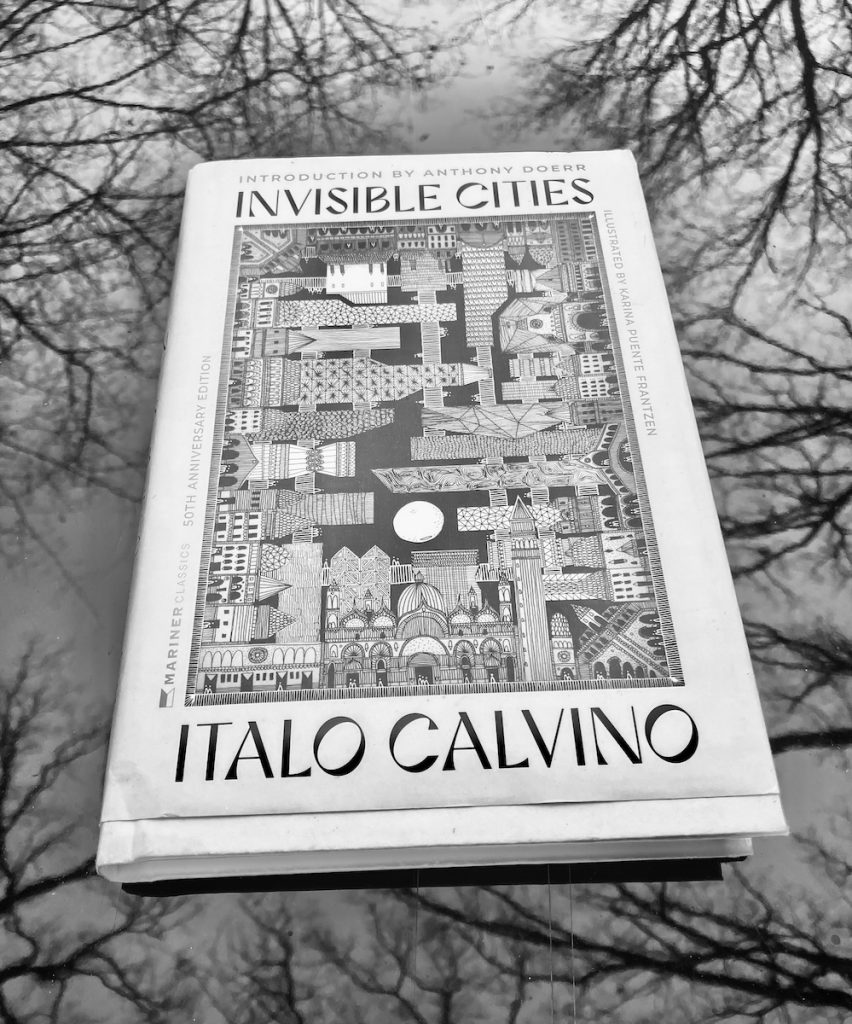
The insight of Italo Calvino and a path to more positive living
Ever committed yourself to something big, something you care deeply about, but that you’ve never done before? Something you believe in your heart you can become adept at, but that you have little idea how to do right now? Ever experienced that anxiety that arises when you start to tell other folks what you’ve decided to do? Does that foreboding fear of failure come flooding in when you declare your intentions to the people you care most about? That’s definitely what it feels like for me.
If the details of this situation sound familiar to you, then I say, “Awesome!” You’ve likely made what radical business writer Carol Sanford calls a “promise beyond ableness.” For the purposes of this piece, I’ll call these promises PBAs.
In the third week of November 1974, around the same time I’d started learning how to be a line cook, the novelist Joseph McElroy published a piece in The New York Times Review of Books about the newly released work of one of Italy’s best-known writers. Looking back at the article late last week, the first few lines caught my attention:
“Invisible Cities” is a new book by Italy’s most original storyteller, Italo Calvino. But this time not a book of stories. Something more.
“Something more” is indeed worthy of our attention. It’s also the particular subject of the essay that follows.
In the introduction to the 50th Anniversary Edition of Invisible Cities, author Anthony Doerr writes about his own imaginative and exploratory childhood, sharing how, as a young boy, he would regularly make up stories while playing with his older brothers:
We search for secret doors. … You find one.
I agree with the young Anthony Doerr who’s embedded so deeply in the adult author’s memory. A meaningful part of our life’s journey starts with just that sort of search. Given time, focus, good self-management, and hard work, all of us can—and, I believe, will—find a “secret door” that’s right for us. We just have to learn how to look for it.
In essence, the decision to go through that secret door is just the sort of PBA that Carol Sanford was so passionate about incorporating into people’s lives. When you take a deep breath and decide to go determinedly through that door, you commit to a PBA. When you share your decision with the world so others know about it and then dive in and start working at it, the odds are high that you will arrive at “something more” in time. When you put in the work, and things work out well, that “more” can be life-changing.
Invisible Cities, as I’ve come to view it, is Italo Calvino’s invitation to see what sort of secret doors might be out there and which ones are well-suited to the way we would like to live our lives. Not necessarily living in the narrow ways that mainstream society deems “successful,” but, rather, by imagining inspiring and enchanting possibilities. Calvino encourages us to explore, much as one of the book’s two main characters, Marco Polo, once explored the world.
Neither Calvino nor Polo, of course, used the term “promises beyond ableness,” but the possibilities PBAs present are essentially what I believe the book is all about. Alex Sager, a philosophy professor at Portland State University, writes that Calvino’s “tales of Marco Polo are exercises of imagination and of perception to alert us to reality and to help us imagine how things might be otherwise.”
In the fall of 2012, 40 years after Invisible Cities came out and a little over 800 years after the real life Marco Polo passed away in his hometown of Venice, Carol Sanford published an intriguing piece of her own. In a 21st-century business kind of way, she offered a path we can take to get to an uplifting future, a path that, with a lot of hard work and a bit of good fortune, can help us get to “Invisible Cities of our own creation.” Sanford explains:
The most fundamental managing principle for innovation is to believe in and practice the principle that everyone is growing and learning and is part of the innovation team.
That is why I created a work system for managing people that sees development as core and is based on “promises beyond ableness”—promises by people to do something that they know they can’t do now, so that they have to grow in order to succeed. Those who make promises beyond ableness have seen something that really needs to change. It is worth the climb, and they commit to the personal and professional growth to accomplish it.
A PBA, as Sanford has frames it, is an answer—a positive, inspiring, and very practical one—for any of us who feel stuck and those of us who are inspired to do more, to grow, to make more meaning in our lives and in the lives of those around us. PBAs can be huge in scale, like envisioning an amazing workplace we will create and how it might look 10 years into the future. Or they can be far smaller by the world’s standards but still significant to the person doing them and the people touched by them. In fact, I now realize that when I sit down to write this essay every week, I’m engaged in making a small-scale PBA come alive. I’m not just restating old information; I’m figuring things out while I write. It’s scary, for sure, but I’ve freely agreed to the deadlines that we have in place, and I’m dedicated to doing the work in a way that will benefit readers around the world, the people who make up the ZCoB (Zingerman’s Community of Businesses), and me in the process.
In a June 2013 piece in The Atlantic, Ilana Masad encouraged readers of Invisible Cities to savor its complexity: “Don’t let this volume’s slimness fool you into thinking it’s insubstantial. Calvino’s masterpiece has multiple layers of riddles.” Which is also, in a sense, the unnerving reality of Carol Sanford’s PBA construct. The future is unclear because, in great part, we are all currently working to create it. Our lives are layers of riddles, riddles that, like writing this essay every week, creating a business from scratch, or learning a new skill, we have the ability to answer. PBAs help make that sort of positive future a reality for anyone open to pursuing it.
When many people first learn about Sanford’s idea of promising beyond one’s ability, they get stuck worrying and wondering just what it is, exactly, that they should promise. Best I can tell, the answer is “I don’t know, and neither does anyone else.” We have to sort it out for ourselves. Self-reflection and internally driven decision-making are important parts of the journey. As Ilana Masad writes, “Whether the places [in Invisible Cities] exist literally or only metaphorically … well, that’s up to you to decide.” While we can, of course, confer with others whose perspectives we care about, in the end, we each must choose the PBAs we are going to pursue for ourselves.
Writing in Medium in the spring of 2019, Carol Sanford noted that our growth as individuals is a natural outcome of the work that emerges from making a PBA:
It is often said, “people are resistant to change.” This is not the case when approaching change through a new and shared understanding of the true nature of change and the elements of change that typically trigger resistance. Developing this understanding and designing from that new mindset is the essence of this phase.
A key difference in this form of work design is to require everyone to make a “promise beyond ableness” which is to contribute something significant to a stakeholder outside the business. It is beyond the current ability of the person making the commitment, would clearly benefit the stakeholder as measured by their terms, and will grow the person making the promise to deliver. They become self-directed, as part of a team, delivering on this promise. It has the effect of awakening motivation, creating new capability for the organization for the future, and building a business that is owned by everyone.
When I give presentations about Zingerman’s life and leadership philosophies, frameworks, and approaches to business at public events, one of the most common questions people ask goes something like this:
This is all great stuff. I love it. It’s just that I work for a boss whose style is almost the exact opposite. What should I do?
The question comes, most typically, from middle managers and folks who are far down the org chart. They’ve often been led to believe they have no say in how things are run, so they feel like this is the truth. I remind them that they likely have more power and influence than they are imagining. Usually, meaningful change can—and does—come in far smaller increments than most have been taught to look for.
When I answer the question, I make clear that because I started Zingerman’s and have been in a leadership position ever since, it’s been ages since I was in the sort of spot they’re in. But with that caveat, I usually suggest pushing ahead anyway. We don’t need to wait for our bosses’ approval to get going in ways that make a difference. Most of us have the power to make small, positive changes in the way we lead and live, changes that will make a meaningful difference but won’t create problems for anyone. Starting to practice servant leadership or the six elements of dignity probably isn’t going to alienate anyone, but will, when we stick with it, make a meaningful difference. Every act of kindness, every new learning, every day we make dignity the heart of what we do … they all have a positive impact!
In a sense, I’m suggesting a small version of Richard Rohr’s notion that “the best criticism of the bad is the practice of the better.” When we operate within our own sphere of influence, it’s pretty rare that anyone will try to stop us from pushing into new, positive territory. It may not work, but the current reality isn’t working either. Natural Law #9, the idea that success means you get better problems, encourages us to decide which problem we want. Should we stay stuck in the status quo or push toward positive possibilities and see what happens? As you can tell, I’ve tried to teach myself to choose the latter and push past my own ever-present fear. It’s almost impossible, I believe, to see the secret doors without sticking our necks out.
Society, of course, often teaches us the opposite: to stay in our boxes, avoid making waves, and wait for the boss to give direction. In the spirit of what I wrote last summer about the power of ordinary people to make a big difference in the world, I’ll share another bit of insight. It’s from the wise and inspiring Carol Sanford:
This drive to take on things we do not understand or cannot do is inherent in each of us, but it goes to sleep unless it is connected to something compelling, something we can see is needed in a situation that we care about. Once we recognize the need and make the promise to do something about it, the beyond ableness part provides the opportunity and reason to stretch and grow. Proactively seeking to work on things we do not already know how to do may seem daunting at first, but in the long run, it is profoundly affirming.
How, then, do we find the “right” promise to extend our ableness? That’s the quest that Marco Polo has taken up in Invisible Cities. As he says in the book, “At times all I need is a brief glimpse, an opening in the midst of an incongruous landscape, a glint of lights in the fog, the dialogue of two passersby meeting in the crowd, and I think that, setting out from there.”
The visioning process we use and teach so regularly here at Zingerman’s is a wonderful way to bring PBAs out into the open. An effective vision, we believe, must be both inspiring and strategically sound. In other words, it includes many PBAs. They are, by definition, both inspiring to the person pursuing them and strategically sound. A good vision is a big stretch, but we believe we can achieve it! A vision without any PBAs may be very strategically sound, but I doubt it’s going to be very inspiring. I can see now that our 2032 Vision actually has any number of PBAs, including commitments to do effective work around succession and to teach young people our approaches to leadership and life.
Looking back now to our organizational beginnings, Paul Saginaw and I were definitely making a PBA when we opened the Deli in 1982. Neither one of us had ever run one before. Same for the Bakehouse in 1992. We didn’t know much of anything about baking; we just were driven to have better bread! In fact, it just dawned on me that our vision for Zingerman’s to achieve by 2009 is another PBA, one that is based on making more in the future. After all, each new venture we get going on has a whole new specialty we’ve never yet made happen, and it involves working with a new managing partner to make it go. The whole visioning process, and the “hot pen” technique we use to do it, is very conducive to getting clear on the PBAs that, in our hearts, we hope to pursue. As Calvino shared in a lecture at NYU’s Institute for the Humanities in 1983, “In a certain sense, I believe that we always write about something we don’t know; we write to make it possible for the unwritten world to express itself through us.”
Italo Calvino’s life story shaped his fascinating and inspiring approach to writing. He was born in Cuba in 1923, in the years following the Spanish flu pandemic. His Italian parents had emigrated to the island, but when young Italo was four, they moved the family back to their hometown of San Remo, in the region of Liguria on the Italian Riviera. Calvino’s father, Mario, was an agronomist, an anarchist, and a scientist whose work was widely held in high regard. His mother was a very values-driven pacifist who, when the Nazis came to Italy in 1944, encouraged her sons, as Calvino later explained in the essay “Political Autobiography of a Young Man, Hermit in Paris,” to join the Resistance in the name of “natural justice and family virtues.”
When the war ended, Calvino completed his graduate thesis on the writing of Joseph Conrad. Soon after, he started authoring articles for publication and quickly became one of the most remarkable writers of the modern era. In a 1992 piece in The Paris Review, the renowned Italian literary critic Pietro Citati argued that Calvino’s “mind became the most complicated, enveloping, sinuous mind any modern Italian writer ever possessed.” The well-known American writer John Updike said that ”no living author is more ingenious.” Merve Emre, writing in The New Yorker three years ago this month, described Calvino as “word for word, the most charming writer to put pen to paper in the twentieth century.” And, in the years before Calvino’s passing, the novelist John Gardner called him ”possibly Italy’s most brilliant living writer.”
In the winter of 1960, Calvino, by then in his late 30s, came to the U.S. for the first time. After spending a few weeks in NYC, he traveled south, in part to meet Dr. Martin Luther King Jr., a man he had admired greatly from afar. By coincidence, Calvino ended up in Montgomery, Alabama, just in time to join the march Dr. King led there that year. Calvino collected his essays from this time under the title An Optimist in America. He seems to have centered himself in his mother’s idea of “natural justice.” Calvino reflected on what he saw take place: “This is a day that I will never forget as long as I live. I have seen what racism is, mass racism, accepted as one of a society’s fundamental rules.”
Over the years, Calvino penned an array of exceptional books and essays, winning awards and acclaim in Italy and around the world. Sadly, he died unexpectedly in September of 1985, after suffering a stroke. He was only 61 years old.
Like anyone who makes great art of any sort, Calvino’s life was, in a way, a series of PBAs that he successfully actualized. PBAs, I’ve come to see, can spring from literal art, like what Calvino makes, or metaphorical art, the sort that every one of us has the ability to create by living our daily lives as artfully as possible. After all, life, as I see it, is art. A PBA that we put into practice can help us go to the next level. In fact, PBAs are always about a long-term learning process, about someone working to master an area of expertise in which they have a high interest but little or no previous experience. A decision to radically diminish the sort of racism Calvino saw in Montgomery would be a great example of what one might commit to doing.
Now that I have PBAs in mind, I can see their impact all over our organization. I remember talking to Lisa Schultz, who would go on to become a managing partner at the Roadhouse, five or six years ago. At the time, Lisa had already worked at the restaurant for almost 15 years, first as a server and then as a supervisor, assistant manager, and front-of-the-house manager. She knew our systems and culture from the ground up and wanted to go to the next level in the organization, but she had zero experience as a business owner. At the time we started talking about her becoming a managing partner, many folks said she wasn’t “ready” yet, technically or tactically. At one point, Lisa said, “I may not always be the fastest learner, but I’ll keep learning until I’m really good at the job!” It was a PBA, and it has played out beautifully. I believed that she could—and would—learn what she needed to know, and I committed myself to supporting her in her development and growth. Sure enough, she keeps getting better and better at her work! She has grown into the role in a wonderful way and continues to grow still every day. The most recent manifestation of all that, is leading the Roadhouse’s extensive renovation project. For those who are in the Ann Arbor area, reopening is still scheduled for some time next week. Stay tuned!
The ZCoB is filled with all kinds of other PBA-driven stories. Ji Hye Kim, managing partner and the chef at the marvelous Miss Kim, came to work at the Deli from the world of health care. She had no experience as either a professional cook or a business owner. Miss Kim was her dream. Fifteen years later, she’s a nationally recognized chef, and the restaurant is busier than ever. Frank Carollo, who taught me to be a line cook around the time Invisible Cities was first released in English, became the managing partner at the Bakehouse when we started it in 1992. At the time, he didn’t know much about baking. But over the years, he became one of the best artisan bakers in the country! The story of Food Gatherers—which was Paul’s idea to start back in 1986, when there were only a handful of comparable food rescue organizations in the country—is another, and anyone who lives near Ann Arbor knows how impactful that PBA has been. I could go on and on with other examples.
My guess is that every managing partner in the ZCoB could tell a story similar to the ones I just mentioned. A few weeks ago, our entire Partner Group took its annual offsite retreat. As I looked around the room, I reflected on how far all of us have come. I think it’s safe to say, in a very good way, that none of the 22 people at the table would have been able to do what they do now back when they started working here. I absolutely include myself in that. What I am writing now, what I am able to see and do and say today, was way beyond my ability back in 1982. There’s no way I would have been able to imagine all of this. Every member of the group has essentially promised, and then delivered, beyond where their ableness was when they joined the organization.
To state the somewhat obvious, all of these stories impact the culture of the ZCoB in a very positive way. When someone new to the organization sees what others have accomplished, the odds of them deciding to do something significant of their own design increase.
My good friend Melvin Parson’s work at We the People Opportunity Farm is great at actualizing PBAs in positive ways. Melvin committed to creating a healthy nonprofit and a successful organic farm without ever having done either. Both he and the community are radically better off for it! Watching him from the outside, I can see that with each PBA he accomplishes, his confidence grows. And shortly after accomplishing a PBA, he commits to a couple of new ones. Now he’s working to open a nonprofit café in Ypsilanti!
By dint of the fact that you’re reading this, you have probably made—and made happen—more than a few PBAs over the course of your life. Our challenge, though, is more about supporting others around us to do the same. A great leader helps craft an organization in which PBAs become the norm, not the exception. Which is, in and of itself, a PBA that any leader reading this might consider committing to. It may not be easy, but that’s the point! Leadership educator Janet Macaluso, who studied with Carol Sanford for seven years, puts it this way:
The PBA: Promise Beyond Ableness.
PBAs aim for what we do NOT know how to do (YET).
But if we were to achieve it, it would increase the ableness and performance of our beloved people, places, or causes.
(so they’re worth it).
PBAs encourage us to commit to something BEYOND current capabilities.
They’re NOT about reckless over-promising.
Promises Beyond Ableness are commitments that:
S-t-r-e-t-c-h us beyond comfort.
Engage innovation on behalf of growing our ECOSYSTEM.
Adopting PBAs as a key organizational ethic is the opposite of the commonly touted Peter Principle. The latter is the belief that people get promoted to the level of their incompetence. PBAs are based, instead, on its inverse: the strongly held belief that when people push themselves to take on something they are passionate about, the odds are high they will learn to do it well. People create their own competence by taking on work they don’t yet know how to do but are strongly committed to getting great at. It’s an internally driven shift rather than an externally directed one. As Italo Calvino said in a talk on March 30, 1983, “Every rite of passage corresponds to a change in mental attitude.”
PBAs are based on the beliefs that:
- Everyone has the ability to grow in multiple ways that exceed their current level of acumen.
- The PBA process will work only when the individual in question commits to the growth because it’s something they are excited about and dedicated to doing.
- The process does not work when others assign the growth. As my friends at Indigenous Resistance write in the beautiful book Mongolia Dub Journey, a PBA emerges when we refuse to be “limited by allowing ourselves to be defined by boxes not of our making.”
- People who aspire to grow beyond ableness work with far greater energy and enthusiasm.
- When people pursue PBAs, their work will benefit others around them. It’s never just an act of selfishness or an attempt to build one’s bank account at the expense of others.
- PBAs help people grow as humans and live more fulfilling lives.
In this context, the leader’s role shifts away from telling people what they should pursue and toward the expectation that each person decides for themselves what they are going to do. A PBA should be something that will help the person, their organization, and the organization’s stakeholders at the same time. The leader must build clarity and confidence rather than focus on command and control. As Sanford writes in No More Gold Stars:
The key to translating all this into change on the ground was a concept that I named promises beyond ableness. Every member of the workforce was encouraged to find an important subject that was relevant to the company’s universe and strategy and, at the same time, was something they cared deeply about. It needed to be a subject that they were willing to work on over the coming years. Put another way, each worker identified and pursued his own long-thought process.
…
When people are developing their ableness and potential, directing themselves using principles calling for personal agency and responsibility, and working creatively in the service of higher purposes that they care deeply about, they are living the ultimate life. They are doing work they value, making contributions that matter, and living in communities and nations [and organizations] that give them the freedom to make a real difference with their lives.
Done well, PBAs have the power to change lives.
In the closing paragraph of Invisible Cities, Calvino’s Marco Polo presents, in a very poetic way, the choice that I believe all of us face: to be frustrated but accept the status quo and go with the flow, or to take on the risky but rewarding challenge of creating the kind of positive futures we hope to have:
The inferno of the living is not something that will be; if there is one, it is what is already here, the inferno where we live every day, that we form by being together. There are two ways to escape suffering it. The first is easy for many: accept the inferno and become such a part of it that you can no longer see it. The second is risky and demands constant vigilance and apprehension: seek and learn to recognize who and what, in the midst of inferno, are not inferno, then make them endure, give them space.
The latter of Marco Polo’s two options is, of course, what I have opted to pursue. My new pamphlet, “Why Democracy Matters,” is an effort to find people who are “not inferno,” in the midst of the inferno and give them enduring space in the ongoing huddle in my head. As Calvino writes, it’s risky and demands constant vigilance, but it seems the more positive path by far.
The new pamphlet, I realize now, is also the result of a PBA: my commitment to writing about a subject that I began to see that I cared deeply about but had never written on before. Risky for sure, but the right thing to do. Carol Sanford has this to say on democracy and how it relates to PBAs:
Ableness is the exercise of a skill or capacity at will whenever it is needed. … To grow ableness, a Responsible Business … builds people’s ability to manage their own state of being—their attitudes, behaviors, and ability to remain purposeful. … A Responsible Business next seeks to develop deliberative dialogue and critical thinking skills. … Democratic systems only work effectively when they move beyond the idea that there are only two sides to an issue.
It struck me this week that a dedication to democracy right now requires us all to make a very serious PBA. No American, after all, has rebuilt a healthy democracy at this scale, at least not in this country. This rebuilding requires us to make a collaborative promise beyond our collective ableness. And then deliver on it. We have the opportunity, as Marco Polo says, to make a whole new world from which everyone can benefit.
Near the end of Invisible Cities, the great ruler of the Mongol Empire, Kublai Khan, seeks the sort of straightforward answer from an expert that so many of us have been taught to listen to. He says to the world traveler Marco Polo:
You who go about exploring and who see signs, can tell me toward which of these futures the favoring winds are driving us.
Marco Polo shifts the conversation in a very different direction. The answer we all seek doesn’t come from experts. It emerges from regular reflection, from an intuitive, internally driven sense of the seeker. Polo explains his process:
At times all I need is a brief glimpse, an opening in the midst of an incongruous landscape, a glint of lights in the fog, the dialogue of two passersby meeting in the crowd, and I think that, setting out from there, I will put together, piece by piece, the perfect city, made of fragments mixed with the rest of instants, separated by intervals, of signals one sends out, not knowing who receives them. If I tell you that the city toward which my journey tends is discontinuous in space and time, now scattered, now more condensed, you must not believe the search for it can stop. Perhaps while we speak, it is rising, scattered, within the confines of your empire; you can hunt for it, but only in the way I have said.
I believe that together, we can do much more than most people believe possible. As I explain in the new pamphlet, I am ready to get going! I have had a brief glimpse of what is possible, an opening in the midst of apparent incongruity. You and I, we can hunt for the “cities” we seek. If we keep looking, we will find the secret door. It’s out there, waiting for us to do our work.
Craft a vision of greatness
P.S. I’ll be doing a book talk on Thursday, March 5, at Darius Smith’s new Ohana Lounge in Ypsilanti. It’s about the soon-to-be-released “Why Democracy Matters” pamphlet. The conversation kicks off a bit after 6 pm! We’ll have copies of the new pamphlet and other Zingerman’s Press books for sale and signing. Hope to see you there!
Tag: ARI WEINZWEIG

Putting honest poetry into the world, even under pressure
In 1940, a few months before she passed away in Toronto at the age 71, the anarchist activist and author Emma Goldman published a pamphlet entitled “The Place of the Individual in Society.” Like so much of her writing, it contained some remarkably prescient observations. Here’s one of them:
The minds of men are in confusion, for the very foundations of our civilization seem to be tottering. People are losing faith in the existing institutions. …
Individuality may be described as the consciousness of the individual as to what he is and how he lives. It is inherent in every human being and is a thing of growth. …
The very essence of individuality is expression; the sense of dignity and independence is the soil wherein it thrives. Individuality is not the impersonal and mechanistic thing that the State treats as an “individual.” The individual is not merely the result of heredity and environment, of cause and effect. He is that and a great deal more, a great deal else. … [H]e is not a part of this or of that; he is a whole, an individual whole, a growing, changing, yet always constant whole.
In trying times like those we’re immersed in today, mass movements—fascism, communism, etc.—come along to impose an identity that significant numbers of people who are struggling to find themselves in society sign up for. Emma Goldman reminds me that going the other direction—helping each person have a meaningful, values-aligned, vision-focused life—is a far more regenerative way to work. Rather than immersing ourselves in a mass movement in which adrenaline and anger energize, we can embrace the harder but far more rewarding work of slowly but surely becoming ourselves.
Organizations that can effectively support that work over time, both culturally and systemically, are almost certain to be healthier and happier places to be a part of. Ultimately, helping to make that happen is our work. As Emma and her colleague Max Baginski said at a talk in Amsterdam back in 1907: “[T]he true function of organization lies in personal development and growth.” Or as my friend and longtime customer Carly Sharp keeps telling me about our work here in the ZCoB (Zingerman’s Community of Businesses), “You don’t just grow businesses. You grow humans!”
How does one help others stay true to who they are? One unexpected possibility is to approach the world as a poet. Last year, I wrote a lot about learning to take a poetic approach to leadership. But in today’s enews, I’m taking that one step farther and applying a poetic approach to the whole of our lives.
In the spirit of seeing life as art, which I wrote about in the pamphlet “The Art of Business,” I’m reminded of what Gustav Landauer said of anarchists: “We are poets.” Like most of the ideas this turn-of-the-20th-century German Jewish pacifist-anarchist brought into the world, I like it. It’s an expansive entrée into figuring out how to lead the lives we want to lead. And into making a difference in the world. Thinking poetically allows us to more effectively bring together the magic and the mundane. As poet Carl Sandburg—who, like Emma Goldman, once spoke from the famous soapbox in Chicago’s Washington Square Park (aka Bughouse Square)—described it, “Poetry is the synthesis of hyacinths and biscuits.”
Per Emma Goldman’s encouragement to find meaningful paths to become ourselves—or, as she put it, “an individual whole, a growing, changing, yet always constant whole”—I’d like to suggest that thinking poetically makes more life paths possible. It encourages us to look in all sorts of remarkable directions. As the Doors’ Jim Morrison once said, “Real poetry opens all doors. You can walk through any one that suits you.”
The door that’s been suiting me of late leads me to the somewhat mysterious, historically fascinating, now-Italian town of Trieste. Back in 1911, the Triestino poet Umberto Saba published a manifesto that, even 115 years later, has caught my attention. Saba was born in March of 1883, and he was 28 when the manifesto made its way around Trieste’s literary community. His mother was Jewish, which would later become a far bigger factor in his life than anyone had previously anticipated. Saba was considered one of the most important poets of the 20th century in Italy. His published poems were known for their vulnerability and honesty. In 2009, in a New Republic piece entitled “Life Is a Poem,” poet and essayist Rosanna Warren wrote that Saba was “a poet of mysterious and difficult simplicity. … Like his native city [of Trieste], he is difficult to situate and to define.”
Saba’s 1911 manifesto, “What Remains for Poets to Do,” contained a recommendation that seems straightforward: “[P]ursue what until now has only rarely and partially been accomplished: honest poetry.”
The last two words of Saba’s statement have been on my mind for weeks. When a government regularly makes massively untrue statements, making honest poetry becomes a rather radical act of resistance. As novelist George Orwell warned in his 1949 book, 1984, “Intellectual honesty is a crime in any totalitarian country.”
The idea of writing honest poetry in our lives—literally, metaphorically, or both—may seem easy. A single concept, two simple words, five short syllables. Who wouldn’t want that? But writing—and living—honestly, even under the best of conditions, can be difficult. Doing it under duress, especially in settings where autocratic leaders (in companies, countries, or both) are pressuring us to abandon our values in order to conform to their views, is infinitely harder.
Sometimes people’s lives quickly and clearly coalesce around making honest poetry. From the outside looking in, the shift appears intuitive. These “poets” seem to have little hesitation in doing what their inner voices are calling them to do. Myroslav Marynovych, one of the only living Soviet dissidents left in Ukraine, seems to be one of those people. Marynovych is one of Ukraine’s leading public intellectuals and an educator at Catholic University in Lviv. He’s made a life out of writing very honest poetry, often in the face of great adversity. In fact, the honesty of Marynovych’s lived “poetry” put him in prison. As Marynovych said in a speech at Catholic University last summer, “Just being yourself … that was the main crime at that time.”
Per George Orwell’s warning, this is a truth that everyone living in the autocratic reality that is Russia knows all too well. One does not just share honest poetry in public. As the amazing early-20th-century poet Osip Mandelstam once opined, “Only in Russia poetry is respected—it gets people killed.”
Back in the mid-’60s, Myroslav Marynovych tried to protect himself by telling his friends not to say anything in his presence that might be deemed suspect by Soviet security services. He wanted to be able to state, with honesty and conviction, that he didn’t know. That helped for a bit, but the pressure to conform grew ever stronger. Over time, he explains, the “‘loop’ of lies became unbearable.” The KGB tried to bribe him by offering him a well-paying job and a nice apartment, but he continued to turn them down. In frustration, one of the agents looked at him and said angrily, “Who is not with us is against us.” In response, Marynovych said, “O.K., then I will be against you.” Marynovych paid a steep price for his honest poetry: seven years in extreme-security camps and another five in what Russians refer to as “internal exile.” While in the camps, Marynovych continued to be true to himself, speaking his truth to Soviet power by participating in a wide range of hunger strikes and other resistance actions in support of human rights.
In the forthcoming pamphlet “Why Democracy Matters,” I share how I have been carrying Timothy Snyder’s small book On Tyranny in my shoulder bag pretty much everywhere I go for nearly two years now. Leaving it in there all this time was an early sign that, at some not-quite-conscious level, I knew that things were not going well in our country. That tyranny, aka autocracy, was becoming a real possibility.
Lesson #1 on Snyder’s list of 20 things we can all do to resist tyranny fits well with this discussion. Snyder, who also authored the foreword for Marynovych’s 2021 book The Universe Behind Barbed Wire: Memoirs of a Ukrainian Soviet Dissident, urges us all to do the following when autocrats come to power:
Do not obey in advance.
Most of the power of authoritarianism is freely given. In times like these, individuals think ahead about what a more repressive government will want, and then offer themselves without being asked. A citizen who adapts in this way is teaching power what it can do.
In other words, don’t cave in just because it seems convenient. When our actions are out of alignment with who we are because we’re giving in to pressure to conform, we are indeed obeying in advance.
Of course, saying we should stay true to ourselves is, in my experience, significantly easier to say than it is to do. Thinking about Myroslav Marynovych’s simple and decisive act of courage, and his determination to stay true to himself under enormous pressure to abandon his values, gives me chills. “Just being yourself” in autocratic, abusive, or unfair settings can be a crime in and of itself. This means that staying true to ourselves is an act of active resistance.
The second element of dignity is to be authentic without acting out. And to give other people the encouragement, support, and space to do it, too. As Snyder writes:
The risks that [Marynovych] and others took as human rights activists in the Soviet Ukraine of the 1970s were not a deliberate provocation of the state. … In the Soviet Union, one could be punished for singing Ukrainian songs or speaking of Ukrainian history. One should do such normal things not to court punishment, but rather because not doing so would compromise the self.
It’s this last point that’s on my mind. What it’s like when singing an old folk song or telling someone you love them in the “wrong” language can mean going to prison. I can’t say for sure that I would have the courage that Marynovych did if I found myself in the same circumstances. Many people, I know, do not. The 20th-century psychologist Rollo May seems to agree. He writes about what makes it hard for many of us to write honest poetry of our own:
Many people feel they are powerless to do anything effective with their lives. It takes courage to break out of the settled mold, but most find conformity more comfortable. This is why the opposite of courage in our society is not cowardice, it’s conformity.
…
Finding the center of strength within ourselves is in the long run the best contribution we can make to our fellow men. … One person with indigenous inner strength exercises a great calming effect on panic among people around him. This is what our society needs—not new ideas and inventions; important as these are, and not geniuses and supermen, but persons who can be, that is, persons who have a center of strength within themselves.
This last bit—“persons who have a center of strength within themselves”—seems a positive prerequisite for the creation of honest poetry. Marynovych clearly has this center of strength. I hope I can follow in his courageous footsteps. When I start to feel overwhelmed at work or when thinking about the state of the world, I remind myself that finding and regularly returning to that center of inner strength is the key to almost everything I hope to do.
The idea of writing honest poetry with my life reminded me that the freedom to be true to oneself is more important than ever. It matters to now-well-known public figures like Marynovych. It also matters to young people struggling to grow into themselves (as we all do), people I admire such as Carly Sharp’s amazing 14-year old daughter, Amaya.
To be clear, I know this is a freedom I’ve been fortunate to have in a society dominated by straight white males. I’m aware that I have a better income than most and get to work in a caring, creative workplace I co-lead and have spent 44 years helping to create. I know that the way I experience things is very different from what most other people experience. People of color have been subjected to racist biases, negative beliefs, and an array of legal codes and restrictions that are based on those biases and beliefs. Same for the many people whose sexuality does not conform to the “norm.” Claude McKay’s 1919 poem “If We Must Die,” written after the killings of Black Americans in that year’s Red Summer, is one poignant and powerful example.
The bottom line? Autocratic settings make it very risky to live in ways that feel true to oneself, at least outwardly. Staying rooted in values and vision, in making our own honest poetry a practical reality, becomes a radical act of resistance.
The same challenge can come up in companies as well. People tell me all the time that they can’t even come close to being themselves at work. Keeping quiet, pretending, and posing become the norm. A Zingerman’s alum who recently moved to Minneapolis to take a position in finance in a large company shared a story about this last week. In the days following Alex Pretti’s killing, demonstrators were filling the streets en masse. Meanwhile, in this person’s office, “No one shares even a single thought. It’s like little-to-nothing is going on outside.”
This thinking about the courage and clarity to be oneself also reminds me why, as a University of Michigan student so many years ago, I immersed myself in studying anarchism. One of the main things that convinced me to do this—and still calls me to do it today—is anarchism’s focus on encouraging people to be themselves. As Emma Goldman writes in her 1934 autobiography Living My Life:
Anarchism insists that the center of gravity in society is the individual—that he must think for himself, act freely, and live fully. … If he is to develop freely and fully, he must be relieved from the interference and oppression of others.
Speaking of anarchism, Nestor Makhno was one of Marynovych’s spiritually aligned Ukrainian ancestors. Makhno led an anarchist resistance army in Ukraine from 1918 to 1921, effectively fighting off the Bolshevik regime in Moscow for longer than any other resistance. In his 1920s essay “The Anarchist Revolution,” he noted that “the idea of anarchism, the teaching of a renewed life for man as an individual and as a social being, is therefore bound up with man’s self-awareness and his awareness of … injustice in modern society.”
Makhno also understood one of the things that I hope to convey in “Why Democracy Matters.” The work we do to make democracy a reality in the workplace is a prerequisite for making democratic constructs possible on a much larger scale. The more we’re true to ourselves, the more centered, grounded, inclusive, and effective our society is likely to be. It’s true in the workplace, and it’s true in the world around us. As Makhno writes, “The freedom of any individual carries within it the seed of a free and complete community.” From free-thinking, self-actualized staff members we make great organizations. The inverse is also true: Great organizations encourage the development of self-actualized, free-thinking individuals!
The 10th of Timothy Snyder’s lessons in On Tyranny is to embrace the truth. As he writes:
Believe in truth. To abandon facts is to abandon freedom. If nothing is true, then no one can criticize power, because there is no basis upon which to do so. If nothing is true, then all is spectacle. The biggest wallet pays for the most blinding lights.
If we aren’t living in ways that are true to ourselves, we are starting, even unwittingly, from a place of untruth. I’ve done it. There is so much pressure not to do what Myroslav Marynovych did. The untruths can start in small ways. Over time they add up to big problems. In the Substack newsletter he published last Sunday, Snyder wrote that, “One answer to a big lie, to a Nazi alternative reality, are the small truths.”
During World War II, when the Nazis came to Italy in 1943, Umberto Saba found himself in an especially tough position. As a Jew, he was in great danger, but he refused to leave the Italy he loved or do a fake conversion to Christianity. He practiced what he preached. He went into hiding in Tuscany and continued to write throughout. After the war, Saba returned to Trieste, where he continued to write until his death in the summer of 1957.
Over time, the great poet of Trieste continued to work at being true to himself. In the context of all of what I’ve written here, these lines from Saba’s 1929 poem bring my main point alive:
The separate threads of life my parents gave me
I twisted in a single thread, in peace.
Part of what we’re able to accomplish in our lives, of course, depends on where we’re doing it. To a great extent, I am who I am because of the contributions of the ZCoB. Looking at Umberto Saba’s great work, I’m reminded that Trieste has always seemed like a magical town to me. Truth is, I’ve been fascinated with Trieste ever since I was a kid. I had its stamps in my collection! And I’m still drawn to it now.
In part, I was taken by Trieste because the city, like me, didn’t seem to fit in. It was moved from one country to another over the years, ruled at various points by Austria, Yugoslavia, and Italy. Between 1947 and 1954, it was a free city, the 20th-century equivalent of medieval city-states. Somewhere I still have a binder that includes postage stamps from that era.
Jan Morris, who wrote one of the best-known books about the city, Trieste and the Meaning of Nowhere, described it as a place that existed “in the fold of the map”, a city that seems to those who don’t know it to be insignificant, and yet, has a special essence: Trieste’s energy, its authenticity, its honesty, enchants those who take time to know it. Morris described it as an “existentialist sort of place, and its purpose is to be itself.” Sure enough, over the centuries Trieste has somehow stayed true to itself, an imperfect but intriguing town that’s unlike any other, a city that exemplifies the idea of writing honest poetry, something that one of its own, Umberto Saba, challenged all of us to do.
Trieste, Morris writes, has a hard-to-place sort of magic: “Visitors tend to leave it puzzled, and when they get home remember it with a vague sense of mystery, something they can’t put a finger on.” That magical, or maybe mysterious, feeling is what Morris came to call “the Trieste Effect,” or “Triesticity.” As she explains:
When a suggestion of Trieste is summoned so exactly into my consciousness that wherever I am, I feel myself transported there… It is as though I have been taken, for a brief sententious glimpse, out of time to nowhere … a sweet melancholy [that] illustrates not just my adolescent emotions of the past, but my lifelong preoccupations, too.
Jan Morris, it turns out, was someone who, for most of her life, didn’t fit. Born James Morris in Wales in the fall of 1926, Morris married, had children, and built an exceptionally successful career in journalism. She climbed Mount Everest as a reporter, published nearly 20 well-received books, and came to be called “The Correspondent to Everywhere.” In 1972, at the age of 46, Morris had gender-reassignment surgery in Morocco. Then, living true to herself, she continued to write and work for another 20 years. Morris published Trieste in 2001. In it, she describes herself as a “lifelong aspirant anarchist.” Jan Morris died in 2020 at the age of 94. Two years later, the Times Literary Supplement published a piece about her entitled “Capturing a life less ordinary … a writer who crossed every frontier, geographical and personal.”
So, how do we stay true to who we are? I have no easy answer to offer. I have written a lot about it in Managing Ourselves, in particular in Secret #31. Staying true to ourselves is also about honoring our essence. It’s about clarity around ethics and values. In particular, getting clear on your philosophy provides a good frame for figuring out your ethics, values, essence, and more. Spending time in self-reflection and solitude helps a lot. In the pamphlet “A Taste of Zingerman’s Food Philosophy,” I arrived at the belief that “philosophy = values + mission + beliefs.” The clearer we get on all that, the quicker and more honest the “poetry” is, the better we feel, and the healthier the ecosystem we belong to becomes.
As I wrote in “The Art of Business,” every choice we make, every sentence we speak, every time we roll our eyes, and every word we write is, in essence, akin to another brush stroke on the painting of our lives. As business and leadership thinker Carol Sanford, another person who persisted in being true to herself with creativity and determination, suggested we can do this work best and in a regenerative way when we “reconcile toward elegance.”
That elegance is generally not well received by powerful authoritarian leaders. Writers of honest poetry like Marynovych, Snyder, Saba, and Morris really seem to piss off autocratic rulers. Then there’s Mohamed Tadjadit, a young Algerian fruit seller who started writing poetry in his spare time at his market stall. In 2019, he went to protests and began to read his poetry aloud, an act of bravery. One piece included this pointed comment on the authoritarian rulers of his country:
The ignorant took power.
They placed justice under money’s weight
And made freedom forbidden.
In a late-November Observer article about Algeria, Steve Bloomfield explained that Tadjadit faced life in prison or even the death penalty for the honesty of his poetry. Being true to himself had put him in the autocratic government’s crosshairs. He is not alone. Whether it’s in companies or countries, people who write honest poetry appear to provoke people who have too much power. As Bloomfield writes:
Poets don’t threaten democrats … but dictators feel differently. Over the past few years, poets in Eritrea and Iran, Russia and Egypt, China and Myanmar have been locked up because their words were deemed too dangerous. It is the paradox of dictatorships that they are enormously powerful and yet fear they can be undone by verse.
To me, all of this means that the current situation in our country calls on any of us who are willing to continue to make our poetry and our lives as honest—and hence as powerful—as possible. When we do, business will be better, communities kinder and more collaborative, countries more caring.
In a sense, Trieste could be a poetic image, a way to symbolize the calling we have in our hearts to be true to ourselves. In the current, stressed-out state of the world, Trieste is a place I want to imagine and internalize. A place where, instead of pushing people out, everyone is welcomed in. As Morris writes in Trieste, “Honesty is still the norm here, manners are generally courteous, bigotries are usually held in check, people are generally good to each other.”
Tying all this together, Morris describes what is possible in a wonderful way:
There are people everywhere who form a Fourth World, or a diaspora of their own. They are the lordly ones. They come in all colours. They can be Christians or Hindus or Muslims or Jews or pagans or atheists. They can be young or old, men or women, soldiers or pacifists, rich or poor. They may be patriots, but they are never chauvinists. They share with each other, across all the nations, common values of humour and understanding. When you are among them you know you will not be mocked or resented, because they will not care about your race, your faith, your sex or your nationality, and they suffer fools if not gladly, at least sympathetically. They laugh easily. They are easily grateful. They are never mean. They are not inhibited by fashion, public opinion or political correctness. They are exiles in their own communities, because they are always in a minority, but they form a mighty nation, if they only knew it. It is the nation of nowhere, and I have come to think that its natural capital is Trieste.
At the end of Trieste, Jan Morris issues a call to action, calling in all of us outliers, people who push themselves to keep writing honest poetry, even under duress, to come together to create something peaceful, something special, someplace positive, a place where aspiring autocrats have no following and where every person present is supported and encouraged to stay true to themselves:
Citizens of nowhere, unite! Join me in Trieste, your capital.
Honest poetry for the ages. I hope to see you there!
Find your truth and live it
P.S. On March 25 and 26, I will be co-teaching with my good friend Gareth Higgins! Gareth is an Irish author whose life is inspiringly honest poetry. He authored the amazing How Not to Be Afraid and also co-wrote The Seventh Story with Brian McLaren. This will be the third straight year we’re doing this special two-day ZingTrain seminar, “Reframing Your Leadership Stories and Beliefs.” It is an uncommon opportunity to learn from Gareth’s great work on the power of storytelling in our lives and blend it with deep work on beliefs, the kind I detailed extensively in The Power of Beliefs in Business. Both Gareth and I speak and teach regularly around the world, but this is the only time we do it together. Telling better stories is a powerful way to support the start of what you want to make in your organization.
P.P.S. In the context of what I wrote above, consider coming to ZingTrain’s two-day Managing Ourselves seminar! The next one is April 27 and 28. It’s guaranteed to leave you closer to living your own life!
Tag: ARI WEINZWEIG

Jelly Bean was an amazing tri-colored Corgi who I had the honor of spending 17 great years with. She brought me so much joy, caring companionship, and comfort over the years. Jelly Bean helped me through any number of hard times and she showed me what resilience could be like as she worked through her own medical challenges over the years. Over the years she taught me about unconditional love and how to live life happily and fully every day. For most of her life, Jelly Bean ran with me each afternoon. Even now, many years later, I can’t help but smile as I think about her positive, generous-of-spirit presence.
The grief that followed Jelly Bean’s death on May 27, 2015, was very difficult for me to deal with. Anyone who has lost a dog they loved like that will likely know the feeling. In an effort to make something positive out of the pain of her passing, we decided to start a fundraiser in her memory. At the suggestion of Marsha Ricevuto, who helped care for Jelly Bean over the years, we named it “The Jelly Bean Jump Up.” We decided that we would use the Jump Up to raise money for SafeHouse Center, the local shelter for victims of domestic abuse here in Washtenaw County, for a few reasons. Providing safe spaces for victims of domestic abuse is so critical in modern society, Tammie and I live very close to SafeHouse, and many members of the SafeHouse staff would see me and Jelly Bean out and about each afternoon as left for, or returned from, our run.
For many people trapped in violent home situations with no place to go, SafeHouse offers exactly what its name implies: a safe shelter that takes in those in need. With the current state of the country, with so much funding being cut from not-for-profit organizations that help those in need, and with tensions up nationwide in what writer Elif Shafak calls the “Age of Anxiety,” victims of domestic abuse are even more at risk than usual. Which means that supporting SafeHouse Center and other comparable causes has become even more important than ever.

Jelly Bean Jump Up 2026 Calendar
This calendar features photos of a dozen or so local dogs and cats, including a few of Ari’s! Dollar Bill Printing generously donates the printing work, so the entire $20 purchase price of each calendar goes directly to SafeHouse.
The Jelly Bean Jump Up calendars are available for sale at the Coffee Company, Deli, and Roadhouse. If you live out of town and want to buy some calendars to be shipped, email Melaina Bukowski, coordinator of our community giving program, at [email protected].
Special Event: 11th Annual Jelly Bean Jump Up Dinner
We officially wrap up our annual fundraiser in support of SafeHouse Center with a special dinner at Zingerman’s Roadhouse and an online silent auction.
This year’s event is focused on an ingredient beloved by humans and pups alike—BACON!
We’ve had the great pleasure of cooking, serving, and eating Nueske’s applewood smoked bacon every day at Zingerman’s for over 40 years. So we’re understandably thrilled to welcome our friends from Nueske’s for a very special evening featuring what we think is the best bacon you’ll ever eat. Chef Bob has created an incredible multi-course dinner showcasing just how good Nueske’s smoked bacon is in a variety of ways. Join us to hear stories about what the Nueske’s family does best—bacon.
Tuesday, March 31 at 7:00 pm
Zingerman’s Roadhouse
2501 Jackson Ave
Ann Arbor, MI
Tag: ARI WEINZWEIG

Why the power of making tops the power of taking
I would prefer to dwell in denial. It certainly seems easier, in a sense, to pretend that none of us has seen the news out of Minneapolis over the last few weeks. That, though, does not seem like a sound idea. Whether we like it or not, reality remains what it is. For insight on how to handle the situation, I go back to Brenda Ueland—the freethinking writer who lived and worked in Minneapolis most of her long life—for guidance. Ueland is, after all, a prominent voice in the huddle in my head. What she said in her 1937 book, If You Want to Write, seems a good reminder about why writing from the heart right now is the soundest way to approach the situation. As Ueland put it nearly 90 years ago:
You have talent, are original, and have something important to say. … It is a privilege to get to do this. Your motto: Be Bold, be Free, be Truthful.
This past Monday morning, journalist Jonathan V. Last (or JVL, as he is widely known) honored Ueland’s words as he addressed the state of the world in a Bulwark column entitled “Our Gettysburg Moment.” To say the least, Last got me thinking.
As someone who majored in Russian history, not American history, drawing a parallel to Gettysburg was definitely not my first impulse, but it is a powerful way to frame what’s happening in the greater ecosystem in which all of our organizations currently operate. As Last explains it, “The people in the battle could not understand its significance. It would take time for everyone to grasp exactly what the events of Gettysburg meant.” He is drawing the same conclusion about what’s been taking place in the Twin Cities. His column’s subtitle says a lot: “The stakes in Minneapolis are higher than even the participants may realize.”
While we consider the weight of what Gettysburg might mean in our current context, we all also need to get back to work. Our customers and coworkers are counting on us.
How we handle those two in tandem—the momentousness of a modern-day Gettysburg and the mundanity of starting work tomorrow morning—is what’s on my mind this week. We can, I believe, make a difference in both of these situations. In fact, the same efforts might be equally effective in each of these seemingly disparate settings.
Twenty-six years ago, back in 2020, Wendell Berry released his 20th book, which he lovingly entitled Life Is a Miracle. In it, Berry, who would later teach me and others that “the leaders will need to be led,” wrote:
Good artists are people who can stick things together so that they stay stuck. They know how to gather things into formal arrangements that are intelligible, memorable, and lasting. Good forms confer health upon the things that they gather together. Farms, families and communities are forms of art just as are poems, paintings and symphonies. None of these things would exist if we did not make them. We can make them either well, or poorly; this choice is another thing that we make.
To my imperfect eye, Wendell Berry’s entire paragraph is an inspiring framing for what we at Zingerman’s, and so many of you as well, are trying to do. My emphasis in this essay is on his last sentence, the part that starts with “We can make them.” It is another way to work with Jonathan V. Last’s idea that we are in a Gettysburg moment. We can make what we make—our lives, our organizations, our communities, our country—well or poorly. Berry reminds us that the choice is ours.
The folks at Project Threadways, including founder and longtime friend Natalie Chanin and outstanding associate director Olivia Terenzio, are just the sort of artists that Wendell Berry is writing about. They are all about making. The only qualifier I want to add is that the people at Project Threadways don’t really stick things together; they sew them.
The point, of course, is still the same. What they make confers health on the people that gather around them in their small, wonderful, and wonderfully out-of-the-way hometown of Florence, Alabama. This past weekend, Project Threadways kicked off its weekly enews with this line:
We believe in the power of making.
Succinct and, without question, well said. As it has many times in the past, Project Threadways’ insight inspires me.
Here in the ZCoB (Zingerman’s Community of Businesses), we can say much the same about why making matters so much. We have been, from Day One, committed to craft, artisan production, and the belief that skilled makers produce some of the most amazing flavors out there. And also that skilled coworkers can come together to collaboratively craft creative, caring, dignity-centered organizations. Our work was never to just show up, see how things go, make as much money as we could, and then, as the late and much-loved musician Vic Chesnutt used to sing, “Get the fuck out of Dodge.” Rather, it’s to shape, to create, and to craft an organization that makes a positive difference, an organization that appeals to the authenticity of each individual and encourages them to be themselves in wonderful ways. We want to make things that are, as Wendell Berry writes, “intelligible, memorable, and lasting.”
The opposite of the power of making, I would suggest, is the power of taking. Generally, per the Zingerman’s Statement of Beliefs, I’m a big believer in an abundance mentality, the spirit of generosity applied in mutually aiding action. There are, though, a few exceptions. The relationship between making (as in making magic) and taking (as in taking others down) is one of them. Making and taking are not compatible. The more making, the less taking. The more people are taking to benefit themselves, the less making there’s likely to be. And taking is in the news right now far more than I would want it to be.
Making, by contrast, is what Project Threadways and everyone in the ZCoB have long been committed to. Maybe you have been comparably committed to it, too. The more we make, the more we spread magic. Or, as my friends at Indigenous Resistance in Uganda shared with me recently, making helps us all to “Multiply the dub.”
I have come to see, during the writing of the forthcoming “Why Democracy Matters” pamphlet, that democracy is also something we make. Democratic constructs, in companies or countries, cannot be bought and sold any more than love or dignity or hope or humility. We have to make them. Democracy, when it comes down to it, is much the same. It doesn’t just happen by accident. It is always about active, engaged, caring, generous, dignity-centered making.
In that sense, making democracy, in either a company or a country, is not all that different from the way that Alabama Chanin makes a dress. Start with a commitment to dignity in every direction (staff, suppliers, the products those same suppliers make, the people who buy those products, the planet, and the community). Make a dignity-aligned plan to make it—democracy or a dress—with the material we have on hand. Then get down to it and make it come alive. It’s not particularly glamorous during the making, but when it all comes together well, the results can be wondrous.
Alabama Chanin’s clothing is made one stitch at a time. Democracy is made in a similar way. There’s no such thing as a “ready-to-wear” democratic construct. You can’t just order one online in advance of opening your business. If democracy, at work or in the broader world, is what we want to create, we can’t spend our time waiting for others to get their act together. We need to make it.
Autocracy, in companies or countries, is essentially the opposite. It’s not about making. It’s all about taking. Taking charge. Taking over. Taking advantage. Taking away rights and freedoms. Taking more for the people who are part of the in-group, leaving less and less for those who are left out. Taking, over time, makes trauma.
Right now, it is not obvious on a national level whether making or taking will take precedence. I am determined to keep working hard to help making come out ahead.
Difficult as these days are, I am neither down nor depressed. Only determined to do better. As YouTube newsperson Keith Edwards said when reporting on the tragic killing of Alex Pretti in Minneapolis:
I am going to remain strong and unafraid, and I’m going to continue to fight.
My lone alteration to Edwards’ exclamation is that, as I’ve written here many times in the past, I’ve always lived with fear. I am, in fact, almost always afraid, so now isn’t all that different. Over the years, I’ve just taught myself to go forward anyway when I believe what needs to be done is the right thing to do.
I know I’m not alone in this sort of emotional struggle. Project Threadways’ Natalie Chanin has often shared her version of the same struggle. In her beautiful book, Embroidery: Threads and Stories, she writes:
Creating can be painful and vulnerable, or at least slow, which explains the constant search for “inspiration” or “secret sauce” or perfect setting—anything at all that will simplify and expedite the process. But in my experience, there is no shortcut; however, if I keep showing up, day after day, the work and inspiration arrives. I make a rule with myself that I will show up in fear; I show up in love, and when it rains, and when the sun shines, and when I’d rather be a thousand other places but here. I show up in doubt, and grief, and joy. I show up to do the work—even if the work is one sentence or a single board or a stitch. Showing up is a commitment to something greater than ourselves; showing up is the commitment to ourselves. As Rollo May puts it in The Courage to Create, “Commitment is healthiest when it is not without doubt but in spite of doubt.” Doubt doesn’t go away with time, but it does go away some days. Either way, we still show up.
Making democratic constructs is challenging in the best of times. Making anything of exceptional quality in collaborative and caring ways becomes significantly more difficult in an autocratic setting. Which is, in part, what has helped me see that what happens on a national level is a whole lot closer to our organizational home in Ann Arbor than I would ever have understood 10 or 12 years ago. It is nearly impossible, I now understand, to make a dignity-centered, democratically run organization in a country that is ruled by a brutal, arbitrary autocracy.
In his most recent book, On Freedom, Timothy Snyder argues that “to resist big lies, society requires institutions that produce ‘millions of little truths.’” It’s my hope that we in the ZCoB will be one of these institutions. Loads of little truths, piled high on really tasty, traditionally made, metaphorical loaves of Jewish rye bread. Truth in advertising, truth in artisan making, truth in anarchism, truth in full-flavored food and drink, truth in deliciousness, truth in trying our best to make democratic constructs come alive in our everyday lives.
In situations in which small actions often feel superfluous, irrelevant, or even pointless, I take the opposite tack: The little things can make an enormous difference. That’s much the same point that Timothy Snyder makes. Last Sunday, he released an essay about the situation unfolding nationally and, more specifically, the horror of what’s playing out in Minneapolis. Putting our current national situation into the appropriate historical contexts, Snyder notes:
Words matter, uttered first or repeated. They create an atmosphere, they normalize—or they do not. We can choose to see, to call things by their proper names, to call out people who lie. We have to.
Minneapolis is, of course, only the latest and perhaps most painful piece of the national situation. Most everyone I know is struggling with how to wrap their minds around what we’re seeing and experiencing in our greater ecosystem. Much of the horror of what we’ve witnessed in the news this week is, I believe, about taking. Taking away people’s sense of safety and security, then replacing it with arbitrary exercises of power and authority that are mostly about proving that the people in charge can do it. To be clear, this is also a style that small companies burdened with autocratic bosses often use. It is never, in my experience, a good thing. When taking takes over as the organizing philosophy of anything we’re a part of, trouble lies ahead.
The contrast between taking and making is playing out in the tragic taking of lives in Minneapolis. What we make of it remains our choice. As author Rebecca Solnit wrote in LitHub a year ago last fall, “We’re here to make history.”
I’ve been speaking a lot of late, both by text and by phone, to a friend in the Twin Cities. She is, like most everyone there that I know, struggling to stay centered. All the while, she’s attempting to keep her business viable and work under a sort of duress, stress, and uncertainty that reminds me of what it was like when Covid came into our lives back in March of 2020. No one I knew was sure what to do then, and they don’t know what to do now, either. In truth, I don’t think any of us could have been prepared for what’s happened in the U.S. over the course of the last year, unless we’ve lived in another country, a place that was governed by a harshly autocratic regime. I mean, no business school I know of offers a class called “Leading Progressively When Autocracy Is on the Rise.” Not yet, anyhow. Which means we are all working in wholly uncharted organizational territory, leading while feeling more than a bit lost, trying our best to figure out the best way forward.
As she has been for many years now, my friend is trying to run her business, be a good person and a good leader, and do the right thing for her staff, for the community, and for the country. As she said later that same morning in our text exchange, “I’ve long avoided the dystopian genre of film and literature. Now we’re living it.”
I checked back in on my friend Friday morning, the day of the general strike, to see how she was doing. Her business, like thousands of others, was closed. It was seemingly a “normal” day for her, as normal as it can be living in what is increasingly akin to a war zone. “So far so good. I had a good cry this morning—surprisingly, the first time since this all started. Then I led a very grounding yoga session. And I gave a ride into work to one of our dishwashers,” she told me. As is true of watching the pain and struggle of people in any war zone, being empathic, actively supportive, and really, really far away is a frustrating combination. To show a little support, I told her Zingerman’s was going to send some rugelach—apricot, of course, since it’s the symbol of dignity and democracy—to her team next week to let them know that they’re not alone and that someone somewhere else is thinking of them.
I decided to check in on her once again the following day. I was thinking, optimistically, that things might be a bit more stable. I was totally wrong. In truth, it turned out, they were way worse. “How’s the morning?” I asked. “Not good,” she answered almost immediately, adding, “I just learned that a man was wrestled to the ground by five agents, kicked in the head, and shot and killed by agents. It’s one block from my business partner’s house. She’s out there now getting tear gassed.”
My friend is, of course, a really fine person and a longtime independent business owner who works long hours and whose business employs hundreds of people. She loves to learn, has been to ZingTrain a couple dozen times, and cares deeply about the world. When I read her note on Friday morning about crying, doing yoga, and picking up the dishwasher, I smiled at her resilience and her self-management skills. A certain sense of self-awareness lets a leader do yoga before taking the risk of driving a long way to pick up a dishwasher who’s afraid to come to work on public transport. It’s inspiring.
When I read her note on Saturday, I cried. I did not do yoga. Nor did I think about Gettysburg. Instead, I went to work. After getting myself recentered, I sat down to do what I so often do when I’m at an emotional and intellectual loss. I started writing, working hard, fingers moving fast and mental wheels turning almost as quickly, to figure out what the heck we can all do when this is the state of the country in which we are all caringly but confusedly living. What she was describing is the horrible, arbitrary sort of taking that I studied when I was in school. I’ve been reading about Russian history regularly since I was something like 17 years old. The autocratic story there has stayed very much the same over many centuries: Police pummeling protestors, authorities arresting people who were in the wrong place at the wrong time, increasingly extreme violence committed against innocent individuals. It has happened in Moscow and St. Petersburg tens of thousands of times in the course of many centuries of autocratic rule. Now it’s happening in Minneapolis and St. Paul.
In Bread of Angels, poet, performance artist, author, and punk rock pioneer Patti Smith writes, “At times I mourn the worlds I knew.” Exactly halfway into the book, she adds, “Eventually we must act.” Her words resonate. Gettysburg moments in Minneapolis. Bread of Angels. Apricot Rugelach. Writing. Trying hard to figure out the right thing to do in very difficult times. Wendell Berry wrote that “Farms, families and communities are forms of art just as are poems, paintings and symphonies.” So, too, are businesses and, I now see, democracies. Imperfect forms of organizational art.
The kind of “acting” Patti Smith is talking about is really about making. Making music, making love, making poetry, making records. It’s about making paintings, making organizations, and making democracies. Maybe she’s right, and it’s time for me, and for you, to mourn the world we once knew and then to get down to work making what we want in its place. I love Vic Chesnutt’s song, but Dodge is where we live. “Getting the fuck out” may sound fine, but me, I’m not going anywhere. Rather than departing, it’s time to double down on democracy. At our organizations, we may need to start small and in the metaphorical cellar. We can begin, in our everyday interactions, to make democracy the way Project Threadways teaches people to make a dress. One small stitch at a time, one small action at a time.
This past Thursday, the amazing Minneapolis artist Ifrah Mansour published a great essay in Hyperallergic entitled “On Being a Somali Artist in Minnesota.” I love Mansour’s artwork. And I’m fully aligned with what she wrote:
Violence has a way of turning familiar places into guarded ground. And yet, I ask not what has been taken, but what we will continue to build from what remains. … My work draws on the tools of the past to heal the present and to design the future. It is rooted in radical imagination; in abundance, in kindness, and in collective care.
What Ifrah Mansour is making clear is the positive power of making. I’m with her. More making, less taking. More radically cool imagination, more abundance, more kindness, more collective care. More work that helps create democratic constructs. In her Instagram post about the article, Mansour said something I also believe to be true about the magic of the moment and the positive future I choose to believe in and work for every day:
When tomorrow comes, kindness will too.
Having spent most of my adult life studying autocracy and advocating its more democratic and anarchistic opposites, it is clear to me what is happening. It’s not good, I am all too aware. The more that autocratic actions appear in the headlines, the higher my anxiety goes. Others this weekend affirmed my anxious assessment. The writer M. Gessen, who was raised in Russia, said it’s time to call it what it is: “There is a logic, and this logic has a name. It’s called state terror.” Conservative attorney George Conway said it’s “about destroying any sense of that safety.” Jonathan Rauch, longtime writer for the Atlantic and senior fellow for governance at the Brookings Institution, said this last Sunday: “Yes, it’s Fascism. Until recently, I thought it a term best avoided. But now, the resemblances are too many and too strong to deny.”
All of that authoritarian activity is, at its core, about taking.
Here in the ZCoB, by contrast, we want to be making. We can, though, stop for a few seconds to take stock. For me, our national situation stopped being about politics a while ago. As I write in the “Why Democracy Matters” pamphlet, democracy is about people, it’s about dignity, it’s about positive beliefs. It’s about kindness, collaboration, and creativity. If fascism is what we’re dealing with, then, to Timothy Snyder’s point, it’s better to own the reality and do what we can. Denial won’t be any more helpful than pretending that the giant storm that blew through Ann Arbor (and a bunch of other communities) this past weekend didn’t happen.
Nobody I know welcomes storms, but we do know how to deal with them. Unlike winter snowstorms, which nearly everyone in our part of the world has worked through many times, this is a first encounter with fascism for many of us. For most people in the U.S., it’s wholly unfamiliar. And yet, here we are. When we go to work next Monday morning, fascism will still pretty surely be the word of the day out of Washington. Which means that you and I, if we choose, can build democracy back better in the basement or maybe the back room. Not next fall, not in four years. I’m talking about today, tomorrow, and the next day. No need to wait for big names or big plans. As Augustus Pablo, the revolutionary Jamaican reggae artist, said in an interview with Ian McCann in the January 1988 issue of Echoes, “We do it a small way first and try it out. That’s the way I want to go still, go a small way and then come big, that’s the way we a fe do it.”
What’s a good way to get going in an organization? Start doing Appreciations. Open your meetings to more people. Change to Open Book Management. Come together to think through your organizational governance. Consider more inclusive methods of decision-making. Teach the six elements of dignity to everyone in your organization. Better still, make them a job expectation. There are dozens of other down-to-earth ways to start doing this work. None are perfect, but all make a difference. I’m happy to make time to trade thoughts—drop me an email any time. We can work together to make the most of a very difficult time.
In the postscript of the new “Why Democracy Matters” pamphlet, I shared my belated glimpse of the obvious, the realization that the commitment to making that Project Threadways states so passionately in its recent Manifesto is completely akin to what it would mean for each of us to make democracy. What it means to believe in the power of making, not just with cloth but with companies and countries. As you’ll see in the pamphlet, every belief that’s stated with such beauty and passion in their document can easily be adapted to the making of democracy. Which is why I wanted to add it to the pamphlet—to show that the same craft, care, and diligence it takes to handsew a beautiful garment is the same craft, care, and diligence it takes to make democracy.
It’s hard to say how I might have responded to something like our current national situation many years ago. The notion that autocracy could be a real life possibility in the U.S. seemed like the sort of science fiction my friend in Minneapolis is not inclined to read. The studying, reflection, and writing that I’ve been doing on democracy over the last few years has shifted my frame. It’s a shift from the feeling of “Man, we got sold a lemon by that guy we bought this from. It totally sucks, and someone needs to fix it for me” to the feeling that I have here in the ZCoB when we fall short. First, I get down about it. I feel terrible. Sometimes I’m frustrated that it went the way it went. Then, fairly quickly, I take a deep breath and get to work on fixing whatever we messed up. I acknowledge the error. Apologize. And start working, to the best of my imperfect ability, to make things right.
Journalist Jackie Hernandez nicely summed up this difference between buying a readymade product and instead making one’s own in a Remodelaholic article entitled “What to Do When You Make Something and Don’t Like It”:
When you buy decor and don’t like it when you get it home, you always have the option to return it. … With do-it-yourself projects, it doesn’t work that way.
…
DIY projects are usually more involved than we think they will be. If you enjoy problem-solving, creative-thinking, don’t mind doing some re-work, and can handle occasional project failures, then DIY projects are a good fit for you.
…
Through a failure you’ll probably come up with a whole list of ways you could make the project or end result better. Even if you never want to do this particular type of project again, this is still a good question to answer.
I actually do want to do this particular type of democratic project again, which means that it’s time to get down to it. Someone needs to. No blaming, no finger-pointing, no “I was off that day” or “I told them to be careful, but they weren’t.” It’s more like, “Damn, I’m sorry. Let’s make this all right.” We have work to do. As Augustus Pablo once said, “You have to have someone holding the vibes.”
Anyone in business, whether it’s my friend in Minneapolis or your mother in Phoenix, will almost certainly have experienced failure a few times, or possibly a few thousand. We’ve been failing with great frequency here since we opened the Deli’s doors for the first time on March 15, 1982. Most of us know all too well how to get up, dust off our metaphorical behinds, and get right back at it. You start working harder to make it better. You don’t blame. You take a deep breath, get grounded, and get down to business. Every small act of dignity and democratically inclined improvement we make in our workplaces will make a difference. A thousand small truths accumulate one tiny truth at a time.
Which is how I feel right now about the current state of the country. It is not going the way I would have suggested had anyone sat me down to ask. But, like it or not, someone has to get going. Like Augustus Pablo said about the music of Jamaica almost 40 years ago:
There’s been a lot of breakdown in the music over the past few years, the music has been broken down a lot because you don’t have no-one guiding no-one, it’s just like left alone and dismantled. Someone [has] to bring it back, someone has to try. Everybody waiting on the next man to make his move, and nobody’s making any move.
We can begin the work. As Augustus Pablo posited, “We have to set a foundation first, if we don’t set a foundation … how can we help anyone?”
A little over a year ago, on November 9, 2024, Timothy Snyder wrote this about the end of the separation that the Berlin Wall symbolized:
Thirty-five years ago today, the Berlin Wall did not fall.
Thirty-five years ago today, some people made history, amidst other people making history, thanks to some prior cooperation, and some good thinking about what freedom means.
We cannot change the world all at once. But we can change the way we think. We can clear away the clichés and make ourselves more lively. We can work together and then, when other things are in motion, be ready to turn the change in the right direction.
Tomorrow morning, autocracy or not, we all need to get up, Gettysburg in the back of our minds, and get to work. What we decide to make of the situation at hand, as Wendell Berry writes, is up to us. I’m with Natalie Chanin, who says:
I’ve come to believe that craft, making, and creative endeavors toward producing sustainable products will create an enduring future for our community.
Here in the ZCoB, we remind each other—good days, bad days, days filled with winter storms or wonderfully sunny summer Sundays—“You really can make a difference!” We have always put the emphasis on “can.” We have more influence to make an impact than most of us have historically been led to imagine. You really can make a difference. I, too, believe in the power of making. Let’s get to work.
Create hope during hard times
P.S. Two months from now, on March 25 and 26, I will be co-teaching with my good friend Gareth Higgins! Gareth is an Irish author who wrote the amazing How Not to Be Afraid and co-wrote The Seventh Story with Brian McLaren. This will be the third straight year we’re doing this special two-day ZingTrain seminar, “Reframing Your Leadership Stories and Beliefs.” It is an uncommon opportunity to learn from Gareth’s great work on the power of storytelling in our lives and blend it with deep work on beliefs, the kind I detailed extensively in The Power of Beliefs in Business. Both Gareth and I speak and teach regularly around the world, but this is the only time we do it together. Telling better stories is a powerful way to support the start of what you want to make in your organization.
Tag: ARI WEINZWEIG
A new pamphlet, the impact of inches, and more
In Steven Spielberg’s now-famous 1999 film Any Given Sunday, the coach, played by Al Pacino, gives an inspirational pre-game speech. The players have been struggling, and he knows that they need to get their act together to get out of the hole they have dug for themselves. There’s no quick fix, but, he assures them, it can be done:
We’re in hell right now, gentlemen, believe me. And, we can stay here … or we can fight our way back into the light. We can climb outta hell one inch at a time.
Thirty years earlier, on New Year’s Day 1970, Wendell Berry published a piece in Orion that strikes me as similar to Pacino’s pep talk: State the difficult reality, offer the positive path forward, which, though it’s hard to make happen, is nevertheless still possible. The Orion essay opens with five words in all caps, in which Berry states, bluntly and boldly: “WE ARE DESTROYING OUR COUNTRY.” He emphasizes that, as grim as things are getting, we retain the power to change course. The decision, like the one Pacino frames for his football team, Berry says clearly, is ours to make:
If we decide to continue the destruction, that will not be because we have no other choice. This destruction is not necessary. It is not inevitable, except that by our submissiveness we make it so.
Whether you’re inspired by a fictional football coach, one of the most amazing American thinkers of the modern era, or both, the message is pretty much the same. Things around us may look grim on any given day, but we always have the freedom and power to choose what we’re going to do about the situation going forward.
The following year, Wendell Berry released his third book, The Unforeseen Wilderness. (He’s gone on to publish nearly 50 more!) The second chapter is entitled “The One-Inch Journey.” In it, Berry suggests that one way to stop the destruction he’s warning us about is to engage anew with “lessons in what to look for and how to see,” lessons that help us regain “access of delight, vision, beauty, joy that entice us to keep alive and reward us for living.” All of which, I’m reminded here, are regular subjects for anyone who becomes accustomed to what we’ve long called Appreciations here in the Zingerman’s Community of Businesses (ZCoB). We’ve been using Appreciations as an end-of-meeting ritual for over 30 years now. The more consistently we do Appreciations, the more delight, vision, beauty, and joy we experience.
The remarkable writer, friend, and all-around wise human being Peter Block reminds me regularly that despite our best efforts to the contrary, “Cooperation never makes the news.” It does, though, make this enews all the time. This week will add one more positive piece of cooperative newscraft to my very long list. Regardless of what may be going on in the world around us, here in the ZCoB, our situation feels far more positive than the ones Al Pacino and Wendell Berry were framing. We may want to improve in many areas of our work, but we are definitely not “in hell,” nor are we “destroying” our companies. As I wrote last week, we’re mostly just working hard to make more magic happen.
Josef Albers, the artist who led Black Mountain College from 1933 (less than a year before Wendell Berry was born) until 1949, made so much magic through painting, writing, and teaching. He once penned a poem entitled “More or Less.” In it is this lovely set of lines:
To distribute material possessions
is to divide them
to distribute spiritual possessions
is to multiply them
I’ll leave the work of division to those who are currently leading the country and focus instead on what seems much more meaningful to me: multiplying our spiritual possessions. In this case, that multiplication is made to happen without drama or difficulty or really any cost, through the practical practice of ending ZCoB meetings with a few minutes of Appreciations.
What follows is, in a sense, the sort of writing and reflection that Manchán Magan, of whom I wrote so much last week in my essay on magic and loss, had mastered so thoroughly. Manchán’s Deep Understanding came out of his extensive studies of the Irish language; mine right now is emerging from studying what it means to make democratic practices part of our daily lives within our organizations. An example of Regenerative Study, that work has me paying attention anew, excited about the future, and taking notice now of things that would otherwise have gone past unremarked upon. In this case, how a seemingly small, easily missed, and almost irrelevant-seeming (to the unknowing) organizational practice can change a company, a community, and maybe even a country. If I were to write a headline about cooperation here, it would be something like “Doing Appreciations Regularly is Even More Important Than I’d Ever Imagined!”
To be clear, I’ve long known—and written about—how great the practice of Appreciations is. They are certainly not new news to anyone who’s been around the ZCoB. That said, I had two eye-openingly positive insights about Appreciations, both within a period of two days last week, that struck me as newsworthy. I want to start a new statement for Peter Block to share: “Cooperation regularly makes for good news.” Here are those insights:
- Appreciations are an awesome, down-to-earth, easy-to-implement democratic practice. That’s right: This simple end-of-the-meeting ritual every ZCoBber knows so well is a great way to make democracy come alive! Our practice of Appreciations is many decades old, but the understanding of it as an implicitly effective democratic practice has been with me for only the last couple days. I’m still sort of in shock about it, but in the best and most inspiring of ways!
- Appreciations are one of the most effective ways to spread dignity and democracy through communities. Peter Block is probably right that cooperation may not make the news very often, but it does, most definitely, make for healthier organizational cultures! When we do Appreciations for five minutes at the end of a meeting, we multiply spiritual possessions. The appreciated, the appreciator, their colleagues, the organization, and the community at large all come out ahead.
What are Appreciations? I learned about them oh so long ago—back in the early 1990s—from my good friend Lex Alexander. He’s the one who taught me to call them Appreciations, and we still use that name all these years later. Doing them couldn’t be much simpler. Formal meetings will have “Appreciations” written on the agenda. More informal sessions will likely just have someone bring it up: “Appreciations?” Either way, we take at least a few minutes to let anyone present who feels inspired to appreciate anyone or anything they want. It may be work-related, it may not; it may be appreciating someone who’s in the room or someone who isn’t. It may be something that seems huge or someone who brought them coffee a couple days earlier.
Newcomers or meeting attendees who are in a hurry, I’ve found over the years, may well suggest skipping Appreciations. When that happens, someone who knows better will nearly always remind them that, though they’re welcome to head out, it’s important for us to devote at least a couple minutes to Appreciations. The process is remarkably simple, but it’s hugely powerful. To an untrained outsider, it may seem as if there’s really no overtly big action involved, but almost everything feels different after we do them. The whole energy of the room can shift in what we might think of as only a metaphorical emotional inch.
The value of doing Appreciations is not just anecdotal, and it’s not only an organizational flight of fancy. There are reams of data in neuroscience and psychology that speak to the enormous benefits of gratitude practices. In “The Neuroscience of Gratitude and Its Effects on the Brain,” a PositivePsychology.com piece published last fall, psychologist Melissa Madeson writes extensively about the impact of regular application of gratitude practices like Appreciations. The studies Madeson points to in her article have found associations between gratitude and lower cortisol levels, better cardiac function, more emotional resilience, higher levels of happiness and well-being, increased levels of gray matter in the brain, better immune system functioning, higher levels of creativity, and more.
The point, then, is simply that by inserting Appreciations into your meetings and sticking with the ritual of it for a few years, you can have all of these benefits accrue in your organization. And you don’t need me to calculate what all of those things could mean: fewer sick calls, lower turnover, increased interest in the organization’s work, not to mention long-term lowering of health care costs. All for a few minutes of “work” at the end of the meeting. I’d take that deal in a heartbeat. Oh yeah, I already did, 30 years ago!
While that Appreciative magic is being made here in the ZCoB, it’s critical to remain realistic about the challenges we are facing right now as a country. The health of the greater ecosystem around us seems neither awesome nor appreciative, and whether we like it or not, context always counts. It would be both naïve and eminently unhelpful to gloss over the glaring tensions that are dominating international relations—and making headlines—right now. In fact, that difficulty of dealing with what’s going on around us makes the work of Appreciations all the more important. It grounds us away from the negative, bringing us back into the many positives of our own ecosystem.
Although the particulars of our present national situation do seem to be unique, to my sense of things as a history major, this is hardly the first time the country has been under duress. The great investigative reporter Sy Hersh, still actively reporting at the age of 88, has been through any number of national challenges before. His investigations, his courage, and his often-unorthodox perspectives have earned my respect over the years. Last week, in an insightful and inspiring interview with The Ink, Hersh did not hesitate to share his deep concern about the current state of the country: “It’s chaos. We’re in a total crisis.”
Hersh is a marvelous role model, pushing forward even when there are a hundred good reasons to hide. He is not put off or overwhelmed by the challenges at hand. To the contrary, Hersh adds with adamance, “You have to keep at it. How can you not have that fire? I don’t get why people don’t understand the extent to which we’re in an existential crisis.” Crisis or not, I, for one, am committed to keep going. Appreciations alone aren’t going to fix the whole situation, but they are, I’ve come to see, a meaningful small step—or at least a shift of a couple inches—in a better direction.
While the state of the nation does, indeed, seem to be as Sy Hersh says it is, here inside the ZCoB, there is neither chaos nor crisis. There are always, of course, shortfalls and problems to work through, but mostly there’s calm determination and a continued effort to make meaningful magic happen every day. Which is, I suppose, part of why I’m able to both absorb the terrible truth of what Sy Hersh is telling us and, at the same time, study the quiet but powerfully creative impact of Appreciations playing out here in the ZCoB. What’s more, they’re a meaningfully effective, very grassroots democratic practice. I can put the two together to remind myself, and maybe you, that we don’t have to despair when faced with autocratic cruelty and indignity. As folksinger and artist Carrie Newcomer writes:
Living well with gratitude and joy is an act of resistance, a claiming and affirmation of all that is still good and still true.
I don’t have any tattoos, but if I were gonna get a couple right now, they could well be the two phrases that have been serving as my mantras in recent months. Each has been helping me stay centered and inspired while the world is swirling around us, yet still focused on moving forward in the face of whatever adversity appears.
The first line, which you’ve likely heard me say many times by now, is from the theologian Richard Rohr: “The best criticism of the bad is the practice of the better.” Rohr’s words remind me that simply doing the work that we do here in the ZCoB, in the dignity-focused, caring, gentle, honest way that we try to do it every day, is in itself a meaningful act of resistance against the imposition of autocracy. Kind of like ending meetings with Appreciations.
The other words are from above-mentioned Mr. Berry, a greatly respected figure in the world of those who are trying to improve the health of our communities, planet, the people we work with, and ourselves. Berry reminds me that, although I, like many others, want the people in charge of the country to get their collective act together, that’s not how real democracy is likely to work. Rather, as Berry puts it, “The leaders will have to be led.”
Berry’s line comes from a terrific talk that he gave to the Kentuckians for the Commonwealth back in the summer of 2013. For context, that means he was already aware of and addressing this issue long before the ascent of autocracy that is now so readily apparent:
We must reject the idea—promoted by politicians, commentators, and various experts—that the ultimate reality is political, and therefore that the ultimate solutions are political. If our project is to save the land and the people, the real work will have to be done locally. Obviously we could use political help, if we had it. Mostly, we don’t have it. There is, even so, a lot that can be done without waiting on the politicians. It seems likely that politics will improve after the people have improved, not before. The “leaders” will have to be led.
Leading with appreciation instead of antipathy and anger is a wonderful way to do that. Spiritual possessions really do multiply, almost magically so. Or, one could bring the worlds of profit and magic together and say that, when we do them regularly, Appreciations appreciate.
Going back to the two stories that got me into this appreciative rabbit hole in the first place. This first serves, for me, as a bit of evidence of said Appreciations. It drives home just how much cultural impact we can have through these sorts of small, undramatic, dignity-centered actions. The story unfolded this past Friday, a bit after midday, when a group of us came together at the public library for what was something like our 100th construction meeting for the Roadhouse over the course of the last couple years. The sessions bring together a series of Roadhouse leaders (managing partner Lisa Schultz, longtime head chef Bob Bennett, and more), plus our builders, our architect, our finance crew, my business partner Paul Saginaw, and Paul’s talented wife, Lori Saginaw, who’s doing the design work in the dining room. Because our meetings are open, various ZCoB folks will show up on occasion. As one example, Yvo from our IT team came once, got into the conversation, and just started showing up every week. Before we knew it, he was integral to the work, making sure that all the wiring for the computers was going to be correct and more. (I appreciate the beauty of making our meetings open so that Yvo could even consider coming in the first place!)
Even though ⅓ to ½ of the folks in attendance are not formally part of the ZCoB, we continue to run the renovation meetings the way we run all of our other meetings. The Roadhouse’s Felipe Diaz is doing a fantastic job with facilitation. We end these meetings, as we do all our other gatherings, with a chance for people to share announcements, and then, last but not least, Appreciations. In a seriously magical moment on Friday, I noted that, of the 15 or so folks at the meeting, the first person to offer an Appreciation was Mark Hiser, owner of Phoenix Construction. He shared a beautiful and powerful Appreciation for the crew, both the Roadhouse team and everyone working on the construction end of things. It was awesome, all the more so coming from someone who’s not really part of the ZCoB. Before anyone else could say anything, Louie Marr, our longtime construction manager and liaison, chimed in with another Appreciation. With magic on my mind, I smiled inside. Seriously, if you’d have told me 30 years ago that a construction crew would be leading the way with Appreciations at the end of a meeting, I don’t know that I’d have believed you! Which reminds me that although the national news may now be grim, the best criticism of that “bad” can simply be to continue to do real, good, and very caring work. (Oh yeah, the big material news from the meeting is that the renovation project remains on time, so we’re still scheduled to reopen the Roadhouse in mid-February. Fingers all crossed!)
The second story is about how, after many months of trying to work to get the project going, we are now nearing completion of the next pamphlet in the Zingerman’s Guide to Good Leading Series. The title is “Why Democracy Matters: A Deep Understanding of Democracy in Our Everyday Lives.” As is always the case, I have learned an enormous amount in the process of writing. The great writer Joan Didion once noted what I also have experienced many times over: “I don’t know what I think until I write it down.” Writing opens intellectual and emotional doors to new understandings of the world. It’s helped me see how much of a difference down-to-earth and democratic practices can make in the world, how big a part they have played in making the ZCoB what it has become, and how we can use them to make those tattoo-worthy lines I mentioned earlier a reality. The new pamphlet, at its core, is all about committing to the practice of the better, no matter what else is going on around us. And it’s all about moving ahead, without waiting for higher-ups in the social hierarchy to start the process for us. All of which means that people like you and I, and maybe your great aunt in Arizona, can start to lead the leaders in far more positive directions!
Another one of the beauties of writing, for me, is that a book or pamphlet coming back from the printer means that I will get to teach from it soon thereafter. The learning experience, with a generous dose of magic, comes next. In my head, I’ve been working to clarify the main messages about my new beliefs about democracy. While I’ve been doing this, the amazing artist Jerry Zeniuk has given me even more insight still. Zeniuk, a lifelong adherent of Josef Albers’ philosophies around art, has seen a great deal of both magic and loss over the course of his 80 years on the planet. His beliefs and painting practice have helped me better understand the impact of Appreciations, both inside our organization and out.
Jerry Zeniuk was born sometime in 1945, in a refugee camp near the north German town of Luneberg, to parents who had escaped Ukraine during the war. Later, like millions of others, the family was displaced by the war. When Jerry was 5 years old, the family moved from Germany to the U.S. He grew up in Colorado and went to work in New York in 1969. In 1992, he moved to Munich, where he has lived and painted ever since. Zeniuk’s abstract work, which is often referred to as Radical Painting, is an inspiration, and his 2017 book How to Paint quickly became a classic for people interested in avant-garde and unorthodox approaches to art. In a brief period of time, I’ve already learned a bundle of things from his philosophy. For instance, Zeniuk says that making sense of what you see in a painting requires patience:
To look at a painting, to understand what you see, takes time. Since we look at images from before we can remember, we think we know how to look. But there comes a time when we realize that there is more to see than we are used to seeing.
I think what Zeniuk says about painting is also true for organizational frameworks. If we stick with them long enough and pay close attention, there comes a time when we suddenly see that there is way more to them than we’d ever imagined in the first place. When Zeniuk says it “takes time,” he means years. Maybe many years. I see now that that’s what happened to me last week with Appreciations: Sure enough, after doing them regularly for over 30 years, I suddenly saw Appreciations in a whole new way. It happened when I was working on what seemed like they might be the final paragraphs of the pamphlet this past Saturday morning. For the first time in my life, I realized that Appreciations are one of the quiet but effective ways we make democratic practice a gentle daily reality in our lives here at Zingerman’s.
Appreciations are, I see now with surprising clarity, an awesome example of down-to-earth democracy in action. They involve everyone—no one is excluded, all are welcome. At the same time, no one has to say anything. Some people appreciate just one other person; others mention 10 or 15. Some people appreciate folks they know at work, but others will appreciate their family, friends, suppliers, etc. Others still, their dogs. It’s all free choice, it’s all collaborative, it’s all about the collective.
In the new pamphlet, I write extensively about how integral the practice of day-to-day dignity is to making democracy happen. And when I check the Appreciation process against the six elements of dignity, this gratitude practice seems to answer the call quite beautifully:
- Appreciations are all about honoring the humanity of both the appreciated and the appreciator.
- Appreciations are very authentic and real. People often tear up, even though they’re smiling when they speak. Folks take this sharing very seriously.
- Everyone gets a voice since anyone who feels moved can speak.
- Appreciations are all about positive beliefs!
- Appreciations support people’s effort to get to greatness. The more Appreciations we share, the more other people’s positive beliefs about themselves improve, the more confidence increases, and the higher the odds they will get to greatness.
- We do Appreciations in a way that actualizes equity. People don’t share in order of rank or anything to do with an org chart—rather, it’s done only in the order that moves them or the order that the facilitator calls on them.
Jerry Zeniuk’s artwork is, in a way, also very democratic. The artist Michael Brennan, whose paintings hang in some classic California restaurants, writes of Zeniuk’s pieces:
It is interesting how generous these paintings appear, particularly in light of their context. … These paintings in their incomplete manner allow the viewer considerable room to move about, and perhaps even enter these works more deeply.
This seems very much aligned with some of what I’ve learned about democracy. What matters most isn’t who gets the headlines, but rather how you and I behave every day. Democracy, in the context I have focused on in the new pamphlet, is not about politics; it’s about people and ethics and everyday activity. It doesn’t give answers; it opens doors to conversation, to caring, and to connection. Using effective frameworks like the six elements of dignity can and does guide us in designing our organizations and our lives in ever more connected and collaborative ways.
Zeniuk really got me thinking, though, with this line:
The painting is not about the color. It’s about the space between the colors. And the painting is not about paint, it’s about the space I create.
Most people are, per Zeniuk’s point, looking at the world’s metaphorical equivalent of the colors in a painting. They see newly appointed CEOs, record profits, leveraged buyouts—or big crises, failures, falloffs. They look to bold achievements like “Best Reuben,” or our incredible Sour Cream Coffee Cake made better by Vermont Creamery Cultured Butter, or the dramatic downsides of financial collapse or ethical failure. It’s becoming ever clearer to me that democracy lives, per Zeniuk’s point, in the spaces in between those attention-grabbers! Which is why the democratic work that made them possible—the meetings, the emails, the non-hierarchical thinking that went into the conversations, etc.—is missed by most folks.
Appreciations are one of the most awesome examples around. In that sense, they are hugely powerful, but they aren’t what gets in the headlines. The Roadhouse renovation work is akin to Zeniuk’s use of color. It’s what people will look at. Mark Hiser’s Appreciation at the meeting last week lives in the space in between. Few people would notice its deeply democratic, humble nature, yet it is a big part of what is making the project go as well as it is going.
In “Democracy,” an essay in the Fall 2020 issue of Lapham’s Quarterly, the anarchist anthropologist David Graeber wonders what would happen if we were to shift our focus away from the darkness, drama, divisiveness, and the drive to dominate that fills the headlines—or, as we might say in the context of what I wrote last week, to focus first on making magic. It’s a call to shift from problems to possibilities, away from waiting for heroes to show up and settle instead into what we can do ourselves in the here and now. According to Graeber:
One result is that the human past would start to look very different, because once you begin searching for it, evidence of democratic practice is actually much more common than one might think … Often it is hiding in plain sight.
And sure enough, after 30 years of using them, Appreciations are a deeply democratic practice of the sort Graeber is writing about. It’s very clear to me now. It’s also clear that by doing Appreciations diligently, consistently, and caringly over time, we have a positive impact on the organizational cultures of others around us.
With both of those insights in mind, I see that, per David Graeber’s observation, democracy breaks out somewhere in the ZCoB every day! More power to voting on election day, but why wait for that infrequent opportunity to actualize democracy when we could just be democratic this afternoon? Appreciations are a great way to practice. While headlines are swirling, we can get centered. Appreciations, I know, are not enough to singlehandedly right the course of the national ship. But they are a start, a bigger one by far than I’d understood up until last week. When you use them regularly, it’s hard to imagine not wanting to do Appreciations forever. They move us forward just an inch or at a time, but those inches, over time, absolutely add up.
The point of the “Why Democracy Matters” pamphlet really is my own shift to understand that democracy is mostly not about voting (but please do vote). It’s about what you and I do every day. It’s about making democratic practice part of our daily routines. It’s about building democratically oriented organizations, organizations in which people are encouraged to think for themselves, to participate, to push for what they believe in, to engage in conversation even when there is conflict. To care. To come with compassion. To make cooperation a big part of the daily news. It’s also that:
- We can start where we are and make democracy the lived experience of more and more people rather than waiting for the right leader to take charge.
- While the loss and darkness do exist, and, as Sy Hersh has said, absolutely need to be dealt with, they do not have to dominate our days.
- Appreciation and joy and dignity are acts of healthy resistance, and we can use them to model that the best criticism of the bad is indeed the practice of the better.
- By modeling things like Appreciations at the end of meetings, we can help to lead the leaders. Though 18 Appreciations at the end of a Zingerman’s huddle will not, on their own, make the state of the country do a 180, they’re a step in the right direction.
In the current national context, the work of Appreciations also reminds me of these lovely lyrics from the ’60s jazz singer Jeanne Lee:
In these last days
of total
disintegration
where every day
is a struggle
against becoming
an object in
someone else’s nightmare
there is great joy
in being
Naima’s mother
and unassailable strength
in being
in the way.
While I know that Appreciations are exceptionally effective here in the ZCoB, I do, on occasion, like to imagine what would happen in other settings. If the leaders are going to be led, what would it be like if every congressional session concluded with Appreciations? If everyone in the room, not just the congresspeople, could participate, meaning that staff members and court reporters could also raise their hands and be called on to appreciate others? If congresspeople who were full of bravado 15 minutes earlier would suddenly show vulnerability and appreciate their mothers for all they’ve done, or someone on the other side of the aisle for showing compassion as their child deals with cancer? If tears could be shed, voices could quaver, joy could become normal, not at the expense of someone else, but in honest, heartfelt appreciation for how others have been of help? It can’t hurt to hope, right?
The fact that two years of study, writing, and reflection about democracy has brought me back to a practice we’ve used every day for decades does make me chuckle. It took all of this to get me to appreciate this long-standing organizational ritual in a whole new way. It all makes me appreciate Appreciations even more than I already did. And it gets smiling over this other insightful observation from Wendell Berry’s The Unforeseen Wilderness:
And the world cannot be discovered by a journey of miles, no matter how long, but only by a spiritual journey, a journey of one inch, very arduous and humbling and joyful, by which we arrive at the ground at our own feet, and learn to be at home.
Jerry Zeniuk says that “A masterpiece never seems to have been painted, but rather to have always existed.” And that is certainly what it feels like to reexamine the impact of Appreciations at the start of 2026—a practical democratic practice, a positive way to model what we do. It’s a future I look forward to inching my way into and being Appreciatively part of for many years to come.
Don’t forget, we’re all in this together! I appreciate you!
Create a culture of appreciation
P.S. While we’re not quite done with “Why Democracy Matters,” we are close enough to put it up online for pre-order now! Order today, and as soon as it comes in, we’ll mail it to you!
P.P.S. Speaking of tattoos, one of the very good vendors at the Specialty Food Association’s Winter FancyFaire in San Diego, Sam from Burlap and Barrel, was especially excited about the Apricots for Dignity and Democracy project. So much so, she told me, that she’s contemplating adding an apricot tattoo to her already impressive ink! Darned good idea, I thought! If you do the same, be sure to send photos! And by the way, if you live, like I do, in cold-weather country, we now have Carhartt jackets available on the site! I’ve been wearing mine regularly in recent weeks. The embroidered apricot drawing by Ian Nagy regularly invites cool and caring conversations!