
Tag: ARI WEINZWEIG

Making magic while living between, in, and around the loss
Last Sunday morning, I was sitting in a sunny corner of a café in central San Diego. Focused and working hard, I was trying to get a bit of writing done before slowly making my way over to the Specialty Food Association’s Winter FancyFaire. I was beginning to explore a hard topic, writing about the death of my friend Manchán Magan, the writer, performance artist, ardent advocate for the Irish language, and amazing human being. I was in the middle of double-checking the date of Manchán’s death—it was October 2 of this last year—when, out of the corner of my eye, I caught sight of something completely and wholly unexpected. I did a double-take, then doubled down, shifted my focus, and looked more closely. Sure enough, it was indeed as I’d imagined: a man walking by with a white parrot perched on his right shoulder.
It seemed almost magical at the time. You certainly don’t see tropical birds like that around these parts very often! Pigeons? Sure. Parrots? Not so much. Maybe, though, this was mostly a matter of my paying attention, not magic per se. If I hadn’t caught the bird out of the corner of my eye, the parrot would have passed by completely unnoticed. Reflecting even further, I realized the two could actually be one and the same. Paying attention can be an entrée into magic-making—especially the kind of magic that Manchán was widely acknowledged to have made in such insightful and thoughtful abundance. Like the white parrot, the magic would have been there no matter what; most people just let it pass without ever taking notice.
To be honest, I almost missed the parrot altogether. I was absolutely not expecting to see one. I’d sat down simply to sip coffee and get some work done, not for exotic West Coast bird-watching. If the omens are accurate, though, it’s a good thing I saw it. A white parrot is said to be a symbol of peace, hope, and new beginnings. All of which we could use right now, given the current state of the country around us.
Speaking of hope and inspiration, 34 years ago this week, Lou Reed released his remarkable 16th album, Magic and Loss. I know that Lou Reed and Manchán Magan might seem like two radically different people, people who might never before have appeared in the same sentence. The former was a Jewish poet and musician, intimately immersed in the dark sides of New York City street life; the latter was deeply drawn to centuries-old nuances of the Irish language and culture rooted in the countryside. And yet, each was, in his own unique way, amazingly adept at making magic, acknowledging loss, and helping others to live magical, meaningful lives of their own.
Like almost all of Lou Reed’s music, Magic and Loss was panned by some people and, at the same time, adored by others. As with most everything Reed has done, those who already loved his work, like me, loved it a lot. David Fricke, writing in Rolling Stone, was clearly in the same category:
Magic and Loss is Lou Reed’s most affecting, emotionally direct solo work since The Blue Mask, a stunning consummation of that album’s naked guitar clamor, the hushed-chapel intimacy of the third Velvet Underground album and the barbed reportorial vitality of Reed’s best songwriting. He offers no great moral revelations and no happy ever after, just big questions and some basic horse sense. “There’s a bit of magic in everything,” he sings at the very end of the record, “and then some loss to even things out.”
Reed’s album title, and that last line of the lyrics, sum up the current state of my mind, the state of the world, and the essence of this essay. There is, like it or not, both magic and a whole lot of loss in the air right now. For me, the loss began with Manchán’s death at the far-too-early age of 55 last fall.
Speaking of New York City, I want to tell you about three thought leaders who are a big part of a new grassroots organization, Friends of Attention, which is affiliated with the Brooklyn-based Strother School of Radical Attention. D. Graham Burnett is a historian, Alyssa Loh is a filmmaker, and Peter Schmidt is a director at the Strother School. They do not, to my knowledge, make records, speak Irish, or write anything about parrots, though Burnett did recently author a book whose title fits this essay: In Search of the Third Bird. Together, the trio authored a powerful and poignant op-ed in the Saturday New York Times. In a piece entitled “The Multi-Trillion-Dollar Battle for Your Attention Is Built on a Lie,” they pushed back hard against the 21st-century mind-as-machine focus on measurement of attention, which many people think of in the context of social media. Here’s an excerpt:
Does it need to be said? We are not machines. Our lives are not data problems that can be quantitatively optimized. And the actual human ability to attend is something much more expansive and much more beautiful than a tool for filtering information or extending our time on task. True attention lies at the heart of personhood: reason, judgment, memory, curiosity, responsibility, the feeling of a summer day, the burying of our dead.
The impact of the trends they are talking about is not insignificant. Burnett, Loh, and Schmidt argue that tragically, this “slice, dice, measure, and make metrics” approach is leading us into ever more difficult and more divisive times. It is also, they add, leading toward the loss of democracy. People with low and divided attention, it turns out, don’t do well in the kind of deep discussion that’s called for in democratic constructs.
The writers do, though, offer an alternative, a way forward one that’s far more grounded and productive than the shape-shifting and attention-splitting that’s increasingly been dominating so much of so many people’s days. They suggest that rather than segmenting attention into milliseconds, we aim for:
A theory of attention rooted in love, care and commitment, an ethics of attention that cannot be sold or stolen. … Call it attention activism or even, as we have come to think of it, a new politics of “attensity.”… The fullness of our authentic human attention, shared with others, is the power with which we make the world. It’s worth fighting for.
At its best, this type of kind, generous, and emotion-centered attentiveness opens a door to making magic. It is absolutely the sort of attention Manchán Magan gave to Irish language and culture. And the results of his hard work and the attensity he poured into it were more than magical.
Manchán, to be clear, didn’t fight for attention. He simply made it happen by doing interesting work, not to mention by being a beautiful writer and a passionate student of the history and language of his homeland. Folks who do work as fascinating as Manchán’s are the sort that other people are eager to tune in to.
I first encountered Manchán, as I did the white parrot, almost entirely by accident and simply by being in the right place at the right time. I was not looking for him any more than I was the parrot. Manchán was simply the very tall, very kind, very smart, and very creative significant other of Aisling Rogerson, cofounder of the very magical Fumbally Café in Dublin. At the time I met him, Aisling and I were just beginning to form what has become a rewarding, long-distance friendship. We’ve been sharing ideas about business and life and food and cooking for many years now. It’s through Aisling that I got to know Manchán’s writing and then, eventually, the man himself.
Manchán came here to Ann Arbor a few years back to visit in person and perform his one-man show about traditional sourdough bread and butter, Aran Im. It’s by reading Manchán’s remarkable writing that I—and many thousands of others who speak no Irish at all—was able to access the amazing, nuanced beauty of the Irish language.
If you have not yet read the man’s books, now would most definitely be a good time to do it. They are the exact opposite of what Burnett, Loh, and Schmidt are urging us to avoid: stuff designed for short-term attention. Thirty-Two Words for Field and Listen to the Land Speak are both fascinating, attention-getting deep dives into the kinds of complex cultural nuances I am so intrigued by. My copies of each are heavily underlined and abundantly bookmarked. I go back to them regularly to revisit the intricate beauty of the Irish language and the history that is so beautifully revealed in them. Manchán’s 2022 release, Tree Dogs, Banshee Fingers and Other Irish Words for Nature, is as amazing as its title sounds!
Many hundreds of tributes to Manchán have been written and spoken, and probably painted and poeted as well, in the three-plus months since he passed. They were often put together by people who knew him far better than me, in their efforts to navigate the pain and loss that accompanies the death of someone so special at the entirely too young age of 50. Ireland is not a big country, and everyone seems to know everyone else! The Irish Times’ obituary for Manchán notes how he “radiated infectious curiosity, cultural nuance, and a sense of the mystical undercurrents in life.” The obituary writer even called him “a national treasure”—rightly, I think—in great part for his work with the language. Musician Liam Ó Maonlaí, from the band Hothouse Flowers, offered that “There was a gentleness to Manchán. He was an otherworldly guy.” Journalist Anthony Murphy, who has himself written extensively about Irish tradition and culture (and is currently writing his next book on a very traditional 1952 Olympia SMS typewriter), added about Manchán:
He had all the appearance of eternal youth about him. He was a man upon whom it seemed no stress or angst or sorrow or regret could find rest. He was constantly bursting with the enthusiasm of a child, eager to tell the adult world about all the things he was passionate about. He was ever impassioned, effusive; even glowing.
I hope that anyone who encounters Manchán’s words will appreciate the magic to be found in his books and recorded performances. Believing, though, that Manchán himself was the magical entity, a presence that others can admire but not emulate, misses the main point he would have made. Manchán did not actually make the magic any more than I made the white parrot. The magic was actually there all along. In the case of the Irish language, it waited centuries for someone like Manchán to bring it to light for the rest of us to learn from.
There is, to state the obvious, a whole lot of loss all around us right now. The potential loss of democracy in the country, loss of traditions we have long counted on, loss of a sense of security. Many of us are feeling a deep sense of loss following the killing of Renee Nicole Good, the 37-year-old poet and mother of three who was shot by an ICE officer in Minneapolis last Wednesday. Professor Kent Wascom, who taught Good at Old Dominion in 2019, told the New York Times: “What I saw in her work was a writer that was trying to illuminate the lives of others. I very much remember her being someone who made others feel better in that moment.” In a similar way, Manchán always seemed to manage a more positive approach. As he would say, “I see a world where people realise they have more in common than ever divided them.”
Manchán was also adept at identifying magic in others, maybe because he was so skilled at noticing the subtle nuances of the natural world. After hearing Liam Ó Maonlaí’s story of childhood struggle and loss, Manchán quickly transformed it into a tale of magic. Ó Maonlaí shares that Manchán’s response, “Oh, so you had to fly at a young age,” made him “look at life with a critical eye. In other words: to learn to fly.” I had a similarly lovely experience after I sent Manchán a link to an essay I wrote about appreciation that references his amazing work. He wrote me back:
A beautiful exploration of an Fóidín Meara and … a gorgeous parallel between Ireland’s reliance on myth as much as history, and Zingerman’s ability to bridge both conventional business practises and the almost magical realistic elements of visioning and believing strongly in a win-win, people-focused mode of business.
This ability to identify the magic and also to make it is, I believe, a trait common among those who’ve engaged with what Manchán calls the “other world.” It’s also what Carol Sanford taught me to see as Deep Understanding. People who arrive at Deep Understanding, like Manchán, seem strikingly different to those who encounter them. Their energy is ethereal, upbeat, lighter, livelier. Their insight and their ability to communicate it to others appear exceptional. The truth is, while these folks all live in the same world as the rest of us, they somehow see more, share more, and enlighten others in amazing ways.
The main message of this whole piece is that the magic that Manchán Magan, Lou Reed, Carol Sanford, and others we know manifest is something we can all make happen. The magic is there, waiting for us to learn how to work with it.
To confirm the point, I reached out to someone who is an expert in magic. Acar (AH-jar) Altinsel, a longtime and loyal Zingerman’s customer and the humble and the wise founder of Penguin Magic, has turned his own Deep Understanding of the magician’s art into the country’s most popular mail-order purveyor of magic-trick supplies. Seth Godin is a big fan, and so are many thousands of others around the country. “Can anyone make magic?” I asked Acar over email last week. “Yes,” he answered almost immediately. “Definitely anyone.” Which means to me that the white parrots of the world are almost always present, or at least about to appear. We just need to pay more attention. In a way, perhaps the subtitle Listen to the Land Speak says it all: We can take “A journey into the wisdom of what lies beneath us.”
While loss is in the air right now, there is still, per Lou Reed’s song lyrics and Manchán’s sense of the world, a lot of magic to be found all around us. Last week, I was fortunate enough to see a photocopy of a letter a local 10-year-old boy wrote to his cousin. This was not just an ordinary message from one young cousin to another who’s a year or two older and struggling, as so many are in the world today. This wonderful kid told his cousin how much she matters and how much he loves her in such a lovely way. I had tears in my eyes the whole time I was reading his letter. When 10-year-olds can write letters like that, then I know for sure that, regardless of what you might find in the financial pages of the Wall Street Journal, magic really does exist in the world. The problem is that most people miss it.
You don’t, I’m pretty sure, get to the sort of Deep Understanding Manchán had about the Irish language or Lou Reed had about pain, loss, rejection, and life on the edge by following society’s suggested life plans. Patti Smith shares in her new autobiography, Bread of Angels, that as a young child she was regularly “scolded for straying.” In truth, people need to stray from the straight and all too narrow to dig into something that could evolve into the exceptional. Straying seems to be a prerequisite for Deep Understanding. Manchán would regularly say that when he reached his late teens, fear of being forced into some kind of mainstream office job was part of what made him flee for the Far East, where he took up filmmaking and travel reporting! A few years later, Manchán was back in Ireland studying the ancient roots of his own culture, as he had studied so many others in his travels.
The Irish language, and many parts of Irish culture that Manchán studied so deeply, were banned in centuries past by British colonial rulers, much as Native American language and culture were treated here in the U.S. Manchán spoke and wrote regularly about “the indigeneity of Irish culture,” and the insight to be gleaned from it. The magic of Manchán, I would suggest, emerges from his Deep Understanding of the Irish language and his efforts to bring its nuanced detail and depth back into everyday awareness. As Manchán said so often, “Our people have always known that there’s only a very, very thin veil between us and the Netherworld…but to encounter it… It’s just beyond us, just between, just above and beyond the threshold, but it’s near to us.” And this is, indeed, the lesson I’ve taken from reading so much of his efforts!
Drawing on Carol Sanford’s good work, I’ve distilled four characteristics that make Deep Understanding practical and usable for nearly any subject:
- It emerges within an area of knowledge that already exists.
- It reframes that knowledge in new ways, creating new insights and ways of being in the world.
- It positively impacts the lives of others who are connected to the person doing the understanding.
- It helps the understanders become themselves in more meaningful ways.
In my view, this is very clearly what Manchán did with his deep studies of Irish. And it’s with Manchán (and Lou Reed) in mind that I’m now inclined to offer a fifth characteristic: What comes out of Deep Understanding, regardless of who has it or what it’s about, tends to feel like magic.
Magic, I realized last week, could well be an entrée into helping us understand our approach to what others experience as the hard-edged world of business. I’ve often tried to explain to people over the years that the truth of my work life is that I never started a business because I thought it would make me a lot of money. I know that may sound odd to many. Don’t get me wrong. I definitely didn’t want to start a business to lose money. Nor am I down on money per se. I have certainly made some over the years, which makes it possible for me to live with a lot less financial stress than most. It has never, though, been my motivator.
“Why else, then, would you start a business?” many wonder. I try to explain that for me, it’s mostly about making a great business. I’m more like Lou Reed, who, when asked many years ago if he was bothered by the Velvet Underground’s lack of commercial success, said, “We just wanted to make great music. The other stuff would have been nice, but we would never have changed the music to do it.” Same story here. This past weekend, it struck me that I might make better headway if I told them my intent was to make magic. What, I began to wonder then, if instead of the standard business Profit and Loss statements, we might publish regular Magic and Loss statements. The more magic we make, the better we’re doing!
Magic, well done and well managed, can, in fact, make you money. More importantly, it makes for a meaningful life. It means doing work we believe in, that we’re learning from, that others are leaning into, that is slowly but surely changing lives for the better. Money alone may sound great, but ultimately it all too often seems to send people in the wrong direction. As Seth Godin says, “People are measuring the wrong thing. Scale isn’t the point. Magic is the point. You want to find the right scale that lets you make the magic you want.”
The authors of the other day’s New York Times op-ed point out that when people dig deep and really pay close attention over a long period of time, the results often appear to you and me as magic. Attention, I see now, opens the door to Deep Understanding, which many later understand as magic. Whatever we call it, it is very clear that it reveals new and wonderful things, things that have been there all along, but that far too many people have chosen not to look at long enough to see. Here’s an excerpt from their “Twelve Theses on Attention”:
I. The astonishing reality of things and persons—this is the object of pure attention.
II. True attention does the work of bringing forth. It is the aperture through which the latency of things and persons becomes present. … unmixed attention—pure attention to what cannot be used, to what no one already wants, to what promises no knowledge or gain—does not require doors, because it walks through walls.
III. This true attention, given to objects, unerringly reveals the presence of others.
. . .
What is needed is an ethics of attention. This is akin to a practical mysticism. Practical mysticism is not impractical. It is no more and no less than the effort to draw closer to the astonishing reality of things, through those forms of pure attention that are unmixed with evaluations of utility and judgment, and free from the deforming grasp of a seizing hand (or eye or mind).
So what do we do to make this kind of magic happen? While I’m not totally sure, I know that you have to start somewhere. As Seth Godin’s voice in the huddle in my head reminds me regularly, “It’s better to ship imperfect work and build on it than it is to push pause and wait for near perfection.” I’ll share something of a start here. With Manchán, Acar Altinsel, Carol Sanford, and Seth Godin all in my mind, here are six steps to making magic. Or six steps to developing Deep Understanding. Or, maybe better still, a recipe for entering into a world where Irish fairy stories and white parrot sightings are an everyday occurrence:
- Pay more attention. Manchán, obviously, did not invent Irish, and Lou Reed definitely didn’t develop loss, rejection, and social “outcastism.” The material for the magic is there. We just have to embrace it, uncomfortable as that may be. There are, after all, metaphorical white parrots, real-life Manchán Magans, and caring 10-year-old cousins all around us, waiting for us to tune in.
- Go back and attend again. Instead of scrolling to the next item, stay with the image. Study regeneratively. Go deeper. And deeper. And deeper still. When you think you’ve done all you can, go back and find ways to do more again, still. Repeat regularly. You’re at the beginning still, but at least you’re going in a good direction.
- Connect things. There is much more about this in Secret #39. But yes, connecting things that are not otherwise connected can often make magic. Connect what’s in your head with what’s in your heart, or what’s in the news with what’s new that you’re learning. Manchán brought ancient Irish words into modern conversation by writing about them and speaking about them so regularly and so beautifully. Lou Reed connected pain, rejection, and emotional crisis on the street with popular music.
- Put it all into new frames. Take what you find and frame it, fit it, or refit it into your own world. Shape it to your own sensibility while letting your sensibility be shaped by it. As Manchán would say about the start of his deep work with Irish, “I decided I want to take back the Irish language and my connection with my surroundings, but not have it be about violence.”
- Sort out how to share it. Figure out how to take this magic that you are assembling in the secrecy of your own mental spaces into the wider world.
- Practice in public. Put it out there regularly because, as Acar Altinsel says, when it comes to magic, practice really matters. You can’t make magic by simply sitting at home and not sharing what you’re imagining with others. As Seth Godin reminds everyone who will listen, we have to ship good work. He adds this:It’s not complicated, but it’s surprising.
The work makes us who we are.
…
Do the work, ship the work, now you’re creative.
Not the other way around.
Don’t wait for it to be perfect.
Don’t wait to be inspired.
And don’t wait for someone to give you a badge or a diploma or a label.
Simply do the work.
Ship the work.
Repeat.
…
We do the work and then we become creative.
My message, then, is that as magical as Manchán, Lou Reed, Acar Altinsel, Carol Sanford, and Seth Godin can seem to the rest of us, there’s nothing they have done that you and I aren’t able to make a personalized, unique-to-you-and-me version of ourselves. In “Manchán and Otherworld,” a performance that Manchán did for and with the filmmaker-musician Myles O’Reilly (also a magic maker) three years ago and then released online half a year later, he spoke of insight from the Irish classic Tir Na Nog:
It seems that all these accounts are trying to tell us that it’s not the simplest thing to get there despite the fact that it’s everywhere. But the challenges of getting there are worth overcoming.
Manchán’s words are a summation of why we would want to let go of the road more traveled, the ordinary, mainstream jobs that Manchán and I both managed to avoid, and instead tap into the magic. As Manchán says, this idea of magic “makes no sense, no logical reason sense in a world that’s based on the clock on time and space foreign.” Many withdraw when they encounter a bit of magic, quickly returning to the safety of the straight and narrow. As Manchán points out, though, it might be too late to escape what the magic offers: “Part of you was in the other world from the moment you first thought about going there from the moment you decided to go there you were there.”
Manchán’s presence is already sorely missed by many, many people, but his magic continues on apace. Asked in an interview whether the passing on of his poetic ancestors, Aogán O Rathaille and his great grand-uncle, The O’Rahilly (or Mícheál Seosamh Ó Rathaille, his full Irish name), meant that their work was lost to the world, Manchán answered quickly and confidently: “They aren’t lost. I feel like they remain alive through their writing.” This is, of course, also true of Manchán. The magic and the loss move forward together.
In a world where both magic and loss are always present, interwoven, intertwined, and overlaid, it becomes increasingly important that more and more of us work hard to make magic, that we don’t let the losses get us down. The magic, as Manchán would remind us, is always there, somewhere near the surface. Our role is to dig in, to study hard, to immerse ourselves in learning, and then to be ready to receive whatever magic appears. If we’re patient and persistent, positive, and perceptive, sooner or later it will come. White parrots, ancient Irish words, and an array of old Lou Reed songs are all waiting for us to find them and put them to work. As Lou Reed invited all of us to do so many years ago, we can all “Take a walk on the wild side.”
One thing I’m now certain of is that when we’re looking in the right direction and approaching things like Manchán did—working hard, refusing to give up, and reflecting regularly and deeply—magic surely awaits us. And as Acar Altinsel makes clear, “Anyone can do it!”
Delve into Deep Understanding
P.S. Speaking of magic and Irish writers, on March 25th and 26th, I will be co-teaching with my good friend Gareth Higgins! Gareth is the author of the amazing How Not to Be Afraid and also The Seventh Story (co-written with Brian McLaren). It will be the third straight year we’re doing this special two-day ZingTrain seminar, “Reframing Your Leadership Stories & Beliefs.” This is a chance to learn from Gareth’s great work on the power of storytelling in our lives and blend it with deep work on beliefs, the kind I detailed extensively in The Power of Beliefs in Business. Both Gareth and I speak and teach regularly around the world, but this is the only time we do it together. And, said humbly, it is a magical experience. Spaces are limited. Hope to see you there.
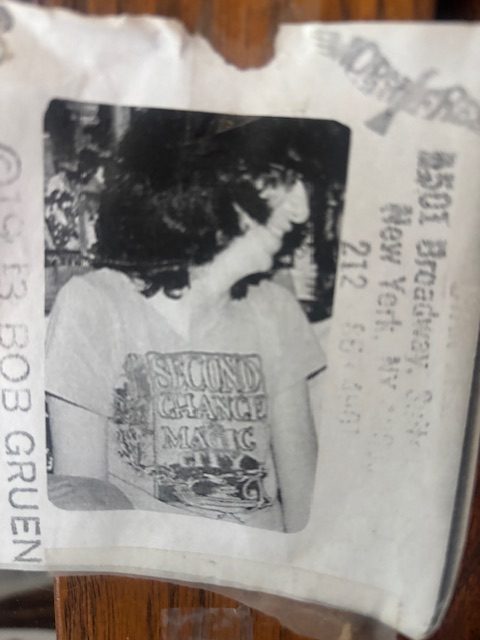
P.P.S. As if by magic, while I was working on this piece, I heard from John Carver, who started the Second Chance venue in Ann Arbor in 1974. I wrote about him a few weeks ago in the essay that started with the Ramones playing in Ann Arbor in the first week of October 1981. In the photo, Joey Ramone is wearing a t-shirt that says “Second Chance, Magic City.”
Tag: ARI WEINZWEIG
Pint-sized ideas, the struggle of self-doubt, and learning to take action anyway
“The revolution must begin with each one of us and not with external, environmental influences. … All great things start on a small scale, all great movements begin with you and me as individuals.” —Jidda Krishnamurti
In an interview on the On Being podcast this past summer, author and activist adrienne maree brown said something that’s stuck with me ever since I first heard it. Although I often feel the pressure to find “big” solutions, brown reminded me that there’s “something about smallness.” Grand sweeping plans sound, well, grand, but long-term greatness so often comes, instead, from small and well-intended actions. We may feel uncertain when we take small steps, and they’re rarely really glamorous, but over time, they do make a difference. Instead of waiting for the grand sweep of history to have its way with us, these sorts of small actions are more like whisk brooms we hold in our hands. On their own, they seem insignificant, maybe even a bit silly. Over time, though, they get the job done far more effectively than many might imagine. Small acts of generosity, daily dedication to dignity, running a healthy meeting, a bit of kindness here and some compassion there… they may all appear, at first, to be far too small to matter, but these small positive acts of resistance engage the people around us in quietly meaningful ways.
Small stuff, I remind myself regularly, can add up to make a really big difference.
Maybe you can relate. Throughout my work life, I have very regularly felt like I’m falling short. Like we’re faced with big challenges—both at work and in the larger world—and like I’m not doing anywhere near enough. Thankfully, I’ve had enough therapy and have done enough work on my beliefs that I know better—on an intellectual level, at least. I know how to reground, to regroup, to reassure myself that these self-critical thoughts are only a feeling. I often remind myself that even though what I’m working on may not feel like it will be that impactful, it is, nevertheless, far more significant than my deeply rooted fears might lead me to believe. I just had someone from another city who’s in town for a ZingTrain seminar walk over to me to tell me how much his boss has been influenced by what we do here, and that the great growth his own organization is currently experiencing is, to a great extent, due to philosophies and frameworks that they adapted from us. That was a humbling and happy moment. Two minutes of impromptu, in-the-moment conversation energized me to keep going strong for the rest of the day.
As I look at the enormity of our greater ecosystem’s challenges right now—the increase in the number of autocratically-inspired activities around us and the accompanying diminishment of democracy—I keep coming back to this thought about the size of our actions. When I feel self-doubt, the smallness of my own actions, or the seeming insignificance of these actions in the scheme of the big world, I consider, for a minute or two, not taking any action. Then I repeat what has become something of a mantra for me of late: “It’s a small thing, but it’s something.” Uncertainty, in my head at least, is almost inevitable. This is my encouragement to myself to take action anyway. I remind myself regularly of what author Rebecca Solnit writes:
History is full of small acts that changed the world in surprising ways.
Whether we’re talking about organizational improvement, self-development, or resistance to autocracy, the truth of the matter is that big things almost always start small. Grand strategies sound great, but the reality of real-life change is that it’s mostly a series of small things. Each, on its own, can easily be ignored. If the initiator descends into self-doubt, the actions might never happen. This essay is an encouragement to act anyway, to look self-doubt in the eye, take a deep breath, and take positive action. What seems small, I have come to learn, is far bigger than we have been led to believe. As adrienne maree brown said in the On Being interview,
It’s all these small activities that we need to get great at if we want to actually have anything that would be a real democracy.
We never know what actions will alter history
On January 6, 2023, historian Timothy Snyder posted a piece reflecting on what had happened at the Capitol two years previous. As he points out, had a few people taken action instead of staying on the sidelines, the story in the months that followed might have played out very differently. Snyder’s main message gives me solace when I’m struggling, feeling like I’m failing when I don’t find “big,” clear answers or determine which large, decisive actions will resolve most of our issues at work and beyond. When I’m starting to slip into self-doubt, I come back to what Snyder wrote:
A tiny bit of courage, a tiny bit of truth, can change history.
Looking at the magnitude of the issues all around us, it’s easy to feel irrelevant, insignificant, defeated. As adrienne maree brown writes, “The crisis is everywhere, massive massive massive. And we are small.” Still, brown is clear: “starting small” is an excellent antidote to overwhelm. I, as you can tell, agree.
If you do feel overwhelmed, know that you are not alone. Last fall, journalist Katie Couric asked Jill Lepore, a professor of American history at Harvard, to assess the state of our nation as autocracy seems to increase its reach with each passing week. Lepore, Couric thought, would have a good sense of the emotional state of the nation. After all, Lepore had just done several weeks of book events around the country. Unfortunately, her answer was not very uplifting. People around the country are “defeated, confused—there’s a great sinking feeling.”
I am not a psychologist, but I’m pretty sure that this cannot be a good thing. When people who work in a business, or any organization, believe they’re about to lose, they are almost certain to descend into the failure they have so effectively, if unintentionally, already imagined for themselves. I am determined not to descend into feeling defeated. If ordinary people like me won’t take action, who will? Which is, in great part, what’s pushing me to stick my neck out and make the newly available “Apricots for Dignity and Democracy” t-shirts. They feature a lovely scratchboard drawing by Ian Nagy and are produced by Underground Printing here in Ann Arbor. We’re donating the proceeds to the non-partisan, nonprofit news organization Democracy Now! In the grand scheme of things, it sure seems small. But, still, I remind myself, it’s something.
The voice in my head that keeps telling me that I ought to be able to come up with “big,” bold solutions is just another self-doubting, anxiety-centered way to arrive at inaction. When I struggle with it, and when Timothy Snyder’s quote doesn’t shift my energy from worrying to getting down to work, I turn back to adrienne maree brown. Her 2017 book, Emergent Strategy, is one of my favorites of the last eight years. In it, she is very clear that the little things are ultimately what make the biggest difference. It’s not about the “next big sale” or finding “hiring the perfect manager” or hitting the business equivalent of a hole-in-one with our next new product. The first item on brown’s “Principles of Emergent Strategy” list sends the same message loud and clear:
Small is good, small is all.
In a conversation with her sister Autumn on the How to Survive the End of the World podcast, brown noted:
If I take my mind off of the massive crisis and bring it down to the small thing that I can care about, there’s magic, and it’s available right now. What we practice at the small scale sets the patterns for the whole system.
Eventually, brown’s wise words help me work my way back to reality. My anxiety and sense of helplessness may be big, but the little things still matter. A small “extra mile,” like bringing a first-time guest a taste of something they didn’t ask for, helps them to feel welcome. Sending a regular customer home with one of our croissants (newly improved by the addition of Vermont Creamery Cultured Butter) could make their day. Or emailing a ZingTrain client I haven’t heard from for a while, just to see how they’re doing, often turns out to offer some surprisingly timely support. None of these actions alone will fix our national issues or even all of our challenges here in the Zingerman’s Community of Businesses (ZCoB). But they do, as Timothy Snyder and adrienne maree brown remind me, make a difference.
Some small actions can turn out to help even more quickly than we might have hoped. Bridgette Carr—University of Michigan law professor, co-director of both the AI Law and Policy Clinic and the Human Trafficking and Immigration Clinic, and longtime Zingerman’s customer—reached out to tell me that the enews I wrote early in the autumn about the import of leading dignity-centered and inclusive meetings had a huge impact on her and the departments she leads. She forwarded the essays to a host of colleagues. (Email me at [email protected] and I’ll send it to you too! Deep conversations have commenced, and these folks have already begun working to make their meetings better! Her clients—and the community and the country—will all feel the impact as she and her team improve the effectiveness of their incredibly important work.
Likes don’t count
In other instances, it may take years to realize what our seemingly small, almost irrelevant, actions inspire. My research for the pamphlet “A Revolution of Dignity in the Twenty-First Century Workplace” (at Zingermanspress.com) made this all too clear. I’ve shared this story many times, but it sums up beautifully the significance of small actions. It also reminds me that what seems like a tiny, uncertain action could actually start a revolution.
In 2013, Mustafa Nayyem, then a 32-year-old Afghan-Ukrainian journalist, took a small step that turned out to have a huge national impact. Nayyem’s father had been a progressive teacher in Afghanistan. He escaped when the Taliban came to power, bringing Nayyem and his younger brother, Masi, to Ukraine. Nayyem arrived there in 1990, becoming an awkward immigrant at age eight. By 2013, he had established himself as an effective and progressive journalist, but he was not a well-known national leader.
On November 21, 2013, the Russian-sponsored president of Ukraine pulled the plug on a long-promised agreement with the European Union, one that was supposed to connect Ukraine more meaningfully with Europe. Hopes in Ukraine, especially among young people, had been high. The sudden switch in national direction dashed those hopes and drove many into deep despair. I’d imagine many Ukrainians felt much like the Americans that journalist and Harvard professor Jill Lepore referenced above. Mustafa Nayyem, though, decided to do something. It was a small thing, but it was something.
Late on that cold night—it was in the mid-30s in Kyiv—Nayyem posted on Facebook:
Come on, let’s get serious. Who is ready to go out to the Maidan by midnight tonight?
Wisely anticipating what many would do in response, he added:
“Likes” don’t count.
My point here is not that Mustafa Nayyem is some sort of magical superhero. He was just another caring, competent person who was concerned about the state of his country. Instead of retreating into indifference, as many others would have, he leaned in and decided to take a small action. When he made the post, Nayyem may have anticipated that a few dozen of his friends would show up on the Maidan, bundled up to protect themselves from inclement weather, and that this gathering would have been the end of it. Instead, Ukraine found its footing in a philosophy rooted in dignity and democracy. This belief is core to the country’s 21st-century being.
Two years ago, friend and writer Gareth Higgins taught me that it’s impossible to know how the story of a small action will play out over, say, the next 10 years. In other words, we need to take action without any assurance of impact. The idea of which brings me back to a lesser-known story from the life of Mustafa Nayyem that illustrates the point of how good work can, unwittingly, later create remarkable outcomes that we would likely never have imagined!
In January 2023, Nayyem became head of Ukraine’s War Reconstruction work, repairing roads, buildings, and bridges as quickly as possible after Russian drones and rockets destroyed them. That summer, his brother Masi, fighting on the front, was badly injured. He lost his left eye, but it could have been much worse had his Nayyem not made headway so quickly with the road repairs. As Nayyem explained, Masi was “delivered to the hospital by a road which we had repaired previously, and he was delivered in two hours. Before the repair, it took four or six hours, and he would not have survived.”
Stop waiting to get picked
The unexpected significance of Nayyem’s work on Ukraine’s roads also brings to mind the story of Bobby Cain, who passed away last week at the age of 85. Back in 1957, he was a high school student in a small town near Knoxville. When the Brown v. Board of Education ruling came down from the Supreme Court, he was a 14-year-old kid living in the Black neighborhood of Clinton, Tennessee. Two years later, Cain and 11 other Black teenagers from his town were bused to what had always been an all-white school. They suffered both verbal and physical abuse from other students, being beaten, provoked, and put down continually throughout the year. Cain could have opted to quit. It would’ve been an easy decision, I think. His impact in the school, on its own, probably seemed small. He was just another high schooler struggling to get through his final year before applying to college. But by sticking it out, Cain ended up making a mark. He became the first Black student to graduate from a public high school in an integrated setting in the American South. The impact of Cain’s isolated act of courage changed the course of history.
Mustafa Nayyem and Bobby Cain’s small actions turned out to be significant, but it’s only years later that they, or anyone else, would realize their historical import. In the moment, they were just two people trying to figure out if they should take action in the face of uncertainty and adversity. As Rebecca Solnit has shared a related point that’s of equal import: “Nobody can know the full consequences of their actions.”
In his Beyond the Brand podcast, Bryan Elliott thanked author and marketing maven Seth Godin for giving some great advice along these lines. Anxious and frustrated that his work was not taking off, Bryan reached out to Seth. Though Seth could have smiled and nodded and simply encouraged Bryan to keep going, he responded with surprising directness. As Bryan recalls, Seth said:
Bryan, there’s no Prince Charming in this story. There are no rescue boats. No one’s coming. Stop waiting to get picked.
On air and with tears in his eyes, Bryan shared how much Seth’s simple statement meant to him: “That just pierced my heart like no other, and in that moment, my whole point of view changed.”
What Seth said to Bryan is a good reminder for me, and maybe for you. Whether it’s about the state of our companies, the quality of the energy on a shift we’re working, or the state of the country around us, no one is coming to save us. It’s up to us. Take a chance. Lean in. Speak up. Big things might well come of it.
This understanding of small actions’ significance also shows up in academic settings as well.. Back in the winter of 1984, two years after we had opened the Deli, U of M professor Karl published a paper in American Psychologist. It highlighted what he called “the import of small wins”:
By itself, one small win may seem unimportant. … Once a small win has been accomplished, forces are set in motion that favor another small win. When a solution is put in place, the next solvable problem often becomes more visible. This occurs because new allies bring new solutions with them and old opponents change their habits. Additional resources also flow toward winners, which means that slightly larger wins can be attempted.
Even within our own organizations, we often don’t realize how meaningful our work can be. A guest who runs a business of his own on the other side of the county shared with me how great a visit to Ann Arbor had been. He’d brought along his entire leadership team. To convey to his crew what ZCoB culture is about, he asked their server at the Roadhouse to share her story. She related that she’s been here for over 20 years. Aware that high turnover is typical in the food business, he asked her why she’d stayed so long. Knowing how quiet she usually is, I was curious to hear what she’d said. Her answer took my breath away: “Because I have agency.” It’s true. Here in the ZCoB, she really does have the power and authority to take action to improve her guests’ experiences. She doesn’t have to wait for a thumbs-up from on high. Her response is a great reminder that, awkward or uncomfortable as it may be to take action, the rest of us also have agency. If—and it’s a big if—we opt to use it, that is.
Take a chance Tuesday, or any day!
So, what can we do with these points about small actions’ big impact? Maybe we should take a cue from The Ark, Ann Arbor’s much-loved, longstanding folk music venue. It’s the home of “Take a Chance Tuesdays,” a series of performances by little-known acts. I like the idea of creating a little and maybe silly ritual to encourage people to take small, positive actions in the face of self-doubt. Perhaps every Tuesday, we all decide to take a chance on some small idea that we liked, one that self-doubt might well have led us to pass on.
If you give this technique a try, let me know what happens. What you do might just end up changing the course of history. So take a chance, try something, get moving. Resistance, change, the future, starts with us. As Timothy Snyder says, “It is important to take action, even in a small way, every day.”
One more small thing to add to the story: When I’m deep in doubt and need some emotional backup for Timothy Snyder and adrienne maree brown, I like to call up a little humor to help stay centered. This line from the Dalai Lama makes me laugh:
If you think you are too small to make a difference, try sleeping with a mosquito.
This originally appeared in the January/February edition of Zingerman’s News—check out the rest of the newsletter!
Tag: ARI WEINZWEIG

Why they’re so important to any democratically oriented organization
One afternoon, about 15 years or so ago, I was chatting with Amy Emberling, longtime co-managing partner of the Bakehouse. We were reflecting on the high level of collaboration we’ve built into the culture and systems of the ZCoB (Zingerman’s Community of Businesses) and how lots of conversations and connections happen here before any kind of big decision is made. We talk about things, gather diverse perspectives, review, revise, converse, and collaborate quite a bit before we take action. We do take action, of course. It’s just not done on a whim, or in a burst of emotionally fueled fury from an angry boss. Amy laughed, smiled, and said something like, “I really can’t even remember the last time I made a decision on my own!”
She didn’t, of course, mean it in a completely literal sense. Clearly, we all make a myriad of small decisions all day. We decide what we’ll eat for dinner or if we’ll have another cup of coffee, how long we’ll read our book or what time we’ll head to bed. That said, I agree with Amy about how we do what we do here in the ZCoB: There are really no significant decisions that are made by just one person working completely on their own. Even in the most casual settings, there are always at least a couple of collaborative conversations about how to handle the situation at hand. And in anything bigger than that—product source changes, new guidelines for almost anything, big equipment purchases, menu changes, etc.—there will always be multiple chances to check in with others well before the decision is a done deal.
In fact, I think it’s reasonable to say that most people, especially those in leadership, spend a good deal of their day checking with others to gather insight and ideas on the subject that’s on the table. All of the input is used to further enhance and better balance the impact of the decisions we’ll be making. It takes more time, for sure, but it leads to far more holistic and helpful decisions, decisions that have essentially been created by collaborative conversation, both formal and informal. It’s kind of like the “huddle in my head” that I wrote about last week, only in this case, the conversations are audible to all. I’m only sorry that Joey Ramone, who I also wrote about last week, isn’t here to help us find our way to the best possible decision.
Historically, we really haven’t talked much about the philosophical import of “checks and balances” here in the ZCoB, but we have, I see now, been using a lot of these tools all along. And when we do our work well—whether that’s deciding to switch to the Vermont Creamery Cultured Butter at the Roadhouse and then the Bakehouse, open up Little Kim last fall, or approve Joanie Hales as co-managing partner of ZingTrain—it is in great part because we have used some of the hundreds of checks and balances we have in place. And that when we do make a decision, we’re ready for a little bit of the Ramones’ classic line “Hey, ho, let’s go!”
In hindsight, I think it’s reasonable to say that effective application of checks and balances has quietly been one of the reasons we’ve continued to do what we do here at Zingerman’s in the way that we do it. We’re not perfect, of course, but checks and balances have helped us stay on course and true to our values. We’ve managed to do this when so many others seem to sell out or opt for short-term solutions and shiny objects that, over time, almost inevitably undercut the ethical integrity of their work. That’s why I believe that checks and balances are a key factor in helping us do what Joey Ramone said about the music of the band he helped start in 1974. To paraphrase him, we’ve always stayed true to who we are.
The impact of this work, I see a little more clearly every week, is far bigger than I ever would have believed. It’s not just which butter we use to bake our Sour Cream Coffee Cake. It has an impact on the community around us, and, over time, the entire country. I keep coming back to Wendell Berry’s wise words: “The leaders will have to be led.”
With all that said, here’s some of what I’ve been thinking about in recent weeks in this context: If we want a country that is governed graciously, with effective checks and balances in place, a good starting point is having our organizations do similar work. Big changes often start with small businesses. So hey, why wait? The more we create constructive, well-designed checks and balances in our workplaces, the healthier the ecosystems around us are likely to become. I believe we can do it. As Emily Ullman sings on the first song on her newly released album, Severe Clear, “If you expect the best, you get the best.”
While checks and balances are in the news mainly because some people are trying so hard to get around them right now, I believe that they do not need to be an obstacle. To the contrary, when done well, they enhance creativity and collaboration while increasing inclusion. They help organizations, and the people in them, to work in more positive, empowering, collaborative, and creativity-generating ways.
You may not have heard of Kim Scott. I can say honestly that I hadn’t until recently. We would all do well, though, to check out her work. In addition to being the author of Radical Candor: Be a Kick-Ass Boss Without Losing Your Humanity and Radical Respect; How to Work Better Together, she is the founder of the company Radical Candor. Aside from writing business books, Scott lives in Silicon Valley and teaches at Apple University. She once ran a health clinic for kids in Kosovo, followed by a diamond-cutting factory in Moscow. Needless to say, the Russian history major in me was intrigued by the latter. Perhaps even more intriguing is what she has to say about checks and balances.
In a March 2023 essay with the hard-to-pass-up title of “Here’s How to Stop Disempowering Your Employees and Start Creating a Cohesive Team,” Scott noted that many workplaces set the stage for top-down coercion by giving “managers up and down the org chart unchecked authority to make decisions that have profound consequences for their employees.” She added that it doesn’t have to be this way:
You can bake checks and balances—management systems in which leaders are held accountable for doing their jobs well rather than given unilateral decision-making authority—into your organizational design, or you can design a system that creates mini-dictators.
In my experience, people who are not actively involved in governance (which is, of course, most people) tend to think about checks and balances mostly in the context of the American Constitution. They’re obviously not incorrect. Checks and balances are clearly a critical component of trying to create a healthy country with well-functioning governance. I want to suggest, though, that well-designed and diligently used checks and balances are equally important—if far less often talked about—in the context of our companies.
It’s not like organizations can’t operate without any checks and balances. There are many that work that way. Unless the unchecked leader is beyond exceptional, incredibly emotionally intelligent, and ethical to the core, the odds of things going well over time are low. We all miss things, and we all make mistakes. Checks and balances help to turn what could have gone way wrong into a regenerative right! I, for one, would not be doing what I do had I not benefited from some of the many checks and balances we’ve woven into the ZCoB. At an extreme, when leaders are allowed to be autocrats, they can make the kind of terrible, ego-driven decisions that Kim Scott is talking about. History is full of examples. It’s true in countries, but it’s equally true in companies large and small. When there are no checks on power, things will nearly always end up getting way out of balance.
Autocratic leaders who lack any effective checks and balances on their decision-making power can wreak havoc or even go to war in a heartbeat—literally in the case of countries, figuratively in the context of companies. Since no one else has to sign off on their decisions, autocrats can essentially just authorize whatever it is they want to do and then do it. In fact, autocratic organizations are designed around the belief that the boss always knows best and should not be hindered by the flawed perspectives of others. To some, it sounds strong and decisive, but it is almost always dangerous in the end. Maria Alonso, writing in Forbes late last year, offered this:
In any organization, leadership requires decisiveness, but when authority is unchecked, it can lead to environments that are unfair, toxic and even hostile. Leaders who fail to consider alternative perspectives or respond empathetically to challenges risk alienating their teams and fostering distrust. This dynamic can be particularly harmful in businesses, where the well-being and engagement of employees directly influence productivity and innovation.
Democratically oriented organizations, by contrast, are designed around the reality that nobody’s perfect. That we all—bosses, bakers, bussers, and corporate bigwigs alike—need help. That on our own, each of us will always miss important things. Conversely, when we tap into the wisdom of the group, we will do far better in the long run. As one member of the Ann Arbor-based Students for a Democratic Society said back in the ’60s: “Democracy is an endless meeting.” And sure enough, as per what I shared from Amy up top, on pretty much every issue of consequence, extensive ZCoB conversations precede action. People have a lot of autonomy to act, but hey, why wouldn’t you want a second or third or fourth opinion from someone you respect before you make any big decision?
Even in an emergency, conversations can be convened quickly so that more people are involved within a matter of minutes. Here in the ZCoB, no one will just decide to do something drastic and then do it. In great part that’s because there are always effective checks and balances in place. As an example, we do not fire very many people here, but when we do, no one can be terminated without a member of our Department for People (aka HR) or a managing partner present. Terminations are always done by at least two people together, never one of us on our own, and always after many conversations with our HR folks. It’s a small thing that is used relatively rarely, but still, it can keep some really big problems from happening!
There are, I see now, a lot of checks and balances in the world that I had never consciously considered but that we work with freely. As anarchist anthropologist and author David Graeber shows:
[P]rocesses of egalitarian decision-making … occur pretty much anywhere, and are not peculiar to any one given “civilization,” culture, or tradition. They tend to crop up wherever human life goes on outside systematic structures of coercion.
And, sure enough, now that I’ve been paying attention, I realize that checks and balances are already all around us, even if we don’t usually think of them as such. To wit: Quarterbacks have coaches. Classrooms have teachers. Writers have editors. We all drive on roads with speed limits. And many of us live in houses. In his song “Bobbie’s House,” Jeremy James Meyer sings:
So I’m building a roof
For my soul to dwell
Cause my home needs protection
I’ve got staying power
Meyer’s lyrics led me to wonder if the roof on a home is a check on the weather, one that allows us to lead better and more balanced lives. Poet Gary Snyder’s excellent tome The Etiquette of Freedom also reminds me that nature knows checks and balances quite well:
Social order is found throughout nature—long before the age of books and legal codes. It is inherently part of what we are, and its patterns follow the same foldings, checks and balances, as flesh or stone. What we call social organization and order in government is a set of forms that have been appropriated by the calculating mind from the operating principles in nature.
Checks and balances are also, of course, in the Bible. One of the most fascinating and intriguing examples is the Sabbatical year. Every seven years, debts were supposed to be forgiven. It was meant to rebalance economics in the community, prevent excessive accumulation of wealth, and help out those who were struggling to get by and had borrowed money to keep going. It’s an inspiring Biblical directive that, interestingly, seems to be ignored in most modern settings.
Looking back on our nearly 44 years of history at Zingerman’s, I realize now that we’ve been both checking and balancing, in a sense, since Day One. Even when we only had two employees, Paul (Saginaw, of course) and I were working together to make any meaningful decision by consensus. We came to agreement—often after a lot of disagreement—or we didn’t act. Since then, the list of checks and balances has grown longer. While it may not be an approach for the autocratically minded, it is pretty clearly working for us.
The desire to weave checks and balances into our work, the sort of beliefs that Paul and I both had back at the beginning, is not unique to us. It’s a very different belief system than many organizations have, though, one that encourages humility and collaboration in the interest of everyone coming out ahead and succeeding together. In her recent enews, Dana Margolin, leader of the British band Porridge Radio, wrote:
Everything in the room is defined by everything around it in the room that is not it. If you spend enough time looking at all the empty spaces around everything in the room, you start to notice all the empty spaces around yourself that make you up. The empty room around me is as important to the physical space I think of as myself as the little bits that are touchable that I also think of as myself. That makes me know more about my place in the world.
Margolin’s beautifully written observation is one that comes from someone inclined to collaboration and the quality improvement that comes from well-designed and caringly used checks and balances. Someone with an autocratic mindset, by contrast, is the inverse. Their ego fills the room, they have all the answers, and checks and balances are only an obstacle put in their way by “less competent” colleagues. It’s Dana Margolin’s approach that I’m advocating here, of course. Well-designed and thoughtfully applied checks and balances come with several benefits:
- They make sure that we all come up with the best answers we can.
- They’re a systemic way to actualize and benefit from diversity.
- They help us avoid making rash, bad, or deeply destructive decisions when we’re caught up in an emotional reaction.
- They encourage us to accept limits that may feel restrictive, but I believe they’re actually regenerative contributors to our ecosystem’s health.
- They’re an important element of making any kind of inclusive, democratically oriented organization work. Without them, decisions are often made by bosses who get really excited or angry and then act in response to these feelings without really thinking through the implications of their actions. I’m all for emotion, but it is best when it’s balanced by the diverse inputs of others.
People do need to have good intentions to use checks and balances. Those who don’t care or who are acting out of malice just work hard to figure out how to fake their way past them. It takes an ethical organization or community to keep checks and balances in active and effective use. In a 2024 interview on the Live at the National Constitution Center podcast, author, political commentator, and chair of Princeton’s Department of African American Studies Eddie Glaude Jr. offered:
We have to cultivate the cognitive virtues of being open to deliberation, of being willing to understand when we’re wrong, to engage in a kind of experimentation with regards to matters, right? So cognitive virtues that allow us to be open to growth, right? As well as kind of emphasizing notions of courage. Of being caring and tending towards others.
I’ll add something to that: Checks and balances won’t work if you don’t believe they have a benefit. They definitely don’t work well with people who see checks and balances as a pain in the ass that they need to figure out how to get around. The author of Small is Beautiful, E.F. Schumacher, writes that “Gandhi used to talk disparagingly of ‘dreaming of systems so perfect that no one will need to be good.’” There are, of course, no such people. When people’s main goal with agreed-upon checks and balances is determining how to get around them, they will almost certainly find a way.
Here at Zingerman’s, there are a whole host of things that I now see are healthy, equity- and dignity-based checks and balances. Here are a few:
- Paul and I working by consensus: Right from the get-go in 1982, Paul and I quickly agreed that if we weren’t able to come to an agreement as partners, we wouldn’t take action.
- Expecting consensus from other partners: In 1994, when we rolled out the Zingerman’s 2009 Vision, we extended that same agreement to all the new managing partners. Neither they nor we, no matter how big a share of the business we owned, would act on something without consensus from all of the other partners. The model, we knew then and know now, is not a good one for people who just want to do what they want to do without input.
- Leveraging the tension of businesses operating both together and independently: When creating the 2009 Vision, we built in tension between our overarching organization (the Zingerman’s Community of Businesses) and our semi-autonomous businesses. Each essentially checks the other. Instead of having a typical corporate headquarters tell everyone what to do, our businesses will constructively check the shared services team and vice versa.
- Introducing our Training Compact: Put in place in 1994, this compact gives 100% of the responsibility for the effectiveness of the training work on both the trainee and the trainer. In other words, both the trainer and the trainee are turned into checkers and balancers, each guiding the other to get to a successful training session.
- Building consensus into Partners Group decision-making: In 1994, we moved responsibility for running the ZCoB to our newly formed Partners Group. The group began as seven or eight people—me and Paul and some managing partners. Today, there are 22 people. The consensus model Paul and I had used together since 1982, became, more formally, the model we use in the Partners Group. They approve things like new businesses, new partners, the ZCoB benefits plan for the next year, changes in organization-wide policy, and new long-term visions for the organization. Again, those decisions are made now by 20-plus people. Yes, it can be frustrating for anyone who’s ready to get going, but it helps us get to better outcomes in which we are all really on board.
When we made this move for the bigger group to adopt consensus-based decision-making, it meant that Paul and I willingly gave up the chance to operate without any real checks on our organization-wide work. Yes, we were important, but the Partners Group (of which we were a part), not “Paul and Ari,” made the big decision. As I tell doubters all the time, Paul and I have not been in charge of the organization since 1994! We are only two voices. I’m not saying we’re irrelevant—only that we gave up the chance to just do what we want as co-founders without getting full consensus from the other partners.
- Bottom-Line Change: For 25 years, we’ve been using this organizational change recipe, which globally recognized writer and leadership coach Verne Harnish regularly refers to as the best he’s ever seen. This recipe (aka framework) for change is all about good checks and effective balances. It’s designed to bring more people into the conversation before a decision about change is made. In the process, we tend to take into account issues autocrats will almost certainly have ignored. (Far more can be found in the pamphlet “Bottom-Line Change.”)
- Incorporating staff partners into decision-making: By putting four folks who are not managing partners into our Partners Group and having them be part of the consensus, we add diversity and increase the odds of someone stopping something from going forward without considering the needs of the majority of the people who work here. Each of their voices counts as much in the Partner Group consensus as mine!
- Embracing open-book management: Thirty years into using open-book management, I can see that it absolutely serves as a check and a balance. Busboys might ask about the balance sheet. People in one business wonder why another is getting the results it is. Everyone who’s interested can see the info.
- Holding open meetings: By defaulting to having our meetings open, we’re more likely to get a diverse group of people and perspectives in the room, and the likelihood that someone will speak up and voice a different view is greater. It is often an informal but effective check and balance on our work.
- Creating our Stewardship Council: This is a five-person group of managing partners (I‘m one of the five) who are filling the role Paul and I filled since 1994—leaders among leaders. While all the managing partners are deeply committed to, and care about, the organization, the Stewardship Council members are committed to spending a significant percentage of their time working on the whole organization. This provides both formal and often informal checks on what managing partners might otherwise do (or not do) when left to work on their own, alone.
- Using meeting facilitators: The facilitator in our meetings essentially serves to check those who tend to speak more and better balance the conversation to bring out the voices of those who might tend to hang back.
- Having shared services: Our Department for People (aka HR), Finance, Creative Services, and other teams that serve all ZCoB businesses help keep our ethics, legal obligations, and internally agreed-upon expectations in place.
- Having three bottom lines: Our three bottom lines are Great Food, Great Service (to each other and the community as well as guests), and Great Finance. The checks and balances happen pretty naturally in this setup. If one bottom line starts to get overemphasized, it’s almost inevitable in an open organization like ours that someone will speak up to advocate for the bottom line that got lost. Rebalancing begins.
- Clearly defining quality: Everyone who’s worked here for more than a couple of weeks will likely know that our definition of quality at Zingerman’s is a) full-flavored, which we further define as “balance, complexity, and finish,” and b) traditional food. This is not about keeping products out of the ZCoB, per se. Rather, it offers a sense of calm confidence for anyone who works here that they, too, can learn to assess quality without having to wait for some hierarchical boss to pronounce something “good enough.”
- Establishing our perpetual purpose trust: This freely chosen check and community-minded balance prevents Zingerman’s from being sold and selling its soul in the process. Here’s much more I wrote about it. Email me at [email protected] if you’d like to know more.
Checks and balances do not need to be done in a dictatorial way. Sometimes, doing better systems-design work puts a check or balance in place in an ecosystem-aligned way that is very effective but that hardly anyone notices. In that regard, I realize now that all of our frameworks are essentially freely chosen checks and balances. They guide us toward better decisions while still requiring each of us who uses them to think things through pretty effectively. It’s hard to imagine someone going radically off course while giving their all to living the 3 Steps to Great Service, trying to practice dignity, or using the Six-Pointed Hope Star, and so on.
In his wonderful forthcoming book, Flourish, Dan Coyle shares the story of a Dutch engineer named Hans Monderman, who did some wonderfully creative work to check and (re)balance traffic. In 1982, Monderman was in his late 30s and living in Holland, while we had just opened the Deli here in Ann Arbor. He was assigned to work on a traffic problem in the small town of Oudehaske. As is true of many European towns, Oudehaske is relatively small, but still located along a fairly major roadway. Which means that high-speed motorists need to slow way down when they get to the edge of town. All kinds of warning signs had been tried, but to no avail. Drivers simply sped on through, risking lives in the process. Monderman’s approach, later dubbed Shared Space, was counterintuitive to most of his colleagues. Rather anarchistically, he opened up the traffic space entering the town, creating a wide, flat, unmarked area. Because every driver needed to figure out what was coming at them and from which direction, they all slowed down, on average by about 40%. Fewer formal boundaries, better results, more self-regulation, and accidents were reduced in the process! Wow!
Another example is the ZCoB’s ritual of ending every meeting with what we call “appreciations.” It’s a totally voluntary, “Quaker-style” sharing of gratitude by anyone present for anyone anywhere. They are, I just realized this week, a great example of a regenerative check and balance. They remind us in every meeting to return to a place of gratitude before we get into the rest of our day. After critical, even tense, conversations, they get us back on an appropriately appreciative track before we break up our gathering.
There are also checks and balances that we can impose on ourselves. To wit, Paul taught me early on to never act in anger. It’s a great guideline. By all means, be angy—just don’t act while I’m angry. Another simple one I made for myself is committing to smiling when I’m writing an email. It’s a check that pushes me to stay positive, polite, and dignity-focused rather than dash off a note in frustration.
Part of having effective checks and balances in an organization is that if we don’t hold ourselves accountable for actually using them, well, they won’t work. Which means that often my role as a leader (or that of other leaders here) is to say stuff like, “We really should slow down and use Bottom-Line Change to roll this out properly,” and “This decision really ought to be discussed in an open meeting so more people can be part of the conversation. Let’s pause and put in the agenda for next month’s ZCoB huddle.” It’s not always fun or easy to do this. When momentum is pushing people forward and they’re ready to get going, it’s not much fun to feel like I’m the one holding them back. I remind myself, though, that it’s not me—it’s the checks and balances that we had already agreed to use. That is the work that needs to be done. As Kim Scott says:
Being responsible sometimes means pissing people off. You have to accept that sometimes people on your team will be mad at you. In fact, if nobody is ever mad at you, you probably aren’t challenging your team enough.
Does all this really matter that much? I believe so. My sense is that checks and balances are a far bigger deal than most of us might imagine. Grace Lee Boggs, writing in The Next American Revolution, puts all of this in context:
All over the planet more and more people are thinking beyond making a living to making a life—a life that respects Earth and one another. Just as we need to reinvent democracy, now is the time for us to reimagine work and reimagine life. The new paradigm we must establish is about creating systems that bring out the best in each of us, instead of trying to harness the greed and selfishness of which we are capable. It is about a new balance of individual, family, community, work, and play that makes us better humans.
Which is exactly, I believe, what thoughtfully designed, caringly crafted, and purposefully used checks and balances can do when used regularly.
There is, of course, no perfect way to do this work. Each ecosystem will need to design its own checks and balances. Take a bit of time this week to check in on what checks and balances look like in your life. Let me know what you learn. Our collective future may hang in the balance!
Build balance into your systems
Tag: ARI WEINZWEIG

A lovely combo of roasted butternut squash, sautéed spinach, and anchovies
While we wait for spring to show up, try this lovely warm salad that, around Ann Arbor at least, can be made using locally grown vegetables that we can still get during the depths of the cold months. It has been one of my favorite things to make in recent months! Anchovies and squash may sound like a strange combination, but the sweet/salty/savory blend of flavors comes together beautifully. If you want to skip the anchovies, you could make the salad with a really good feta cheese! Or, if you want to go wild, use both!
To make the salad, peel a good-sized butternut squash and remove the seeds. Cut into 1-inch cubes. Toss with extra virgin olive oil, sea salt, and freshly ground black pepper and then roast in a 400-degree oven for 30 to 40 minutes, until the squash is very tender and golden brown on the outside. I stir it partway through to encourage even cooking. When the squash is nice and tender, remove the baking dish from the oven and set it aside.
When you’re ready to eat, wash a bunch of fresh spinach and pat it dry. Sauté it in hot olive oil. Add a pinch of sea salt. If you like garlic, add a clove that’s been peeled and bruised.
When the spinach is soft, remove it from the pan and place it on the bottom of a platter or a series of salad plates. Mound some cooked squash on top of the spinach. Squeeze the juice of a small orange over the top and then dress with a good olive oil, plus more salt and pepper to taste.
Arrange anchovies on top—I’m a big fan of the ones we get from both Fishwife and Ortiz! Grate some zest from the orange peel on top of the salad for aroma, color, and flavor.
Eat and enjoy!
Tuck into some tinned fish
Tag: ARI WEINZWEIG
Why I wish I’d known Joey Ramone and other imaginative oddities
On the rather foggy, drizzly, and gray afternoon of Monday, October 5, 1981, the Ramones were signing album covers at Schoolkids Records, the classic Ann Arbor shop that inspired the name of the #38 sandwich at the Deli. The band’s latest LP, Pleasant Dreams, had just been released in the third week of July, so the four musicians were actively touring, as they often did throughout their 32 years together. There are some great black-and-white photos of the signing, shot by Robert Chase, who I happened to see at the Coffee Company this past Sunday!
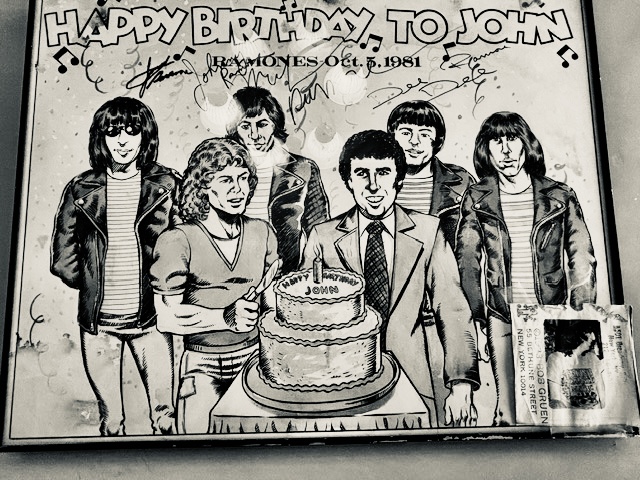
Later that evening, the band played at the Second Chance on Liberty Street, just up the block from Schoolkids. Tickets were $9.50, and the show was scheduled to start at half past nine. It was the Ramones’ fifth Ann Arbor appearance. They’d played the Second Chance regularly ever since their first record debuted in 1976. For that first show, in late March of 1977, they opened for Fred “Sonic” Smith’s Rendezvous Band. John Carver, Second Chance owner and a regular at the Roadhouse all these years later, reported that the Ramones requested $400 and a bag of cheeseburgers as their fee. The photo above is a drawing the Ramones made for John, done for his October 5 birthday at the time of the 1981 show.
Writing in The Michigan Daily the day of that first Ann Arbor gig in 1977, David Keeps called the Ramones a “New York-based, Benzedrine-powered powderkeg.” The week after the show, Keeps authored a wonderful review, calling the band “Undeniably the loudest, fastest band around.” And 25 years later, Elizabeth Hill wrote another Michigan Daily story about the band. She noted that they used a simple formula: “Four chords, four guys, same last name and no song over two minutes.” It was uncomplicated, but no one else had ever done it. And although it may sound easy, in practice, playing that way was anything but.
I didn’t attend the show that October evening, but I already owned all of the Ramones’ first four albums and had spun them on my turntable at home many hundreds of times. While the band was high on my listening list, I had other issues on my mind that month. I hadn’t said anything about it to more than a handful of people, but I’d spent the summer and early autumn of 1981 considering whether or not I ought to leave my job as a kitchen manager at Maude’s. The work, pay, and people were perfectly fine, so there was really nothing wrong with it, and I’d been with their organization for almost four years. Over time, though, the work had begun to feel less and less inspiring. I was totally into food and cooking, but I had a growing sense that where the organization was headed, though it was a well-accepted and oft-followed path for mainstream business growth, was not a place in which I wanted to spend my life. Quite simply, the work was not the soul-filling type that I intuitively, if still kind of subconsciously, knew I wanted.
Three weeks later, on November 1, 1981, perhaps in an unconscious acknowledgement of the Ramones’ punk spirit, I gave two months’ notice at Maude’s. I was completely unclear on what I would do next. Two days later, Paul Saginaw, then my friend and soon my business partner as well, called me: The little two-story brick building across the street from his existing business, Monahan’s Seafood Market (co-owned with Mike Monahan), was going to be available. Paul and I had worked together in the restaurant a few years earlier, and he thought the two of us should go check out the space. The time seemed right, he said, to open the deli we had talked about off and on over the nearly four years that we had known each other. Less than five months later, on March 15, 1982, we opened Zingerman’s Deli. It was the culinary equivalent of starting our own band. Given our very small opening budget and down-to-earth approach, we did it in a pretty punk way. I didn’t realize that at the time, but thanks to this reflection on the Ramones, I do now. As Kirk Hammett of Metallica later said of Joey Ramone: “He ignored all the trends. He didn’t follow anything. He set his own trend.” We were always intent on doing it our own way, and we still are today.
Over the last couple of weeks, I’ve found myself wishing that I’d known Joey Ramone. Not because he was a rock ’n’ roll star or because I loved the band’s music—that’s what would have drawn me to Schoolkids to get a signature back in 1981. Today, it’s still fun to listen to the music and watch clips of the band playing live. I like to see Joey’s one-of-a-kind stage presence in action. Elizabeth Hill, writing in The Michigan Daily 25 years ago this spring, described 6-foot-6-inch Joey as towering over everyone else, “staring behind his trademark shades and black curtains of hair” as he “belted out countless punk songs at a breakneck pace, sometimes ballistic, sometimes bubble-gum.”
All that said, my interest now is centered much more on Joey Ramone’s philosophical and artistic inspirations, his emotional intelligence, his joy and generosity of spirit, and his intellectual insight. I have a feeling that if I had known Joey Ramone in 1981, he’d have told me to quit my corporate job long before I had the courage to do it. I also think he’d have encouraged me to find something much more aligned with what the Ramones were all about—being themselves in unique and wonderful ways. As Joey used to say:
To me, punk is about being an individual and going against the grain and standing up and saying, “This is who I am.”
Earlier that year, in July of 1981, by coincidence (or maybe not), the Ramones released a song called “This Business is Killing Me.” I can only smile now as I think back on it. I wasn’t yet in a mental place where I was consciously looking for song lyrics to inform my life, nor was I self-aware enough to notice that I was doing work that was fine but not hugely fulfilling or as fun as it once had been. Fortunately, I gave notice that fall anyway. Paul called, we quickly concurred, and after about four months of renovation and preparation, we opened. For many years now, I’ve been fortunate to be in a business that enlivens me and is pretty darned true to who I am.
Fast-forward 44 years to late in the fall of 2025. It was a few days after publishing a piece about the amaZingness of the Zingerman’s Community of Businesses (or the ZCoB in what we call Zinglish) huddle. I had sort of a strange thought.
As those who know me well are well aware, odd-sounding ideas are not uncommon for me. Some sound good when I think of them, but I quickly let them go after further reflection. This one, though, I really liked. Strange as it sounded when I first said the words out loud, it still seemed to make sense as I thought about it more. Not surprisingly, though, within a day or so, a couple of critical voices began to kick up in the back corner of my mind, telling me to forget the whole thing. They dismissively implied that I was wasting my time and that the idea at hand—or, more accurately, in my head—was way too wacky to be writing about, let alone acting on.
For a few days, I listened to those negative voices, setting the idea aside while I engaged with the myriad other things I have on my mind. Still, though, the idea continued to resonate. Fortunately, those critical voices that have been with me for most of my life are not the only ones I have in my head. Now, 44 years and a few months after the Ramones played that gig here in 1981, I have a whole host of positive voices that come into my internal conversation to get it back on track.
One of them is Hugh MacLeod, the Scottish author of the highly recommended Ignore Everybody. I’ve never met Mr. MacLeod in person, but I’ve read—and then reread half a dozen times—his book, underlined it extensively, and internalized much of his inspiring and insightful message over the years. MacLeod has much wisdom to impart, including this lovely line that I know now to be both accurate and super helpful: “Good ideas are always initially resisted.”
To wit, when the Ramones played their first shows together, they were almost universally panned by the music press. They were often described as “aliens.” Per MacLeod’s insight, though, the critics turned out to be totally wrong. The band’s 14th and final album, Adios Amigos, was released 30 years ago this past summer, and they were inducted into the Rock and Roll Hall of Fame in 2002.
For years, I took MacLeod’s words to mean that when I introduce a new idea into the organization, there will always be resistance, and that I should not let the resistance keep me from advancing something that I believe to be true in my gut. Last week, though, I had what Stas’ Kazmierski—former ZingTrain co-managing partner, the man who taught us visioning and bottom-line change, and someone whose voice I’ve internalized—taught me to call a “belated glimpse of the obvious.” The resistance to good ideas that MacLeod is writing about is not restricted to what others have to say about our suppositions. The same sort of resistance happens inside our own heads, too.
MacLeod’s wise words are always helpful! And happily, he is not alone in his encouragement. Stephen Pressfield’s voice has become fairly well ensconced in my head over the years as well. As he wrote in his terrific book The War of Art:
Resistance really takes the shape, for me, in voices in my head telling me why I can’t do something or why I should put it off for another day, procrastinate for another day.
…
Resistance is experienced as fear. … [T]he more fear we feel about a specific enterprise, the more certain we can be that that enterprise is important to us and to the growth of our soul.
In this case, having learned what I’ve learned over the years, I can let my critical voices speak their minds negatively but not give in to what they are calling for. MacLeod and Pressfield, I’m happy to say, won the metaphorical day.
So, pray tell, what’s the odd insight? In the Ramones’ world, putting forth this insight could be considered the release date—the first sharing of something new with the world, or my world at least. It’s not as exciting as the first Ramones record back in 1976, but this new idea has had my mind abuzz. It’s the realization that, much like we have our regular huddles at Zingerman’s, including the big ZCoB huddle I’ve written about recently, I have a huddle going on in my head. No one else can see it, but I know now that’s in there.
As with the ZCoB huddle, the quality of the huddle in my head is determined by:
- Which voices are present, which ones speak up, and which ones are heard
- How well the gathering is facilitated by me (or you, if it’s your huddle)
How effectively that internal huddle runs makes an enormous difference in how well I lead. This is also true for the relationship between the ZCoB huddle and our organizational health. Meeting quality, quite simply, matters more than most people realize.
Singer-songwriter Leonard Cohen (whose 1977 album Death of a Ladies’ Man was produced by Phil Spector, who later produced the Ramones’ 1980 release, End of the Century) once said, “The voices in my head, they don’t care what I do, they just want to argue the matter through and through.” That sounds a lot like how I spent the first 30 years or so of my life. Lots of voices, lots of chatter, very often not very constructive, all having at it in my head and all talking at pretty much the same time. In hindsight, I’ve realized that when I experienced hard times, mental chaos, anxiety and confusion would always follow. Knowing what I know now, the sound inside my mind must have been something akin to listening to five separate Ramones songs simultaneously. The volume and pace are high, but very little constructive material comes out in the chaos and confusion.
By contrast, if we learn to manage the voices in our heads well and get the right voices in the room, the whole thing can be a much more productive experience. An experience that, when it’s working well, is akin to the kind of beauty, insight, dignity, grace, and collaboration that I witnessed in the ZCoB huddle a few weeks back and then wrote about afterward.
Why would all of this matter? Because, quite simply, the quality of the conversation in our heads is manifested in the quality of everything else we say, decide, and do in our lives. As I wrote in Secret #38, “Thinking About Thinking,” the way we think is, often unconsciously, the way we work! And the more positive and insightful voices we have in our heads, well, I’m pretty sure the more positive and insightful our work is going to be.
While I’ve loved the Ramones’ music for many years now, I knew next to nothing about Joey Ramone other than he was very tall, cool, and a one-of-a-kind punk rocker. The last few weeks have changed that. Having spent some time getting into his life story and worldview, I’m absolutely going to invite him to my internal huddle. Joey Ramone had the sort of ethical voice I prefer to surround myself with. As he explained, what drove him was punk: “I want to be my individual self. Doing it your way. Your own principles. You’re going against the rules, so a lot of people may turn on you.” Joey Ramone demonstrated that you can live in ways that are aligned with your values anyway. As he said later in his career, “We always stayed true to what the Ramones are.” I certainly hope that that’s what folks will one day say about what we do at Zingerman’s!
Joey Ramone, born Jeffrey Hyman in 1951, grew up in a middle-class Jewish family in Forest Hills, New York. He was diagnosed with OCD early on. In those days, there was very little good support, and he struggled with deep insecurity. His mother would later say, “He was quiet and shy. He wasn’t like other kids. He was a loner. The projections for him were not good. He was a slow student. But he was highly intelligent.” A young Jeffrey was apparently quite geeky, always super tall and skinny, and was regularly pushed around by the tough kids in his high school. Fortunately for us, the “highly intelligent” won out over the other issues, and the kid who would later become Joey Ramone persevered. He started playing drums at 13, and he was a big fan of the Stooges, David Bowie, The Who (in 1994, the Ramones recorded a cover of “Substitute”), and many other artists. In 1972, he became the singer in a glam-rock band called Sniper. And then, in 1974, he co-founded the band that famously became the Ramones. Soon Jeffrey Hyman became Joey Ramone.
In the spring of 1976, the band released their first album, The Ramones. I bought a copy, almost certainly at Schoolkids, shortly thereafter. It was—and still is—awesome. At the time, I just liked the music. I didn’t understand contextually or intellectually exactly what the Ramones were doing with music and why it was so hard to pull off—all downstrokes, barely ever taking a break between songs, playing and singing faster than anyone else around.
The Ramones were definitely far more than just another band. According to Andy Schwartz, former editor of New York Rocker, “They were the great Johnny Appleseed pioneers of punk rock.” Lou Reed, yet another Jewish New York punk rocker, was cajoled by friend and manager Danny Fields into coming to CBGB to see the Ramones play in 1975. Reed loved them, as some footage from the documentary Danny Says makes clear. Per his style, he didn’t mince words:
They’re crazy. That is without a doubt, the most fantastic thing you’ve ever played for me, bar none. It makes everybody else look so bullshit and wimpy—Patti Smith and me included, just wow. Everybody else looks like they’re really old-fashioned. That’s rock ’n’ roll. They really hit where it hurts. They are everything everybody worried about; every parent would freeze in their tracks if they heard this stuff.
John Holmstrom, artist and co-founder of Punk magazine, went to see the band back in one of their shows at CBGB in New York in the mid-’70s, saying later that “The Ramones defined punk rock. … They were the first punk rock band. That first album changed the world.” The Ramones went on to have a huge influence on The Clash, the Sex Pistols, and a host of other bands. Bono of U2 would later say, “We would not be here if it weren’t for the Ramones.” And that’s not to mention the millions of anxious young people struggling to find their footing, as Jeffrey Hyman did back in Forest Hills in the ’50s and ’60s, who’ve found something they need in the Ramones’ music, too.
While the band gained fame and acclaim, Joey Ramone, I’ve come to realize, was far from being just another rock star. His worldview, his philosophy, and his positive and supportive nature set him apart. In the Ramones documentary End of the Century, Sonic Youth’s Thurston Moore says:
He was to thousands, hundreds of thousands, millions of people a liberator. He liberated them from their own sense of failure, unpopularity. Joey was a hero because he overcame the odds. He triumphed over geekiness. And he started off as an alien in the world in which he was raised. Joey was never the healthiest person in the world, but he was one of the strongest people I’ve ever known, you know, and he managed to fight off anything and everything all the time.
As you can tell, Joey Ramone refused to conform to social norms and instead found ways to create a life of his own, to live his vocation, and then to share his work in constructive and creative ways that inspired young people like me, people who wanted to push back against the status quo. I love that he did it his way. Longtime rock journalist Legs McNeil wrote:
You know, Joey took everything that was wrong with him and made it beautiful, which I always thought was the greatest thing about Joey, and … the whole philosophy of punk. You take everything that’s shit and you celebrate it and make it good.
McNeil’s counterpart, Bill Bois, writing in TNOCS a couple of months ago, described Joey beautifully:
His depth made him attractive, even fascinating.
His lanky physique and goofy movements made his sudden intensity seem raw, real, and unrehearsed, because it was. His authenticity came across as courageous.
…
He could be tough without being mean, and tender without being weak.
…
Joey didn’t try to be other people’s idea of the ideal singer.
He owned his oddness and made it part of his art. Refusing to hide one’s weaknesses takes confidence, and confidence is deeply attractive.
Having reflected further on his own article, Bois embellished his original piece with additional comments about Joey Ramone, comments that really drove home how special a person Joey seemed to be.
[Joey] wrote what he wanted to write and sang the way he sang without worrying about what people thought. That’s what artists should do.
Say what you need to say. Express yourself the way you want. No one else can do that, only you. Some people will like it, others won’t, but that’s not your concern.
…
That’s what made Joey cool. He didn’t care whether you thought he was cool or not. He just was.
That is, no question, the kind of person I’d want in my huddle. I figure that my figurative Joey Ramone would be super supportive, especially of seemingly oddball ideas like this notion of having a huddle in my head. Unlike the constantly self-critical voice I had in my head as a kid, Joey Ramone’s voice seems joyful and positive. In a piece published in Far Out in London last weekend, Lucy Harbron wrote of the Ramones:
If the band liked you … they’d back you hard and back you loyally,
Like Joey Ramone, I spent many years working to locate my own voice in the (dis)array of critical voices that made it incredibly hard to hear the more positive voices that I knew were also in there, just quieter. So much chatter. So little clarity. Way too much overthinking and self-doubt. You might be able to relate.
Today, it’s a totally different story. Critical voices continue to appear, but there are only two or three of them compared to many dozens of much more positive ones that now show up in my mind so regularly. It’s quite a list, really: Paul Saginaw. Peter Block. Emma Goldman. Seth Godin. Philosopher and later friend Sam Keen. Brenda Ueland, who I wrote about last week. Amazing authors like Julia Cameron and Anne Lamott. Peter Koestenbaum. Rebecca Solnit. Grace Lee Boggs. Gustav Landauer. Maggie Bayless from ZingTrain. Good friends like Molly Stevens and Melvin Parson. John Abrams. I could go for ages and pages, but you get the idea. Some are folks I’ve known in person for many years. Others, like Joey Ramone, I’ve never actually met. Either way, their voices are in the huddle in my head. And with fairly effective facilitation, I’m able to assimilate a wide range of perspectives from people whose views I value a great deal, all of which inform what I do. Decisions are still mine to make, but those decisions are so much sounder thanks to all the good input from a pretty prestigious and values-aligned group of huddle participants.
The cool thing about the huddle in your head—I’m assuming you have one, too, though I know you also may not—is that, unlike real-life huddles or any other meetings we have, we can add anyone we want to it. As long as the participants aren’t perpetually talking over each other and trying to take over the room, the more the merrier, right? So if we come across someone whose wisdom we wish we could tap into regularly, we can slowly but surely and effectively add their voice to our internal huddle.
To do that, we simply need to spend a lot of time with them. That can be in person, as it has been with Paul Saginaw. It can be reading their written work, as it was for me with Emma Goldman. By listening to their talks online. Or a combination of all of those, as it’s been with Peter Block. I’ve read all of his books, I’ve listened to him online, and we talk in person. Essentially, we can get to know new participants in the internal huddle through the sort of regenerative study I wrote about a few weeks ago. When I take a deep dive into the work of someone who inspires me, my energy will almost always increase significantly. Which, as you can tell, is what’s happened to me recently with Joey Ramone.
It turns out that the idea of a huddle in your head isn’t quite as unusual as my critical voices would have had me believe! As Rochel Spangenthal wrote in a 2015 Hevria magazine essay entitled “How To Train The Voices in Your Head,” “It is not just the crazier amongst us; we all hear voices in our heads.” In “Getting to Know the Voices in Your Head,” a 10-year-old Scientific American piece, journalist Ferris Jabr wrote that “We talk to ourselves to stay motivated, tame unruly emotions, plan for the future and even maintain a sense of self.” All of which is, of course, just what happened for me in the ZCoB huddle a few weeks ago.
The original research that introduced the idea of inner voices was done many years ago by another middle-class Jewish guy. In 1977, the Ramones released Rocket to Russia. But half a century earlier, Lev Semyonovich Vygotsky, a Russian and Soviet psychologist studying child development, suggested that we’ve all internalized the voices of others, at first primarily our parents but also others of influence. In fact, this single line from Vygotsky sums up this whole essay in five words: “Through others we become ourselves.” A hundred years ago this month, near the end of 1925, Vygotsky completed his graduate dissertation, “The Psychology of Art.” Soviet censors kept it from being published until the 1960s. In it, he wrote that “art is the collectivisation of feeling,” a beautiful description of both the music the Ramones made together and of what we do here in the ZCoB!
Ethan Kross, a psychologist at the University of Michigan, wrote Chatter, a nationally recognized book that goes deep into the impact of inner dialogue. I happened to meet him last month when he was having dinner at the Roadhouse. Kross writes, “The inner voice is a kind of Swiss army knife of a human mind. It is a multipurpose tool that lets you do many things.” I prefer “huddle” to “knife” since I imagine the inner voices as being present in varied abundance. I also imagine myself facilitating their input effectively to get to good conclusions. The idea, though, is similar. As Kross writes, “The mind is flexible, if we know how to bend it.” For me at least, one of the best ways to do that is to add new voices to my inner huddle! Each new voice adds more diversity and depth. Kross, in what could have been an unconscious nod to Vygotsky, says that “We are like Russian nesting dolls of mental conversations.” This week, I’m welcoming Joey Ramone into my Russian history major’s mind.
To be clear, it’s not a bad thing to have some critical voices in our internal huddles. They raise what could be appropriate concerns and bring a touch of cynicism or skepticism. As management consultant Tony Fakhry writes, “It is unwise to get rid of negative thoughts because they can serve a purpose. … All thoughts have their place in the mind, even negative ones. … By turning down the volume on negative chatter, you allow the authentic self to emerge.”
Many albums, thousands of concerts, and plenty of ups and downs later, Joey Ramone died, sadly, in the spring of 2001 from lymphoma. He passed away a few days short of the 25th anniversary of the release of that first Ramones record and a month before what would have been his 50th birthday. As Bill Bois wrote about him:
Emotional closeness—the sense that someone is letting you into their private world — is rare in Pop music, let alone in Punk.
But he had it.
If this internal huddle idea isn’t too terribly strange for you, try giving it a bit of thought. Here are a few questions to mull over:
- Who’s in the huddle in your head right now?
- How can you better facilitate the various participants contributing to your inner conversation, letting the negative voices have their say but keeping them from dominating?
- Who would you like to add to your huddle? Who can help you to add ever more meaning? Who can support you in living a life like Joey Ramone’s—not to be a rock star, but rather to live in a way that makes you say with calm and centered confidence, “This is who I am”?
Let me know what you learn!
Wisdom, emotional intelligence, a deep determination to be himself, exceptional creative expression, joy, and generosity … the things Joey Ramone brought the world make him the kind of human I’d like to have to the huddle in my head. As Joey said, “For me, punk is about real feelings. It’s not about, ‘Yeah, I am a punk and I’m angry.’ That’s a lot of crap. It’s about loving the things that really matter: passion, heart, and soul.”
Huddle even better
Sign up for Ari’s weekly e-news
Tag: ARI WEINZWEIG
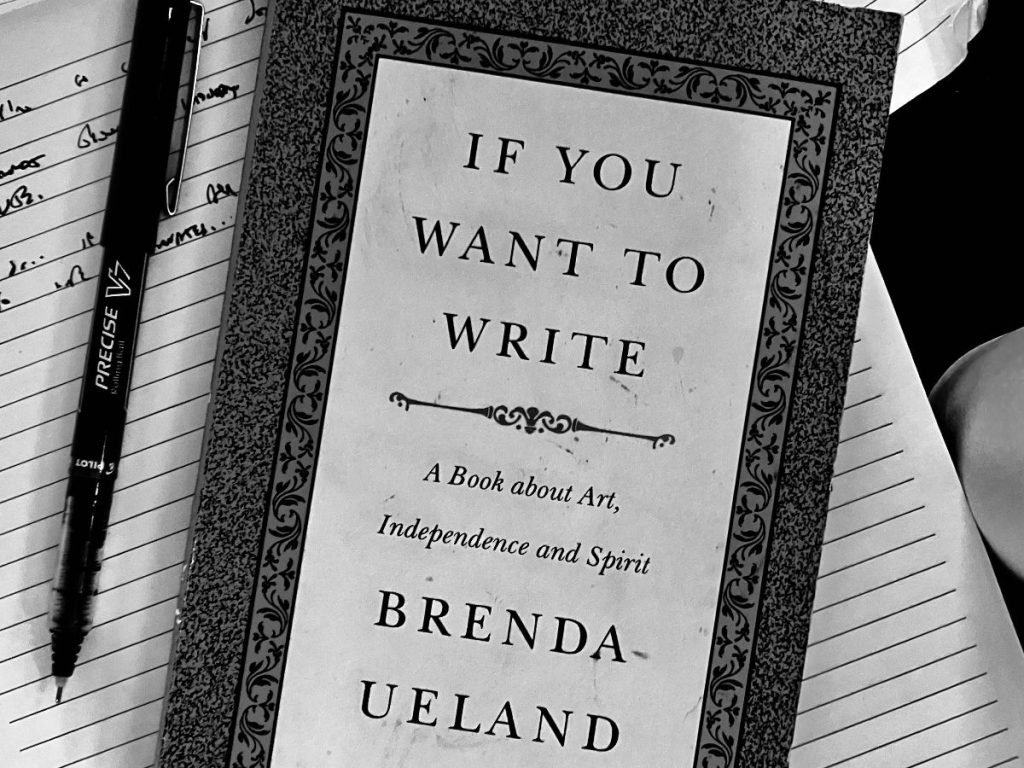
Learning anew and renewing an end-of-year tradition
Two years ago, I decided to try starting a tradition. Or, if you prefer, a ritual.
The first time you do something, there’s absolutely nothing traditional about it. The idea has yet to sink roots into the cultural context in which it’s being planted. If it takes, then, by the second or third or fourth year, it might have gained a bit of momentum.
The tradition I’m talking about is a late-December invitation to reread some of the other 51 essays that have come out in this enews earlier in the year. And also to celebrate the import of rereading. Rereading, I’ve come to believe, is significantly more important in our current era of social media scrolling, when far too many people seem to spend about 20 seconds on something before moving on. The idea is to go back and pull out some of the essays I’ve written over the last year, the ones that feel most worthy of rereading, and then share them here for folks to dig into in the downtime many find themselves with during the week of the holidays.
Rereading, I’ll suggest, comes up a lot less often than it ought to. I wonder, now and then, why we tend to listen to our favorite records over and over again, often one time immediately after another, without thinking twice about why we do it. Almost everyone (me included) listens to music they like multiple times. The written word, by contrast, is seen as a one-and-done experience more often than not. One reads, one learns, one leaves it behind.
My hope here is to encourage all of us (me included) to take up rereading as a much more regular activity. Our lives, our learning, our companies, and the country, I believe, would be better off for it! The poet Sonia Sanchez once advised, “In order to survive, you should reread Toni Morrison every 10 years.” I’ll take her wise words one step further. I’m going to track down one of Toni Morrison’s many great books from my shelves and return to what I have already read and learned from once before.
The benefit of doing this is not, of course, limited to books by Toni Morrison. In order to thrive, we would be wise to reread the work of writers we learn from far more frequently than most of us are inclined to do. New insights, creative connections, inspiring ideas, and then some are almost certain to emerge.
The poet Joseph Brodsky, who taught at the University of Michigan here in Ann Arbor for many years after escaping from the autocratic oppression of the Soviet Union, wrote that “Man is what he reads.” Those of us who have committed ourselves to living reflective lives would be wise to remember to do regular rounds of rereading! In which context, I’d now consider paraphrasing Brodsky: Reflective man is what he rereads! (I let Brodsky’s use of “man” stand, but of course the point is relevant to all human beings who like to learn.) The books and essays that have influenced me most are the ones I have reread. I find new insights and much more.
I have said many times, and will almost certainly say many times again, that the writer Brenda Ueland changed my life. When I first read her 1938 book, If You Want to Write, about 30 years ago, it blew my mind and altered almost every belief I had about writing. I’ve lost track of how many times I’ve read its 175-or-so pages, but it’s probably somewhere close to 10. The other day, I picked up Ueland’s book once again because … why not? Brenda Ueland has never let me down. I learn something new every time I go through If You Want to Write. My copy is heavily underlined and bookmarked, to the point of being unworkable, but still, when I reread, I learn anew what I know that I once knew. Often, it’s something I liked early on but had forgotten about. Other times, it’s something I’d missed in my many reads.
The other day I did it again and was rewarded. When I began to reread If You Want to Write, I was reminded of the inspiring message that’s square in the middle of the first page. It’s a line that fits wonderfully well with my anarchist studies and that, to this day, informs a lot of my own belief system:
Everybody is talented, original and has something important to say.
That belief underlies everything we do in our organization, so I was grateful to read it again. It’s what I found so inspiring about last week’s huddle for the entire Zingerman’s Community of Businesses (ZCoB). It underlies my beliefs about democracy, why it is both possible and practical and why I decided to get to work on a pamphlet that I hope to have out for sale soon. Autocratic leaders, in companies or countries, generally believe the inverse: In the absence of humility, they work with the belief that they themselves are incredibly talented, that they are original in ways no one else can match, and that they have a wealth of wonderfully important things to say that a whole company, or whole country, needs to hear. By contrast, the way we work here in the ZCoB, is based, essentially, on what Ueland wrote back in 1938.
I have tried to train myself to pay attention to each person I meet—young or old—in the belief that what they are about to tell me might inform what we do in new ways or offer insights that spark further thoughts that help me process the world in new ways. That is, in fact, exactly what happened with the piece I wrote about regenerative studying a few weeks ago. Talking to Fionna Gault about salt and pepper shakers led to a whole new way to look at what I’ve actually been doing my whole life.
What is true of regenerative studying is equally true with rereading. I have noticed several parallels:
- I am reminded of insights I had long since forgotten about.
- Because I underline when I read, I can see what was interesting to me back at the time I first read the material.
- I learn new things every time I do it. I can’t imagine I’ve ever gotten every possible learning out of any book, and rereading helps me notice descriptions, observations, connections, and more that I completely missed the first time through. Writer Clifton Fadiman—who famously once wrote that cheese is “milk’s leap into immortality”—was a big believer in rereading for this reason. As he puts it:When you reread a classic you do not see more in the book than you did before; you see more in you than there was before.
It’s certainly true for me. Rereading Brenda Ueland recently, I stumbled on a second line that I had totally spaced on, one that remains remarkably good advice nonetheless, advice I try to live every day and every week in this enews: “Write only what you think.” Ueland’s directive reinforces my long-standing resistance to write about anything I don’t believe. It’s also, I can see now, an invitation to revisit the piece I did last spring on the idea of meaningful and regenerative marketing, marketing that, unlike so much mass marketing in the modern era, is based on telling the truth.
What I think here is that taking time to reread is a really good idea! I’m aligned with Ciflton Fadiman’s daughter, the writer Anne Fadiman, who echoed her father’s feelings on the subject:
The reader who plucks a book from her shelf only once is as deprived as the listener who, after attending a single performance of a Beethoven symphony, never hears it again.
The reader who plucks a book from her shelf only once is as deprived as the listener who, after attending a single performance of a Beethoven symphony, never hears it again.
The Fadimans are hardly the only folks who feel this way. The other afternoon I was chatting casually with ZingTrain Co-Managing Partner Joanie Hales. She told me that the ZingTrain team is starting its own version of the Leaders Are Readers program that the Roadhouse managers started five or six years ago and are still doing regularly. Last week all the Roadhouse managers read and then discussed “Secret #42: “It’s All About Alignment.” During the course of the conversation, Joanie shared thoughts on the idea with ZingTrain’s Kerstin Woodside, who will be co-leading the ZingTrain reading program. Joanie said this:
When I need to retain information, I find it helpful to revisit a section multiple times. Similarly, when I’m seeking an extra boost of inspiration, returning to something I’ve found meaningful in the past often helps. I think of rereading like watching a movie for a second time: I already know the major plot points, but I notice the smaller details with greater depth and appreciation.
I’jaaz Tello, who works in the Bakehouse, offered another wonderful take on rereading, sort of a voyeuristic version (in a good way). It’s certainly something that had never crossed my mind, but now that I’jaaz shared it, I’m intrigued. “I like to buy used books,” he told me, “and I’m always hoping that I’ll get one that was underlined by whoever owned it before me. I love seeing what they marked.”
Part of what I value so much about doing this writing every week is the interaction that it initiates with so many of you. After last year’s piece on rereading, Kate Mueller, a longtime ZingTrain client who lives in Maine and writes Live with Sass, shared some great insights on her own learnings from rerereading:
For a whole variety of reasons, [last] December I decided to resume rereading. I’m reading the books in roughly the order I very first experienced them in, over a decade ago.
They are all heavily underlined, annotated, and dog-eared.
It is a lot like catching up with an old friend, to see the familiar passages and to remember a bit about who I was when these resonated.
But it’s also been fascinating to discover that there are new passages that resonate now, some that I hadn’t previously underlined or annotated.
It’s a bit of a relief, to be honest, to discover that the reading is giving me things again. Or to feel that I’m open enough to hear them.
Sometimes it feels to me as if this is the one true measure I have of seeing how much I’ve grown or changed as a person, to discover the books that do (or don’t) still resonate with me, and which parts of them do. As if it’s an acknowledgement of where I was stuck or the problems I was facing before, and how I’ve moved past those into new problems or sticking points.
With all of Kate’s wise words in mind, in rereading, I was reminded that on the final page of If You Want to Write, Brenda Ueland makes this point:
The best way to know the Truth or Beauty is to try to express it. And what is the purpose of existence … but to discover truth and beauty and express it, i.e., share it with others?
Which, I realize now, sort of sums up what I try to do every week with writing. To know some new truth and beauty, to understand better so that I can do better, to share my own learnings so that they can illuminate your life and work as well. I never take for granted how great it is to be part of such a positive, interesting, and insightful community. To be able to learn from people like Brenda Ueland, Joanie Hales, and Kate Mueller, to be able to really write, as Brenda Ueland and I believe best, only what I really think. To make, serve, and sell only products that I—or, in many cases, we—really believe in. To be part of a community, both inside the ZCoB and in Washtenaw County, that is so caring, so thoughtful, so supportive, and so patient.
The first piece on the rereading list below is “Living Customer Service as a Love Story.” In the spirit of which, much love and appreciation to you all for making all that we do at Zingerman’s possible. A thousand thanks for all your caring support! It means the world!
Reread! Rejoice! Return over and over again to what you believe. Remember, as Brenda Ueland emphasized:
Everybody is talented, original and has something important to say.
10 Top 5s to Reread
- “Living Customer Service as a Love Story: Seventh Stories, Patti Smith, and a 1932 Sōetsu Yanagi essay on patterns“
- “Using Frameworks to Foster Free Thinking: Helping everyone we hire learn how to think for themselves”
- “An Appreciation for Apricity and the Story of the Serbian Students: Finding hope and inspired resistance in wholly unexpected places”
- “Lessons from the Dust Bowl—How Humility Can Change the World: Learning from “wrong side up” and the wisdom of Woody Guthrie”
- “Trying to Do Right by Democracy in Difficult Times: Maybe apricots are the answer”
- “Helping Others Become Themselves: Learning to ‘fill oneself with oneself’ could change the world”
- “Owning Our Lives Opens the Door to Making a Meaningful Difference: The inspiration of two ‘extra-ordinary’ women”
- “Small Actions Matter in Much Bigger Ways Than We Might Imagine: Pint-sized ideas, the struggle of self-doubt, and learning to take action anyway”
- “The Beauty and Benefit of Regenerative Studying: Digging into any subject yields fascinating results”
- “The Power of Joy to Transform Our Organizations: Cut-up poetry and prioritizing joyfulness even in the face of pain”
Actually, here’s one more that I almost forgot to include:
“Learning to Lead While Feeling Lost: Life Lessons from The Tao of Archibald Tiny”
“Learning to Lead While Feeling Lost” shares life lessons from the blind and deaf senior Shih Tzu that Tammie rescued in August of 2024. At the time, he was very thin and barely able to walk. She named him Archie. Tammie told me later that he was in such bad shape that she didn’t think he’d live two weeks. Sixteen months later, Archie is an inspiration. He’s healthy: He has gained weight, eats home-cooked meals, and happily walks all over the house.
I realized this week that Archie is happily “rereading” the smells of the house to go to where he knows the water bowls are, or to his bed, or to the spot in the living room where he likes to lie in the sun. Archie inspires me anew every night. Even though he can neither see nor hear, within minutes of me coming home, he’s caught my scent and begins barking for me to pick him up and hold him. In fact, he’s sitting on my lap right now while I write. When I’ve felt down, anxious, or unsure of how to go forward in recent months, I reread this essay. If Archie can do it, I can do it, too!
Be well! Happy everything!
Sign up to get my weekly e-news in your inbox
P.S. If you want to reread even more, check out last year’s piece on rereading, and keep scrolling for earlier write-ups about really terrific items we carry at the Deli, Bakeshop, Roadhouse, and Mail Order!
P.P.S. For those who might be looking for a great gift, or just a way to keep warm, the Apricots for Democracy and Dignity t-shirt site I set up with Rishi Narayan of Underground Printing here in Ann Arbor, now has Carhartt jackets we can order with apricots embroidered on the breast pocket! Scroll down a small bit to find the Carhartt stuff. I just ordered two! Plus, there are now apricot beanies and baseball caps to boot! Join us, if you’d like, in sending a quiet, inclusive, and inspiring positive message to the world. All proceeds are donated to Democracy Now!