
Tag: ARI WEINZWEIG
Need to catch up? Here’s Part 2.
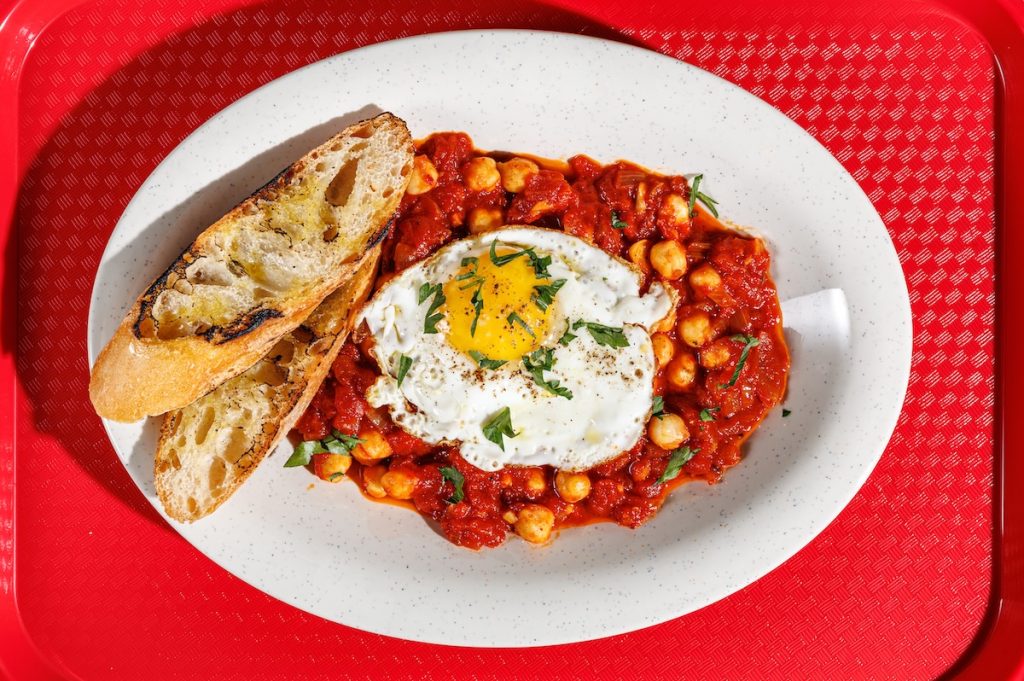
21. Little Kim’s Eggs in Purgatory
Creamy gochujang marinara, chickpeas, soft egg, served with Zingerman’s toast
Chef Ji Hye Kim’s Eggs in Gochujang Purgatory is at the top of my list. It’s got a great gochujang (Korean chile sauce) spiked tomato marinara, lots of tender chickpeas, all topped with a sunny-side-up egg. Toasted Bakehouse Farm bread is served on the side! This super tasty treat is inspired by the culinary internship Ji Hye did many years ago in Rome. And that is only the opening bid on the great meals you’ll be able to eat and enjoy from the Little Kim kitchen!
Eggs in Purgatory is quite common in Italy, and other Mediterranean cultures make their own version of it as well. And now you can get Ji Hye’s awesome Korean-accented version at Little Kim! Worth driving over just to eat it!
22. Little Kim’s Paneer Sandwich!
A lovely lunch offering from our new vegetarian restaurant
One of the early favorites on the Little Kim menu is the Paneer Sandwich. Chef and managing partner Ji Hye Kim shared a bit about it:
It’s a paneer sandwich with Japanese curry mayo, farm tomatoes, slivers of red cabbage and pickled red onions, and the most delectable cilantro chutney from our line cook Raunaq. It’s based on Chef Nella Paniz’s Green Chutney—cilantro, serrano chiles, fresh mint, chickpeas, and a little lemon and salt.. People have been loving it!
The Paneer is flash-fried and then stacked onto slices of Bakehouse Farm Bread along with Japanese Curry Mayo, the Green Chutney, some shredded red cabbage, and pickled onions. Super tasty!
Little Kim is open Tuesday through Sunday, 11:30 am–5 pm. Swing by for lunch, either eat in or carry out! This sandwich is sure to become a signature item soon!
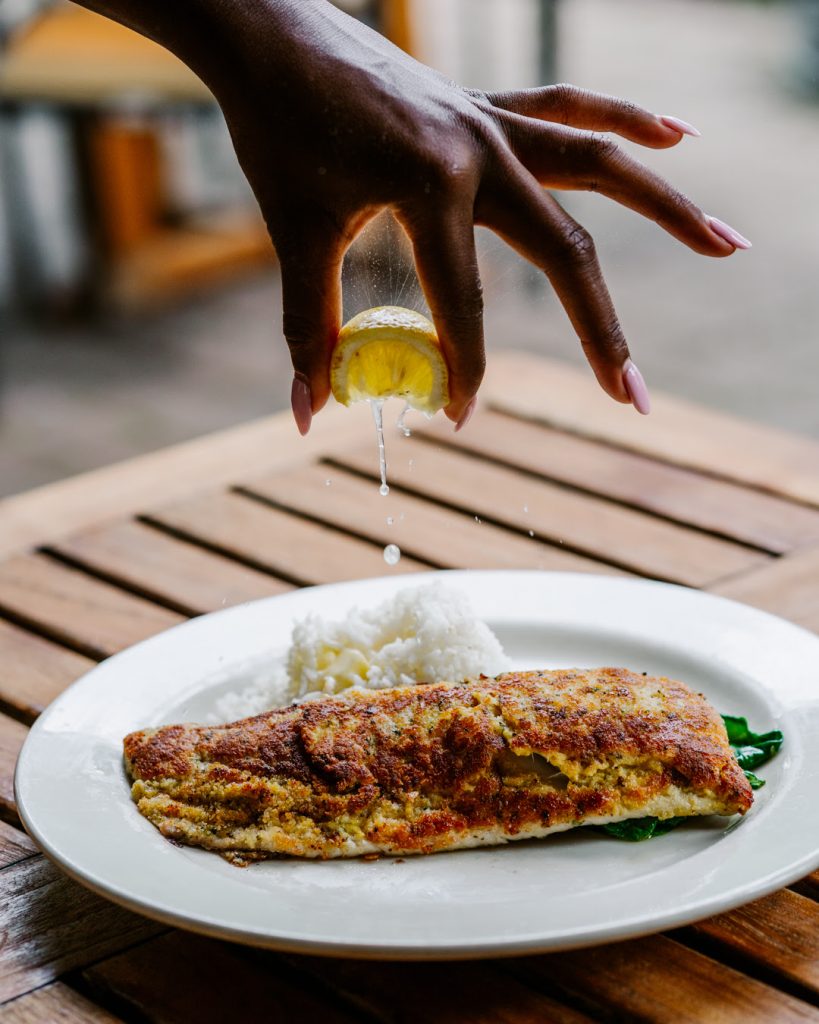
23. Herb-Crusted Whitefish at the Roadhouse
One of the Great Lakes’ greatest culinary hits
This dish has quietly become one of the regular bestsellers at the Roadhouse! And for good reason. It’s delicious! Fresh Lake Superior whitefish rubbed down with Dijon mustard, topped with herbs (basil and parsley) and toasted breadcrumbs, and then cooked until it’s golden brown on the griddle.
My grandmother cooked whitefish for the family regularly, just lightly floured, salted, peppered, and pan-fried. She used to tell us that fish was brain food and that we should eat it regularly to increase our intelligence. The Roadhouse’s wonderful Herb-Crusted Whitefish is sort of a 21st-century way to do just that. It comes with that truly remarkable Carolina Gold Rice and some sautéed spinach. I think it’s a meal that would make my great-grandfather and my grandmother happy.
Truly terrific taste of the Great Lakes—really good American food at its finest!
24. Butterscotch Pudding with a Bit of Better Butter
A long-standing Roadhouse classic is more flavorful than ever!
If you’ve eaten at the Roadhouse in recent years, you’ll likely already know that the Butterscotch Pudding is one of the tastiest and best-selling desserts! Made with Muscovado brown sugar and plenty of Calder Dairy cream, topped with a small bit of French fleur de sel sea salt, the pudding has been a fan favorite—the Roadhouse makes many gallons of it every week. That’s a lot of slow simmering and a LOT of stirring!
Last summer, the already amazing after-dinner treat took a step up to an even higher level of excellence when the Roadhouse chefs started using the remarkably good Vermont Creamery Cultured Butter in the pudding. Wow! Like I said, it’s been great for years, but now it’s getting more attention than ever! Creamery, richer, smoother, and more delicious!
The benefits of the Vermont Creamery Cultured Butter are evident in every creamy, smooth spoonful. If you’re taking some of this stuff home—or for that matter, if you’re enjoying it at the Roadhouse—try it with a bit of a Bakehouse Ginger Jump-Up cookie crumbled on top. Pretty terrific!
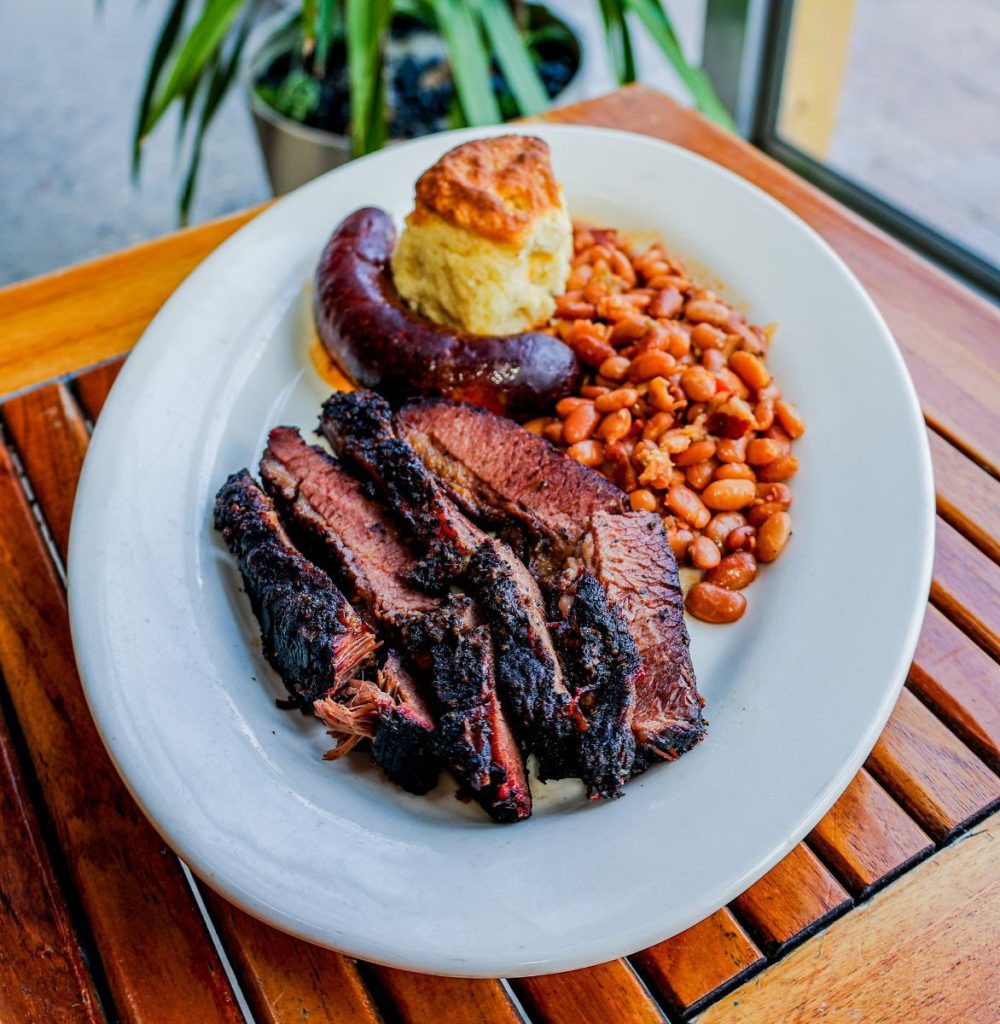
25. Tellicherry Texas Brisket at the Roadhouse
A marvelous taste of tradition
Over the course of the last six months, the terrificness of Texas BBQ has been front and center at the Roadhouse—and Head Chef Bob Bennett is bringing it to life in truly stellar form. He’s starting with super-premium briskets from Niman Ranch, known for their humane animal practices and exceptional flavor. The briskets are rubbed down with a LOT of the amazing farm-to-table Tellicherry black pepper from India that many of you will already know well from our wonderful pepper fries. Add some salt, a lot of hours of smoke over whole Michigan oak logs, and even more time in the oven after that, and you end up with a tender, super tasty, smoky, peppery, and ultra-delicious piece of meat!
Much to my surprise, Texas BBQ like this—incredibly popular today in the Longhorn State—is a much more modern addition to Texas eating than I’d have imagined. It’s only in the late ’50s and early ’60s that Texas BBQ took off—right around the time President Lyndon B. Johnson was here in Ann Arbor delivering the University of Michigan commencement address in May of 1964, Texas BBQ was getting really big! It had long been made from various cuts of meat, but the president’s caterer, Walter Jetton, is who seemingly decided that Texas BBQ should be made only from brisket. Over time, the popularity grew and grew and grew. And brisket, once an inexpensive cut that was hard to sell, became highly prized!
The big point is, it’s terrific! If you’re a meat-eater, swing by soon and score some! With the quality of the Niman Ranch beef, that amazing black pepper from India, and the oak smoke … man, oh man, you’ll have a marvelous meal!
26. Tiny Weddings at Cornman Farms
Three days of small ceremonies with big significance!
What sort of wedding one hopes for is, like anything else in our lives, mostly about what we want, not what others will think we should do. The answer to that question is certainly up to you. We love to host big weddings at Cornman Farms, and we do just that nearly every weekend in the summer! On the other hand, you might be someone who wants to avoid a lot of the coordination that accompanies getting a few hundred people together for a wedding. If, instead, you would like to create a super cool and very intimate event at an exceptionally memorable nationally-recognized farm venue right here in Washtenaw County, we can help!
Tabitha Mason, one of the two managing partners at Cornman, says,
Each year, we dedicate a number of days at our property to host a series of all-inclusive micro weddings in partnership with the best local Michigan wedding vendors. Our expert event producers coordinate everything from the ceremony to the cake cutting, making each wedding feel spontaneous, effortless, and stress-free. Meanwhile, each year we will feature an exclusive seasonal design from one of Michigan’s top event designers. The result is The Tiny Wedding—an elopement for the couple who desires the simplicity of a courthouse wedding but envisions a beautifully curated experience.
What is included in the Tiny Wedding package?
- A really wonderful little wedding ceremony with a totally official officiant
- An hour and a half of wedding time at an award-winning, nationally recognized venue
- A wedding coordinator (and witness if needed)
- Seasonal design and decor
- Our wedding photographer and 45 digital images
- A super tasty cake handcrafted by the crew at Zingerman’s Bakehouse
- One sparkling wine toast
- A surprise wedding keepsake
- Bouquet(s) and/or boutonnière(s) (a total of two)
- A lifetime of limitless joy and good memories!
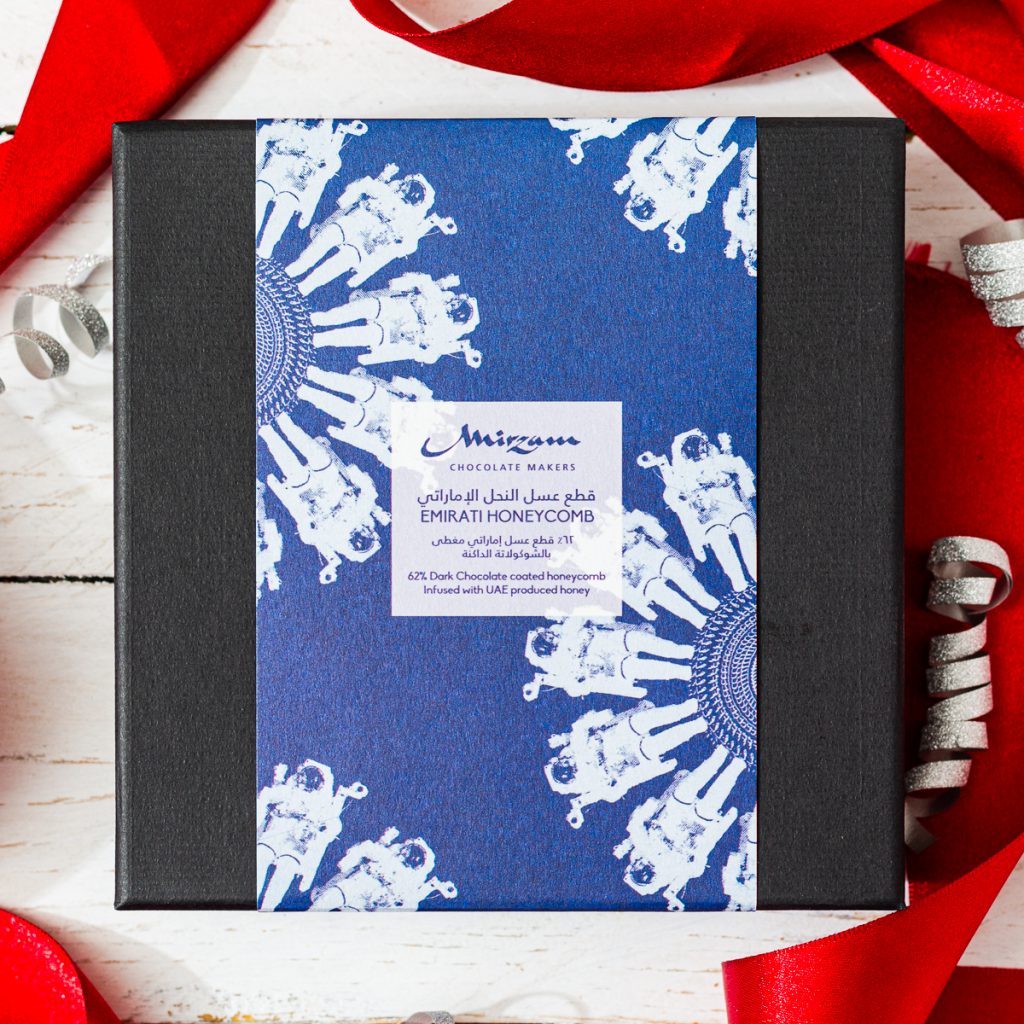
27. Dark Chocolate-Covered Emirati Honeycomb from Dubai
A magical confectionery combination
If you’re looking for a gift for someone who loves great food and is intrigued by the unusual, this rare, terrifically delicious, sweet treat from Dubai might just do the trick. For years now, the folks at Mirzam have been quietly making some of the best chocolate confectionery around. This exceptional combination of spun-honey-“seafoam” dipped into bean-to-bar 62% dark chocolate is one of the best examples of their cross-cultural creativity.
To make this rare and magical confection, local mountain honey is brought to a light boil with a small bit of baking soda and vinegar. It makes the confectionery equivalent of the kind of foam that forms along the seashore from the waves, hence the name. You can imagine it as sort of a caramelly dark “honey brittle;” it’s made first into big sheets, then broken by hand into smaller chunks. The “honeycomb” creates a light, gently crunchy, melt-in-your-mouth confection that’s then dipped into 62% dark chocolate. Its chewy, gently bitter, subtly sweet flavor is unlike anything else I’ve ever eaten.
Available at the Candy Store.
28. Kieron’s Cured Ham from Zingerman’s Cornman Farms
18 ingredients come together to make a great holiday ham
We’ve been making Cornman’s co-managing partner and chef Kieron Hales’ recipe annually for many years. They have, for those fortunate enough to get one, become a happy part of the Zingerman’s holiday tradition. How’s the ham made? Here’s what the British-born Mr. Hales says:
We take a fresh ham … Bone it and clean it. Then we net the ham. We dry rub it with salt and spices like clove, cumin, nutmeg … there are actually 18 ingredients. We hang it for a week, so the air circulates around it and it begins to cure. Then it goes into a “wet rub” with sherry, brandy, and a good bit of honey from the farm. It stays in there for about four and a half weeks. After it comes out, it spends two days drying. We smoke it for 16 hours over oak that was harvested in northern Michigan. Then we sous vide (low temperature-controlled cooking) it for 24 hours, then baste it with the honey we get from the bees here at the farm, Dijon mustard, and Gingras organic apple cider vinegar, and then blast it in the oven at high temperature to encrust it.
Kieron’s love and passion, along with the quality of the ingredients, come through loud and clear. Just heat it at home and serve, and you will have a marvelously memorable main course for your holiday meal, not to mention some lovely leftovers for sandwiches and snacks the following day. Each ham is about two to three pounds and serves four to five people.
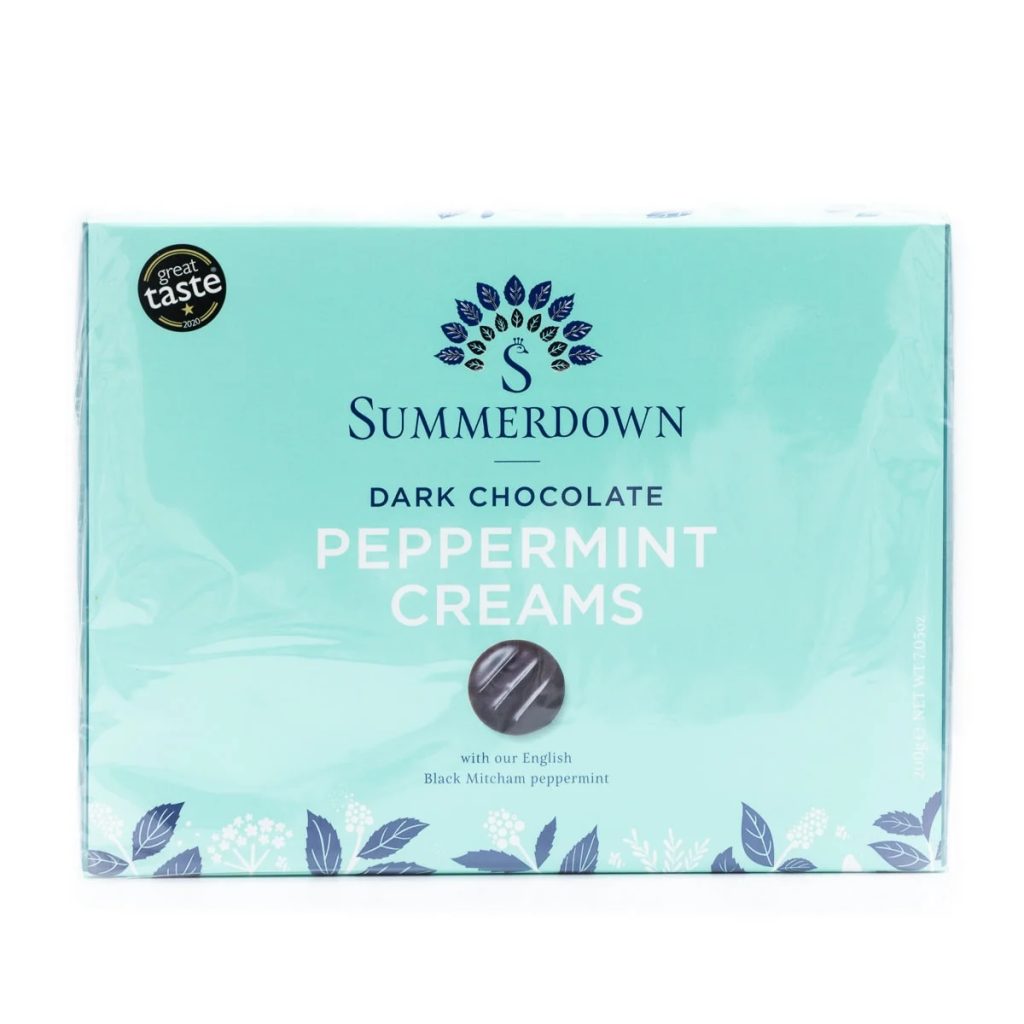
29. Summerdown Peppermint Chocolates
Made with English Black Mitcham peppermint
I love these remarkable mint chocolates, the story of the Colman family who created them to help revive the nearly lost tradition of heirloom variety British mint growing, the exceptional elegance, the balance of dark chocolate, cool mint, and sweet cane sugar. Let me just say I eat very little confectionery because I prefer bread and cheese, but I have a hard time if we don’t have some of these on hand in our house!
Mint-growing like this had gone missing from the British agricultural scene for half a century. The Colmans have brought it back, and in a wonderfully sustainable way to boot! As Sir Michael Colman, then already in his late 70s, said to the Guardian in the summer of 2007, “Everyone thought I was crazy. But occasionally in life you have to take a step and say to people, maybe there is more to this than you thought.” The Colmans use the Black Mitcham variety of mint, and man, is it marvelous!
There are Peppermint Creams (like an amazing artisan version of York Peppermint Patties). And also thin, crunchy Peppermint Crisps—like thin tiles of dark chocolate loaded up with slivers of caramelized fresh mint leaves! And now we have Peppermint Cream Dominoes—thin, creamy, domino-shaped rectangles of 55% dark chocolate and mint oil made from the Black Mitcham.
Available at the Candy Store, Deli, and Mail Order.
30. Zzang!® Bars from the Candy Manufactory
Exceptional artisan confectionery
The first of the now many amaZing artisan candy bars we craft at the Candy Manufactory! It remains a huge seller and for good reason! It has beautiful balance, great complexity, and a lovely, long, delicious finish!
For those of you who aren’t yet familiar, a Zzang! bar is a homemade peanut butter and honey caramel, mixed with giant-size Virginia Runner peanuts, dipped into dark chocolate, all accented by a small pinch of sea salt. A customer stopped me the other day to sing the Zzang! bars’ praises, and said it was “maybe the best candy bar I’ve had in my entire life!”
Tag: ARI WEINZWEIG
Psst: Did you miss Part 1? Find it here.
11. Zingerman’s Food Tours Make Terrific Gifts
A week of tasting terrific, traditional, full-flavored food at its source
If you want to go big on a gift this year, it’s for me to imagine anything more exciting than a seat (or two) on a Zingerman’s Food Tour. No matter which of the 15 different destinations you choose—Spain, Italy, Ireland, Oaxaca (Mexico), Korea, or Catalunya—the voyage is guaranteed to be beyond great. Visit with small artisan producers you’re unlikely to find on your own; meals cooked for the group in home kitchens; behind-the-scenes winery tours, and so so so much more! Imagine coming to the Deli for the first time and finding all those amazing artisan foods staring you in the face? And then imagine finding out for the first time that we have all of them open to taste? Now take all that and imagine doing that tasting in the places in which those foods were crafted. And having that tasting guided by the people who make them! Add in some remarkable scenery, beautiful farmers markets, and maybe a little local music, and … you’re starting to get the idea of what a Zingerman’s Food Tour is like!

12. Cultured Butter Croissants from the Bakehouse
A Bakehouse classic uses better butter to get even better than ever!
We’ve been making croissants for nearly 30 years now! And to be clear, they have always been really, really good. Nevertheless, in the last few months, we’ve done what we’ve done thousands of times over our now nearly 44 years in business—make a meaningful quality improvement to raise the flavor bar on a product that was already widely appreciated. By starting to use the Vermont Creamery Cultured Butter in the croissants, what has long been really good, just got better still. As we say so often, you really can taste the difference! The flavor and aroma are both bigger, more complex, and more buttery. Try it for yourself—break one open and stick your nose in to take in the aroma! To my taste—I should smell—they are remarkable. And the flavor follows suit!
P.S. Same goes for the Juliet Almond Croissants, Chile Cheddar Croissants, Parmesan and Prosciutto Croissants, and the terrific Pain au Chocolat (Chocolate Croissants) that we make with dark chocolate from French Broad Chocolate Company in Asheville! Kudos to the Bakehouse on taking classic croissants to incredible new heights of flavor!
13. Ginger Scones from the Bakehouse
A luscious little bit of buttery baked goodness to brighten your day
Although we’ve been baking these beauties for many years now, they remain a bit of what we call a “Zecret”—many long-time customers who are well-versed in the world of Zingerman’s know them well and love them. But for a first-time visitor, though, they’re easy to miss.
The scone dough itself is incredible (as retired Bakehouse co-founder Frank Carollo would always say, “just enough flour to hold the butter and heavy cream together”), and that’s spiked with spicy cubes of crystallized ginger from the South Pacific (which means they’re dipped into sugar syrup then dusted with coarse sugar crystals). And now, just like those better-than-ever French Croissants, we’ve begun making the scones—Ginger, Currant, and Lemon—with that terrific Vermont Creamery Cultured Butter. And once again, what was already great got better still! It’s hard to imagine, but they are even more buttery than ever!
The ginger is lively but not dominant; the butter is rich but not over-the-top. Beautifully balanced, comfortably complex, and with a lovely long finish, the ginger scones are the epitome of how we think of “full flavor” here at Zingerman’s. A quick and easy way to add a bit of world-class eating to your day! You can buy ginger scones at the Bakeshop, Deli, and Roadhouse every day. And thanks to the Mail Order crew, we’re shipping more and more of these classic tastes of Zingerman’s to pastry lovers all over the country with each passing year!
PS: If you want to bake Ginger Scones at home, pick up a copy of Zingerman’s Bakehouse!

14. Newly Arrived Olive Oil from Western Greece
Outstanding organic olive oil from Navarino Icons
Captain Vassilis Constantakopoulos was born in 1935 in the small village of Diavolitsi in Messenia in the southwest of Greece, due north of the town of Kalamata, and due east of the island of Sicily. As a young man, he was forced to flee the village for Athens during the Greek Civil War in the late 1940s. He went on to become a leading Greek businessman, most of his work centering around shipping, sailing, and the seacoast. Navarino was one of the capstones of his long and creative career. It’s the leading sustainable resort on the Mediterranean!
The Navarino Icons segment of their work is very aligned with our longtime focus here at Zingerman’s on full-flavored and traditional foods. Offering, as they say, “Authentic food products inspired by the culinary history of the Peloponnese region, they are true to Captain Constantakopoulos’ hope to honor the kind of simple and delicious country dishes he grew up on.
Last year, we scored some of their limited-edition, single-estate extra virgin olive oil. It’s made from the beloved, native-to-Greece, Koroneiki olives. The trees are farmed organically, without any chemicals. All the olives are hand-picked, which is super labor-intensive and very costly but makes for exceptional oil. They are then pressed within two hours at a local mill—the impressively short time between the tree and pressing is a significant contributor to keeping the oil’s quality so high. The flavor is fantastic. Big, bold, and peppery, but not overpowering. I’m impressed anew each time I eat it.
The oil is terrific on toast and great on salad greens. I used it the other evening to finish a dish of Mancini spaghetti, sautéed radish greens, and Fishwife anchovies. I added a bit of the IASA peperoncino as well! Great on sautéed fresh fish, potatoes, or pasta, or, for that matter, pretty much anything!
Available at the Deli and Mail Order.
15. 2024 Harvest Olive Oil from the Marqués de Valdueza
Amazing flavor from a 1000-year-old family business in western Spain
If you’re looking for a wonderful, world-class olive oil, you might well want to buy a bottle of the Marqués de Valdueza from the 2024 harvest. The family—formally known as the House of Álvarez de Toledo—has been a fixture in Spanish history for something like 10 centuries. The farmland on which the olives grow was first worked by the family in 1624. This makes the current oil we have on hand the 400th anniversary edition of what is made on the Marques de Valdueza lands. Fadrique Álvarez de Toledo, who leads the family business today, is the 13th generation to formally carry on the family tradition.
Everything about this special oil speaks to its excellence. The olives are all carefully picked by hand. Harvesting is done quite early in the autumn, when yields are significantly lower, but the flavor of the oil is far more interesting. The trees are grown with much wider row spacing than most of the huge commercial farms that have been planted in the southern part of the country to allow the wind to pass freely through the trees, reducing pests, and encouraging the roots to spread naturally without being piled on top of the root system of the surrounding trees. Most importantly, in the moment, the flavor of the Valdueza oil is exceptional. It’s made from a unique blend of four different varietals that grow on the farm—Hojiblanca, Picual, Arbequina, and the rare and unique to the region, Morisca. It has a super fine, long finish with well-balanced complexity.
The Valdueza oil is wonderful, eaten simply, with Paesano or Rustic Italian bread from the Bakehouse. Oil of this quality is at its best when used to finish a dish—drizzle it over fresh fish straight from the broiler, just-sautéed local spinach, or a salad.
Available at the Deli and Mail Order.
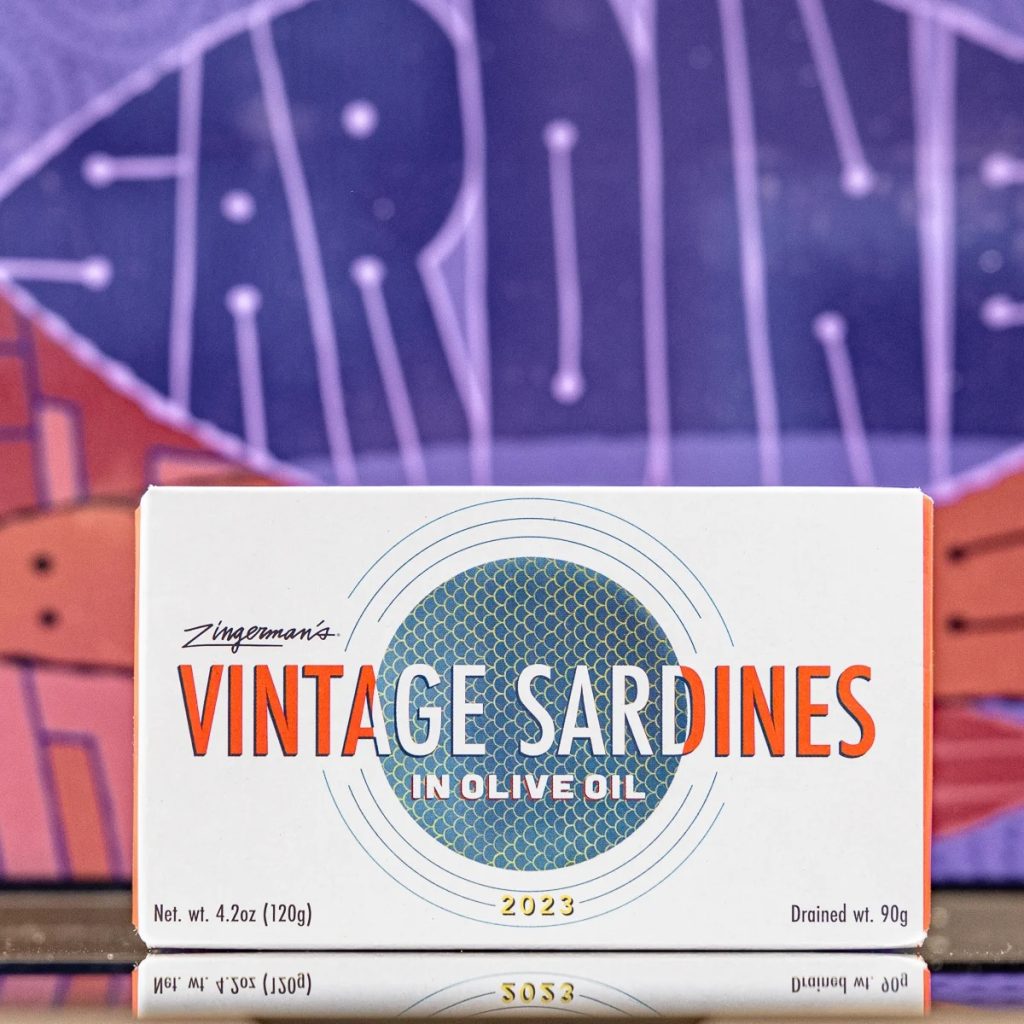
16. Vintage Sardines from 2020–2023
Amazing and hard-to-find luxury for tinned fish lovers
Although most mid-century North Americans experienced sardines as low-end eating, they’ve actually occupied the other end of the culinary spectrum in Europe. According to John Thorne, writer of the simply wonderful, Simple Cooking, Oscar Wilde’s son, Vyvyan Holland, started London’s first sardine tasting club in 1935. Writing in the Spanish journal Gourmetour, Jose Carlos Capel said,
In the larders of some European gourmets, tins of sardines in olive oil occupy a place of honour alongside pots of foie gras with truffles or jars of caviar. A cult has built up around these canned fish, which, with its preaching of the special qualities of the best brands, the correct year and maturity period within the tin, constitute a kind of gastronomical religion.
The most sumptuous sardines are those that have been allowed to mature and mellow for years—if not decades—before they’re eaten. I like to eat the aged sardines in simple ways—next to a small green salad, or with some toast topped with a bit of butter or extra virgin olive oil. A sprinkling of sea salt seals the deal. In this Breton fleur de sel would be geographically correct, and its delicate texture would be a good complement for the sardines.
Available at the Deli and Mail Order.
17. M’Hamsa Couscous from the Mahjoub family in Tunisia
Hand-rolled and sun-dried by a fourth-generation family business
The couscous is comparably world-class! It altered my entire image of what couscous could be! I love it!
The couscous comes to us from the Mahjoub family’s farm, about an hour outside of Tunis, in the small town of Tebourba. They grow the wheat for the couscous on the farm, mill it, and then use the resulting semolina flour to make couscous. They roll each small round by hand and then dry it all slowly and naturally in the sun. M’hamsa actually means “by hand.” “Phenomenal” is, far and away, an understatement when it comes to this stuff. When you cook it, your whole kitchen will smell like wheat. It’s also incredibly easy to prepare, so easy that I was skeptical when we first started stocking it 15 years or so ago. But sure enough, all you do is use 1½ parts water for 1 part couscous. Salt the water lightly, bring it to a boil, then add the couscous. Stir, cover, turn off the heat altogether, and let the couscous steam in the pot for about 12 minutes. It should come out light and almost fluffy once you move it around a bit with a fork.
While the couscous is cooking, cut some fresh asparagus spears into 1-inch pieces. Sauté the pieces in hot olive oil. Sprinkle with a small bit of sea salt, stir, and cook til tender. When it’s done, remove them from the pan. Keep the oil hot, crack a couple of eggs per person, and cook lightly (or longer if you like them that way). I recommend the eggs over easy, so the yolk breaks nicely onto the dish. Additionally, coarsely chop some toasted almonds (or pine nuts, hazelnuts, or walnuts).
Available at the Deli and Mail Order.

18. 2025 Holiday Blend Coffee
An annual tradition from the Coffee Company
Every year, the Coffee Company crew convenes to come up with a way to take some of the year’s best single-origin coffees and bring them together in the form of an exceptional blend. I look at it as something akin to a rock supergroup, where each member has made great music on their own, but gets together with a handful of other great players for fun to produce music they couldn’t create on their own. The coming together isn’t permanent—it’s a special short-term collaboration that creates some really cool outcomes!
This year’s Holiday Blend is a duo—beans from our long-time friends at Daterra in Brazil and also from Hacienda Miramonte in Costa Rica. The crew at the Coffee Company offers,
Their flavors are playing especially nicely together this year, leaving us with an unmistakable richness and smooth finish. Think toasted nuts, caramels, and a silky smooth texture. Comfort and joy in a cup!
The Holiday Blend is designed to appeal to both serious coffee aficionados and those who are new arrivals to the specialty coffee scene. A bag makes a great gift—it’s wonderful way to send a taste of Zingerman’s to a coffee-loving loved one or colleague, and a beautiful addition to gift baskets! Enjoy it now while it lasts!
19. Il Molino Organic Apricot Preserves at the Deli
Lovely artisan jam handmade from Lazio in Central Italy
I just tasted some of this jam again the other day when I was walking through the Deli, and it was out for sampling. I guess I shouldn’t be so surprised, but it’s pretty darned amazing stuff. The team at the Il Molino estate (a restored 17th-century farmhouse) in Central Italy does a marvelous job of making exceptional jam out of the wonderfully flavorful organic apricots that they harvest on their lands every June.
My friend Lex Alexander in North Carolina, who’s studied the subject of artisan jam making for many decades, always tells me that apricot is the hardest fruit to successfully put up in preserves. With Lex’s wise words in mind, I am extra appreciative of the work of the team Il Molino—they’re a great way to put an inspirational bit of apricot into your daily dining, and a wonderful way to appreciate the beauty of the apricot at its absolute best.

20. Brand New Vegan Chocolate Cake from the Bakehouse
Tasty and terrific with vanilla oat milk ermine frosting
Can you really make a super delicious vegan chocolate cake? No eggs? No butter? No honey? Yes, you can! This is evidence thereof from the Bakehouse team! That’s right—lots of flavor and verifiably vegan!
The Ermine frosting that covers the cake may be new to most 21st-century Americans, but its origins go back to the 1880s, when it was also known variously as “milk frosting” or “boiled milk frosting.” It’s made by starting with a flour-based roux—for this vegan cake, we’re using oat milk. The chocolatiness comes from cocoa powder crafted by the Dutch firm of Bensdorp, one of the first in the world to make cocoa powder. The vanilla is the real deal—from the island of Madagascar.
The results are terrific! Great anyway you like to eat your cake—alongside an AeroPress-brewed cup of the 2025 Holiday Blend at the Coffee Company, the marvelous Mexican Chiapas. Be sure to serve your cake at room temperature to get the full flavor!
Tag: ARI WEINZWEIG
Each year when I write this holiday list, I am regrounded in gratitude! I have so much appreciation for you all, one of the kindest and most supportive communities of customers anywhere in the world. I am appreciative anew of all the incredible artisans who care so deeply about the food and drink they so diligently craft for us. And I am humbled and honored to work with the 700+ people who work in the Zingerman’s Community of Businesses (ZCoB), AND the 400 other great folks who come on board this time of year to help us make all of your amazing holiday orders happen! As we enter our 43rd holiday season, thank you! In these challenging times in which we are working, gratitude, love, dignity, and appreciation have become more important than ever. As author Brother David Steindl-Rast writes,
You can feel either grateful or alienated, but never both at the same time. Gratefulness drives out alienation; there is not room for both in the same heart. When you are grateful, you know that you belong to a network of give-and-take, and you say, “yes,” to that belonging. This “yes” is the essence of love.
Thank you for saying yes so often.
I hope the foods on the list below will give you as much joy as they have brought me.
All the best,
Ari Weinzweig
Co-founding Partner
Zingerman’s Community of Businesses

1. Wild Harvested Purple Mulberries from Afghanistan
Delicate, hard-to-find fruit is super fine for snacks, salads, and sauces
In the remote regions of Afghanistan, there are a plethora of wild mulberry trees. The trees are, as they were hundreds of years ago, growing essentially unmanaged—unhindered by pesticides or commercial farming methods. That we have them now here in Ann Arbor is a rather remarkable feat. The ripe berries are carefully hand-picked each summer and then gently dried to protect the fragile fruit. Thanks to all that work, we have access to one of the tastiest dried fruits I’ve tried in a long time. The mulberries come to us through the good work of the folks at Ziba. They pay the over 250 farmers and foragers they work with higher prices for their harvests, and Ziba directly employs about 25 Afghan women full-time.
The dried purple Afghan mulberries are smaller and sweeter than most and are recognized as some of the best in the world. Naturally sweet (no sugar is added) and crunchy, they’re great as a snack, baked into granola, or added to yogurt or desserts. You can also sprinkle some onto cereal, oatmeal, salads, or, really, anywhere you’d usually use raisins or currants. I like them out of hand, where I can appreciate their complex, natural sweetness. The size of a small raspberry, they have a lovely, delicate honey-like flavor with a brilliant, crunchy mouthfeel.
Available at the Candy Store and the Deli.
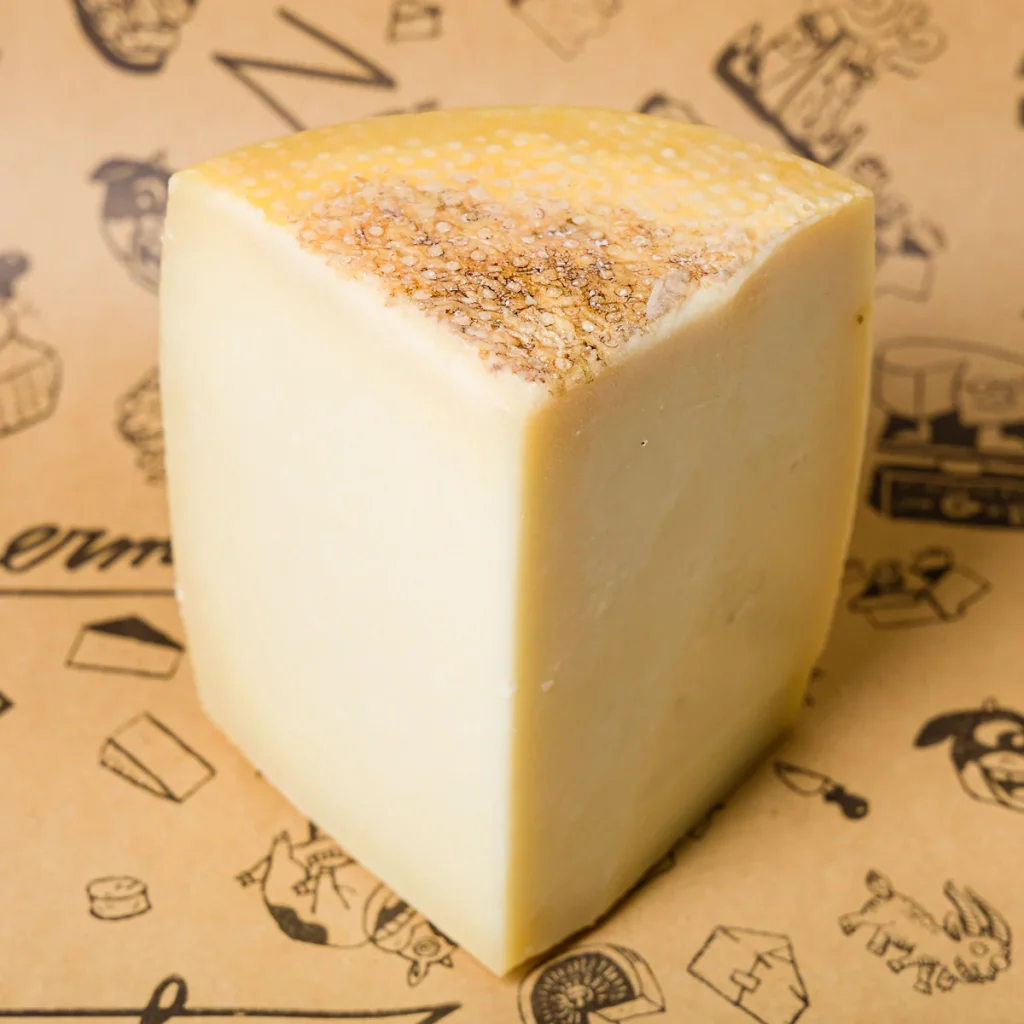
2. Pantaleo Cheese from Sardinia
Aged goat’s milk cheese from Italy
A great new arrival from the island of Sardinia in the western Mediterranean. Today, Sardinia is one of the autonomous regions of Italy, but it has been ruled by nearly every historical Mediterranean part over the years and was also an independent monarchy for many years. Both Sardinian and Italian are recognized as official languages. The topography varies from town to town, with dozens of magical microclimates making up the island—so many that it is sometimes referred to as a mini-continent! In the early part of the 19th century, much of the island’s once-abundant forest land was cut down to provide wood for building in Piedmont and other parts of northern Italy as industrialization took hold.
Pantaleo is made in the small (3,500 people) town of Santadi, by the dairy that bears the village’s name. The name “Pantaleo” comes from the name of the nearby forest, the largest in the south of Sardinia. Since most of the cheeses we see here from Sardinia are made with sheep’s milk, it’s great to get ahold of this wonderfully delicious, aged goat’s milk cheese. Andrea, the maker, works with the milk of his own herd of about 250 goats, along with milk from 22 other small producers. The goats are the ancient Sarda breed (one of eight registered indigenous goat breeds in Italy) and only produce milk for six months out of the year. Semi-firm in texture, sort of, say, like maybe a young Manchego. Smooth full flavor, nutty, some say lemony, with a really fine clean finish that even folks who think they don’t like goat cheese could well be drawn to. Wonderful on a salad, grilled cheese, or pasta, or served with a bit of honey after the main course.
Available at the Deli and Mail Order.
3. west~bourne’s Extra Virgin Avocado Oil Arrives in Ann Arbor
Extraordinary organic oil from California
The folks at west~bourne have set a whole new standard for me of what avocado oil can be—it really does redefine the class! Each bottle is filled with a beautiful green-gold, cold-pressed oil that’s really the essence of what makes the best avocados so special. The flavor, like any of the great extra virgin oils we sell, is complex, beautifully balanced, and has a lovely, long, lingering finish. It tastes, as you would expect, intensely of what you would expect from the best ripe avocados (which, to be clear, we rarely get around these parts)—buttery, subtly sweet, amazingly aromatic with a little hint of licorice and a titch of tarragon! Food & Wine journalist Kyle Beechey says west~bourne’s is the best avocado oil she’s ever had.
Use west~bourne’s extra virgin avocado oil to dress salad as you do olive oil. Make bruschetta with it—toast some Bakehouse bread, and, while it’s hot, pour on some avocado oil, then sprinkle a pinch of good sea salt and some freshly ground black pepper on top. (I love the top-grade Tellicherry at the Deli, and also at the Roadhouse, where it’s on all the tables and those incredible Pepper Fries.) Drizzle it on avocado toast, and you’ll take your usual favorite to new culinary heights. Great on a tin of high-quality tuna—try Salade Nicoise with avocado oil. Superfine on a salad with fresh fennel and oranges, and, if you want, slices of ripe avocado as well. Great on pasta with grated Parmigiano Reggiano (the Valserena is tasting particularly great right now) or Pecorino, a bunch of freshly ground black pepper, and avocado oil.
Available at the Deli and Mail Order.
4. Traditional German Challah at the Bakehouse
An integral element of Central European Jewish culinary culture
If you haven’t yet tried this new addition to the Bakehouse’s already wonderful repertoire, now’s the time! It’s terrific! Challah of this sort has actually been the norm in the German Jewish community for hundreds of years. What most German Jews will know as berches is made without eggs, and it’s only subtly sweet, so much so that savory food lovers like me might not even notice the small bit of honey we use in the recipe.
Culinary historians say that while eating special bread for the Sabbath dates back to biblical times, the origins of berches are pretty surely a product of the 15th century, when Jews in Austria and Southern Germany began modeling their Shabbat bread on a popular German braided loaf. The beautiful braided berches (sometimes called “water challah” since they don’t include eggs) became the bread of choice. Whether you want a new way to celebrate the Sabbath or experience a bit of Jewish cultural diversity, or whether, like me, you just like to eat good bread, swing by and grab a loaf or two of the German Challah soon!
It’s terrific torn into chunks right from the loaf. I love it toasted—the aroma of the whole grains is wonderful. Lovely spread with a bit of Vermont Creamery Cultured Butter (at room temperature!) and some American Spoon Early Glow Strawberry jam. On the savory side, it’s terrific for sandwiches, especially for chopped liver!

5. Traditional Artisan Cheese from Sweden Arrives at the Deli
Wrångebäck brings full flavor and 150 years of history to town
Wrångebäck is a farmstead cheese made at Almnäs Bruk, on the west bank of Sweden’s second-largest lake, Vättern. About four hours southwest of Stockholm, the estate was founded by monks in August 1225. While cheese likely has been made there in some form since the beginning, the estate began producing what we now know as Wrångebäck formally in the spring of 1889.
Sweden’s oldest known cheese by name, Wrångebäck, has a European PDO—in other words, its traditional production methods are legally protected. The cheese is made only with milk from the organic farm’s own 180-cow herd, and the cheeses are matured on the same wooden planks that have been in use for 150 years. Like a sourdough starter, the wood becomes enriched with natural cultures over time, passing them on to the wheels placed on it and contributing in unique ways to the cheese’s flavor development.
The final cheese has a firm texture and a lovely combination of mountain cheese and washed-rind character. The wheels of Wrångebäck we have right now, matured for nearly a year, are some of the best I’ve ever tasted—full, clean flavor with hints of mushrooms or caramelized onions, with a beautiful, long finish. Excellent on its own, or on some of the Bakehouse’s Vollkornbrot, Dinkelbrot, or Caraway Rye—better still if you spread a little of that great Vermont Creamery Cultured Butter on first. A truly traditional taste of Scandinavia!
6. Zingerman’s Artwork on Some Special Skis and Snowboards
A cool artisan collab to add a bit of Zing to the slopes
Most snowboards and skis start by sending American lumber all the way to Asia, where they are produced en masse, and then shipped back to the U.S. to be sold in giant stores. Gilson, on the other hand, is small, local, and handmade. Their workshop is located in the small Central Pennsylvania town of Selinsgrove (population a bit shy of 6,000 people) on the Susquehanna River in the foothills of the Appalachians. There, they work with Pennsylvania poplar, which, as they describe it, is “the lightest and lowest density hardwood out there, it grows fast and can be sustainably harvested, and it arrives on the back of our Gilson pickup truck,” adding, “It couldn’t be more local.” And they have a series of design innovations that are over my head, but apparently make for some very special snowboarding and skiing! Above and beyond all that, the amazing Zingerman’s graphics by our Ian Nagy are sure to turn heads, and they’ll likely put you in a good mood every time you head out in the snow! Check them out!


7. Vermont Creamery Cultured Butter Takes ZCoB Flavors to the Next Level
Top quality Vermont cream is carefully cultured the old-fashioned way
When I spoke to a group of business leaders at MIT in Boston late last summer, one of them asked me, “How can you keep improving products that are already so great?” For him, it seemed like something that would be exceptionally hard to do. In my mind, it’s actually easy! “Everything can always be made better!” I shared with heartfelt enthusiasm based on 44 years of real-life practice. When he asked for an example, Vermont Creamery Cultured Butter was what came quickly to mind! There’s more about it on page 11, but I didn’t want to leave it off this list! Made much as great butter would have been made 150 years ago, allowing super high-quality local Vermont cream to ripen and develop natural bacterial cultures, the flavor is far, far better than anything around. Honestly, I think everyone who tries it loves it! (Be sure to serve at room temperature—it makes a BIG difference!).
In the 18 months since we started using it, the Vermont Creamery Cultured Butter has improved the flavors of a number of dishes at the Roadhouse: the Bakehouse Bread Service, Butterscotch Pudding (also on this list!), Anson Mills grits, Buttermilk Biscuits, Biscuit Bread Pudding, and Mashed Potatoes. As of this fall, we’ve been weaving into some of our favorite baked goods at the Bakehouse, too! And, the Bakehouse, Roadhouse, and Deli all have the 86% butterfat Cultured Butter for sale for folks like you and me to take home—it became a regular item at our house!
8. Really Fine Papillon Roquefort at the Deli
Baking bread to make blue mold, as it’s been done for centuries
Papillon was founded by Paul Alric in 1906, in the village of Villefranche-de-Panat, about 45 minutes northwest of Roquefort. It has always been one of the smaller firms in the region. Still family-owned, the firm has nearly 200 farms producing milk for its cheese. Even with that, it accounts for only about 10 percent of Roquefort. Like Gilson, Papillon today is an interesting blend of modern technology with a devotion to tradition. Its cheeses are made at a neat new facility. They use mechanized stirring of rennet and starters, and have developed a machine to cut curd, which they say they designed to “carry out human gestures.”
Today in 2025, Papillon is proudly the only producer still making its own mold from the traditional loaves of rye bread—all the others buy prepared mold from labs. They employ a baker year-round to make bread and keep the mother mold alive. The Alrics are adamant that this more traditional mold leads to a creamier texture, and my experience bears that out. I’m seduced by its softness—at room temperature, it’s almost velvety smooth; it will literally melt on your tongue, like a perfect chocolate truffle. Most of all, I love the flavor—it’s often described as “nutty,” but I’ll add bold, with a hint of butterscotch; the finish is substantial, long, and lingering.
I love the Roquefort—always at room temperature—spread onto toasted Country Miche or a hunk of fresh French baguette. Great on salads, or with fresh pears or apples. Delicious with the dates from Rancho Meladuco, red walnuts, or our Spiced Pecans.

9. Zingerman’s Spiced Pecans
An annual holiday classic handcrafted across the ZCoB
After making these for nearly 30 years now, I am comfortable saying that they have become a Zingerman’s classic. About 15 years ago, we started buying nuts for the Spiced Pecans from the South Georgia Pecan Company in the town of Valdosta. Today, the firm is owned and run by the Work family, who bought it in 1983, a year after we opened the Deli, but for historical context, the company was started in 1913 by one of the first Jewish families in town, the Pearlmans. The pecans are pretty darned delicious—fresher tasting, and a small, but meaningfully, bit more flavorful than what we’d been getting. After being toasted with butter, the pecans get tossed—while still warm—with lots of freshly ground Tellicherry black pepper, Jamaican allspice, ginger, Indian cloves, and other enticing spices.
The spiced pecans are delicious, just as they are. Try them chopped, then tossed onto gelato, mashed sweet potatoes, roasted carrots, or green salads. They pair particularly well with blue cheese—I love them with the Roquefort—and also with fresh slices of pear or apple. Coarsely chop some and toss them on top of rice pudding or noodle kugel. Or try sprinkling some atop your holiday stuffing. In the spirit of how we have long defined “full flavor” here at Zingerman’s (see my pamphlet “A Taste of Zingerman’s Food Philosophy” for more on this), the Spiced Pecans have a wonderful complexity. They are nicely balanced so that the flavor of all the spices, butter, and nuts comes together as you eat.
Available at the Deli, the Candy Store, and Mail Order.
10. Pfeffernüsse from the Bakehouse
One of my favorite small tastes of the holiday season
If you were to walk into a German bakery a thousand or so years ago, in, say, the year 1123, pfeffernüsse would probably have been one of the most prized—and most expensive—offerings in the shop. Back in those days, black pepper was one of the most expensive products you could find. Black pepper, at times, traded for the price of gold, which means that a package of these innocent little cookies could have cost someone the 12th-century equivalent of a sumptuous meal. In ancient times, pepper and assorted other spices were used as often in sweets as in savories. Spices imported from afar at great expense were a way to show honor for one’s guests and to demonstrate abundance. Nearly every traditional Christmas sweet in Europe is evidence of this tradition. Pfeffernüsse are right there in the tradition of using—and in this case, being named for—pepper.
At the Bakehouse, we’re supporting the black pepper with a bit of nutmeg, cloves, anise, Indonesian cinnamon, and some muscovado sugar. A touch of sea salt brings the flavors out beautifully. If you’re serving them on a platter, I recommend a fresh bonus-grinding of black pepper over the top—looks good, adds a nice little aroma, and adds a bit more pepper to the flavor. Lovely balance of sweet and spicy, with a wonderful, palate-awakening complexity, and a really fine long finish. It makes a great stocking stuffer or surprise gift to enliven someone’s afternoon. This cookie is great with coffee, tea, or just about anything else! Terrific with the 2025 Holiday Blend or a shot of Espresso Blend #1.
Tag: ARI WEINZWEIG

A caring reflection on a curious question
This all began, as so many good learnings are wont to do, with a question.
Last week I was talking for a while to Sarah Harris, the musician and caring creative force behind the band Dolly Creamer, whose music I wrote about near near the end of last week’s enews. She and I were sharing assorted stories while she had supper at the Roadhouse. Since Sarah is reading some of the stuff I’ve written, and I, in turn, have been listening to a lot of her music since we met at the Deli the week previous, there’s a whole lot of philosophical and artistic material for us to talk through.
As the conversation continued, we swapped learnings, trying to find philosophical framings for what we do and firmly agreeing, more than once, I think, that we both like to work a lot. I think it’s safe to say that Sarah and I would each align with what artist, sculptor, and author Anne Truitt writes: “We agree that work is the backbone of a properly conducted life, serving at once to give it shape and to hold it up. Of like mind, industrious by nature, we work even as we talk.”
As the conversation progressed, the two of us began talking about the import of curiosity. At some point, Sarah paused for a second and put her own curiosity into immediate practice by throwing an out-of-context, slightly off-kilter (in the best possible way) question at me. One minute we were talking about loving to learn and leadership, and then, out of the blue, she quietly asked me this:
What keeps you going?
It was, at first glance, a casual sort of question, a tiny bit of an aside asked seriously but gently, the result of a small shift in a smart and creative woman’s brain in the middle of a conversation that covered a couple dozen other topics that probably seemed far more important. It was a curious wondering-aloud that would have been all too easy to miss. Anne Truitt had it right about a half a century ago when she wrote, “Everything that happened was a matter of curiosity to be explored and examined with hearty directness.” And, sure enough, a casual, completely spontaneous conversation turned out to provide a positive prompt for some serious self-reflection, the result of which appears in this essay. Four simple words spoken quietly and wrapped up with a question mark launched a week of meaningful self-exploration.
Sarah’s question, to be quite honest, stumped me at first. What she was asking hadn’t really crossed my mind. Her question couldn’t have been any clearer, but it took me 10 days to find an answer. What follows is my first attempt to offer her a clearer, more coherent, and more helpful response than the “Wow, that’s a good question” and “I don’t really know” sort of stuff I stumbled through that evening.
The reality of my life is that—to state what has to be obvious to everyone reading this—I happily and eagerly do keep going, as I have for well over 40 years now. Still, simply doing is not, for me, a substitute for serious understanding. Which is why I’ve spent so much of the last week wondering:
- Why, indeed, do I keep going with such diligence and determination?
- What keeps me moving forward so consistently every day when there are 44 other directions I could easily alter my path to pursue?
- Why am I still excited to go to work every day after all these years when so many people I know would rather do anything but?
- Although “keeping going” is not on Timothy Snyder’s On Tyranny list of 20 lessons to practice to resist the imposition of autocracy, it seems clear that if we don’t keep going, we lose democracy. Democracy may or may not die in darkness, but it definitely dies if the people who are part of it stop working hard to make it happen. So, how does one keep going in the face of autocratic adversity?
- What does keep me going, when all is said and done? Day in and day out, when coolers break, plans go awry, orders fail to show up, and leadership is difficult to do even moderately well, how do I keep pushing forward?
Approaching life with an abundance of curiosity in hand, as Sarah Harris also seems to do, I spent a fair bit of time turning her good question over in my mind. I started to sort out the answers through my usual research process. Reading always reveals interesting insights, and I almost always get my own thinking going by learning from others. It didn’t take me very long, though, to realize the absurdity of that approach. Other people’s inspiration, in this context, was pretty irrelevant. I mean, how in the heck was looking up other people’s answers to Sarah’s good question going to help me know why I keep going?
Self-reflection, it quickly became obvious, was really the only research I needed to do as I tried to ascertain an answer. I needed to do what Anne Truitt talked about: “contemplate all this with curiosity and wonder.” And that is indeed how I’ve spent a good part of the last week—wondering to myself, wandering through the back corners and creative crevices of my curious mind, making my best attempt to ascertain an answer. That sort of self-examination is not always easy work. As Truitt tells it, “The most demanding part of living a lifetime as an artist is the strict discipline of forcing oneself to work steadfastly along the nerve of one’s own most intimate sensitivity.”
My initial inclination is to answer Sarah’s question with a right-on response from another musician, a man who made his mark on a different genre and a different generation than Sarah. Pharoah Sanders was a free spirit who played free jazz, a saxophonist who set a high bar for any other aspiring jazz musician. Born 85 years ago this past week in Little Rock, Arkansas, Pharoah Sanders, quite simply, was something else! A lot like Anne Truitt and Sarah Harris, Sanders was, to my ear and eye, an artist driven by a lifelong creative quest and a commitment to making his art, all the while remaining determinedly true to himself.
Jon Pareles wrote the following in Pharoah Sanders’ New York Times obituary three years ago last month:
The sound Mr. Sanders drew from his tenor saxophone was a force of nature: burly, throbbing and encompassing, steeped in deep blues and drawing on extended techniques to create shrieking harmonics and imposing multiphonics. He could sound fierce or anguished; he could also sound kindly and welcoming.
When reviewing one of Sanders’ shows for The New York Daily News in the summer of 1977, music critic Stan Mieses wrote:
There was a moment Tuesday night when I felt like yelling out loud and launching my head through the ceiling—that’s the kind of feverish pitch that Pharoah Sanders and his group hit me. … They have to be seen and heard to be believed.
With his music, Pharoah Sanders seems to have attained what I’ve come to think of—thanks to the writing of creative business thinker Carol Sanders, who kept working until weeks before she died of ALS in her 80s last December—as Deep Understanding. He took his playing to places no one else had been, in ways that helped him to be himself and brought beauty to anyone who leaned in to listen. As the late, legendary Danish jazz journalist Boris Rabinowitsch noted in a 1977 review in the newspaper Politiken:
The music [Sanders] made … drew from the jazz tradition, but elevated the form so as to embrace gospel, soul, African folk, R&B and what would soon be deemed world music, weaving it all into a tapestry that spoke of African-American identity, spiritual realization and world peace. … It is the tone, its sonorous—and emotional, expressive possibilities, that Sanders has succeeded not only in cultivating … with a deep personal commitment, that today he himself stands out as one of jazz’s great individuals.
I share Sanders’ story here in part because more people ought to know about him, but mostly because my initial answer to Sarah’s question is what he said, simply and directly, in a January 2020 interview with The New Yorker:
If you’re in the song, keep on playing.
For me at least, what he said is so right-on that I can only smile, reread, and repeat. The eight words in Pharoah Sanders’ statement are essentially an honest answer to Sarah’s question. I have been deep in the song for decades now, determined to keep playing day in and day out! When you’re “in” whatever you do in that way every day, “What keeps you going?” doesn’t really come up. Upon further reflection, it occurred to me that Sarah answered her own question, at least partially, five years ago. This answer—“Just make your art!”—is in the inspiring song “Icicles” on her stripped-down debut, Best of Luck. I think it’s a remarkable, vulnerable, and insightful album. After all, as she accurately observes a few lines later in the song, “Your art made you!”
And much as I love Sarah Harris’ and Pharoah Sanders’ short and to-the-point statements of creative fact, I know full well that there must be more to the answer. I challenged myself to sort out and then share my answer to Sarah’s question. Not because my answer will necessarily bear any resemblance at all to yours—we all keep going, after all, for our own reasons—but because it’s a really good question and because it seems like something we would all do well to answer for ourselves.
Anne Truitt noted that the “truth of an intuitive leap is pure and straight.” For me, finding an answer to Sarah’s curious question was more of a slow, meandering mountain path than anything pure or straight. More like a Pharoah Sanders’ free jazz show than some corporate chatbot’s quick, off-the-shelf answer to a frequently asked question. Wandering, wondering, reflecting, writing, reading, and back through again about 18 times over the course of the last week.
Increased attention of this sort, I know from experience, nearly always unveils new evidence. And, sure enough, as soon as I started reflecting more meaningfully, clues began to crop up all over the place. Like Sarah’s question, the evidence arose out of the kind of wholly unplanned and completely unexpected interstitial events that unfold in all of our lives. If and when we’re paying attention, we can catch them like falling stars. There is, I believe, magical inspiration in those moments.
This past Monday morning was a turning point for me in understanding the answer to Sarah’s question. I had just arrived at the Roadhouse after working at home for a few hours. I grabbed a cup of Tree Town coffee and a glass of water. As I’ve done many hundreds of times now over the years, I plugged in my computer and opened my doc to continue working on this enews on the day of my usual “get-your-darned-draft-in” deadline.
Before I’d typed more than 20 words, I looked up and saw a customer for whom I have an enormous amount of respect. She’s a longtime Roadhouse regular, so that’s the first way I think of her. We met many years ago while I was pouring water at her table, the kind of encounter with an exceptional creative thinker that happens in the Ann Arbor ecosystem with surprising frequency. In the years since, I’ve come to see her as a scholar, a philosophically minded expert in global finance, a friend, a fellow Russian studies major, and a Russian speaker (her Russian is much better than mine these days) as well. She’s also a caring human who has accomplished amazing things in her life. She remains humble, determined, thoughtful, and joyful while overcoming a host of challenges. She is, for me, an inspiration and a source of wisdom who appreciates what we bake and cook as well as the caring, dignity-centered spaces we’ve worked so hard to create in the Zingerman’s Community of Businesses (ZCoB) over the years. From the outside looking in, it sure seems like she’s “in the song,” and, best I can tell from the outside looking in, she’s determined to keep playing.
That morning, this longtime guest had just finished a breakfast meeting with her minister, also an amazing human being and also, like her, a regular customer. Before I could really ask how she was doing, curious and caring soul that she is, she asked a question of me: “Are you writing your newsletter?” As I started to answer in the affirmative, she looked me in the eye and said with quiet gravity:
Keep writing. It makes a difference. Right now, more than ever. I read it every week, and I’m sure a lot of other people do, too.
I was touched, humbled, and inspired anew. Remembering that I had a handful of apricot pins with me that I had ordered for occasions just like this one, I reached into my shoulder bag and pulled one out to offer it to her as a gift, a small symbol of support in the challenging times she continues to work through in her own workplace with so much grace and determination. I began to explain what the apricot’s about, but since she reads this enews every week, she already knew about the apricot’s role as a positive symbol of dignity and democracy. “Thank you!” she said. “I have a bag I’m bringing with me to tough meetings. I’m gonna put this in there.”
After she left to go on with her day, I started to type again. One aspect of the answer to Sarah’s question was now immediately clear to me. There’s now no doubt in my mind that I keep going, in great part, because the work that I do for so much of every day makes a meaningful difference to people who mean a lot to me.
Before I got even two sentences into the writing, that first observation was confirmed anew when a second guest walked over to say hello. He had a big smile on his face, and I sensed that he was someone I knew but wouldn’t be able to place immediately. Happily for me, he reintroduced himself. His younger sister has been part of the ZCoB off and on for about 20 years now, and he himself has been a customer pretty much since we opened the Deli in 1982. He proceeded to thank me profusely for providing a positive place for his sister to work, and also for all we have done in the community over the years. I thanked him back for his support and assured him, from the heart, that it makes a huge difference to know that the work we do really does resonate. “It’ll be 44 years in March,” I shared. “Wow! You look like a young man still,” he said. And, with a big smile, he added, “I guess when you do what you love, it keeps you young!”
Having made both of our mornings better, he then headed off to have breakfast while I got my head back into writing, reminded for the second time in something like six minutes that we really do make a difference. My energy increased, I started clicking typewriter keys, much in the way, I imagine, Pharoah Sanders did with keys of his saxophone back in the ’60s and ’70s. Sure enough, if you’re in the song, keep playing.
I managed to make it about two paragraphs further before yet another regular customer came over to say hi. This is the amazing advantage of the “edge” that I wrote about last month—spending time in spots where customers, coworkers, and others can just come up and tell you things that they wouldn’t likely seek you out to share. Anyway, though this customer is far less famous than the first guest I got to talking to, she is nevertheless remarkable. She retired long ago, but she keeps playing her song happily—last year, she treated herself to a long-dreamed-of cruise that crossed much of the world over the course of about six months. That morning, she shared with me that she’ll soon be moving into independent living. She explained the thinking behind the move and shared what she was looking forward to. It turns out she’s going to teach watercolor painting to the other folks in her new place. Her determination to stay positive and curious, and to continue contributing to her community, is an inspiration. Very different life story, but the song remains very much the same. If you’re in the song, keep on playing!
This last customer’s story gave me a second clue in my search for an answer to Sarah’s question: Whether I’m reading, listening, looking, or interacting with someone in another way, spending time with people who are “in the song” and “keep playing” inspires me to do the same! Together, we create our imperfect version of what Anne Truitt once called “experiments in space, color, and form,” a beautiful way, I might add, to imagine our lives.
So, after all that, what does keep me going? I’ve already shared two important parts of my answer:
- Being determined to make a difference
- Hanging around with other people who keep going when the going gets tough
Here’s half a dozen other pieces of my answer:
Honoring my drive to learn. Back on September 10, Sarah Harris posted a newsletter piece that included, amongst a host of other good thoughts, a photo she’d taken of some words—possible pieces of songs, poems, or just journal prompts—that she’d thrown down on a white legal pad while reflecting over the course of the previous week. The caption under the photo reads “none of these lines were used lol.” That, though, is no longer true since I’m about to use one of them here and now. The second set of words on Sarah’s photographed page says, “U ain’t gonna find it by doin the same old thing.” I know for sure that that bit of wisdom is totally true for me, too. Learning from folks like Pharoah Sanders, Sarah Harris, Anne Truitt, and a host of others whose names I don’t even know is a very significant part of my answer to Sarah’s question. No doubt about it, learning keeps me going. The way I have designed my life and the way I try to live it have pretty much guaranteed that I rarely go more than a few minutes without learning something new!
Immersing myself in self-study. As Pharoah Sanders said, “Everything comes from within. It all comes from inside. [I] try to bring the best of myself or the best quality of myself and try to grow and try to develop and be a man of quality.” I completely concur. I have been working to study myself since somewhere around the time I turned 30. That study—which I wrote about extensively in Managing Ourselves, and which is evidenced, I suppose, by this essay—will not end until I leave consciousness at some unknown date down the road. I am not alone in this self-exploration—it seems a common theme for most people who are “in the song.” Though Anne Truitt made her name as a sculptor and artist, she created a whole new role for herself through journaling. In 1984, when she was already in her 60s, Truitt published her first book, called Daybook: The Journal of an Artist, a collection of pieces taken (as was Sarah Harris’s above-mentioned essay) taken from her written reflections. Over the years that followed, Truitt continued to publish her private thoughts, which evolved into a series of highly recommended books. She took on the challenge as a way to better understand herself. As critic and essayist Megan O’Grady writes, “Journaling also allowed [Truitt] to refine her sense of purpose in making art.” It has, without question, done the same for me. Journaling has helped me to face my fears, find focus, learn and grow, and go forward even when I don’t feel like it.
Figuring out how to make my art without losing my heart. Writer Toni Cade Bambara says that “a people entrenched in another people’s fiction is an endangered people!” I’ll take this beautiful statement further: A person entrenched in other people’s fiction is an endangered person. I am determined to figure out what it means to be true to myself and to make a difference for others, without losing who I am, to own my life in ways that are aligned with my essence and my ethics. The same, it seems, is true for Anne Truitt, Sarah Harris, and Pharaoh Sanders.
Noticing more, seeing more, tasting more, hearing more. This entire essay—plus all the reflection that went with it and the work that will come from it—came out of one standalone question in the middle of an hour-long conversation that wasn’t really at all about the subject at hand. These sorts of learning opportunities, I’ve come to see, are all around us all the time. With that in mind, I spend much of my day prospecting, mining for metaphorical gold, seeking tiny snippets of stuff that have significance far beyond what any observer looking only at the surface would ever see. I hope to be like Pharoah Sanders, who once said in a 2020 interview in The New Yorker: “I listen to things that maybe some guys don’t … listen to the waves of the water. Train coming down. Or I listen to an airplane taking off.”
Continuing to grow as a person. This is what Anne Truitt wrote about and practiced. It’s what Sarah Harris sings and writes about regularly—on her album Purple Bonnet Phase, she sings what I see as true: “You are always becoming.” This is also the work that Pharoah Sanders did so well for decades. He continued to evolve throughout his 82 years. When an interviewer asked Sanders, “Do you feel it is important to keep searching, and possibly changing?” he offered a response that seems right to me: “How would I create without changing?”
Perpetually finding curiosity. Curiosity is, in a sense, what got this whole conversation and self-reflection going in the first place. I am endlessly fascinated by the virtual and virtuous cycle that I wrote about last winter, the overlay and interplay of history, theory, and practice. Because we have created a workplace in which that framework is at the center of what we do every day, I am rarely more than a few minutes removed from it. For me, it is an inspiring source of infinitely renewable energy. And, I’ve come to understand, almost anything I start to study in depth will pretty quickly draw me in!
One more thought came to mind as my curiosity kept bringing me back to Sarah’s question: Effective energy management is definitely needed to “keep playing.” I’ve written a lot about this in Secrets #20 and #21 in Being a Better Leader. In brief, though, anyone who is able to hold course, to keep going as Anne Truitt, Pharoah Sanders, and Sarah Harris have all done, must have some effective ways to manage their energy. For me, that means spending nearly all of my time in energy-building activities like those I’ve listed above and very little in work that drains me.
All of this, of course, is only the start of my attempt to answer Sarah’s question. I will continue to ponder it all in the weeks, months, and years to come. Which is, I realize now, another reason I keep going—because when one does the work in this way, the work will never be “done.” Living a good life isn’t something one can cross off a list. If you’re in the song, as I pretty clearly am, continuing to play my music is just what I do. And, I have come to believe, if one plays well enough and long enough, we can arrive at what I wrote about poet Nikki Giovanni after she died last December: Deep Understanding of Ourselves. How well will we do it? Only time will tell.
Though music is her main focus, Sarah Harris also works part-time at a small craft brewpub in Los Angeles so that, like most musicians I know, she can keep current with her bills while crafting the art she cares about so much. In a Dolly Creamer newsletter essay entitled “Ready is not a feeling, it is a decision,” Sarah noted that she tends bar two nights a week. Here’s her message in case you find yourself in L.A., wanting to talk with this curious artist and collaborate on ways to keep ourselves going as we walk together through whatever we are walking through together right now:
[I’ll] be at Solarc every Tuesday and Wednesday night so come by and hangout we can talk shop. There we can change the world. And here too. 🙂
Thank you.
You are a miracle don’t forget.
It could well be that the answer to “What keeps you going?” was, as is so often the case, already embedded in the question itself. One good way to keep going—for me and maybe for Sarah and you as well—is to hang around with other people who also keep going. Spending time with folks who keep pushing through adversity, who stay focused even when the world around them feels like it’s coming apart, is more reason to keep playing when others head off to do other things. I learn whenever I lean into even small bits of time with people who keep pushing themselves in healthy, positive, and self-reflective ways. Their answers and, of course, their questions, inspire more often than not. Together, we conspire to contemplate our compatible curiosities, we support and share and encourage each other to put one foot in front of the other, and, in our world at Zingerman’s at least, put another plate of great food on the table, pull another loaf of artisan bread from the oven or pack another box to send to someone special in some city or small town a long way from where we live.
Sarah Harris summed all this up wonderfully well in her newsletter piece, in a straight-to-the-point way that’s both true and true to who she is:
We are breathing into the worry and we are showing up to the moment as imperfect and sloppy. … WE ARE HERE AND ALIVE AND ITS A FUCKING MIRACLE.
Anne Truitt, Sarah Harris, Pharoah Sanders, me, you, your neighbor, and your Aunt Nancy, we each have our own way to keep going. All of these approaches, though, seem to be some variation on an endlessly variable but always energizing theme. Which is why I’m now curious to hear what you think. Here’s what I want to know:
- How would you answer Sarah’s question?
- What, after all is said and not really done, keeps you going?
In closing, I want to say again that I appreciate you all enormously. You help keep me going. And I never take that for granted! Here’s to good things to come! As Pharaoh Sanders said in an interview with @ All About Jazz:
I just love to work. I would rather work three hundred and something days out of the year. I would rather be working. They don’t know. I love playing. Then I can really get my music together. … I want to play as long as I have my horn, a long, long time.
Manage your energy better than ever
Tag: ARI WEINZWEIG

Why the willingness to take a pass is so important
It’s taken me something like 60 years to see it, but sure enough, smack dab in the center of the word “know” is another word we all know well: “no.” To know, we also have to know when to say no. To be poetic about it: No “no,” no know.
The news this past weekend was, among other things, a good reminder of how important it can be to say no at significant moments in our lives. On Saturday, as you likely know, about 7 million Americans came together to make the rest of the country hear their collective “no” loud and clear.
While our own individual “nos” are generally less attention-getting than that, they are, nevertheless, of great import. Knowing when to say no and how to do it in thoughtful, intentional, caring and dignity-centered ways is a life skill that, to my knowledge, is really never taught in school. We’re taught a lot about “knowing,” but the art of “no-ing” is mostly taken for granted. It might be time to up our ante. Embracing strategic “naysaying” can help us create the kinds of lives and businesses that we want.
This sort of naysaying is not about repeating “no” the way a tired 2-year-old might. Rather, it’s meant as a thoughtful, strategically sound, and ethically oriented action step. Author, friend, speaker, and leadership thinker Nataly Kelly described this work wonderfully in a LinkedIn piece she published this week:
I make choices. Each and every day. So do you.
The question isn’t whether you’re making trade-offs.
You are. Everyone is.
The question is whether you’re making them intentionally or by default.
I fully agree with Nataly. When we’re making choices intentionally and thoughtfully, it is both inevitable and appropriate that the decision will sometimes be not to do something that we might well have done. Others might argue that the option in front of us is a great idea, but for us, it is not. Saying no in the face of near-universal advice to the contrary can be incredibly difficult. I regularly revisit 20th-century psychologist Rollo May’s words: “The opposite of courage in our society is not cowardice, it’s conformity.”
The point is that the “nos” I’m describing here are done knowingly, as a way to live out our vision, mission, values, and intentionally chosen beliefs. They are not done out of overwhelm and reactivity. Here in the Zingerman’s Community of Businesses (ZCoB), we’ve shared our commitment to “Starting with ‘yes’” in our 2032 Vision, and I’m a big believer in “Leading with Positive Beliefs.” However, there are critical moments when leaders must have the courage to say no. We can honestly start with “yes,” but after careful consideration come to the conclusion that “no” remains the right answer.
The story of Zingerman’s, as many of you know well by now, is woven around the long-term vision, mission, values, and beliefs to which we committed long ago. All are positive statements about the future we are dedicated to creating, about the ways we will work together and interact with the world around us as we do it. While we don’t talk about it as much as we do the positive parts, implicit in the commitment to a clear vision, mission, values, and beliefs is what we’re not going to do. In a sense, we are defined as much by what we consistently say no to as what we have built and embraced. A lot of “nos” have been said in order to create the knowledge that forms the basis of our shared philosophy.
One close-to-home example that comes to my mind regularly: In our 2032 Vision, we restate our now-44-year-long commitment to staying rooted in our community. The fifth of 12 sections of this Vision is called “Community Roots; Staying Put in Order to Grow.” Here’s an important part of it:
By choosing to stay local, we have opened up opportunities we never imagined. We understand the wisdom of Zen poet Gary Snyder’s words: “First, don’t move; and second, find out what that teaches you.”
By enthusiastically saying yes to staying local, and by opening Zingerman’s businesses only in the Ann Arbor area, we are saying no to a steady stream of offers to open in places that range from Kalamazoo to California, Detroit to Denver, Nevada to New York. I just received another one this past weekend. The conversations are always kind, appreciative, and dignity-focused. Other doors often open in the process, like “We’d love to wholesale you our candy bars,” or “You might want to come to a ZingTrain seminar.” The answer, though, is always the same: “We’re honored, but our vision is that we only open businesses here in the Ann Arbor area.” It matters not how much money is being offered, how great the demographics might be, or how cool the project is. The response remains a polite, calm, caring “no, thank you.”
We all, consciously or not, make choices of this sort. The key, per Nataly Kelly’s well-taken point, is to make them mindfully, considering how they fit into our vision, mission, values, and beliefs. Trappist monk, writer, and mystic Thomas Merton says it well about his own choices:
By my monastic life and vows I am saying no to all the concentration camps, the aerial bombardments, the staged political trials, the judicial murders, the racial injustices, the economic tyrannies, and the whole socioeconomic apparatus which seems geared for nothing but global destruction in spite of all its fair words in favor of peace.
At times when, or perhaps especially when, we are struggling with uncertainty and self-doubt—as was the case for so many of the folks who were out carrying signs in city centers, town squares, and streets across the country this past Saturday—a purposeful, well-thought-out, and clearly elucidated “no, thank you” can be one of the most important contributors to quality of life we ever make. Knowing what we really want nearly always means also saying no to what we do not.
Even when no one else is saying no, when we’re worried about being out of step or standing out too much, a thoughtful “no” can make an enormous difference. Once one person sees someone else speaking the truth they have in their own heart but have been reluctant to say aloud, a community of thoughtful naysayers can come together. In the process, people can work together to create what Czech philosopher Jan Patocka once called “the solidarity of the shaken.” We may each be struggling on our own, but when we come together, we can accomplish amazing things in our companies, our communities, and our countries. Someone sharing a carefully considered, values- and vision-aligned “no” over here, and a couple of others following suit, can alter the course of what comes next. As Patocka says, this is “What history is about.”
When one person sees someone else say no to something they’re also uncomfortable with, the odds that they, too, will speak up increase significantly. One thoughtful “no” here, another well-articulated “no” there, and before you know it, as Arlo Guthrie sang in “Alice’s Restaurant,” you’ve got three people together and therefore have “an organization.” When you’ve got 50 folks in alignment, as Guthrie sang back in 1967, “you have a movement.”
This is what happened with what the progressive business world now knows as “small giants.” It began when one thoughtful journalist and editor, Bo Burlingham, wrote about Zingerman’s in a 2003 Inc. magazine story. Bo highlighted how we had consistently decided to turn down the chance to franchise, as well as the opportunity to open other delis all over the country. That cover story, titled “The Coolest Small Company in America,” was about one modestly sized organization in a modestly sized Midwestern city and how it said no to the business world’s widely traveled roads of expansion. Two years later, that one “no” spoken aloud in Ann Arbor, evolved into what became Bo’s best-selling book Small Giants. That, in turn, developed into the Small Giants Community, which now has hundreds of members and a packed conference at the end of April every year.
This story of a single individual being inspired to say no, and then others coming in to support them, is not a new one. For example, it’s encapsulated in an old Circassian folk song that Jrpej, the musical collective I wrote about last week, plays. Other traditional musicians in the region perform the tune, too. The “Song of the Dog and the Boar” is a beautiful lesson in this long-standing life pattern. A wild boar and a hunting dog find themselves face-to-face in the forest. A fight commences. The boar, of course, is much bigger and stronger than the dog. The dog, though, is a quicker thinker and more collaborative. It says no to the one-on-one fight but not to the bigger battle. As the members of Jrpej explain the storyline:
The dog goes away to the village and gathers all the dogs she can find. The strong dogs, the fast dogs, and even the blind dogs, the dogs that can’t run. But they all go to the forest together and kill the boar.
In Hope in the Dark: Untold Histories, Wild Possibilities, fellow history major Rebecca Solnit writes that “the Angel of Alternative History tells us that our acts count, that we are making history all the time, because of what doesn’t happen as well as what does.” Here at Zingerman’s, we are what we are in great part because of what we consistently have said no to. What hasn’t happened is actually hugely important to our ability to live and work in ways that are true to our essence. I’ve realized there’s a “no” in “economic” as well. Yes, good businesses begin with vision and values, but what they say no to is just as essential to making them meaningfully healthy. No one will do well when they try to be everything to everyone.
Here’s a quick list of “nos” that have helped define who we are at Zingerman’s:
- No to opening multiple units of our “successful Deli”
- No to franchising
- No to opening shops outside the Ann Arbor area
- No to going public and collecting on the big payoff of an IPO
- No to buying lower-quality ingredients when costs go up
- No to letting our name be used to promote products made by people whose values we don’t share
- No to abandoning our Guiding Principles at times when they might be inconvenient or uncomfortable
- No to consolidating ownership—we now have 19 Managing Partners and 319 staff who own what we call a Community Share
- No to selling the business to some big-ticket buyer who wants “the brand”
- No to changing our Vision when crises like the pandemic come
- No to breaking up my now-44-year-long partnership with Paul Saginaw when things get awkward, as they do at times in all relationships (I always remember the response of George Harrison’s second wife, Olivia, when she was asked to share the secret of a great, long-term marriage: “Don’t get divorced.”)
- No to opening in Disney World (Orlando, after all, is not in Ann Arbor.)
- No to taking things for granted, coasting, or resting on our laurels
There’s a common pattern among organizational outliers like us—businesses, bands, progressive schools, artists’ collectives, etc.—that opt to walk their own way. Organizations and individuals that choose to live mindfully and purposefully, those that exist on the edge, consistently turn down offers and suggestions to shift towards the mainstream. It’s a pattern that Bo Burlingham identified years ago in Small Giants. Leaders in those businesses, Bo writes, had to
overcome the enormous pressures on successful companies to take paths they had not chosen and did not necessarily want to follow. The people in charge had remained in control, or had regained control, by doing a lot of soul searching, rejecting a lot of well-intentioned advice, charting their own course, and building the kind of business they wanted to live in, rather than accommodating themselves to a business shaped by outside forces.
One of the most famous “nos” of modern history happened four years ago this coming winter. On Thursday, February 24, 2022, Russia invaded Ukraine. Vladimir Putin, and for that matter, many Western experts, expected the “war” to be over in less than a week. Fearing the worst, the American government offered to get Ukrainian president Volodymyr Zelensky out of Kyiv on a quick airlift. In one of the more poignant “nos” of recent years, Zelensky turned down the offer with what has now become a line for the ages: “The fight is here; I need ammunition, not a ride.” Nearly three years later, Ukraine is getting stronger, and to many experts’ eyes, it has gained momentum as it defends against the invasion that Russia still refuses to end.
Learning to say no at the right time is, I believe, an important skill for life and leadership. I know I, for one, often have a hard time actually doing it. And I know I’m not alone in resisting saying no, even when I know in my heart that “no” is the right response for me. Hungarian and part-Jewish writer László Krasznahorkai, who’s also the newly awarded Nobel Prize winner, says that it’s “very difficult to say no.” It takes work to learn to do it well. It also takes courage to defy the expectations of others. As Sunita Sah, professor of organizational psychology at Cornell, points out:
Defiance is a practice, not a personality. Defiance is a skill that’s available and necessary for all of us to use. … To defy is simply to act in accordance with your true values when there’s pressure to do otherwise.
László Krasznahorkai has said no in strategically important ways many times in his life. This, I’ve come to believe, is a pattern that everyone who’s lived a life that is true to their essence will inevitably have followed. People like this consistently opt out of things that are out of line with their vision and values. They leave money on the table or take a pass on lucrative opportunities that don’t feel true to who they are. It is often difficult, but they do it anyway. In an interview earlier this year about his own country, Hungary, Krasznahorkai discussed autocratic leader Victor Orban’s decision to stay “neutral” about the Russian invasion of Ukraine. Krasznahorkai made this statement:
A dirty, rotten war is unfolding before my eyes. The world is starting to get used to it. I cannot get used to it. I am incapable of accepting that people are killing people.
We never know what one “no” will lead to until that first “no” has been brought forward. Given his international recognition, Krasznahorkai’s “no” carries a good deal of weight in the world. As Walt Hunter, a poet, writer, editor, and professor at Case Western Reserve in Cleveland, says:
Krasznahorkai’s work throws an obstacle in front of our habituation to violence and war by showing us that what should be surreal or impossible has, in fact, become our reality.
One “no,” affirmed by others in the know, can carry the whole thing even farther. Hunter writes:
In its choice to honor [Krasznahorkai’s] prophetic body of work, the Nobel committee has broadcast a reminder that the political relevance of art lies, paradoxically, in its sense of feeling apart from time.
This work of saying the strategic no out loud is of equal import in our personal lives. Author Anna Holmes shared this story in an Atlantic essay entitled “How About Never?”:
A few years ago, on the eve of my giving a commencement address at Emma Willard, a girls’ boarding school in upstate New York, the mother of one of the graduates approached me with a question: “If you could go back to your younger self—say, six years after you’d graduated from high school—what would you ask?”
I thought about it for a second and then said, “I’m not so sure I’d ask my younger self anything, but here’s what I’d tell her: that she needs to remember to listen more carefully to the voice inside her head, especially the one saying no.”
Successfully owning and designing our lives requires the effective application of well-conceived, strategically placed “nos.” We each can and need to say no to different things. As Nataly Kelly writes:
To make room for the things I prioritize most, I don’t really: go out that much, watch much TV, or spend much time scrolling news feeds or social media, which I’m fairly careful to timebox.
The trade-offs are real. And they’re highly individual to each person.
I have many of my own “nos” that fit into Nataly’s good framing. I stopped watching TV long ago. Uncomfortable as I am in group social settings, I simply decided to stop going to parties and, for that matter, nearly all social events. I don’t go to movies. I decided to stop watching and going to sports events, too. I use social media mostly for research. I opt not to offer the books and pamphlets I publish through Zingerman’s Press on Amazon. None of these are rules I follow religiously—I bend and break them when and where I choose to. But, for the most part, those “nos” have helped me to learn, grow, and “know” so many other things that I have given myself time to study. That said, when I’m speaking on stage, I do actively share my email address and, at times, my cell phone number because I’ve found that great connections and conversations that would likely not happen otherwise come out of it. I’m not suggesting that any of these choices are remotely right for anyone else. They are, though, working well for me.
In every “no,” then, there is also an invitation to a “yes.” When, after graduating from the University of Michigan, I decided not to move back home to Chicago, it opened the door to what became the rest of my life. My “no” to going to law school, as my mother so determinedly believed would be best, gave me the chance to be a line cook. Later, this choice made it possible for me to partner with Paul and help build the ZCoB. More recently, my purposeful decision to turn away from the antipathy and negativity in the news, to say no to the apparent attempts to impose autocracy, has created new opportunities. Specifically, it has opened the door to an affirmation of dignity and democracy, and my efforts to turn apricots into a positive symbol of that work. (For those who haven’t seen them, new apricot t-shirts and sweatshirts are now for sale thanks to Underground Printing. The backstory is here, and proceeds go to the nonprofit, nonpartisan news organization Democracy Now!)
Speaking of democracy, it seems clear that the freedom to say no without being immediately, rudely punished or summarily removed from an organization—or a company, family, or country—is a key sign that we are living in a functioning, though ever imperfect, democratic kind of construct. As author Peter Block says, “Partners have a right to say no.”
How do we learn to be these kinds of constructive naysayers? Saying no—and I’m going to assume for the rest of this piece that we mean a well-thought-out, values- and vision-focused “no”—is a skill that takes practice. Five years ago this week, Romanian-born, Alabama-dwelling poet and writer Alina Stefanescu published a piece entitled “21 ways to end a poem or leave your lover.” Number 11 on Alina’s list is about learning to say no more effectively:
Practice saying NO at different pitches. In different places. With different props. … Aim for the most irresistible no you can manage, and give it texture, sonics, beat, passion, lyric. The most magic no.
Stefanescu also suggests that we can say no by putting our thoughts and feelings “in a poem about refusing.” The thought of it makes me smile. I know. No “no,” no know.
Italian writer Umberto Eco reminds his readers that examining what we have chosen not to do in our lives is often as interesting as looking at what we have opted to do. As an author, Eco appropriately focuses the conversation on books. Nearly everyone who reads a lot (certainly me!) must have dozens of books they bought with good intentions but have not actually read (yet). Eco calls this “a library of the unread,” and it is an interesting way to understand our lives. It’s also an intriguing journal prompt: Consider for a couple minutes all the life options you’ve said no to. Expand them into short stories to create your own “library of the unlived.”
Author Leslie Jamison has done something similar. She says she decided
to make something I called the “Notebook of Noes.” On every page, I wrote down an opportunity I had decided to decline: a speaking gig, a magazine commission, an invitation from a friend. Then I drew a line across the page. Underneath, I wrote what saying no had made room for.
The benefits of well-placed, values-aligned “nos” can be hugely beneficial to our personal health. The Mettinger Clinic, in a collaboration with Psychology Today, tells it straight: “Saying no can create more mental health stability by helping with self-care and build your self-esteem and confidence by setting boundaries. Saying no may be daunting, but there are ways to do it.”
To be clear, saying no can be done with dignity. We don’t need to disrespect the person who asked. We can be courteous, caring, and thoughtful in how we turn something down. I try to, more often than not, offer a chance to continue the conversation in ways that work better for me. About nine years ago, I decided not to join any more boards. I do, though, offer “yes” by sending my cell phone number to anyone who asks me to join their board. When they need help, I suggest they simply call me.
All of this emphasis on choice works well only when we are making our choices freely, and when we wholeheartedly own all the decisions we make. I’ve written extensively on this in Secret #32 in Managing Ourselves, “It’s All About Free Choice.” Author Courtney Martin, writing for The On Being Project, reinforces the import of making choices that are right for us:
Forget balance. Balance is bullshit. What I mostly crave is integrity and joy—a sense that I’m doing what I do excellently and getting a lot of pleasure out of it, that I’m used up and useful.
You say no so you can say yes. It’s sad in the way that all limitations are, but also liberating. You are human and finite and precious and fumbling. This is your one chance to spend your gifts, your attention, most importantly your love, on the things that matter most. Don’t screw it up by being sentimental about what could have been or delusional about your own capacity. Have the grace to acknowledge your own priorities. Prune and survive.
Learning to say no, has certainly made my life far richer. I feel freer, and I spend almost all of my time doing things I actually want to do! Nataly Kelly’s wise words are a good way to frame the work that’s involved in doing this sort of naysaying skillfully:
Choose what you love. Choose what matters.
Whatever you do, don’t choose because of what you see someone else doing.
They are not you. You should not want to be them.
…
When you stop trying to be all things to all people, you free up enormous mental and emotional energy. You stop feeling guilty about what you’re not doing and start feeling proud of what you are doing.
My good friend, the Irish writer Gareth Higgins, taught me that you’ll “never know where a story will end, especially when you’re in it.” In this context, we never know where one well-placed, carefully considered, and life-affirming “no” can lead. Someone has to start so others can follow. One person who decides to deliver a well-considered, principle-centered “no” can change the course of a company, a community, or even a country.
In the spirit of which, I’ll close here with a mention of Rosa Parks, who delivered one of the most important “nos” in American history. Parks passed away 20 years ago this week, at the age of 92. Born into the then-segregated state of Alabama in the winter of 1913, Parks was active in civil rights work throughout her life. In the 1940s and early ’50s, she was an active member of the NAACP, serving as secretary of the Montgomery, Alabama chapter for many years. In the summer of 1955, Parks attended the Highlander Folk School in Tennessee—one of the only spots in the South in which integrated meetings could be conducted. It was also a leadership training center for civil rights activists and the alma mater of civil rights activist and nonviolence expert Bernard Lafayette, who I wrote about last week. Parks’ now-famous “no” came 70 years ago this fall.
Parks was not the first Black citizen of Montgomery to say no on a segregated city bus. Earlier that year, a 15-year-old high school student named Claudette Colvin had also refused to give up her seat to a White rider. The incident passed without much hubbub, but Parks’ situation later that year got far more attention. At about 5:00 on December 1, 1955, Parks left work and, after stopping at the store to pick up a few things, boarded the bus to head home. In that era, Black people were required to sit in the seats in the back part of the vehicle, while up front it was “Whites only.” When the “White seats” filled up that evening, the driver directed the Black riders in the middle of the bus to move further back. Parks famously refused. The driver went to a pay phone and called his bosses, who directed him, in turn, to phone the police. Shortly after, local law enforcement officers boarded the bus and arrested Parks.
Rosa Parks’ “no” that Thursday evening, almost an hour after dark on that late autumn day, was not reactive; rather, it was well-thought-out, carefully considered, and very much values-centered. As she explained later:
I felt that, if I did stand up, it meant that I approved of the way I was being treated, and I did not approve. … People always say that I didn’t give up my seat because I was tired, but that isn’t true. I was not tired physically, or no more tired than I usually was at the end of a working day. I was not old, although some people have an image of me as being old then. I was forty-two. No, the only tired I was, was tired of giving in.
That simple, determined, dignity-centered “no” initiated what became the Montgomery Bus Boycott. In court, Parks pleaded not guilty, but she was convicted and fined anyway. About a year after Parks’ arrest, the Supreme Court overturned her conviction and ordered that Montgomery buses be desegregated. The boycott ended the following afternoon, after 381 days. The BBC called Parks’ decision “the ‘no’ that sparked the civil rights movement” and a “courageous act of defiance [that] set in motion a chain of events that ended segregation in the U.S.”
Rosa Parks’ remarkable courage and values-based “no” illustrates the importance of what historian Timothy Snyder writes: “A tiny bit of courage, a tiny bit of truth, can change history.” Nobody knows which history-changing “no” could be next. I do know that we have the power. A wisely spoken and deeply felt “no” next Wednesday, or any other day, just might alter the world.
Let me k-no-w what you think!
Tag: ARI WEINZWEIG
What MLK Jr., Gandhi, and Gene Sharp can teach us about doing business
The Irish philosopher, poet, and author John Moriarty once wisely pointed out, “There are some things you can only see in the dark.”
Moriarty was writing about the beauty of the stars and the night sky in the west of Ireland; invisible during the day, they can be quite remarkable after dark. For me, though, Moriarty’s insightful observation has been most helpful in a metaphorical sense. As autocracy is being increasingly implemented in our country, and as cruelty and unprovoked violence are becoming common tactics for those in power, we are, to my eye, experiencing an emotional darkness. One of the only upsides of living through that darkness is that more and more good learnings have become clear because of it. My understanding of democracy, and our shared role in its application, is one of them. It’s detailed in a pamphlet on the subject that I’m working on finishing soon. The learnings in this essay are another. I never would have seen them if so many of us weren’t struggling to find our way as this metaphorical darkness dominates our days.
Russian democracy advocate Vladimir Kara-Murza, a history major who has survived two near-miss assassination attempts by the Russian Federal Security Service (FSB) and served many years in the Russian prison system before being freed in a prisoner swap a year ago last summer, says, “History doesn’t have only tragic lessons in store for us—it has some very hopeful ones as well.” What follows is one of the latter. Hopeful and, I hope, helpful as well. It’s about my belated glimpse of the obvious that nonviolence can be effectively put into practice in the day-to-day work of our organizations.
I didn’t put together all the pieces in this essay until the last couple of weeks. Now, though, the connections all seem so incredibly clear that I can hardly believe I didn’t see it all sooner:
- In our own imperfect and often unconscious ways, we have put many of the principles of nonviolence to work within the Zingerman’s Community of Businesses (ZCoB). We’ve done it informally over the course of our nearly 44 years in business. We’ve never used the term “nonviolence” to describe what we’re doing, but looking back, I see the elements of it being applied many times over the course of our history. It is, I see now, a big part of how we have managed to become who we are.
- Although violence is what grabs the headlines, any number of studies show that nonviolence makes for more effective organizations. Drama decreases, there is far less unnecessary destruction, stress drops, quality of life goes up, and more gets done. Practicing nonviolence is not easy. But there’s really no question: in a nonviolent context, dignity, kindness, love, compassion, positive beliefs, and generosity abound.
- Nonviolence applied in businesses and in organizations of any sort increases the odds of us collectively creating a less violent, kinder, and more collaborative country.
- With all that in mind, we would be wise to study and apply nonviolence in more intentional ways going forward within our workplaces.
To be clear, I have an enormous amount to learn about the subject from those who have studied nonviolence and those who have bravely lived it out long before I understood its organizational importance. I’ve always, of course, thought that nonviolence is an inspiring and uplifting idea, and admired people like Mahatma Gandhi and Dr. Martin Luther King Jr. enormously for the ways they used nonviolence to alter the course of history in their respective countries. My belated understanding, though, is that the sort of emotional nonviolence they taught for use in society at large is of equal import inside our organizations.
I know that nonviolence is not a mainstream approach to doing business. The subject, I’m pretty sure, is not taught in business school. And yet, with the all-important anarchist belief that the means we use must be congruous with the ends we want to achieve in mind, the import of this new (to me) understanding is suddenly incredibly clear. Yes, of course, we can absolutely vote for different people and advocate for better laws to be passed, but if we want less violence in our society, the best place to begin is where we spend so much of our time every week: in our organizations. Less violent, kinder, and more collaborative societies start with less violent, kinder, and more collaborative workplaces.
In the opening pages of her 2009 book, The Winter Sun: Notes on a Vocation, Fanny Howe recalls a friend teaching her early on in her writing career that “Poetry is backwards logic.” If poetry is backwards logic, then perhaps the application of nonviolence inside an organization would be a bit of backwards business logic at its uplifting, peace-loving best. In a mainstream business world that equates leading to “taking no prisoners,” “dominating the market,” “competing at all costs,” “undercutting the competition,” and so on, nonviolence leads us in a more positive and more peaceful direction: toward better listening, more love, a deeper understanding of dignity, and a compelling application of compassion. Sure, there may, at times, be fewer dollars to distribute in the short term, but in the long run, nonviolence seems far more sustainable—for the business, the people who are part of it, and the communities and countries where it operates.
By contrast to the kind of takeovers, force-outs, leveraged buyouts we read about in business sections, nonviolence plays out quietly in the actions of our organizations. There’s less drama and more dignity. Like poetry, it calls on us to pay more attention to the metaphorical equivalent of line breaks, rhythm, and word spacing—a well-placed pause in a meeting, a skillful shift in facilitation, a personal note of apology or appreciation, the willingness to thoughtfully consider subtle adjustments in approach. None of these things make the news, but they are ways to make nonviolence part of our everyday activity. After all, as Fanny Howe puts it, “Philosophy should only be written as poetry.” Here we go then. I know I have a long way to go, but if I do my work well, I can bring about what Howe says of her poetry: “It’s just built into my life patterns.”
The inspiring “backwards logic” of a nonviolent approach is evidenced by how alien nonviolence seems to be to most of this country. Erica Chenoweth, political scientist at the Harvard Kennedy School and an expert on the impact of nonviolence, says that when they speak in class or at conferences about violent social resistance, their remarks typically go unchallenged. By contrast, their comments about the effectiveness of nonviolence—for instance, that “nonviolent resistance campaigns are 10 times as likely to result in democratic change”—evoke a lot of pushback.
I wasn’t pushing back, but neither was I paying proper attention. As is so often the case, I have missed many clues on the way to this peaceful and inspiring conclusion about the positive impact nonviolence can have on our organizations.
Sometimes, I’ve learned, the clues appear long before we come to a clear sense of what they all mean. I can’t remember exactly when this first clue occurred, but as is often the case with restaurant people, I know exactly where it took place: table 409 at the Roadhouse, the rounded banquette of a booth all the way in the far back corner of the building. Dr. Bob Wright, who has been working in the field of leadership transformation for 40-something years (and who kindly wrote the foreword for Managing Ourselves), was visiting us from Chicago to attend a ZingTrain seminar. I think it was somewhere around, I’ll say, 2014. I know for sure that it was far from Bob’s first visit. He’d already spent a fair bit of time with Paul and me and the other ZCoB partners, including guest speaking at one of our annual offsite retreats.
Bob is no novice to this sort of thing. By the time we all came together at the corner booth that evening, he had probably talked to and helped thousands of people, including a long list of very successful CEOs and upper-level managers. Bob is quite skilled at both self-management and conflict resolution—years of coaching couples helps—and with his wife, Dr. Judith Wright, has written and taught extensively on both. He was certainly a good sounding board for us as we tried to sort out the situation at hand. Which is why Paul and I began bouncing ideas around about how to best deal with some particularly challenging situations we were facing with Bob after he’d eaten dinner.
In the weeks and months leading up to that evening, Paul and I, both together and separately, had tried to make things work with the various parties at hand. Somehow, though, the situation still hadn’t gotten sorted out. We were pretty clear on where we wanted to end up, but we were struggling mightily in trying to get others on board.
While we definitely wanted to get things resolved, as we have done countless times over our years of working together, without any (verbal, of course) pushing or shoving. In truth, as Bob pointed out to us more than once, we were likely in the right, both ethically and legally. If push had come to shove, we probably would have had the upper hand, but neither of us was interested in taking that route.
Bob, who’s quite a calm, wise, and peace-loving guy, suggested some typical and slightly more “aggressive” strategies to consider, too. All were things that I suspect had worked for some of his other clients. But, in a way that might have frustrated or fascinated Bob just a little bit, neither Paul nor I was willing to bite. At some point in the conversation, Bob paused, chuckled, looked from one of us to the other, and then back again, and then, with a big smile on his face, said, “You guys are the most nonviolent organization I know!”
At the time, we chuckled, but in truth, I didn’t give his comment much thought. I was too focused on figuring out how to handle the situation at hand to understand the wisdom in Bob’s words. Sitting here all these years later—as I listen to “Cruel” from the new Caitlin Canty album and reflect on the overt cruelty and determined efforts at retribution that are in the news right now—violence and the alternative path of nonviolence are both very much on my mind. I’ve only now started to see that there was a lot more to Bob’s comment about our organizational inclination to nonviolence.
With all of this front of mind now, I recently recalled a second clue that I could well have picked up if I’d been paying more attention. Twenty-one years ago this month, I attended my second Southern Foodways Alliance (SFA) symposium. The theme that year was “Race and Food,” and it was one of the most impactful conferences I’ve ever gone to. One of the speakers was someone I had heard of but, at the time, knew relatively little about: Bernard Lafayette. Then 64 years old, he delivered a talk titled “Beloved Community: The Civil Rights Movement and Food.” Lafayette has dedicated his whole life to nonviolence.
Lafayette grew up in Tampa in the 1940s, which was still segregated at the time. When he was 20 years old, he moved to Nashville, where he studied nonviolence formally at the Highlander Folk School and learned from nonviolence experts such as James Lawson. Lafayette participated in the Nashville lunch counter sit-ins in the winter of 1960 and was part of the group that helped co-found the Student Nonviolent Coordinating Committee that spring. Lafayette’s talk at SFA that afternoon was terrific. I took it all in, took lots of notes, and, unfortunately, sort of left it at that. I never quite made the connection between his incredible knowledge of nonviolence and the kind of culture we were working so hard to create here at Zingerman’s. My mistake. In a TED Talk delivered 10 years later in Atlanta, Lafayette said:
Nonviolence is as old as the history of mankind, and yet it’s a foreign term to many people. … People must learn the strategies of nonviolence as a skill for use in their homes, their work, and in making social change. … Violence is an inarticulate language.
Today, I know much more about the man who was, in his early 20s, one of the most important followers of Dr. Martin Luther King Jr. and an amazing leader and writer in his own right. In a 2017 conversation for Coursera, Lafayette talked about some of his learnings:
The nonviolence philosophy, which is espoused by Mahatma Gandhi and Martin Luther King Jr., has proven to be very effective as a way of life, rather than just a tactic or method that’s used to respond to conflict and violence. It has a transformative effect … When we talk about violence, it’s not just about physical confrontations. Sometimes, words can be just as violent, and often much more permanent, because of the invisible pain and scars people suffer. … With this knowledge, they can prevent it from escalating. Violence starts on the inside.
Violence doesn’t just start on the inside—it can also impact us on the inside. Emotional pain can be inflicted without causing any immediate physical harm. Lafayette tells a moving story about this in his book In Peace and Freedom: My Journey in Selma. When he was seven years old, he went to board a cable car with his grandmother. Segregation rules required Black citizens to pay in the front of the vehicle but then get back out in order to board in the back. Lafayette and his grandmother politely got on to pay and then stepped off to go around to the rear entrance. As soon as they stepped off, the driver purposely pulled away. No one was physically hurt, but the driver’s decision to drive off was very definitely an act of emotional violence.
This sort of thing can, and does, happen in less obvious ways inside any organization. I will never forget the ZCoB staff member who, after working here for a few months, shared his reflection: “This is the first job I’ve had where I don’t go home angry every day.” I’ve heard countless stories of workplaces where the people in charge don’t make eye contact or even acknowledge the existence of folks in front-line jobs. And you don’t have to be a boss to inflict this sort of violence. Rude snubs, cynical eye rolls, purposely leaving people out of conversations, cutting sarcastic comments in meetings. All are subtle, emotionally violent actions that, far too often, go by unremarked. I’m certain that I’ve unthinkingly done all of them over the years. My intentions were never bad, but, in small and ultimately unhelpful ways, my behavior certainly was.
All of these clues about the organizational role of nonviolence began to come together over the last couple of weeks when I started to study the work of Gene Sharp. I got to reading Sharp’s work because his books and thinking have been such a huge influence on nonviolent resistance movements everywhere, from Burma to Serbia, through Ukraine and across South and Central America, across the Arab world and of course the U.S. Wherever autocracy is on the rise—as it appears to be here—Sharp’s writings serve as primary reference materials for those who want to peacefully and effectively resist.
Sharp might be the most important contributor to nonviolent thinking that hardly anyone outside of experts in nonviolence has heard of. Those in the know, though, are well acquainted with his writing. In 1960, he released his first book, Gandhi Wields the Weapon of Moral Power, for which he managed to get the great Albert Einstein to write a foreword. Over the course of his life, Sharp authored more than 30 books and was nominated for four Nobel Prizes. This quiet, very humble man has been referred to as the “founder of academic nonviolence,” the “Machiavelli of Nonviolence” and the “Clausewitz of Nonviolent Warfare.” As Ruaridh Arrow, his biographer and author of Gene Sharp: How to Start a Revolution, writes, “For more than 30 years, if you wanted to start a revolution, you went to see Gene Sharp for help.” Arrow adds: “It’s not Che Guevara they’re tweeting in South America. It’s Gene Sharp.”
Twenty years or so before Bob Wright had dinner at table 409, Sharp released his now-classic book From Dictatorship to Democracy: A Conceptual Framework for Liberation. He wrote the book to honor a request for help from Burmese democracy activists, and it was originally published in Bangkok by Burma’s Committee for the Restoration of Democracy. It was quickly translated into Burmese and, over the years, into about 50 other languages as well. At the time, Sharp wrote, “It was circulated surreptitiously inside Burma and among exiles and sympathizers elsewhere … Even until 2005, a decade after the small book came out, Burmese were being sentenced to seven-year-long prison terms just for carrying it.”
In 2015, Sharp was interviewed on the British news show “HARDtalk.” The interviewer opened the conversation by asking about the nature of nonviolence: “You’re very clear that this is not about an ethical choice. It’s a pragmatic choice. Explain.”
Sharp’s response was this:
People get very confused about nonviolence. … They used to tie this up with pacifism. … They think that this kind of struggle takes forever. … But nonviolence is not something that’s derived from ethical religious perspectives. Nonviolence is something that people have done for many centuries, going way back to the beginning of human beings. … Violence is something which plays into the hands of the strong, of the dictators. Nonviolence is actually a much more effective strategy.
Working as we have to bring dignity into our day-to-day lives, to make the love and care in our Mission Statement a meaningful reality, to live our Guiding Principles and practice what’s in our Statement of Beliefs, violent actions are not the norm in the ZCoB. But they do happen.
The sooner we can get that unacknowledged violence out of our organizations, the more effective we will be. Adopting nonviolence in our organizations isn’t just the right thing to do ethically. Extrapolating business strategies from Sharp’s insights on nonviolence, which are built on his in-depth study of Gandhi, King, and others, is simply more effective.
Sharp’s work is supported by an in-depth statistical assessment by political scientists Erica Chenoweth and Maria Stephan. You can find some of their extensive research in their book, Why Civil Resistance Works. In an interview published by Harvard’s Weatherhead Center for International Affairs, Chenoweth shared an interesting statistic about the effectiveness of nonviolence:
Countries in which there were nonviolent campaigns were about 10 times likelier to transition to democracies within a five-year period compared to countries in which there were violent campaigns—whether the campaigns succeeded or failed.
Their more recent research reinforces Sharp’s writings. In 1959, he published an article in the Ann Arbor-based Journal of Conflict Resolution. (It’s the same journal at which the mysterious and magical musician Connie Converse became the editor a few years later.) The essay, entitled “Totalitarianism and Non-Violent Resistance,” demonstrated Sharp’s strong belief that nonviolence is the more effective way to combat any kind of authoritarianism. Over and over, Sharp demonstrates that the violent nature of retribution and retaliation—physical or emotional or both—doesn’t really work. As Sharp says, “As soon as you choose to fight with violence, you’re choosing to fight against your opponents’ best weapons, and you have to be smarter than that.” In the business world, arguments become more and more forceful, usually ending with people being painfully pushed out, long and costly legal struggles, and an array of other antagonistic outcomes. As Dr. Martin Luther King Jr. makes clear, “The ultimate weakness of violence is that it is a descending spiral, begetting the very thing it seeks to destroy.”
Sharp’s writing has given me a new sense of perspective on my work to make apricots an effective symbol of dignity and democracy. I see now, six months after I started this project, that number 19 on Sharp’s list of 198 nonviolent tactics is “Wearing of symbols.” Better still, Sharp shares the story of the surprisingly effective nonviolent resistance to the Nazis that took place in Norway in 1942. It started when teachers refused to sign an oath of loyalty to the new Quisling puppet government the Nazis had installed. Teachers who chose to resist began to wear paper clips on their lapels as a sign of sticking together. Sharp quotes Haakon Holmboe, one schoolteacher he got to know, who said, “What was done often seemed ridiculous, but it had the effect of uniting all the opposition forces.” It created a sense of solidarity. And as Erica Chenoweth, the contemporary scholar of resistance mentioned above, says, “To know you’re not alone, that’s the key.” That knowledge has certainly been a big factor for me in figuring out how to make my way as a leader in these challenging times—thank you for all your kind notes and comments.
In order to really make nonviolence a reality in our daily work, I have a lot more to learn about the subject. As Bernard Lafayette says, “It won’t work unless you know how to work it!” In an early training pamphlet written for demonstrators, Sharp lays out six key points for people who want to practice nonviolence. “If you believe in the objectives of this demonstration,” he writes, “we ask you to abide by the following discipline. If you cannot comply, we ask you not to take part in this demonstration and withdraw quietly.” Over half a century later, they seem like a great way to get started practicing nonviolence within our workplaces. Here are the points:
- Do not use any language or take any action that is likely to provoke violence by others. A dignified bearing and courteous determination will greatly contribute to victory for this cause.
- If you are jeered at or called names, do not yell back or jeer at those who have views different from ours. Silence and a friendly smile are the best ways to reply to hostility.
- If anyone attempts to pull down your banner, seize your sign, remove an armband, or destroy leaflets, let go at once. Do not struggle with the attacker. … Stand silently with your hands at your sides, looking straight ahead, or continue marching as before with hands at your sides.
- Do not, under any conditions, use violence, regardless of provocation. If you are struck, keep your hands at your sides and do not strike back. … Dignity, restraint, courage, and a friendly smile are the best answers
- If anyone else is attacked, do not use any violence against the attacker. Each demonstrator must himself or herself be responsible for standing up to such violence and suffering for achieving our objective.
- If a fight or struggle does begin near you and there are no police to deal with it, you must be prepared to separate fighters by standing between them, even if you are thereby injured.
Obviously, we would need to adapt the wording to fit the workplace, and the injuries at work would be emotional, not physical, but the principles are a powerful, nonviolent way to go into a tense situation or awkward conversation. In fact, I’m going to add them to my mix for meeting management!
I’m realizing now that we unconsciously practiced nonviolence within the ZCoB over the course of some awkward negotiations last year. Things could have gone very badly. Intentions were good, but, nevertheless, meetings grew tense. Money was involved, which generally evokes awkward emotions. Conversations and attempts to come to an agreement stretched out longer than all involved had hoped. Outside experts warned us repeatedly that we were being overly generous with what we were offering. Many of the experts, who are used to working with more mainstream organizations, told us that with “right” on our side, we could and probably should draw a hard line in the metaphorical sand. I wasn’t surprised by their approach. Western culture constantly warns us to guard against others taking advantage of us, and advocates “standing our ground,” “taking charge,” and “forcing your opponent to back down.” This stuff is tempting, but I’m glad to say we didn’t fall for it.
In the end, we didn’t cave, nor did we get sucked into conflict during the negotiation process. It all went down very smoothly. In the short term, yes, we probably gave up a bit more than others think we should have. But rather than getting stuck in endless arguments and a long court case, we chose a positive path forward. Coming to a calm, nonconfrontational conclusion let us put our collective energies back into what we wanted to work on. It was, I see now, nonviolence in organizational action. Backwards logic by mainstream standards, but pretty magical by ours here in the ZCoB.
Bernard Lafayette worked closely with Dr. Martin Luther King Jr. for many years. On April 3, 1968, the two talked on the phone. As Lafayette recalls it, the conversation was wrapping up when King said, “Now Bernard, the next thing we’re gonna work on is to institutionalize nonviolence.” Lafayette pauses at this point in the story, then says, “The next day he was shot.”
Perhaps each of us can, within our own small spheres of organizational influence, pick up that piece of Dr. King’s legacy. To work to institutionalize nonviolence. In our case, that work happens in the business community.
There are some things you can only see in the dark.
Peace, love, kindness, and dignity to all.