
Tag: Ari’s Holiday Gift List 2013

Stay tuned as we post selections from Ari’s list in the coming weeks!
Charles Poirier’s Louisiana Cane Syrup
I don’t know exactly how many new foods get sent our way from producers and distributors who would like us to carry their products. We taste them all but bring only a handful here to sell. We’ve got pretty full shelves already so something’s got to be really great if we’re going to squeeze out some shelf space for it. Maybe four or five times a year a food grabs me and hits me hard in the best possible way. Charles Poirer’s can syrup is truly one of the tastiest new things I’ve tried in a really long time! Old-style, traditionally made down in Lafayette, Louisiana. I probably shouldn’t promote the product too loudly as Charles’ production is so small that it’s only slightly bigger than what would be called homemade. He’s doing the entire thing on his farm: growing the cane, crushing it, cooking it down and bottling it.
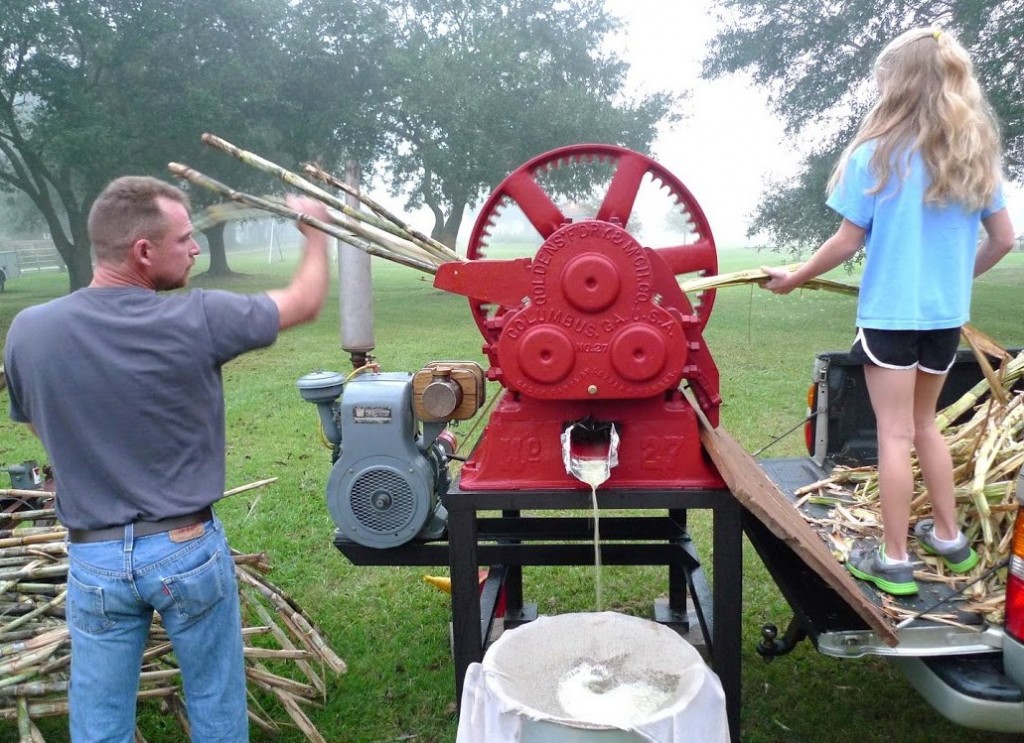
While artisan cane production and processing for syrup (and sugar) were once found all over Louisiana, they’re now almost non-existent. Cane syrup can certainly be bought, but pretty much all you’ll find is commercially produced and nowhere near as tasty as Mr. Poirier’s. As the local production has petered out over the last century or so, so too has all the infrastructure and community knowledge. Charles spent a good bit of time looking for someone to teach him how to make it. “About seven years ago I found an older gentleman named Harold just south of Baton Rouge. I was telling folks I was interested and someone gave me his number. He said I could come watch while he made a batch, so I did.”
Like so many people in the food world, Charles was driven by the desire to rediscover family tradition. “My great grandfather in St. Martinville used to make syrup. He died in 1941. My father told me about his, and how he made cane syrup before he passed away, and so I’ve had it in my mind ever since. There used to be mills all over the countryside. I thought I’d enjoy doing it. So I grow all my own cane.” The yield is anything but high. “It takes about 15 gallons of juice,” Charles explained, “to make about a gallon of syrup. It takes me about 61⁄2 to 7 hours to cook it down. I cut all the cane by hand. At first I was just making it and giving it to family and friends. But now we’ve started to sell a bit of it.” Happily, he has just enough to be able to sell us a few dozen bottles.
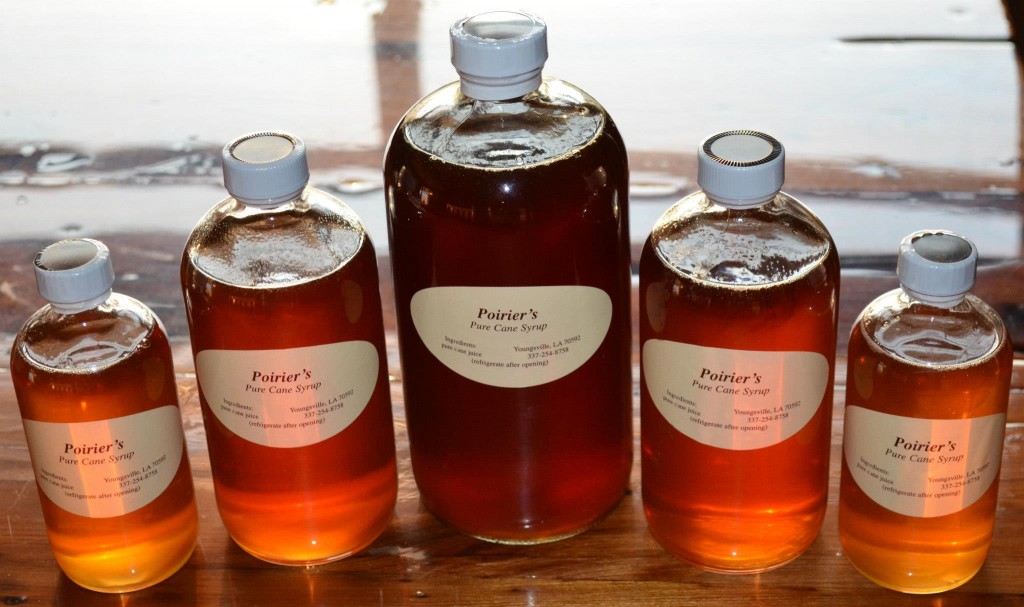
Charles’ cane syrup is dark, delicious, sensual, and superb. It’s like the best traditional brown sugar made into a swirling, thick, sensuous elixir. If we were back in the Middle Ages, I’m pretty sure someone would be recommending this stuff as a cure for pretty much anything that ails you.
For me, tasting Charles’ cane syrup is the complete opposite of eating standard white sugar. Pick your own analogy; great estate bottle extra virgin olive oil compared to commercially processed pulp? The best maple syrups you’ve ever had compared to commercial pancake syrup. I’m not a big sweet eater but I could (and actually have) taken a few swigs of this stuff straight out of the bottle. Given its rarity, I savor each sip.
Just a touch of the deep reddish brown cane syrup on sautéed sea scallops is fantastic. It’s terrific on corncakes. On pancakes, French toast, or donuts. It’s beautiful on biscuits. Drizzled on roast duck. Put a bit on grilled pork chops. On cheese it’s terrific—try it on any of the great aged sheep cheeses we’ve got. Fantastic. Amazing on the stone ground Irish oatmeal we have at the Deli. I mixed some with a bottle of sparkling water and it was so good that I think I could drink that all day. It might be good on almost every- thing now that I think about it. Or of course you can just drink it straight from the bottle!
Three cheers for Charles! Beautiful stuff!
We’ll continue to post excerpts from Ari’s list over the next few weeks.
You can download the entire list in the November/December Newsletter!
Stay tuned as we post selections from Ari’s list in the coming weeks!
Krémes
I don’t know that I can effectively convey the passion that Hungarians seem to have for Krémes (pronounced “Kre- mesh”). If I just tell you the ingredients it may sound good but it’ll probably not compel you to gather up your family and go to the bakery to buy some. And yet, that’s what Hungarians seem to do with amazing regularity!
So what is it already? Krémes is fantastic vanilla cream custard, set between three layers of flaky pastry dusted with powdered sugar. When you eat it, 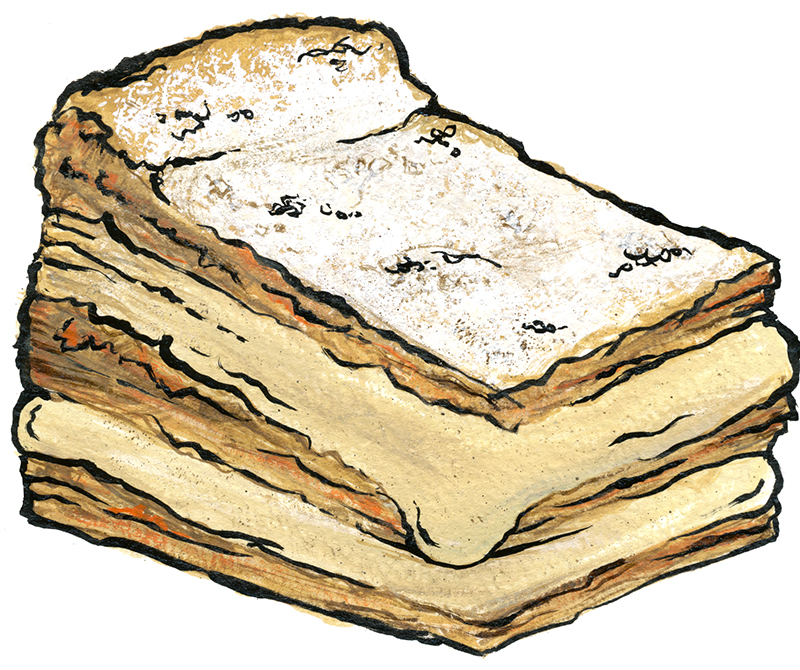 the custard kind of oozes out between the pastry layers. Here’s what Hungarian food writer András Szántó said about it in the Wall Street Journal: “To know a Hungarian is to know someone who takes dessert very seriously. . . Nothing embodies this more fully than the krémes: a quivering quadrangle of vanilla crème, sandwiched between layers of crisp mille-feuille and finished with a dusting of confectioner’s sugar. . . The krémes is dessert stripped to the essentials. It’s usually consumed on its own, not after a meal. Best to order before noon, when cream and crust are both fresh, their contrasting textures clearly discernible.”
To get the full Krémes experience you’ll either have to go to Budapest or come to the Bakehouse. We’re making it every day now. Most days it sells out pretty fast so get here early!
Kifli
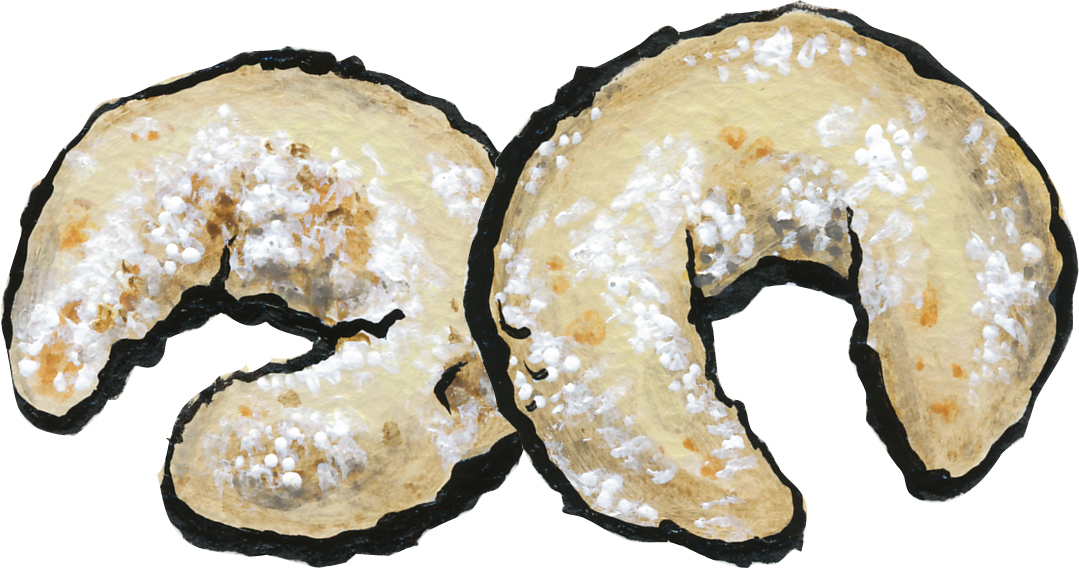 If you, like me, have a high affection for Mexican wedding cookies or any other powdered-sugar-coated, kind of crumbly butter cookie, I’m totally confident that you’re gonna love these Hungarian almond kifli from the Bakehouse. A good number of people who work here have told me that they can’t stop eating them. And if you figure that they could pretty much have their pick of all the amazing things that bakers at the Bakehouse bring out of the ovens every day, that’s really saying something. A couple of these tasty little crescent-shaped cookies are an ideal accompaniment to coffee or tea. To take things up a notch as well, we’re packing them into pretty beautiful gift boxes as well—bring one to any holiday event, give it as a gift to lovers of great cookies and use ‘em to win the hearts and minds of pretty much anyone you know with Hungarian roots.
We’ll continue to post excerpts from Ari’s list over the next few weeks.
You can download the entire list in the November/December Newsletter!
Stay tuned as we post selections from Ari’s list in the coming weeks!
Iberico Bellota Bacon
If you want to taste some truly amazing pork, have a small sliver of anything from Spain that carries the tag Iberico Bellota. The Iberico is an old school black-hoofed hog, harder to raise, but far more flavorful than the now typical standard “white pig” that most other commercial hams around the world are made from. “Bellota” is Spanish for “acorns”—in this case it refers to the Iberico hogs that spend the last three or four months of their lives eating autumn acorns as they fall from the tree. Only about 10% percent of Iberico pigs become Bellota. But the ones that do enter a pretty elite porcine world. The oils from the acorns add enormous richness to the meat and the fat turns into something so delicious, so flavorful, and so memorable that the resulting product really is like no other piece of pork.
The piece de resistance of Iberico pork is of course the three-year-old Iberico Bellota ham—the Spanish version of prosciutto I suppose, but that fails to convey how different the flavor of the Iberico is in comparison to the also excellent but very different flavor of its Italian cousin. The Bellota pork is just much earthier, sweeter in a sort of succulent, sensually compelling way.
Of late we’ve begun to get some of the other cuts of Iberico Bellota pork. Of particular note is this Iberico bacon—it’s probably the most expensive bacon you’ll buy by the pound but then Iberico Bellota ham is the costliest ham on our counter. What both the bacon and the ham bring to the table is their terrific, complex, compellingly memorable flavor. If you want a holiday brunch that everyone will remember fry up a few slices of this stuff. Or lay a couple slices of it over a chicken or pork roast. You can clearly make do with any of the other wonderful artisan bacons we’ve got on hand but once in a while, why not treat yourself to something that’s super special?
We’ll continue to post excerpts from Ari’s list over the next few weeks.
You can download the entire list in the November/December Newsletter!
Stay tuned as we post selections from Ari’s list in the coming weeks!
Two Terrific Pastas
Filotea Egg Pasta
from the Marche
A delicious newly arrived egg pasta from the Marche (pronounced “Mar- kay”) region on the east coast of Italy. It’s made from an old family recipe: owner Antonio Lupini’s grandmother used to add a small percentage of white flour in with the more typical semolina that everyone in the area uses. The family relies heavily on fresh eggs as well—nearly a third of the pasta’s weight is accounted for by fresh eggs that come from a farm five kilometers from the pastaficio. Like the other artisan pastas we carry, the surface of the Filotea egg pasta is very rough, meaning that it holds sauce much better than standard commercial offerings. It also holds its texture after its been cooked al dente and then sauced, not an easy thing to pull of with an egg pasta. Serve it with butter and cheese, with a simple tomato sauce, or with a bit of meat ragu. Whatever you do with it it’s pretty surely going to be delicious.
Cavalieri Whole Wheat Pasta from Puglia
Down in the town of Lecce, in the region of Puglia (in the heel of the Italian boot) Benedetto Cavalieri con- tinues to craft exceptional pasta as his family has done since the early 20th century. The Cavalieri family actually started in the area as wheat farmers in 1872. Only later, in 1918 as WWI was winding down,did they move into pasta making. With over ninety years of making pasta in the same spot it’s no surprise that the place is something like a pasta fun house. The whole place is put together in this intricate patchwork. But it’s put together in a way that works. People climb up narrow stairs and down ladders. Archways abound in the storeroom where 300-plus sacks of grain stand ready to be put into mixers.
Speaking of grain, the Cavalieri’s use primarily old varieties of low yielding, full-flavored hard durum wheat grown in the hills of the region. On the package Sr. Cavalieri appropriately shares the credit for the quality of his pasta with “the farmer and the miller.” Without great wheat, he points out, the pasta maker is helpless. Ever wondered why different cuts of pasta from the same producer can be notably different? Sr. Cavalieri has a different blend of grains and different dough for each cut of pasta that he makes.
The mixing is done in a six by six foot hopper mounted on a metal platform. Although it makes the dough harder to work and requires extended time for mixing and extruding, Sr. Cavalieri insists on using only room-temperature water to protect the gluten, lysine, and character of the wheat. To the same end the mixers are lined with aluminum, again to help reduce heat. The dough in turn is pushed through the old-style bronze dies mounted onto the front of the extruding machines.
The dough falls out of the dies onto a small conveyer belt and from there it moves to the drying rooms. They have a different dryer for each shape and size. The wooden drying cabinets were built in 1936. They’re “the only machine that will dry the short shapes” the way Sr. Cavalieri likes. He takes his time with the drying; thirty six hours for the short cuts, and just under two very deliberate days for the longer pasta shapes. The drying is done at about 100°F, roughly half the temperature employed by speed-oriented industrial pasta makers. The key, Sr. Cavalieri explains gesturing with his hands is “not to shock the pasta” to protect its nutritional value, texture and flavor.
As with Martelli or Rustichella, when you drop the Cavalieri pasta into boiling water you’ll be struck by the wheaty aroma that rises from the pot. And you will truly be able to taste the difference. Which leads me to the most recent arrival on our shelves from the Cavalieri family—by far the tastiest whole wheat pasta I’ve ever had.
In honesty, I generally don’t like whole-wheat pasta that much. It usually lacks the chewy texture and fine flavor that I love about artisan pastas from Italy. But through some secret the Cavalieri’s aren’t quite ready to divulge, this one is different. It tastes great. Its texture is terrific—you can cook it al dente and it holds its integrity long after it’s cooked. I’ve been preparing it in pretty much every manner you can imagine—tomato sauce, with cheese, with tuna and roasted peppers—and all have proven excellent.
We’ll continue to post excerpts from Ari’s list over the next few weeks.
You can download the entire list in the November/December Newsletter!