
Tag: CAMP BACON
Zingerman’s 4th Annual Camp Bacon is coming soon and to help get everyone prepared, we’re sharing tasty excerpts and recipes from Ari’s book, Zingerman’s Guide to Better Bacon.
Angels, Devils, Pigs . . . and a Nice Date with Bacon
These four little appetizers have been around a long time. They’re great ways to bring bacon into a party setting without a whole lot of work. You can adjust the portions easily to fit whatever appetite, group size, budget or BQ (Sarah Katherine Lewis’ “bacon quotient”) you’re working with.
Angels on Horseback
The angels, in this case, are oysters—their little frilly flaps get all fluffy and angelically wing-like under the heat of the broiler. Angels on Horseback is often presented as fancy food, but it’s in really basic books too, like V. M. Sherlock’s Apalachicola Seafood Recipes—a small, softcover, brown pamphlety thing that I like a lot. Ms. Sherlock calls them by the unfancy name “broiled oysters,” which just reinforces my belief that they’re really a pretty darned down-to-earth way to eat. I like to use Arkansas long pepper bacon—it’s got a nice bit of spice, but the moderate smoke level keeps the wood from completely overtaking the dish. Other bacons from the lighter smoke end of the spectrum, like Vande Rose, Nodine’s and Nueske’s, will also work well. As for the angels, any good oyster will work. I love Apalachicolas, which we bring to the Zingerman’s Roadhouse regularly from Florida. I’ll just share this note from Sherlock, who wrote that, “Throughout the ages, men have argued over the superior flavor of oysters of their regions, but until they have tasted the Apalachicola oyster, they’re in no position to judge.”
Ingredients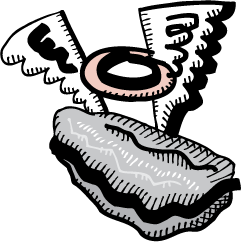
- 8 oysters, shucked
- 4 slices bacon, cut in half crosswise
Procedure:
- 1. Heat the broiler.
- 2. Wrap a half-slice of bacon around each oyster and then run a toothpick through the whole thing to hold it together. Place on a baking sheet, run it under the broiler and cook until the bacon is done, giving it a turn halfway through. If you want the bacon well done you can cook it part way in a pan before wrapping it around the oysters.
- 3. Cook carefully: as V. M. Sherlock says, “Local appetites may differ but most will agree that you should never wash an oyster and never overcook one.”
Devils on Horseback
These are made in the same manner as Angels, except that the oysters are replaced by dark Devils—in this case, prunes. Pork and prunes are a classic combination found in all sorts of big-flavored dishes from southwestern France, and this easy-to-make appetizer delivers that same wonderful flavor pairing to your guests in mere minutes! Of course you know already that I’m going to say you have to find really good ingredients to work with—my favorites are the prunes from Agen in France, but I don’t think you can get them in the U.S. anymore. If you find a variety that’s better than the standard supermarket grade, grab it. I like to make this dish with one of the smoky, dry-cured bacons to balance the sweetness of the dried fruit.
Ingredients:
- 8 really good prunes, pitted
- 4 slices bacon, cut in half crosswise
Procedure:
- 1. Heat the broiler.
- 2. Wrap a half-slice of bacon around each prune and then run a toothpick through the whole thing to hold it together. Place on a baking sheet, run it under the broiler and cook until the bacon is done, turning the “devils” halfway through the cooking. Again, if you want the bacon well done, you’ll do better to cook it partially through on its own before you do the wrapping.
Clam Pigs
This is the same dish as Angels on Horseback, but made with fresh clams instead of oysters. Gotta love the name, which I came across in Sherlock’s Apalachicola cookbook!
Ingredients:
- 8 fresh clams, shucked
- 4 slices bacon, cut in half crosswise
Procedure:
- Follow the instructions for Angels on Horseback, substituting the raw clams for oysters.
Bacon Dates
Taking our passion for bacon a tad bit beyond the now-standard allusions to love and sex, it seems reasonable to go ahead and actually make a real life “date with bacon,” don’t you think? That said, I guess this recipe really is a literal as well as figurative date with bacon (or, actually, if you prepare the whole recipe, 16 dates with bacon). Of course there’s really no limit, since you can multiply the recipe as many times as you like.
Bacon dates are a great little appetizer and extremely easy to make. If you’re up for a “double date” you could serve it for dessert, too—I’ve never thought of using the same dish to both start and end a supper before, but given Americans’ fondness for bacon it sort of makes sense to bacon-end the meal. I love the organic dates from Four Apostles in Bermuda Dunes, California. The sweet smokiness of the bacon with the buttery richness of their ripe dates and the spice of the long pepper gives this finger food a great bit of balance in its flavors.
Ingredients:
- 16 dates, pitted
- 8 slices bacon (we prefer these with the Broadbent bacon), cut in half crosswise
- 4 whole Balinese long peppers, quartered lengthwise
Procedure:
- 1. Heat the broiler.
- 2. Stuff each date with a sliver of long pepper, then wrap with a half-slice of bacon and secure with a toothpick. Place the bacon-wrapped dates on a baking sheet and broil 10 to 15 minutes or until the bacon is crisp, turning once. Keep an eye on them so they don’t burn!
- 3. Remove from the oven once the bacon is done, let cool for a couple of minutes and serve while still warm.
SEE YOU AT CAMP!
Ari recently had a chance to chat with renowned Wisconsin bacon maker Bob Nueske about the history of his family’s business.
Bob will be speaking at Zingerman’s 4th Annual Camp Bacon this summer. Please join us!
Bob Nueske’s great-grandfather came to the small town of Wittenberg, Wisconsin in 1882. Shortly thereafter he started to cure and smoke meats in the style of his German heritage. Located up near the UP, they’ve been making their bacon using basically the same family recipe for nearly a century and a half now. We’ve cooked off Nueske’s Applewood smoked bacon at the Deli every morning for over 31 years now. I have no idea how many tens of thousands of pounds it adds up to but I know it’s a lot. That record, like the bacon on which it’s based, is something special. So too is the man behind the bacon—Bob Nueske is a marvelous story teller, a very grounded and forward thinking business man, a “Small Giant” long before Bo Burlingham wrote the book, a master bacon maker and a bacon lover. We’re excited to have successfully enticed Bob to leave northern Wisconsin for the wilds of Ann Arbor and a few days at Camp Bacon.
Ari: Can you tell me a bit of the Nueske story?
Bob: I hardly know how to begin. When you’re born and raised into something that becomes your life it’s hard to know where to start. The only way I can explain it is that if you’re born in a cooler and raised in a smokehouse it permeates into your being and you don’t even realize it. I’ve been part of Nueske bacon literally my whole life.
And when you are born and raised in a family business, working as a father and son it makes a special situation. I had a good father. He smiled a lot. He was a good man and a good businessman. He was really firm and fair. And yet as a kid, you know, when you’re 16, 17, 18, and you have all the answers . . . when I was 16 years old . . . . Well, I’ll you a story. Back when I was 16 I had a car. Back then Wittenberg was a town of 895 people (Today, it’s totally taken off—the 2010 census said it had 1081 people). It’s all a farm community. I figured the best way for me to see the world was to head down to Chicago on my own. So I drove south. I got downtown by myself. I’d never been there. I was looking at all these great big buildings and I noticed there were a whole lot of good restaurants. But I couldn’t afford to eat in em. And I thought to myself, I’d love to understand ’em. Now, who’d have ever thought that bacon would take you to places like that? But today our bacon is in some of the best restaurants and stores in the country.
As I remember growing up, my dad had put four hours in at work by the time we kids got up in the morning. We were always eating the odd shaped pieces he didn’t want to sell to other people. My mother would say, “I’m married to the man who has the best bacon, but you always bring home the other stuff!” He’d say, “We don’t sell those odd cuts, we eat em. It tastes the same. It just don’t look the same!”
We have some pictures of me sitting on a truck with three birthday candles. When you’re little it seems like your parents are doing things you could never do. Then you get to the age when you think, “They don’t know anything.” But then eventually you realize that things that seemed big aren’t that big, they aren’t that important. And I realized that my dad knew what he was doing. In learning how to do a product like my dad taught us it was time consuming and it wasn’t like I took notes. Day in and day out you learn it and you don’t even know you’re learning it. But my dad had these little books that he used. And they weren’t just sitting on the shelf. They were well read, well worn. And he would take a lot of notes.
My dad was a good student of bacon. Making bacon like ours is like making fine wine. You don’t hurry the process. I remember him saying, “You know Bobby, we do it this way because of . . . . ., but, not this way because . . . ” There were good reasons why each piece of the process happened. I remember thinking “There has to be a faster quicker way to make bacon!” But eventually I realized that he really knew what he was doing.
Where did your grandfather come from?
He was from Germany. I’m still trying to figure out exactly where. I got drafted into the military got my medical training at Ft. Sam Houston and thought for sure I was headed for Vietnam. It was not a pretty time. But somehow I was the only one in our class that ended up stationed in Germany. So through a fluke of luck I learned the heritage of the meat. My great grandfather came to Wisconsin in 1882. Wilhelm Nueske. I’m still trying to find out what town he came from. No one really knows. We know it’s German heritage. I’m starting to discover that it was up in the northeast area of Germany and what’s now Poland. There are still some Nueskes up there. It’s not that common a name. I literally know most everyone of them in this country.
After I went through the military I went into the printing press business for a while. But then I came back to smoking meats and I began to experiment a little on my own, I realized that speeding things up, going fast just creates another me-too product. Volume and big is not what we’re after at Nueske’s. We don’t want to be the biggest. One of the best words I’ve learned over all these years is, “No.” When we’re approached by certain companies to sell to them we look at how they actually run their business. A lot of times I can see that we’re not large enough to produce enough for them so we say, “No.”
Speaking of which, you and I both read a lot of business books. Were there any that were particularly helpful to you?
I was remembering a book called Beyond World Class. It’s by Ross Alan. It was written about the way I think a business should be run. It said that if your suppliers don’t treat you like you wanted to be treated, and if someone in your company or a customer doesn’t fit the way you want to work, then you just say, “We’re not interested.” You just don’t stay with them. You need to work with people who care like you do and who want to work the way you do.
That’s a recipe for how to have fun while you’re running your company. You enjoy your relationship with everyone and you work with a great group of people. It takes work to keep it that way. But growing up in a company like ours . . . well, you know . . .
When I left the family business at 18 I had two really good experiences. One was in a small printing company. And then I was wooed away to American Can Company. It was a huge corporation. I actually got that feeling of putting your brains up on the time clock when you punched in. They didn’t want your thoughts. And then you picked them up when you left. They didn’t want you to think. I learned I could get done 8 hours work in 3 hours and kept pushin’. But then I was told “Don’t do that again.”
People that work here like what they do and they’re having fun. That’s the key. Many an outsider looking in at our company goes by and says, “How do you do this? How do you get your culture?” At first they think it was a trick, like when you used to go to Russia and they put on a stage Grand Tour to fool you. But after a while, the visitors realize there’s no “Grand Tour.” That’s the key. What your people do. How they smile. How they work. That’s what makes a great company. It just seems to work.
We love your bacon here at Zingerman’s. It’s gotten great press in the New York Times and just about everywhere else. What makes the bacon so great?
Well, what really makes the difference how the hogs are fed. How they’re grown. How they’re treated as far as stress. You don’t want stress in the hogs. You have to find companies who know how to slaughter and cut and sort correctly. And then how you cure and smoke the meat properly. We taste test constantly. Even though there are strict formulas, there’s still always the human side. If something doesn’t seem right when we taste the product we pull it off.
We all know that our bacon is a natural product and the whole production system can run a little off one way or another. Pretty much it means the standards of where you want it to be even though the flavor profile never changes. Something comes in wrong and you have to make a point and send it back. Consistency is key. Don’t accept anything that’s less than what you really want.
Our hogs are raised in Canada. They’re the Belgian Pietrain breed and some others. We cure the bellies and then give them 24 hours in the smoker. We use real Wisconsin Applewood. We actually have one man who’s responsible to select the Applewood. We buy full trees, not wood already cut in pieces. He actually cuts it as we need it. When you select the wood it has to be the right balance of dryness and greenness. Not too dry, not too green. We use wild Cherrywood and it’s the same thing there. We start with a full tree. We’re fortunate . . . when I think back when my grandparents moved here, we’re fortunate that they picked an area with so many apple and cherry orchards.
 It’s pretty impressive that Nueske’s has stayed small and focused for four generations. Why do you think it’s worked so well?
Let me tell you another story. There’s a man around here who started a very large nationally known meat curing company around the time my father was getting going. He and my dad knew each other pretty well. The companies were just about 45 miles a part. Our location was on a dead end street. We didn’t really have a retail store. We just were wholesaler but my dad would let people in when they knocked on the door. Finally he put in a tiny little counter. Anyways, Fritz would come in to that little counter and buy our bacon and smoked liver sausage. “I said why are you buying our bacon when you have your own?” He said, “I want to buy the good stuff for our big shots coming up to my cottage up north.”
“Well, Fritz is probably in his 70s now. He came in one day quite a few years ago now and he asks one of the retail clerks in our shop, if I was there. I asked him the same question I would ask every time he came back when I was 14. “What are you doing buying bacon here?” And he said the same thing he said back then: “I’m going up to my cabin and need the good stuff.”
But then he said, “I want to tell you a story about your dad and me. You know, I would tell your dad, ‘Robert, I’m gonna build the biggest meat company I can. And your dad would look at me and say, ‘Well Fritz, I’m gonna become the best meat company I can become.'” Then Fritz said to me, “I succeeded. I sold out to a big company. I made a lot of money. But I don’t like what the big company did with our products. And you know what? Your dad was right and I was wrong. I would never do that again.” When I think of the decisions I’ve made over the years. You gotta know when to say ‘No!’
What’s your favorite way to eat bacon?
I love it best when you lay it on parchment paper and bake it in the oven. It comes out sort of crispy and soft in the middle. I love it that way.
See you at camp!
An Interview with Natalie Chanin
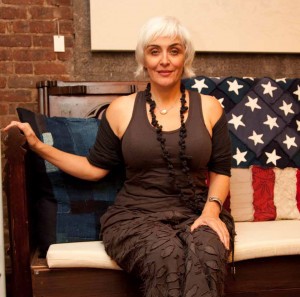
I first met Natalie Chanin at Southern Foodways Alliance. I don’t know Natalie that well but I do know her enough to say with confidence that pretty much everything she touches is very special, and that she moves through the world with a light and elegant energy the likes of which I’ve rarely experienced in the world. In the small northern Alabama town of Florence she and her staff do an amazing job of cutting, sewing and reconstructing clothing to make some beautiful, limited edition items. They do for clothing what our the artisan food producers we work with do for bread, cheese, olive oil and bacon—take great raw materials, traditional techniques, and a lot of careful hand work to make really excellent, limited edition items. If you don’t know her work, check it out at her website. While she’s not directly in the food business, Natalie is a BIG supporter of Southern Foodways. And on top of all that, Natalie will be coming up our way for the weekend of Camp Bacon!
On Saturday, June 1st, Natalie will be speaking—and sewing—as part of Camp Bacon’s main event. She’ll be doing a segment on Sewing with Bacon (you read that right!) that I’m personally really looking forward to! To cap off her Zingerman’s Experience Seminar she’ll be staying after Camp to come to the ZingTrain two-day, Creating a Vision of Greatness seminar. -Ari
Ari: I’m really excited that you’re coming to Ann Arbor to be part of Camp Bacon and to share your artisan approaches to clothing. Since most folks up here won’t know you yet, can you tell us a bit about your business?
Natalie: Alabama Chanin is an artisan-based company based in Florence, Alabama. We make clothing, accessories, and home goods primarily by-hand, using the most ethical and sustainable methods possible. We have also published three craft books, have an ongoing dinnerware collaboration with Heath Ceramics, and, of course, have a deep appreciation for the food that goes onto those plates.
Ari: I’m sure you’ve told the story six thousand times by now but it’s a good one—how did you get the company started?
Natalie: I worked as a designer and stylist in Vienna, Austria, where I really got my education in style and design. My first Alabama Chanin-style garments I made for myself. The positive response I received from wearing those pieces gave me the idea to begin a clothing line. The company has continued to grow and expand and we hope to keep growing.
Ari: What’s drawing you to Camp Bacon?
Natalie: Other than the smell of sizzling bacon? I am looking forward to seeing all of my Southern Foodways Alliance friends and making new ones, and I believe that there is talk of some sort of bacon/sewing moment… Just saying.
Ari: What’s your experience with Southern Foodways Alliance?
Natalie: I’ve been involved with the Southern Foodways Alliance for almost a decade now. I admire their mission and goal because I feel that we believe in many of the same things—education, community, sustainability, individuality. I try to support the organization however I can, attend as many events as I can fit into my schedule, and I get a lot of love back (and a lot of food).
Ari: Was bacon a big part of what you ate as a kid?
Natalie: Growing up, we ate bacon and eggs for breakfast every day. Most days we ate toast, but on really good days there were biscuits. Bacon, eggs, and biscuits—the perfect breakfast. My daughter Maggie and I still use this format on many days (although she adores sausage as well).
Ari: Tell us about the sewing class/workshop that you’re going to be teaching while you’re here?
Natalie: The workshop we’re hosting allows each participant to select an Alabama Chanin DIY project to create. Then we bring all of the prepared materials and tools to complete the project. We’ll talk a little about Alabama Chanin, demonstrate different techniques and stitches, help one another with our projects, laugh, and tell stories… and, of course, eat good food.
Ari: You’re also staying over for the ZingTrain Creating a Vision of Greatness session on the Monday and Tuesday after Camp Bacon. what’s drawing you to it?
Natalie: I am just looking forward to having two days to sit and think about the company. As an entrepreneur, it happens so often that you get so busy running the day-to-day that you don’t really have a change to sit down and be creative with the company itself. Can’t wait to do a bit of brainstorming on that…
SEE YOU AT CAMP!
Zingerman’s 4th Annual Camp Bacon is coming soon and to help get everyone prepared, we’re sharing tasty excerpts and recipes from Ari’s book, Zingerman’s Guide to Better Bacon.
 American Fried Bread
I learned this really simple dish from the book Things Mother Used to Make, published in 1914 by Lydia Maria Gurney. It’s probably as down-to-earth, backwoods American cooking as you’re going to get. You can serve it as is for breakfast or add a bit sorghum syrup, maple syrup, or molasses drizzled on top. It’s also good sitting next to a salad for lunch or a light supper.
If you have reserved bacon fat on hand already you can just use that. If not, start by frying some bacon (let’s say one slice per slice of bread) in a skillet. Remove the bacon, leaving the fat in the pan. (In tight time, the meat would have been used for other purposes later, but I’d say chop it and serve it on a salad alongside the bread.)
Keeping the fat hot, put slices of stale bread into the pan. You can, of course, use most any bread, but my current favorite is a Zingerman’s Bakehouse mainstay and longtime American classic. Around here we call it Roadhouse Bread, but it was known in the eighteenth and nineteenth centuries as Rye ‘n’ Injun, or, at times, Thirded Bread. It’s made with a mix of rye, wheat, and corn (hence the reference to thirds) and has a bit of molasses in it, as well. It’s great on its own, and better still with bacon.
While the bread is frying add a couple of teaspoonfuls of either warm water or milk to the pan, and, if you like, flip it and cook until it’s nicely browned on the other side. As Mrs. Gurney said at the start of the last century, “This is a very appetizing dish.”
SEE YOU AT CAMP!
Zingerman’s 4th Annual Camp Bacon is coming soon and to help get everyone prepared, we’re sharing tasty excerpts and recipes from Ari’s book, Zingerman’s Guide to Better Bacon.
 Bacon hash
This hash has turned out to be a big hit with most everyone who’s had it. It’s an excellent way to take advantage of the big flavor of top-of-the-line bacons. The bacon is the headliner rather than just a couple of strips alongside another main dish. I like making it with the dry-cured intensity of the Broadbent’s, Benton’s, Father’s, or Edwards’, but it would really work with any good bacon.
You can make the recipe a day or tow in advance if you like, then reheat it in a skillet when you’re ready to serve. Regardless, you’ll want to cook both the bacon and potatoes and let them cool before you move on to the rest of the recipe. Serve with rye toast and a couple of poached eggs if you like, as well.
Ingredients:
- 4 tablespoons rendered bacon fat
- 1 medium onion, coarsely chopped
- 1 medium red bell pepper, coarsely chopped
- 1 stalk celery, coarsely chopped
- 2 tablespoons flour
- 1 1/2 cups chicken broth
- 2 tablespoons Worcestershire sauce
- 10 ounces sliced bacon (about 5 to 7 slices), lightly cooked and shopped
- 2 pounds potatoes (I like Yukon Golds, German Butterballs, or others of that ilk), steamed over salted water until tender, then diced with the skins on
- 1/4 cup heavy cream
- Coarse sea salt to taste
- Freshly ground Tellicherry black pepper to taste
Procedure:
Melt the bacon fat in a large skillet over moderate heat. Add the onion, bell pepper, and celery, and cook, covered, for 5 to 6 minutes, until soft.
Sprinkle the flour over the wilted vegetables and stir well to avoid lumps. Cook for another 4 to 5 minutes, stirring constantly to keep from sticking, until the flour blends with the bacon fat into a thickened roux.
Add the broth, a bit at a time, stirring well after each addition so the mixture stays smooth and creamy. The sauce should coat the back of your spoon before you add more liquid. Stir in the Worcestershire sauce.
Continue simmering the sauce over moderate heat until it thickens, about 5 minutes. Add the bacon and potatoes and mix well. Add the cream and cook, stirring, a few more minutes. Stir in salt and freshly ground pepper tot taste.
Serve immediately, or cool and reheat in a skillet until you get a nice golden brown crust.
Serves 4 to 6 as a main dish.
SEE YOU AT CAMP!
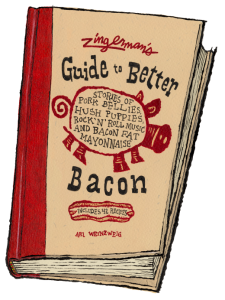 Zingerman’s 4th Annual Camp Bacon is coming soon and to help get everyone prepared, we’re sharing tasty excerpts and recipes from Ari’s book, Zingerman’s Guide to Better Bacon.
Death of a Slaughterman
In Adventures of a Bacon Curer, one-named British author Maynard (“may-NARD”) mentions a no-longer-existent pig-related profession: the journeyman-curer. In early 20-century England this was the man who “would come down and kill the pig. He would stop overnight and cure the pig the next day, and that was the ritual. It was important that he did it correctly as that was the main meat source for the winter.”
In her Irish Traditional Cooking, Darina Allen describes a similar scene: “…on my relative’s farm in Tipperary,” she writes, “a local man skilled in the killing of pigs would arrive on an ass’s cart, bringing all the tools of the trade — a mallet, a knife, a saw, an apron, and a galvanized bath. He was highly thought of and had to be booked ahead.” I can’t say that these journeymen have disappeared entirely, but I’ve not (yet!) heard tell of one still in business.
No one I’ve asked in the U.S. remembers such curers here. The closest I came was in a story from baconmaker extraordinaire, Allen Benton: “In the hills of Virginia, it was common to have someone in the community who would go around at hog butchering time and help the neighbors slaughter the hogs and help work up the meat. They were usually paid either money or in fresh pork.”
Back in Britain, Maynard writes that there are quite a few stories about the old journeyman-curers and how they were compensated. “Sometimes they were paid in surprising ways,” he writes, “And sometimes,” he goes on, “they left a few children behind.”