Tag: CORNMAN FARMS
Cornman Farms bounty makes its way to Zingerman’s Roadhouse menus!
Since back in the snowy days of winter, Mark Baerwolf and his team have been planning and preparing for this year’s exciting garden season! Seed planting began in March, with special emphasis on tomatoes and peppers.
We like to think of our tomatoes and peppers as examples of wonderful slow foods. They grow for a very long time before they are harvested, turning the summer’s sun, rain, and rich soil into a product that has incredible flavor.
Our method of growing can best be described in a phrase that we’ve borrowed from the garden writer Elliot Coleman, “beyond organic” (more info here). We’re using the organic principles of feeding the soil and not the plant. A fall cover crop brings nutrients to the soil and a spring spreading of compost adds another layer of strength and disease resistance.
Throughout the fall and winter, we’ve been collecting compost at record levels, from the Zingerman’s Roadhouse, the Zingerman’s Deli and we recently added Food Gatherers. Everyone else’s garbage is our gold! It adds up to a mixture of over 3500 lbs./week of organic material, mixed with high carbon straw and bedding material. We water and weed, but we use no chemicals or pesticides on our plants.
Some tomato varieties are chosen specifically for roasting. We select these roasting varieties for their size (4 oz. or larger) and most importantly for flavor. We want a balance between sweet and tart with a small seed cavity and low moisture. These roasters tend to reduce to the best balanced flavor and their texture makes the final sweetness pleasing without being over the top. The different paste varieties like Italian heirlooms, Opalka, Gilbertie, and German Johnson are the ones that we turn into roasted tomatoes.
Others are best enjoyed fresh and raw, often straight off the plant. We checked in with Mark to see what he and the folks have planned for us this summer:
“I’m really pleased with quality of tomato transplants we’ve got this year; it’s looking better than ever because of new seed starting mix from a Michigan company called Dairy Doo. That and Chef Alex’s greenhouse addition have made a huge difference for us. Things get even better in 2014 as we’ll be able to sell a very select few of our transplants for folks to plant in their home gardens. I’m also excited about growing several rows of Brandywines and Mortgage Lifters in rows with no plastic mulch, side dressed with goat barn straw. These are two varieties I love, but they have not liked the very intense mid-summer heat (90 to 100 degree days). If I can keep their roots cooler with goat straw they will be happier plants and we will reduce our plastic use by over 10%. There’re a lot of other varieties I can’t wait to try. I always love the Cherokee Purple tomatoes for their salty depth of flavor and deep purple, bruise-y color. This year, we’re trialing two other Cherokee toms, Black Cherokee and Cherokee Green. We’ve also acquired seeds of several other very rare tomatoes that I can’t wait to try: Paul Robeson, a dark-skinned, big, ugly and delicious tomato and Stump of the World (from the breeder who basically saved the classic Brandywine from extinction—this is also his own personal favorite). We’ve also got Ananas Noire (a green variation of the superb Pineapple tomato). Ultimately I can’t wait for a good summer tomato, warm from the sun, juice dripping down my shirt. They should start trickling into the Roadhouse by the 2nd week in July and then the red flood begins for real in August and lasts into the first week of October if we’re lucky.”
Thanks Mark!
Tag: CORNMAN FARMS
Cornman Farms is getting ready for the upcoming growing season and there’s a lot going on.
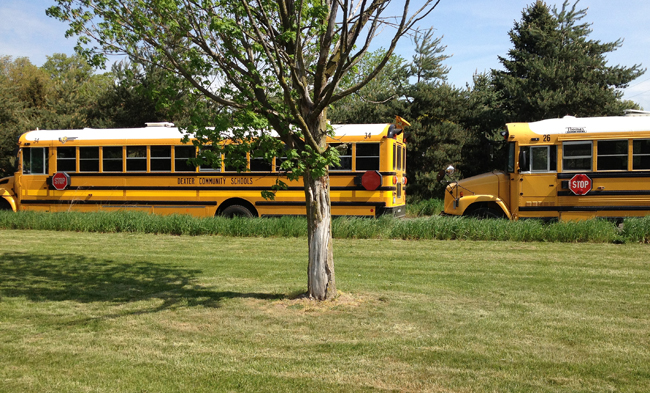
Yesterday, we were very pleased to welcome students from Dexter Community Schools. The students were given a tour of the farm to learn more various aspects of farm life. At various stations, Cornman staff talked to students about the feed and care of animals, growing and nurturing plants and crops, and how bees can help a farm be healthy.
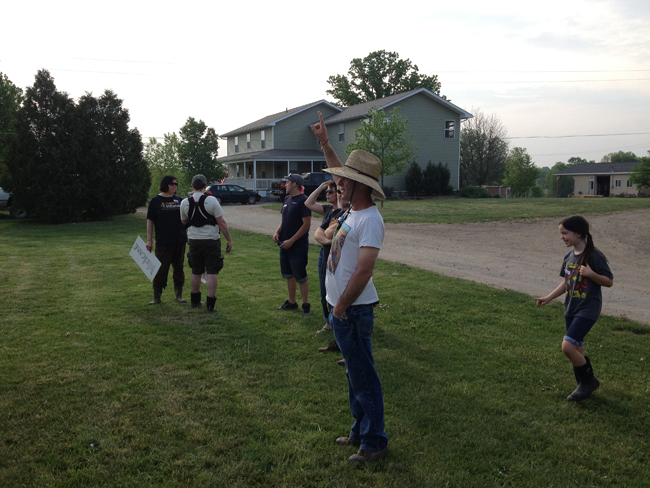
Chef Alex of the Zingerman’s Roadhouse welcomes everyone and talks about all the things students will see as they tour the farm.
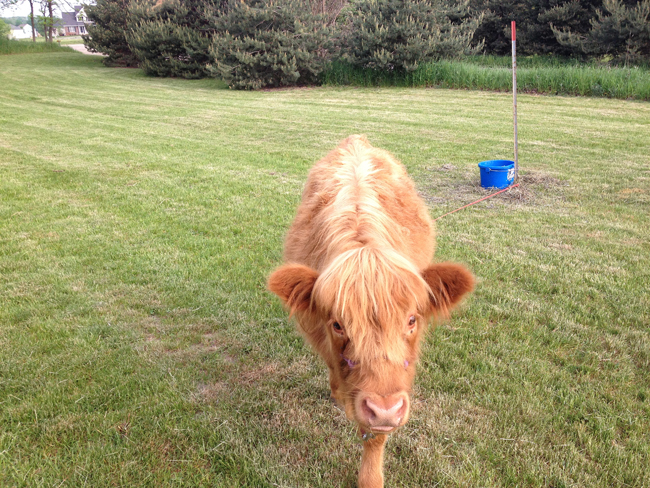
Another Cornman Farms resident extends the hoof of welcome.
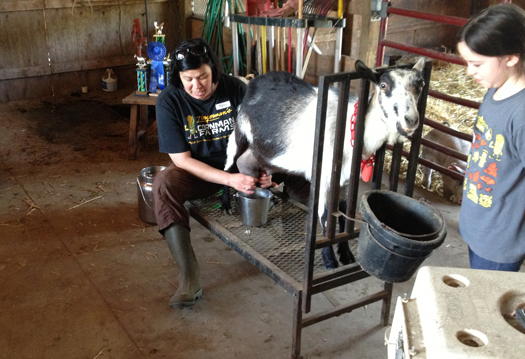
At this station, Kelly gives a milking demonstration on Mrs. Tiller, an Alpine goat raised on the farm. Mrs. Tiller was patient, occasionally commenting “baaaaa!” Kelly also talked about some of the other animals in the barn, including goats, sheep, pigs, and chickens.
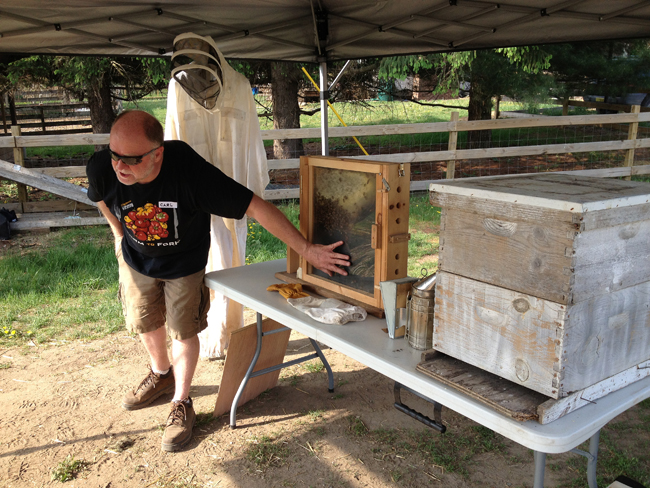
At our next station, Carl talked about the bees kept on the farm. He talked about how a bee colony is organized and what tasks each type of bee will perform. He opened an empty hive to show us how it’s constructed to make harvesting fresh honey easy for the beekeepers, while not disturbing the colony too much. Carl demonstrated how a smoker is used to calm the bees, and why he sometimes uses his protective bee suit. Finally, he showed students the glass-enclosed hive so all could see what bees look like inside their hive. Bees are very good for a farm, helping the pollination process and providing fresh, delicious honey.
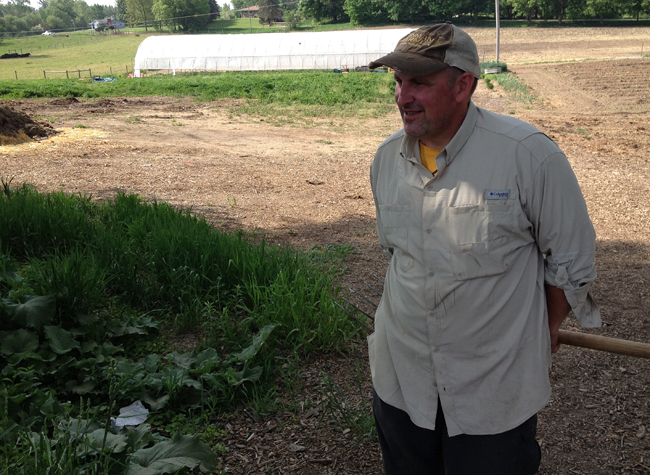
Next up, Mark talked about the farm’s planting fields, and the very important role that compost plays in enriching the soil at Cornman. Compostable materials are collected from Zingerman’s businesses and worked into the compost pile at the farm.
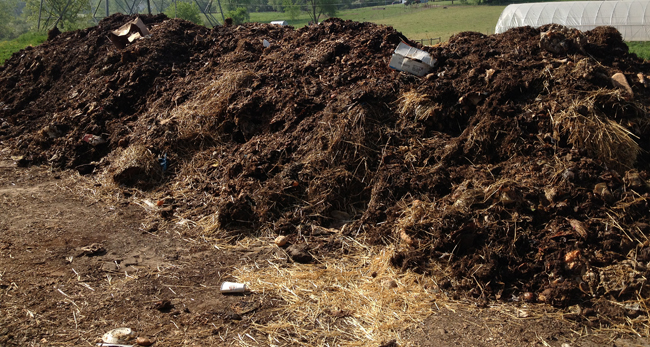
It’s big and ripe with the smell of decomposing vegetable food waste, field waste from the farm, and compostable paper and packaging products. Basically, anything and everything that can be composted is thrown into the pile. The compost breaks it all down into a vitamin-rich mixture that feeds the crops at the farm, helping them grow strong and healthy. The process generally takes about a year, but the resulting compost helps keep the soil at Cornman continually fertile and suitable for planting.
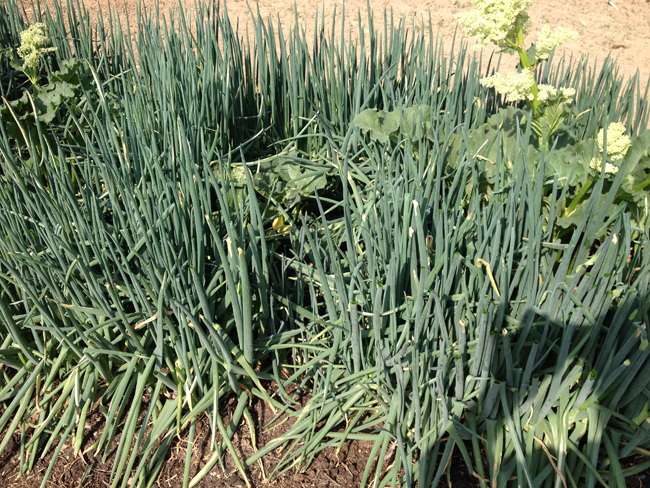
Next, Mark showed us the compost in action. This patch of green onions was grown in soil enriched with compost from the farm. Mark invited students to run their hands through the soil and smell it. Mark pointed out that, after a year, the compost just smelled like good soil. All the stinky things in the compost had done their job and these happy onions were the result.
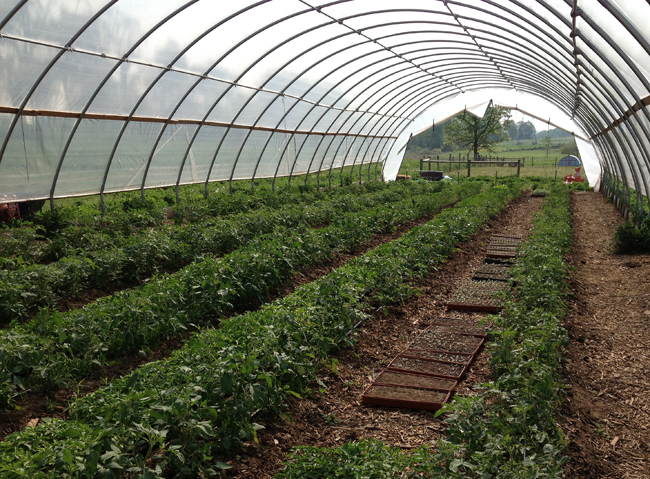
Here’s the field hothouse where young tomato and pepper plants are nurtured in a warm environment to help them get a strong start before moving into the fields. Peppers and tomatoes originated in warmer climates than Michigan, so it’s important that they be kept warm enough when they’re still young. Mark asked the students what might be added to their soil to help them grow better? Compost!
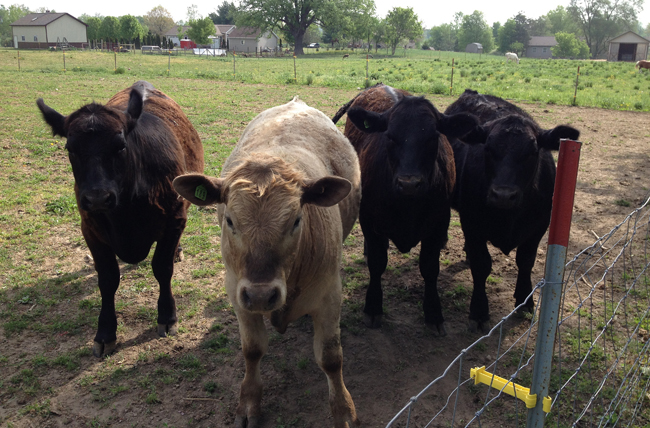
On the way to the next station, more Cornman residents took time out of their busy schedule to say hello!
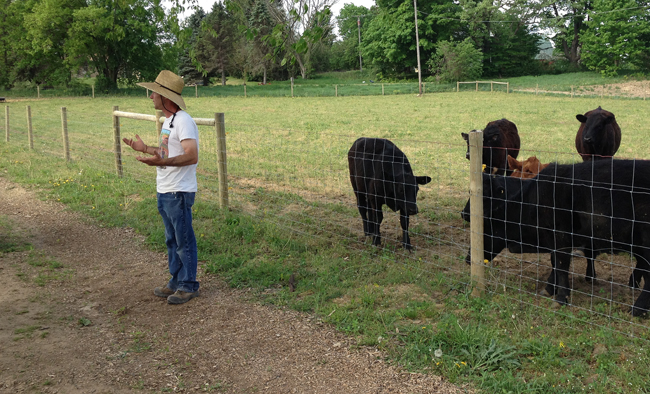
Here, Chef Alex talked about how the Cornman cows are cared for. Students learned that because cows main diet is grass, they require four stomachs to fully digest their food. As the cows graze, they chew the grass down until it’s very short. After a while, the cows have to be moved to another meadow for fresh food, but also to allow their previous field time for the grass to replenish itself. In drier seasons, the grass doesn’t grow quickly enough and the cows’ diet must be supplemented with grain so they get enough to eat.
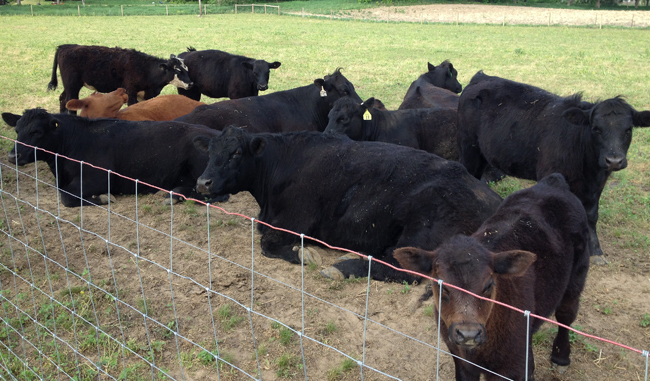
After their lunch, the cows relax in the shade.
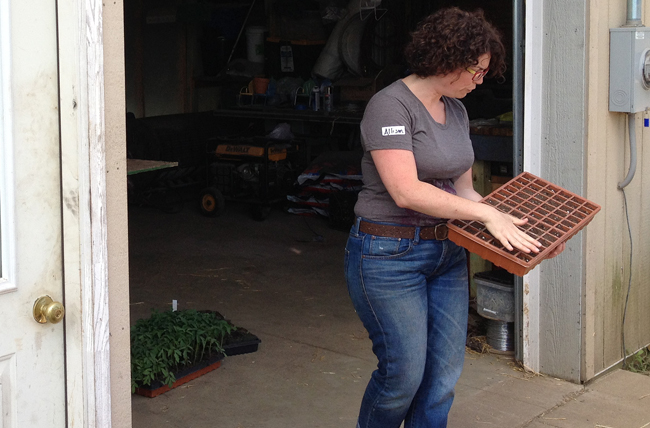
At the next station, Allison talks about how Cornman Farms plans what crops to grow in the coming year. The farm draws maps showing various crops, how much land they’ll need, and where they’ll be located on the farm. The farm uses this map to plan how many seeds they’ll need to order for the coming year. Each spring, they germinate their seeds into seedlings for planting. Here, Alison shows us a seedling tray used to start the plants.
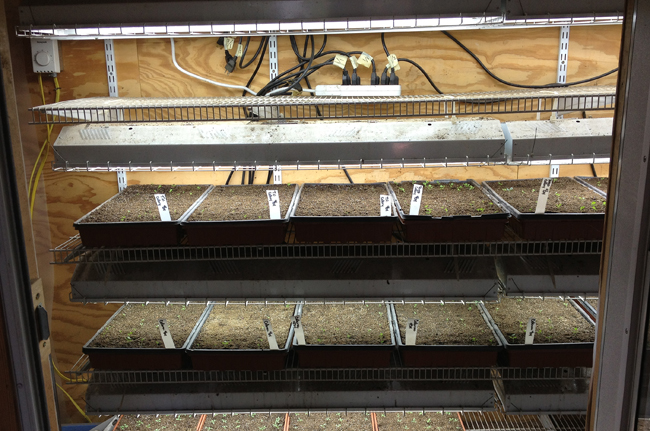
After the seeds are planted in the trays, the trays go into the germination room where they receive lots of light and heat. The seeds need to be kept warm and the light stimulates the young shoots to travel up through the soil to the light source. The seedlings stay here for a few days after sprouting to gain strength.
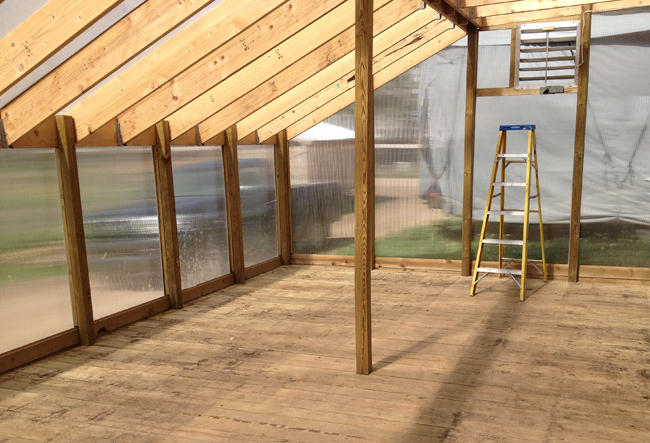
When they’re strong enough, the seedlings are moved into the greenhouse. The greenhouse has lots of windows to give the plants sufficient light. It’s kept very warm to help the fragile young plants grow big enough to move outside when the time comes. The greenhouse is empty now because it’s planting season and the young plants have been moved out to the fields.
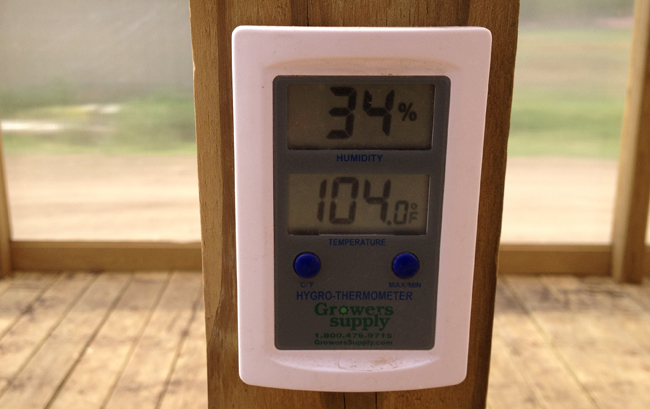
When we say the greenhouse is warm, we mean it!
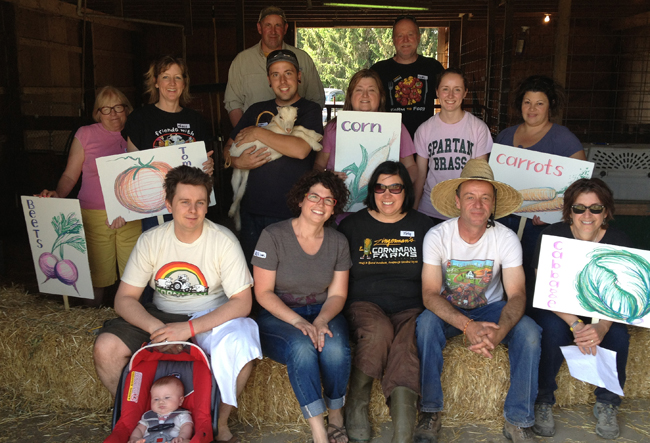
The Cornman Farms staff and volunteers would like to thank all of our young guests for coming our to visit us!
Tag: CORNMAN FARMS
*From time to time, we share the writing of our friends and co-workers on this site. Today’s guest post comes from the blog of Cornman Farms’ Allison Anastasio Zeglis. Allison’s blog is called The Last Bite.
 I’m working my way through M.F.K. Fisher’s anthology The Art of Eating. It is not a cookbook, but a series of books that contain short essays about food and eating and cooking and their social im.plications. Although I have come across her work in “best of” food writing collections, I decided to make the commitment to read through her whole body of work.
She is a fantastic writer, full of wit, tongue-in-cheek humor, insightful examinations of human behavior seen through the eyes of the cook and the eater. If prose can be poetry, she nails that subtlety. There are over 700 pages of nuance, so I’m not going to summarize it all. But I was so struck by something I read last night, I wanted to take note of it and share the experience with you.
The final book in this collection is Alphabet for Gourmets. As you’d expect, each chapter has some alphabetical significance in it’s title and inspiration.
‘H is for Happy’ is a love song. She starts out by discussing the times when people are most happy at the table: when they’re young, when they’re in love, when they’re alone… There are many more.
In a prior essay called ‘The Pale Yellow Glove’ from Serve it Forth, Fisher discusses those moments of “complete gastronomic satisfaction.” They’re rare if you’re a foodie, maybe because we are often more aware of the shortcomings of a food experience. But in this essay, she touches on those times when the stars align, when the food and the experiences, internal and external, are in harmony to produce a scintillating memory It is the sense of being simultaneously satisfied, physically and emotionally. It could be the complicated result of a good friend making you a five star birthday dinner or the simplicity of eating blackberries from your garden that are more sweet than sugar and still warm from the heat of the afternoon August sun. For me, music can provide the same sort of accord between the physical and emotional. For a pregnant second, the world seems to stop so you can absorb something bigger than yourself, something immortal. It’s as if you can feel LIFE.
Keeping that in mind, we’ll travel back to ‘H is for Happy.’ Fisher dwells on a memory of eating fried egg sandwiches, but not just any… Aunt Gwen’s fried egg sandwiches. They were a secret treat at the time, something that neither her grandmother nor mother would have indulged in. Take a look at this excerpt and recipe:
When I was a child my Aunt Gwen (who was not an aunt at all but a large-boned and enormous-hearted woman who, thank God, lived next door to us) used to walk my little sister Anne and me up into the hills at sundown. She insisted on pockets. We had to have at least two apiece when we were with her. In one of them, on those twilight promenades, would be some cookies. In the other, oh, deep sensuous delight! would be a fried egg sandwich!
Nobody but Aunt Gwen ever made fried egg sandwiches for us. Grandmother was carefully protected from the fact that we had ever even heard of them, and as for Mother, preoccupied with a second set of children, she shuddered at the thought of such grease-bound proteins with a thoroughness which should have made us chary but instead succeeded only in satisfying our human need for secrets.
The three of us, Aunt Gwen weighing a good four times what Anne and I did put together, would sneak out of the family ken whenever we could, into the blue-ing air, our pockets sagging and our spirits spiraling in a kind of intoxication of freedom, breathlessness, fatigue, and delicious anticipations. We would climb high above the other mortals, onto a far rock or a fallen eucalyptus tree and sit there, sometimes close as burrs and sometimes apart, singing straight through Pinafore and the Episcopal Hymn Book (Aunt Gwen was British and everything from contralto to basso profundo in the Whittier church choir), and biting voluptuously into our tough, soggy, indigestible and luscious suppers. We flourished on them, both physically and in our tenacious spirits.
AUNT GWEN’S FRIED EGG SANDWICHES
ingredients (physical)
1/2 to 1 cup drippings
6 fresh eggs
12 slices bread
waxed paperThe drippings are very English, the kind poured off an unidentified succession of beef, mutton, and bacon pans, melted gradually into one dark puddle of thick unappetizing grease which immediately upon being dabbed into a thick hot iron skillet sends out rendingly appetizing smells.
The eggs must be fresh, preferably brown ones, best of all freckled brown ones.
The bread must be good bread, no puffy, blanched, uniform blotters from a paper cocoon.
The waxed paper must be of honest quality, since at the corners where it will leak a little some of it will stick to the sandwich and in a way merge with it and be eaten.ingredients (spiritual)
These have been amply indicated in the text, and their prime requisite-Aunt Gwen herself would be the first to cry no to any further exposition of them. Suffice it that they were equal parts of hunger and happiness.method
Heat the drippings in a wide flat-bottomed skillet until they spit and smoke. Break in the eggs, which will immediately bubble around the edges, making them crisp and indigestible, and break their yolks with a fork and swirl them around, so that they are scattered fairly evenly through the whites. This will cook very quickly and the eggs should be tough as leather.Either push them to one side of the pan or remove them, and fry bread in the drippings for each sandwich, two slices to an egg. It too will send off a blue smoke. Fry it on one side only, so that when the sandwiches are slapped together their insides will turn soggy at once. Add to this sogginess by pressing them firmly together. Wrap them well in the waxed paper, where they will steam comfortably.
These sandwiches, if properly made and wrapped, are guaranteed, if properly carried in sweater or pinafore pockets, to make large oily stains around them.
Seasoning depends on the state of the drippings. As I remember Aunt Gwen’s, they were such a “fruity” blend of last week’s roast last month’s gammon, that salt and pepper would have been an insult to their fine flavor.
prescription
To be eaten on top of a hill at sunset, between trios of “A Wandering Minstrel I” and “Onward Christian Soldiers” preferably before adolescence and its priggish queasiness set in.
Can you not feel yourself walking & singing with Aunt Gwen? I’d like to advocate including both physical and spiritual ingredients in recipes, in addition to prescriptions of how to enjoy. Not just the common “serve with rice” but literally the how, where, who with. If we demanded this, can you imagine how many insipid recipes would be forced to come to terms with their irrelevance?
As I’ve said before on The Last Bite, sometimes food is fuel, and when you’re cooking for a family, preparing food spiritually might feel like a stretch. But we should all remember that providing sustenance is more than fulfilling a physical need. It is filling a need bigger than a stomach. Because it is life sustaining, most literally, it carries a heavier weight than caloric input. It has the opportunity to reach someone deep down in their core being. It has the capacity to stop the world for a second, to cause a person to take inventory of where they are in the universe, to create a memory that will stick with them through the rest of their days.
Tag: CORNMAN FARMS
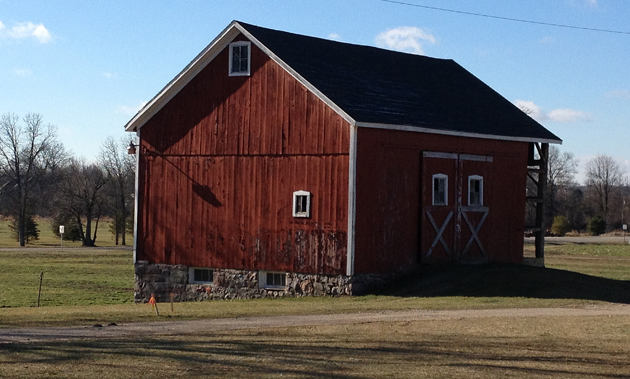
For all the old buildings that slowly fall into disrepair until they are torn down (or just wither away), one local landmark will experience a happier fate as part of the development of Zingerman’s Cornman Farms in Dexter. Alex Young, Managing Partner at Zingerman’s Roadhouse and the driving force behind Cornman Farms is working with local architect Charles Bultman to rescue the barn on his recently acquired property on Island Lake Road in Dexter.
(read more about Charles Bultman here)
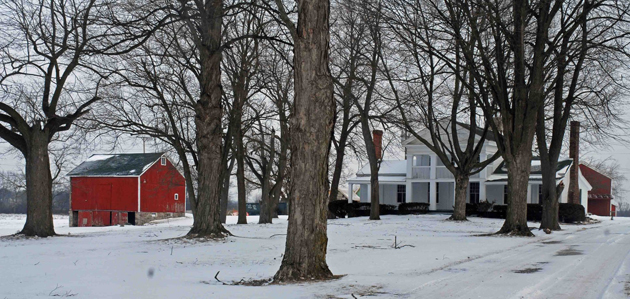
As the project begins, it might look to passers-by that the barn is being torn down, but that is not the case. Instead, the barn will be dismantled, piece by piece and every salvageable item will be tagged and shipped to a barnwright in Ohio, Christian and Son, who will begin the painstaking process of rebuilding the grand structure.
Architect Bultman notes eloquently that an event like this shouldn’t pass without notice:
History is told in retrospect, and often with great struggle to try to sort fact from fiction. Witnesses to many significant events can seem to not have the same experiences, as evidenced by accounts that sometimes vary wildly. But then these events are rarely cued up for us, and they do occur in real time, which can be faster than we might want to admit.
Some events however can come at us slowly and deliberately. And if we don’t stop to acknowledge them they pass in a flash. One such event begins this week in Dexter.
A barn that has stood in service to its Dexter farm since Dexter was founded, pre-dating the Civil War and possibly Michigan’s statehood, is going to be dismantled. To those of us who bring buildings to life, these moments give us great pause. As best we know right now, this barn has graced its property since the founding of Dexter; the adjacent house is said to have been built in 1834 and the barn either pre-dates that, or followed right after. Regardless of the date, this barn has been a landmark on Island Lake Road for generations and will be gone for the first time since the early 1800’s.
Bultman also notes that the case of barns is a special one in the world of historic preservation.
Sadly, most barns are not afforded this opportunity. Their descent is not interrupted and they languish; slowly decaying and sinking. This too should give us great pause, but it rarely does, due to the relentlessly slow pace of the decline. But the work that begins this week and continues in the coming months will bring great change to the barn and the farm. And these events will highlight the fact that there is so much that is valuable and interesting in these old structures and that they can, and should, become as important in our future as they have been in our past.
The entire project is expected to last into the summer of 2014. The barn will be refurbished and brought back to its site, where it will be re-raised in approximately the same location it has occupied for well over a century. It will then begin its new life as an integral part of Zingerman’s Cornman Farms and will be the center of food celebrations for decades to come.