
Tag: MICHAEL PATERNITI
Michael Paterniti’s book The Telling Room documents his pursuit of an obscure Spanish cheese – a cheese he first encountered while working at the Zingerman’s Deli back in 1991.
On Thursday, September 26, 6:30pm, Mike will visit the Deli and tell the story himself. He’ll sign copies of the book, as well as copies of the Zingerman’s newsletter that features the book’s release. We’ll also taste a delicious selection of fine Spanish foods, including many of our favorite traditional cheeses. Copies of Michael’s new book are available at fine bookstores everywhere, but seats at the event are limited. Reserve a seat online or call 734-663-3400!
You’ve created a great non-profit in Portland Maine called the Telling Room. Can you share with folks what it’s about?
Thanks so much for asking! We’re coming up on our tenth anniversary, and it’s just been amazing to be a part of this organization that has about 200 volunteers, and serves roughly 2,500 kids a year. Among other things, we offer writing and storytelling workshops, in all genres and media. And we work with wonderfully diverse storytellers, who constantly blow our minds. When my wife and I came back from living in Spain in 2003, we decided we wanted to try to make a telling room in Portland, to mimic Ambrosio’s in Guzmán, a space where people could tell their stories and secrets and dreams. That’s where we began, and today it’s grown into this wonderful nexus in our community. And I’m always awed and inspired by how courageous the kids are, what natural storytellers we all are if given some guidance and an audience. We’re at www.tellingroom.org, for anyone who might want to know more. I can say, though, that it’s been one of the best things in my life.
Talking about storytelling and sharing tradition, Gary Snyder, the Beat poet, wrote that “Books are our grandparents.” It struck me that, in the same way Ambrosio was hoping each successive batch of cheese would “remember” him and his family, that the books we write them are as much our children as they are “our grandparents” later when we read them. You worked to give birth to this book for a long time. Is it like a child?
I’m gonna go with that! I haven’t given birth myself, but man, at times it felt as if I was. I think of books as having a birthing process but maybe emerging as grandparents. Does that work?
Ambrosio says at one point, “When you put love and care and hundreds of years of history into a product like this one, you can taste all of it.” He goes on to say, “. . . if you asked me the secret, I’d say it was because we made it in our home, the old way, the way it had been made for hundreds of years. Perhaps in the United States you don’t know what it’s like to have old flavors, flavors from the past, from centuries before. But we lived with them every day here. My children know those flavors.” And then he finishes the point: “My mission is to make sure we don’t forget the old way.” It’s a great bit of the book for me. It makes me realize why I was so drawn to Páramo de Guzmán cheese back in the early ‘90s. He’s really summed up what we believe at Zingerman’s and about our pursuit of traditional food and flavor. Thoughts?
I think it’s absolutely no coincidence that I found this cheese here at Zingerman’s. I’m not sure many, if anyone else, in the country was selling Páramo de Guzmán at the time. You and Ambrosio are simpatico brothers, for sure.
You write about Ambrosio’s tale as being “the kind of fable in which everything, especially the hero, is bigger than life and thus takes on the quality of legend.” I think that kind of sums up the spirit of the whole story. Is Ambrosio a man of almost mythical proportion?
For years, he was exactly that to me. And in order to finish the book, my greatest struggle was forcing myself to try to see him as a man, a person with flaws like all of us, but who as you say had this “mythical proportion,” and life philosophy, that I really needed to believe in.
You write that Páramo de Guzmán “was a visionary’s cheese: It cut to the heart of how (Ambrosio) felt a human being should eat.” It’s funny that twenty years later, here we are at Zingerman’s teaching visioning to the rest of the world, and this cheese that resonated with you and with me so long ago was very much a cheese that fits with that model. What makes you say it was a visionary’s cheese?
Because it was an impossible cheese, too. It took some years to recover the recipe because it wasn’t written down. And it was hard to make. It relied on local sheep, Churra sheep, that produce less milk. And the milk was then rushed a quarter mile from the barn to the stable where they first made the cheese. And the curd of the cheese was cut quite small, which was time-consuming and made it very dense. Ambrosio would take the cheese up to the cave for aging, but then he’d show up every day, to turn the wheels, too. The process of making the cheese required care and attention, from the be- ginning to the end. And as Ambrosio said, this process of pouring your love and care into something was also what you tasted when you tasted Páramo de Guzmán. It was the classic case of one person, rebelling, looking at a culture fattened on industrialized food, on cheese products spelled C-H-E-E-Z (Cheez Whiz, Cheez Doodles) and asking, Why can’t we make it like this, by hand, the old way? I think people tasted that in the cheese—and fell in love with it, too.
What’s it been like to come back to Zingerman’s twenty years later?
Fantastic—and a bit of a mind-bend! I mean, look at this place. The Roadhouse. The Creamery. All the things you have going on. It feels as if that original seed, planted all those years ago, spurred an American movement that coincided with these bigger ideas about food that we now hold more commonplace. We want to know where our food comes from, and what the stories are. Talk about visionary: You guys really were here at the beginning, preaching all of this before it was fashionable!
When all else is said and done, what would you like people to know about the book?
In reading it, I’d love for them to feel that sense of awe I have every time I go back to Guzmán, and spend time in Ambrosio’s presence because he’s such an immense, compelling character. I’d love for people to feel they’ve escaped the digital speed of our lives for a little bit, and been transported to a pretty magical place that exists up there on those Castilian highlands. I would hope that they might be embraced inside this story the way I was—as if sitting in a real telling room, listening to Ambrosio—and then feel the trapdoors open, until they’re lost in this otherworld where nothing really is exactly as it seems, where some of the deeper pains of life are alleviated by the pleasure of the stories that get told.
See you at the event!
Tag: MICHAEL PATERNITI
Michael Paterniti’s book The Telling Room documents his pursuit of an obscure Spanish cheese – a cheese he first encountered while working at the Zingerman’s Deli back in 1991.
On Thursday, September 26, 6:30pm, Mike will visit the Deli and tell the story himself. He’ll sign copies of the book, as well as copies of the Zingerman’s newsletter that features the book’s release. We’ll also taste a delicious selection of fine Spanish foods, including many of our favorite traditional cheeses. Copies of Michael’s new book are available at fine bookstores everywhere, but seats at the event are limited. Reserve a seat online or call 734-663-3400!
You spent nearly a decade pursuing this cheese and the man who had made it. I’d imagine you caught a bit of grief, or at least disbelief, from people you knew during that time?
All the time. On those occasions when I told people I was writing about cheese, some were quick to say, “Oh, like ‘Who Moved My Cheese?’” And I would respond, “Sorta—but with a Shakespearean murder plot.” I think, in the end, time was a friend to the book. I was waiting to see what would happen between Ambrosio and Julian, the man he claimed had stolen his cheese. To see how that murder plot would really unfold, but I also came to this realization that what I was doing was Slow Reporting, too. And some Slow Living. In my job as a magazine journalist, I never quite had that luxury. You might land in Cambodia or India or the Sudan and have X days to get your story—and then get out. I loved the idea of sinking in a little. Our family lived there for a summer, too, and those are some of my best memories of the kids.
I love all the footnotes in the book. Can you share the story behind them?
Castilian storytelling is a wild business, full of digressions and asides, historical footnotes and factoids. Often, it’s what gets said in the marginalia, or that excursion away from the story itself, that reflects the truth of the story being told. The legend of the great Castilian hero, El Cid, says as much, for instance, about Ambrosio’s blood feud with his best friend, Julian. I’ve sat in Ambrosio’s telling room for an entire days, listening to him tell a story so full of digressions that even by midnight, he still might not be done. So I wanted the book to reflect the spirit not just of Slow Food but Slow Storytelling, the way it’s practiced in Guzmán. Besides that, they were a blast to write!
Early in the book, Ambrosio tells you about eating in an “ancient way”—probably what we at Zingerman’s would call traditional. He says, “You start by eating good beans and a good lettuce salad with olive oil and tender lamb chop or fresh rabbit. Everything is accompanied by a good piece of wheat bread and a good wine and good friends and, at the end, a sip of brandy.” It sounds fabulous. Have you had that meal? Maybe we should recreate it?
I had that meal—and many others like it! Each awesome in their own way. If you re-create it, I’ll be there!
One of the things I’ve learned about writing is to push forward and let the seed of what’s inspiring grow and develop and see where it takes me. You wrote, “The story itself spoke, calling out for a teller and a hero. It craved a dramatic ending, even if the truth needed tweaking or the lead needed revising.” What have you learned about writing from pursuing the cheese and the story? About life?
That everything—a political campaign, marriage, family dinner—is a narrative collaboration, or battle. And that you need great patience in order to deconstruct someone’s story or legend or myth, to find the truth. Or your truth. You need great patience to figure out what it is you mean to say—and what you believe. What I learned about writing is that on certain days you find yourself on a very lonely island, feeling a little betrayed by your own limitations, and the only way off is to keep writing the words that become the bridge that lead eventually to the epiphanies that make it all worthwhile again.
Food plays a pretty different role in the rural Spain in which Ambrosio grew up than in the America that we were raised in. Can you talk a bit about that?
Ambrosio describes the lost art of eating like this: “As a child, I lived an old kind of life. Not like people living in Madrid or Tokyo or New York. It was a way of life that meant you raised chickens from the egg, you had a good relationship with your dog, you held your animals and prepared the animals for your table by giving them your love. It was the end of an era when everything was natural. There were no mad cows, there was no such thing as preservatives here. We ate in an ancient way.” I think the big thing is that the food grown there, and eaten there, is inextricably linked to their identity, to who they are, and their sense of themselves. Ambrosio describes what it was like in 1955, and he’s describing what it’s like for him today, too.
You wrote that making the cheese again “became Ambrosio’s overriding obsession.” Is it fair to say that that obsession passed through to you. Do you think you became a bit obsessed with the idea of telling the story of his obsession?
Exactly! And then after I’d faithfully laid down the legend of his cheese as he told it, I became obsessed with finding the truth behind it, too.
You share the story of Ambrosio and what he said as he would taste each successive batch of cheese in his drive to reproduce the family’s old recipe. “For this, he had a little ritual,” you wrote. “Before taking a bite, he’d ask the cheese, ‘Are you the one who’ll remember us?’” That’s a nice image—the idea of a mutually beneficial, meaningful relation- ship between traditional food and its maker.
I love that. And I love the way Ambrosio really does talk to his animals and to the grapes that make the wine, etc. Everything is animated in his world—and alive. And that forces a deeper kind of respect for everything.
Part three (conclusion) will appear tomorrow.
Tag: MICHAEL PATERNITI
Michael Paterniti’s book The Telling Room documents his pursuit of an obscure Spanish cheese – a cheese he first encountered while working at the Zingerman’s Deli back in 1991.
On Thursday, September 26, 6:30pm, Mike will visit the Deli and tell the story himself. He’ll sign copies of the book, as well as copies of the Zingerman’s newsletter that features the book’s release. We’ll also taste a delicious selection of fine Spanish foods, including many of our favorite traditional cheeses. Copies of Michael’s new book are available at fine bookstores everywhere, but seats at the event are limited. Reserve a seat online or call 734-663-3400!
It’s over twenty years ago now that you were here. What brought you to Ann Arbor?
I came to write fiction in the MFA program, under the great Nick Delbanco and Charlie Baxter, both amazing writers and Ann Arbor legends in their own right!
What do you remember about the town?
I remember Ann Arbor as a place in which you could find anything—anything in the world (great books and movies, great food and minds at work)—within a one-mile radius of campus. I also loved that open Midwestern friendliness. Coming from the East, I didn’t know what to do with it at first. Like, did that guy really just say hi to me for no reason?
The book begins really with your work here at Zingerman’s, or at least, behind the scenes on our newsletter. What do you remember about the Deli from those days?
The Deli, for me, was a little slice of heaven, a foodie paradise, a spectacular world unto its own. I was interested in food, but didn’t have the money to be really interested in it. That is, I was broke, and I really wanted to try that Finnish licorice, but I knew the Finnish licorice would be like my gateway drug, and next I’d be imbibing the sherry vinegars and scarfing latkes, throwing down sandwiches (that sandwich board was like standing before the departing flights screen in a foreign airport) and demanding Italian chocolates while being fanned by my pet monkey, Bubbles. It was a little decadent in the deli, and I loved the hum and energy of it, just being swept up in it.
Can you tell people who Ambrosio is and a bit about Páramo de Guzmán cheese?
So Ambrosio Molinos is a farmer
in the little Castilian village of
Guzmán (pop. 80), in north-central Spain. He also happens to be
a force of nature, a larger-than-
life character of Falstaffian
belly, and really perhaps the best
storyteller I’ve met in my travels as
a journalist. The cheese he made came
from a centuries-old, discontinued family recipe. One day in the Eighties, he bought a bunch of Churra sheep, began grazing them on the highlands around Guzmán, took their milk to a little stable across from the house he was born in, and made cheese, aging it in a family cave nearby. When people in the village were given some, they thought it was amazing, like the old house cheeses they remembered their mother serving, robust and Manchego-like. And so the cheese was passed along, from village to village, and then to Madrid, where it was sold. The legend of the cheese is that the Spanish royal family loved it, as did the British royal family. It was served to Ronald Reagan and Frank Sinatra. Fidel Castro tried to buy all of Ambrosio’s stock. The cheese won several awards, and in 1991, I know you brought it back from London, to sell here at Zingerman’s, which is where I first learned about it, when I was proofreading your newsletter!
So you carried that little clip from the newsletter in your wallet for nearly ten years?
I mean initially it was in my wallet. Eventually it went in a file. And then when I went to Spain on assignment in 2000, to spend time with the great futurist chef Ferran Adria, it went back in my wallet. Those four paragraphs you wrote in 1991 felt like the beginning of a fairytale: Once upon a time there was a piece of cheese, and a cheesemaker named Ambrosio… I remember, too, that it was the most expensive cheese Zingerman’s had ever sold at the time.
Early in the book you write, “What was so crazy about believing in purity—and then going to find it?” In many ways, that’s the story of our approach to visioning work. What would you say on the subject today, knowing what you know about the cheese and Ambrosio and life?
That this ideal of purity, at some level, is achievable, given that you’re deliberate in how you live your life. I mean there are all sorts of sugary temptations in this world, but what captivated me about Ambrosio was his rejection of the packaged modern world. As he said, “The world is rushing forward, so I need to go back.” But it wasn’t just a sort of unrealistic, antediluvian rejection of that world. I mean, he has a cell phone. He drives a car. He enjoys certain creature comforts. But it’s this idea of having a code or philosophy, and then sticking to it. Long ago, he decided to feed his body with homemade wines and chorizos and cheeses, with lamb raised right there on the land, and he’s tried not to waver from that.
It’s a long way from Ann Arbor to Guzmán—what was it like when you first arrived there?
Oh, the place is beautiful! I thought that straightaway. About a half-mile above sea level, bathed in this thin, ecclesiastical light. There were vineyards and wheat fields, and then Guzmán was there on a hill, above it all, looking down on the Meseta. The village itself was crumbling and dying, too. Some of the houses were split open and you could see a tattered book, someone’s bloomers. Everything—and everyone—seemed so old, as opposed to Ann Arbor, which buzzes on that youthful energy of the university, and those connected to it.
And then on that first visit, Ambrosio told me this incredible story about his cheese, in essence how it had been stolen from him by his best friend, and how he was now plotting the best friend’s murder. He unraveled this story over about eight hours in a place there known as a “telling room.” It was a little room built above the cave, where people went to eat and sit by the fire and tell their stories.
Part Two will appear tomorrow.
Tag: MICHAEL PATERNITI
A VERY SPECIAL EVENING WITH MICHAEL PATERNITI
Author of The Telling Room
Thursday, September 26th, 6:30pm to 8:30pm
Zingerman’s Events on Fourth
415 N. Fifth Ave in Kerrytown
While award-winning author Michael Paterniti will probably do a few hundred book release events this fall, this is the one that takes him back to the source of his story. We’re honored to welcome Mike back to reconnect with roots of the book—Zingerman’s Delicatessen, good writing, and a really great story about a strangely compelling Spanish cheese.
It’s not every day that a best-selling book, written by a nationally known author, has a storyline that starts at Zingerman’s. But that’s exactly what’s taken place with the recent release of The Telling Room. Twenty-two years ago this fall, Mike was a graduate student studying English at University of Michigan. He took a part-time job here at Zingerman’s editing our newsletter to help pay a few bills. But funny things can happen when you get around good people and good food. Mike’s part-time job turned into a life-altering obsession.
In issue #87 of the Zingerman’s News, there was an essay, written by Zingerman’s co-founder, Ari Weinzweig, about his seven favorite Spanish cheeses. The seventh on the list was a very expensive and exciting new arrival. Whatever Ari said in those four short paragraphs about the Paramo di Guzman caught Mike Paterniti’s attention. He clipped it out and carried it in his wallet for a good ten years, regularly reflecting on it and wondering what happened to Ambrosio, the man who made this wonderful cheese.
Many of us have these things that lodge in our minds. Maybe we could call it “wonderlust,” the hundreds of “what happened tos,” “what ifs” and “I wonders” of our lives. Most us never act on them; we go to our graves not knowing. Mike Paterniti is different. After ten years of wondering, he uprooted his family and set off for Spain in search of Paramo di Guzman, and the man who made it. What happened on this journey changed his life.
In the years since he worked proofing the newsletter at the Deli, Mike has made quite a name for himself. He authored the bestselling Driving Mr. Albert: A Trip Across America with Einstein’s Brain, and his work has appeared in several nationally known publications, including the New York Times Magazine, National Geographic, Harper’s, Outside, Esquire, and GQ. In the process he’s been nominated eight different times for the National Magazine Award, and received an NEA grant and a pair of MacDowell Fellowships. Now the prodigal Mr. Paterniti is returning to Zingerman’s Delicatessen, where his journey began, to share the story of his search for an elusive and wondrous cheese he first read about in issue #87 of the Zingerman’s News.
Twenty-two years down the road and we’re on issue #240 of Zingerman’s News, which appropriately again features our homage to foods of Spain and the story behind Michael’s new book. On Thursday, September 26, Mike will visit the Deli and tell the story himself. He’ll sign copies of the book, as well as copies of the Zingerman’s News that features the book’s release. We’ll also taste a delicious selection of fine Spanish foods, including many of our favorite traditional cheeses.
Copies of Michael’s new book are available at fine bookstores everywhere, but seats at the event are very limited. Reserve your seat today!
$30/person, reserve a seat online or call 734-663-3400!
Tag: MICHAEL PATERNITI
Award-winning author Michael Paterniti, whose book The Telling Room recounts his adventures searching for a long-lost Spanish cheese first encountered at Zingerman’s Deli, was interviewed this past weekend by Linda Werthheimer on NPR’s Weekend Edition Saturday.
Paterniti talks about how how Ari’s food-seeking adventures led to his book. From the NPR site: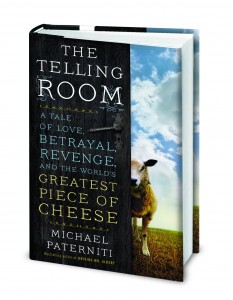
“He had been eating Spanish food and gone to Spain,” Paterniti tells NPR’s Linda Wertheimer, “and then in four paragraphs, in this very short entry about this cheese, Paramo de Guzman, Ari told the story of having met this cheesemaker, Ambrosio, and he had had this conversation about the cheese, and was told that the cheese came from an old family recipe, that it was aged in a cave for a year. And Ari described it as sublime. About 10 years later, when I went on assignment to Spain, I decided to go up to the village and see if I could try a little bit.”
Listen to Linda Werthheimer’s interview with Michael.
On Thursday, September 26, Michael Paterniti comes to Zingerman’s Events on 4th to tell the story first-hand. He’ll be signing copies of the book, as well as copies of the Zingerman’s News that cover its release. We’ll also be tasting an array of very fine Spanish foods, including many of our favorite traditional cheeses.
Watch this space: More event details to come!