
Tag: MUSTARD
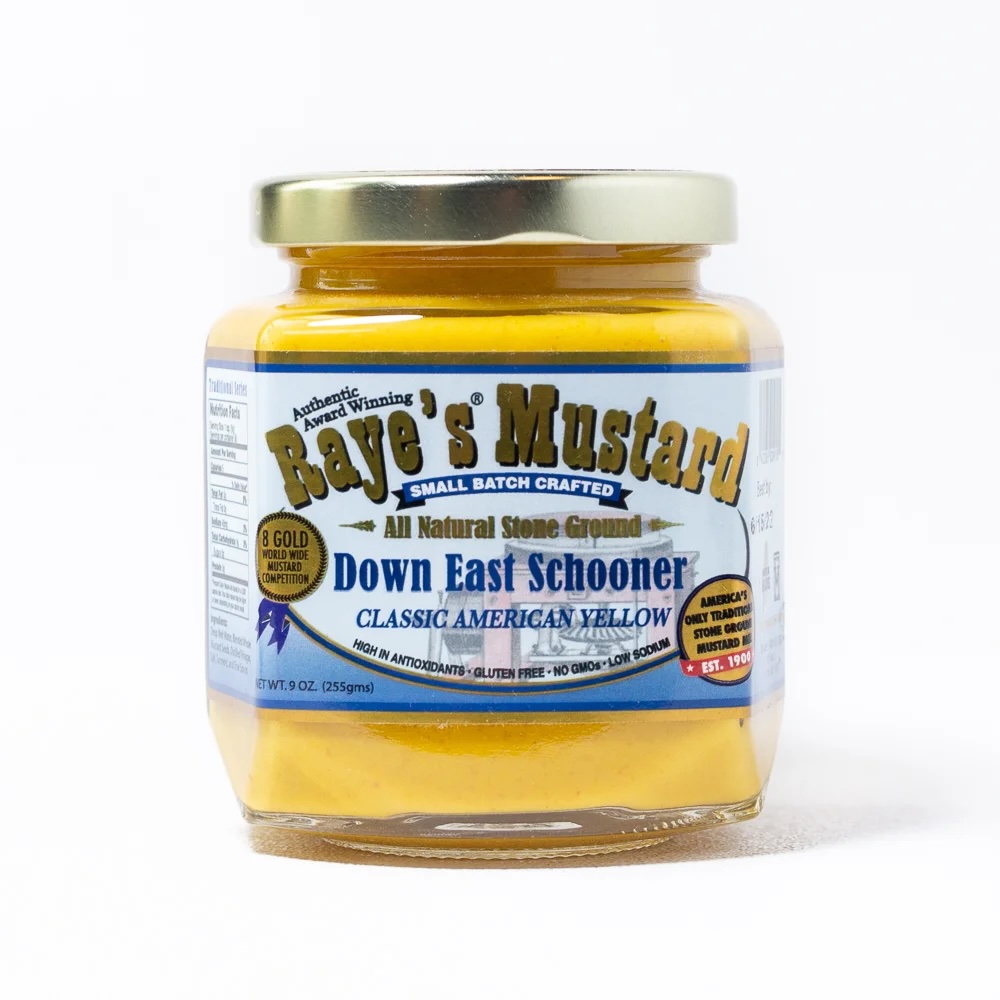
Traditional stone-milled mustard with marvelous flavors
Looking for something to spread on the turkey sandwiches you might make this coming weekend? Something to perk up the school lunches you’ll be packing in the weeks leading up to the December holidays? The perfect mustard to make a pastrami sandwich with, and what I think is the best yellow mustard in America?
Raye’s Mustard is absolutely worth paying attention to. Stone ground in small batches by the same family since the turn of the last century, it is in a yellow-mustard class by itself. How good is it? Really, really good. It’s got complexity, striking a great balance with a gentle vinegary push and a creamy stone grind. And it has a lovely, long finish that can take anything you use it on to the next level. Most people who tend to turn the other way at the mere mention of yellow mustard have a change of heart after they taste Raye’s. Oh yeah—Rachael Ray (no relation to the Rayes) called it a “home run” and “the best ballpark mustard in America.”
Raye’s is located in the tiny town of Eastport, Maine—almost as far north up the coast as one could go without actually crossing the border into Canada. Writing in the New York Times in the summer of 1997, Pamela Petro described the landscape like this:
[It has] a crinkle-cut shoreline where the wind is weighty and cool, where blue spruce and balsam grow with a proprietary air along the rock-rimmed sea, and where houses inhabit the landscape with less ease than do the forests and blueberry barrens. These are the easternmost lands of the United States and perhaps because this is where the sun rises first, flowers grow tall, crisp and tasty—residents harvest them as readily as lettuce—and in colors that rebelliously tweak the stern cast of navy sea and evergreen shore.
The original Raye’s mustard mill was built at the turn of the previous century by Karen Raye’s husband’s great-great uncle, J.W. built the mill at the turn of the previous century, around when the Disderide family constructed the building that now houses the Deli in downtown Ann Arbor. “If he were here today,” Karen told me, “J.W. would see the mill pretty much as it was working when he built it. We’re still using the original stones,” she said, referring to the eight quartz wheels that were quarried, carved, and carted over from France in 1900. Each one weighs 2,000 pounds! The milling and mixing started up back then, in great part to provide mustard for Maine’s booming sardine industry. (For more on that, check out my handmade chapbook “Sardines!”) The sardine trade in Maine is no more, but mustard milling is still going strong. And as the Rayes proudly remind anyone who will listen, “No one else makes mustard this way anymore! No one!” Mustard made in this old-school stone-milled style would have been far more common back in the 19th century, in the same era that cultured butter was far more easily found.
Raye’s is the only traditional stone mustard mill left in the U.S., and right now, it’s in the middle of a once-in-a-century renovation—lifting, stabilizing, preserving, and preparing for its next 125 years. The project is, I realize, a variation on what the Roadhouse will go through in the six-week closure and construction period after January 3. The Raye’s renovation will, like the Roadhouse work, allow them to continue making high-quality products for many years to come.
The Rayes’ work, and their mustard, is all about dignity, and the results are delicious. They treat the mustard seed, the milling, their community, and their customers with grace. As they share:
While most modern mustards are either cooked or ground by high-speed technology, only Raye’s maintains the traditional cold grind process using the original stones from France and made in the same mill since 1900. No one else can make that claim. The cold grind process preserves the volatile taste qualities of the whole seeds.
The mustard-making process at Raye’s starts with whole mustard seed. By contrast, most other commercial products these days start with already-processed mustard powder. The Rayes’ work is all based on cold-stone milling—as the mustard seed passes through each of the four sets of stones, the resulting paste gets ever creamier, which explains why the finished product you and I get out of the Raye’s jar is so smooth. To protect the stone-milled seed, the Rayes use cold water from their 400-foot well. Cooler water takes longer but protects the flavor of the seed. (Most commercial producers today use heat in the production process to speed production and increase yields.) The mustard is then allowed to age for a few weeks before it gets packed up.
Raye’s mustard is darned creamy, with a mellow but mouth-filling flavor. Try it on a sandwich at the Deli, on a burger at the Roadhouse, or added to a grilled cheese. It’s also in the South Carolina Mustard BBQ sauce at the Roadhouse. Put it in potato salads, egg salads, sandwiches, or sauces. It’s great with hard cheese, salami, or fresh salmon. And, in the spirit of its historical origins, put some great sardines on a plate and spoon on a bit of Raye’s. With a few crackers or a slice of toasted rye bread from the Bakehouse, you’ll have a world-class lunch ready in under two minutes! If you know a mustard lover, bring them a jar—once they taste it, it’s pretty sure to make their day!
Yay for Raye’s!
Tag: MUSTARD
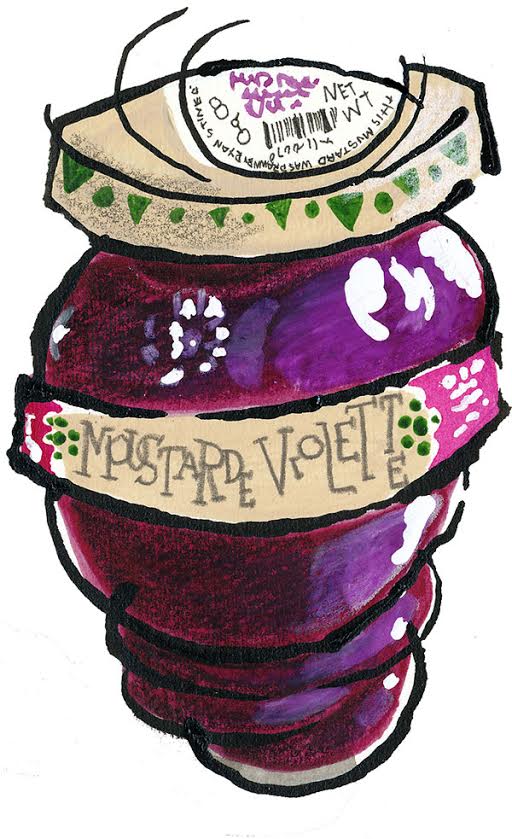 You Need purple mustard in your pantry
In French there’s a saying: “…se croire le premier moutardier du pape.” Roughly translated, it means, “he thinks he’s the pope’s mustard maker.” It describes someone who’s perhaps a bit too proud of himself. The story goes that Pope John XXII got a hankering for the unique purple mustard of his hometown in southwestern France, so he called up his nephew (or sent him a letter, or a papal carrier pigeon—however popes got in touch with their nephews 650 years ago) and invited him to the papal palace to be his own personal mustard maker. I wonder if he just liked purple for its royal connotations, or if he couldn’t bear meals without his hometown mustard?
Despite the papal seal of approval, that purple mustard never really made it big.
When Elie-Arnaud Denoix started making mustard at his family’s cognac distillery in the Périgord region of southwestern France, the purple mustard of his childhood was all but extinct. He decided to revive it, and after a year of making batch after batch of it, he landed on a recipe that he thought tasted like the traditional product. To verify his tastebuds’ intuition, he took it to a nearby village and gave it to as many of the older townsfolk as he could, the ones who grew up eating it. He asked them if it was the mustard they remembered. Half of them told him it was exactly right; half of them said it was completely wrong. Elie counted that as success and started production.
Denoix’s violet mustard is purple because it’s half grape juice.
More specifically, it’s grape must: freshly pressed juice that includes stuff like skins, seeds, and stems. Using grape must is a very old way to make mustard. The word “mustard” actually derives from the Latin mustum (grape must) and ardens (burning), so I’d bet the mustard eaten in ancient Rome looked a lot like violet mustard. By 1407 mustard makers in Dijon, France had switched from using must to vinegar and most of the mustard world followed suit. In Périgord vinegar was more precious as medicine than as food, so they kept using must.
Elie usually uses local grapes for the must, and he looks for ones with a lot of color and sugar. After the juice is pressed it’s heated to evaporate the water and concentrate the flavor. Then he adds the must to a blend of two mustard seeds: mostly there are a lot of milder yellow seeds, but he also includes a small amount of more pungent black seeds. The mix is ground very lightly in a stone mill, leaving lots of the seeds intact and making the mustard a bit crunchy.
Mustard is at its spiciest about 15 minutes after it’s mixed together, but most of us are unlikely to ever try it that fresh unless we make our own. From there it gets mellower with time. Since the violet mustard is meant to be sweet and mellow, Elie ages each 200-pound batch for eight weeks before jarring it. The result is a remarkably soft and sweet mustard with only the barest whisper of heat.
By the way, there are no violets—as in the flowers—in this mustard, as I assumed when I first heard about it. The “violet” is in the name is because violet is the French word for purple.
Violet mustard is really, really good with cheese.
I especially love it paired with the Manchester made by Zingerman’s Creamery—together they’re earthy, tangy, creamy and crunchy from the caviar pop you get from biting down on the whole mustard seeds. (We sell those two paired together in their own gift box.) Elie really likes violet mustard with blue cheese. He also likes it with boudin sausage and cooked apples, a traditional way to serve violet mustard in Périgord. Blended with a bit of balsamic, it also makes an incredible sauce for a steak—and if the current pope had his own personal violet mustard maker, I’d bet that, given his Argentinian roots, that’s how he’d want it served.
Zingerman’s Mustard Pop-up Shop: online now through September 30! A dozen new mustard finds for summer sandwich slathering, salad vinaigrettes, hot dogs, hamburgers—you name it. When they sell out, they’re gone. Check ’em out quick!
Tag: MUSTARD
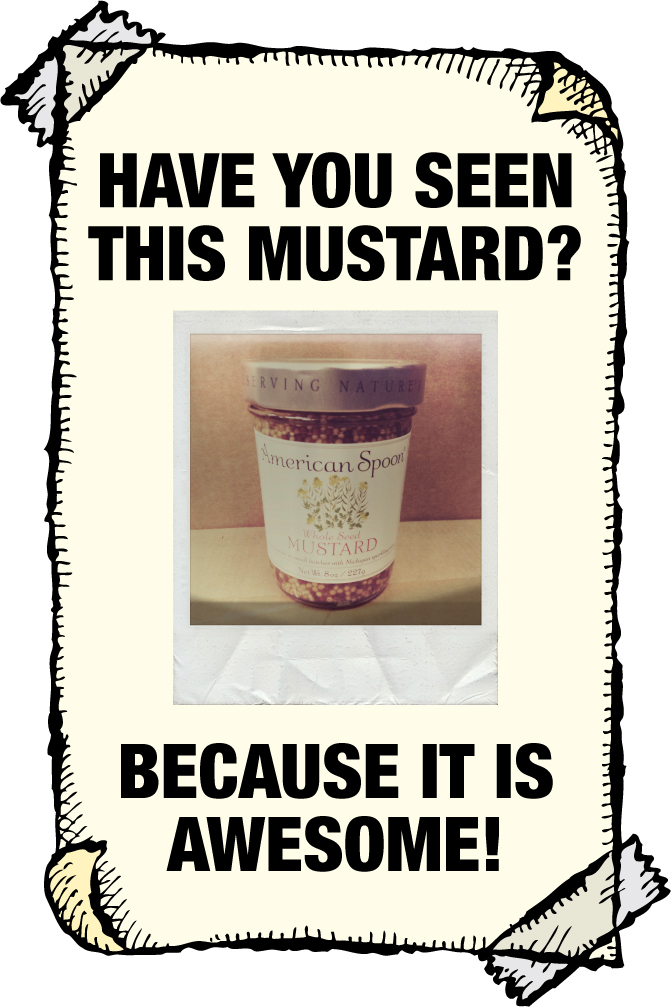
It’s Mustardpalooza! Now through September 30, Zingerman’s Mail Order is hosting a special mustard pop-up shop on our website! We’ve added a dozen new mustards to our collection for summer sandwich slathering, salad vinaigrettes, hot dogs, hamburgers — you name it. This is a one-time only event! When the new mustards sell out, they’re gone. Check it out today!